

A three-dimensional-model inversion of methyl chloroform to constrain the atmospheric oxidative capacity
Open accessPublished version of a preprint
The DOI matches its Crossref record; 65 of the 66 references it cites were found in a registry or an index.
Abstract
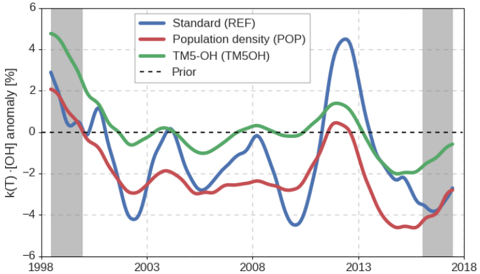
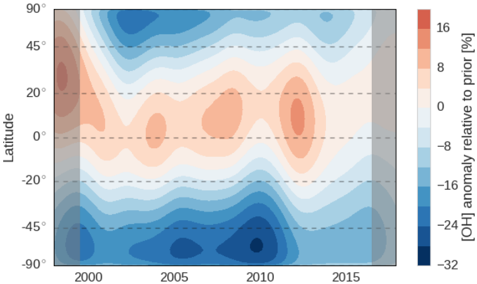
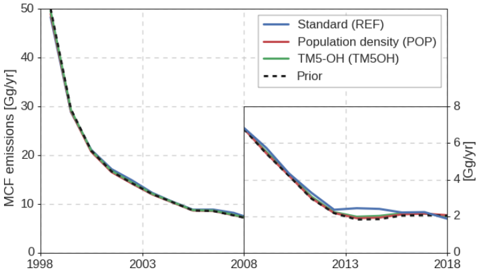
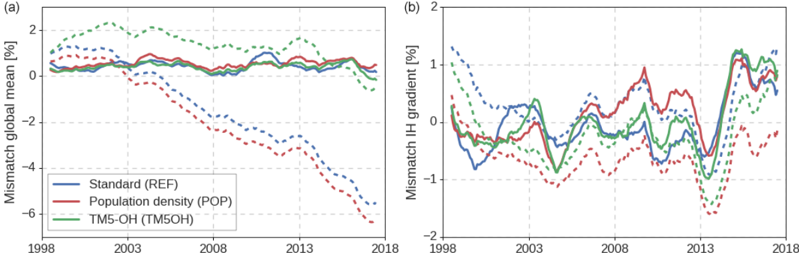
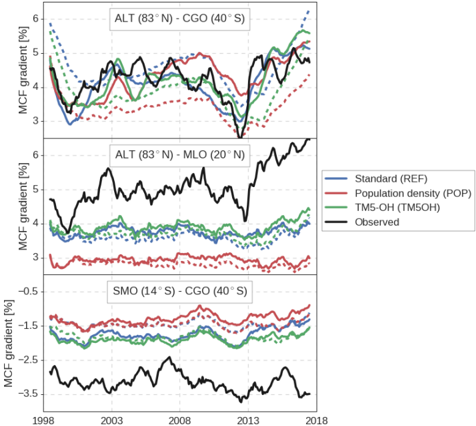
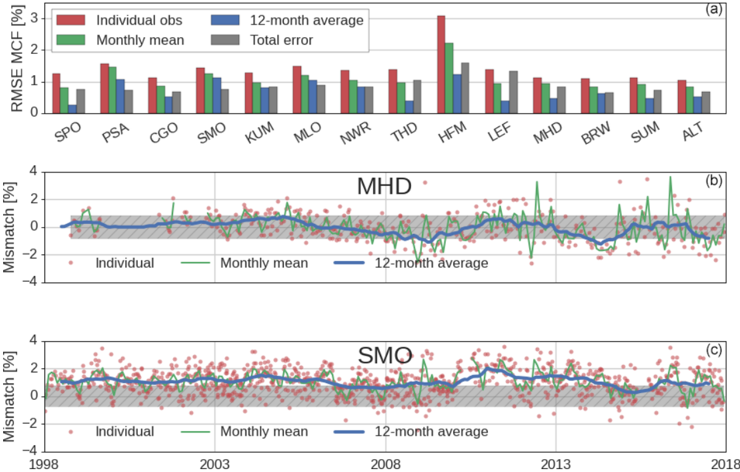
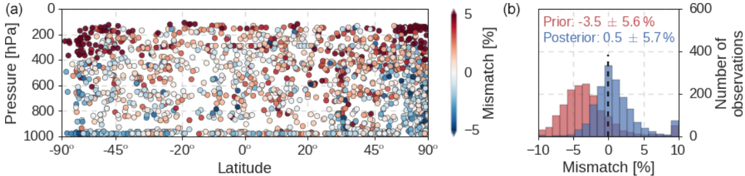
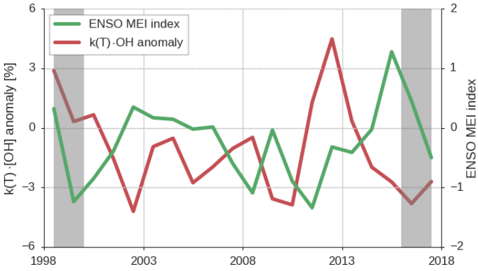
Variations in the atmospheric oxidative capacity, largely determined by variations in the hydroxyl radical (OH), form a key uncertainty in many greenhouse and other pollutant budgets, such as that of methane (CH 4 ). Methyl chloroform (MCF) is an often-adopted tracer to indirectly put observational constraints on large-scale variations in OH. We investigated the budget of MCF in a 4DVAR inversion using the atmospheric transport model TM5, for the period 1998–2018, with the objective to derive information on large-scale, interannual variations in atmospheric OH concentrations. While our main inversion did not fully converge, we did derive interannual variations in the global oxidation of MCF that bring simulated mole fractions of MCF within 1 %–2 % of the assimilated observations from the NOAA-GMD surface network at most sites. Additionally, the posterior simulations better reproduce aircraft observations used for independent validation compared to the prior simulations. The derived OH variations showed robustness with respect to the prior MCF emissions and the prior OH distribution over the 1998 to 2008 period. Although we find a rapid 8 % increase in global mean OH concentrations between 2010 and 2012 that quickly declines afterwards, the derived interannual variations were typically small (< 3 %/yr), with no significant long-term trend in global mean OH concentrations. The inverse system found strong adjustments to the latitudinal distribution of OH, relative to widely used prior distributions, with systematic increases in tropical and decreases in extra-tropical OH concentrations (both up to 30 %). These spatial adjustments were driven by intrahemispheric biases in simulated MCF mole fractions, which have not been identified in previous studies. Given the large amplitude of these adjustments, which exceeds spread between literature estimates, and a residual bias in the MCF intrahemispheric gradients, we suggest a reversal in the extratropical ocean sink of MCF in response to declining atmospheric MCF abundance (as hypothesized in Wennberg et al., 2004). This ocean source provides a more realistic explanation for the biases, possibly complementary to adjustments in the OH distribution. We identified significant added value in the use of a 3D transport model, since it implicitly accounts for variable transport and optimizes the observed spatial gradients of MCF, which is not possible in simpler models. However, we also found a trade-off in computational expense and convergence problems. Despite these convergence problems, the derived OH variations do result in an improved match with MCF observations relative to an interannually repeating prior for OH. Therefore, we consider that variations in OH derived from MCF inversions with 3D models can add value to budget studies of long-lived gases like CH 4 .
Overview
The claims and statistics of this paper haven’t been checked yet.
Free: it reads the open-access text and checks the first 5 claims that cite a source we can check. Create a free account to check every claim.
Integrity signals
Registry
Cites
Statistics
Figures
Verification
Claims the paper makes
The claims and statistics of this paper haven’t been checked yet.
Free: it reads the open-access text and checks the first 5 claims that cite a source we can check. Create a free account to check every claim.
Claims other papers make about this one
Each is checked against this paper’s own text: does it say what the citing paper says it does?
The source backs part of the claim, not all of it — or backs it for a different population, condition or comparison.
In the citing paper
“The drawback of this method is that the emissions (almost entirely anthropogenic) of CH3CCl3 have declined substantially in the last 30 years [145], thus affecting the accuracy and precision of derived amounts of global OH.”
From Changes in tropospheric air quality related to the protection of stratospheric ozone in a changing climate (2023) · cites this paper as [145]
Experimental — accuracy not yet measuredIn the citing paper
“For such studies, methyl chloroform (CH3CCl3) is often used [145] to infer concentrations of OH.”
From Changes in tropospheric air quality related to the protection of stratospheric ozone in a changing climate (2023) · cites this paper as [145]
Self-check
Percentages, sums and reported differences re-computed from the paper’s own numbers.
The self-check needs the paper’s full text.
Citations
Cites
The ERA‐Interim reanalysis: configuration and performance of the data assimilation system
Dee, D. P., Uppala, S. M., Simmons, A. J., Berrisford, P., Poli, P., Kobayashi, S., Andrae, U., Balmaseda, M. A., Balsamo, G., Bauer, P., et al. (2011) · Quarterly Journal of the Royal Meteorological Society · doi:10.1002/qj.828 · Cited by 24,480 · cited 1×
“Transport in TM5 was driven by offline meteorological fields from the ERA-Interim reanalysis from the European Centre for Medium-Range Weather Forecasts (ECMWF) (Dee et al., 2011).”
MethodThe CAMS reanalysis of atmospheric composition
Inness, A., Ades, M., Agusti-Panareda, A., Barré, J., Benedictow, A., Blechschmidt, A.-M., Dominguez, J. J., Engelen, R., Eskes, H., Flemming, J., et al. (2018) · doi:10.5194/acp-2018-1078 · Cited by 1,654
The CAMS reanalysis of atmospheric composition
Inness, A., Ades, M., Agustí-Panareda, A., Barré, J., Benedictow, A., Blechschmidt, A.-M., Dominguez, J. J., Engelen, R., Eskes, H., Flemming, J., et al. (2019) · Atmospheric Chemistry and Physics · doi:10.5194/acp-19-3515-2019 · Cited by 1,480 · cited 2×
“S8, are available as follows: all estimates from the Atmospheric Chemistry and Climate Model Intercomparison Project (Lamarque et al., 2013) are available in Shindell et al. (2020) (http:// catalogue.ceda.ac.uk/uuid/ded523bf23d59910e5d73f1703a2d540); OH fields from the global reanalysis of the Copernicus Atmospheric M…”
BackgroundInfluentialThree‐dimensional climatological distribution of tropospheric OH: Update and evaluation
Spivakovsky, C. M., Logan, J. A., Montzka, S. A., Balkanski, Y. J., Foreman‐Fowler, M., Jones, D. B. A., Horowitz, L. W., Fusco, A. C., Brenninkmeijer, C. A. M., Prather, M. J., et al. (2000) · Journal of Geophysical Research: Atmospheres · doi:10.1029/1999jd901006 · Cited by 910 · cited 2×
“For example, since MCF is predominantly removed in the tropics, the latitudinal distribution of MCF has had a tropical minimum since 1998 (Spivakovsky et al., 2000; Montzka et al., 2000).”
BackgroundMethodInfluentialSelf-citationSome numerical experiments with variable-storage quasi-Newton algorithms
Gilbert, J. C., & Lemaréchal, C. (1989) · Mathematical Programming · doi:10.1007/bf01589113 · Cited by 759 · cited 1×
“Due to the nonlinear nature of this inverse problem, we use the M1QN3 solver (Gilbert and Lemaréchal, 1989).”
MethodEvidence for Substantial Variations of Atmospheric Hydroxyl Radicals in the Past Two Decades
Prinn, R. G., Huang, J., Weiss, R. F., Cunnold, D. M., Fraser, P. J., Simmonds, P. G., McCulloch, A., Harth, C., Salameh, P., O'Doherty, S., et al. (2001) · Science · doi:10.1126/science.1058673 · Cited by 695 · cited 1×
“Phys., 21, 4809–4824, 2021 https://doi.org/10.5194/acp-21-4809-2021 suggested to influence interannual variations in [OH]GM (Prinn et al., 2001; Turner et al., 2018).”
BackgroundInfluentialThe two-way nested global chemistry-transport zoom model TM5: algorithm and applications
Krol, M., Houweling, S., Bregman, B., van den Broek, M., Segers, A., van Velthoven, P., Peters, W., Dentener, F., & Bergamaschi, P. (2005) · Atmospheric Chemistry and Physics · doi:10.5194/acp-5-417-2005 · Cited by 578
Self-citationGlobal tropospheric hydroxyl distribution, budget and reactivity
Lelieveld, J., Gromov, S., Pozzer, A., & Taraborrelli, D. (2016) · Atmospheric Chemistry and Physics · doi:10.5194/acp-16-12477-2016 · Cited by 508 · cited 1×
“…at https://atmosphere.copernicus.eu/catalogue#/product/urn:x-wmo: md:int.ecmwf::copernicus:cams:prod:an:oh:pid443 (Copernicus, 2020); OH fields from Lelieveld et al. (2016) are available at https://doi.org/10.5281/zenodo.4044501 (Gromov et al., 2020); OH fields from Gaubert et al. (2017) are…”
BackgroundInfluentialInverse modeling of global and regional CH4 emissions using SCIAMACHY satellite retrievals
Bergamaschi, P., Frankenberg, C., Meirink, J. F., Krol, M., Villani, M. G., Houweling, S., Dentener, F., Dlugokencky, E. J., Miller, J. B., Gatti, L. V., et al. (2009) · Journal of Geophysical Research: Atmospheres · doi:10.1029/2009jd012287 · Cited by 501 · cited 2×
“TM5-4DVAR has been applied successfully in previous studies to a variety of problems, such as to constrain the global CH4 budget (Bergamaschi et al., 2009) and to investigate the Indonesian wildfires (Nechita-Banda et al., 2018).”
BackgroundMethodSelf-citationGeophysical Research Abstracts, Vol. 7,
Zaccarini, F., Garuti, G., Thalhammer, O. A. R., & Stumpfl, E. F. (2005) · Cited by 500
Cited by
The Global Methane Budget 2000–2017
Saunois, M., Stavert, A. R., Poulter, B., Bousquet, P., Canadell, J. G., Jackson, R. B., Raymond, P. A., Dlugokencky, E. J., Houweling, S., Patra, P. K., et al. (2019) · doi:10.5194/essd-2019-128 · Cited by 2,760
Self-citationThe Global Methane Budget 2000–2017
Saunois, M., Stavert, A. R., Poulter, B., Bousquet, P., Canadell, J. G., Jackson, R. B., Raymond, P. A., Dlugokencky, E. J., Houweling, S., Patra, P. K., et al. (2020) · Earth System Science Data · doi:10.5194/essd-12-1561-2020 · Cited by 2,711
Self-citationAtmospheric Chemistry and Physics
(2017) · doi:10.5194/acp-volume17-issue3-editorial · Cited by 2,667
The global methane budget 2000–2012
Saunois, M., Bousquet, P., Poulter, B., Peregon, A., Ciais, P., Canadell, J. G., Dlugokencky, E. J., Etiope, G., Bastviken, D., Houweling, S., et al. (2016) · Earth System Science Data · doi:10.5194/essd-8-697-2016 · Cited by 1,060
Self-citationGlobal Methane Budget 2000–2020
Saunois, M., Martinez, A., Poulter, B., Zhang, Z., Raymond, P. A., Regnier, P., Canadell, J. G., Jackson, R. B., Patra, P. K., Bousquet, P., et al. (2025) · Earth System Science Data · doi:10.5194/essd-17-1873-2025 · Cited by 427
Self-citationMethyl Chloroform Continues to Constrain the Hydroxyl (OH) Variability in the Troposphere
Patra, P. K., Krol, M. C., Prinn, R. G., Takigawa, M., Mühle, J., Montzka, S. A., Lal, S., Yamashita, Y., Naus, S., Chandra, N., et al. (2021) · Journal of Geophysical Research: Atmospheres · doi:10.1029/2020jd033862 · Cited by 98
Self-citationAnthropogenic emission is the main contributor to the rise of atmospheric methane during 1993–2017
Zhang, Z., Poulter, B., Knox, S., Stavert, A. R., McNicol, G., Fluet‐Chouinard, E., Feinberg, A. I., Zhao, Y., Bousquet, P., Canadell, J. G., et al. (2021) · National Science Review · doi:10.1093/nsr/nwab200 · Cited by 75
“Although there are debates on the potential biases in the box-modelbased OH due to ignorance of complex spatial heterogeneity in OH and transport [33,34], the uncertainties in OH trends and variability are likely large enough to explain any potential CH4 growth scenarios [14,15,35].”
Self-citationMadronich, S., Sulzberger, B., Longstreth, J. D., Schikowski, T., Andersen, M. P. S., Solomon, K. R., & Wilson, S. R. (2023) · Photochemical & Photobiological Sciences · doi:10.1007/s43630-023-00369-6 · Cited by 64
“For such studies, methyl chloroform (CH3CCl3) is often used [145] to infer concentrations of OH.”
BackgroundMethodQu, Z., Jacob, D. J., Bloom, A. A., Worden, J. R., Parker, R. J., & Boesch, H. (2024) · Proceedings of the National Academy of Sciences · doi:10.1073/pnas.2402730121 · Cited by 58
Large and increasing methane emissions from eastern Amazonia derived from satellite data, 2010–2018
Wilson, C., Chipperfield, M. P., Gloor, M. U., Parker, R. J., Boesch, H., McNorton, J., Gatti, L. V., Miller, J. B., Basso, L. S., & Monks, S. A. (2021) · Atmospheric chemistry and physics · doi:10.5194/acp-21-10643-2021 · Cited by 59
Interpreting the Seasonality of Atmospheric Methane
East, J. D., Jacob, D. J., Balasus, N., Bloom, A. A., Bruhwiler, L., Chen, Z., Kaplan, J. O., Mickley, L. J., Mooring, T. A., Penn, E., et al. (2024) · Geophysical Research Letters · doi:10.1029/2024gl108494 · Cited by 57
“…(Zhang, Tian, et al., 2016; Zhang et al., 2020), manure (Chadwick et al., 2011), and fires (Van Der Werf et al., 2017), as well as losses to oxidation by the hydroxyl radical (OH) (Dlugokencky et al., 1997; Naus et al., 2021) and soil uptake (Murguia‐Flores et al., 2018; Nazaries et al., 2013).”
BackgroundChandra, N., Patra, P. K., Fujita, R., Höglund-Isaksson, L., Umezawa, T., Goto, D., Morimoto, S., Vaughn, B. H., & Röckmann, T. (2024) · Communications Earth & Environment · doi:10.1038/s43247-024-01286-x · Cited by 52
“…fromglobalmodelsconstrainedbyemissions 75 versus observationally constrained inversion methods 17,76,77 over 1990 – 2018, as detailed in the recent IPCC-AR6 report 78 , this study presumes no long-term changes in atmospheric OH sink, in line with…”
Self-citationZhao, Y., Saunois, M., Bousquet, P., Lin, X., Hegglin, M. I., Canadell, J. G., Jackson, R. B., & Zheng, B. (2023) · Atmospheric chemistry and physics · doi:10.5194/acp-23-789-2023 · Cited by 48
“…with large uncertainties (Turner et al., 2017; Rigby et al., 2017), while more recent 3D inversions show no significant trend in OH after 2000 (Naus et al., 2021; Patra et al., 2021). contrast to top-down MCF-based inversions, atmospheric chemistry models simulate a positive decadal trend…”
Thompson, R. L., Montzka, S. A., Vollmer, M. K., Arduini, J., Crotwell, M., Krummel, P. B., Lunder, C., Mühle, J., O’Doherty, S., Prinn, R. G., et al. (2024) · Atmospheric chemistry and physics · doi:10.5194/acp-24-1415-2024 · Cited by 43
“…is possible that the ocean has started outgassing MCF, and there are potentially ongoing low-level emissions from continued and exempted industrial production of MCF, both of which lead to considerable uncertainties in the MCF source (Patra et al., 2021; Wennberg et al., 2004; Naus et al., 2021).”
Self-citationAnderson, D. C., Duncan, B. N., Nicely, J. M., Liu, J., Strode, S. A., & Follette‐Cook, M. B. (2023) · Atmospheric chemistry and physics · doi:10.5194/acp-23-6319-2023 · Cited by 28
Radiocarbon monoxide indicates increasing atmospheric oxidizing capacity
Morgenstern, O., Moss, R., Manning, M., Zeng, G., Schaefer, H., USOSKIN, I. G., Turnbull, J. C., Brailsford, G., Nichol, S. E., & Bromley, T. M. (2025) · Nature Communications · doi:10.1038/s41467-024-55603-1 · Cited by 27
Chua, G., Naïk, V., & Horowitz, L. W. (2023) · Atmospheric chemistry and physics · doi:10.5194/acp-23-4955-2023 · Cited by 24
Temporary pause in the growth of atmospheric ethane and propane in 2015–2018
Angot, H., Davel, C. M., Wiedinmyer, C., Pétron, G., Chopra, J., Hueber, J., Blanchard, B., Bourgeois, I., Vimont, I., Montzka, S. A., et al. (2021) · Atmospheric chemistry and physics · doi:10.5194/acp-21-15153-2021 · Cited by 23
Self-citationDowd, E., Wilson, C., Chipperfield, M. P., Gloor, E. U., Manning, A. J., & Doherty, R. M. (2023) · Atmospheric chemistry and physics · doi:10.5194/acp-23-7363-2023 · Cited by 20
Thompson, R. L., Zwaaftink, C. G., Brunner, D., Tsuruta, A., Aalto, T., Raivonen, M., Crippa, M., Solazzo, E., Guizzardi, D., Regnier, P. A. G., et al. (2021) · Philosophical Transactions of the Royal Society A Mathematical Physical and Engineering Sciences · doi:10.1098/rsta.2020.0443 · Cited by 18
Governing atmospheric oxidation capacity is the key to synergistic air quality and climate gains
Tan, Z., Ma, X., Lu, K. D., Li, X., Zhu, Q., Röhrer, F., Novelli, A., Fuchs, H., Wahner, A., Whalley, L., et al. (2026) · One Earth · doi:10.1016/j.oneear.2025.101569 · Cited by 16
Global Fossil Methane Emissions Constrained by Multi‐Isotopic Atmospheric Methane Histories
Fujita, R., Graven, H., Zazzeri, G., Hmiel, B., Petrenko, V. V., Smith, A. M., II, Michel, S., & Morimoto, S. (2025) · Journal of Geophysical Research Atmospheres · doi:10.1029/2024jd041266 · Cited by 16
“In contrast, recent MCF‐based OH shows downward trends by about 8% since 2005 (Rigby et al., 2017; Turner et al., 2017) or rather stable trends since 2000 (Naus et al., 2021; Patra et al., 2021), the latter being consistent with the empirical reconstruction estimate (Nicely et al., 2018).”
Anderson, D. C., Duncan, B. N., Liu, J., Nicely, J. M., Strode, S. A., Follette‐Cook, M. B., Souri, A. H., Ziemke, J. R., Abad, G. G., & Ayazpour, Z. (2024) · Geophysical Research Letters · doi:10.1029/2024gl108531 · Cited by 16
“Similarly, the variability around Indonesia and over the Indian Ocean implies a possible role for ENSO and the IOD (e.g., Anderson et al., 2021; Naus et al., 2021).”
BackgroundChen, A., Xie, Z., Zhan, H., Jiang, B., Zhang, A., Liu, H., Hu, C., Wu, X., Yue, F., & Li, X. (2023) · Journal of Geophysical Research Atmospheres · doi:10.1029/2022jd037597 · Cited by 10
Pandey, S., Houweling, S., & Segers, A. J. (2022) · Geoscientific model development · doi:10.5194/gmd-15-4555-2022 · Cited by 4
Stroo, F. T., Hooghiem, J., Krol, M., & Peters, W. (2026) · Atmospheric chemistry and physics · doi:10.5194/acp-26-16261-2026 · Cited by 3
Self-citationAnderson, D. C., Duncan, B. N., Souri, A. H., Liu, J., Strode, S. A., & Ahn, D. Y. (2026) · Journal of Geophysical Research Atmospheres · doi:10.1029/2025jd045499 · Cited by 1
“…(OH), the dominant methane (CH 4 ) sink, is driven by a complex set of chemical reactions (Fiore et al., 2024; Spivakovsky et al., 1990), which are in turn affected by dynamical variability (e.g., the El Niño Southern Oscillation) (Anderson et al., 2021; Naus et al., 2021; Turner et al., 2018).”
Multi-point Sources Continuous Release Inversion Based on Improved Four-Dimensional Variation MethodPreprint
Han, C., Zhu, X., Gu, J., & Zuo, Q. (2021) · Research Square · doi:10.21203/rs.3.rs-989442/v1 · Cited by 1
(2021) · Atmospheric chemistry and physics · doi:10.5194/acp-2021-285-rc1
(2021) · Geoscientific model development · doi:10.5194/gmd-2021-339-cec1
(2021) · Geoscientific model development · doi:10.5194/gmd-2021-339-rc3
(2021) · Geoscientific model development · doi:10.5194/gmd-2021-339-rc1
(2021) · Geoscientific model development · doi:10.5194/gmd-2021-339-rc2
(2021) · Atmospheric chemistry and physics · doi:10.5194/acp-2021-285-rc2
Angot, H. (2021) · Atmospheric chemistry and physics · doi:10.5194/acp-2021-285-ac2
Angot, H. (2021) · Atmospheric chemistry and physics · doi:10.5194/acp-2021-285-ac1
Author response to the reviewer comments
Pandey, S. (2022) · Geoscientific model development · doi:10.5194/gmd-2021-339-ac2
Pandey, S. (2022) · Geoscientific model development · doi:10.5194/gmd-2021-339-ac1
(2020) · Atmospheric chemistry and physics · doi:10.5194/acp-2020-624-rc1
(2022) · Atmospheric chemistry and physics · doi:10.5194/acp-2022-556-rc1
Zhao, Y. (2022) · Atmospheric chemistry and physics · doi:10.5194/acp-2022-556-ac2
Zhao, Y. (2022) · Atmospheric chemistry and physics · doi:10.5194/acp-2022-556-ac1
Chua, G. (2023) · Atmospheric chemistry and physics · doi:10.5194/acp-2023-9-ac2
Thompson, R. L. (2023) · doi:10.5194/egusphere-2023-1917-ac1
Ocean Outgassing of Methyl Chloroform as an Underestimated Source of Emission
Wang, P., Solomon, S., Scott, J. R., Yvon‐Lewis, S. A., Wennberg, P. O., Weiss, R. F., Rigby, M., & An, M. (2025) · Geophysical Research Letters · doi:10.1029/2025gl118618
“Studies have suggested unexplained emissions occurring at least since 2013 (Naus et al., 2021; Rigby et al., 2017; Turner et al., 2017), when global MCF consumption should have ceased (Rigby et al., 2017).”
InfluentialGlobal Methane Budget 2000-2020
Rocher‐Ros, G. (2025) · Epsilon Open Archive (Sveriges lantbruksuniversitet biblioteket (Swedish University of Agricultural Sciences))
Multi‐Species Constraints Resolve Methane Source Versus Sink Changes: Lessons From 2020
Yu, X., Millet, D. B., Henze, D. K., Worden, H. M., Vigouroux, C., Patra, P. K., Hill, J., & Jackson, R. B. (2026) · Earth s Future · doi:10.1029/2025ef007067
“The prior terrestrial emission estimates are based on Patra et al. (2011) and scaled to 2 Gg/y for year‐2020 based on previous MCF inversions (Naus et al., 2021).”
Self-citationConstraining the atmospheric hydrogen oxidation and soil sink seasonal cycles using HFC-152a
Stone, K. A., Chen, C., Solomon, S., Western, L. M., Krummel, P. B., Pétron, G., Mühle, J., & O’Doherty, S. (2026) · Atmospheric chemistry and physics · doi:10.5194/acp-26-10241-2026
Global Methane Budget 2000-2012
Saunois, M., Bousquet, P., Poulter, B., Peregon, A. M., Ciais, P., Canadell, J. G., Dlugokencky, E. J., Etiope, G., Bastviken, D., Houweling, S., et al. (2016) · DOE Lawrence Berkeley National Laboratory (LBNL) Repository · doi:10.3334/cdiac/global_methane_budget_2016
Self-citationStevenson, D. S. (2026) · Elsevier eBooks · doi:10.1016/b978-0-443-15748-6.00098-8
Metadata
- Authors
- Naus, S., Montzka, S. A., Patra, P. K., & Krol, M. C.
- Affiliations
- Wageningen University & Research (NL)
- National Oceanic and Atmospheric Administration (US)
- Japan Agency for Marine-Earth Science and Technology (JP)
- Utrecht University (NL)
- Corresponding author
- Naus, Stijn
- Montzka, Stephen A.
- Patra, Prabir K.
- Venue
- Atmospheric Chemistry and Physics
- Publisher
- Copernicus GmbH
- Published
- 2021-03-29
- Volume
- 21
- Issue
- 6
- Pages
- 4809-4824
- ISSN
- 1680-7316 (ISSN-L)
- 1680-7324
- OpenAlex
- W3140146871
- Cited by
- 46
- References
- 66
- Citations by year
- 2026: 4 · 2025: 4 · 2024: 5 · 2023: 8 · 2022: 6 · 2021: 14
- FWCI
- 2.89
- Type
- journal article
- Language
- en
- Open access
- gold
- doi.org
- Licence
- Locations
- Atmospheric chemistry and physics (publishedVersion, cc-by)
- Socio-Environmental Systems Modeling (submittedVersion, cc-by)
- DOAJ (DOAJ: Directory of Open Access Journals) (submittedVersion, cc-by-sa)
- NOAA Institutional Repository (submittedVersion, cc-by)
- Data Archiving and Networked Services (DANS) (submittedVersion, other-oa)
- Funders
- National Science Foundation
- European Commission (HORIZON2020, 742798)
- Nederlandse Organisatie voor Wetenschappelijk Onderzoek (824.15.002, 15002)
- National Oceanic and Atmospheric Administration
- Topics
- Physical Sciences › Earth and Planetary Sciences › Atmospheric Science › Atmospheric chemistry and aerosols
- Physical Sciences › Environmental Science › Global and Planetary Change › Atmospheric and Environmental Gas Dynamics
- Physical Sciences › Earth and Planetary Sciences › Atmospheric Science › Atmospheric Ozone and Climate
- Keywords
- 1,1,1-trichloroethane, atmospheric oxidative capacity, hydroxyl radicals, atmospheric transport models, TM5, methane oxidation, greenhouse gas budget, prior sensitivity, convergence problems, aircraft observations
About these checks
Registry, retraction, Cites and statistics results are computed, not judged, with one exception: a printed reference that no index lists is read once by a model before it counts as a citation error. Claims are extracted by a model and kept only when their quote appears verbatim in the text; each cited source is then checked, with a model’s help, for whether it says what the claim relies on. Those verdicts can be wrong — read the claim’s quote and the cited source before relying on one.
Statistics and arithmetic are recomputed, not judged.
Confidence bands are shown only for fields calibrated on our annotated test set. None is calibrated yet, so no band is shown.
What counts as a claim ›How we measure confidence ›How we check this ›
Are you an author, or do you see a problem with this page? Request a review
Data sources
Bibliographic data: Semantic Scholar, OpenAlex, Crossref.
Contains information from the Semantic Scholar Academic Graph Datasets, made available under the ODC Attribution License (ODC-BY 1.0).
Semantic Scholar’s data is described in: Kinney, R., et al. (2023). The Semantic Scholar Open Data Platform. arXiv:2301.10140.
