

Differences in the quasi-biennial oscillation response to stratospheric aerosol modification depending on injection strategy and species
Open accessPublished version of a preprint
The DOI matches its Crossref record; 52 of the 53 references it cites were found in a registry or an index.
Abstract
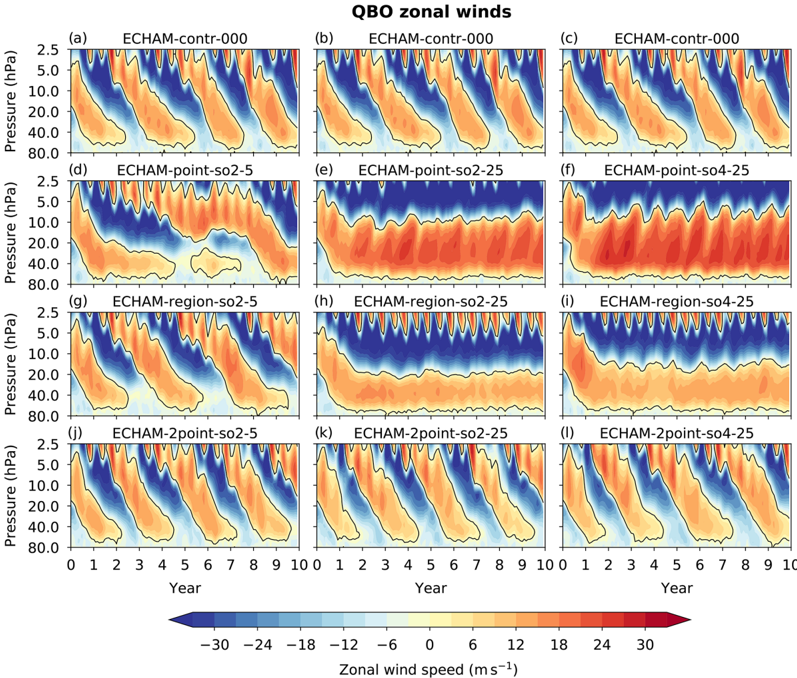
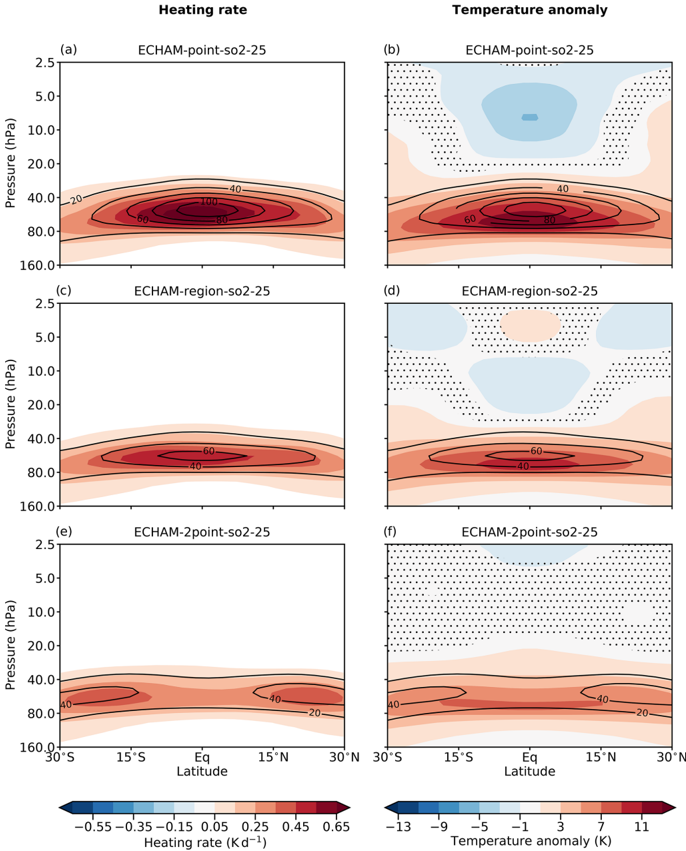
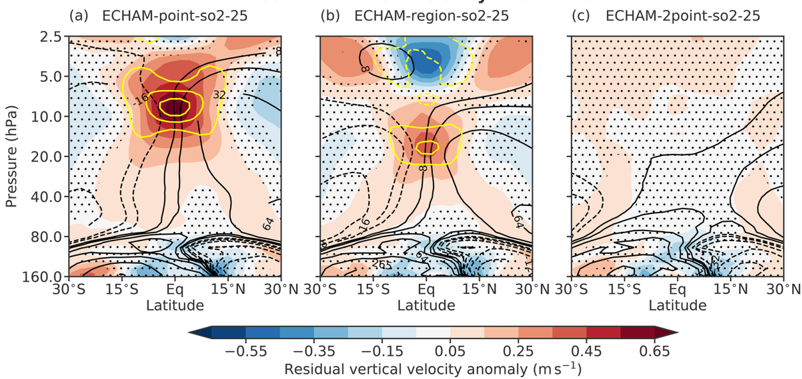
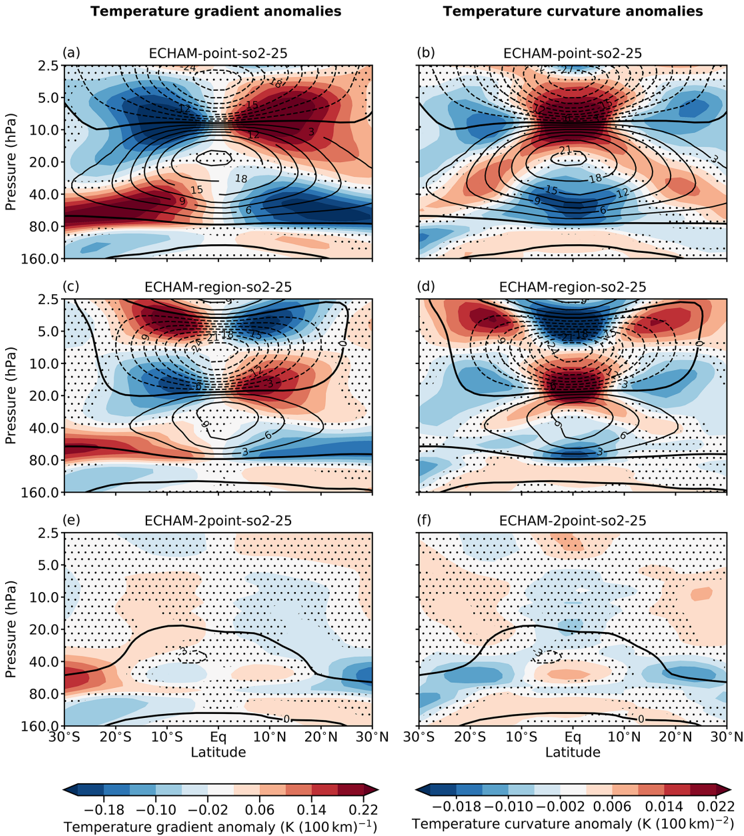
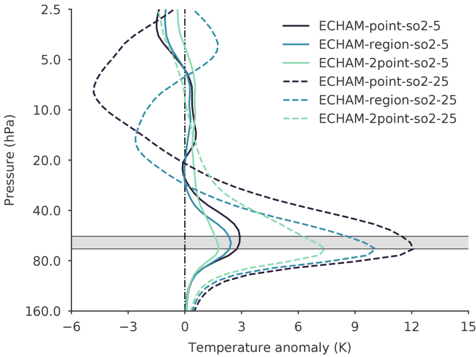
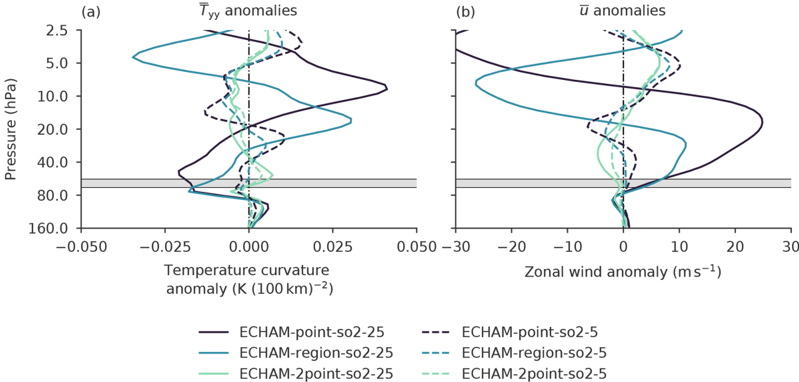
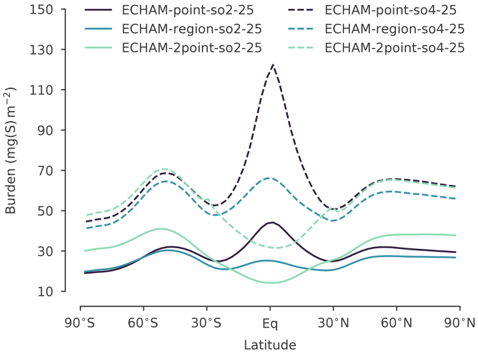
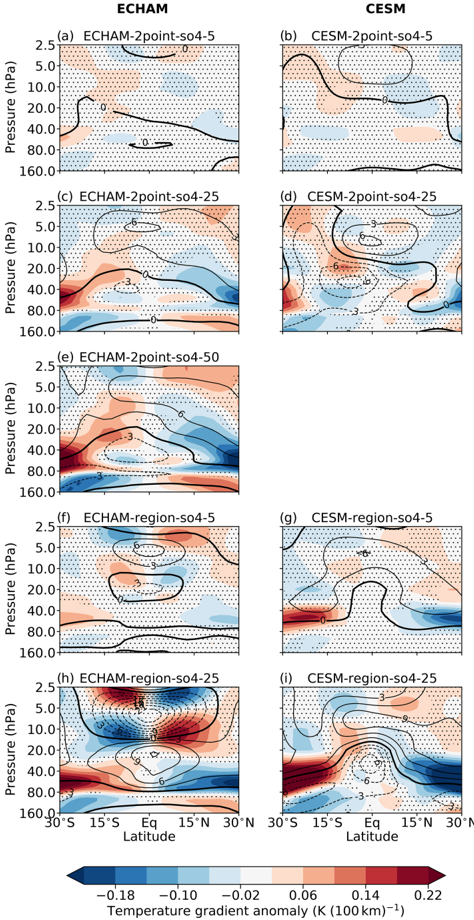
A known adverse side effect of stratospheric aerosol modification (SAM) is the alteration of the quasi-biennial oscillation (QBO), which is caused by the stratospheric heating associated with an artificial aerosol layer. Multiple studies found the QBO to slow down or even completely vanish for point-like injections of SO 2 at the Equator. The cause for this was found to be a modification of the thermal wind balance and a stronger tropical upwelling. For other injection strategies, different responses of the QBO have been observed. A theory which is able to explain those differences in a comprehensive manner has not yet been presented. This is further complicated by the fact that the simulated QBO response is highly sensitive to the used model even under identical boundary conditions. Therefore, within this study we investigate the response of the QBO to SAM for three different injection strategies (point-like injection at the Equator, point-like injection at 30 ∘ N and 30 ∘ S simultaneously, and areal injection into a 60 ∘ wide belt along the Equator). Our simulations confirm that the QBO response significantly depends on the injection location. Based on the thermal wind balance, we demonstrate that this dependency is explained by differences in the meridional structure of the aerosol-induced stratospheric warming, i.e., the location and meridional extension of the maximum warming. Additionally, we also tested two different injection species (SO 2 and H 2 SO 4 ). The QBO response is qualitatively similar for both investigated injection species. Comparing the results to corresponding results of a second model, we further demonstrate the generality of our theory as well as the importance of an interactive treatment of stratospheric ozone for the simulated QBO response.
Overview
The claims and statistics of this paper haven’t been checked yet.
Free: it reads the open-access text and checks the first 5 claims that cite a source we can check. Create a free account to check every claim.
Integrity signals
Registry
Cites
Statistics
Figures
Verification
Claims the paper makes
The claims and statistics of this paper haven’t been checked yet.
Free: it reads the open-access text and checks the first 5 claims that cite a source we can check. Create a free account to check every claim.
Claims other papers make about this one
Each is checked against this paper’s own text: does it say what the citing paper says it does?
The check wasn’t confident either way, so it gives no verdict — never disputed.
In the citing paper
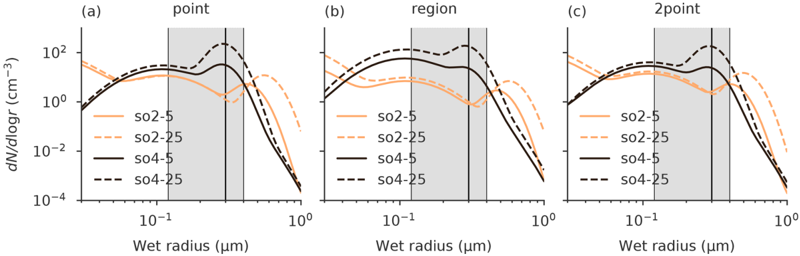
“This is explored by Franke (2021), who found that particle number size distributions (PNSDs) were shifted to larger radii for 25 Tg S injections versus 5 Tg S for more significantly than 32.”
From Engineering and logistical concerns add practical limitations to stratospheric aerosol injection strategies (2025) · cites this paper as [32]
Experimental — accuracy not yet measured
Self-check
Percentages, sums and reported differences re-computed from the paper’s own numbers.
The self-check needs the paper’s full text.
Citations
Cites
Atmospheric Chemistry and Physics: From Air Pollution to Climate Change
Seinfeld, J. H., Pandis, S. N., & Noone, K. (1998) · Physics Today · doi:10.1063/1.882420 · Cited by 8,731 · cited 1×
“…area density (SAD) produced by the aerosols that enhances the ozone destruction by halogens (such as HOCl) in the heterogeneous reaction (at T 200K) ClONO2+H2O→ HOCl+HNO3 (R1) where ClONO2 is one of the main stratospheric reservoirs of inorganic chlorine (see Seinfeld and Pandis, 1998, Sect.”
BackgroundThe Scenario Model Intercomparison Project (ScenarioMIP) for CMIP6
O'Neill, B. C., Tebaldi, C., van Vuuren, D. P., Eyring, V., Friedlingstein, P., Hurtt, G., Knutti, R., Kriegler, E., Lamarque, J.-F., Lowe, J., et al. (2016) · Geoscientific Model Development · doi:10.5194/gmd-9-3461-2016 · Cited by 6,189
The quasi‐biennial oscillation
Baldwin, M. P., Gray, L. J., Dunkerton, T. J., Hamilton, K., Haynes, P. H., Randel, W. J., Holton, J. R., Alexander, M. J., Hirota, I., Horinouchi, T., et al. (2001) · Reviews of Geophysics · doi:10.1029/1999rg000073 · Cited by 2,113 · cited 19×
“Niemeier and Schmidt (2017) obtained a significantly prolonged westerly phase of the QBO for an injection into a zonal belt along the Equator ranging from 30◦N to 30◦ S with an injection rate of 10 Tg(S)yr−1 but weaker than for an equatorial point injection with the same injection rate.”
BackgroundInfluentialAtmospheric component of the MPI‐M Earth System Model: ECHAM6
Stevens, B., Giorgetta, M., Esch, M., Mauritsen, T., Crueger, T., Rast, S., Salzmann, M., Schmidt, H., Bader, J., Block, K., et al. (2013) · Journal of Advances in Modeling Earth Systems · doi:10.1002/jame.20015 · Cited by 1,379
Roeckner, E., Brokopf, R., Esch, M., Giorgetta, M., Hagemann, S., Kornblueh, L., Manzini, E., Schlese, U., & Schulzweida, U. (2006) · Journal of Climate · doi:10.1175/jcli3824.1 · Cited by 1,183 · cited 14×
“Therefore, the impact of SAM on stratospheric ozone is not simulated within MAECHAM5-HAM.”
BackgroundInfluentialThe aerosol-climate model ECHAM5-HAM
Stier, P., Feichter, J., Kinne, S., Kloster, S., Vignati, E., Wilson, J., Ganzeveld, L., Tegen, I., Werner, M., Balkanski, Y., et al. (2005) · Atmospheric Chemistry and Physics · doi:10.5194/acp-5-1125-2005 · Cited by 1,010 · cited 2×
“HAM calculates aerosol microphysical processes like nucleation, accumulation, condensation, and coagulation as well as the sulfate aerosol depletion via sedimentation and deposition (Stier et al., 2005).”
MethodLiu, X., Easter, R. C., Ghan, S. J., Zaveri, R., Rasch, P., Shi, X., Lamarque, J.-F., Gettelman, A., Morrison, H., Vitt, F., et al. (2012) · Geoscientific Model Development · doi:10.5194/gmd-5-709-2012 · Cited by 996
The Whole Atmosphere Community Climate Model Version 6 (WACCM6)
Gettelman, A., Mills, M. J., Kinnison, D. E., Garcia, R. R., Smith, A. K., Marsh, D. R., Tilmes, S., Vitt, F., Bardeen, C. G., McInerny, J., et al. (2019) · Journal of Geophysical Research: Atmospheres · doi:10.1029/2019jd030943 · Cited by 786
Liu, X., Ma, P.-L., Wang, H., Tilmes, S., Singh, B., Easter, R. C., Ghan, S. J., & Rasch, P. J. (2016) · Geoscientific Model Development · doi:10.5194/gmd-9-505-2016 · Cited by 671
An Update of the Observed Quasi-Biennial Oscillation of the Stratospheric Winds over the Tropics
Naujokat, B. (1986) · Journal of the Atmospheric Sciences · doi:10.1175/1520-0469(1986)043<1873:auotoq>2.0.co;2 · Cited by 599 · cited 3×
“Both compare well to the observed period of 28 months on average (Naujokat, 1986).”
BackgroundResultM7: An efficient size‐resolved aerosol microphysics module for large‐scale aerosol transport models
Vignati, E., Wilson, J., & Stier, P. (2004) · Journal of Geophysical Research: Atmospheres · doi:10.1029/2003jd004485 · Cited by 514
Hines, C. O. (1997) · Journal of Atmospheric and Solar-Terrestrial Physics · doi:10.1016/s1364-6826(96)00079-x · Cited by 447
Manzini, E., Giorgetta, M. A., Esch, M., Kornblueh, L., & Roeckner, E. (2006) · Journal of Climate · doi:10.1175/jcli3826.1 · Cited by 386 · cited 1×
“Additionally, it accounts for the momentum flux deposition of unresolved gravity waves (GWs) originating from the troposphere via a parameterization following Hines (1997a, b); its implementation into MAECHAM5 is described by Manzini et al. (2006).”
MethodHines, C. O. (1997) · Journal of Atmospheric and Solar-Terrestrial Physics · doi:10.1016/s1364-6826(96)00080-6 · Cited by 363 · cited 3×
“Additionally, it accounts for the momentum flux deposition of unresolved gravity waves (GWs) originating from the troposphere via a parameterization following Hines (1997a, b); its implementation into MAECHAM5 is described by Manzini et al. (2006). Therefore, MAECHAM5 internally generates a QBO in the tropical stratos…”
MethodInfluentialA model of the quasi‐biennial oscillation on an equatorial beta‐plane
Plumb, R. A., & Bell, R. C. (1982) · Quarterly Journal of the Royal Meteorological Society · doi:10.1002/qj.49710845604 · Cited by 342 · cited 6×
“During a permanent QBO westerly phase, the SMC would also be permanently locked in its corresponding “westerly” phase, which acts to increase w∗ within the tropical stratosphere (Plumb and Bell, 1982).”
BackgroundMethodInfluentialGlobal volcanic aerosol properties derived from emissions, 1990–2014, using CESM1(WACCM)
Mills, M. J., Schmidt, A., Easter, R., Solomon, S., Kinnison, D. E., Ghan, S. J., Neely, R. R., Marsh, D. R., Conley, A., Bardeen, C. G., et al. (2016) · Journal of Geophysical Research: Atmospheres · doi:10.1002/2015jd024290 · Cited by 314
Kravitz, B., Robock, A., Tilmes, S., Boucher, O., English, J. M., Irvine, P. J., Jones, A., Lawrence, M. G., MacCracken, M., Muri, H., et al. (2015) · Geoscientific Model Development · doi:10.5194/gmd-8-3379-2015 · Cited by 297
Self-citationThe impact of geoengineering aerosols on stratospheric temperature and ozone
Heckendorn, P., Weisenstein, D., Fueglistaler, S., Luo, B. P., Rozanov, E., Schraner, M., Thomason, L. W., & Peter, T. (2009) · Environmental Research Letters · doi:10.1088/1748-9326/4/4/045108 · Cited by 254
Climatology and Forcing of the Quasi-Biennial Oscillation in the MAECHAM5 Model
Giorgetta, M. A., Manzini, E., Roeckner, E., Esch, M., & Bengtsson, L. (2006) · Journal of Climate · doi:10.1175/jcli3830.1 · Cited by 251
Mills, M. J., Richter, J. H., Tilmes, S., Kravitz, B., MacMartin, D. G., Glanville, A. A., Tribbia, J. J., Lamarque, J., Vitt, F., Schmidt, A., et al. (2017) · Journal of Geophysical Research: Atmospheres · doi:10.1002/2017jd027006 · Cited by 238
Initial fate of fine ash and sulfur from large volcanic eruptions
Niemeier, U., Timmreck, C., Graf, H.-F., Kinne, S., Rast, S., & Self, S. (2009) · Atmospheric Chemistry and Physics · doi:10.5194/acp-9-9043-2009 · Cited by 167 · cited 5×
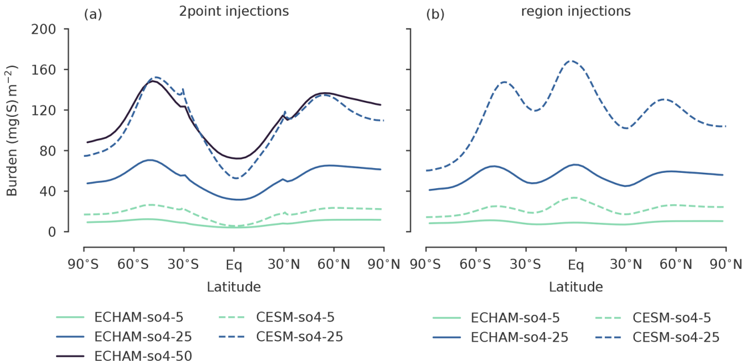
“In accordance with Niemeier et al. (2020), the sulfate burden for a given injection rate is substantially larger in CESM than in ECHAM, which is predominantly due to a stronger w. Given the characteristic meridional distribution of sulfate particles for a 2point injection, this results in a higher sulfate burden in th…”
BackgroundMethodInfluentialSelf-citationSensitivity of Aerosol Distribution and Climate Response to Stratospheric SO2 Injection Locations
Tilmes, S., Richter, J. H., Mills, M. J., Kravitz, B., MacMartin, D. G., Vitt, F., Tribbia, J. J., & Lamarque, J. (2017) · Journal of Geophysical Research: Atmospheres · doi:10.1002/2017jd026888 · Cited by 164
Garfinkel, C. I., & Hartmann, D. L. (2011) · Journal of the Atmospheric Sciences · doi:10.1175/2011jas3665.1 · Cited by 162
What is the limit of climate engineering by stratospheric injection of SO 2 ?
Niemeier, U., & Timmreck, C. (2015) · Atmospheric Chemistry and Physics · doi:10.5194/acp-15-9129-2015 · Cited by 156 · cited 3×
“These simulations use the model setup described in Niemeier et al. (2009) and Niemeier and Timmreck (2015), where more details can be found.”
BackgroundMethodSelf-citationPierce, J. R., Weisenstein, D. K., Heckendorn, P., Peter, T., & Keith, D. W. (2010) · Geophysical Research Letters · doi:10.1029/2010gl043975 · Cited by 146 · cited 3×
“Details on the aerosol microphysical background of an injection of H2SO4 can be found, for example, in Pierce et al. (2010), Benduhn et al. (2016), or Vattioni et al. (2019).”
BackgroundStratospheric Dynamical Response and Ozone Feedbacks in the Presence of SO 2 Injections
Richter, J. H., Tilmes, S., Mills, M. J., Tribbia, J. J., Kravitz, B., MacMartin, D. G., Vitt, F., & Lamarque, J. (2017) · Journal of Geophysical Research: Atmospheres · doi:10.1002/2017jd026912 · Cited by 133
Effects of Different Stratospheric SO2 Injection Altitudes on Stratospheric Chemistry and Dynamics
Tilmes, S., Richter, J. H., Mills, M. J., Kravitz, B., MacMartin, D. G., Garcia, R. R., Kinnison, D. E., Lamarque, J., Tribbia, J., & Vitt, F. (2018) · Journal of Geophysical Research: Atmospheres · doi:10.1002/2017jd028146 · Cited by 127
Improved aerosol radiative properties as a foundation for solar geoengineering risk assessment
Dykema, J. A., Keith, D. W., & Keutsch, F. N. (2016) · Geophysical Research Letters · doi:10.1002/2016gl069258 · Cited by 123
Aquila, V., Garfinkel, C. I., Newman, P. A., Oman, L. D., & Waugh, D. W. (2014) · Geophysical Research Letters · doi:10.1002/2013gl058818 · Cited by 122 · cited 11×
“The dynamic mechanisms which cause the observed modification and breakdown of the QBO for an equatorial point injection of SO2 have been investigated by Aquila et al. (2014). They argue that the absorption of radiation in the near IR and terrestrial wavelengths by the artificial sulfate aerosols and the associated low…”
BackgroundMethodResultInfluentialButchart, N., Anstey, J. A., Hamilton, K., Osprey, S., McLandress, C., Bushell, A. C., Kawatani, Y., Kim, Y.-H., Lott, F., Scinocca, J., et al. (2018) · Geoscientific Model Development · doi:10.5194/gmd-11-1009-2018 · Cited by 121
The dependency of geoengineered sulfate aerosol on the emission strategy
Niemeier, U., Schmidt, H., & Timmreck, C. (2011) · Atmospheric Science Letters · doi:10.1002/asl.304 · Cited by 118 · cited 2×
“In contrast, in ECHAM simulations with permanent lower-stratospheric easterlies instead of a QBO, Niemeier et al. (2011) obtained an increase of the tropicalw∗ of only 5 % to 10 % for an equatorial point injection of SO2 with an injection rate of 4 Tg(S)yr−1.”
ResultSelf-citationTiedtke, M. (1996) · Monthly Weather Review · doi:10.1175/1520-0493(1996)124<2023:tiopss>2.0.co;2 · Cited by 115
Changing transport processes in the stratosphere by radiative heating of sulfate aerosols
Niemeier, U., & Schmidt, H. (2017) · Atmospheric Chemistry and Physics · doi:10.5194/acp-17-14871-2017 · Cited by 102 · cited 7×
“Niemeier and Schmidt (2017) obtained a significantly prolonged westerly phase of the QBO for an injection into a zonal belt along the Equator ranging from 30◦N to 30◦ S with an injection rate of 10 Tg(S)yr−1 but weaker than for an equatorial point injection with the same injection rate.”
BackgroundResultInfluentialSelf-citationMicrophysical simulations of sulfur burdens from stratospheric sulfur geoengineering
English, J. M., Toon, O. B., & Mills, M. J. (2012) · Atmospheric Chemistry and Physics · doi:10.5194/acp-12-4775-2012 · Cited by 101
Stratospheric heating by potential geoengineering aerosols: HEATING BY GEOENGINEERING AEROSOLS
Ferraro, A. J., Highwood, E. J., & Charlton-Perez, A. J. (2011) · Geophysical Research Letters · doi:10.1029/2011gl049761 · Cited by 84
A model of the quasi-biennial oscillation on an equatorial beta-plane
PLUMB, A. R., & BELL, R. C. (1982) · Quarterly Journal of the Royal Meteorological Society · doi:10.1256/smsqj.45603 · Cited by 74
Seasonal Injection Strategies for Stratospheric Aerosol Geoengineering
Visioni, D., MacMartin, D. G., Kravitz, B., Tilmes, S., Mills, M. J., Richter, J. H., & Boudreau, M. P. (2019) · Geophysical Research Letters · doi:10.1029/2019gl083680 · Cited by 69 · cited 1×
“If not otherwise stated, the results presented in this study are averaged over the last 8 years of the respective simulation, since Visioni et al. (2019) showed that the artificial stratospheric sulfate layer has reached equilibrium already by the third year of deployment.”
Self-citationSulfate geoengineering: a review of the factors controlling the needed injection of sulfur dioxide
Visioni, D., Pitari, G., & Aquila, V. (2017) · Atmospheric Chemistry and Physics · doi:10.5194/acp-17-3879-2017 · Cited by 66 · cited 1×
“If not otherwise stated, the results presented in this study are averaged over the last 8 years of the respective simulation, since Visioni et al. (2019) showed that the artificial stratospheric sulfate layer has reached equilibrium already by the third year of deployment.”
Self-citationBittner, M., Timmreck, C., Schmidt, H., Toohey, M., & Krüger, K. (2016) · Journal of Geophysical Research: Atmospheres · doi:10.1002/2015jd024603 · Cited by 58 · cited 4×
“This mechanism has been investigated by Tilmes et al. (2018) for SAM simulations and was also recognized in simulations of a tropical volcanic eruption by Bittner et al. (2016).”
BackgroundInfluentialNiemeier, U., Richter, J. H., & Tilmes, S. (2020) · Atmospheric Chemistry and Physics · doi:10.5194/acp-20-8975-2020 · Cited by 58 · cited 7×
“Multiple studies revealed that the QBO could also be heavily perturbed during a potential deployment of SAM (e.g., Aquila et al., 2014; Richter et al., 2017; Tilmes et al., 2018; Niemeier et al., 2020).”
BackgroundMethodResultInfluentialSelf-citationSchirber, S., Manzini, E., Krismer, T. R., & Giorgetta, M. A. (2014) · Climate Dynamics · doi:10.1007/s00382-014-2314-2 · Cited by 53 · cited 1×
“Schirber et al. (2014) exemplarily showed for the ECHAM6 model (Stevens et al., 2013) that the simulated GW forcing in a GCM is highly dependent on the chosen GW parameterization.”
MethodPunge, H. J., Konopka, P., Giorgetta, M. A., & Müller, R. (2009) · Journal of Geophysical Research: Atmospheres · doi:10.1029/2008jd010518 · Cited by 52 · cited 2×
“For equatorial point injections, the role of ozone in determining the dynamical response to SAM has been already addressed by Richter et al. (2017). They found that for injections of SO2 with an injection rate of 6 Tg(S)yr−1, the QBO is locked in a persistent westerly phase in their simulation with prescribed ozone va…”
BackgroundSeo, J., Choi, W., Youn, D., Park, D.-S. R., & Kim, J. Y. (2013) · Geophysical Research Letters · doi:10.1002/2013gl058266 · Cited by 50 · cited 2×
“2011) and precipitation (Seo et al., 2013), as well as on the stratospheric transport to the extratropics (Plumb and Bell, 1982; Punge et al., 2009) and the polar vortex (Holton and Tan, 1980).”
BackgroundTimmreck, C. (2001) · Journal of Geophysical Research: Atmospheres · doi:10.1029/2001jd000765 · Cited by 48 · cited 3×
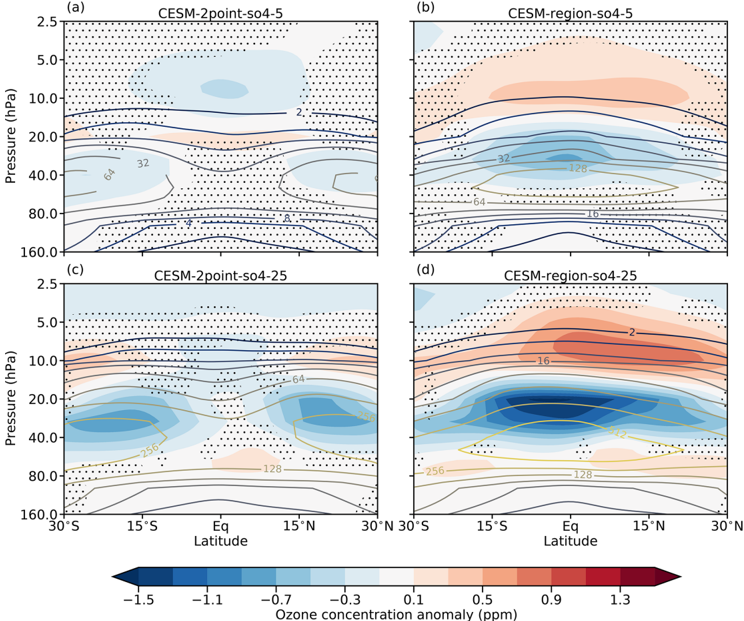
“In this case, while the ozone reduction in the lower stratosphere can be attributed to the same heterogeneous chemistry mechanism described above, the ozone increase in the middle stratosphere can be explained by the predominance of the NOx cycle for the ozone budget at those altitude.”
MethodInfluentialVattioni, S., Weisenstein, D., Keith, D., Feinberg, A., Peter, T., & Stenke, A. (2019) · Atmospheric Chemistry and Physics · doi:10.5194/acp-19-4877-2019 · Cited by 48 · cited 3×
“Details on the aerosol microphysical background of an injection of H2SO4 can be found, for example, in Pierce et al. (2010), Benduhn et al. (2016), or Vattioni et al. (2019).”
BackgroundVisioni, D., Pitari, G., Aquila, V., Tilmes, S., Cionni, I., Di Genova, G., & Mancini, E. (2017) · Atmospheric Chemistry and Physics · doi:10.5194/acp-17-11209-2017 · Cited by 41 · cited 2×
“…the simulation of the QBO response to artificial sulfur injections critically depends on multiple factors, which is further complicated by feedback processes of an altered QBO onto the sulfate distribution and associated dynamical changes (e.g., Niemeier and Schmidt, 2017; Visioni et al., 2017a).”
BackgroundInfluentialSelf-citationStratospheric temperature changes after the Pinatubo eruption
Labitzke, K. G. (1994) · Journal of Atmospheric and Terrestrial Physics · doi:10.1016/0021-9169(94)90039-6 · Cited by 38 · cited 2×
“Pinatubo in June 1991, the lower stratosphere warmed by about 3 K, which led to a prolonged QBO westerly phase in the lower stratosphere (Labitzke, 1994), very likely due to an increased tropical upwelling induced by the aerosol warming (Giorgetta et al.”
BackgroundBenduhn, F., Schallock, J., & Lawrence, M. G. (2016) · Geophysical Research Letters · doi:10.1002/2016gl070701 · Cited by 33 · cited 3×
“Details on the aerosol microphysical background of an injection of H2SO4 can be found, for example, in Pierce et al. (2010), Benduhn et al. (2016), or Vattioni et al. (2019).”
BackgroundModification of stratospheric circulation by trace constituent changes?
Dunkerton, T. J. (1983) · Journal of Geophysical Research Atmospheres · doi:10.1029/jc088ic15p10831 · Cited by 30
Modelling the size distribution of geoengineered stratospheric aerosols
Hommel, R., & Graf, H. (2011) · Atmospheric Science Letters · doi:10.1002/asl.285 · Cited by 14
Franke, H., Niemeier, U., & Visioni, D. (2020) · doi:10.5194/acp-2020-1104-supplement · Cited by 1
Self-citationWang (1980) · doi:10.1175/1520-0469(1980)037
Research works printed but not linked: 3
- Andrews, D. G., Leovy, C. B., and Holton, J. R.: Middle At- mosphere Dynamics, Academic Press, Amsterdam, Boston, 6th Edn., 1987.
- Holton, J. R.: An Introduction to Dynamic Meteorology, Academic Press, Amsterdam, Boston, 4th Edn., 2004.
- Lin, S.-J. and Rood, R. B.: Multidimensional Flux-Form Semi-Lagrangian Transport Schemes, Mon. Weather Rev., 124, 2046-2070, https://doi.org/10.1175/1520- 0493(1996)124<2046:MFFSLT>2.0.CO;2, 1996. · doi:10.1175/1520-0493(1996)1242.0.co;2
Cited by
Visioni, D., MacMartin, D. G., Kravitz, B., Boucher, O., Jones, A., Lurton, T., Martine, M., Mills, M. J., Nabat, P., Niemeier, U., et al. (2021) · Atmospheric Chemistry and Physics · doi:10.5194/acp-21-10039-2021 · Cited by 145
Self-citationJones, A., Haywood, J. M., Scaife, A. A., Boucher, O., Henry, M., Kravitz, B., Lurton, T., Nabat, P., Niemeier, U., Séférian, R., et al. (2022) · Atmospheric Chemistry and Physics · doi:10.5194/acp-22-2999-2022 · Cited by 61
Self-citationBednarz, E. M., Butler, A. H., Visioni, D., Zhang, Y., Kravitz, B., & MacMartin, D. G. (2023) · Atmospheric Chemistry and Physics · doi:10.5194/acp-23-13665-2023 · Cited by 52
Self-citationLaakso, A., Niemeier, U., Visioni, D., Tilmes, S., & Kokkola, H. (2022) · Atmospheric Chemistry and Physics · doi:10.5194/acp-22-93-2022 · Cited by 55
Self-citationWeisenstein, D. K., Visioni, D., Franke, H., Niemeier, U., Vattioni, S., Chiodo, G., Peter, T., & Keith, D. W. (2022) · Atmospheric Chemistry and Physics · doi:10.5194/acp-22-2955-2022 · Cited by 53
“…also perturbs stratospheric circulation and water vapour (Ferraro et al., 2011; Aquila et al., 2014; Richter et al., 2017; Niemeier and Schmidt, 2017; Franke et al., 2021), (4) enhanced diffuse light at the Earth’s surface (Kravitz et al., 2012) and (5) impacts on upper tropospheric ice clouds…”
BackgroundInfluentialSelf-citation
Metadata
- Authors
- Franke, H., Niemeier, U., & Visioni, D.
- Affiliations
- Max Planck Institute for Meteorology (DE)
- Cornell University (US)
- Corresponding author
- Franke, Henning
- Niemeier, Ulrike
- Visioni, Daniele
- Venue
- Atmospheric Chemistry and Physics
- Publisher
- Copernicus GmbH
- Published
- 2021-06-08
- Volume
- 21
- Issue
- 11
- Pages
- 8615-8635
- ISSN
- 1680-7316 (ISSN-L)
- 1680-7324
- OpenAlex
- W3171496082
- Cited by
- 38
- References
- 53
- Citations by year
- 2026: 3 · 2025: 2 · 2024: 2 · 2023: 5 · 2022: 10 · 2021: 16
- FWCI
- 3.38
- Type
- journal article
- Language
- en
- Open access
- gold
- doi.org
- Licence
- Locations
- Atmospheric chemistry and physics (publishedVersion, cc-by)
- DOAJ (DOAJ: Directory of Open Access Journals) (submittedVersion, cc-by-sa)
- MPG.PuRe (Max Planck Society) (submittedVersion, other-oa)
- Funders
- Deutsche Forschungsgemeinschaft (FOR2820, TI344/2-1, SPP1689)
- National Science Foundation (CBET-1818759, 1852977)
- Topics
- Physical Sciences › Environmental Science › Global and Planetary Change › Climate Change and Geoengineering
- Physical Sciences › Earth and Planetary Sciences › Atmospheric Science › Atmospheric Ozone and Climate
- Physical Sciences › Environmental Science › Global and Planetary Change › Atmospheric aerosols and clouds
- Keywords
- quasi-biennial oscillation, injection strategy, stratospheric heating, thermal wind balance, tropical upwelling, sulfur dioxide, sulfuric acid, stratospheric ozone, model sensitivity
About these checks
Registry, retraction, Cites and statistics results are computed, not judged, with one exception: a printed reference that no index lists is read once by a model before it counts as a citation error. Claims are extracted by a model and kept only when their quote appears verbatim in the text; each cited source is then checked, with a model’s help, for whether it says what the claim relies on. Those verdicts can be wrong — read the claim’s quote and the cited source before relying on one.
Statistics and arithmetic are recomputed, not judged.
Confidence bands are shown only for fields calibrated on our annotated test set. None is calibrated yet, so no band is shown.
What counts as a claim ›How we measure confidence ›How we check this ›
Are you an author, or do you see a problem with this page? Request a review
Data sources
Bibliographic data: Semantic Scholar, OpenAlex, Crossref.
Contains information from the Semantic Scholar Academic Graph Datasets, made available under the ODC Attribution License (ODC-BY 1.0).
Semantic Scholar’s data is described in: Kinney, R., et al. (2023). The Semantic Scholar Open Data Platform. arXiv:2301.10140.
