

Detection of large-scale cloud microphysical changes within a major shipping corridor after implementation of the International Maritime Organization 2020 fuel sulfur regulations
Open accessPublished version of a preprint
The DOI matches its Crossref record; 59 of the 59 references it cites were found in a registry or an index.
Abstract
New regulations from the International Maritime Organization (IMO) limiting sulfur emissions from the shipping industry are expected to have large benefits in terms of public health but may come with an undesired side effect: acceleration of global warming as the climate-cooling effects of ship pollution on marine clouds are diminished. Previous work has found a substantial decrease in the detection of ship tracks in clouds after the IMO 2020 regulations went into effect, but changes in large-scale cloud properties have been more equivocal. Using a statistical technique that estimates counterfactual fields of what large-scale cloud and radiative properties within an isolated shipping corridor in the southeastern Atlantic would have been in the absence of shipping, we confidently detect a reduction in the magnitude of cloud droplet effective radius decreases within the shipping corridor and find evidence for a reduction in the magnitude of cloud brightening as well. The instantaneous radiative forcing due to aerosol–cloud interactions from the IMO 2020 regulations is estimated as O (1 W m −2 ) within the shipping corridor, lending credence to global estimates of O (0.1 W m −2 ). In addition to their geophysical significance, our results also provide independent evidence for general compliance with the IMO 2020 regulations.
Overview
The claims and statistics of this paper haven’t been checked yet.
Free: it reads the open-access text and checks the first 5 claims that cite a source we can check. Create a free account to check every claim.
Integrity signals
Registry
Cites
Statistics
Figures
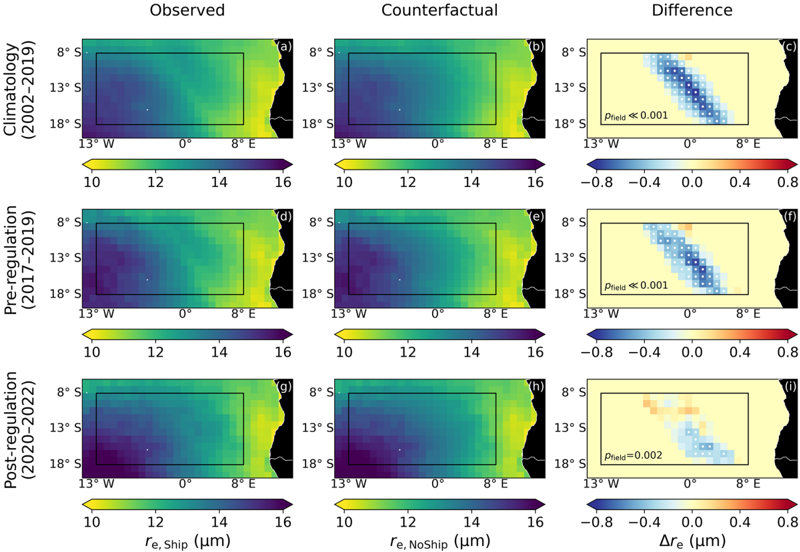
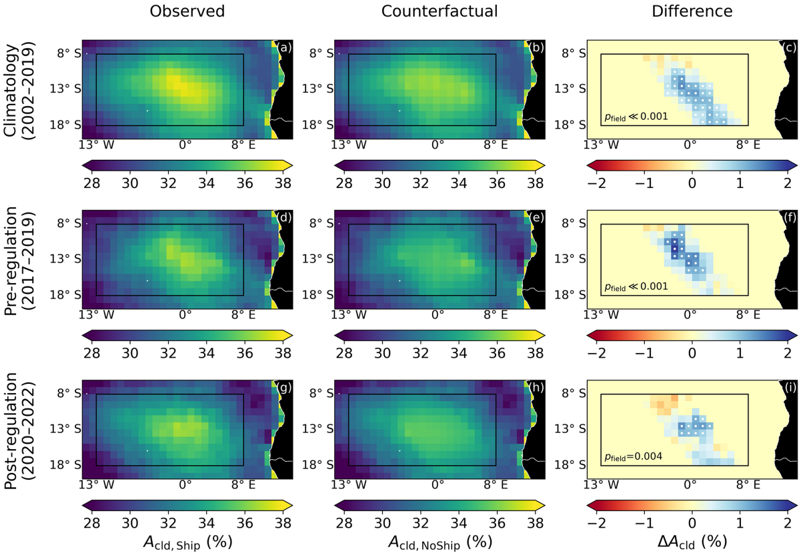
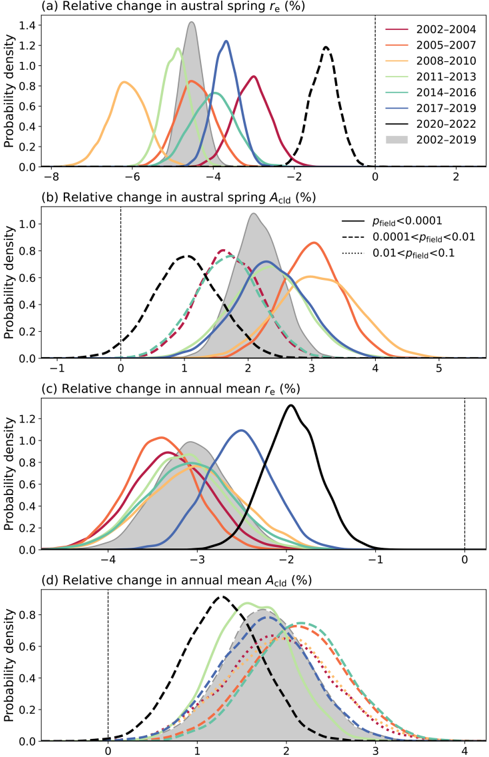
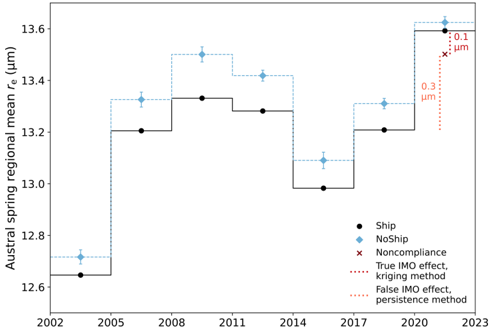
Verification
Claims the paper makes
The claims and statistics of this paper haven’t been checked yet.
Free: it reads the open-access text and checks the first 5 claims that cite a source we can check. Create a free account to check every claim.
Claims other papers make about this one
Each is checked against this paper’s own text: does it say what the citing paper says it does?
The source backs part of the claim, not all of it — or backs it for a different population, condition or comparison.
In the citing paper
“Outside the South Atlantic, the effect of IMO2020 does not have a distinct spatial structure18,19, which makes direct observation of the impact more challenging.”
From Abrupt reduction in shipping emission as an inadvertent geoengineering termination shock produces substantial radiative warming (2024) · cites this paper as [19]
Experimental — accuracy not yet measuredThe source backs part of the claim, not all of it — or backs it for a different population, condition or comparison.
In the citing paper
“The two completely independent approaches yield very similar radiative forcing in the core shipping lane (supporting online material, SOM), which serves as a cross-validation.”
From Abrupt reduction in shipping emission as an inadvertent geoengineering termination shock produces substantial radiative warming (2024) · cites this paper as [19]
Experimental — accuracy not yet measuredThe source backs part of the claim, not all of it — or backs it for a different population, condition or comparison.
In the citing paper
“In the core shipping lane, the forcing is estimated to peak around 0.5Wm−2, the Twomey effect being the dominant factor in this region (see Fig. 2), in our analysis in excellent agreement with theirs19.”
From Abrupt reduction in shipping emission as an inadvertent geoengineering termination shock produces substantial radiative warming (2024) · cites this paper as [19]
Experimental — accuracy not yet measuredThe source backs part of the claim, not all of it — or backs it for a different population, condition or comparison.
In the citing paper
“Regional radiative forcing is already detectable in the Southeast Atlantic shipping lane19.”
From Abrupt reduction in shipping emission as an inadvertent geoengineering termination shock produces substantial radiative warming (2024) · cites this paper as [19]
Experimental — accuracy not yet measuredThe source backs part of the claim, not all of it — or backs it for a different population, condition or comparison.
In the citing paper
“In 2020, the IMO implemented regulations reducing the permissible sulfur content in shipping fuel from 3.5% to 0.5%, leading to an 80% decrease in sulfur dioxide (SO 2 ) emissions.”
From Past Field Experiments of Solar Radiation Modification: A Review of the Scientific and Technical Aspects for Governance (2026) · cites this paper as Diamond, 2023
Experimental — accuracy not yet measured
2 more claims about this paper
Create a free account to see every claim other papers make about this one.
Self-check
Percentages, sums and reported differences re-computed from the paper’s own numbers.
The self-check needs the paper’s full text.
Citations
Cites
Controlling the False Discovery Rate: A Practical and Powerful Approach to Multiple Testing
Benjamini, Y., & Hochberg, Y. (1995) · Journal of the Royal Statistical Society Series B: Statistical Methodology · doi:10.1111/j.2517-6161.1995.tb02031.x · Cited by 109,482 · cited 1×
“…5,000 NoShip simulations that would have a number of individually significant grid boxes greater than or equal to the factual case and are adjusted for multiple testing using a Benjamini-Hochberg adjustment to control the false discovery rate (Benjamini and Hochberg, 1995; Ventura et al., 2004).”
MethodMatplotlib: a 2D graphics environment
Hunter, J. D. (2007) · Computing in Science & Engineering · doi:10.1109/mcse.2007.55 · Cited by 39,249 · cited 1×
“, 2020), cartopy (Met Office, 2010–2015), matplotlib (Hunter, 2007), scipy (Virtanen et al.”
SciPy 1.0: fundamental algorithms for scientific computing in Python
Virtanen, P., Gommers, R., Oliphant, T. E., Haberland, M., Reddy, T., Cournapeau, D., Burovski, E., Peterson, P., Weckesser, W., Bright, J., et al. (2020) · Nature Methods · doi:10.1038/s41592-019-0686-2 · Cited by 38,430
The NCEP/NCAR 40-Year Reanalysis Project
Kalnay, E., Kanamitsu, M., Kistler, R., Collins, W., Deaven, D., Gandin, L., Iredell, M., Saha, S., White, G., Woollen, J., et al. (1996) · Bulletin of the American Meteorological Society · doi:10.1175/1520-0477(1996)077<0437:tnyrp>2.0.co;2 · Cited by 28,360
Harris, C. R., Millman, K. J., van der Walt, S. J., Gommers, R., Virtanen, P., Cournapeau, D., Wieser, E., Taylor, J., Berg, S., Smith, N. J., et al. (2020) · Nature · doi:10.1038/s41586-020-2649-2 · Cited by 23,826
Harris, C., Millman, K., van der Walt, S., Gommers, R., Virtanen, P., Cournapeau, D., Wieser, E., Taylor, J., Berg, S., Smith, N., et al. (2020) · RePEc: Research Papers in Economics · Cited by 17,844
Aerosols, Cloud Microphysics, and Fractional Cloudiness
Albrecht, B. A. (1989) · Science · doi:10.1126/science.245.4923.1227 · Cited by 4,422 · cited 2×
“…cloud brightness effect have been observed within ship tracks as well, and can reinforce the microphysical brightening effect by suppressing drizzle (Albrecht, 1989; Goren and Rosenfeld, 2012) or counteract it by enhancing entrainment (Chen et al., 2012; Coakley and Walsh, 2002; Toll et al., 2019).”
BackgroundPollution and the planetary albedo
Twomey, S. (1974) · Atmospheric Environment (1967) · doi:10.1016/0004-6981(74)90004-3 · Cited by 2,049 · cited 1×
“For the same amount of liquid water within a cloud, increasing aerosol increases the cloud droplet number concentration ( N d ) and decreases the cloud-top effective radius ( r e ), brightening the clouds (Twomey, 1974, 1977).”
BackgroundClouds and the Earth's Radiant Energy System (CERES): An Earth Observing System Experiment
Wielicki, B. A., Barkstrom, B. R., Harrison, E. F., Lee, R. B., Louis Smith, G., & Cooper, J. E. (1996) · Bulletin of the American Meteorological Society · doi:10.1175/1520-0477(1996)077<0853:catere>2.0.co;2 · Cited by 1,957 · cited 1×
“All cloud, radiation, and meteorological data in this work come from the CERES SSF regional 1 ° x 1 ° (SSF1deg) monthly product based on the CERES instrument from the Terra satellite (CERES Science Team, 2021, 2023; Loeb et al., 2018; Wielicki et al., 1996).”
Methodxarray: N-D labeled Arrays and Datasets in Python
Hoyer, S., & Hamman, J. (2017) · Journal of Open Research Software · doi:10.5334/jors.148 · Cited by 1,856 · cited 1×
“com/statsmodels/ statsmodels, statsmodels, 2023) and xarray (Hoyer and Hamman, 2017) packages.”
Research works printed but not linked: 1
- Conover, J. H.: Anomalous Cloud Lines, J. Atmos. Sci., 23, 778-785, https://doi.org/10.1175/1520- 0469(1966)023<0778:Acl>2.0.Co;2, 1966. · doi:10.1175/1520-0469(1966)0232.0.co;2
Cited by
Global warming in the pipeline
Hansen, J. E., Sato, M., Simons, L., Nazarenko, L. S., Sangha, I., Kharecha, P., Zachos, J. C., von Schuckmann, K., Loeb, N. G., Osman, M. B., et al. (2023) · Oxford Open Climate Change · doi:10.1093/oxfclm/kgad008 · Cited by 334
“Diamond [176] finds a cloud brightness decrease of order 1 W/m 2 in a shipping corridor.”
BackgroundRecent global temperature surge intensified by record-low planetary albedo
Goessling, H., Rackow, T., & Jung, T. J. (2024) · Science · doi:10.1126/science.adq7280 · Cited by 236
A global overview of marine heatwaves in a changing climate
Capotondi, A. M., Rodrigues, R. R., Gupta, A. S., Benthuysen, J. A., Deser, C., Frölicher, T. L., Lovenduski, N. S., Amaya, D. J., Grix, N. L., Xu, T., et al. (2024) · Communications Earth & Environment · doi:10.1038/s43247-024-01806-9 · Cited by 222
Yuan, T., Song, H., Oreopoulos, L., Wood, R., Bian, H., Breen, K., Chin, M., Yu, H., Barahona, D., Meyer, K., et al. (2024) · Communications Earth & Environment · doi:10.1038/s43247-024-01442-3 · Cited by 79
“One way to gauge the possible range of uncertainty for our forcing estimate is to compare ours with that from Diamond (2023) 19 in the South Atlantic (SOM).”
Has Reducing Ship Emissions Brought Forward Global Warming?
Gettelman, A., Christensen, M. W., Diamond, M., Gryspeerdt, E., Manshausen, P., Stier, P., Watson‐Parris, D., Yang, M., Yoshioka, M., & Yuan, T. (2024) · Geophysical Research Letters · doi:10.1029/2024gl109077 · Cited by 104
Self-citationPhysical science research needed to evaluate the viability and risks of marine cloud brightening
Feingold, G., Ghate, V. P., Russell, L. M., Blossey, P., Cantrell, W., Christensen, M. W., Diamond, M. S., Gettelman, A., Glassmeier, F., Gryspeerdt, E., et al. (2024) · Science Advances · doi:10.1126/sciadv.adi8594 · Cited by 69
“While global studies have focused on the climate forcing question, studies at the shipping lane ( 44, 45, 56 ) or even individual ship-track scale [see, e.g., ( 17, 57 )] have addressed more microphysically oriented questions (Fig.”
BackgroundResultInfluentialSelf-citationObservational Assessment of Changes in Earth’s Energy Imbalance Since 2000
Loeb, N. G., Ham, S., Allan, R. P., Thorsen, T. J., Meyssignac, B., Kato, S., Johnson, G. C., & Lyman, J. M. (2024) · Surveys in Geophysics · doi:10.1007/s10712-024-09838-8 · Cited by 103
“Studies by Yuan et al. (2022) and Diamond (2023) use satellite observations to quantify the impact of sulfur regulations for shipping fuel on aerosol indirect forcing.”
Kuhlbrodt, T., Swaminathan, R., Ceppi, P., & Wilder, T. (2024) · Bulletin of the American Meteorological Society · doi:10.1175/bams-d-23-0209.1 · Cited by 78
Yi, W., Wang, X., He, T., Liu, H., Luo, Z., Lv, Z., & He, K. (2025) · Earth system science data · doi:10.5194/essd-17-277-2025 · Cited by 62
Drivers of the extreme North Atlantic marine heatwave during 2023
England, M. H., Li, Z., Huguenin, M. F., Kiss, A. E., Gupta, A. S., Holmes, R. M., & Rahmstorf, S. (2025) · Nature · doi:10.1038/s41586-025-08903-5 · Cited by 92
“Reduced sulfate aerosol emissions along the main Atlantic shipping lanes 27,28,31,32 has also been proposed as a driver of the record-breaking 2023 warming.”
Global and regional drivers for exceptional climate extremes in 2023-2024: beyond the new normal
Minobe, S., Behrens, E., Findell, K. L., Loeb, N. G., Meyssignac, B., & Sutton, R. T. (2025) · npj Climate and Atmospheric Science · doi:10.1038/s41612-025-00996-z · Cited by 41
Lightning response to temperature and aerosols
Qie, X., Yair, Y. Y., Di, S., Huang, Z., & Jiang, R. (2024) · Environmental Research Letters · doi:10.1088/1748-9326/ad63bf · Cited by 28
“…through impacting the electrification of hydrometeors and thunderstorm charge structure, which are closely related to the microphysical processes in the mixed phase region (e.g. Mansell and Ziegler 2013, Zhao et al 2015, Tan et al 2017, Lynn et al 2020, Sun et al 2021, 2023, Hazra et al 2022).”
IMO2020 Regulations Accelerate Global Warming by up to 3 Years in UKESM1
Jordan, G., & Henry, M. (2024) · Earth s Future · doi:10.1029/2024ef005011 · Cited by 42
“We estimate a radiative forcing change of 0.139 ± 0.019 Wm 2 due to this decline in shipping emissions which is in agreement with recent studies (Diamond, 2023; Skeie et al., 2024; Yoshioka et al., 2024; Yuan et al., 2024).”
InfluentialEffects of intermittent aerosol forcing on the stratocumulus-to-cumulus transition
Prabhakaran, P., Hoffmann, F., & Feingold, G. (2024) · Atmospheric chemistry and physics · doi:10.5194/acp-24-1919-2024 · Cited by 30
“The increased”
Watson‐Parris, D., Wilcox, L. J., Stjern, C. W., Allen, R. J., Persad, G. G., Bollasina, M. A., Ekman, A. M. L., Iles, C. E., Joshi, M., Lund, M. T., et al. (2025) · Atmospheric chemistry and physics · doi:10.5194/acp-25-4443-2025 · Cited by 27
“1, while Quaglia and Visioni (2024) found a global temperature −”
Trends, Skill, and Sources of Skill in Initialized Climate Forecasts of Global Mean Temperature
Tippett, M. K., & Becker, E. J. (2024) · Geophysical Research Letters · doi:10.1029/2024gl110703 · Cited by 14
“…other proposed contributors include internal variability (Rantanen & Laaksonen, 2024), the Raikoke and Hunga Tonga volcanic eruptions (Schoeberl et al., 2023), reduction of sulfur pollution from ships (Diamond, 2023; Yuan et al., 2024), and an acceleration of global warming (Hansen et al., 2023).”
Rapid saturation of cloud water adjustments to shipping emissions
Manshausen, P., Watson‐Parris, D., Christensen, M. W., Jalkanen, J.-P., & Stier, P. (2023) · Atmospheric chemistry and physics · doi:10.5194/acp-23-12545-2023 · Cited by 20
“(2019b) and Diamond et al. (2020) compare entire regions of high and low shipping emissions, while Watson-Parris et al. (2022) compare higher- and lower-emission years because of regulatory changes.”
BackgroundInfluentialShip emission variations during the COVID-19 from global and continental perspectives
Yi, W., He, T., Wang, X., Soo, Y. H., Luo, Z., Xie, Y., Peng, X., Zhang, W., Wang, Y., Lv, Z., et al. (2024) · The Science of The Total Environment · doi:10.1016/j.scitotenv.2024.176633 · Cited by 18
Communications Earth & Environment
Ghomsi, F. E. K., Stroeve, J. C., Crawford, A., Tamoffo, A. T., Mouassom, F. L., & Ragoasha, M. N. (2025) · RWTH Publications (RWTH Aachen) · doi:10.1038/s43247-024-01911-9
Impact of fuel sulfur regulations on carbonaceous particle emission from a marine engine
Bauer, M., Czech, H., Anders, L., Passig, J., Etzien, U., Bendl, J., Streibel, T., Adam, T. W., Buchholz, B., & Zimmermann, R. (2024) · npj Climate and Atmospheric Science · doi:10.1038/s41612-024-00838-4 · Cited by 13
Haywood, J., Boucher, O., Lennard, C., Storelvmo, T., Tilmes, S., & Visioni, D. (2025) · Frontiers in Climate · doi:10.3389/fclim.2025.1507479 · Cited by 27
Multi-model effective radiative forcing of the 2020 sulfur cap for shipping
Skeie, R. B., Byrom, R., Hodnebrog, Ø., Jouan, C., & Myhre, G. (2024) · Atmospheric chemistry and physics · doi:10.5194/acp-24-13361-2024 · Cited by 24
“Diamond (2023) Using satellite retrievals, reanalysis wind, ship positions and modelled emissions Manshausen et al. (2023) showed that the cloud droplet numbers respond linearly to ship emissions.”
Guizzardi, D., Crippa, M., Butler, T. M., Keating, T. J., Wu, R., Kaminski, J. W., Kuenen, J. J. P., Kurokawa, J., Chatani, S., Morikawa, T., et al. (2025) · Earth system science data · doi:10.5194/essd-17-5915-2025 · Cited by 19
Lightning declines over shipping lanes following regulation of fuel sulfur emissions
Wright, C. J., Thornton, J. A., Jaeglé, L., Cao, Y., Zhu, Y., Liu, J., Jones, R., II, Holzworth, R. H., Rosenfeld, D., Wood, R., et al. (2025) · Atmospheric chemistry and physics · doi:10.5194/acp-25-2937-2025 · Cited by 18
“Finally, we discuss the implications of these results for the mechanisms of shipping lane lightning enhancement and for aerosol particle-DCC interactions generally.”
InfluentialReconciling Earth’s growing energy imbalance with ocean warming
Allan, R. P., & Merchant, C. J. (2025) · Environmental Research Letters · doi:10.1088/1748-9326/adb448 · Cited by 21
“Ship fuel regulations phasing in up to around 2020 are also expected to have amplified these changes, primarily through aerosol-cloud interactions (Diamond et al 2023, Jordan and Henry 2024, Quaglia and Visioni 2024, Yuan et al 2024).”
Michibata, T., Wall, C. J., Hirota, N., Duran, B. M., & Nozawa, T. (2025) · Current Pollution Reports · doi:10.1007/s40726-025-00382-6 · Cited by 15
“More specifically, recent observational and modeling studies suggest that the reduction in sulfur aerosol emissions fromtheshippingsectorfollowingtheInternationalMaritime Organization 2020 regulation (IMO2020) has altered cloud microphysical properties [162] and radiative forcing [163].”
Addressing the urgent need for direct climate cooling: Rationale and options
Baiman, R. P., Clarke, S., Elsworth, C., Field, L. A., MacCracken, M. C., Macdonald, J., Mitchell, D. L., Oeste, F. D., Reed, S., Salter, S. H., et al. (2024) · Oxford Open Climate Change · doi:10.1093/oxfclm/kgae014 · Cited by 11
Santos, L., Salo, K., Kong, X., Hartmann, M., Sjöblom, J., & Thomson, E. S. (2024) · Journal of Geophysical Research Atmospheres · doi:10.1029/2023jd040389 · Cited by 13
“This decrease of cloud condensation nuclei (CCN) emissions is due to reduced emissions of more hygroscopic particles and shifts toward emissions of generally smaller particles, which have higher droplet activation thresholds (Santos et al., 2023; Yu et al., 2020, 2023).”
BackgroundInfluentialKey Gaps in Models' Physical Representation of Climate Intervention and Its Impacts
Eastham, S. D., Butler, A. H., Doherty, S. J., Gasparini, B., Tilmes, S., Bednarz, E., Burkhardt, U., Chiodo, G., Cziczo, D. J., Diamond, M., et al. (2025) · Journal of Advances in Modeling Earth Systems · doi:10.1029/2024ms004872 · Cited by 15
Self-citationDiamond, M., Gristey, J. J., & Feingold, G. (2024) · Geophysical Research Letters · doi:10.1029/2024gl111733 · Cited by 8
“The IMO 2020 regulations decreasing the allowable sulfur mass content of marine fuel oils from 3.5% to 0.5% have already been observed to alter cloud properties (Diamond, 2023; Watson‐Parris et al., 2022; Yuan et al., 2022).”
InfluentialSelf-citationBenas, N., Meirink, J. F., Roebeling, R. A., & Stengel, M. (2025) · Atmospheric chemistry and physics · doi:10.5194/acp-25-6957-2025 · Cited by 9
Ming, T., de Richter, R. K., Felzer, B. S., & Li, W. (2025) · Atmosphere · doi:10.3390/atmos16040406 · Cited by 5
Impact of Ship Emission Control Area Policies on Port Air Quality—A Case Study of Ningbo Port, China
Lu, S., & Zhou, F. (2024) · Sustainability · doi:10.3390/su16093659 · Cited by 4
Investigation of Ship‐Induced Mesoscale Circulation Mechanics and Aerosol Plume Spreading Rates
McMichael, L. A., Blossey, P. N., Wood, R., & Doherty, S. J. (2025) · Geophysical Research Letters · doi:10.1029/2025gl116904 · Cited by 3
“…of the low cloud albedo response in shipping lanes is uncertain and highly dependent on background meteorology (Christensen & Stephens, 2011; Diamond et al., 2020; Gryspeerdt et al., 2019, 2020; Smalley et al., 2024; Tippett et al., 2024) and exhaust composition (Diamond, 2023; Gettelman et…”
Detectable ship tracks account for just 5% of aerosol indirect forcing from ship emissions
Yuan, T., Song, H., Boss, L. F., & Diamond, M. (2025) · Communications Earth & Environment · doi:10.1038/s43247-025-02825-w · Cited by 6
Self-citationBie, S., Hao, J., Zhang, Y., Yuan, Q., Han, Z., Yu, Q., Xiong, Y., Chen, Y., & Yang, X. (2026) · Environmental Science & Technology · doi:10.1021/acs.est.6c00632 · Cited by 3
An Entropy Generation Rate Model for Tropospheric Behavior That Includes Cloud Evolution
Sekhar, J. A. (2023) · Entropy · doi:10.3390/e25121625 · Cited by 5
“In an experiment performed on the seas, fewer low-lying wet clouds were observed when sulfate particles (nuclei) in the atmosphere above the water were reduced [59].”
BackgroundMao, J., Zhang, Y., Bie, S., Han, Z., Song, J., Ye, R., Wang, H., Yu, F., Wu, Y., & Liu, D. (2024) · The Science of The Total Environment · doi:10.1016/j.scitotenv.2024.173142 · Cited by 4
Santos, L., Thomson, E. S., Salo, K., Hartmann, M., Sjöblom, J., & Kong, X. (2023) · doi:10.22541/essoar.170067090.01725875/v1 · Cited by 3
Hernandez‐Galindo, I., Määttänen, A., Redmond Roche, B. H., Boucher, O., Irvine, P. J., & Moore, J. C. (2026) · Earth's Future · doi:10.1029/2025ef007254 · Cited by 2
“While this has improved air quality, it has also reduced the formation of sulfate aerosols that contribute to cloud brightness, potentially diminishing their cooling effect on the climate (Diamond, 2023; Yuan et al., 2024).”
Li, R., Jian, B., Li, J., Li, J., Cao, Z., Wang, Y., Wang, Y., & Huang, J. (2025) · Earth-Science Reviews · doi:10.1016/j.earscirev.2025.105274 · Cited by 3
Hirasawa, H., Henry, M., Rasch, P. J., Wood, R., Doherty, S. J., Haywood, J., Wong, A., Lamarque, J., Brody, E., & Wang, H. (2026) · Geoscientific model development · doi:10.5194/gmd-19-3257-2026 · Cited by 12
Climate warming could weaken aerosol-cloud interactions in subtropical marine stratocumulus
Sun, H., Blossey, P. N., Wood, R., Erfani, E., Doherty, S. J., & Chun, J.-Y. (2026) · npj Climate and Atmospheric Science · doi:10.1038/s41612-026-01357-0 · Cited by 3
Evaluating simulations of ship tracks in a km-scale model
Tippett, A., Field, P. R., & Gryspeerdt, E. (2026) · Atmospheric chemistry and physics · doi:10.5194/acp-26-4251-2026 · Cited by 2
Baiman, R. P., Baiman, R., Bishop, R., Elsworth, C., Gadian, A. M., Melton, B., Petersen, O., & Tao, Y. (2024) · Oxford Open Climate Change · doi:10.1093/oxfclm/kgae008 · Cited by 3
Mao, J., Zhang, Y., Yu, F., Bie, S., Qi, Y., Ma, W., Chen, J., & Chen, L. (2025) · Journal of Geophysical Research Atmospheres · doi:10.1029/2024jd042867 · Cited by 2
“…Lauer et al., 2007; M. Sofiev et al., 2018), while the new fuel regulation transiting the sulfur content from 3.5% to 0.5% on a global scale in 2020 reduced aerosol loadings and have and will significantly accelerate global warming (Diamond, 2023; Hansen et al., 2023; Yuan et al., 2022, 2024).”
InfluentialDiamond, M., & Boss, L. F. (2025) · Atmospheric chemistry and physics · doi:10.5194/acp-25-16401-2025 · Cited by 3
Self-citationAn intercomparison of aircraft sulfur dioxide measurements in clean and polluted marine environments
Temple, L. G., Young, S., Bannan, T. J., Batten, S. E., Bauguitte, S. J.-B., Coe, H., Grant, E., Lacy, S., Lee, J. D., Matthews, E., et al. (2026) · Atmospheric measurement techniques · doi:10.5194/amt-19-1165-2026 · Cited by 3
“…of this regulation has been assessed by a recent surge of radiative forcing estimates ranging from 0.02 to 0.2 W m (Bilsback et al., 2020; Diamond, 2023; Gettel-man et al., 2024; Jin et al., 2018; Jordan and Henry, 2024; Quaglia and Visioni, 2024; Skeie et al., 2024; Sofiev et al., 2018;…”
InfluentialVyve, M. V. (2024) · Oxford Open Climate Change · doi:10.1093/oxfclm/kgae009 · Cited by 2
Substantial Radiative Warming by an Inadvertent Geoengineering Experiment from 2020 Fuel RegulationsPreprint
Yuan, T., Song, H., Oreopoulos, L., Wood, R., Bian, H., Breen, K. H., Chin, M., Yu, H., Barahona, D., Meyer, K., et al. (2023) · Research Square · doi:10.21203/rs.3.rs-3490826/v1 · Cited by 2
Rent-seeking behavior of ship sulfur emission detection based on evolutionary game theory
Liang, J. L., Dong, L., Che, Y., Tang, Y., & Dou, Y. (2025) · Regional Studies in Marine Science · doi:10.1016/j.rsma.2025.104060 · Cited by 1
Jin, Q., Huang, J., Wei, J., & Pu, B. (2025) · npj Climate and Atmospheric Science · doi:10.1038/s41612-025-01256-w · Cited by 2
“Using the method similar to Diamond 23 , the random forest regression model is selected as the mean function with regressors taking the form of various combinationsofSSF1degauxiliarydata(i.e.,surfaceskintemperature(SST), windspeed(WS),estimatedinversionstrength(EIS))andcoordinatedata…”
Geetha, N. K., Darla, N., Chintalapudi, R., Pappula, B., & Makgato, S. S. (2026) · Environmental Research Communications · doi:10.1088/2515-7620/ae44ea · Cited by 1
Allen, R. J., Wilcox, L. J., Samset, B. H., Ahmadi, S., Ekman, A. M. L., Elling, M. T., Fraser-Leach, L., Griffiths, P. T., Keeble, J., Koshiro, T., et al. (2026) · Environmental Research Climate · doi:10.1088/2752-5295/ae5418 · Cited by 7
“The LW terms in equation (3) can be estimated with proxies (Zelinka et al 2014, 2023, Smith et al 2020) according to: where ∆ R LWcs is the change in TOA clear-sky LW radiative flux and ∆ R Tocs is the change in TOA clear-sky LW radiative flux associated with the changes in land surface temperature.”
Cutting ships’ pollution has climate downside
(2023) · Nature · doi:10.1038/d41586-023-02430-x · Cited by 1
Darkening clouds after restrictions in maritime sulfur emissions
Scott, E. (2023) · Nature Reviews Earth & Environment · doi:10.1038/s43017-023-00490-1 · Cited by 1
Behr, L., Xoplaki, E., Luther, N., Josey, S. A., & Luterbacher, J. (2025) · Environmental Research Letters · doi:10.1088/1748-9326/ae0055 · Cited by 2
“…reduced Saharan dust advection and SO 2 emissions from shipping have been linked to increased SSTA due to their influence on solar radiation (Diamond et al 2023, Kuhlbrodt et al 2024, England et al 2025). with increased (decreased) heat uptake, while windA shows reduced (enhanced) wind…”
Mitchell, D. L., & Erfani, E. (2025) · Wiley eBooks · doi:10.1002/9781394204847.ch18 · Cited by 3
Baiman, R. P., Baiman, R., Bishop, R., Elsworth, C., Gadian, A. M., Melton, B., Petersen, O., & Tao, Y. (2024) · doi:10.22541/essoar.171690792.20111702/v1
Visioni, D., Narenpitak, P., & Honegger, M. (2024) · Elsevier eBooks · doi:10.1016/b978-0-323-96026-7.00170-3
What to Consider When Considering Solar Geoengineering
Power, B. L. (2025) · Wiley eBooks · doi:10.1002/9781394204847.ch7
Benas, N. (2025) · doi:10.5194/egusphere-2024-3135-ac3
Visioni, D., Narenpitak, P., & Honegger, M. (2025) · Elsevier eBooks · doi:10.1016/b978-0-443-15748-6.00003-4
Impact on cloud properties of reduced-sulphur shipping fuel in the Eastern North Atlantic
Mace, G. G., Benson, S., Gombert, P. M., & Smallwood, T. (2026) · Atmospheric chemistry and physics · doi:10.5194/acp-26-1041-2026 · Cited by 1
“…with the IMO 2020 regulation have also been documented in a major shipping lane in the tropical Southeast Atlantic off the African continent (Diamond, 2023 Most recently, Yuan et al. (2024) have attempted to quantify the global impact of the IMO 2020 regulation concluding that the reduction…”
Highly light-absorbing particle emissions from low-sulfur marine fuels
Kokkola, T., Sipkens, T. A., Paul, A., Shukla, D., Ihalainen, M., Das, A., Scott, J., Passig, J., Kalamašņikovs, A., Etzien, U., et al. (2026) · npj Climate and Atmospheric Science · doi:10.1038/s41612-026-01369-w · Cited by 1
Dust suppresses aerosol first indirect effects in marine warm clouds over the North Atlantic Ocean
Pandey, S. K., Adebiyi, A. A., Yang, L., Vinoj, V., & Zheng, X. (2026) · Communications Earth & Environment · doi:10.1038/s43247-026-03693-8 · Cited by 1
“Key reasons for this trend in aerosol-induced climate effects are the decline in anthropogenic aerosol emissions and large uncertainties in the trends of natural aerosols, such as dust, which, in turn, affect the trend in clouddropletconcentrations 13 – 15 .”
Omokpariola, D. O. (2026) · Discover Environment · doi:10.1007/s44274-026-00821-1
Global black carbon aerosol: Spatiotemporal distributions, drivers, and health impacts
Yu, H., He, X., Liu, M., Yan, G., Yao, D., Hu, P., Li, X., Jia, Y., Zhong, S., Cao, Z., et al. (2026) · Journal of Hazardous Materials · doi:10.1016/j.jhazmat.2026.142933
Morohashi, M., Yotsuyanagi, H., YABUSAKI, S., Shin, K., Tanikawa, T., Yamashita, N., Kurokawa, J., & Sase, H. (2026) · Atmospheric Environment · doi:10.1016/j.atmosenv.2026.122308
Tatro, T., & Zuidema, P. (2026) · Communications Earth & Environment · doi:10.1038/s43247-026-03995-x · Cited by 1
In Situ Collection and Photochemical Aging of Individual Ship Plumes Captured at Sea
Piel, S. K., Gröger, T., Czech, H., Hakkim, H., Passig, J., Hovorka, J., Osterholz, H., Vojtíšek-Lom, M., Adam, T. W., & Zimmermann, R. (2026) · Environmental Science & Technology Letters · doi:10.1021/acs.estlett.6c00695
Forcing closure suggests stronger aerosol forcing and higher climate sensitivity than the consensus
Yuan, T., Song, H., Loon, S. V., Kramer, R. J., Oreopoulos, L., & Forster, P. M. D. F. (2026) · Science Advances · doi:10.1126/sciadv.aeh6401
Metadata
- Authors
- Diamond, M. S.
- Affiliations
- Florida State University (US)
- Corresponding author
- Diamond, Michael S.
- ORCID
- Diamond, Michael S.
- Venue
- Atmospheric Chemistry and Physics
- Publisher
- Copernicus GmbH
- Published
- 2023-07-25
- Volume
- 23
- Issue
- 14
- Pages
- 8259-8269
- ISSN
- 1680-7316 (ISSN-L)
- 1680-7324
- OpenAlex
- W4385247926
- Cited by
- 72
- References
- 55
- Citations by year
- 2026: 16 · 2025: 25 · 2024: 24 · 2023: 7
- FWCI
- 8.09
- Type
- journal article
- Language
- en
- Open access
- gold
- doi.org
- Licence
- Locations
- Atmospheric chemistry and physics (publishedVersion, cc-by)
- DOAJ (DOAJ: Directory of Open Access Journals) (submittedVersion, cc-by-sa)
- Funders
- Florida State University (N/A (new faculty startup))
- Topics
- Physical Sciences › Environmental Science › Global and Planetary Change › Atmospheric aerosols and clouds
- Physical Sciences › Environmental Science › Environmental Engineering › Maritime Transport Emissions and Efficiency
- Physical Sciences › Earth and Planetary Sciences › Atmospheric Science › Atmospheric chemistry and aerosols
- Keywords
- ship emissions, cloud effective radius, cloud brightening, aerosol-cloud interactions, radiative forcing, counterfactual estimation, southeastern Atlantic
About these checks
Registry, retraction, Cites and statistics results are computed, not judged, with one exception: a printed reference that no index lists is read once by a model before it counts as a citation error. Claims are extracted by a model and kept only when their quote appears verbatim in the text; each cited source is then checked, with a model’s help, for whether it says what the claim relies on. Those verdicts can be wrong — read the claim’s quote and the cited source before relying on one.
Statistics and arithmetic are recomputed, not judged.
Confidence bands are shown only for fields calibrated on our annotated test set. None is calibrated yet, so no band is shown.
What counts as a claim ›How we measure confidence ›How we check this ›
Are you an author, or do you see a problem with this page? Request a review
Data sources
Bibliographic data: Semantic Scholar, OpenAlex, Crossref.
Contains information from the Semantic Scholar Academic Graph Datasets, made available under the ODC Attribution License (ODC-BY 1.0).
Semantic Scholar’s data is described in: Kinney, R., et al. (2023). The Semantic Scholar Open Data Platform. arXiv:2301.10140.
