

Global model simulations of the impact of ocean-going ships on aerosols, clouds, and the radiation budget
Open accessPublished version of a preprint
The DOI matches its Crossref record; 56 of the 56 references it cites were found in a registry or an index.
Abstract
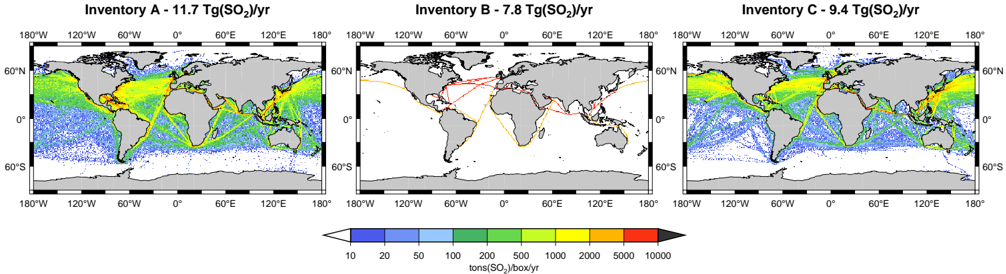
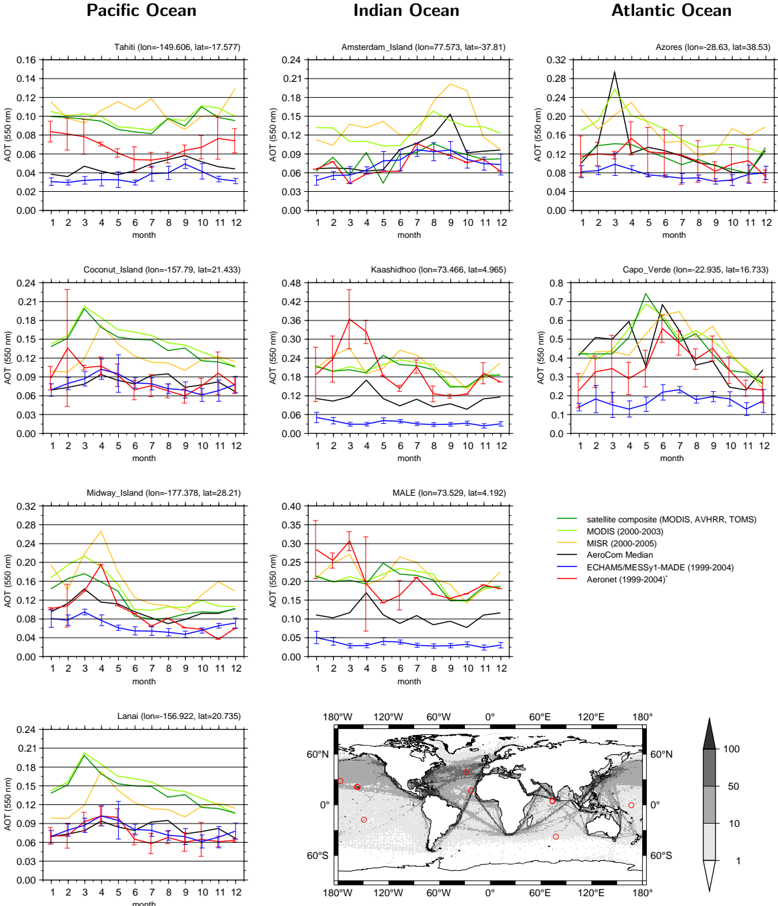
International shipping contributes significantly to the fuel consumption of all transport related activities. Specific emissions of pollutants such as sulfur dioxide (SO2) per kg of fuel emitted are higher than for road transport or aviation. Besides gaseous pollutants, ships also emit various types of particulate matter. The aerosol impacts the Earth's radiation budget directly by scattering and absorbing the solar and thermal radiation and indirectly by changing cloud properties. Here we use ECHAM5/MESSy1-MADE, a global climate model with detailed aerosol and cloud microphysics to study the climate impacts of international shipping. The simulations show that emissions from ships significantly increase the cloud droplet number concentration of low marine water clouds by up to 5% to 30% depending on the ship emission inventory and the geographic region. Whereas the cloud liquid water content remains nearly unchanged in these simulations, effective radii of cloud droplets decrease, leading to cloud optical thickness increase of up to 5–10%. The sensitivity of the results is estimated by using three different emission inventories for present-day conditions. The sensitivity analysis reveals that shipping contributes to 2.3% to 3.6% of the total sulfate burden and 0.4% to 1.4% to the total black carbon burden in the year 2000 on the global mean. In addition to changes in aerosol chemical composition, shipping increases the aerosol number concentration, e.g. up to 25% in the size range of the accumulation mode (typically >0.1 μm) over the Atlantic. The total aerosol optical thickness over the Indian Ocean, the Gulf of Mexico and the Northeastern Pacific increases by up to 8–10% depending on the emission inventory. Changes in aerosol optical thickness caused by shipping induced modification of aerosol particle number concentration and chemical composition lead to a change in the shortwave radiation budget at the top of the atmosphere (ToA) under clear-sky condition of about −0.014 W/m² to −0.038 W/m² for a global annual average. The corresponding all-sky direct aerosol forcing ranges between −0.011 W/m² and −0.013 W/m². The indirect aerosol effect of ships on climate is found to be far larger than previously estimated. An indirect radiative effect of −0.19 W/m² to −0.60 W/m² (a change in the atmospheric shortwave radiative flux at ToA) is calculated here, contributing 17% to 39% of the total indirect effect of anthropogenic aerosols. This contribution is high because ship emissions are released in regions with frequent low marine clouds in an otherwise clean environment. In addition, the potential impact of particulate matter on the radiation budget is larger over the dark ocean surface than over polluted regions over land.
Overview
The claims and statistics of this paper haven’t been checked yet.
Free: it reads the open-access text and checks the first 5 claims that cite a source we can check. Create a free account to check every claim.
Integrity signals
Registry
Cites
Statistics
Figures
Verification
Claims the paper makes
The claims and statistics of this paper haven’t been checked yet.
Free: it reads the open-access text and checks the first 5 claims that cite a source we can check. Create a free account to check every claim.
Claims other papers make about this one
Each is checked against this paper’s own text: does it say what the citing paper says it does?
The cited source says what the claim attributes to it.
In the citing paper
“Our estimate of radiative forcing from IMO2020 is well within the range of estimates of the total forcing from shipping emissions in the literature22–25.”
From Abrupt reduction in shipping emission as an inadvertent geoengineering termination shock produces substantial radiative warming (2024) · cites this paper as [23]
Self-check
Percentages, sums and reported differences re-computed from the paper’s own numbers.
The self-check needs the paper’s full text.
Citations
Cites
AERONET—A Federated Instrument Network and Data Archive for Aerosol Characterization
Holben, B. N., Eck, T. F., Slutsker, I., Tanré, D., Buis, J. P., Setzer, A., Vermote, E., Reagan, J. A., Kaufman, Y. J., Nakajima, T., et al. (1998) · Remote Sensing of Environment · doi:10.1016/s0034-4257(98)00031-5 · Cited by 7,743 · cited 7×
“Phys., 7, 5061–79, 2007 shown inLauer et al.(2005), the cloud forcing and aerosol optical thickness of the E5/M1-MADE simulation have been compared to ERBE (Earth Radiation Budget Experiment) satellite data (Barkstrom, 1984) and Aeronet (Holben et al., 1998) measurements showing reasonable good agreement in most parts…”
MethodInfluentialGlobal indirect aerosol effects: a review
Lohmann, U., & Feichter, J. (2005) · Atmospheric Chemistry and Physics · doi:10.5194/acp-5-715-2005 · Cited by 2,606
Self-citationGlobal indirect aerosol effects: a reviewPreprint
Lohmann, U., & Feichter, J. (2004) · doi:10.5194/acpd-4-7561-2004 · Cited by 1,861
Self-citationKaufman, Y. J., Tanré, D., Remer, L. A., Vermote, E. F., Chu, A., & Holben, B. N. (1997) · Journal of Geophysical Research: Atmospheres · doi:10.1029/96jd03988 · Cited by 1,699 · cited 1×
“For comparison, also satellite data from MODIS (2000–2003) (Kaufman et al., 1997; Tanre et al., 1997), MISR (2000–2005) (Kahn et al., 1998; Martonchik et al., 1998) and a composite of MODIS, AVHRR and TOMS data (Kinne et al., 2006) are shown, as well as the median of several global aerosol models…”
MethodAnalysis and quantification of the diversities of aerosol life cycles within AeroCom
Textor, C., Schulz, M., Guibert, S., Kinne, S., Balkanski, Y., Bauer, S., Berntsen, T., Berglen, T., Boucher, O., Chin, M., et al. (2006) · Atmospheric Chemistry and Physics · doi:10.5194/acp-6-1777-2006 · Cited by 1,272
Self-citationRoeckner, E., Brokopf, R., Esch, M., Giorgetta, M., Hagemann, S., Kornblueh, L., Manzini, E., Schlese, U., & Schulzweida, U. (2006) · Journal of Climate · doi:10.1175/jcli3824.1 · Cited by 1,183 · cited 8×
“We use the global aerosol climate model ECHAM5/MESSy1-MADE, hereafter referred to as E5/M1-MADE, that includes detailed aerosol and cloud microphysics to study the direct and indirect aerosol effects caused by international shipping.”
MethodInfluentialRemote sensing of aerosol properties over oceans using the MODIS/EOS spectral radiances
Tanré, D., Kaufman, Y. J., Herman, M., & Mattoo, S. (1997) · Journal of Geophysical Research: Atmospheres · doi:10.1029/96jd03437 · Cited by 922 · cited 2×
“For comparison, also satellite data from MODIS (2000–2003) (Kaufman et al., 1997; Tanre et al., 1997), MISR (2000–2005) (Kahn et al., 1998; Martonchik et al., 1998) and a composite of MODIS, AVHRR and TOMS data (Kinne et al., 2006) are shown, as well as the median of several global aerosol models…”
BackgroundMethodA parameterization of aerosol activation: 2. Multiple aerosol types
Abdul‐Razzak, H., & Ghan, S. J. (2000) · Journal of Geophysical Research: Atmospheres · doi:10.1029/1999jd901161 · Cited by 897 · cited 3×
“Aerosol activation is calculated following Abdul-Razzak and Ghan(2000).”
MethodInfluentialDentener, F., Kinne, S., Bond, T., Boucher, O., Cofala, J., Generoso, S., Ginoux, P., Gong, S., Hoelzemann, J. J., Ito, A., et al. (2006) · Atmospheric Chemistry and Physics · doi:10.5194/acp-6-4321-2006 · Cited by 887
The impact of humidity above stratiform clouds on indirect aerosol climate forcing
Ackerman, A. S., Kirkpatrick, M. P., Stevens, D. E., & Toon, O. B. (2004) · Nature · doi:10.1038/nature03174 · Cited by 824
Research works printed but not linked: 2
- Conover, J. H.: Anomalous Cloud Lines, J. Atmos. Sci., 23, 778- 785, 1966. · doi:10.1175/1520-0469(1966)023
- Intergovernmental Panel on Climate Change (IPCC): Climate Change 2007: The Physical Science Basis, Contribution of Working Group I to the Fourth Assessment Report of the Inter- governmental Panel on Climate Change, edited by: Solomon, S., Qin, D., Manning, M., Chen, Z., Marquis, M., Averyt, K. B., Tignor, M., and Miller, H. L., Cambridge University Press, Cam- bridge, United Kingdom and New York, NY, USA, 996 pp, 2007.
Cited by
Items 101–200 of 234
Zhang, F., Chen, Y., Su, P., Cui, M., Han, Y. M., Matthias, V., & Wang, G. (2021) · Environmental Pollution · doi:10.1016/j.envpol.2021.117388 · Cited by 42
Rantanen, M., & Laaksonen, A. (2024) · npj Climate and Atmospheric Science · doi:10.1038/s41612-024-00582-9 · Cited by 41
Developing a new green ship approach for flue gas emission estimation of bulk carriers
Bilgili, L., & Çelebi, U. B. (2018) · Measurement · doi:10.1016/j.measurement.2018.02.002 · Cited by 46
Climate Effects of Emission Standards: The Case for Gasoline and Diesel Cars
Tanaka, K., Berntsen, T. K., Fuglestvedt, J. S., & Rypdal, K. (2012) · Environmental Science & Technology · doi:10.1021/es204190w · Cited by 42
Kontovas, C. A. (2020) · Marine Policy · doi:10.1016/j.marpol.2020.103815 · Cited by 48
“Only one study (Lauer et al., 2007) has so far reported detailed calculations of the indirect forcing for shipping; and the uncertainty is particularly large.”
BackgroundPeters, K., Stier, P., Quaas, J., & Graßl, H. (2012) · Atmospheric Chemistry and Physics · doi:10.5194/acp-12-5985-2012 · Cited by 38
“From experiment Bsc, we obtain an upper estimate of the globally averaged AIE from shipping emissions (i.e. 0.32± 0.01Wm 2), which is about half of the largest of previously published estimates of AIEs from shipping emissions ( 0.60Wm 2 as given in Lauer et al., 2007).”
BackgroundMethodResultInfluentialSchulze, B. C., Wallace, H. W., Bui, A. A. T., Flynn, J. H., III, Erickson, M. H., Alvarez, S. L., Dai, Q., Usenko, S., Sheesley, R. J., & Griffin, R. J. (2018) · Atmospheric chemistry and physics · doi:10.5194/acp-18-14217-2018 · Cited by 44
“These results contrast with those from the previous model study of Lauer et al. (2007), who predicted using a global model that shipping contributes only ∼ 30 % of submicron SO4 over the Gulf of Mexico using the AMVER-distributed shipping inventory from Eyring et al. (2005) and as little as 15 % or…”
BackgroundResultA real option application to investment in low-sulphur maritime transport
Acciaro, M. (2014) · International Journal of Shipping and Transport Logistics · doi:10.1504/ijstl.2014.059570 · Cited by 46
“Several studies have made estimates on the ship emissions impact on climate for one or more components (Capaldo et al., 1999; Endresen et al., 2003, 2008; Eyring et al., 2007, 2010; Lee et al., 2007; Lauer et al., 2007; Dalsøren et al., 2007; Fuglestvedt et al., 2008; Berntsen and Fuglestvedt, 2008; Skeie et al., 2009…”
BackgroundReducing CO 2 from shipping – do non-CO 2 effects matter?
Eide, M. S., Dalsøren, S. B., Endresen, Ø., Samset, B. H., Myhre, G., Fuglestvedt, J. S., & Berntsen, T. K. (2013) · Atmospheric chemistry and physics · doi:10.5194/acp-13-4183-2013 · Cited by 46
“…emissions impact on climate for one or more components (Capaldo et al., 1999; Endresen et al., 2003, 2008; Eyring et al., 2007, 2010; Lee et al., 2007; Lauer et al., 2007; Dalsøren et al., 2007; Fu-20 glestvedt et al., 2008; Berntsen and Fuglestvedt, 2008; Skeie et al., 2009; Olivie et al., 2012).”
BackgroundAerosol physicochemical effects on CCN activation simulated with the chemistry-climate model EMAC
Chang, D. Y., Lelieveld, J., Tost, H., Steil, B., Pozzer, A., & Yoon, J. (2017) · Atmospheric Environment · doi:10.1016/j.atmosenv.2017.03.036 · Cited by 37
An aerosol classification scheme for global simulations using the K-means machine learning method
Li, J., Hendricks, J., Righi, M., & Beer, C. G. (2022) · Geoscientific model development · doi:10.5194/gmd-15-509-2022 · Cited by 39
Self-citationShi, Z., Endres, S., Rutgersson, A., Hajjaji, A., Brynolf, S., Booge, D., Hassellöv, I., Kontovas, C. A., Kumar, R., Liu, H., et al. (2023) · Elementa Science of the Anthropocene · doi:10.1525/elementa.2023.00052 · Cited by 51
Klingmüller, K., Steil, B., Brühl, C., Tost, H., & Lelieveld, J. (2014) · Geoscientific model development · doi:10.5194/gmd-7-2503-2014 · Cited by 35
The global impact of the transport sectors on atmospheric aerosol in 2030 – Part 2: Aviation
Righi, M., Hendricks, J., & Sausen, R. (2016) · Atmospheric Chemistry and Physics · doi:10.5194/acp-16-4481-2016 · Cited by 35
“The model setup adopted in this study also includes aerosol–radiation and aerosol– cloud couplings (Lauer et al., 2007), which are essential for quantifying the aerosol impacts on climate.”
MethodSelf-citationQuantification of the Hygroscopic Effect of Soot Aging in the Atmosphere: Laboratory Simulations
Popovicheva, O. B., Persiantseva, N. M., Kireeva, Е., Khokhlova, T. D., & Shonija, N. K. (2010) · The Journal of Physical Chemistry A · doi:10.1021/jp109238x · Cited by 41
Globalisation, transport and the environment
Braathens, N.-A. (2010) · Choice Reviews Online · doi:10.5860/choice.47-6975 · Cited by 35
Jiang, H. T., Wu, G., Li, T., He, P., & Chen, R. (2019) · Environmental Science & Technology · doi:10.1021/acs.est.9b02341 · Cited by 32
Weaker cooling by aerosols due to dust–pollution interactions
Klingmüller, K., Karydis, V. A., Bacer, S., Stenchikov, G. L., & Lelieveld, J. (2020) · Atmospheric chemistry and physics · doi:10.5194/acp-20-15285-2020 · Cited by 31
Löndahl, J., Swietlicki, E., Lindgren, E., & Loft, S. H. (2010) · Atmospheric chemistry and physics · doi:10.5194/acp-10-9441-2010 · Cited by 33
“…other data of RFs from shipping is relevant since there are several assessments of these values and a considerable variation among them (Balkanski et al., 2010; Capaldo et al., 1999; Dalsoren et al., 2007; Endresen et al., 2003; Eyring et al., 2007; Fuglestvedt et al., 2008; Lauer et al., 2007).”
Significant contribution of inland ships to the total NO x emissions along the Yangtze River
Zhang, X., Ronald van der, A., Ding, J., Zhang, X., & Yin, Y. (2023) · Atmospheric chemistry and physics · doi:10.5194/acp-23-5587-2023 · Cited by 36
Lund, M. T., Eyring, V., Fuglestvedt, J. S., Hendricks, J., Lauer, A., Lee, D. S., & Righi, M. (2012) · Environmental Science & Technology · doi:10.1021/es301166e · Cited by 36
Self-citationQuantifying the climate impact of emissions from land-based transport in Germany
Hendricks, J., Righi, M., Dahlmann, K., Gottschaldt, K.-D., Grewe, V., Ponater, M., SAUSEN, R., Heinrichs, D., Winkler, C. G., Wolfermann, A., et al. (2017) · Transportation Research Part D Transport and Environment · doi:10.1016/j.trd.2017.06.003 · Cited by 37
Self-citationPossner, A., Zubler, E. M., Lohmann, U., & Schär, C. (2016) · Journal of Geophysical Research Atmospheres · doi:10.1002/2015jd024685 · Cited by 30
Self-citationEffectiveness of Emission Control Technologies for Auxiliary Engines on Ocean-Going Vessels
Jayaram, V., Nigam, A., Welch, W. A., Miller, J. W., & Cocker, D. R. (2011) · Journal of the Air & Waste Management Association · doi:10.3155/1047-3289.61.1.14 · Cited by 31
Bacer, S., Sullivan, S. C., Karydis, V. A., Barahona, D., Krämer, M., Nenes, A., Tost, H., Tsimpidi, A. P., Lelieveld, J., & Pozzer, A. (2018) · Geoscientific model development · doi:10.5194/gmd-11-4021-2018 · Cited by 29
Aerosol water parameterization: long-term evaluation and importance for climate studies
Metzger, S., Abdelkader, M., Steil, B., & Klingmüller, K. (2018) · Atmospheric chemistry and physics · doi:10.5194/acp-18-16747-2018 · Cited by 24
Righi, M., Hendricks, J., & SAUSEN, R. (2015) · Atmospheric chemistry and physics · doi:10.5194/acp-15-633-2015 · Cited by 25
“For land transport, we consider the number size distribution parameters recommended by Dentener et al. (2006), which is characterized by a single emission mode (corresponding to the Aitken mode of MADE), with a median diameter of 30 nm and a geometric standard deviation of 1.8.”
MethodInfluentialSelf-citationImpacts of climate change and emissions on atmospheric oxidized nitrogen deposition over East Asia
Zhang, J., Gao, Y., Leung, L.-Y. R., Luo, K., Liu, H., Lamarque, J., Fan, J., Yao, X., Gao, H., & Nagashima, T. (2019) · Atmospheric chemistry and physics · doi:10.5194/acp-19-887-2019 · Cited by 23
“Lauer et al. (2007) discussed the significant impact of shipping emissions on aerosols such as aerosol nitrate burden, implying potentially subsequent influence on nitrogen deposition.”
BackgroundBai, C., Li, Y., Liu, B., Zhang, Z., & Wu, P. H. (2020) · Atmosphere · doi:10.3390/atmos11030305 · Cited by 23
Peters, K., Quaas, J., Stier, P., & Graßl, H. (2014) · Tellus B · doi:10.3402/tellusb.v66.24054 · Cited by 26
“…in large scale, climatically relevant AIEs from shipping emissions: modelling suggests substantial effects of up to "0.6 Wm"2 globally averaged RF (Lauer et al., 2007; Righi et al., 2011; Peters et al., 2012, 2013; Partanen et al., 2013), whereas that obtained from satellite observations is…”
BackgroundInfluentialMomenimovahed, A., Gagné, S., Gajdosechova, Z., Corbin, J. C., Smallwood, G. J., Mester, Z., Behrends, B., Wichmann, V., & Thomson, K. A. (2020) · Journal of Aerosol Science · doi:10.1016/j.jaerosci.2020.105651 · Cited by 19
Juwono, A. M., Johnson, G. R., Mazaheri, M., Morawska, L., Roux, F., & Kitchen, B. (2013) · Atmospheric Environment · doi:10.1016/j.atmosenv.2013.03.024 · Cited by 21
Real-case simulations of aerosol–cloud interactions in ship tracks over the Bay of Biscay
Possner, A., Zubler, E. M., Lohmann, U., & Schär, C. (2015) · Atmospheric chemistry and physics · doi:10.5194/acp-15-2185-2015 · Cited by 19
“Global general circulation model (GCM) simulations yield globally averaged ACIs due to ship emissions between −0.6 and −0.07 Wm−2 (Lauer et al., 2007; Righi et al., 2011; Peters D iscussion P aper | D iscussion P aper | D iscussion P aper | D iscussion P aper | et al., 2012; Partanen et al., 2013).”
BackgroundInfluentialSelf-citationSub-micrometer refractory carbonaceous particles in the polar stratosphere
Schütze, K., Wilson, J. C., Weinbruch, S., Benker, N., Ebert, M., Günther, G., Weigel, R., & Borrmann, S. (2017) · Atmospheric chemistry and physics · doi:10.5194/acp-17-12475-2017 · Cited by 24
“However, as these sources emit large amounts of carbonaceous material on a global scale (Bond et al., 2004; Gaffney and Marley, 2009; Corbett and Koehler, 2003; Lauer et al., 2007), they will be discussed shortly.”
BackgroundLohmann, U. (2009) · Geophysical monograph · doi:10.1029/2008gm000761 · Cited by 19
Self-citationCarbonaceous aerosols of aviation and shipping emissions
Popovicheva, O., Kireeva, Е., Тимофеев, М. А., Shonija, N. K., & Mogil’nikov, V. P. (2010) · Izvestiya Atmospheric and Oceanic Physics · doi:10.1134/s0001433810030072 · Cited by 18
“The soot particles emitted into the atmosphere by transport systems can serve as effective cloud conden� sation nuclei (CCN) and ice nucleation nuclei (IN) in cloud and fog formation [ 3 , 4]. In view of this, the impact that aviation and shipping emissions have on climate is one of the most ambiguous current prob�”
BackgroundInfluentialGlobalisation, Transport and the Environment
OECD (2010) · OECD eBooks · doi:10.1787/9789264072916-en · Cited by 60
The Sustainable Global Energy Economy: Hydrogen or Silicon?
Bardsley, W. E. (2008) · Natural Resources Research · doi:10.1007/s11053-008-9077-6 · Cited by 17
Life cycle assessment of present and future marine fuels
Bengtsson, S. (2011) · Chalmers Publication Library (Chalmers University of Technology) · Cited by 17
Peters, K., Stier, P., Quaas, J., & Graßl, H. (2013) · Atmospheric Chemistry and Physics · doi:10.5194/acp-13-6429-2013 · Cited by 17
Cao, K., Zhang, Z., Li, Y., Xie, M., & Zheng, W. (2021) · Environmental Pollution · doi:10.1016/j.envpol.2021.117698 · Cited by 17
Sea Port SO2 Atmospheric Emissions Influence on Air Quality and Exposure at Veracruz, Mexico
García, G. F., Echeverría, R. S., García-Reynoso, J. A., Baldasano, J. M., Rueda, V. M., Retama, A., & Kahl, J. D. W. (2022) · Atmosphere · doi:10.3390/atmos13121950 · Cited by 19
Lauer, A., Wang, Y., Phillips, V. T. J., McNaughton, C. S., Bennartz, R., & Clarke, A. D. (2009) · Journal of Geophysical Research Atmospheres · doi:10.1029/2009jd012201 · Cited by 17
“…mass of carbonaceous particles given by Takemura et al. [2000] has been split into black carbon, soluble and insoluble organics according to the average atmospheric burdens of these aerosol compounds 20 calculated by global model simulation with detailed aerosol microphysics [Lauer et al., 2007].”
BackgroundMethodInfluentialSelf-citationRamana, M. V., & Devi, A. (2016) · Scientific Reports · doi:10.1038/srep30416 · Cited by 17
Aerosol variability and glacial chemistry over the western Himalayas
Rashid, I., Bhat, I. A., Najar, N. A., Kang, S., Jan, F. Z., Dar, S. A., Bhat, S. U., Kashani, S. D. R., & Rasool, W. (2022) · Environmental Chemistry · doi:10.1071/en22022 · Cited by 15
Schreier, M., Joxe, L., Eyring, V., Bovensmann, H., & Burrows, J. P. (2009) · Atmospheric Research · doi:10.1016/j.atmosres.2009.08.005 · Cited by 16
“…model studies are still large, the model results indicate that the cooling due to the indirect aerosol effect outweighs the warming effects from shipping by greenhouse gases such as carbon dioxide (CO2) or ozone, overall causing a negative radiative forcing from shipping today (Lauer et al., 2007).”
BackgroundSelf-citationHaywood, J., Boucher, O., Lennard, C., Storelvmo, T., Tilmes, S., & Visioni, D. (2025) · Frontiers in Climate · doi:10.3389/fclim.2025.1507479 · Cited by 27
The Doubtful Environmental Benefit of Reduced Maximum Sulfur Limit in International Shipping Fuel
Mestl, T., Løvoll, G., Stensrud, E., & Breton, A. (2013) · Environmental Science & Technology · doi:10.1021/es4009954 · Cited by 16
Abou‐Ghanem, M., Murphy, D. M., Schill, G. P., Lawler, M. J., & Froyd, K. D. (2024) · Atmospheric chemistry and physics · doi:10.5194/acp-24-8263-2024 · Cited by 14
Multi-model effective radiative forcing of the 2020 sulfur cap for shipping
Skeie, R. B., Byrom, R., Hodnebrog, Ø., Jouan, C., & Myhre, G. (2024) · Atmospheric chemistry and physics · doi:10.5194/acp-24-13361-2024 · Cited by 24
“More recently, Bilsback et al. (2020) found a smaller ERF of just 0.027 W m -2 for an 85 % reduction in SO 2 emissions from the shipping sector using GEOS-Chem-TOMAS.”
InfluentialBilgili, L. (2020) · Journal of Material Cycles and Waste Management · doi:10.1007/s10163-020-01006-5 · Cited by 16
Popovicheva, O. (2010) · Wiley eBooks · doi:10.1002/9783527630134.ch5 · Cited by 9
Influence of ship emitted sulfur and carbonaceous aerosols on East Asian climate in summer
Zhuang, B., Zhou, Y., Hu, Y., Liang, S., Gao, P., Gao, Y., Chen, H., Li, S., Wang, T., Xie, M., et al. (2025) · Atmospheric Environment · doi:10.1016/j.atmosenv.2025.121035 · Cited by 8
Design and Innovative Application of Ship CCUS Technology Under the Requirements of Green Shipping
Zhang, N., Wang, X., Wang, C., Peng, Z., Chen, Y., Liu, L., Chen, L., Hu, J., Wei, W., & Li, X. (2025) · Journal of Marine Science and Engineering · doi:10.3390/jmse13061157 · Cited by 8
Bilgili, L. (2022) · Journal of ETA Maritime Science · doi:10.4274/jems.2022.53315 · Cited by 10
Zhu, Y., Wan, Q., Hou, Q., Feng, Y., Yu, J., Shi, J., & Xia, C. (2024) · Atmosphere · doi:10.3390/atmos15050580 · Cited by 7
“Particles emitted from ships impact climate through both direct and indirect effects and are often emitted close to populated coastlines where they impact air quality [12,13].”
BackgroundQuantification of Gaseous and Particulate Emission Factors from a Cargo Ship on the Huangpu River
Wang, H., Hu, Q., Huang, C. Y., Lu, K.-F., He, H.-D., & Peng, Z. (2023) · Journal of Marine Science and Engineering · doi:10.3390/jmse11081580 · Cited by 7
Yang, S., Ghadikolaei, M. A., Gali, N. K., Xu, Z., Chu, M., Qin, X., & Ning, Z. (2024) · The Science of The Total Environment · doi:10.1016/j.scitotenv.2024.173765 · Cited by 7
Emission Routing in Maritime Transportation
Bilgili, L., & Çelebi, U. B. (2016) · Green energy and technology · doi:10.1007/978-3-319-30127-3_62 · Cited by 7
Çetinkaya, A. Y., Kuzu, S. L., & Bilgili, L. (2022) · Environmental Monitoring and Assessment · doi:10.1007/s10661-022-09894-w · Cited by 7
“…particulate matter, carbon monoxide (CO), and non-methane volatile organic compounds (NMVOC) have adverse effects on human health and environment (Andreoni et al., 2008; AEA Energy & Environment, 2008; Kågesson, 1999; Haglind, 2008; Lauer et al., 2007; Schreier et al., 2007; Corbett et al., 2007).”
BackgroundTorvanger, A., Bogstrand, B., Skeie, R. B., & Fuglestvedt, J. S. (2007) · BIBSYS Brage (BIBSYS (Norway)) · Cited by 7
Meteorological Conditions Favorable for Strong Anthropogenic Aerosol Impacts on Clouds
Trofimov, H., Post, P., Gryspeerdt, E., & Toll, V. (2022) · Journal of Geophysical Research Atmospheres · doi:10.1029/2021jd035871 · Cited by 6
“The global climate impact of isolated aerosol sources is unclear (Lauer et al., 2007; Schreier et al., 2007), but if weaker large-scale anthropogenic cloud perturbations and tracks behave similarly, then tracks can show under which circumstances anthropogenic air pollution strongly impacts the climate.”
BackgroundEmission and environmental cost estimation of ferries operating in Lake Van
Bilgili, L., & Şahin, V. (2023) · Maritime Technology and Research · doi:10.33175/mtr.2023.262215 · Cited by 6
A Simulation Model for a Hybrid-Electric Craft in Restricted Waters
Mauro, F., la Monaca, U., Marinò, A., & Bucci, V. (2020) · Journal of Advanced Transportation · doi:10.1155/2020/5340814 · Cited by 7
SAUSEN, R., Gierens, K., Eyring, V., Hendricks, J., & Righi, M. (2012) · Research topics in aerospace · doi:10.1007/978-3-642-30183-4_43 · Cited by 9
Self-citationCao, Y., Zhang, W., Wang, X., Wu, L., & Qian, G. (2019) · Journal of the Air & Waste Management Association · doi:10.1080/10962247.2018.1531796 · Cited by 6
Octaviani, M., Tost, H., & Lammel, G. (2019) · Geoscientific model development · doi:10.5194/gmd-12-3585-2019 · Cited by 8
Membrane technologies for exhaust gas cleaning and carbon capture and sequestration
Ghasemzadeh, K., Tilebon, S. M. S., & Basile, A. (2020) · Elsevier eBooks · doi:10.1016/b978-0-12-817807-2.00005-8 · Cited by 5
Global Emissions of Marine Black Carbon: Critical Review and Revised Assessment
Wang, H., & Minjares, R. (2013) · Transportation Research Board 92nd Annual MeetingTransportation Research Board · Cited by 7
Data-driven aeolian dust emission scheme for climate modelling evaluated with EMAC 2.55.2
Klingmüller, K., & Lelieveld, J. (2023) · Geoscientific model development · doi:10.5194/gmd-16-3013-2023 · Cited by 5
Detectable ship tracks account for just 5% of aerosol indirect forcing from ship emissions
Yuan, T., Song, H., Boss, L. F., & Diamond, M. (2025) · Communications Earth & Environment · doi:10.1038/s43247-025-02825-w · Cited by 6
Global Atmospheric Aerosol Modeling
Hendricks, J., Righi, M., & Aquila, V. (2012) · Research topics in aerospace · doi:10.1007/978-3-642-30183-4_34 · Cited by 4
Self-citationMao, J., Zhang, Y., Bie, S., Han, Z., Song, J., Ye, R., Wang, H., Yu, F., Wu, Y., & Liu, D. (2024) · The Science of The Total Environment · doi:10.1016/j.scitotenv.2024.173142 · Cited by 4
International Road and Rail Freight Transport: The Impact of Globalisation on Activity Levels
Woodburn, A. G., Allen, J., Browne, M. J., Léonardi, J., & van Essen, H. (2010) · OECD eBooks · doi:10.1787/9789264072916-7-en · Cited by 6
Baiman, R. P., Baiman, R., Bishop, R., Elsworth, C., Gadian, A. M., Melton, B., Petersen, O., & Tao, Y. (2024) · Oxford Open Climate Change · doi:10.1093/oxfclm/kgae008 · Cited by 3
Mao, J., Zhang, Y., Yu, F., Bie, S., Qi, Y., Ma, W., Chen, J., & Chen, L. (2025) · Journal of Geophysical Research Atmospheres · doi:10.1029/2024jd042867 · Cited by 2
“Ship emissions have a net cooling effect on climate by affecting atmospheric particles and clouds (Eyring et al., 2010; Jan et al., 2009; Lauer et al., 2007; M. Sofiev et al., 2018), while the new fuel regulation transiting the sulfur content from 3.5% to 0.5% on a global scale in 2020 reduced…”
InfluentialZhang, X., Cheng, S., Wu, F., Yue, M., Liu, X., Zhao, D., & Yan, X. (2025) · Marine Pollution Bulletin · doi:10.1016/j.marpolbul.2025.117876 · Cited by 4
Global distribution and warming effect of brown carbon from shipping emissions
Sun, Y., Deng, J., Zhang, F., Hu, W., Zhang, Y., Chen, Y., Xiao, Y., Cui, L., Liu, Y., Zhao, J., et al. (2025) · Carbon Research · doi:10.1007/s44246-025-00212-w · Cited by 2
“The surface concentrations and burdens of shipping BC and BrC are comparable to earlier studies (Balkanski et al. 2010; Kerry 2019; Lauer et al. 2007; Unger et al. 2010).”
Kinetics of saturated water vapor sorption on soot particles
Khokhlova, T. D., Shonija, N. K., & Popovicheva, O. B. (2011) · Russian Journal of Physical Chemistry A · doi:10.1134/s0036024412010141 · Cited by 2
Greenhouse gas and air pollutant emissions from power barges (powerships)
Marais, E. A., Akker, O., & Wiedinmyer, C. (2022) · Environmental Science Advances · doi:10.1039/d1va00049g · Cited by 6
Çalışkan, U. Y., & Zincir, B. (2023) · Springer proceedings in energy · doi:10.1007/978-3-031-30171-1_14 · Cited by 2
Aerosol–cloud interactions studied with the chemistry-climate model EMACPreprint
Chang, D. Y., Tost, H., Steil, B., & Lelieveld, J. (2014) · doi:10.5194/acpd-14-21975-2014 · Cited by 2
Substantial Radiative Warming by an Inadvertent Geoengineering Experiment from 2020 Fuel RegulationsPreprint
Yuan, T., Song, H., Oreopoulos, L., Wood, R., Bian, H., Breen, K. H., Chin, M., Yu, H., Barahona, D., Meyer, K., et al. (2023) · Research Square · doi:10.21203/rs.3.rs-3490826/v1 · Cited by 2
Lee, J. D., Pasternak, D., Wilde, S. E., Drysdale, W. S., Lacy, S., Moller, S. J., Shaw, M., Squires, F., Edwards, P., Temple, L. G., et al. (2025) · Environmental Science Atmospheres · doi:10.1039/d5ea00089k · Cited by 3
Global Chemistry-Climate Modelling with EMAC
SAUSEN, R., Deckert, R., Jöckel, P., Aquila, V., Brinkop, S., Burkhardt, U., Cionni, I., Dall’Amico, M., Dameris, M., Dietmüller, S., et al. (2010) · Springer eBooks · doi:10.1007/978-3-642-13872-0_55 · Cited by 4
“One of the major findings was that the potential of particle emissions or their precursors from shipping to modify the microphysical and optical properties of clouds (the so-called indirect aerosol effect) is significant [9].”
BackgroundMethodInfluentialSelf-citationSantos, L., Frostenberg, H. C., Pérez, A. B., Ekman, A. M. L., Ickes, L., & Thomson, E. S. (2025) · Atmospheric chemistry and physics · doi:10.5194/acp-25-119-2025 · Cited by 4
Gadzhev, G. K., Ganev, K. G., Jordanov, G., Miloshev, N., Todorova, A., Syrakov, D., & Prodanova, M. (2009) · Cited by 1
Climate forcing by battered-and-breaded fillets and crab-flavored sticks from Alaska pollock
McKuin, B. L., Watson, J. T., Haynie, A. C., & Campbell, J. E. (2019) · Elementa Science of the Anthropocene · doi:10.1525/elementa.386 · Cited by 1
Çalışkan, U. Y., & Zincir, B. (2022) · Marine Science and Technology Bulletin · doi:10.33714/masteb.1159477 · Cited by 1
Globale Verkehrsemissionen in der freien Troposphäre und unteren Stratosphäre und ihre Klimawirkung
Schumann, U. (2008) · elib (German Aerospace Center) · Cited by 1
Eyring, V. (2008) · elib (German Aerospace Center) · Cited by 1
Self-citationAssessment of Sustainable Investments in Shipping
Voorham, C. H. M. (2013) · Research Repository (Delft University of Technology)
Analytical Framework to Evaluate Emission Control Systems for Marine Engines
Jayaram, V. (2010) · eScholarship (California Digital Library) · Cited by 3
Reply by Prof. Keith Shine, Reading University
Shine, K. P. (2008) · Weather · doi:10.1002/wea.196
“This is because the impact of sulphur emissions from ships leads to sulphate particles which cool the climate (Lauer et al., 2007) and this is currently thought to dominate the warming effect of the CO2 emissions from ships.”
BackgroundThe influence of sulphur emissions from ship traffic on clouds and climate
Kai, K. H. (2010) · NORA - Norwegian Open Research Archives
Tittel: Climate regulation of ships Title: Climate regulation of ships
Torvanger, A., Bogstrand, B., Fuglestvedt, J. S., & Rypdal, K. (2007)
Evaluation of stratospheric temperature simulation results by the global GRAPES model
Liu, N., Wang, Y., Ma, X., & Zhang, Y. (2017) · IOP Conference Series Earth and Environmental Science · doi:10.1088/1755-1315/100/1/012191
Atmospheric Emissions from Ships
Bell, T. G., Yang, M., & Ussher, S. J. (2020) · Cambridge University Press eBooks · doi:10.1017/9781108381598.003
Li, J. (2021) · Geoscientific model development · doi:10.5194/gmd-2021-191-ac2
Metadata
- Authors
- Lauer, A., Eyring, V., Hendricks, J., Jöckel, P., & Lohmann, U.
- Affiliations
- Deutsches Zentrum für Luft- und Raumfahrt e. V. (DLR) (DE)
- Max Planck Institute for Chemistry (DE)
- Institute for Atmospheric and Climate Science (CH)
- Venue
- Atmospheric Chemistry and Physics
- Publisher
- Copernicus GmbH
- Published
- 2007-10-04
- Volume
- 7
- Issue
- 19
- Pages
- 5061-5079
- ISSN
- 1680-7316 (ISSN-L)
- 1680-7324
- OpenAlex
- W2093456659
- Cited by
- 234
- References
- 53
- Citations by year
- 2026: 3 · 2025: 10 · 2024: 11 · 2023: 18 · 2022: 14 · 2021: 22 · 2020: 12 · 2019: 10 · 2018: 13 · 2017: 11 · 2016: 14 · 2015: 11 · 2014: 9 · 2013: 12 · 2012: 11
- FWCI
- 16.73
- Type
- journal article
- Language
- en
- Open access
- gold
- doi.org
- Licence
- Locations
- Atmospheric chemistry and physics (publishedVersion, cc-by-nc-sa)
- Repository for Publications and Research Data (ETH Zurich) (publishedVersion, cc-by-nc-sa)
- elib (German Aerospace Center) (acceptedVersion)
- HAL (submittedVersion, other-oa)
- DOAJ (DOAJ: Directory of Open Access Journals) (submittedVersion)
- Max Planck Institute for Plasma Physics (submittedVersion)
- MPG.PuRe (Max Planck Society) (submittedVersion)
- ETH Zürich Research Collection
- Funders
- Universität zu Köln
- European Centre for Medium-Range Weather Forecasts
- Topics
- Physical Sciences › Environmental Science › Environmental Engineering › Maritime Transport Emissions and Efficiency
- Physical Sciences › Environmental Science › Global and Planetary Change › Atmospheric aerosols and clouds
- Physical Sciences › Earth and Planetary Sciences › Atmospheric Science › Atmospheric chemistry and aerosols
- Keywords
- ship emissions, marine aerosols, aerosol indirect effect, cloud droplet number concentration, cloud optical thickness, aerosol optical depth, shortwave radiation budget, top-of-atmosphere radiation, aerosol radiative forcing, sulfur dioxide emissions, black carbon, sulfate aerosols, emission inventory, cloud microphysics, aerosol number concentration
About these checks
Registry, retraction, Cites and statistics results are computed, not judged, with one exception: a printed reference that no index lists is read once by a model before it counts as a citation error. Claims are extracted by a model and kept only when their quote appears verbatim in the text; each cited source is then checked, with a model’s help, for whether it says what the claim relies on. Those verdicts can be wrong — read the claim’s quote and the cited source before relying on one.
Statistics and arithmetic are recomputed, not judged.
Confidence bands are shown only for fields calibrated on our annotated test set. None is calibrated yet, so no band is shown.
What counts as a claim ›How we measure confidence ›How we check this ›
Are you an author, or do you see a problem with this page? Request a review
Data sources
Bibliographic data: Semantic Scholar, OpenAlex, Crossref.
Contains information from the Semantic Scholar Academic Graph Datasets, made available under the ODC Attribution License (ODC-BY 1.0).
Semantic Scholar’s data is described in: Kinney, R., et al. (2023). The Semantic Scholar Open Data Platform. arXiv:2301.10140.
