

Global model simulations of the impact of ocean-going ships on aerosols, clouds, and the radiation budget
Open accessPublished version of a preprint
The DOI matches its Crossref record; 56 of the 56 references it cites were found in a registry or an index.
Abstract
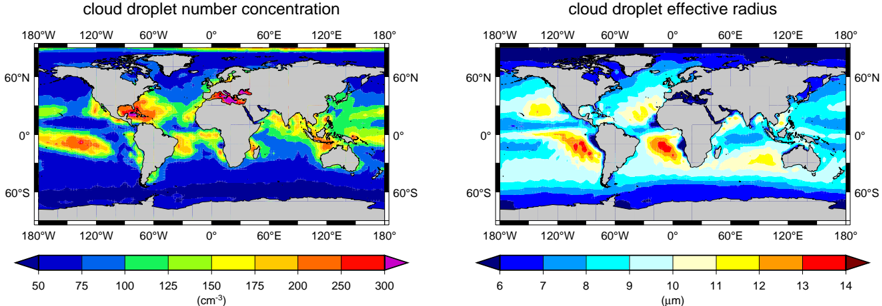
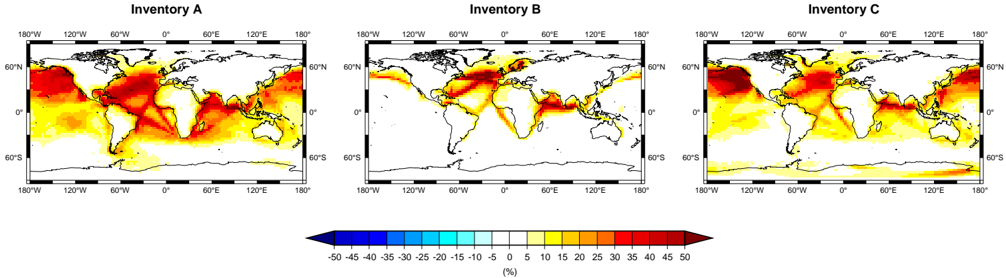
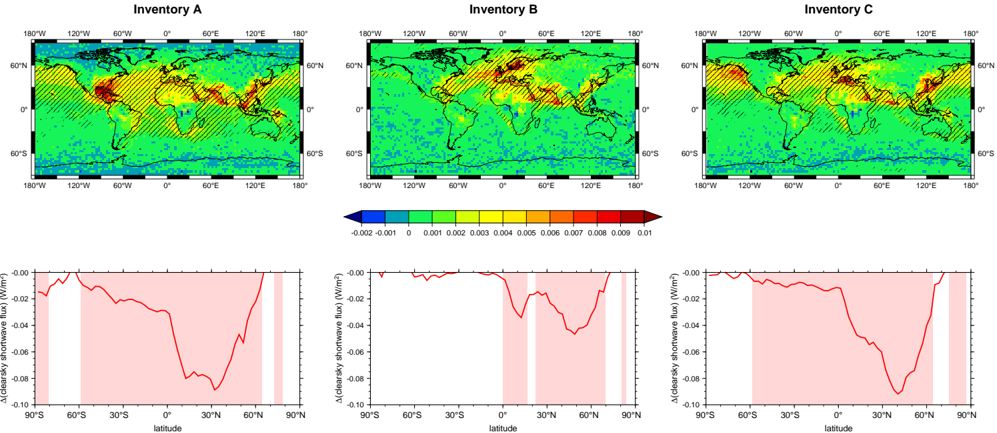
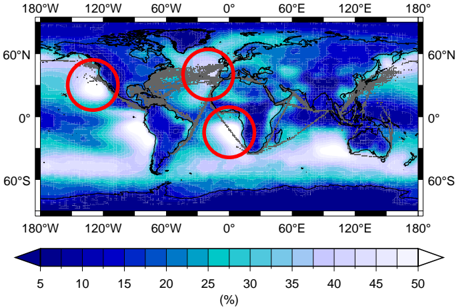
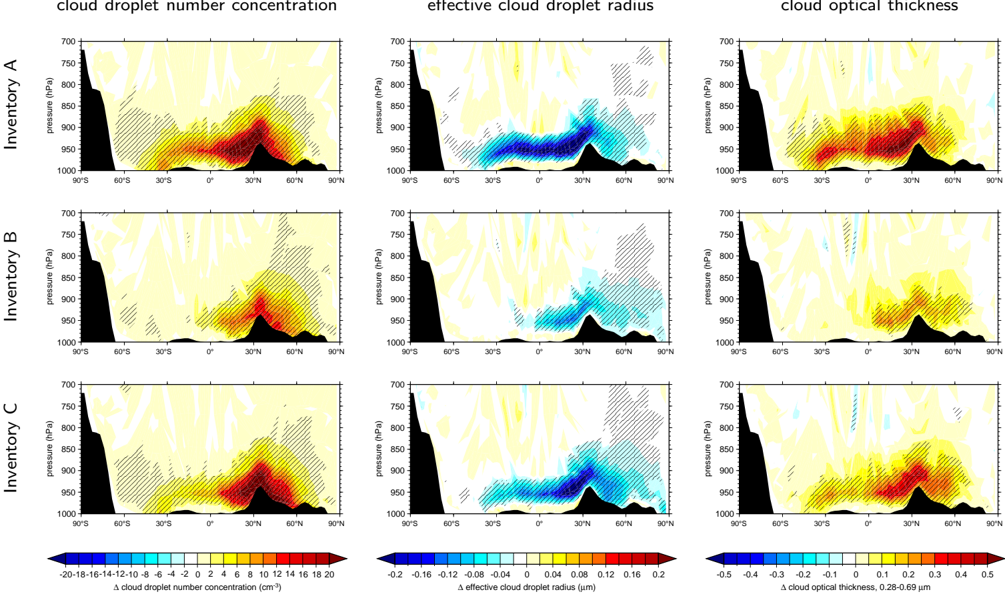
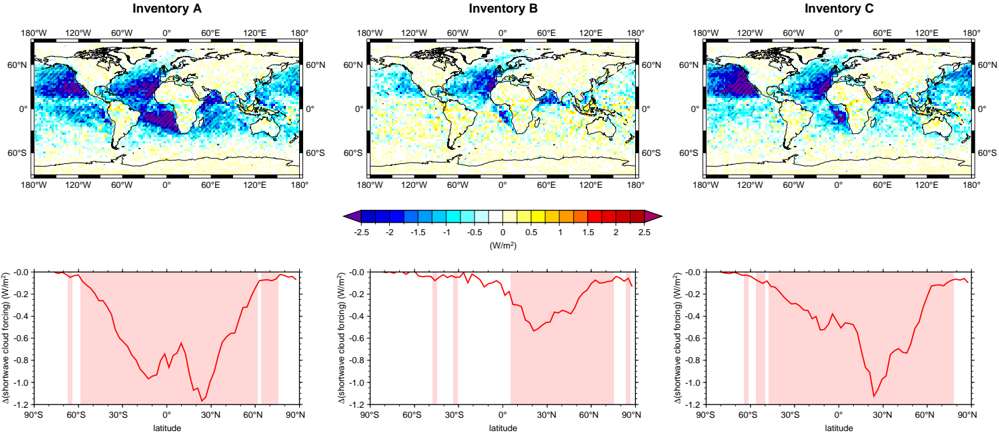
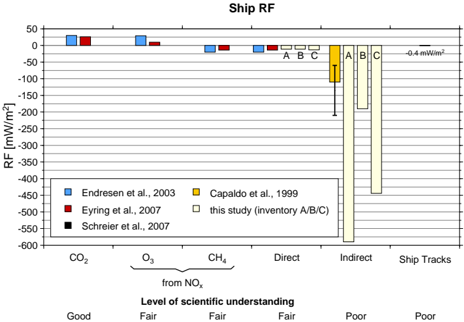
International shipping contributes significantly to the fuel consumption of all transport related activities. Specific emissions of pollutants such as sulfur dioxide (SO2) per kg of fuel emitted are higher than for road transport or aviation. Besides gaseous pollutants, ships also emit various types of particulate matter. The aerosol impacts the Earth's radiation budget directly by scattering and absorbing the solar and thermal radiation and indirectly by changing cloud properties. Here we use ECHAM5/MESSy1-MADE, a global climate model with detailed aerosol and cloud microphysics to study the climate impacts of international shipping. The simulations show that emissions from ships significantly increase the cloud droplet number concentration of low marine water clouds by up to 5% to 30% depending on the ship emission inventory and the geographic region. Whereas the cloud liquid water content remains nearly unchanged in these simulations, effective radii of cloud droplets decrease, leading to cloud optical thickness increase of up to 5–10%. The sensitivity of the results is estimated by using three different emission inventories for present-day conditions. The sensitivity analysis reveals that shipping contributes to 2.3% to 3.6% of the total sulfate burden and 0.4% to 1.4% to the total black carbon burden in the year 2000 on the global mean. In addition to changes in aerosol chemical composition, shipping increases the aerosol number concentration, e.g. up to 25% in the size range of the accumulation mode (typically >0.1 μm) over the Atlantic. The total aerosol optical thickness over the Indian Ocean, the Gulf of Mexico and the Northeastern Pacific increases by up to 8–10% depending on the emission inventory. Changes in aerosol optical thickness caused by shipping induced modification of aerosol particle number concentration and chemical composition lead to a change in the shortwave radiation budget at the top of the atmosphere (ToA) under clear-sky condition of about −0.014 W/m² to −0.038 W/m² for a global annual average. The corresponding all-sky direct aerosol forcing ranges between −0.011 W/m² and −0.013 W/m². The indirect aerosol effect of ships on climate is found to be far larger than previously estimated. An indirect radiative effect of −0.19 W/m² to −0.60 W/m² (a change in the atmospheric shortwave radiative flux at ToA) is calculated here, contributing 17% to 39% of the total indirect effect of anthropogenic aerosols. This contribution is high because ship emissions are released in regions with frequent low marine clouds in an otherwise clean environment. In addition, the potential impact of particulate matter on the radiation budget is larger over the dark ocean surface than over polluted regions over land.
Overview
The claims and statistics of this paper haven’t been checked yet.
Free: it reads the open-access text and checks the first 5 claims that cite a source we can check. Create a free account to check every claim.
Integrity signals
Registry
Cites
Statistics
Figures
Verification
Claims the paper makes
The claims and statistics of this paper haven’t been checked yet.
Free: it reads the open-access text and checks the first 5 claims that cite a source we can check. Create a free account to check every claim.
Claims other papers make about this one
Each is checked against this paper’s own text: does it say what the citing paper says it does?
The cited source says what the claim attributes to it.
In the citing paper
“Our estimate of radiative forcing from IMO2020 is well within the range of estimates of the total forcing from shipping emissions in the literature22–25.”
From Abrupt reduction in shipping emission as an inadvertent geoengineering termination shock produces substantial radiative warming (2024) · cites this paper as [23]
Self-check
Percentages, sums and reported differences re-computed from the paper’s own numbers.
The self-check needs the paper’s full text.
Citations
Cites
AERONET—A Federated Instrument Network and Data Archive for Aerosol Characterization
Holben, B. N., Eck, T. F., Slutsker, I., Tanré, D., Buis, J. P., Setzer, A., Vermote, E., Reagan, J. A., Kaufman, Y. J., Nakajima, T., et al. (1998) · Remote Sensing of Environment · doi:10.1016/s0034-4257(98)00031-5 · Cited by 7,743 · cited 7×
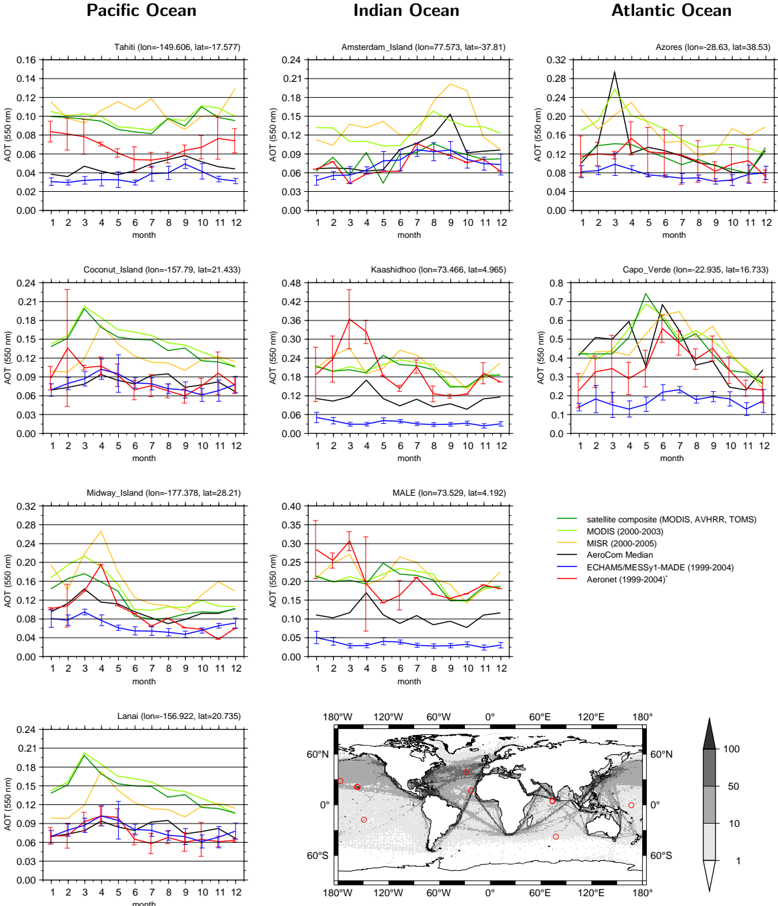
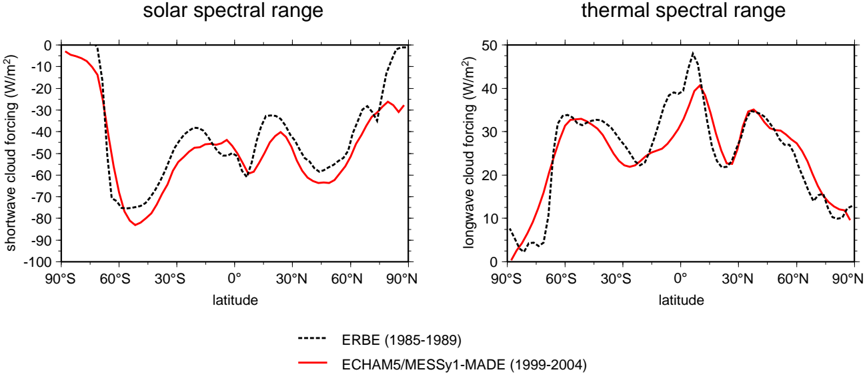
“Phys., 7, 5061–79, 2007 shown inLauer et al.(2005), the cloud forcing and aerosol optical thickness of the E5/M1-MADE simulation have been compared to ERBE (Earth Radiation Budget Experiment) satellite data (Barkstrom, 1984) and Aeronet (Holben et al., 1998) measurements showing reasonable good agreement in most parts…”
MethodInfluentialGlobal indirect aerosol effects: a review
Lohmann, U., & Feichter, J. (2005) · Atmospheric Chemistry and Physics · doi:10.5194/acp-5-715-2005 · Cited by 2,606
Self-citationGlobal indirect aerosol effects: a reviewPreprint
Lohmann, U., & Feichter, J. (2004) · doi:10.5194/acpd-4-7561-2004 · Cited by 1,861
Self-citationKaufman, Y. J., Tanré, D., Remer, L. A., Vermote, E. F., Chu, A., & Holben, B. N. (1997) · Journal of Geophysical Research: Atmospheres · doi:10.1029/96jd03988 · Cited by 1,699 · cited 1×
“For comparison, also satellite data from MODIS (2000–2003) (Kaufman et al., 1997; Tanre et al., 1997), MISR (2000–2005) (Kahn et al., 1998; Martonchik et al., 1998) and a composite of MODIS, AVHRR and TOMS data (Kinne et al., 2006) are shown, as well as the median of several global aerosol models…”
MethodAnalysis and quantification of the diversities of aerosol life cycles within AeroCom
Textor, C., Schulz, M., Guibert, S., Kinne, S., Balkanski, Y., Bauer, S., Berntsen, T., Berglen, T., Boucher, O., Chin, M., et al. (2006) · Atmospheric Chemistry and Physics · doi:10.5194/acp-6-1777-2006 · Cited by 1,272
Self-citationRoeckner, E., Brokopf, R., Esch, M., Giorgetta, M., Hagemann, S., Kornblueh, L., Manzini, E., Schlese, U., & Schulzweida, U. (2006) · Journal of Climate · doi:10.1175/jcli3824.1 · Cited by 1,183 · cited 8×
“We use the global aerosol climate model ECHAM5/MESSy1-MADE, hereafter referred to as E5/M1-MADE, that includes detailed aerosol and cloud microphysics to study the direct and indirect aerosol effects caused by international shipping.”
MethodInfluentialRemote sensing of aerosol properties over oceans using the MODIS/EOS spectral radiances
Tanré, D., Kaufman, Y. J., Herman, M., & Mattoo, S. (1997) · Journal of Geophysical Research: Atmospheres · doi:10.1029/96jd03437 · Cited by 922 · cited 2×
“For comparison, also satellite data from MODIS (2000–2003) (Kaufman et al., 1997; Tanre et al., 1997), MISR (2000–2005) (Kahn et al., 1998; Martonchik et al., 1998) and a composite of MODIS, AVHRR and TOMS data (Kinne et al., 2006) are shown, as well as the median of several global aerosol models…”
BackgroundMethodA parameterization of aerosol activation: 2. Multiple aerosol types
Abdul‐Razzak, H., & Ghan, S. J. (2000) · Journal of Geophysical Research: Atmospheres · doi:10.1029/1999jd901161 · Cited by 897 · cited 3×
“Aerosol activation is calculated following Abdul-Razzak and Ghan(2000).”
MethodInfluentialDentener, F., Kinne, S., Bond, T., Boucher, O., Cofala, J., Generoso, S., Ginoux, P., Gong, S., Hoelzemann, J. J., Ito, A., et al. (2006) · Atmospheric Chemistry and Physics · doi:10.5194/acp-6-4321-2006 · Cited by 887
The impact of humidity above stratiform clouds on indirect aerosol climate forcing
Ackerman, A. S., Kirkpatrick, M. P., Stevens, D. E., & Toon, O. B. (2004) · Nature · doi:10.1038/nature03174 · Cited by 824
Research works printed but not linked: 2
- Conover, J. H.: Anomalous Cloud Lines, J. Atmos. Sci., 23, 778- 785, 1966. · doi:10.1175/1520-0469(1966)023
- Intergovernmental Panel on Climate Change (IPCC): Climate Change 2007: The Physical Science Basis, Contribution of Working Group I to the Fourth Assessment Report of the Inter- governmental Panel on Climate Change, edited by: Solomon, S., Qin, D., Manning, M., Chen, Z., Marquis, M., Averyt, K. B., Tignor, M., and Miller, H. L., Cambridge University Press, Cam- bridge, United Kingdom and New York, NY, USA, 996 pp, 2007.
Cited by
Mortality from Ship Emissions: A Global Assessment
Corbett, J. J., Winebrake, J. J., Green, E. H., Kasibhatla, P., Eyring, V., & Lauer, A. (2007) · Environmental Science & Technology · doi:10.1021/es071686z · Cited by 1,083
“The second model, ECHAM5/MESSy1-MADE (referred to as E5/M1-MADE), is an aerosol microphysics module (MADE) coupled to a general circulation model (ECHAM5), within the framework of the Modular Earth Submodel System MESSy (23).”
MethodSelf-citationBouman, E. A., Lindstad, E., Rialland, A. I., & Strømman, A. H. (2017) · Transportation Research Part D: Transport and Environment · doi:10.1016/j.trd.2017.03.022 · Cited by 899
Development cycle 2 of the Modular Earth Submodel System (MESSy2)
Jöckel, P., Kerkweg, A., Pozzer, A., Sander, R., Tost, H., Riede, H., Baumgaertner, A., Gromov, S., & Kern, B. (2010) · Geoscientific Model Development · doi:10.5194/gmd-3-717-2010 · Cited by 551
Self-citation(2023) · Climate Change 2021 – The Physical Science Basis · doi:10.1017/9781009157896.008 · Cited by 637
Chemistry and the Linkages between Air Quality and Climate Change
von Schneidemesser, E., Monks, P. S., Allan, J. D., Bruhwiler, L., Forster, P., Fowler, D., Lauer, A., Morgan, W. T., Paasonen, P., Righi, M., et al. (2015) · Chemical Reviews · doi:10.1021/acs.chemrev.5b00089 · Cited by 522
Self-citationCleaner fuels for ships provide public health benefits with climate tradeoffs
Sofiev, M., Winebrake, J. J., Johansson, L., Carr, E. W., Prank, M., Soares, J., Vira, J., Kouznetsov, R., Jalkanen, J.-P., & Corbett, J. J. (2018) · Nature Communications · doi:10.1038/s41467-017-02774-9 · Cited by 504
Jalkanen, J.-P., Brink, A., Kalli, J., Pettersson, H., Kukkonen, J., & Stipa, T. (2009) · Atmospheric Chemistry and Physics · doi:10.5194/acp-9-9209-2009 · Cited by 502
Transport impacts on atmosphere and climate: Metrics
Fuglestvedt, J. S., Shine, K. P., Berntsen, T., Cook, J., Lee, D. S., Stenke, A., Skeie, R. B., Velders, G. J. M., & Waitz, I. A. (2010) · Atmospheric Environment · doi:10.1016/j.atmosenv.2009.04.044 · Cited by 458
“Some studies present results that are sector specific (e.g. Lauer et al., 2007 for shipping emissions and Stevenson et al., 2004 for aviation) and these results are used for calculations of sectorspecific metrics.”
BackgroundInfluentialCharacterisation of particulate matter and gaseous emissions from a large ship diesel engine
Moldanová, J., Fridell, E., Popovicheva, O., Demirdjian, B., Tishkova, V., Faccinetto, A., & Focsa, C. (2009) · Atmospheric Environment · doi:10.1016/j.atmosenv.2009.02.008 · Cited by 434
Attribution of climate forcing to economic sectors
Unger, N., Bond, T. C., Wang, J. S., Koch, D. M., Menon, S., Shindell, D. T., & Bauer, S. (2010) · Proceedings of the National Academy of Sciences · doi:10.1073/pnas.0906548107 · Cited by 284
“A detailed breakdown of the SLS and AIE RFs is given in Table S2.”
ResultInfluentialDalsøren, S. B., Eide, M. S., Endresen, Ø., Mjelde, A., Gravir, G., & Isaksen, I. S. A. (2009) · Atmospheric Chemistry and Physics · doi:10.5194/acp-9-2171-2009 · Cited by 271
“Fewer model studies have been performed on other aerosols (Black carbon (soot), organic carbon, etc) than sulphate (Lauer et al., 2007; Dalsøren et al., 2007).”
BackgroundParticulate emissions from commercial shipping: Chemical, physical, and optical properties
Lack, D. A., Corbett, J. J., Onasch, T., Lerner, B., Massoli, P., Quinn, P. K., Bates, T. S., Covert, D. S., Coffman, D., Sierau, B., et al. (2009) · Journal of Geophysical Research: Atmospheres · doi:10.1029/2008jd011300 · Cited by 220
“Although this relationship is expected, assessments of the cloud nucleating ability of shipping emissions are very limited which contributes to the large uncertainty reported for the radiative forcing from ships [Capaldo et al., 1999; Lauer et al., 2007; Schreier et al., 2007].”
BackgroundWinebrake, J. J., Corbett, J. J., Green, E. H., Lauer, A., & Eyring, V. (2009) · Environmental Science & Technology · doi:10.1021/es803224q · Cited by 216
Self-citationImproving Spatial Representation of Global Ship Emissions Inventories
Wang, C., Corbett, J. J., & Firestone, J. (2008) · Environmental Science & Technology · doi:10.1021/es0700799 · Cited by 208
Murphy, S. M., Agrawal, H., Sorooshian, A., Padró, L. T., Gates, H., Hersey, S., Welch, W. A., Jung, H., Miller, J. W., Cocker, D. R., et al. (2009) · Environmental Science & Technology · doi:10.1021/es802413j · Cited by 200
Lightning enhancement over major oceanic shipping lanes
Thornton, J. A., Virts, K. S., Holzworth, R. H., & Mitchell, T. P. (2017) · Geophysical Research Letters · doi:10.1002/2017gl074982 · Cited by 188
Emissions and health impacts from global shipping embodied in US–China bilateral trade
Liu, H., Meng, Z.-H., Lv, Z.-F., Wang, X.-T., Deng, F.-Y., Liu, Y., Zhang, Y.-N., Shi, M.-S., Zhang, Q., & He, K.-B. (2019) · Nature Sustainability · doi:10.1038/s41893-019-0414-z · Cited by 173
Liu, Z., Lu, X., Feng, J., Fan, Q., Zhang, Y., & Yang, X. (2017) · Environmental Science & Technology · doi:10.1021/acs.est.6b03834 · Cited by 170
Moldanová, J., Fridell, E., Winnes, H., Holmin-Fridell, S., Boman, J., Jedynska, A., Tishkova, V., Demirdjian, B., Joulie, S., Bladt, H., et al. (2013) · Atmospheric Measurement Techniques · doi:10.5194/amt-6-3577-2013 · Cited by 168
AOD trends during 2001–2010 from observations and model simulations
Pozzer, A., de Meij, A., Yoon, J., Tost, H., Georgoulias, A. K., & Astitha, M. (2015) · Atmospheric Chemistry and Physics · doi:10.5194/acp-15-5521-2015 · Cited by 167
Becagli, S., Sferlazzo, D. M., Pace, G., di Sarra, A., Bommarito, C., Calzolai, G., Ghedini, C., Lucarelli, F., Meloni, D., Monteleone, F., et al. (2012) · Atmospheric Chemistry and Physics · doi:10.5194/acp-12-3479-2012 · Cited by 162
Comparative assessment of alternative marine fuels in life cycle perspective
Bilgili, L. (2021) · Renewable and Sustainable Energy Reviews · doi:10.1016/j.rser.2021.110985 · Cited by 181
Substantial Cloud Brightening From Shipping in Subtropical Low Clouds
Diamond, M. S., Director, H. M., Eastman, R., Possner, A., & Wood, R. (2020) · AGU Advances · doi:10.1029/2019av000111 · Cited by 151
“Whereas observations show a small or unclear impact of shipping on global ACI, climate 113 models (Capaldo et al., 1999; Lauer et al., 2007; Partanen et al., 2013; Peters et al., 2014; Righi 114 et al., 2011; Sofiev et al., 2018) have produced substantial radiative forcings (energy imbalances) 115 ranging from -0.”
BackgroundPrimary particles in ship emissions
Fridell, E., Steen, E., & Peterson, K. (2007) · Atmospheric Environment · doi:10.1016/j.atmosenv.2007.10.042 · Cited by 144
“It is also becoming clear that emitted particles have a strong influence on climate both due to direct effects on the radiative balance and through increased cloud formation (Lauer et al., 2007).”
BackgroundShipping contributes to ocean acidification
Hassellöv, I., Turner, D. R., Lauer, A., & Corbett, J. J. (2013) · Geophysical Research Letters · doi:10.1002/grl.50521 · Cited by 141
Self-citationShipping Emissions: From Cooling to Warming of Climate—and Reducing Impacts on Health
Fuglestvedt, J., Berntsen, T., Eyring, V., Isaksen, I., Lee, D. S., & Sausen, R. (2009) · Environmental Science & Technology · doi:10.1021/es901944r · Cited by 138
Self-citationOpportunistic experiments to constrain aerosol effective radiative forcing
Christensen, M. W., Gettelman, A., Cermak, J., Dagan, G., Diamond, M., Douglas, A., Feingold, G., Glassmeier, F., Goren, T., Grosvenor, D. P., et al. (2022) · Atmospheric Chemistry and Physics · doi:10.5194/acp-22-641-2022 · Cited by 138
Pozzer, A., de Meij, A., Pringle, K. J., Tost, H., Doering, U. M., van Aardenne, J., & Lelieveld, J. (2012) · Atmospheric Chemistry and Physics · doi:10.5194/acp-12-961-2012 · Cited by 133
Emission factors for gaseous and particulate pollutants from offshore diesel engine vessels in China
Zhang, F., Chen, Y., Tian, C., Lou, D., Li, J., Zhang, G., & Matthias, V. (2016) · Atmospheric chemistry and physics · doi:10.5194/acp-16-6319-2016 · Cited by 143
Particle Emissions from Ships: Dependence on Fuel Type
Winnes, H., & Fridell, E. (2009) · Journal of the Air & Waste Management Association · doi:10.3155/1047-3289.59.12.1391 · Cited by 130
A new radiation infrastructure for the Modular Earth Submodel System (MESSy, based on version 2.51)
Dietmüller, S., Jöckel, P., Tost, H., Kunze, M., Gellhorn, C., Brinkop, S., Frömming, C., Ponater, M., Steil, B., Lauer, A., et al. (2016) · Geoscientific Model Development · doi:10.5194/gmd-9-2209-2016 · Cited by 130
“CC-BY 3.0 License. the dynamical aerosol models MADE (Lauer et al., 2007), MADE3 (Kaiser et al., 2014), M7 (Vignati et al., 2004), GMXE (Pringle et al., 2010), or from external data via IMPORT.”
MethodInfluentialSelf-citationParticulate matter in marine diesel engines exhausts: Emissions and control strategies
Natale, F. D., & Carotenuto, C. (2015) · Transportation Research Part D Transport and Environment · doi:10.1016/j.trd.2015.08.011 · Cited by 147
Corbin, J. C., Pieber, S. M., Czech, H., Zanatta, M., Jakobi, G., Massabò, D., Orasche, J., Haddad, I. E., Mensah, A. A., Stengel, B., et al. (2018) · Journal of Geophysical Research Atmospheres · doi:10.1029/2017jd027818 · Cited by 129
The Green Ship Routing and Scheduling Problem (GSRSP): A conceptual approach
Kontovas, C. A. (2014) · Transportation Research Part D Transport and Environment · doi:10.1016/j.trd.2014.05.014 · Cited by 125
“Although this is not an easy task, there are some studies (e.g. Fuglestvedt et al., 2010; Lauer et al., 2007) which can be used to determine the weights needed to aggregate the effects of various gases in the shipping sector.”
Constraints on ship NO x emissions in Europe using GEOS-Chem and OMI satellite NO 2 observations
Vinken, G. C. M., Boersma, K. F., van Donkelaar, A., & Zhang, L. (2014) · Atmospheric chemistry and physics · doi:10.5194/acp-14-1353-2014 · Cited by 115
“Aerosols originating from ships can also have an indirect (negative) effect on radiative forcing by altering the properties of clouds (e.g. Schreier et al., 2007; Lauer et al., 2007).”
Economic savings linked to future Arctic shipping trade are at odds with climate change mitigation
Lindstad, H., Bright, R. M., & Strømman, A. H. (2016) · Transport Policy · doi:10.1016/j.tranpol.2015.09.002 · Cited by 107
Wood, R. (2021) · Atmospheric Chemistry and Physics · doi:10.5194/acp-21-14507-2021 · Cited by 104
Studying geoengineering with natural and anthropogenic analogs
Robock, A., MacMartin, D. G., Duren, R., & Christensen, M. W. (2013) · Climatic Change · doi:10.1007/s10584-013-0777-5 · Cited by 103
“General circulation model simulations (Capaldo et al. 1999; Lauer et al. 2007) indicate that the radiative effect from shipping could be as large as 40 % of the total aerosol indirect forcing due to all anthropogenic activities.”
BackgroundAstitha, M., Lelieveld, J., Abdelkader, M., Pozzer, A., & de Meij, A. (2012) · Atmospheric chemistry and physics · doi:10.5194/acp-12-11057-2012 · Cited by 122
Lindstad, E., & Eskeland, G. S. (2016) · Transportation Research Part D Transport and Environment · doi:10.1016/j.trd.2016.05.004 · Cited by 117
Ultrafine particles pollution in urban coastal air due to ship emissions
González, Y., Rodríguez, S., Guerra, J. C., Trujillo, J. L., & García, R. D. (2011) · Atmospheric Environment · doi:10.1016/j.atmosenv.2011.06.002 · Cited by 116
An introduction to clouds from the microscale to climate
Lohmann, U., Lüönd, F., & Mahrt, F. (2016) · Cited by 122
Self-citationPresent-Day and Future Global Bottom-Up Ship Emission Inventories Including Polar Routes
Paxian, A., Eyring, V., Beer, W., Sausen, R., & Wright, C. (2010) · Environmental Science & Technology · doi:10.1021/es9022859 · Cited by 96
Self-citationRighi, M., Hendricks, J., & Sausen, R. (2013) · Atmospheric chemistry and physics · doi:10.5194/acp-13-9939-2013 · Cited by 96
Self-citationMarelle, L., Thomas, J. L., Raut, J.-C., Law, K. S., Jalkanen, J.-P., Johansson, L., Roiger, A., Schlager, H., Kim, J., Reiter, A., et al. (2016) · Atmospheric Chemistry and Physics · doi:10.5194/acp-16-2359-2016 · Cited by 92
Maritime shipping and emissions: A three-layered, damage-based approach
Lindstad, E., Eskeland, G. S., Psaraftis, H. N., Sandaas, I., & Strømman, A. H. (2015) · Ocean Engineering · doi:10.1016/j.oceaneng.2015.09.029 · Cited by 108
Global temperature change from the transport sectors: Historical development and future scenarios
Skeie, R. B., Fuglestvedt, J. S., Berntsen, T. K., Lund, M. T., Myhre, G., & Rypdal, K. (2009) · Atmospheric Environment · doi:10.1016/j.atmosenv.2009.05.025 · Cited by 101
ORACLE (v1.0): module to simulate the organic aerosol composition and evolution in the atmosphere
Tsimpidi, A. P., Karydis, V. A., Pozzer, A., Pandis, S. Ν., & Lelieveld, J. (2014) · Geoscientific model development · doi:10.5194/gmd-7-3153-2014 · Cited by 104
“The optical properties of aerosols (optical thickness, single-scattering albedo, asymmetry factor) are calculated within the AEROPT sub- model (Lauer et al., 2007) based on pre-calculated look-up tables from Mie theory.”
MethodPetzold, A., Lauer, P., Fritsche, U. R., Hasselbach, J., Lichtenstern, M., Schlager, H., & Fleischer, F. (2011) · Environmental Science & Technology · doi:10.1021/es2021439 · Cited by 100
An AIS-based approach to calculate atmospheric emissions from the UK fishing fleet
Coello, J., Williams, I. D., Hudson, D. A., & Kemp, S. (2015) · Atmospheric Environment · doi:10.1016/j.atmosenv.2015.05.011 · Cited by 86
Global temperature responses to current emissions from the transport sectors
Berntsen, T., & Fuglestvedt, J. (2008) · Proceedings of the National Academy of Sciences · doi:10.1073/pnas.0804844105 · Cited by 84
“A recent study (23) indicates that the RF due to indirect cloud effects (both first and second indirect effects) after SO2 emissions from shipping may be substantially higher than the values used in ref.”
BackgroundKattner, L., Mathieu-Üffing, B., Burrows, J. P., Richter, A., Schmolke, S., Seyler, A., & Wittrock, F. (2015) · Atmospheric chemistry and physics · doi:10.5194/acp-15-10087-2015 · Cited by 83
“When oxidised, SO2 forms small sulfate particles, which have an effect on cloud properties and change their reflectivity and lifetime (Lauer et al., 2007).”
BackgroundZhang, F., Chen, Y., Chen, Q., Feng, Y., Shang, Y., Yang, X., Gao, H., Tian, C., Li, J., Zhang, G., et al. (2018) · Environmental Science & Technology · doi:10.1021/acs.est.7b04002 · Cited by 88
Direct radiative effect of aerosols emitted by transport: from road, shipping and aviation
Balkanski, Y., Myhre, G., Gauss, M., Rädel, G., Highwood, E. J., & Shine, K. P. (2010) · Atmospheric Chemistry and Physics · doi:10.5194/acp-10-4477-2010 · Cited by 78
“Lauer et al. (2007) assessed the effect of international ship-ping on aerosols and clouds.”
Yuan, T., Song, H., Oreopoulos, L., Wood, R., Bian, H., Breen, K., Chin, M., Yu, H., Barahona, D., Meyer, K., et al. (2024) · Communications Earth & Environment · doi:10.1038/s43247-024-01442-3 · Cited by 79
Tsimpidi, A. P., Karydis, V. A., Pandis, S. Ν., & Lelieveld, J. (2016) · Atmospheric chemistry and physics · doi:10.5194/acp-16-8939-2016 · Cited by 86
Global reduction in ship-tracks from sulfur regulations for shipping fuel
Yuan, T., Song, H., Wood, R., Wang, C., Oreopoulos, L., Platnick, S. E., von Hippel, S., Meyer, K., Light, S., & Wilcox, E. (2022) · Science Advances · doi:10.1126/sciadv.abn7988 · Cited by 76
Has Reducing Ship Emissions Brought Forward Global Warming?
Gettelman, A., Christensen, M. W., Diamond, M., Gryspeerdt, E., Manshausen, P., Stier, P., Watson‐Parris, D., Yang, M., Yoshioka, M., & Yuan, T. (2024) · Geophysical Research Letters · doi:10.1029/2024gl109077 · Cited by 104
“Studies estimate the global average change in radiative forcing due to all shipping in the range of − 0.06 to 0.6 Wm 2 (Yuan et al., 2022), or 10%–40% of the total aerosol cooling effect (Lauer et al., 2007).”
InfluentialConstraining the ship contribution to the aerosol of the central Mediterranean
Becagli, S., Anello, F., Bommarito, C., Cassola, F., Calzolai, G., Iorio, T. D., di Sarra, A. G., Gómez-Amo, J.-L., Lucarelli, F., Marconi, M., et al. (2017) · Atmospheric chemistry and physics · doi:10.5194/acp-17-2067-2017 · Cited by 82
“…CO, hydrocarbons, particles (Lloyd’s Register Engineering Services, 1995; Corbett et al., 2007) and solar radiation budget through aerosol direct and indirect effects such as black carbon and sulfur containing particles (Devasthale et al., 2006; Lauer et al., 2007; Coakley Jr. and Walsh, 2002).”
Simple emission metrics for climate impacts
Aamaas, B., Peters, G. P., & Fuglestvedt, J. S. (2013) · Earth System Dynamics · doi:10.5194/esd-4-145-2013 · Cited by 74
Diamond, M. S. (2023) · Atmospheric Chemistry and Physics · doi:10.5194/acp-23-8259-2023 · Cited by 72
“The strongest shipping effect in Lauer et al. (2007) represented 40% of their global ACI; a 70% reduction from that fraction would represent a forcing of 0.2 ± 0.1 W m -2 based on the currently assessed IRF ACI value of 0.7 ± 0.5 W m -2 , or 0.3 ± 0.2 W m -2 including adjustments (Forster et al.,…”
BackgroundMethodInfluentialAquila, V., Hendricks, J., Lauer, A., Riemer, N., Vogel, H., Baumgardner, D., Minikin, A., Petzold, A., Schwarz, J. P., Spackman, J. R., et al. (2011) · Geoscientific Model Development · doi:10.5194/gmd-4-325-2011 · Cited by 71
Self-citationPhysical science research needed to evaluate the viability and risks of marine cloud brightening
Feingold, G., Ghate, V. P., Russell, L. M., Blossey, P., Cantrell, W., Christensen, M. W., Diamond, M. S., Gettelman, A., Glassmeier, F., Gryspeerdt, E., et al. (2024) · Science Advances · doi:10.1126/sciadv.adi8594 · Cited by 69
Short-lived climate forcers from current shipping and petroleum activities in the Arctic
Ødemark, K., Dalsøren, S. B., Samset, B. H., Berntsen, T. K., Fuglestvedt, J. S., & Myhre, G. (2012) · Atmospheric Chemistry and Physics · doi:10.5194/acp-12-1979-2012 · Cited by 66
Marmer, E., Dentener, F. J., van Aardenne, J., Cavalli, F., Vignati, E., Velchev, K., Hjorth, J., Boersma, K. F., Vinken, G. C. M., Mihalopoulos, N., et al. (2009) · Atmospheric chemistry and physics · doi:10.5194/acp-9-6815-2009 · Cited by 74
Possner, A., Wang, H., Wood, R., Caldeira, K., & Ackerman, T. P. (2018) · Atmospheric Chemistry and Physics · doi:10.5194/acp-18-17475-2018 · Cited by 63
“07 Wm−2 (Lauer et al., 2007; Righi et al., 2011; Peters et al., 2012; Partanen et al., 2013) due to open-ocean shipping.”
InfluentialThe MESSy aerosol submodel MADE3 (v2.0b): description and a box model test
Kaiser, C., Hendricks, J., Righi, M., Riemer, N., Zaveri, R. A., Metzger, S., & Aquila, V. (2014) · Geoscientific model development · doi:10.5194/gmd-7-1137-2014 · Cited by 81
“We use MADE for comparison because previous studies on the shipping effect were carried out with this submodel (Lauer et al., 2007, 2009; Righi et al., 2011, 2013).”
InfluentialSelf-citationShip particulate pollutants: Characterization in terms of environmental implication
Popovicheva, O. B., Kireeva, Е., Shonija, N. K., Zubareva, N. A., Persiantseva, N. M., Tishkova, V., Demirdjian, B., Moldanová, J., & Mogil’nikov, V. P. (2009) · Journal of Environmental Monitoring · doi:10.1039/b908180a · Cited by 70
Zhang, Y., Deng, F., Man, H., Fu, M., Lv, Z., Xiao, Q., Jin, X., Liu, S., He, K., & Liu, H. (2019) · Atmospheric chemistry and physics · doi:10.5194/acp-19-4899-2019 · Cited by 63
“…(Eyring et al., 2005, 2010; Endresen et al., 2003; Fridell et al., 2008; Jalkanen et al., 2009; Liu et al., 2016; Viana et al., 2014), climate (Lauer et al., 2007; Tronstad Lund et al., 2012; Liu Published by Copernicus Publications on behalf of the European Geosciences Union. et al., 2016)…”
BackgroundMonitoring shipping emissions in the German Bight using MAX-DOAS measurements
Seyler, A., Wittrock, F., Kattner, L., Mathieu-Üffing, B., Peters, E., Richter, A., Schmolke, S., & Burrows, J. P. (2017) · Atmospheric chemistry and physics · doi:10.5194/acp-17-10997-2017 · Cited by 63
Chen, D., Tian, X., Lang, J., Zhou, Y. C., Li, Y., Guo, X., Wang, W., & Liu, B. (2018) · The Science of The Total Environment · doi:10.1016/j.scitotenv.2018.08.313 · Cited by 63
Lauer, A., Eyring, V., Corbett, J. J., Wang, C., & Winebrake, J. J. (2009) · Environmental Science & Technology · doi:10.1021/es900922h · Cited by 59
Self-citationSpecific Climate Impact of Passenger and Freight Transport
Borken, J., Berntsen, T. K., & Fuglestvedt, J. S. (2010) · Environmental Science & Technology · doi:10.1021/es9039693 · Cited by 68
Boris, A. J., Lee, T., Park, T., Choi, J., Seo, S. J., & Collett, J. L. (2016) · Atmospheric chemistry and physics · doi:10.5194/acp-16-437-2016 · Cited by 57
Wen, J., Wang, X., Zhang, Y., Zhu, H., Chen, Q., Tian, Y., Shi, X., Shi, G., & Feng, Y. (2018) · Atmospheric Environment · doi:10.1016/j.atmosenv.2018.07.038 · Cited by 57
Cheng, Y., Wang, S., Zhu, J., Guo, Y., Zhang, R., Liu, Y., Zhang, Y., Qi, Y., Ma, W., & Zhou, B. (2019) · Atmospheric chemistry and physics · doi:10.5194/acp-19-13611-2019 · Cited by 57
“CO2 and NO are the main pollutants emitted by ships, and NO is rapidly converted to NO2 by reaction with O3 (Eyring et al., 2005; Becagli et al., 2012; Coggon et al., 2012; Diesch et al., 2013; Lauer et al., 2007; Seyler et al., 2017).”
BackgroundAfrican biomass burning affects aerosol cycling over the Amazon
Holanda, B. A., Franco, M. A., Walter, D., Artaxo, P. E., Carbone, S., Cheng, Y., Chowdhury, S., Ditas, F., Beer, M. G., Klimach, T., et al. (2023) · Communications Earth & Environment · doi:10.1038/s43247-023-00795-5 · Cited by 71
Climate Impact of Biofuels in Shipping: Global Model Studies of the Aerosol Indirect Effect
Righi, M., Klinger, C., Eyring, V., Hendricks, J., Lauer, A., & Petzold, A. (2011) · Environmental Science & Technology · doi:10.1021/es1036157 · Cited by 56
Self-citationAndersson, K., Baldi, F., Brynolf, S., Lindgren, J. F., Granhag, L. M., & SVENSSON, E. I. (2016) · Springer eBooks · doi:10.1007/978-3-662-49045-7_1 · Cited by 58
Modeling the evolution of aerosol particles in a ship plume using PartMC-MOSAIC
Tian, J., Riemer, N., West, M., Pfaffenberger, L., Schlager, H., & Petzold, A. (2014) · Atmospheric chemistry and physics · doi:10.5194/acp-14-5327-2014 · Cited by 64
Alternative fuel for sustainable shipping across the Taiwan Strait
Hua, J., Wu, Y.-H., & Chen, H.-L. (2017) · Transportation Research Part D Transport and Environment · doi:10.1016/j.trd.2017.03.015 · Cited by 60
Pozzer, A., Reifenberg, S. F., Kumar, V., Franco, B., Kohl, M., Taraborrelli, D., Gromov, S., Ehrhart, S., Jöckel, P., Sander, R., et al. (2022) · Geoscientific model development · doi:10.5194/gmd-15-2673-2022 · Cited by 66
Self-citationKerkweg, A., & Jöckel, P. (2012) · Geoscientific model development · doi:10.5194/gmd-5-87-2012 · Cited by 63
Self-citationGreenhouse Gas Emissions from Aviation and Marine Transportation: Mitigation Potential and PoliciesPreprint
McCollum, D. L., Gould, G., & Greene, D. L. (2010) · RePEc: Research Papers in Economics · Cited by 76
Shipping emissions in the Iberian Peninsula and the impacts on air quality
Nunes, R. A. O., Alvim-Ferraz, M. C. M., Martins, F. G., Calderay-Cayetano, F., Durán-Grados, V., Moreno-Gutiérrez, J., Jalkanen, J.-P., Hannuniemi, H., & Sousa, S. I. V. (2020) · Atmospheric chemistry and physics · doi:10.5194/acp-20-9473-2020 · Cited by 64
“, 2019) and applying air quality models (AQMs) at local, regional, and global levels (Abrutytė et al., 2014; Aksoyoglu et al., 2016; Aulinger et al., 2016; Barregard et al., 2019; Chen et al., 2017, 2018; EEA, 2013; Eyring et al., 2007; Lauer et al., 2007; Liu et al., 2017; Marelle et al., 2016; Marmer and Langmann, 2…”
Prank, M., Sofiev, M. A., Tsyro, S. G., Hendriks, C., Semeena, V. S., Francis, X., Butler, T. M., van der Gon, H. D., Friedrich, R., Hendricks, J., et al. (2016) · Atmospheric chemistry and physics · doi:10.5194/acp-16-6041-2016 · Cited by 61
“Aerosol microphysics is simulated with the sub-model MADE (Lauer et al., 2005, 2007), which describes the aerosol 25 population by means of three log-normal size modes, taking into account nucleation of new particles, condensation of sulphuric acid vapour and condensable organic compounds, and…”
MethodInfluentialSelf-citationGlobal aerosol modeling with MADE3 (v3.0) in EMAC (based on v2.53): model description and evaluation
Kaiser, C., Hendricks, J., Righi, M., Jöckel, P., Tost, H., Kandler, K., Weinzierl, B., Sauer, D. N., Heimerl, K., Schwarz, J. P., et al. (2019) · Geoscientific model development · doi:10.5194/gmd-12-541-2019 · Cited by 66
“that sulfate formed from ship emissions may be one of the major contributors to the negative anthropogenic aerosol radiative forcing (Capaldo et al., 1999; Lauer et al., 2007; Lauer et al., 2009; Righi et al., 2011, 2013; Olivié et al., 2012; Peters et al., 2012, 2013).”
BackgroundMethodInfluentialSelf-citationDirect radiative effect of dust–pollution interactions
Klingmüller, K., Lelieveld, J., Karydis, V. A., & Stenchikov, G. L. (2019) · Atmospheric chemistry and physics · doi:10.5194/acp-19-7397-2019 · Cited by 58
“Aerosol optical properties are calculated by the AEROPT (AERosol OPTical properties) submodel (Lauer et al., 2007; Pozzer et al., 2012; Klingmüller et al., 2014), which assumes the aerosol components within each mode to be wellmixed in spherical particles with a volume-averaged refractive index.”
MethodWu, D., Ding, X., Li, Q. X., Sun, J., Huang, C. Y., Yao, L., Wang, X., Ye, X., Chen, Y., He, H., et al. (2019) · Journal of Cleaner Production · doi:10.1016/j.jclepro.2019.117862 · Cited by 50
Tsimpidi, A. P., Karydis, V. A., Pozzer, A., Pandis, S. Ν., & Lelieveld, J. (2018) · Geoscientific model development · doi:10.5194/gmd-11-3369-2018 · Cited by 59
“…(ONLEM and OFFLEM; Kerkweg et al., 2006b), dry deposition and sedimentation (DRYDEP and SEDI; Kerkweg et al., 2006a), cloud scavenging (SCAV; Tost et al., 2006), cloud microphysics (CLOUD; Jöckel et al., 2006; Bacer et al., 2018), and aerosol optical properties (AEROPT; Lauer et al., 2007).”
Peters, K., Quaas, J., & Graßl, H. (2011) · Journal of Geophysical Research: Atmospheres · doi:10.1029/2011jd016531 · Cited by 47
“These utilize general circulation models (GCMs) to quantify the effect of shipping emissions on clouds on a global scale [Capaldo et al., 1999; Lauer et al., 2007, 2009].”
Methodde Meij, A., Pozzer, A., Pringle, K. J., Tost, H., & Lelieveld, J. (2012) · Atmospheric Research · doi:10.1016/j.atmosres.2012.05.014 · Cited by 48
Fitzgerald, W. B., Howitt, O. J. A., & Smith, I. J. (2011) · Energy Policy · doi:10.1016/j.enpol.2010.12.026 · Cited by 46
“Lauer et al. (2007) calculated a global annual average decrease in shortwave radiative flux at the top of the atmosphere of between 0.19 W/m 2 and 0.60 W/m 2 due to the indirect effects of shipping emissions.”
BackgroundInfluentialWyant, M. C., Bretherton, C. S., Wood, R., Carmichael, G. R., Clarke, A. D., Fast, J. D., George, R. C., Gustafson, W. I., Hannay, C., Lauer, A., et al. (2015) · Atmospheric chemistry and physics · doi:10.5194/acp-15-153-2015 · Cited by 53
“Monthly mean aerosol concentrations are prescribed for these simulations based on global model simulations of aerosol mass (see Lauer et al., 2007) and observed aerosol size distributions (see McNaughton, 2008).”
MethodSelf-citationApproaches to Observe Anthropogenic Aerosol-Cloud Interactions
Quaas, J. (2015) · Current Climate Change Reports · doi:10.1007/s40641-015-0028-0 · Cited by 48
Krüger, O. O., Holanda, B. A., Chowdhury, S., Pozzer, A., Walter, D., Pöhlker, C., Hernández, M. D. A., Burrows, J. P., Voigt, C., Lelieveld, J., et al. (2022) · Atmospheric chemistry and physics · doi:10.5194/acp-22-8683-2022 · Cited by 46
Global-scale combustion sources of organic aerosols: sensitivity to formation and removal mechanisms
Tsimpidi, A. P., Karydis, V. A., Pandis, S. Ν., & Lelieveld, J. (2017) · Atmospheric chemistry and physics · doi:10.5194/acp-17-7345-2017 · Cited by 43
“, 2006), aerosol optical properties (AEROPT; Lauer et al., 2007), dry deposition and sedimentation (DRYDEP and SEDI; Kerkweg et al.”
BackgroundSensitivity of transatlantic dust transport to chemical aging and related atmospheric processes
Abdelkader, M., Metzger, S., Steil, B., Klingmüller, K., Tost, H., Pozzer, A., Stenchikov, G. L., Barrie, L. A., & Lelieveld, J. (2017) · Atmospheric chemistry and physics · doi:10.5194/acp-17-3799-2017 · Cited by 47
Jin, Q., Grandey, B. S., Rothenberg, D., Avramov, A., & Wang, C. (2018) · Atmospheric chemistry and physics · doi:10.5194/acp-18-16793-2018 · Cited by 48
“…at TOA has large uncertainties due to the complication in simulating clouds and aerosol–cloud interactions, ranging from − 0.60 to − 0.07 W m − 2 (Capaldo et al., 1999; Lauer et al., 2007; Eyring et al., 2010; Righi et al., 2011; Peters et al., 2012; Partanen et al., 2013; Peters et al., 2013).”
BackgroundInfluentialYu, C., Pasternak, D., Lee, J. D., Yang, M., Bell, T. G., Bower, K. N., Wu, H., Liu, D., Reed, C., Bauguitte, S. J.-B., et al. (2020) · Environmental Science & Technology · doi:10.1021/acs.est.0c04039 · Cited by 48
Metadata
- Authors
- Lauer, A., Eyring, V., Hendricks, J., Jöckel, P., & Lohmann, U.
- Affiliations
- Deutsches Zentrum für Luft- und Raumfahrt e. V. (DLR) (DE)
- Max Planck Institute for Chemistry (DE)
- Institute for Atmospheric and Climate Science (CH)
- Venue
- Atmospheric Chemistry and Physics
- Publisher
- Copernicus GmbH
- Published
- 2007-10-04
- Volume
- 7
- Issue
- 19
- Pages
- 5061-5079
- ISSN
- 1680-7316 (ISSN-L)
- 1680-7324
- OpenAlex
- W2093456659
- Cited by
- 234
- References
- 53
- Citations by year
- 2026: 3 · 2025: 10 · 2024: 11 · 2023: 18 · 2022: 14 · 2021: 22 · 2020: 12 · 2019: 10 · 2018: 13 · 2017: 11 · 2016: 14 · 2015: 11 · 2014: 9 · 2013: 12 · 2012: 11
- FWCI
- 16.73
- Type
- journal article
- Language
- en
- Open access
- gold
- doi.org
- Licence
- Locations
- Atmospheric chemistry and physics (publishedVersion, cc-by-nc-sa)
- Repository for Publications and Research Data (ETH Zurich) (publishedVersion, cc-by-nc-sa)
- elib (German Aerospace Center) (acceptedVersion)
- HAL (submittedVersion, other-oa)
- DOAJ (DOAJ: Directory of Open Access Journals) (submittedVersion)
- Max Planck Institute for Plasma Physics (submittedVersion)
- MPG.PuRe (Max Planck Society) (submittedVersion)
- ETH Zürich Research Collection
- Funders
- Universität zu Köln
- European Centre for Medium-Range Weather Forecasts
- Topics
- Physical Sciences › Environmental Science › Environmental Engineering › Maritime Transport Emissions and Efficiency
- Physical Sciences › Environmental Science › Global and Planetary Change › Atmospheric aerosols and clouds
- Physical Sciences › Earth and Planetary Sciences › Atmospheric Science › Atmospheric chemistry and aerosols
- Keywords
- ship emissions, marine aerosols, aerosol indirect effect, cloud droplet number concentration, cloud optical thickness, aerosol optical depth, shortwave radiation budget, top-of-atmosphere radiation, aerosol radiative forcing, sulfur dioxide emissions, black carbon, sulfate aerosols, emission inventory, cloud microphysics, aerosol number concentration
About these checks
Registry, retraction, Cites and statistics results are computed, not judged, with one exception: a printed reference that no index lists is read once by a model before it counts as a citation error. Claims are extracted by a model and kept only when their quote appears verbatim in the text; each cited source is then checked, with a model’s help, for whether it says what the claim relies on. Those verdicts can be wrong — read the claim’s quote and the cited source before relying on one.
Statistics and arithmetic are recomputed, not judged.
Confidence bands are shown only for fields calibrated on our annotated test set. None is calibrated yet, so no band is shown.
What counts as a claim ›How we measure confidence ›How we check this ›
Are you an author, or do you see a problem with this page? Request a review
Data sources
Bibliographic data: Semantic Scholar, OpenAlex, Crossref.
Contains information from the Semantic Scholar Academic Graph Datasets, made available under the ODC Attribution License (ODC-BY 1.0).
Semantic Scholar’s data is described in: Kinney, R., et al. (2023). The Semantic Scholar Open Data Platform. arXiv:2301.10140.
