

Global model simulations of the impact of ocean-going ships on aerosols, clouds, and the radiation budget
Open accessPublished version of a preprint
The DOI matches its Crossref record; 56 of the 56 references it cites were found in a registry or an index.
Abstract
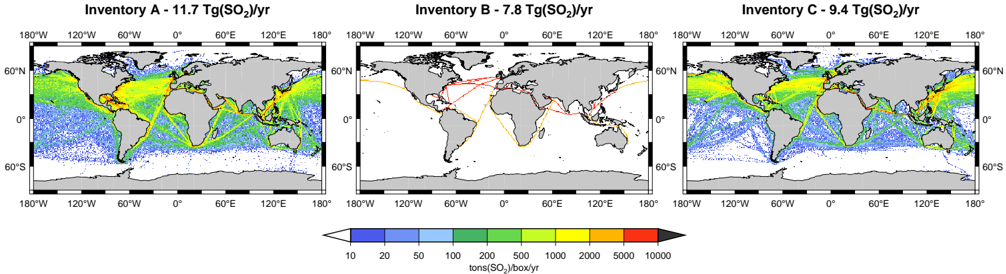
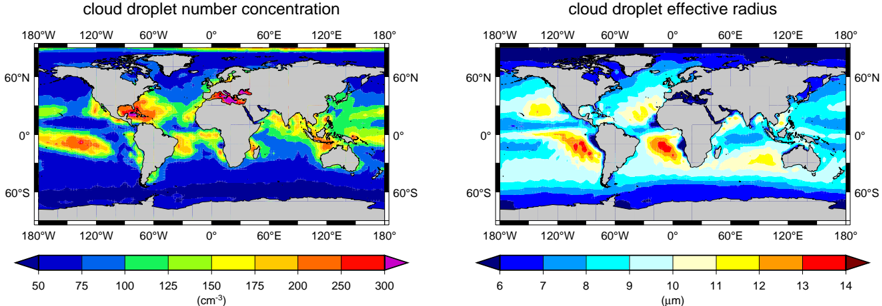
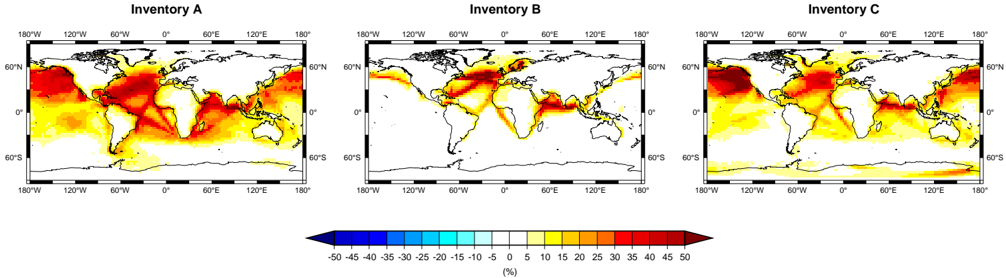
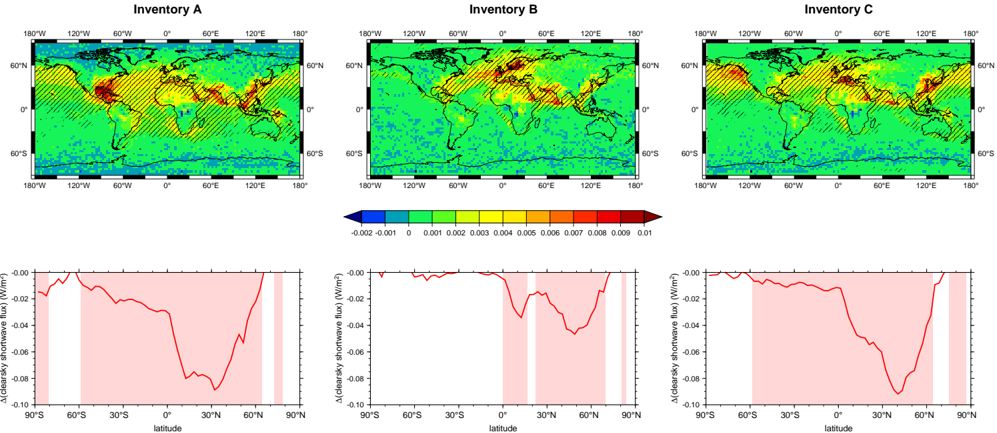
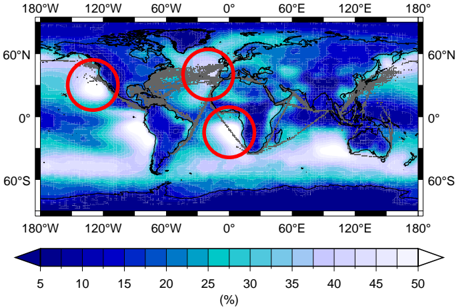
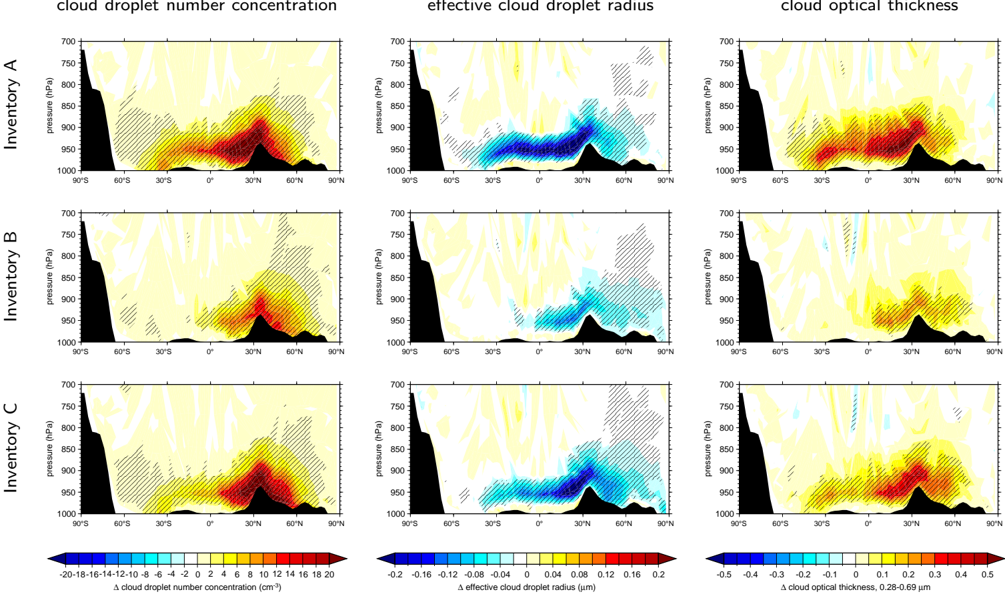
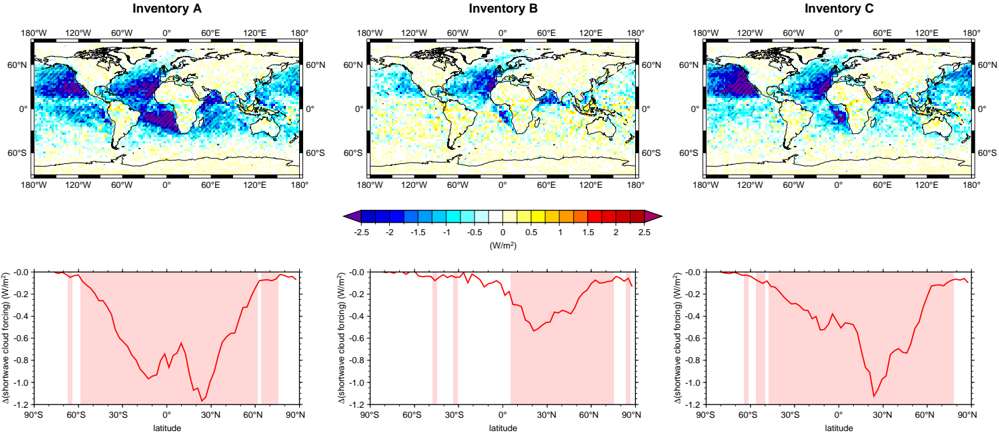
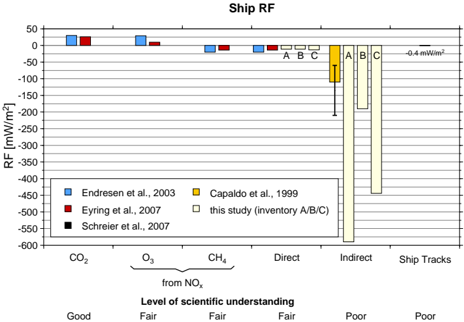
International shipping contributes significantly to the fuel consumption of all transport related activities. Specific emissions of pollutants such as sulfur dioxide (SO2) per kg of fuel emitted are higher than for road transport or aviation. Besides gaseous pollutants, ships also emit various types of particulate matter. The aerosol impacts the Earth's radiation budget directly by scattering and absorbing the solar and thermal radiation and indirectly by changing cloud properties. Here we use ECHAM5/MESSy1-MADE, a global climate model with detailed aerosol and cloud microphysics to study the climate impacts of international shipping. The simulations show that emissions from ships significantly increase the cloud droplet number concentration of low marine water clouds by up to 5% to 30% depending on the ship emission inventory and the geographic region. Whereas the cloud liquid water content remains nearly unchanged in these simulations, effective radii of cloud droplets decrease, leading to cloud optical thickness increase of up to 5–10%. The sensitivity of the results is estimated by using three different emission inventories for present-day conditions. The sensitivity analysis reveals that shipping contributes to 2.3% to 3.6% of the total sulfate burden and 0.4% to 1.4% to the total black carbon burden in the year 2000 on the global mean. In addition to changes in aerosol chemical composition, shipping increases the aerosol number concentration, e.g. up to 25% in the size range of the accumulation mode (typically >0.1 μm) over the Atlantic. The total aerosol optical thickness over the Indian Ocean, the Gulf of Mexico and the Northeastern Pacific increases by up to 8–10% depending on the emission inventory. Changes in aerosol optical thickness caused by shipping induced modification of aerosol particle number concentration and chemical composition lead to a change in the shortwave radiation budget at the top of the atmosphere (ToA) under clear-sky condition of about −0.014 W/m² to −0.038 W/m² for a global annual average. The corresponding all-sky direct aerosol forcing ranges between −0.011 W/m² and −0.013 W/m². The indirect aerosol effect of ships on climate is found to be far larger than previously estimated. An indirect radiative effect of −0.19 W/m² to −0.60 W/m² (a change in the atmospheric shortwave radiative flux at ToA) is calculated here, contributing 17% to 39% of the total indirect effect of anthropogenic aerosols. This contribution is high because ship emissions are released in regions with frequent low marine clouds in an otherwise clean environment. In addition, the potential impact of particulate matter on the radiation budget is larger over the dark ocean surface than over polluted regions over land.
Overview
The claims and statistics of this paper haven’t been checked yet.
Free: it reads the open-access text and checks the first 5 claims that cite a source we can check. Create a free account to check every claim.
Integrity signals
Registry
Cites
Statistics
Figures
Verification
Claims the paper makes
The claims and statistics of this paper haven’t been checked yet.
Free: it reads the open-access text and checks the first 5 claims that cite a source we can check. Create a free account to check every claim.
Claims other papers make about this one
Each is checked against this paper’s own text: does it say what the citing paper says it does?
The cited source says what the claim attributes to it.
In the citing paper
“Our estimate of radiative forcing from IMO2020 is well within the range of estimates of the total forcing from shipping emissions in the literature22–25.”
From Abrupt reduction in shipping emission as an inadvertent geoengineering termination shock produces substantial radiative warming (2024) · cites this paper as [23]
Self-check
Percentages, sums and reported differences re-computed from the paper’s own numbers.
The self-check needs the paper’s full text.
Citations
Cites
AERONET—A Federated Instrument Network and Data Archive for Aerosol Characterization
Holben, B. N., Eck, T. F., Slutsker, I., Tanré, D., Buis, J. P., Setzer, A., Vermote, E., Reagan, J. A., Kaufman, Y. J., Nakajima, T., et al. (1998) · Remote Sensing of Environment · doi:10.1016/s0034-4257(98)00031-5 · Cited by 7,743 · cited 7×
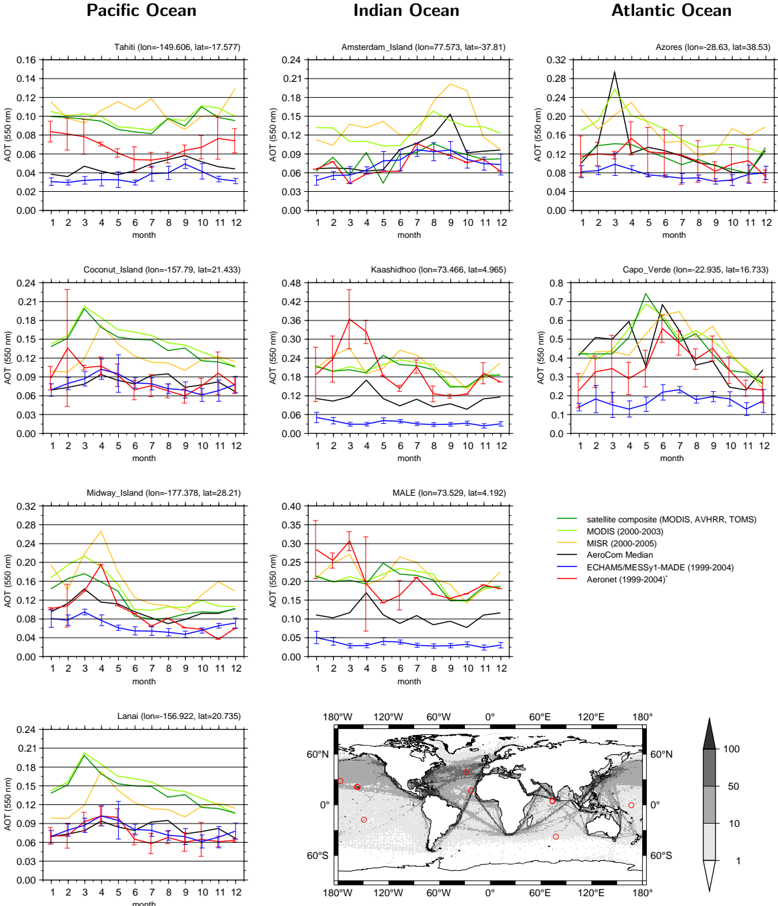
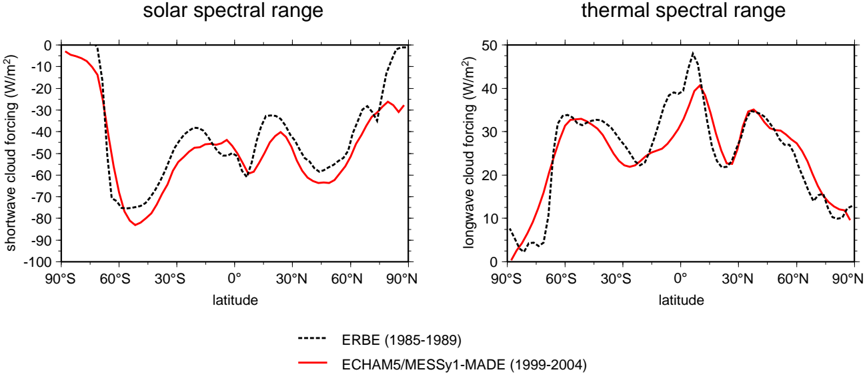
“Phys., 7, 5061–79, 2007 shown inLauer et al.(2005), the cloud forcing and aerosol optical thickness of the E5/M1-MADE simulation have been compared to ERBE (Earth Radiation Budget Experiment) satellite data (Barkstrom, 1984) and Aeronet (Holben et al., 1998) measurements showing reasonable good agreement in most parts…”
MethodInfluentialGlobal indirect aerosol effects: a review
Lohmann, U., & Feichter, J. (2005) · Atmospheric Chemistry and Physics · doi:10.5194/acp-5-715-2005 · Cited by 2,606
Self-citationGlobal indirect aerosol effects: a reviewPreprint
Lohmann, U., & Feichter, J. (2004) · doi:10.5194/acpd-4-7561-2004 · Cited by 1,861
Self-citationKaufman, Y. J., Tanré, D., Remer, L. A., Vermote, E. F., Chu, A., & Holben, B. N. (1997) · Journal of Geophysical Research: Atmospheres · doi:10.1029/96jd03988 · Cited by 1,699 · cited 1×
“For comparison, also satellite data from MODIS (2000–2003) (Kaufman et al., 1997; Tanre et al., 1997), MISR (2000–2005) (Kahn et al., 1998; Martonchik et al., 1998) and a composite of MODIS, AVHRR and TOMS data (Kinne et al., 2006) are shown, as well as the median of several global aerosol models…”
MethodAnalysis and quantification of the diversities of aerosol life cycles within AeroCom
Textor, C., Schulz, M., Guibert, S., Kinne, S., Balkanski, Y., Bauer, S., Berntsen, T., Berglen, T., Boucher, O., Chin, M., et al. (2006) · Atmospheric Chemistry and Physics · doi:10.5194/acp-6-1777-2006 · Cited by 1,272
Self-citationRoeckner, E., Brokopf, R., Esch, M., Giorgetta, M., Hagemann, S., Kornblueh, L., Manzini, E., Schlese, U., & Schulzweida, U. (2006) · Journal of Climate · doi:10.1175/jcli3824.1 · Cited by 1,183 · cited 8×
“We use the global aerosol climate model ECHAM5/MESSy1-MADE, hereafter referred to as E5/M1-MADE, that includes detailed aerosol and cloud microphysics to study the direct and indirect aerosol effects caused by international shipping.”
MethodInfluentialRemote sensing of aerosol properties over oceans using the MODIS/EOS spectral radiances
Tanré, D., Kaufman, Y. J., Herman, M., & Mattoo, S. (1997) · Journal of Geophysical Research: Atmospheres · doi:10.1029/96jd03437 · Cited by 922 · cited 2×
“For comparison, also satellite data from MODIS (2000–2003) (Kaufman et al., 1997; Tanre et al., 1997), MISR (2000–2005) (Kahn et al., 1998; Martonchik et al., 1998) and a composite of MODIS, AVHRR and TOMS data (Kinne et al., 2006) are shown, as well as the median of several global aerosol models…”
BackgroundMethodA parameterization of aerosol activation: 2. Multiple aerosol types
Abdul‐Razzak, H., & Ghan, S. J. (2000) · Journal of Geophysical Research: Atmospheres · doi:10.1029/1999jd901161 · Cited by 897 · cited 3×
“Aerosol activation is calculated following Abdul-Razzak and Ghan(2000).”
MethodInfluentialDentener, F., Kinne, S., Bond, T., Boucher, O., Cofala, J., Generoso, S., Ginoux, P., Gong, S., Hoelzemann, J. J., Ito, A., et al. (2006) · Atmospheric Chemistry and Physics · doi:10.5194/acp-6-4321-2006 · Cited by 887
The impact of humidity above stratiform clouds on indirect aerosol climate forcing
Ackerman, A. S., Kirkpatrick, M. P., Stevens, D. E., & Toon, O. B. (2004) · Nature · doi:10.1038/nature03174 · Cited by 824
Research works printed but not linked: 2
- Conover, J. H.: Anomalous Cloud Lines, J. Atmos. Sci., 23, 778- 785, 1966. · doi:10.1175/1520-0469(1966)023
- Intergovernmental Panel on Climate Change (IPCC): Climate Change 2007: The Physical Science Basis, Contribution of Working Group I to the Fourth Assessment Report of the Inter- governmental Panel on Climate Change, edited by: Solomon, S., Qin, D., Manning, M., Chen, Z., Marquis, M., Averyt, K. B., Tignor, M., and Miller, H. L., Cambridge University Press, Cam- bridge, United Kingdom and New York, NY, USA, 996 pp, 2007.
Cited by
Items 201–234 of 234
Christensen, M. W. (2021) · Atmospheric chemistry and physics · doi:10.5194/acp-2021-559-ac1
“Shipping corridor perturbation results are from Diamond et al. (2020), effusive volcanic eruption is from Malavelle et al. (2017), and the global shipping model is from Lauer et al. (2007) and Peters et al. (2013).”
Influential(2021) · Geoscientific model development · doi:10.5194/gmd-2021-295-rc2
Pozzer, A. (2021) · Geoscientific model development · doi:10.5194/gmd-2021-295-ac2
Pozzer, A. (2021) · Geoscientific model development · doi:10.5194/gmd-2021-295-ac1
Christensen, M. W., Gettelman, A., Cermak, J., et al. (2021) · Atmospheric chemistry and physics · doi:10.5194/acp-2021-559-rc2
(2021) · Geoscientific model development · doi:10.5194/gmd-2021-295-rc3
“The aerosol optical properties are calculated with the submodel AEROPT (Dietmüller et al., 2016), which is based on the scheme by Lauer et al. (2007) and makes use of predefined lognormal modes (i.e. the mode width σ and the mode mean radius have to be taken into account).”
MethodPozzer, A. (2021) · Geoscientific model development · doi:10.5194/gmd-2021-295-ac3
(2022) · Atmospheric chemistry and physics · doi:10.5194/acp-2021-1100-rc1
(2021) · Geoscientific model development · doi:10.5194/gmd-2021-295-rc1
Wood, R. (2021) · Atmospheric chemistry and physics · doi:10.5194/acp-2021-327-ac1
Wood, R. (2021) · Atmospheric chemistry and physics · doi:10.5194/acp-2021-327-ac2
Christensen, M. W., Gettelman, A., Čermák, J., et al. (2021) · Atmospheric chemistry and physics · doi:10.5194/acp-2021-559-rc1
Christensen, M. W., Gettelman, A., Čermák, J., Dagan, G., Diamond, M., Douglas, A., Feingold, G., Glassmeier, F., Goren, T., Grosvenor, D. P., et al. (2021) · doi:10.5194/acp-2021-559-supplement
Krüger, O. O. (2022) · Atmospheric chemistry and physics · doi:10.5194/acp-2021-1100-ac1
(2021) · Atmospheric chemistry and physics · doi:10.5194/acp-2021-327-rc1
(2021) · Geoscientific model development · doi:10.5194/gmd-2021-191-rc1
“…have been conducted in previous studies to investigate the potential of global aerosol simulations and their limitations (e.g. Textor et al 2006; Lauer et al, 2007; Bauer et al 2008; Koch et al 2009; Mann et al., 2010, 2014; Pringle et al., 2010; Aquila et al 2011; Huneeus et al 2011; Kirkewåg…”
Method(2021) · Atmospheric chemistry and physics · doi:10.5194/acp-2021-327-rc2
Supplementary material to "Weaker cooling by aerosols due to dust-pollution interactions"
Klingmüller, K., Karydis, V. A., Bacer, S., Stenchikov, G. L., & Lelieveld, J. (2020) · doi:10.5194/acp-2020-531-supplement
Li, J. (2021) · Geoscientific model development · doi:10.5194/gmd-2021-191-ac1
(2021) · Geoscientific model development · doi:10.5194/gmd-2021-191-rc2
Zhang, X. (2023) · doi:10.5194/egusphere-2022-1411-ac1
Zhang, X. (2023) · doi:10.5194/egusphere-2022-1411-ac2
Diamond, M. (2023) · doi:10.5194/egusphere-2023-971-ac2
Diamond, M. (2023) · doi:10.5194/egusphere-2023-971-ac1
An optimized electric propulsion system for hybrid electric marine vessels
Joseph, D., Katta, P., Akila, S., Mani, P. K., & Ramkumar, S. (2024) · AIP conference proceedings · doi:10.1063/5.0218795 · Cited by 1
Maruhashi, J., Righi, M., Sharma, M., Hendricks, J., Jöckel, P., Grewe, V., & Dedoussi, I. C. (2026) · Geoscientific model development · doi:10.5194/gmd-19-2747-2026 · Cited by 3
Self-citationProposal of CO2e indicator for policies of maritime transportation emissions
Çalışkan, U. Y., & Zincir, B. (2025) · WMU Journal of Maritime Affairs · doi:10.1007/s13437-025-00398-1
Ryan, R. G., Harrison, D. P., Johansson, L., & Schofield, R. (2026) · Communications Earth & Environment · doi:10.1038/s43247-025-03088-1 · Cited by 1
“The overall radiative impact has been modelled on global 15,36 and regional 37,38 scales, with Partanen et al. (2013) determining that the effective radiative forcing from shipping aerosol emissions in 2010 was − 0.39 W m − 2 39 .”
InfluentialLarge present-day and future climate forcing due to non-CO2 emissions from global transport
Hendricks, J., Righi, M., Brinkop, S., Dahlmann, K., Mertens, M., Beer, C. G., Grewe, V., Kaiser, C., & Ponater, M. (2026) · npj Climate and Atmospheric Science · doi:10.1038/s41612-026-01383-y
Self-citationShip Plumes: Impacts on atmospheric chemistry, climate and nutrient supply to the oceans
von Glasow, R., & SALTZMAN, E. S. (2008)
Metadata
- Authors
- Lauer, A., Eyring, V., Hendricks, J., Jöckel, P., & Lohmann, U.
- Affiliations
- Deutsches Zentrum für Luft- und Raumfahrt e. V. (DLR) (DE)
- Max Planck Institute for Chemistry (DE)
- Institute for Atmospheric and Climate Science (CH)
- Venue
- Atmospheric Chemistry and Physics
- Publisher
- Copernicus GmbH
- Published
- 2007-10-04
- Volume
- 7
- Issue
- 19
- Pages
- 5061-5079
- ISSN
- 1680-7316 (ISSN-L)
- 1680-7324
- OpenAlex
- W2093456659
- Cited by
- 234
- References
- 53
- Citations by year
- 2026: 3 · 2025: 10 · 2024: 11 · 2023: 18 · 2022: 14 · 2021: 22 · 2020: 12 · 2019: 10 · 2018: 13 · 2017: 11 · 2016: 14 · 2015: 11 · 2014: 9 · 2013: 12 · 2012: 11
- FWCI
- 16.73
- Type
- journal article
- Language
- en
- Open access
- gold
- doi.org
- Licence
- Locations
- Atmospheric chemistry and physics (publishedVersion, cc-by-nc-sa)
- Repository for Publications and Research Data (ETH Zurich) (publishedVersion, cc-by-nc-sa)
- elib (German Aerospace Center) (acceptedVersion)
- HAL (submittedVersion, other-oa)
- DOAJ (DOAJ: Directory of Open Access Journals) (submittedVersion)
- Max Planck Institute for Plasma Physics (submittedVersion)
- MPG.PuRe (Max Planck Society) (submittedVersion)
- ETH Zürich Research Collection
- Funders
- Universität zu Köln
- European Centre for Medium-Range Weather Forecasts
- Topics
- Physical Sciences › Environmental Science › Environmental Engineering › Maritime Transport Emissions and Efficiency
- Physical Sciences › Environmental Science › Global and Planetary Change › Atmospheric aerosols and clouds
- Physical Sciences › Earth and Planetary Sciences › Atmospheric Science › Atmospheric chemistry and aerosols
- Keywords
- ship emissions, marine aerosols, aerosol indirect effect, cloud droplet number concentration, cloud optical thickness, aerosol optical depth, shortwave radiation budget, top-of-atmosphere radiation, aerosol radiative forcing, sulfur dioxide emissions, black carbon, sulfate aerosols, emission inventory, cloud microphysics, aerosol number concentration
About these checks
Registry, retraction, Cites and statistics results are computed, not judged, with one exception: a printed reference that no index lists is read once by a model before it counts as a citation error. Claims are extracted by a model and kept only when their quote appears verbatim in the text; each cited source is then checked, with a model’s help, for whether it says what the claim relies on. Those verdicts can be wrong — read the claim’s quote and the cited source before relying on one.
Statistics and arithmetic are recomputed, not judged.
Confidence bands are shown only for fields calibrated on our annotated test set. None is calibrated yet, so no band is shown.
What counts as a claim ›How we measure confidence ›How we check this ›
Are you an author, or do you see a problem with this page? Request a review
Data sources
Bibliographic data: Semantic Scholar, OpenAlex, Crossref.
Contains information from the Semantic Scholar Academic Graph Datasets, made available under the ODC Attribution License (ODC-BY 1.0).
Semantic Scholar’s data is described in: Kinney, R., et al. (2023). The Semantic Scholar Open Data Platform. arXiv:2301.10140.
