

The DOI matches its Crossref record; 5 of the 5 references it cites were found in a registry or an index.
Technical note: In situ measurement of flux and isotopic composition of CO 2 released during oxidative weathering of sedimentary rocks
Open accessPublished version of a preprint
Abstract
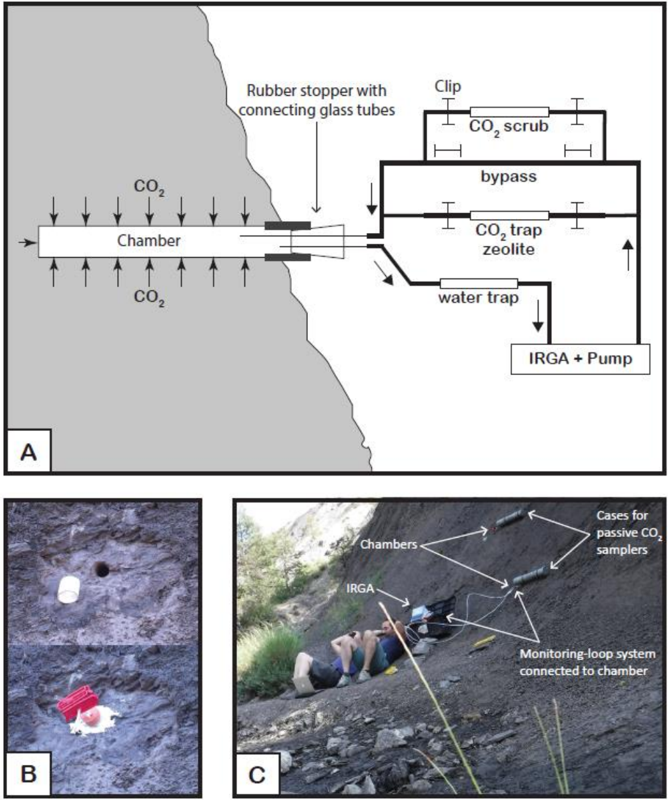
Oxidative weathering of sedimentary rocks can release carbon dioxide (CO 2 ) to the atmosphere and is an important natural CO 2 emission. Two mechanisms operate – the oxidation of sedimentary organic matter and the dissolution of carbonate minerals by sulfuric acid. It has proved difficult to directly measure the rates at which CO 2 is emitted in response to these weathering processes in the field, with previous work generally using methods which track the dissolved products of these reactions in rivers. Here we design a chamber method to measure CO 2 production during the oxidative weathering of shale bedrock, which can be applied in erosive environments where rocks are exposed frequently to the atmosphere. The chamber is drilled directly into the rock face and has a high surface-area-to-volume ratio which benefits measurement of CO 2 fluxes. It is a relatively low-cost method and provides a long-lived chamber (several months or more). To partition the measured CO 2 fluxes and the source of CO 2 , we use zeolite molecular sieves to trap CO 2 “actively” (over several hours) or “passively” (over a period of months). The approaches produce comparable results, with the trapped CO 2 having a radiocarbon activity (fraction modern, Fm) ranging from Fm = 0.05 to Fm = 0.06 and demonstrating relatively little contamination from local atmospheric CO 2 (Fm = 1.01). We use stable carbon isotopes of the trapped CO 2 to partition between an organic and inorganic carbon source. The measured fluxes of rock-derived organic matter oxidation (171 ± 5 mgC m −2 day −1 ) and carbonate dissolution by sulfuric acid (534±16 mgC m −2 day −1 ) from a single chamber were high when compared to the annual flux estimates derived from using dissolved river chemistry in rivers around the world. The high oxidative weathering fluxes are consistent with the high erosion rate of the study region. We propose that our in situ method has the potential to be more widely deployed to directly measure CO 2 fluxes during the oxidative weathering of sedimentary rocks, allowing for the spatial and temporal variability in these fluxes to be determined.
Overview
The claims and statistics of this paper haven’t been checked yet.
Run the check — free, no account needed. It reads the open-access text and checks the sources it cites.
Integrity signals
Registry
Cites
Statistics
Figures



Verification
Claims the paper makes
The claims and statistics of this paper haven’t been checked yet.
Run the check — free, no account needed. It reads the open-access text and checks the sources it cites.
Claims other papers make about this one
Each is checked against this paper’s own text: does it say what the citing paper says it does?
The source backs part of the claim, not all of it — or backs it for a different population, condition or comparison.
In the citing paper
“Direct microbial coal degradation has already been observed in incubation experiments on mine soils (Rumpel and Kögel-Knabner, 2002; Waschkies and Huttl, 1999) or shale bedrock directly exposed to the surface (Soulet et al., 2018).”
From Geogenic organic carbon in terrestrial sediments and its contribution to total soil carbon (2021) · cites this paper as Soulet et al., 2018
Experimental — accuracy not yet measured
Self-check
Percentages, sums and reported differences re-computed from the paper’s own numbers.
The self-check needs the paper’s full text.
Citations
Cites
Discussion: Reporting and Calibration of Post-Bomb 14 C Data
(2004) · Radiocarbon · doi:10.1017/s0033822200033154 · Cited by 906
Reporting 14C Activities and Concentrations
Mook, W. G., & van der Plicht, J. (1999) · Radiocarbon · doi:10.1017/s0033822200057106 · Cited by 456
A field study of the chemical weathering of ancient sedimentary organic matter
Petsch, S. T., Berner, R. A., & Eglinton, T. I. (2000) · Organic Geochemistry · doi:10.1016/s0146-6380(00)00014-0 · Cited by 267
Microbial oxidation of lithospheric organic carbon in rapidly eroding tropical mountain soils
Hemingway, J. D., Hilton, R. G., Hovius, N., Eglinton, T. I., Haghipour, N., Wacker, L., Chen, M.-C., & Galy, V. V. (2018) · Science · doi:10.1126/science.aao6463 · Cited by 183
Self-citationStorage and release of fossil organic carbon related to weathering of sedimentary rocks
Copard, Y., Amiotte-Suchet, P., & Di-Giovanni, C. (2007) · Earth and Planetary Science Letters · doi:10.1016/j.epsl.2007.03.048 · Cited by 88
Research works printed but not linked: 45
- Bardgett, R. D., Richter, A., Bol, R., Garnett, M. H., Bäumler, R., Xu, X., Lopez-Capel, E., Manning, D. A. C., Hobbs, P. J., Hartley, I. R., and Wanek, W.: Heterotrophic microbial communities use ancient carbon following glacial retreat, Biol. Lett., 3, 487–490, 10.1098/rsbl.2007.0242, 2007. · DOI
- Berner, E. K. and Berner, R. A.: Global environment: Water, air, and geochemical cycles, Princeton University Press, 488 pp., 2012. · DOI
- Berner, R. A. and Canfield, D. E.: A new model for atmospheric oxygen over Phanerozoic time, Am. J. Sci., 289, 333–361, 10.2475/ajs.289.4.333, 1989. · DOI
- Bertoni, G., Ciuchini, C., and Tappa, R.: Measurement of long-term average carbon dioxide concentrations using passive diffusion sampling, Atmos. Environ., 38, 1625–1630, 10.1016/j.atmosenv.2003.12.010, 2004. · DOI
- Billett, M. F., Garnett, M. H., and Hardie, S. M. L.: A Direct Method to Measure 14CO2 Lost by Evasion from Surface Waters, Radiocarbon, 48, 61–68, 10.1017/S0033822200035396, 2006. · DOI
- Blair, N. E., Leithold, E. L., Ford, S. T., Peeler, K. A., Holmes, J. C., and Perkey, D. W.: The persistence of memory: the fate of ancient sedimentary organic carbon in a modern sedimentary system, Geochim. Cosmochim. Ac., 67, 63–73, 10.1016/S0016-7037(02)01043-8, 2003. · DOI
- Borges, A. V., Delille, B., Schiettecatte, L.-S., Gazeau, F., Abril, G., and Frankignoulle, M.: Gas transfer velocities of CO2 in three European estuaries (Randers Fjord, Scheldt, and Thames), Limnol. Oceanogr., 49, 1630–1641, 10.4319/lo.2004.49.5.1630, 2004. · DOI
- Bouchez, J., Beyssac, O., Galy, V., Gaillardet, J., France-Lanord, C., Maurice, L., and Moreira-Turcq, P.: Oxidation of petrogenic organic carbon in the Amazon floodplain as a source of atmospheric CO2, Geology, 38, 255–258, 10.1130/G30608.1, 2010. · DOI
- Calmels, D., Gaillardet, J., Brenot, A., and France-Lanord, C.: Sustained sulfide oxidation by physical erosion processes in the Mackenzie River basin: Climatic perspectives, Geology, 35, 1003–1006, 10.1130/G24132A.1, 2007. · DOI
- Calmels, D., Galy, A., Hovius, N., Bickle, M., West, A. J., Chen, M.-C., and Chapman, H.: Contribution of deep groundwater to the weathering budget in a rapidly eroding mountain belt, Taiwan, Earth Planet. Sc. Lett., 303, 48–58, 10.1016/j.epsl.2010.12.032, 2011. · DOI
- Cras, A., Marc, V., and Travi, Y.: Hydrological behaviour of sub-Mediterranean alpine headwater streams in a badlands environment, J. Hydrol., 339, 130–144, 10.1016/j.jhydrol.2007.03.004, 2007. · DOI
- Dalai, T. K., Singh, S. K., Trivedi, J. R., and Krishnaswami, S.: Dissolved rhenium in the Yamuna River System and the Ganga in the Himalaya: Role of black shale weathering on the budgets of Re, Os, and U in rivers and CO2 in the atmosphere, Geochim. Cosmochim. Ac., 66, 29–43, 10.1016/S0016-7037(01)00747-5, 2002. · DOI
- Das, A., Chung, C.-H., and You, C.-F.: Disproportionately high rates of sulfide oxidation from mountainous river basins of Taiwan orogeny: Sulfur isotope evidence, Geophys. Res. Lett., 39, L12404, 10.1029/2012GL051549, 2012. · DOI
- Davidson, G. R.: The stable isotopic composition and measurement of carbon in soil CO2, Geochim. Cosmochim. Ac., 59, 2485–2489, 10.1016/0016-7037(95)00143-3, 1995. · DOI
- Galy, A. and France-Lanord, C.: Weathering processes in the Ganges-Brahmaputra basin and the riverine alkalinity budget, Chem. Geol., 159, 31–60, 10.1016/S0009-2541(99)00033-9, 1999. · DOI
- Galy, V., Beyssac, O., France-Lanord, C., and Eglinton, T.: Recycling of Graphite During Himalayan Erosion: A Geological Stabilization of Carbon in the Crust, Science, 322, 943–945, 10.1126/science.1161408, 2008. · DOI
- Garnett, M. H. and Hardie, S. M. L.: Isotope (14C and 13C) analysis of deep peat CO2 using a passive sampling technique, Soil Biol. Biochem., 41, 2477–2483, 10.1016/j.soilbio.2009.09.004, 2009. · DOI
- Garnett, M. H. and Hartley, I. P.: A passive sampling method for radiocarbon analysis of atmospheric CO2 using molecular sieve, Atmos. Environ., 44, 877–883, 10.1016/j.atmosenv.2009.12.005, 2010. · DOI
- Garnett, M. H. and Murray, C.: Processing of CO2 Samples Collected Using Zeolite Molecular Sieve for 14C Analysis at the NERC Radiocarbon Facility (East Kilbride, UK), Radiocarbon, 55, 410–415, 10.1017/S0033822200057532, 2013. · DOI
- Garnett, M. H., Billett, M. F., Gulliver, P., and Dean, J. F.: A new field approach for the collection of samples for aquatic 14CO2 analysis using headspace equilibration and molecular sieve traps: the super headspace method, Ecohydrology, 9, 1630–1638, 10.1002/eco.1754, 2016. · DOI
- Garnett, M. H., Hartley, I. P., Hopkins, D. W., Sommerkorn, M., and Wookey, P. A.: A passive sampling method for radiocarbon analysis of soil respiration using molecular sieve, Soil Biol. Biochem., 41, 1450–1456, 10.1016/j.soilbio.2009.03.024, 2009. · DOI
- Graz, Y., Di-Giovanni, C., Copard, Y., Mathys, N., Cras, A., and Marc, V.: Annual fossil organic carbon delivery due to mechanical and chemical weathering of marly badlands areas, Earth Surf. Process. Land., 37, 1263–1271, 10.1002/esp.3232, 2012. · DOI
- Hahn, V., Högberg, P., and Buchmann, N.: 14C – A tool for separation of autotrophic and heterotrophic soil respiration, Glob. Chang. Biol., 12, 972–982, 10.1111/j.1365-2486.2006.001143.x, 2006. · DOI
- Hardie, S. L. M. L., Garnett, M. H. H., Fallick, A. E. E., Rowland, A. P. P., and Ostle, N. J. J.: Carbon dioxide capture using a zeolite molecular sieve sampling system for isotopic studies (13C and 14C) of respiration, Radiocarbon, 47, 441–451, 10.2458/azu_js_rc.v.2838, 2005. · DOI
- Hartley, I. P., Garnett, M. H., Sommerkorn, M., Hopkins, D. W., and Wookey, P. A.: The age of CO2 released from soils in contrasting ecosystems during the arctic winter, Soil Biol. Biochem., 63, 1–4, 10.1016/j.soilbio.2013.03.011, 2013. · DOI
- Hilton, R. G., Galy, A., Hovius, N., Horng, M. J., and Chen, H.: Efficient transport of fossil organic carbon to the ocean by steep mountain rivers: An orogenic carbon sequestration mechanism, Geology, 39, 71–74, 10.1130/G31352.1, 2011. · DOI
- Hilton, R. G., Gaillardet, J., Calmels, D., and Birck, J. L.: Geological respiration of a mountain belt revealed by the trace element rhenium, Earth Planet. Sc. Lett., 403, 27–36, 10.1016/j.epsl.2014.06.021, 2014. · DOI
- Hindshaw, R. S., Heaton, T. H. E., Boyd, E. S., Lindsay, M. R., and Tipper, E. T.: Influence of glaciation on mechanisms of mineral weathering in two high Arctic catchments, Chem. Geol., 420, 37–50, 10.1016/j.chemgeo.2015.11.004, 2016. · DOI
- Horan, K., Hilton, R. G., Selby, D., Ottley, C. J., Gröcke, D. R., Hicks, M., and Burton, K. W.: Mountain glaciation drives rapid oxidation of rock-bound organic carbon, Sci. Adv., 3, e1701107, 10.1126/sciadv.1701107, 2017. · DOI · Paper page
- Jaffe, L. A., Peucker-Ehrenbrink, B., and Petsch, S. T.: Mobility of rhenium, platinum group elements and organic carbon during black shale weathering, Earth Planet. Sc. Lett., 198, 339–353, 10.1016/S0012-821X(02)00526-5, 2002. · DOI
- Keller, C. K. and Bacon, D. H.: Soil respiration and georespiration distinguished by transport analyses of vadose CO2, 13CO2, and 14CO2, Global Biogeochem. Cy., 12, 361–372, 10.1029/98GB00742, 1998. · DOI
- Kutzbach, L., Schneider, J., Sachs, T., Giebels, M., Nykänen, H., Shurpali, N. J., Martikainen, P. J., Alm, J., and Wilmking, M.: CO2 flux determination by closed-chamber methods can be seriously biased by inappropriate application of linear regression, Biogeosciences, 4, 1005–1025, 10.5194/bg-4-1005-2007, 2007. · DOI
- Li, S. L., Calmels, D., Han, G., Gaillardet, J., and Liu, C. Q.: Sulfuric acid as an agent of carbonate weathering constrained by δ13C DIC: Examples from Southwest China, Earth Planet. Sc. Lett., 270, 189–199, 10.1016/j.epsl.2008.02.039, 2008. · DOI
- Maquaire, O., Ritzenthaler, A., Fabre, D., Ambroise, B., Thiery, Y., Truchet, E., Malet, J.-P., and Monnet, J.: Caractérisation des profils de formations superficielles par pénétrométrie dynamique à énergie variable?: application aux marnes noires de Draix (Alpes-de-Haute-Provence, France), Comptes Rendus Geosci., 334, 835–841, 10.1016/S1631-0713(02)01788-1, 2002. · DOI
- Mathys, N. and Klotz, S.: Draix: A field laboratory for research on hydrology and erosion in mountain areas, in: Proceedings of the 4th Canadian Conference on Geohazards: From Causes to Management, edited by: Locat, D.D., Perret, D., and Turmel, D., 594, 2008.
- Mathys, N., Brochot, S., Meunier, M., and Richard, D.: Erosion quantification in the small marly experimental catchments of Draix (Alpes de Haute Provence, France), Calibration of the ETC rainfall-runoff-erosion model, CATENA, 50, 527–548, 10.1016/S0341-8162(02)00122-4, 2003. · DOI
- Oostwoud Wijdenes, D. J. and Ergenzinger, P.: Erosion and sediment transport on steep marly hillslopes, Draix, Haute-Provence, France: an experimental field study, CATENA, 33, 179–200, 10.1016/S0341-8162(98)00076-9, 1998. · DOI
- Petsch, S. T.: Weathering of Organic Carbon, in: Treatise on Geochemistry, 12, 217–238, Elsevier, Amsterdam, 2014. · DOI
- Petsch, S. T., Eglinton, T. I., and Edwards, K. J.: 14C-Dead Living Biomass: Evidence for Microbial Assimilation of Ancient Organic Carbon During Shale Weathering, Science, 292, 1127–1131, 10.1126/science.1058332, 2001. · DOI
- Pirk, N., Mastepanov, M., Parmentier, F.-J. W., Lund, M., Crill, P., and Christensen, T. R.: Calculations of automatic chamber flux measurements of methane and carbon dioxide using short time series of concentrations, Biogeosciences, 13, 903–912, 10.5194/bg-13-903-2016, 2016. · DOI
- Spence, J. and Telmer, K.: The role of sulfur in chemical weathering and atmospheric CO2 fluxes: Evidence from major ions, δ13CDIC, and δ34SSO4 in rivers of the Canadian Cordillera, Geochim. Cosmochim. Ac, 69, 5441–5458, 10.1016/j.gca.2005.07.011, 2005. · DOI
- Stuiver, M. and Polach, H. A.: Discussion Reporting of 14C Data, Radiocarbon, 19, 355–363, 10.1017/S0033822200003672, 1977. · DOI · Paper page
- Sundquist, E. T. and Visser, K.: Geologic history of the carbon cycle, Biogeochemistry, 8, 425–472, 2005. · DOI
- Torres, M. A., West, A. J., and Li, G.: Sulphide oxidation and carbonate dissolution as a source of CO2 over geological timescales, Nature, 507, 346–349, 10.1038/nature13030, 2014. · DOI
- Travelletti, J., Sailhac, P., Malet, J.-P., Grandjean, G., and Ponton, J.: Hydrological response of weathered clay-shale slopes: water infiltration monitoring with time-lapse electrical resistivity tomography, Hydrol. Process., 26, 2106–2119, 10.1002/hyp.7983, 2012. · DOI
Cited by
Sorted by citations
Geogenic organic carbon in terrestrial sediments and its contribution to total soil carbon
Kalks, F., Noren, G., Mueller, C. W., Helfrich, M., Rethemeyer, J., & Don, A. (2021) · SOIL · doi:10.5194/soil-7-347-2021 · Cited by 48
Metadata
- Authors
- Soulet, G., Hilton, R. G., Garnett, M. H., Dellinger, M., Croissant, T., Ogrič, M., & Klotz, S.
- Affiliations
- Durham University (GB)
- Institut National de Recherche en Sciences et Technologies pour l'Environnement et l'Agriculture (FR)
- Corresponding author
- Soulet, Guillaume
- ORCID
- Venue
- Biogeosciences
- Publisher
- Copernicus GmbH
- Published
- 2018-07-04
- Volume
- 15
- Issue
- 13
- Pages
- 4087-4102
- ISSN
- 1726-4170 (ISSN-L)
- 1726-4189
- OpenAlex
- W2768393184
- Cited by
- 39
- References
- 5
- Citations by year
- 2026: 1 · 2025: 2 · 2024: 4 · 2023: 12 · 2022: 3 · 2021: 12 · 2020: 3 · 2019: 1 · 2018: 1
- FWCI
- 2.13
- Type
- journal article
- Language
- en
- Open access
- gold
- doi.org
- Licence
- Locations
- Biogeosciences (publishedVersion, cc-by)
- ENLIGHTEN (Jurnal Bimbingan dan Konseling Islam) (acceptedVersion, cc-by-sa)
- Durham Research Online (Durham University) (acceptedVersion)
- Durham Research Online (Durham University) (submittedVersion, cc-by)
- HAL (submittedVersion)
- DOAJ (DOAJ: Directory of Open Access Journals) (submittedVersion, cc-by-sa)
- Cemadoc (Cemagref / IRSTEA) (submittedVersion)
- Biogeosciences (European Geosciences Union) (submittedVersion, cc-by)
- Funders
- European Research Council
- Topics
- Physical Sciences › Environmental Science › Environmental Engineering › CO2 Sequestration and Geologic Interactions
- Physical Sciences › Earth and Planetary Sciences › Geochemistry and Petrology › Groundwater and Isotope Geochemistry
- Physical Sciences › Environmental Science › Global and Planetary Change › Atmospheric and Environmental Gas Dynamics
- Keywords
- oxidative weathering, CO2 flux, sedimentary rock, organic matter oxidation, carbonate dissolution, sulfuric acid, CO2 isotopic composition, carbon-14, zeolite molecular sieves, erosion, stable carbon isotopes
About these checks
Registry, retraction, Cites and statistics results are computed, not judged, with one exception: a printed reference that no index lists is read once by a model before it counts as a citation error. Claims are extracted by a model and kept only when their quote appears verbatim in the text; each cited source is then checked, with a model’s help, for whether it says what the claim relies on. Those verdicts can be wrong — read the claim’s quote and the cited source before relying on one.
Statistics and arithmetic are recomputed, not judged.
Confidence bands are shown only for fields calibrated on our annotated test set. None is calibrated yet, so no band is shown.
What counts as a claim ›How we measure confidence ›How we check this ›
Are you an author, or do you see a problem with this page? Request a review
How to cite
Cite CoChat for the checks on this page, and the paper for its own findings.
- This page
- CoChat. (2026). Citation check: Technical note: In situ measurement of flux and isotopic composition of CO 2 released during oxidative weathering of sedimentary rocks. https://app.cochat.ai/papers/10.5194/bg-15-4087-2018
- The paper
- Soulet, G., Hilton, R. G., Garnett, M. H., Dellinger, M., Croissant, T., Ogrič, M., & Klotz, S. (2018). Technical note: In situ measurement of flux and isotopic composition of CO 2 released during oxidative weathering of sedimentary rocks. Biogeosciences. https://doi.org/10.5194/bg-15-4087-2018
