

Twenty-first century ocean warming, acidification, deoxygenation, and upper-ocean nutrient and primary production decline from CMIP6 model projections
Open accessPublished version of a preprint
The DOI matches its Crossref record; 201 of the 201 references it cites were found in a registry or an index.
Abstract
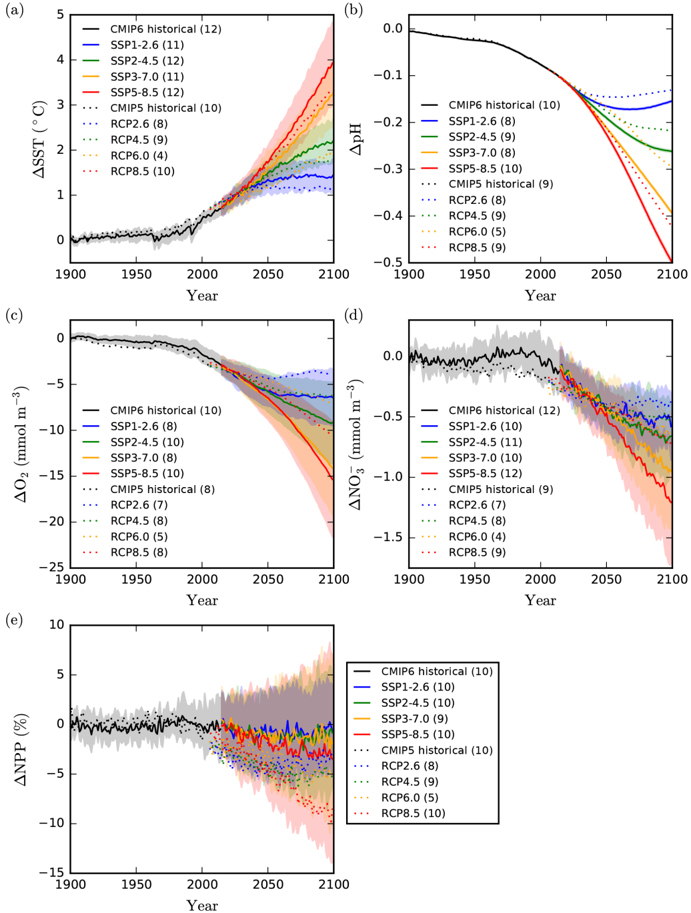
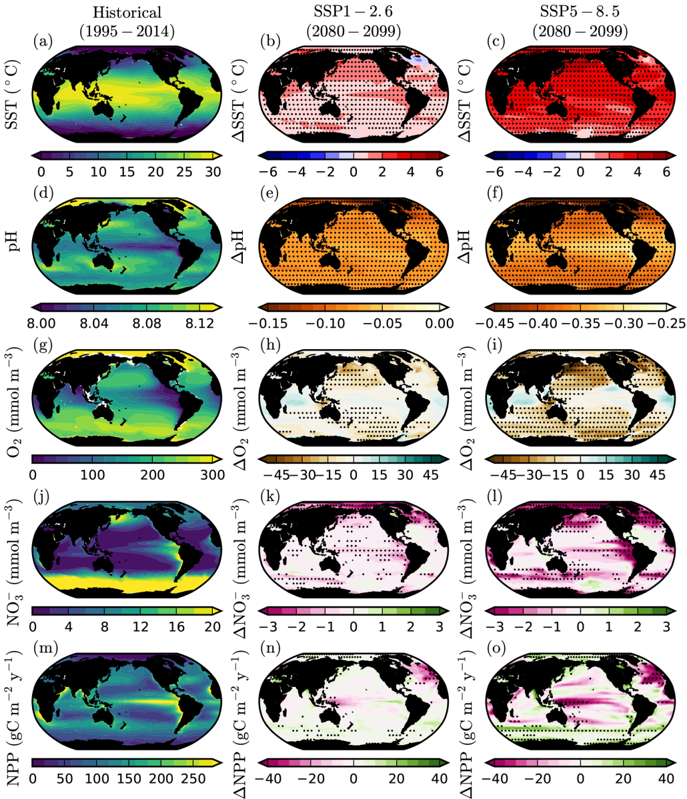
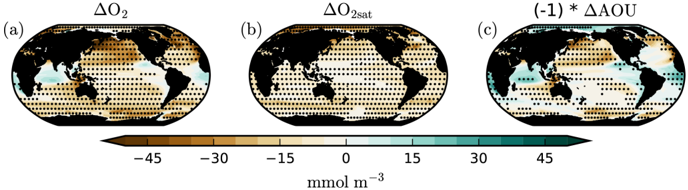
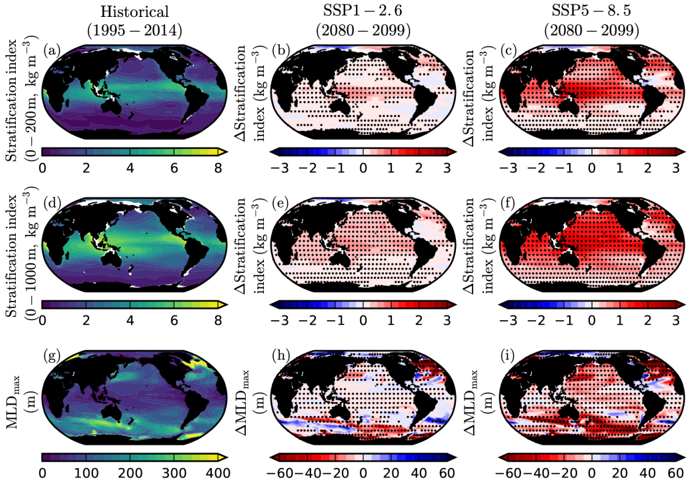
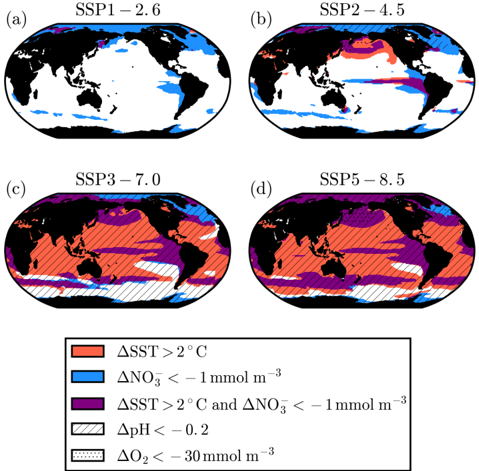
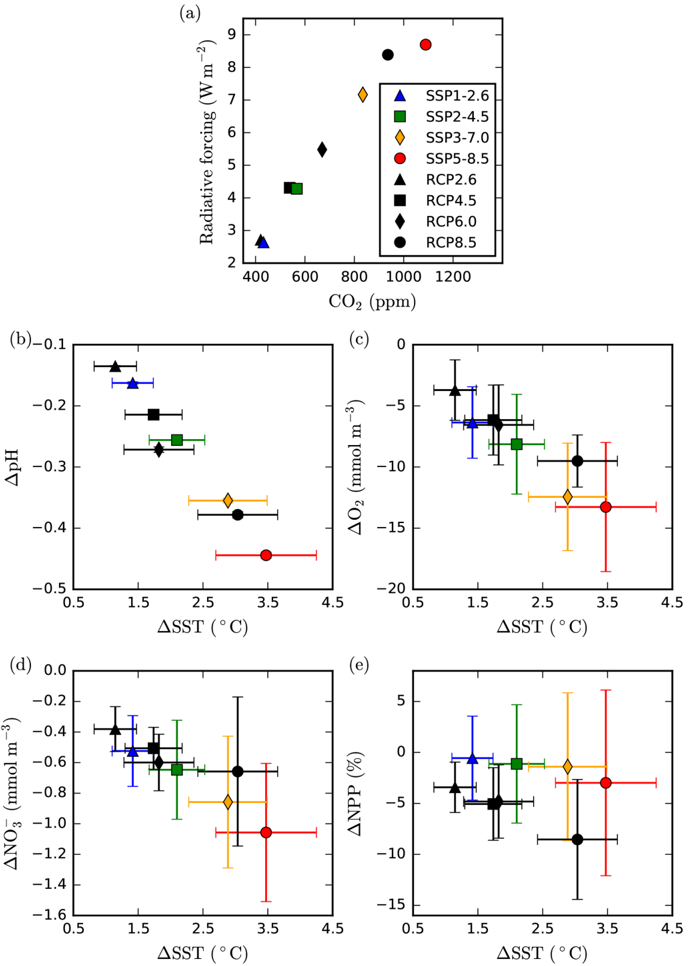
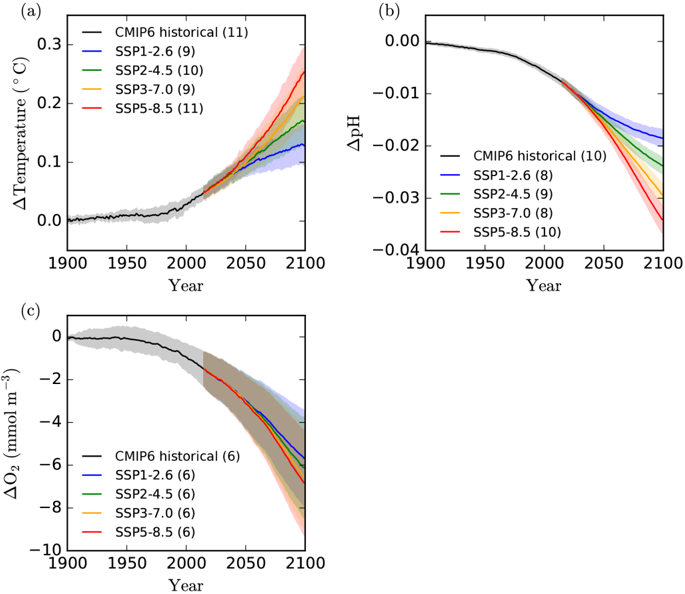
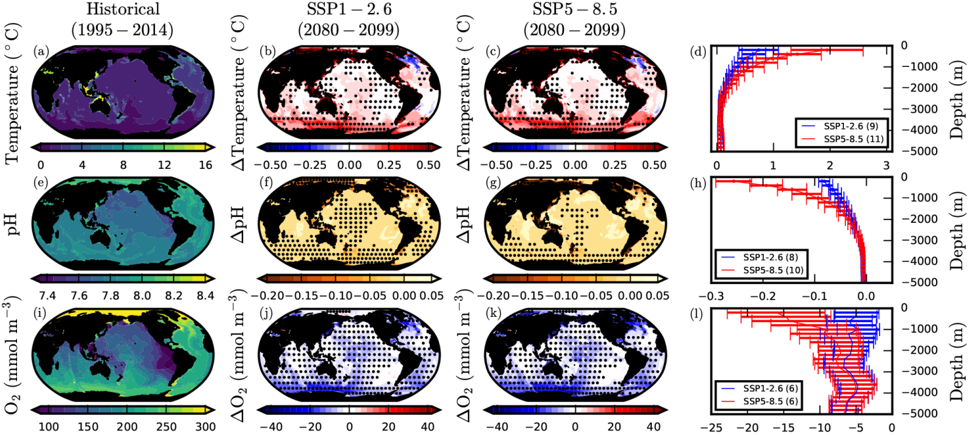
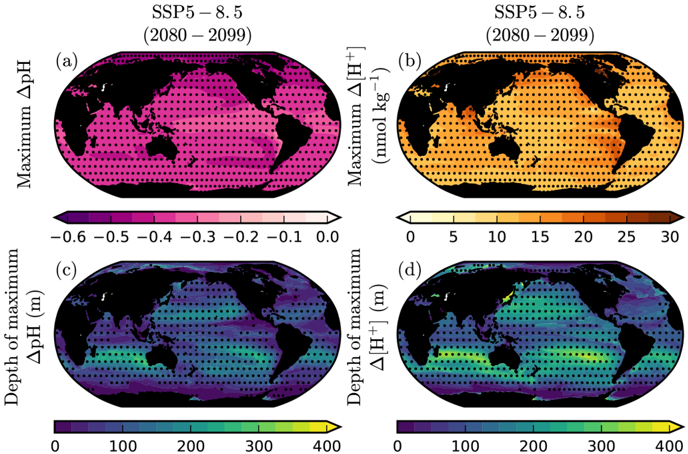
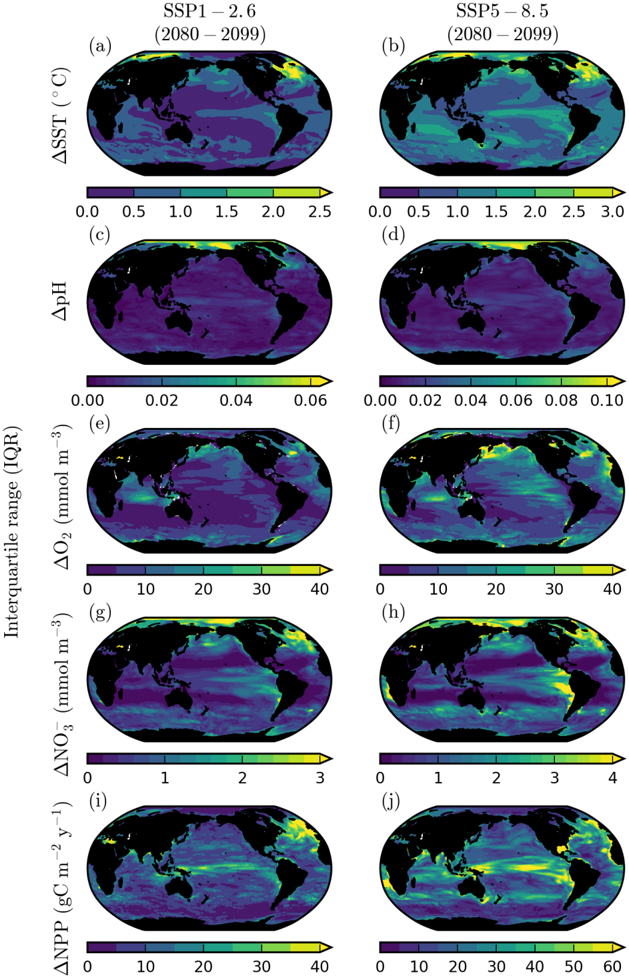
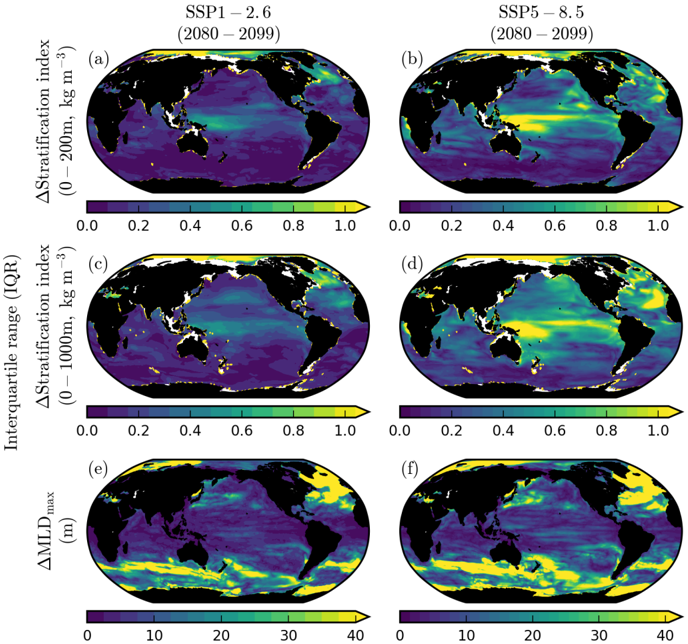
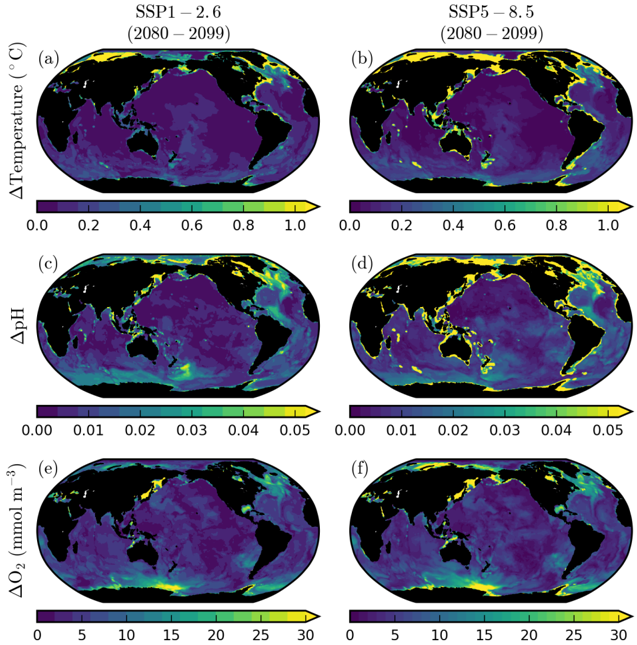
Anthropogenic climate change is projected to lead to ocean warming, acidification, deoxygenation, reductions in near-surface nutrients, and changes to primary production, all of which are expected to affect marine ecosystems. Here we assess projections of these drivers of environmental change over the twenty-first century from Earth system models (ESMs) participating in the Coupled Model Intercomparison Project Phase 6 (CMIP6) that were forced under the CMIP6 Shared Socioeconomic Pathways (SSPs). Projections are compared to those from the previous generation (CMIP5) forced under the Representative Concentration Pathways (RCPs). A total of 10 CMIP5 and 13 CMIP6 models are used in the two multi-model ensembles. Under the high-emission scenario SSP5-8.5, the multi-model global mean change (2080–2099 mean values relative to 1870–1899) ± the inter-model SD in sea surface temperature, surface pH, subsurface (100–600 m) oxygen concentration, euphotic (0–100 m) nitrate concentration, and depth-integrated primary production is +3.47±0.78 ∘ C, -0.44±0.005, -13.27±5.28, -1.06±0.45 mmol m −3 and -2.99±9.11 %, respectively. Under the low-emission, high-mitigation scenario SSP1-2.6, the corresponding global changes are +1.42±0.32 ∘ C, -0.16±0.002, -6.36±2.92, -0.52±0.23 mmol m −3 , and -0.56±4.12 %. Projected exposure of the marine ecosystem to these drivers of ocean change depends largely on the extent of future emissions, consistent with previous studies. The ESMs in CMIP6 generally project greater warming, acidification, deoxygenation, and nitrate reductions but lesser primary production declines than those from CMIP5 under comparable radiative forcing. The increased projected ocean warming results from a general increase in the climate sensitivity of CMIP6 models relative to those of CMIP5. This enhanced warming increases upper-ocean stratification in CMIP6 projections, which contributes to greater reductions in upper-ocean nitrate and subsurface oxygen ventilation. The greater surface acidification in CMIP6 is primarily a consequence of the SSPs having higher associated atmospheric CO 2 concentrations than their RCP analogues for the same radiative forcing. We find no consistent reduction in inter-model uncertainties, and even an increase in net primary production inter-model uncertainties in CMIP6, as compared to CMIP5.
Overview
The claims and statistics of this paper haven’t been checked yet.
Free: it reads the open-access text and checks the first 5 claims that cite a source we can check. Create a free account to check every claim.
Integrity signals
Registry
Cites
Statistics
Figures
Verification
Claims the paper makes
The claims and statistics of this paper haven’t been checked yet.
Free: it reads the open-access text and checks the first 5 claims that cite a source we can check. Create a free account to check every claim.
Claims other papers make about this one
Each is checked against this paper’s own text: does it say what the citing paper says it does?
The cited source says what the claim attributes to it.
In the citing paper
“Models used by the IPCC do not even agree on the direction of change in NPP in response to climate change (89).”
From Earth beyond six of nine planetary boundaries (2023) · cites this paper as [89]
Self-check
Percentages, sums and reported differences re-computed from the paper’s own numbers.
The self-check needs the paper’s full text.
Citations
Cites
An Overview of CMIP5 and the Experiment Design
Taylor, K. E., Stouffer, R. J., & Meehl, G. A. (2012) · Bulletin of the American Meteorological Society · doi:10.1175/bams-d-11-00094.1 · Cited by 14,052 · cited 2×
“Here we assess future projections of climate-related drivers of marine impacts within the Coupled Model Intercomparison Project Phase 6 (CMIP6; Eyring et al., 2016; O’Neill et al., 2016) simulations, evaluating how these differ from previous CMIP5 (Taylor et al., 2011) simulations.”
MethodEyring, V., Bony, S., Meehl, G. A., Senior, C. A., Stevens, B., Stouffer, R. J., & Taylor, K. E. (2016) · Geoscientific Model Development · doi:10.5194/gmd-9-1937-2016 · Cited by 11,981
Riahi, K., van Vuuren, D. P., Kriegler, E., Edmonds, J., O’Neill, B. C., Fujimori, S., Bauer, N., Calvin, K., Dellink, R., Fricko, O., et al. (2017) · Global Environmental Change · doi:10.1016/j.gloenvcha.2016.05.009 · Cited by 6,607
The Scenario Model Intercomparison Project (ScenarioMIP) for CMIP6
O'Neill, B. C., Tebaldi, C., van Vuuren, D. P., Eyring, V., Friedlingstein, P., Hurtt, G., Knutti, R., Kriegler, E., Lamarque, J.-F., Lowe, J., et al. (2016) · Geoscientific Model Development · doi:10.5194/gmd-9-3461-2016 · Cited by 6,189
Orr, J. C., Fabry, V. J., Aumont, O., Bopp, L., Doney, S. C., Feely, R. A., Gnanadesikan, A., Gruber, N., Ishida, A., Joos, F., et al. (2005) · Nature · doi:10.1038/nature04095 · Cited by 4,590
Self-citationOcean Acidification: The Other CO 2 Problem
Doney, S. C., Fabry, V. J., Feely, R. A., & Kleypas, J. A. (2009) · Annual Review of Marine Science · doi:10.1146/annurev.marine.010908.163834 · Cited by 4,173 · cited 2×
“825 The uptake of carbon by the oceans affects marine chemistry via ocean acidification (Gattuso and Buddemeier, 2000; Orr et al., 2005; Doney et al., 2009), a process that increases seawater concentrations of CO2, H and HCO3, and reduces pH and CO3 ion concentrations.”
BackgroundThe Oceanic Sink for Anthropogenic CO 2
Sabine, C. L., Feely, R. A., Gruber, N., Key, R. M., Lee, K., Bullister, J. L., Wanninkhof, R., Wong, C. S., Wallace, D. W. R., Tilbrook, B., et al. (2004) · Science · doi:10.1126/science.1097403 · Cited by 4,035
The RCP greenhouse gas concentrations and their extensions from 1765 to 2300
Meinshausen, M., Smith, S. J., Calvin, K., Daniel, J. S., Kainuma, M. L. T., Lamarque, J.-F., Matsumoto, K., Montzka, S. A., Raper, S. C. B., Riahi, K., et al. (2011) · Climatic Change · doi:10.1007/s10584-011-0156-z · Cited by 3,584
Declining oxygen in the global ocean and coastal waters
Breitburg, D., Levin, L. A., Oschlies, A., Grégoire, M., Chavez, F. P., Conley, D. J., Garçon, V., Gilbert, D., Gutiérrez, D., Isensee, K., et al. (2018) · Science · doi:10.1126/science.aam7240 · Cited by 3,253
The Community Climate System Model Version 4
Gent, P. R., Danabasoglu, G., Donner, L. J., Holland, M. M., Hunke, E. C., Jayne, S. R., Lawrence, D. M., Neale, R. B., Rasch, P. J., Vertenstein, M., et al. (2011) · Journal of Climate · doi:10.1175/2011jcli4083.1 · Cited by 3,133
Research works printed but not linked: 2
- 11. Bindoff, N. L., Cheung, W. W. L., Kairo, J. G., Arístegui, J., Guin- der, V. A., Hallberg, R., Hilmi, N., Jiao, N., Karim, M. S., Levin, L., O'Donoghue, S., Purca Cuicapusa, S. R., Rinkevich, B., Suga, T., Tagliabue, A., and Williamson, P.: Changing Ocean, Marine Ecosystems, and Dependent Communities. In: IPCC Special Re- port on the Ocean and Cryosphere in a Changing Climate, edited by: Pörtner, H.-O., Roberts, D. C., Masson-Delmotte, V., Zhai, P., Tignor, M., Poloczanska, E., Mintenbeck, K., Alegría, A., Nico- lai, M., Okem, A., Petzold, J., Rama, B., Weyer, N. M., in press., 2020.
- 12. Bindoff, N. L., Willebrand, J., Artale, V., Cazenave, A., Gregory, J. M., Gulev, S., Hanawa, K., Le Quere, C., Levitus, S., Nojiri, Y., Shum, C. K., Talley, L. D., Unnikrishnan, A. S., Josey, S. A., Tamisiea, M., Tsimplis, M., and Woodworth, P.: Observa- tions: oceanic climate change and sea level, in Climate change 2007: the physical science basis. Contribution of Working Group I, edited by: Solomon, S., Qin, D., Manning, M., Chen, Z., Mar- quis, M., Averyt, K. B., Tignor, M., Miller, H. L., Cambridge University Press, Cambridge, pp. 385-428, 2007.
Cited by
Earth beyond six of nine planetary boundaries
Richardson, K., Steffen, W., Lucht, W., Bendtsen, J., Cornell, S. E., Donges, J. F., Drüke, M., Fetzer, I., Bala, G., von Bloh, W., et al. (2023) · Science Advances · doi:10.1126/sciadv.adh2458 · Cited by 3,311
“Models used by the IPCC do not even agree on the direction of change in NPP in response to climate change ( 89 ).”
Ubiquity of human-induced changes in climate variability
Rodgers, K. B., Lee, S.-S., Rosenbloom, N., Timmermann, A., Danabasoglu, G., Deser, C., Edwards, J., Kim, J.-E., Simpson, I. R., Stein, K., et al. (2021) · Earth System Dynamics · doi:10.5194/esd-12-1393-2021 · Cited by 544
Overcoming the coupled climate and biodiversity crises and their societal impacts
Pörtner, H.-O., Scholes, R. J., Arneth, A., Barnes, D. K. A., Burrows, M. T., Diamond, S. E., Duarte, C. M., Kiessling, W., Leadley, P., Managi, S., et al. (2023) · Science · doi:10.1126/science.abl4881 · Cited by 519
“Warming thus constrains the potential of nature-based solutions in terrestrial systems, exacerbated by drought (69, 73–75), and in some ocean systems (71, 76, 77).”
CMIP6 Simulations With the CMCC Earth System Model (CMCC‐ESM2)
Lovato, T., Peano, D., Butenschön, M., Materia, S., Iovino, D., Scoccimarro, E., Fogli, P. G., Cherchi, A., Bellucci, A., Gualdi, S., et al. (2022) · Journal of Advances in Modeling Earth Systems · doi:10.1029/2021ms002814 · Cited by 426
Future phytoplankton diversity in a changing climate
Henson, S. A., Cael, B. B., Allen, S. R., & Dutkiewicz, S. (2021) · Nature Communications · doi:10.1038/s41467-021-25699-w · Cited by 350
The marine nitrogen cycle: new developments and global change
Hutchins, D. A., & Capone, D. G. (2022) · Nature Reviews Microbiology · doi:10.1038/s41579-022-00687-z · Cited by 338
Summertime increases in upper-ocean stratification and mixed-layer depth
Sallée, J.-B., Pellichero, V., Akhoudas, C., Pauthenet, E., Vignes, L., Schmidtko, S., Garabato, A. N., Sutherland, P., & Kuusela, M. (2021) · Nature · doi:10.1038/s41586-021-03303-x · Cited by 333
Biogeochemical extremes and compound events in the ocean
Gruber, N., Boyd, P. W., Frölicher, T. L., & Vogt, M. (2021) · Nature · doi:10.1038/s41586-021-03981-7 · Cited by 326
Impact of climate change and anthropogenic activities on aquatic ecosystem – A review
A. K, P., M, M., Rajamanickam, S., Sivarethinamohan, S., Gaddam, M. K. R., Velusamy, P., R, G., Ravindiran, G., Gurugubelli, T. R., & Muniasamy, S. K. (2023) · Environmental Research · doi:10.1016/j.envres.2023.117233 · Cited by 321
Next-generation ensemble projections reveal higher climate risks for marine ecosystems
Tittensor, D. P., Novaglio, C., Harrison, C. S., Heneghan, R. F., Barrier, N., Bianchi, D., Bopp, L., Bryndum-Buchholz, A., Britten, G. L., Büchner, M., et al. (2021) · Nature Climate Change · doi:10.1038/s41558-021-01173-9 · Cited by 289
Self-citationClimate change in the Baltic Sea region: a summary
Meier, H. E. M., Kniebusch, M., Dieterich, C., Gröger, M., Zorita, E., Elmgren, R., Myrberg, K., Ahola, M. P., Bartosova, A., Bonsdorff, E., et al. (2022) · Earth System Dynamics · doi:10.5194/esd-13-457-2022 · Cited by 283
Gregor, L., & Gruber, N. (2021) · Earth System Science Data · doi:10.5194/essd-13-777-2021 · Cited by 266
Monitoring and modelling marine zooplankton in a changing climate
Ratnarajah, L., Abu-Alhaija, R., Atkinson, A., Batten, S., Bax, N. J., Bernard, K. S., Canonico, G., Cornils, A., Everett, J. D., Grigoratou, M., et al. (2023) · Nature Communications · doi:10.1038/s41467-023-36241-5 · Cited by 255
“Models provide a powerful method that extends inherent limitations of fi eld and laboratory experiments to improve our understanding of marine ecosystems under a changing climate 132 – 134 .”
Garcia-Soto, C., Cheng, L., Caesar, L., Schmidtko, S., Jewett, E. B., Cheripka, A., Rigor, I., Caballero, A., Chiba, S., Báez, J. C., et al. (2021) · Frontiers in Marine Science · doi:10.3389/fmars.2021.642372 · Cited by 251
Uncertain response of ocean biological carbon export in a changing world
Henson, S. A., Laufkötter, C., Leung, S., Giering, S. L. C., Palevsky, H. I., & Cavan, E. L. (2022) · Nature Geoscience · doi:10.1038/s41561-022-00927-0 · Cited by 231
Avoiding ocean mass extinction from climate warming
Penn, J. L., & Deutsch, C. (2022) · Science · doi:10.1126/science.abe9039 · Cited by 212
Simulations With the Marine Biogeochemistry Library (MARBL)
Long, M. C., Moore, J. K., Lindsay, K., Levy, M., Doney, S. C., Luo, J. Y., Krumhardt, K. M., Letscher, R. T., Grover, M., & Sylvester, Z. T. (2021) · Journal of Advances in Modeling Earth Systems · doi:10.1029/2021ms002647 · Cited by 208
Tagliabue, A., Kwiatkowski, L., Bopp, L., Butenschön, M., Cheung, W., Lengaigne, M., & Vialard, J. (2021) · Frontiers in Climate · doi:10.3389/fclim.2021.738224 · Cited by 191
“, 2020), greater surface warming and enhanced upper ocean nutrient decline in CMIP6 than CMIP5, global NPP decline over the 21st century is less, not more, extensive (Kwiatkowski et al., 2020).”
BackgroundInfluentialSelf-citationThe quiet crossing of ocean tipping points
Heinze, C., Blenckner, T., Martins, H., Rusiecka, D., Döscher, R., Gehlen, M., Gruber, N., Holland, E., Hov, Ø., Joos, F., et al. (2021) · Proceedings of the National Academy of Sciences · doi:10.1073/pnas.2008478118 · Cited by 182
Self-citationRixen, T., Cowie, G., Gaye, B., Goés, J. I., Gomes, H. D. R., Hood, R. R., Lachkar, Z., Schmidt, H., Segschneider, J., & Singh, A. (2020) · Biogeosciences · doi:10.5194/bg-17-6051-2020 · Cited by 186
“…options including mesoscale processes in models used in the Cou- Biogeosciences, 17, 6051–6080, 2020 https://doi.org/10.5194/bg-17-6051-2020 pled Model Intercomparison Project Phase 6 (CMIP6), there are only moderate improvements in subsurface oxygen representation (Kwiatkowski et al., 2020).”
MethodInfluentialFuture loss of local-scale thermal refugia in coral reef ecosystems
Dixon, A. M., Forster, P. M. D. F., Heron, S. F., Stoner, A. M. K., & Beger, M. (2022) · PLOS Climate · doi:10.1371/journal.pclm.0000004 · Cited by 173
Ocean biogeochemical modelling
Fennel, K., Mattern, J. P., Doney, S. C., Bopp, L., Moore, A. M., Wang, B., & Yu, L. (2022) · Nature Reviews Methods Primers · doi:10.1038/s43586-022-00154-2 · Cited by 196
Self-citationThe ICON Earth System Model Version 1.0
Jungclaus, J. H., Lorenz, S. J., Schmidt, H., Brovkin, V. A., Brüggemann, N., Chegini, F., Crüger, T., de Vrese, P., Gayler, V., Giorgetta, M. A., et al. (2022) · Journal of Advances in Modeling Earth Systems · doi:10.1029/2021ms002813 · Cited by 181
Self-citationCompound marine heatwaves and ocean acidity extremes
Burger, F. A., Terhaar, J., & Frölicher, T. L. (2022) · Nature Communications · doi:10.1038/s41467-022-32120-7 · Cited by 175
High-Resolution Reanalysis of the Mediterranean Sea Biogeochemistry (1999–2019)
Cossarini, G., Feudale, L., Teruzzi, A., Bolzon, G., Coidessa, G., Solidoro, C., Biagio, V. D., Amadio, C., Lazzari, P., Brosich, A., et al. (2021) · Frontiers in Marine Science · doi:10.3389/fmars.2021.741486 · Cited by 153
“0012 pH units y−1; higher in the eastern subbasins) agrees with previously estimated global acidification trends (e.g., 0.0016 pH units y−1; Gehlen et al., 2020; Kwiatkowski et al., 2020), and is confirmed by the regional observations reported in Flecha et al.”
ResultInfluentialGlobal ocean lipidomes show a universal relationship between temperature and lipid unsaturation
Holm, H. C., Fredricks, H. F., Bent, S. M., Lowenstein, D. P., Ossolinski, J. E., Becker, K. W., Johnson, W. M., Schrage, K. R., & Mooy, B. A. S. V. (2022) · Science · doi:10.1126/science.abn7455 · Cited by 150
A committed fourfold increase in ocean oxygen loss
Oschlies, A. (2021) · Nature Communications · doi:10.1038/s41467-021-22584-4 · Cited by 149
Environmental vulnerability of the global ocean epipelagic plankton community interactome
Chaffron, S., Delage, E., Budinich, M., Vintache, D., Henry, N., Nef, C., Ardyna, M., Zayed, A. A., Junger, P. C., Galand, P. E., et al. (2021) · Science Advances · doi:10.1126/sciadv.abg1921 · Cited by 142
“Here, we predicted that specific plankton lineages and MPGs will be affected, which has substantial implications and may even worsen under currently projected scenarios of climate change (33) in the Arctic and in nutrient-rich oceanic regions.”
BackgroundMethodIncreasing hypoxia on global coral reefs under ocean warming
Pezner, A. K., Courtney, T. A., Barkley, H. C., Chou, W., Chu, H.-C., Clements, S. M., Cyronak, T. J., DeGrandpre, M. D., Kekuewa, S. A. H., Kline, D. I., et al. (2023) · Nature Climate Change · doi:10.1038/s41558-023-01619-2 · Cited by 141
Compound high-temperature and low-chlorophyll extremes in the ocean over the satellite period
Grix, N. L., Zscheischler, J., Laufkötter, C., Rousseaux, C. S., & Frölicher, T. L. (2021) · Biogeosciences · doi:10.5194/bg-18-2119-2021 · Cited by 151
A Dynamically Downscaled Ensemble of Future Projections for the California Current System
Buil, M. P., Jacox, M. G., Fiechter, J., Alexander, M. A., Bograd, S. J., Curchitser, E., Edwards, C. A., Rykaczewski, R. R., & Stock, C. A. A. (2021) · Frontiers in Marine Science · doi:10.3389/fmars.2021.612874 · Cited by 145
“, 2013, 2020), the inclusion of ocean biogeochemical components provided new insights into ocean acidification, deoxygenation, and productivity changes (Bopp et al., 2013; Kwiatkowski et al., 2020).”
BackgroundSelf-citationA global overview of marine heatwaves in a changing climate
Capotondi, A. M., Rodrigues, R. R., Gupta, A. S., Benthuysen, J. A., Deser, C., Frölicher, T. L., Lovenduski, N. S., Amaya, D. J., Grix, N. L., Xu, T., et al. (2024) · Communications Earth & Environment · doi:10.1038/s43247-024-01806-9 · Cited by 222
Self-citationGlobal Surface Ocean Acidification Indicators From 1750 to 2100
Jiang, L., Dunne, J. P. P., Carter, B. R., Tjiputra, J. F., Terhaar, J., Sharp, J. D., Olsen, A. S., Alin, S. R., Bakker, D. C. E., Feely, R. A., et al. (2023) · Journal of Advances in Modeling Earth Systems · doi:10.1029/2022ms003563 · Cited by 157
“5 (Kwiatkowski et al., 2020).”
BackgroundInfluentialSelf-citationEnhanced silica export in a future ocean triggers global diatom decline
Taucher, J., Bach, L. T., Prowe, A. E. F., Boxhammer, T., Kvale, K., & Riebesell, U. (2022) · Nature · doi:10.1038/s41586-022-04687-0 · Cited by 128
“Consistent with other Earth system models, our simulations predict profound impacts of climate change on the world ocean, for example, sea surface warming and decreased nutrient supply, which in turn lead to a decline in phytoplankton biomass (including diatoms 28,29 ; see Methods).”
Lindmark, M., Audzijonytė, A., Blanchard, J. L., & Gårdmark, A. (2022) · Global Change Biology · doi:10.1111/gcb.16341 · Cited by 131
“It also indicates that because productivity may decline with warming in large parts of the oceans (Kwiatkowski et al. 2020) (although there is large variation in these predictions across ecosystems (Steinacher et al. 2010)), reduced fisheries yields may be common in a warming world.”
BackgroundPalacios‐Abrantes, J., Frölicher, T. L., Reygondeau, G., Sumaila, U. R., Tagliabue, A., Wabnitz, C. C. C., & Cheung, W. W. L. (2022) · Global Change Biology · doi:10.1111/gcb.16058 · Cited by 123
Self-citationFour Decades of Trends and Drivers of Global Surface Ocean Acidification
Ma, D., Gregor, L., & Gruber, N. (2023) · Global Biogeochemical Cycles · doi:10.1029/2023gb007765 · Cited by 123
“Our global pH trend matches also well those given by a range of Earth System Models (Kwiatkowski et al., 2020).”
BackgroundResultInfluentialDiverging Fates of the Pacific Ocean Oxygen Minimum Zone and Its Core in a Warming World
Busecke, J. J. M., Resplandy, L., Ditkovsky, S., & John, J. G. (2022) · AGU Advances · doi:10.1029/2021av000470 · Cited by 119
Self-citationTowards the next generation of Geospatial Artificial Intelligence
Mai, G., Xie, Y., Jia, X., Lao, N., Rao, J., Zhu, Q., Liu, Z., Chiang, Y., & Jiao, J. (2025) · International Journal of Applied Earth Observation and Geoinformation · doi:10.1016/j.jag.2025.104368 · Cited by 222
Southern Ocean anthropogenic carbon sink constrained by sea surface salinity
Terhaar, J., Frölicher, T. L., & Joos, F. (2021) · Science Advances · doi:10.1126/sciadv.abd5964 · Cited by 112
“All models include coupled ocean biogeochemistry schemes and have been applied within the context of both climate and ocean biogeochemical projections (68, 69).”
BackgroundMethodDrenkard, E. J., Stock, C. A. A., Ross, A. C., Dixon, K. W., Adcroft, A., Alexander, M. A., Balaji, V., Bograd, S. J., Butenschön, M., Cheng, W., et al. (2021) · ICES Journal of Marine Science · doi:10.1093/icesjms/fsab100 · Cited by 115
“5◦–1◦ (∼50–100 km) in the horizontal (Kwiatkowski et al., 2020; Séférian et al., 2020).”
Self-citationExploring pathways for world development within planetary boundaries
van Vuuren, D. P., Doelman, J., Tagomori, I. S., Beusen, A. H. W., Cornell, S., Rockström, J., Schipper, A. M., Stehfest, E., Ambrósio, G., van den Berg, M., et al. (2025) · Nature · doi:10.1038/s41586-025-08928-w · Cited by 149
“Ocean acidification was estimated using a relationship between cumulative CO 2 emissions and ocean pH using a correlation of SSP data and the pH numbers reported from CMIP6 (see below in Additional information on methods) 60 .”
Chapter 2 : Climate Trends. Fifth National Climate Assessment
Marvel, K., Su, W., Delgado, R., Aarons, S. M., Chatterjee, A., Garcia, M., Hausfather, Z., Hayhoe, K., Hence, D. A., Jewett, E. B., et al. (2023) · doi:10.7930/nca5.2023.ch2 · Cited by 132
Zooplankton grazing is the largest source of uncertainty for marine carbon cycling in CMIP6 models
Rohr, T. W., Richardson, A. J., Lenton, A. A., Chamberlain, M. A., & Shadwick, E. H. (2023) · Communications Earth & Environment · doi:10.1038/s43247-023-00871-w · Cited by 133
Self-citationAcidification, deoxygenation, and nutrient and biomass declines in a warming Mediterranean Sea
Reale, M., Cossarini, G., Lazzari, P., Lovato, T., Bolzon, G., Masina, S., Solidoro, C., & Salon, S. (2022) · Biogeosciences · doi:10.5194/bg-19-4035-2022 · Cited by 111
“…of the oxygen, nutrient concentration and net primary production related to water column stratification are all potential marine stressors affecting marine organisms and ecosystem dynamics (see Kwiatkowski et al., 2020 for a review of the synergistic effects among potential marine stressors).”
BackgroundInfluentialPotential negative effects of ocean afforestation on offshore ecosystems
Boyd, P. W., Bach, L. T., Hurd, C. L., Paine, E. R., Raven, J. A., & Tamsitt, V. (2022) · Nature Ecology & Evolution · doi:10.1038/s41559-022-01722-1 · Cited by 100
(IPCC), I. P. O. C. C. (2023) · Cambridge University Press eBooks · doi:10.1017/9781009325844.023 · Cited by 116
Meier, H. E. M., Dieterich, C., & Gröger, M. (2021) · Communications Earth & Environment · doi:10.1038/s43247-021-00115-9 · Cited by 93
Global chlorophyll responses to marine heatwaves in satellite ocean color
Noh, K. M., Lim, H., & Kug, J. (2022) · Environmental Research Letters · doi:10.1088/1748-9326/ac70ec · Cited by 107
Observation-constrained estimates of the global ocean carbon sink from Earth system models
Terhaar, J., Frölicher, T. L., & Joos, F. (2022) · Biogeosciences · doi:10.5194/bg-19-4431-2022 · Cited by 108
Lacroix, F. K. M., Ilyina, T., Mathis, M., Laruelle, G. G., & Regnier, P. A. G. (2021) · Global Change Biology · doi:10.1111/gcb.15822 · Cited by 90
Self-citationFeedbacks between phytoplankton and nutrient cycles in a warming ocean
Hutchins, D. A., & Tagliabue, A. (2024) · Nature Geoscience · doi:10.1038/s41561-024-01454-w · Cited by 101
“…mid-and high-latitude diatom groups may be disadvantaged under the warmer, lower-NO 3 conditions that will become more widespread in the future temperate and subpolar oceans 9,23 , and diatom nutrient stress may be further exacerbated by parallel declines in the availability of silicon 24 (Fig.”
InfluentialSelf-citationClimate, Oxygen, and the Future of Marine Biodiversity
Deutsch, C. A., Penn, J. L., & Lucey, N. (2023) · Annual Review of Marine Science · doi:10.1146/annurev-marine-040323-095231 · Cited by 100
Meta‐analysis of multiple driver effects on marine phytoplankton highlights modulating role ofpCO2
Seifert, M., Rost, B., Trimborn, S., & Hauck, J. (2020) · Global Change Biology · doi:10.1111/gcb.15341 · Cited by 81
“The warming of the oceans is projected to continue, with strongest trends expected for the tropics and the northern high latitudes (Bindoff et al., 2019; Gruber, 2011; Kwiatkowski et al., 2020; Meredith et al., 2019).”
BackgroundTorres, O., Kwiatkowski, L., Sutton, A. J., Dorey, N., & Orr, J. C. (2021) · Geophysical Research Letters · doi:10.1029/2020gl090228 · Cited by 81
“5, respectively), relative to 1870–1899 values (Kwiatkowski et al., 2020).”
BackgroundSelf-citationTrophic level decoupling drives future changes in phytoplankton bloom phenology
Yamaguchi, R., Rodgers, K. B., Timmermann, A., Stein, K., Schlunegger, S., Bianchi, D., Dunne, J. P. P., & Slater, R. D. (2022) · Nature Climate Change · doi:10.1038/s41558-022-01353-1 · Cited by 79
Self-citationA functional vulnerability framework for biodiversity conservation
Auber, A., Waldock, C. A., Maire, A., Goberville, É., Albouy, C. P., Algar, A. C., McLean, M. J., Brind’Amour, A., Green, A. L., Tupper, M. H., et al. (2022) · Nature Communications · doi:10.1038/s41467-022-32331-y · Cited by 86
Self-citationEvaluation of ocean dimethylsulfide concentration and emission in CMIP6 models
Bock, J., Michou, M., Nabat, P., Abe, M., Mulcahy, J. P., Olivié, D., Schwinger, J., Suntharalingam, P., Tjiputra, J. F., van Hulten, M., et al. (2021) · Biogeosciences · doi:10.5194/bg-18-3823-2021 · Cited by 84
Self-citationDiazotrophy as a key driver of the response of marine net primary productivity to climate change
Bopp, L., Aumont, O., Kwiatkowski, L., Clerc, C., Dupont, L., Éthé, C., Gorguès, T., Séférian, R., & Tagliabue, A. (2022) · Biogeosciences · doi:10.5194/bg-19-4267-2022 · Cited by 91
Self-citationThe history of Earth’s sulfur cycle
Fakhraee, M., Crockford, P. W., Bauer, K. W., Pasquier, V., Sugiyama, I., Katsev, S., Raven, M. R., Gomes, M. L., Philippot, P., Crowe, S. A., et al. (2024) · Nature Reviews Earth & Environment · doi:10.1038/s43017-024-00615-0 · Cited by 79
“For example, Earth system models predict that OAE-like conditions could occur under the range of possible future climate scenarios 133,134 .”
Cumulative impacts to global marine ecosystems projected to more than double by mid-century
Halpern, B. S., Frazier, M. R., O’Hara, C. C., Vargas‐Fonseca, O. A., & Lombard, A. T. (2025) · Science · doi:10.1126/science.adv2906 · Cited by 83
Yool, A., Palmiéri, J., Jones, C., de Mora, L., Kuhlbrodt, T., Popova, E. E., Nurser, A. J. G., Hirschi, J., Blaker, A. T., Coward, A. C., et al. (2021) · Geoscientific model development · doi:10.5194/gmd-14-3437-2021 · Cited by 81
Self-citationGlobal decline of pelagic fauna in a warmer ocean
Ariza, A., Lengaigne, M., Menkès, C., Lebourges‐Dhaussy, A., Receveur, A., Gorguès, T., Habasque, J., Gutiérrez, M., Olivier, M., & Bertrand, A. (2022) · Nature Climate Change · doi:10.1038/s41558-022-01479-2 · Cited by 79
Sharp, J. D., Fassbender, A. J., Carter, B. R., Johnson, G. C., Schultz, C., & Dunne, J. P. P. (2023) · Earth system science data · doi:10.5194/essd-15-4481-2023 · Cited by 118
“The somewhat more negative GOBAI-O 2 trends compared with previous estimates suggest a possible acceleration of ocean deoxygenation over the last decade or so, which would be consistent with expectations (Kwiatkowski et al., 2020 .”
MethodResultSelf-citationThe need for carbon-emissions-driven climate projections in CMIP7
Sanderson, B. M., Booth, B. B. B., Dunne, J. P. P., Eyring, V., Fisher, R. A., Friedlingstein, P., Gidden, M., Hajima, T., JONES, C. D., Jones, C., et al. (2024) · Geoscientific model development · doi:10.5194/gmd-17-8141-2024 · Cited by 113
Self-citationDemystifying global climate models for use in the life sciences
Schoeman, D. S., Gupta, A. S., Harrison, C. S., Everett, J. D., Brito‐Morales, I., Hannah, L., Bopp, L., Roehrdanz, P. R., & Richardson, A. J. (2023) · Trends in Ecology & Evolution · doi:10.1016/j.tree.2023.04.005 · Cited by 64
Self-citationPlankton energy flows using a global size-structured and trait-based model
Negrete-García, G., Luo, J. Y., Long, M. C., Lindsay, K., Levy, M. N., & Barton, A. D. (2022) · Progress In Oceanography · doi:10.1016/j.pocean.2022.102898 · Cited by 68
Technical note: Interpreting pH changes
Fassbender, A. J., Orr, J. C., & Dickson, A. G. (2021) · Biogeosciences · doi:10.5194/bg-18-1407-2021 · Cited by 69
Self-citationPredicting how climate change threatens the prey base of Arctic marine predators
Florko, K. R. N., Tai, T. C., Cheung, W. W. L., Ferguson, S. H., Sumaila, U. R., Yurkowski, D. J., & Auger‐Méthé, M. (2021) · Ecology Letters · doi:10.1111/ele.13866 · Cited by 70
Major environmental drivers determining life and death of cold-water corals through time
Portilho-Ramos, R. C., Titschack, J., Wienberg, C., Rojas, M. G. S., Yokoyama, Y., & Hebbeln, D. (2022) · PLoS Biology · doi:10.1371/journal.pbio.3001628 · Cited by 61
Marine Pelagic Ecosystem Responses to Climate Variability and Change
Ducklow, H. W., Cimino, M. A., Dunton, K. H., Fraser, W. R., Hopcroft, R. R., Ji, R., Miller, A. J., Ohman, M. D., & Sosik, H. M. (2022) · BioScience · doi:10.1093/biosci/biac050 · Cited by 70
Climate change exacerbates nutrient disparities from seafood
Cheung, W. W. L., Maire, E., Oyinlola, M. A., Robinson, J. P. W., Graham, N. A. J., Lam, V. W. Y., MacNeil, M. A., & Hicks, C. C. (2023) · Nature Climate Change · doi:10.1038/s41558-023-01822-1 · Cited by 72
“Though the large-scale patterns of projected changes in catch and mariculture production potential from our models agree with previous estimates, the magnitude of climate impacts vary between models, particularly in the Arctic Ocean 56 .”
Terhaar, J., Torres, O., Bourgeois, T., & Kwiatkowski, L. (2021) · Biogeosciences · doi:10.5194/bg-18-2221-2021 · Cited by 71
Self-citationPredictable Variations of the Carbon Sinks and Atmospheric CO 2 Growth in a Multi‐Model Framework
Ilyina, T., Li, H., Spring, A., Müller, W. A., Bopp, L., Chikamoto, M. O., Danabasoglu, G., Dobrynin, M., Dunne, J. P. P., Fransner, F., et al. (2020) · Geophysical Research Letters · doi:10.1029/2020gl090695 · Cited by 60
Self-citationEffect of climate change on marine ecosystems
Williamson, P. C., & Guinder, V. A. (2021) · Elsevier eBooks · doi:10.1016/b978-0-12-822373-4.00024-0 · Cited by 78
Fast local warming is the main driver of recent deoxygenation in the northern Arabian Sea
Lachkar, Z., Mehari, M., Azhar, M. A., Lévy, M., & Smith, K. S. (2021) · Biogeosciences · doi:10.5194/bg-18-5831-2021 · Cited by 66
“The deoxygenation trend seems to emerge mostly from changes in the apparent oxygen utilization (AOU) as Osat2 shows no similar decline and even slightly increases during the study period (Fig.”
InfluentialACCESS datasets for CMIP6: methodology and idealised experiments
Mackallah, C., Chamberlain, M. A., Law, R. M., Dix, M., Ziehn, T., Bi, D., Bodman, R. W., Brown, J. R., Dobrohotoff, P., Druken, K. A., et al. (2022) · Journal of Southern Hemisphere Earth System Science · doi:10.1071/es21031 · Cited by 69
Self-citationNutrient uptake plasticity in phytoplankton sustains future ocean net primary production
Kwon, E. Y., Sreeush, M. G., Timmermann, A., Karl, D. M., Church, M. J., Lee, S., & Yamaguchi, R. (2022) · Science Advances · doi:10.1126/sciadv.add2475 · Cited by 62
Large Pelagic Fish Are Most Sensitive to Climate Change Despite Pelagification of Ocean Food Webs
Petrik, C. M., Stock, C. A. A., Andersen, K. H., van Denderen, P. D., & Watson, J. R. (2020) · Frontiers in Marine Science · doi:10.3389/fmars.2020.588482 · Cited by 65
“Projected global NPP changes of –3.6% by the latter half of the twenty-first century are consistent with declines projected in the majority of global ESMs and near the mid-point of the simulated range (Bopp et al., 2013; Laufkötter et al., 2015; Kwiatkowski et al., 2020).”
BackgroundInfluentialSelf-citationFu, W., Moore, J. K., Primeau, F., Collier, N., Ogunro, O. O., Hoffman, F. M., & Randerson, J. T. (2022) · Journal of Geophysical Research Oceans · doi:10.1029/2022jc018965 · Cited by 75
A quantitative analysis of marine heatwaves in response to rising sea surface temperature
Cheng, Y., Zhang, M., Song, Z., Wang, G., Zhao, C., Shu, Q., Zhang, Y., & Qiao, F. (2023) · The Science of The Total Environment · doi:10.1016/j.scitotenv.2023.163396 · Cited by 66
Organic Matter Supply and Utilization in Oxygen Minimum Zones
Engel, A., Kiko, R., & Dengler, M. (2021) · Annual Review of Marine Science · doi:10.1146/annurev-marine-041921-090849 · Cited by 65
Dunne, J. P. P., Bociu, I., Bronselaer, B., Guo, H., John, J. G., Krasting, J. P., Stock, C. A. A., Winton, M., & Zadeh, N. (2020) · Journal of Advances in Modeling Earth Systems · doi:10.1029/2019ms002008 · Cited by 62
Self-citationOceanic primary production decline halved in eddy-resolving simulations of global warming
Couespel, D., Lévy, M., & Bopp, L. (2021) · Biogeosciences · doi:10.5194/bg-18-4321-2021 · Cited by 67
Self-citationThe crucial contribution of mixing to present and future ocean oxygen distribution
Lévy, M., Resplandy, L., Palter, J. B., Couespel, D., & Lachkar, Z. (2021) · Elsevier eBooks · doi:10.1016/b978-0-12-821512-8.00020-7 · Cited by 55
Global ecological and biogeochemical impacts of pelagic tunicates
Luo, J. Y., Stock, C. A. A., Henschke, N., Dunne, J. P. P., & O’Brien, T. (2022) · Progress In Oceanography · doi:10.1016/j.pocean.2022.102822 · Cited by 64
Self-citationImpact of climate change on Arctic macroalgal communities
Lebrun, A., Comeau, S., Gazeau, F., & Gattuso, J. (2022) · Global and Planetary Change · doi:10.1016/j.gloplacha.2022.103980 · Cited by 58
Planchat, A., Kwiatkowski, L., Bopp, L., Torres, O., Christian, J. R., Butenschön, M., Lovato, T., Séférian, R., Chamberlain, M. A., Aumont, O., et al. (2023) · Biogeosciences · doi:10.5194/bg-20-1195-2023 · Cited by 75
Self-citationVeenhof, R. J., Burrows, M. T., Hughes, A. D., Michalek, K., Ross, M. E., Thomson, A. I., Fedenko, J. R., & Stanley, M. S. (2024) · Frontiers in Marine Science · doi:10.3389/fmars.2024.1483330 · Cited by 60
Laurent, A., Fennel, K., & Kuhn, A. M. (2021) · Biogeosciences · doi:10.5194/bg-18-1803-2021 · Cited by 54
“Kwiatkowski et al. (2020) recently showed that projected surface temperature, nitrate and net primary production differ significantly in CMIP5 and CMIP6 model ensembles.”
BackgroundProjected loss of brown macroalgae and seagrasses with global environmental change
Manca, F., Benedetti‐Cecchi, L., Bradshaw, C. J. A., Cabeza, M., Gustafsson, C., Norkko, A. M., Roslin, T. V., Thomas, D. N., White, L., & Strona, G. (2024) · Nature Communications · doi:10.1038/s41467-024-48273-6 · Cited by 59
“…of the future distribution of brown macroalgae and seagrasses,andinparticularthat( i )theprojectedglobalincreaseinsea surface temperature 42 — and surface air temperature for intertidal macrophytes 36 — will exceed the physiological thresholds of many brown algal and seagrass species,…”
Tagliabue, A., Twining, B. S., Barrier, N., Olivier, M., Berger, M., & Bopp, L. (2023) · Global Change Biology · doi:10.1111/gcb.16854 · Cited by 69
Self-citationOcean Biogeochemical Signatures of the North Pacific Blob
Mogen, S. C., Lovenduski, N. S., Dallmann, A., Gregor, L., Sutton, A. J., Bograd, S. J., Quirós, N. C., Lorenzo, E. D., Hazen, E. L., Jacox, M. G., et al. (2022) · Geophysical Research Letters · doi:10.1029/2021gl096938 · Cited by 58
“Anthropogenic climate change is leading to simultaneous warming, deoxygenation, and acidification stress on marine ecosystems (Bopp et al., 2013; Doney et al., 2009; Kwiatkowski et al., 2020).”
BackgroundSelf-citationAssessment and Constraint of Mesozooplankton in CMIP6 Earth System Models
Petrik, C. M., Luo, J. Y., Heneghan, R., Everett, J. D., Harrison, C. S., & Richardson, A. J. (2022) · Global Biogeochemical Cycles · doi:10.1029/2022gb007367 · Cited by 63
Aquatic deoxygenation as a planetary boundary and key regulator of Earth system stability
Rose, K. C., Ferrer, E. M., Carpenter, S. R., Crowe, S. A., Donelan, S. C., Garcon, V. C., Grégoire, M., Jane, S. F., Leavitt, P. R., Levin, L. A., et al. (2024) · Nature Ecology & Evolution · doi:10.1038/s41559-024-02448-y · Cited by 68
“Current models predict that ongoing increases in greenhouse gas emissions will continue to increase air and water temperatures, stimulating further deoxygenation in surface waters 75,76 .”
The Impact of Fine-Scale Currents on Biogeochemical Cycles in a Changing Ocean
Lévy, M., Couespel, D., Haëck, C., Keerthi, M. G., Mangolte, I., & Prend, C. J. (2023) · Annual Review of Marine Science · doi:10.1146/annurev-marine-020723-020531 · Cited by 81
Coleman, S., Dewhurst, T., Fredriksson, D. W., Gelais, A. T. S., Cole, K. L., MacNicoll, M. T., Laufer, E., & Brady, D. C. (2022) · Frontiers in Marine Science · doi:10.3389/fmars.2022.966304 · Cited by 60
“Introducing a new species to regions of the ocean that underpin food systems, the blue economy (FAO, 2020), and global net primary productivity (Kwiatkowski et al., 2020) is inherently risky.”
BackgroundReduced CO2 uptake and growing nutrient sequestration from slowing overturning circulation
Liu, Y., Moore, J. K., Primeau, F., & Wang, W. (2022) · Nature Climate Change · doi:10.1038/s41558-022-01555-7 · Cited by 70
‘Oceans are hugely complex’: modelling marine microbes is key to climate forecasts
Tagliabue, A. (2023) · Nature · doi:10.1038/d41586-023-03425-4 · Cited by 47
Self-citationCoral distribution and bleaching vulnerability areas in Southwestern Atlantic under ocean warming
Bleuel, J., Pennino, M. G., & Longo, G. O. (2021) · Scientific Reports · doi:10.1038/s41598-021-92202-2 · Cited by 52
Metadata
- Authors
- Kwiatkowski, L., Torres, O., Bopp, L., Aumont, O., Chamberlain, M., Christian, J. R., Dunne, J. P., Gehlen, M., Ilyina, T., John, J. G., Lenton, A., Li, H., Lovenduski, N. S., Orr, J. C., Palmieri, J., Santana-Falcón, Y., Schwinger, J., Séférian, R., Stock, C. A., Tagliabue, A., Takano, Y., Tjiputra, J., Toyama, K., Tsujino, H., Watanabe, M., Yamamoto, A., Yool, A., & Ziehn, T.
- Affiliations
- Centre National de la Recherche Scientifique (FR)
- CSIRO Oceans and Atmosphere (AU)
- Fisheries and Oceans Canada (CA)
- National Oceanic and Atmospheric Administration (US)
- Max Planck Institute for Meteorology (DE)
- Institute of Arctic and Alpine Research (US)
- Bjerknes Centre for Climate Research (NO)
- University of Liverpool (GB)
- Los Alamos National Laboratory (US)
- Japan Meteorological Agency (JP)
- Japan Agency for Marine-Earth Science and Technology (JP)
- National Oceanography Centre (GB)
- Corresponding author
- Kwiatkowski, Lester
- Chamberlain, Matthew
- Gehlen, Marion
- Ilyina, Tatiana
- John, Jasmin G.
- Li, Hongmei
- Lovenduski, Nicole S.
- Orr, James C.
- Schwinger, Jörg
- Tjiputra, Jerry
- Tsujino, Hiroyuki
- Watanabe, Michio
- Yamamoto, Akitomo
- Yool, Andrew
- Ziehn, Tilo
- ORCID
- Kwiatkowski, Lester
- Torres, Olivier
- Bopp, Laurent
- Aumont, Olivier
- Chamberlain, Matthew
- Christian, James R.
- Dunne, John P.
- Gehlen, Marion
- Ilyina, Tatiana
- John, Jasmin G.
- Lenton, Andrew
- Li, Hongmei
- Lovenduski, Nicole S.
- Orr, James C.
- Palmieri, Julien
- Santana-Falcón, Yeray
- Schwinger, Jörg
- Séférian, Roland
- Stock, Charles A.
- Tagliabue, Alessandro
- Takano, Yohei
- Tjiputra, Jerry
- Toyama, Katsuya
- Tsujino, Hiroyuki
- Watanabe, Michio
- Yamamoto, Akitomo
- Yool, Andrew
- Ziehn, Tilo
- Venue
- Biogeosciences
- Publisher
- Copernicus GmbH
- Published
- 2020-07-06
- Volume
- 17
- Issue
- 13
- Pages
- 3439-3470
- ISSN
- 1726-4170 (ISSN-L)
- 1726-4189
- OpenAlex
- W3040588293
- Cited by
- 897
- References
- 178
- Citations by year
- 2026: 107 · 2025: 165 · 2024: 171 · 2023: 211 · 2022: 138 · 2021: 95 · 2020: 9
- FWCI
- 54.34
- Type
- journal article
- Language
- en
- Open access
- gold
- doi.org
- Licence
- Locations
- Biogeosciences (publishedVersion, cc-by)
- UTAS Research Repository (acceptedVersion)
- NERC Open Research Archive (Natural Environment Research Council) (acceptedVersion)
- HAL (submittedVersion, other-oa)
- Acceda (Universidad de Las Palmas de Gran Canaria) (submittedVersion)
- DOAJ (DOAJ: Directory of Open Access Journals) (submittedVersion, cc-by-sa)
- Figshare (submittedVersion)
- NOAA Institutional Repository (submittedVersion)
- NOAA Institutional Repository (submittedVersion, cc-by)
- MPG.PuRe (Max Planck Society) (submittedVersion, other-oa)
- Funders
- Horizon 2020
- National Science Foundation (OCE-1752724, OCE-1558225)
- Agence Nationale de la Recherche (ANR-18-ERC2-0001-01)
- Topics
- Physical Sciences › Earth and Planetary Sciences › Oceanography › Marine Plankton and Biogeochemistry
- Physical Sciences › Earth and Planetary Sciences › Oceanography › Ocean Acidification Effects and Responses
- Physical Sciences › Earth and Planetary Sciences › Oceanography › Oceanographic and Atmospheric Processes
- Keywords
- ocean warming, ocean acidification, ocean deoxygenation, sea surface temperature, surface pH, subsurface oxygen, nitrate, upper ocean stratification, climate sensitivity, Shared Socioeconomic Pathways, SSP5-8.5, SSP1-2.6
About these checks
Registry, retraction, Cites and statistics results are computed, not judged, with one exception: a printed reference that no index lists is read once by a model before it counts as a citation error. Claims are extracted by a model and kept only when their quote appears verbatim in the text; each cited source is then checked, with a model’s help, for whether it says what the claim relies on. Those verdicts can be wrong — read the claim’s quote and the cited source before relying on one.
Statistics and arithmetic are recomputed, not judged.
Confidence bands are shown only for fields calibrated on our annotated test set. None is calibrated yet, so no band is shown.
What counts as a claim ›How we measure confidence ›How we check this ›
Are you an author, or do you see a problem with this page? Request a review
Data sources
Bibliographic data: Semantic Scholar, OpenAlex, Crossref.
Contains information from the Semantic Scholar Academic Graph Datasets, made available under the ODC Attribution License (ODC-BY 1.0).
Semantic Scholar’s data is described in: Kinney, R., et al. (2023). The Semantic Scholar Open Data Platform. arXiv:2301.10140.
