

Twenty-first century ocean warming, acidification, deoxygenation, and upper-ocean nutrient and primary production decline from CMIP6 model projections
Open accessPublished version of a preprint
The DOI matches its Crossref record; 201 of the 201 references it cites were found in a registry or an index.
Abstract
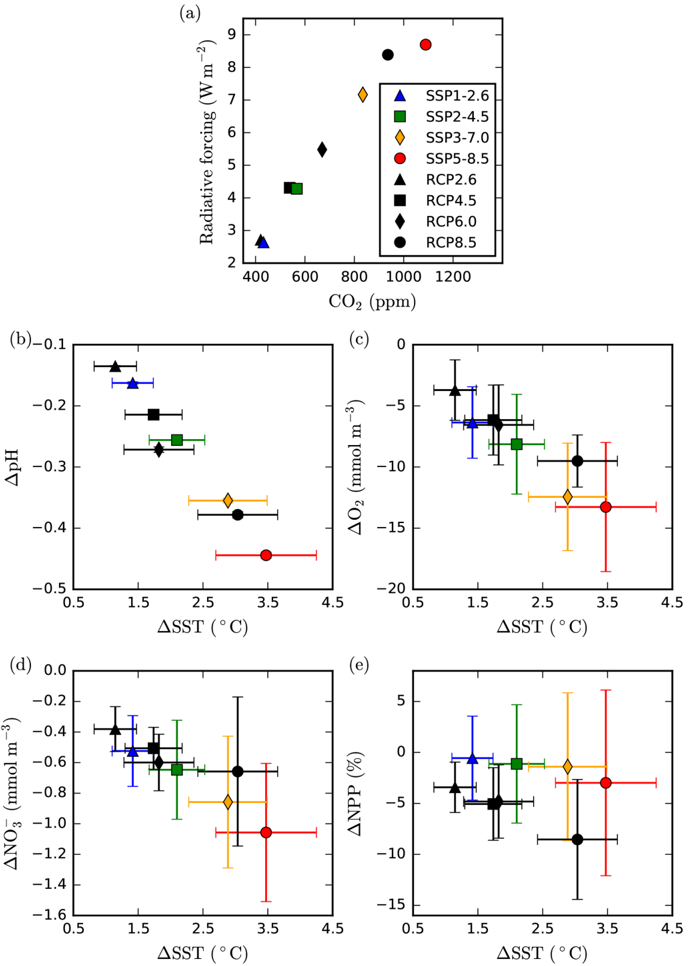
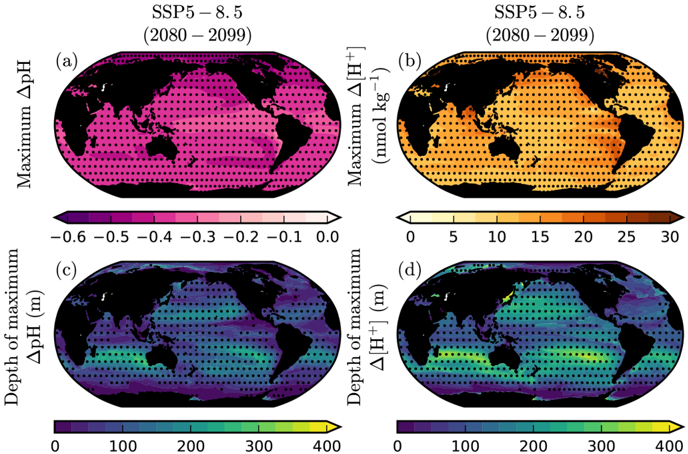
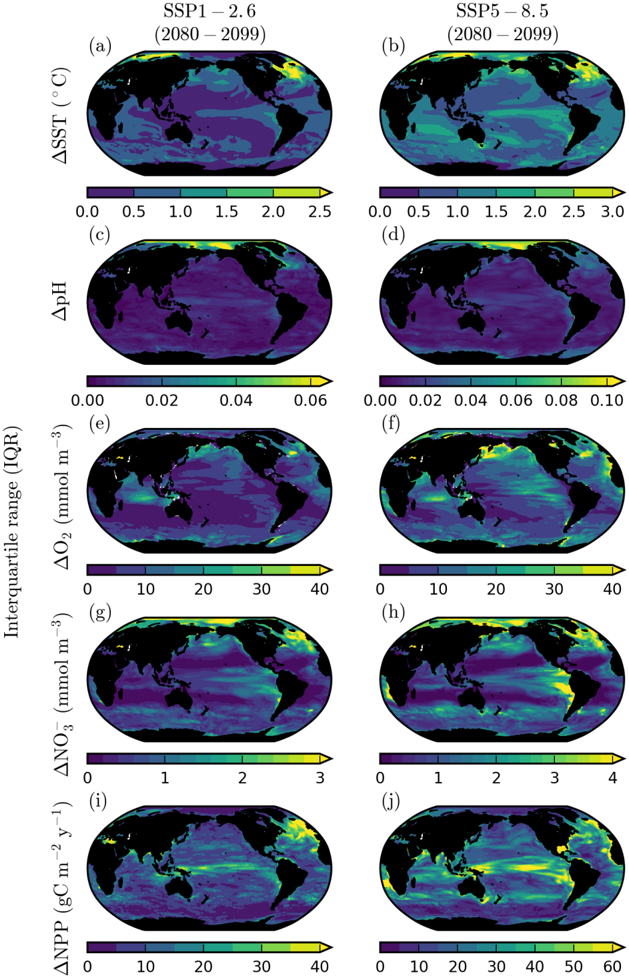
Anthropogenic climate change is projected to lead to ocean warming, acidification, deoxygenation, reductions in near-surface nutrients, and changes to primary production, all of which are expected to affect marine ecosystems. Here we assess projections of these drivers of environmental change over the twenty-first century from Earth system models (ESMs) participating in the Coupled Model Intercomparison Project Phase 6 (CMIP6) that were forced under the CMIP6 Shared Socioeconomic Pathways (SSPs). Projections are compared to those from the previous generation (CMIP5) forced under the Representative Concentration Pathways (RCPs). A total of 10 CMIP5 and 13 CMIP6 models are used in the two multi-model ensembles. Under the high-emission scenario SSP5-8.5, the multi-model global mean change (2080–2099 mean values relative to 1870–1899) ± the inter-model SD in sea surface temperature, surface pH, subsurface (100–600 m) oxygen concentration, euphotic (0–100 m) nitrate concentration, and depth-integrated primary production is +3.47±0.78 ∘ C, -0.44±0.005, -13.27±5.28, -1.06±0.45 mmol m −3 and -2.99±9.11 %, respectively. Under the low-emission, high-mitigation scenario SSP1-2.6, the corresponding global changes are +1.42±0.32 ∘ C, -0.16±0.002, -6.36±2.92, -0.52±0.23 mmol m −3 , and -0.56±4.12 %. Projected exposure of the marine ecosystem to these drivers of ocean change depends largely on the extent of future emissions, consistent with previous studies. The ESMs in CMIP6 generally project greater warming, acidification, deoxygenation, and nitrate reductions but lesser primary production declines than those from CMIP5 under comparable radiative forcing. The increased projected ocean warming results from a general increase in the climate sensitivity of CMIP6 models relative to those of CMIP5. This enhanced warming increases upper-ocean stratification in CMIP6 projections, which contributes to greater reductions in upper-ocean nitrate and subsurface oxygen ventilation. The greater surface acidification in CMIP6 is primarily a consequence of the SSPs having higher associated atmospheric CO 2 concentrations than their RCP analogues for the same radiative forcing. We find no consistent reduction in inter-model uncertainties, and even an increase in net primary production inter-model uncertainties in CMIP6, as compared to CMIP5.
Overview
The claims and statistics of this paper haven’t been checked yet.
Free: it reads the open-access text and checks the first 5 claims that cite a source we can check. Create a free account to check every claim.
Integrity signals
Registry
Cites
Statistics
Figures
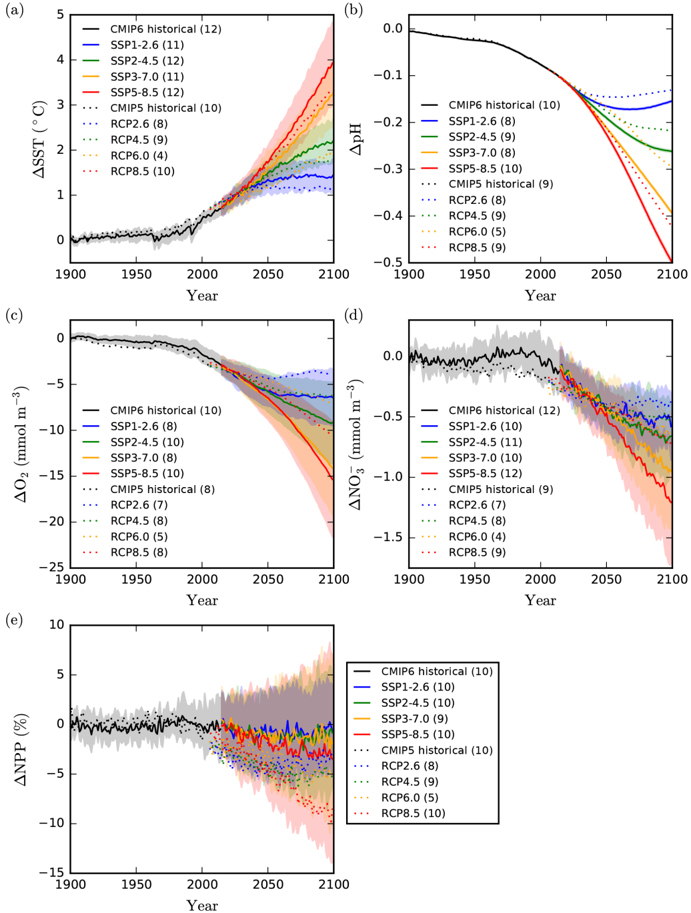
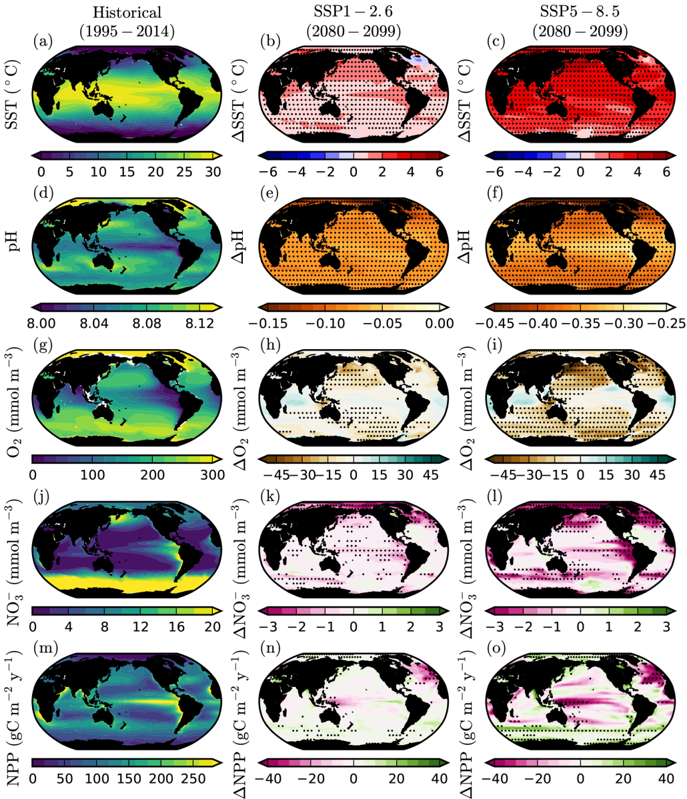
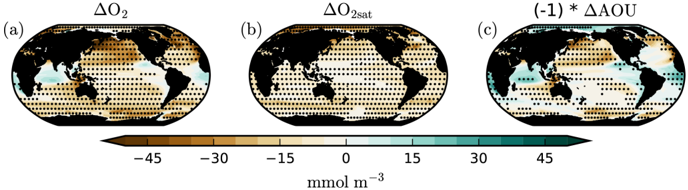
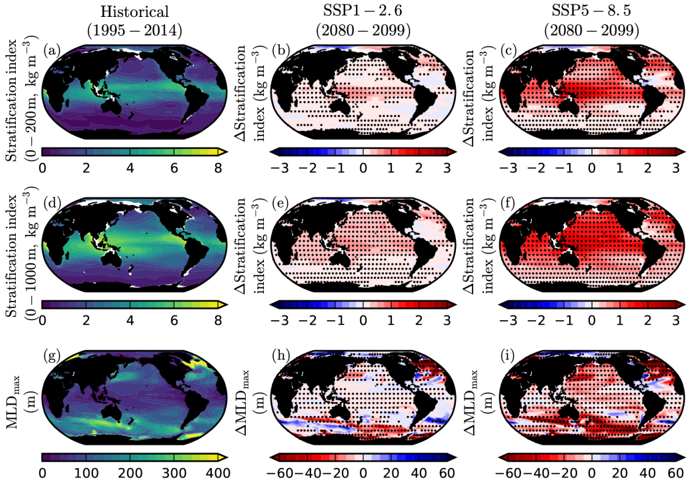
Verification
Claims the paper makes
The claims and statistics of this paper haven’t been checked yet.
Free: it reads the open-access text and checks the first 5 claims that cite a source we can check. Create a free account to check every claim.
Claims other papers make about this one
Each is checked against this paper’s own text: does it say what the citing paper says it does?
The cited source says what the claim attributes to it.
In the citing paper
“Models used by the IPCC do not even agree on the direction of change in NPP in response to climate change (89).”
From Earth beyond six of nine planetary boundaries (2023) · cites this paper as [89]
Self-check
Percentages, sums and reported differences re-computed from the paper’s own numbers.
The self-check needs the paper’s full text.
Citations
Cites
An Overview of CMIP5 and the Experiment Design
Taylor, K. E., Stouffer, R. J., & Meehl, G. A. (2012) · Bulletin of the American Meteorological Society · doi:10.1175/bams-d-11-00094.1 · Cited by 14,052 · cited 2×
“Here we assess future projections of climate-related drivers of marine impacts within the Coupled Model Intercomparison Project Phase 6 (CMIP6; Eyring et al., 2016; O’Neill et al., 2016) simulations, evaluating how these differ from previous CMIP5 (Taylor et al., 2011) simulations.”
MethodEyring, V., Bony, S., Meehl, G. A., Senior, C. A., Stevens, B., Stouffer, R. J., & Taylor, K. E. (2016) · Geoscientific Model Development · doi:10.5194/gmd-9-1937-2016 · Cited by 11,981
Riahi, K., van Vuuren, D. P., Kriegler, E., Edmonds, J., O’Neill, B. C., Fujimori, S., Bauer, N., Calvin, K., Dellink, R., Fricko, O., et al. (2017) · Global Environmental Change · doi:10.1016/j.gloenvcha.2016.05.009 · Cited by 6,607
The Scenario Model Intercomparison Project (ScenarioMIP) for CMIP6
O'Neill, B. C., Tebaldi, C., van Vuuren, D. P., Eyring, V., Friedlingstein, P., Hurtt, G., Knutti, R., Kriegler, E., Lamarque, J.-F., Lowe, J., et al. (2016) · Geoscientific Model Development · doi:10.5194/gmd-9-3461-2016 · Cited by 6,189
Orr, J. C., Fabry, V. J., Aumont, O., Bopp, L., Doney, S. C., Feely, R. A., Gnanadesikan, A., Gruber, N., Ishida, A., Joos, F., et al. (2005) · Nature · doi:10.1038/nature04095 · Cited by 4,590
Self-citationOcean Acidification: The Other CO 2 Problem
Doney, S. C., Fabry, V. J., Feely, R. A., & Kleypas, J. A. (2009) · Annual Review of Marine Science · doi:10.1146/annurev.marine.010908.163834 · Cited by 4,173 · cited 2×
“825 The uptake of carbon by the oceans affects marine chemistry via ocean acidification (Gattuso and Buddemeier, 2000; Orr et al., 2005; Doney et al., 2009), a process that increases seawater concentrations of CO2, H and HCO3, and reduces pH and CO3 ion concentrations.”
BackgroundThe Oceanic Sink for Anthropogenic CO 2
Sabine, C. L., Feely, R. A., Gruber, N., Key, R. M., Lee, K., Bullister, J. L., Wanninkhof, R., Wong, C. S., Wallace, D. W. R., Tilbrook, B., et al. (2004) · Science · doi:10.1126/science.1097403 · Cited by 4,035
The RCP greenhouse gas concentrations and their extensions from 1765 to 2300
Meinshausen, M., Smith, S. J., Calvin, K., Daniel, J. S., Kainuma, M. L. T., Lamarque, J.-F., Matsumoto, K., Montzka, S. A., Raper, S. C. B., Riahi, K., et al. (2011) · Climatic Change · doi:10.1007/s10584-011-0156-z · Cited by 3,584
Declining oxygen in the global ocean and coastal waters
Breitburg, D., Levin, L. A., Oschlies, A., Grégoire, M., Chavez, F. P., Conley, D. J., Garçon, V., Gilbert, D., Gutiérrez, D., Isensee, K., et al. (2018) · Science · doi:10.1126/science.aam7240 · Cited by 3,253
The Community Climate System Model Version 4
Gent, P. R., Danabasoglu, G., Donner, L. J., Holland, M. M., Hunke, E. C., Jayne, S. R., Lawrence, D. M., Neale, R. B., Rasch, P. J., Vertenstein, M., et al. (2011) · Journal of Climate · doi:10.1175/2011jcli4083.1 · Cited by 3,133
Structure and function of the global ocean microbiome
Sunagawa, S., Coelho, L. P., Chaffron, S., Kultima, J. R., Labadie, K., Salazar, G., Djahanschiri, B., Zeller, G., Mende, D. R., Alberti, A., et al. (2015) · Science · doi:10.1126/science.1261359 · Cited by 2,921
A hierarchical approach to defining marine heatwaves
Hobday, A. J., Alexander, L. V., Perkins, S. E., Smale, D. A., Straub, S. C., Oliver, E. C. J., Benthuysen, J. A., Burrows, M. T., Donat, M. G., Feng, M., et al. (2016) · Progress in Oceanography · doi:10.1016/j.pocean.2015.12.014 · Cited by 2,769
Climate-driven trends in contemporary ocean productivity
Behrenfeld, M. J., O’Malley, R. T., Siegel, D. A., McClain, C. R., Sarmiento, J. L., Feldman, G. C., Milligan, A. J., Falkowski, P. G., Letelier, R. M., & Boss, E. S. (2006) · Nature · doi:10.1038/nature05317 · Cited by 2,485 · cited 1×
“This results in a reduction in the supply of nutrients to the euphotic zone, with enhanced nutrient limitation generally leading to observed declines in net primary production (Behrenfeld et al., 2001; Behrenfeld et al., 2006).”
BackgroundThe central role of diminishing sea ice in recent Arctic temperature amplification
Screen, J. A., & Simmonds, I. (2010) · Nature · doi:10.1038/nature09051 · Cited by 2,336 · cited 2×
“be primarily driven by temperature and surface albedo feedbacks (Screen and Simmonds, 2010; Pithan and Mauritsen, 2014).”
BackgroundInfluentialThresholds of hypoxia for marine biodiversity
Vaquer-Sunyer, R., & Duarte, C. M. (2008) · Proceedings of the National Academy of Sciences · doi:10.1073/pnas.0803833105 · Cited by 1,971 · cited 1×
“At low O2 levels, marine animals are unable to sustain aerobic metabolism, which can lead to mortality (Vaquer-Sunyer and Duarte, 2008).”
BackgroundMarine heatwaves under global warming
Frölicher, T. L., Fischer, E. M., & Gruber, N. (2018) · Nature · doi:10.1038/s41586-018-0383-9 · Cited by 1,904 · cited 1×
“Concurrently, the frequency, intensity, and duration of ocean heat waves has increased in the observational record and is projected to substantially increase in the future (Frölicher et al., 2018).”
BackgroundThe shared socio-economic pathway (SSP) greenhouse gas concentrations and their extensions to 2500
Meinshausen, M., Nicholls, Z. R. J., Lewis, J., Gidden, M. J., Vogel, E., Freund, M., Beyerle, U., Gessner, C., Nauels, A., Bauer, N., et al. (2020) · Geoscientific Model Development · doi:10.5194/gmd-13-3571-2020 · Cited by 1,815
Climate change projections using the IPSL-CM5 Earth System Model: from CMIP3 to CMIP5
Dufresne, J.-L., Foujols, M.-A., Denvil, S., Caubel, A., Marti, O., Aumont, O., Balkanski, Y., Bekki, S., Bellenger, H., Benshila, R., et al. (2013) · Climate Dynamics · doi:10.1007/s00382-012-1636-1 · Cited by 1,755
Self-citationMarine heatwaves threaten global biodiversity and the provision of ecosystem services
Smale, D. A., Wernberg, T., Oliver, E. C. J., Thomsen, M., Harvey, B. P., Straub, S. C., Burrows, M. T., Alexander, L. V., Benthuysen, J. A., Donat, M. G., et al. (2019) · Nature Climate Change · doi:10.1038/s41558-019-0412-1 · Cited by 1,748
Ocean Deoxygenation in a Warming World
Keeling, R. F., Körtzinger, A., & Gruber, N. (2010) · Annual Review of Marine Science · doi:10.1146/annurev.marine.010908.163855 · Cited by 1,712
Presentation and Evaluation of the IPSL‐CM6A‐LR Climate Model
Boucher, O., Servonnat, J., Albright, A. L., Aumont, O., Balkanski, Y., Bastrikov, V., Bekki, S., Bonnet, R., Bony, S., Bopp, L., et al. (2020) · Journal of Advances in Modeling Earth Systems · doi:10.1029/2019ms002010 · Cited by 1,694
Self-citationGiorgetta, M. A., Jungclaus, J., Reick, C. H., Legutke, S., Bader, J., Böttinger, M., Brovkin, V., Crueger, T., Esch, M., Fieg, K., et al. (2013) · Journal of Advances in Modeling Earth Systems · doi:10.1002/jame.20038 · Cited by 1,666
Self-citationMultiple stressors of ocean ecosystems in the 21st century: projections with CMIP5 models
Bopp, L., Resplandy, L., Orr, J. C., Doney, S. C., Dunne, J. P., Gehlen, M., Halloran, P., Heinze, C., Ilyina, T., Séférian, R., et al. (2013) · Biogeosciences · doi:10.5194/bg-10-6225-2013 · Cited by 1,649 · cited 31×
“The projected increase in NPP in the high latitudes is, however, broadly consistent with previous model intercomparisons (Steinacher et al., 2010; Bopp et al., 2013), which have attributed these increases to the retreat of sea ice, reduced deep mixing and corresponding reductions in light…”
BackgroundMethodResultInfluentialSelf-citationMeta-analysis reveals negative yet variable effects of ocean acidification on marine organisms
Kroeker, K. J., Kordas, R. L., Crim, R. N., & Singh, G. G. (2010) · Ecology Letters · doi:10.1111/j.1461-0248.2010.01518.x · Cited by 1,621 · cited 2×
“Calcifying species, such as echinoderms, bryozoans, and cnidarians, exhibit depressed calcification, growth, and survival under acidification (Kroeker et al., 2010; Albright et al., 2016; Kwiatkowski et al., 2016), altering the competitive balance in ecosystems (Kroeker et al.”
BackgroundMauritsen, T., Bader, J., Becker, T., Behrens, J., Bittner, M., Brokopf, R., Brovkin, V., Claussen, M., Crueger, T., Esch, M., et al. (2019) · Journal of Advances in Modeling Earth Systems · doi:10.1029/2018ms001400 · Cited by 1,520
Self-citationExpanding Oxygen-Minimum Zones in the Tropical Oceans
Stramma, L., Johnson, G. C., Sprintall, J., & Mohrholz, V. (2008) · Science · doi:10.1126/science.1153847 · Cited by 1,516
Development and evaluation of an Earth-System model – HadGEM2
Collins, W. J., Bellouin, N., Doutriaux-Boucher, M., Gedney, N., Halloran, P., Hinton, T., Hughes, J., Jones, C. D., Joshi, M., Liddicoat, S., et al. (2011) · Geoscientific Model Development · doi:10.5194/gmd-4-1051-2011 · Cited by 1,516
Pörtner, H.-O. (2010) · Journal of Experimental Biology · doi:10.1242/jeb.037523 · Cited by 1,458 · cited 1×
“…impacts on photosynthesis, calcification, reproduction, and survival of marine organisms (Harvey et al., 2013), while compound exposure to acidification and low oxygen can also have synergistic effects (McBryan et al., 2013) and may reduce the thermal tolerance of certain species (Pörtner, 2010).”
BackgroundObservations: Atmosphere and Surface
(2014) · Climate Change 2013 – The Physical Science Basis · doi:10.1017/cbo9781107415324.008 · Cited by 1,430
Decline in global oceanic oxygen content during the past five decades
Schmidtko, S., Stramma, L., & Visbeck, M. (2017) · Nature · doi:10.1038/nature21399 · Cited by 1,398 · cited 4×
“A recent assessment, based on three different analyses (Helm et al., 2011; Schmidtko et al., 2017; Ito et al., 2017), concluded that the oxygen content over the first 1000 m of the”
BackgroundInfluentialThe Canadian Earth System Model version 5 (CanESM5.0.3)
Swart, N. C., Cole, J. N. S., Kharin, V. V., Lazare, M., Scinocca, J. F., Gillett, N. P., Anstey, J., Arora, V., Christian, J. R., Hanna, S., et al. (2019) · Geoscientific Model Development · doi:10.5194/gmd-12-4823-2019 · Cited by 1,386
Self-citationArctic amplification dominated by temperature feedbacks in contemporary climate models
Pithan, F., & Mauritsen, T. (2014) · Nature Geoscience · doi:10.1038/ngeo2071 · Cited by 1,363 · cited 2×
“be primarily driven by temperature and surface albedo feedbacks (Screen and Simmonds, 2010; Pithan and Mauritsen, 2014).”
BackgroundInfluentialDunne, J. P., John, J. G., Adcroft, A. J., Griffies, S. M., Hallberg, R. W., Shevliakova, E., Stouffer, R. J., Cooke, W., Dunne, K. A., Harrison, M. J., et al. (2012) · Journal of Climate · doi:10.1175/jcli-d-11-00560.1 · Cited by 1,349
Self-citationUKESM1: Description and Evaluation of the U.K. Earth System Model
Sellar, A. A., Jones, C. G., Mulcahy, J. P., Tang, Y., Yool, A., Wiltshire, A., O'Connor, F. M., Stringer, M., Hill, R., Palmieri, J., et al. (2019) · Journal of Advances in Modeling Earth Systems · doi:10.1029/2019ms001739 · Cited by 1,335
Self-citationYUKIMOTO, S., KAWAI, H., KOSHIRO, T., OSHIMA, N., YOSHIDA, K., URAKAWA, S., TSUJINO, H., DEUSHI, M., TANAKA, T., HOSAKA, M., et al. (2019) · Journal of the Meteorological Society of Japan. Ser. II · doi:10.2151/jmsj.2019-051 · Cited by 1,127
Self-citationBentsen, M., Bethke, I., Debernard, J. B., Iversen, T., Kirkevåg, A., Seland, Ø., Drange, H., Roelandt, C., Seierstad, I. A., Hoose, C., et al. (2013) · Geoscientific Model Development · doi:10.5194/gmd-6-687-2013 · Cited by 1,084
GARRABOU, J., COMA, R., BENSOUSSAN, N., BALLY, M., CHEVALDONNÉ, P., CIGLIANO, M., DIAZ, D., HARMELIN, J. G., GAMBI, M. C., KERSTING, D. K., et al. (2009) · Global Change Biology · doi:10.1111/j.1365-2486.2008.01823.x · Cited by 1,049
The oceanic sink for anthropogenic CO 2 from 1994 to 2007
Gruber, N., Clement, D., Carter, B. R., Feely, R. A., van Heuven, S., Hoppema, M., Ishii, M., Key, R. M., Kozyr, A., Lauvset, S. K., et al. (2019) · Science · doi:10.1126/science.aau5153 · Cited by 990 · cited 1×
“The oceans have absorbed approximately 30 % of anthropogenic carbon emissions since the pre-industrial era (Sabine et al., 2004; Khatiwala et al., 2009, 2013; Gruber et al., 2019), resulting in global surface pH declines of approximately 0.1 units (Bindoff et al., 2007).”
BackgroundInfluentialDunne, J. P., Horowitz, L. W., Adcroft, A. J., Ginoux, P., Held, I. M., John, J. G., Krasting, J. P., Malyshev, S., Naik, V., Paulot, F., et al. (2020) · Journal of Advances in Modeling Earth Systems · doi:10.1029/2019ms002015 · Cited by 982
Self-citationSéférian, R., Nabat, P., Michou, M., Saint‐Martin, D., Voldoire, A., Colin, J., Decharme, B., Delire, C., Berthet, S., Chevallier, M., et al. (2019) · Journal of Advances in Modeling Earth Systems · doi:10.1029/2019ms001791 · Cited by 920
Self-citationClimate model genealogy: Generation CMIP5 and how we got there
Knutti, R., Masson, D., & Gettelman, A. (2013) · Geophysical Research Letters · doi:10.1002/grl.50256 · Cited by 918 · cited 1×
“However, within the CMIP6 ensemble two modelling groups contributed two ESMs and within the CMIP5 ensemble three modelling groups contributed two ESMs, which is likely to influence the extent of model independence (Masson and Knutti, 2011; Knutti et al., 2015; Sanderson et al., 2015; Lovenduski and Bonan, 2017).”
MethodResponse of ocean ecosystems to climate warming
Sarmiento, J. L., Slater, R., Barber, R., Bopp, L., Doney, S. C., Hirst, A. C., Kleypas, J., Matear, R., Mikolajewicz, U., Monfray, P., et al. (2004) · Global Biogeochemical Cycles · doi:10.1029/2003gb002134 · Cited by 908 · cited 1×
“Earth system model projections consistently show enhanced stratification and associated reductions in euphotic zone nutrient concentrations under scenarios of climate change (Bopp et al., 2001; Sarmiento et al., 2004; Cabré et al., 2014; Fu et al., 2016).”
BackgroundSelf-citationA Global Pattern of Thermal Adaptation in Marine Phytoplankton
Thomas, M. K., Kremer, C. T., Klausmeier, C. A., & Litchman, E. (2012) · Science · doi:10.1126/science.1224836 · Cited by 897 · cited 3×
“While certain marine organisms may have the potential to acclimate to rising ocean temperatures, poleward range shifts of many species have already been observed (Gregory et al., 2009; Sorte et al., 2010), with associated declines in tropical diversity projected (Thomas et al., 2012).”
BackgroundEcosystem effects of ocean acidification in times of ocean warming: a physiologist’s view
Pörtner, H. (2008) · Marine Ecology Progress Series · doi:10.3354/meps07768 · Cited by 864
A Higher‐resolution Version of the Max Planck Institute Earth System Model (MPI‐ESM1.2‐HR)
Müller, W. A., Jungclaus, J. H., Mauritsen, T., Baehr, J., Bittner, M., Budich, R., Bunzel, F., Esch, M., Ghosh, R., Haak, H., et al. (2018) · Journal of Advances in Modeling Earth Systems · doi:10.1029/2017ms001217 · Cited by 810
Self-citationForcing, feedbacks and climate sensitivity in CMIP5 coupled atmosphere‐ocean climate models
Andrews, T., Gregory, J. M., Webb, M. J., & Taylor, K. E. (2012) · Geophysical Research Letters · doi:10.1029/2012gl051607 · Cited by 779 · cited 1×
“Historically, such differences have been attributed to diversity in cloud feedbacks and to a lesser extent water vapour and lapse-rate feedbacks (Andrews et al., 2012; Vial et al., 2013).”
BackgroundClimate change tightens a metabolic constraint on marine habitats
Deutsch, C., Ferrel, A., Seibel, B., Pörtner, H.-O., & Huey, R. B. (2015) · Science · doi:10.1126/science.aaa1605 · Cited by 747 · cited 2×
“For example, the combined effect of 855 warming and deoxygenation is projected to force poleward and vertical contractions of metabolically viable habitat for marine ectotherms (Deutsch et al., 2015).”
BackgroundFossil-fueled development (SSP5): An energy and resource intensive scenario for the 21st century
Kriegler, E., Bauer, N., Popp, A., Humpenöder, F., Leimbach, M., Strefler, J., Baumstark, L., Bodirsky, B. L., Hilaire, J., Klein, D., et al. (2017) · Global Environmental Change · doi:10.1016/j.gloenvcha.2016.05.015 · Cited by 735
Ocean acidification impairs olfactory discrimination and homing ability of a marine fish
Munday, P. L., Dixson, D. L., Donelson, J. M., Jones, G. P., Pratchett, M. S., Devitsina, G. V., & Døving, K. B. (2009) · Proceedings of the National Academy of Sciences · doi:10.1073/pnas.0809996106 · Cited by 713
Reconstruction of the history of anthropogenic CO2 concentrations in the ocean
Khatiwala, S., Primeau, F., & Hall, T. (2009) · Nature · doi:10.1038/nature08526 · Cited by 675 · cited 1×
“The oceans have absorbed approximately 30 % of anthropogenic carbon emissions since the pre-industrial era (Sabine et al., 2004; Khatiwala et al., 2009, 2013; Gruber et al., 2019), resulting in global surface pH declines of approximately 0.1 units (Bindoff et al., 2007).”
BackgroundInfluentialDominance of the Southern Ocean in Anthropogenic Carbon and Heat Uptake in CMIP5 Models
Frölicher, T. L., Sarmiento, J. L., Paynter, D. J., Dunne, J. P., Krasting, J. P., & Winton, M. (2015) · Journal of Climate · doi:10.1175/jcli-d-14-00117.1 · Cited by 672
Self-citationHajima, T., Watanabe, M., Yamamoto, A., Tatebe, H., Noguchi, M. A., Abe, M., Ohgaito, R., Ito, A., Yamazaki, D., Okajima, H., et al. (2020) · Geoscientific Model Development · doi:10.5194/gmd-13-2197-2020 · Cited by 671
Self-citationGunderson, A. R., Armstrong, E. J., & Stillman, J. H. (2016) · Annual Review of Marine Science · doi:10.1146/annurev-marine-122414-033953 · Cited by 666 · cited 1×
“At the physiological level, experimental studies indicate that synergistic effects between potential marine stressors are common (Gunderson et al., 2016).”
BackgroundBiospheric Primary Production During an ENSO Transition
Behrenfeld, M. J., Randerson, J. T., McClain, C. R., Feldman, G. C., Los, S. O., Tucker, C. J., Falkowski, P. G., Field, C. B., Frouin, R., Esaias, W. E., et al. (2001) · Science · doi:10.1126/science.1055071 · Cited by 649
The Australian Earth System Model: ACCESS-ESM1.5
Ziehn, T., Chamberlain, M. A., Law, R. M., Lenton, A., Bodman, R. W., Dix, M., Stevens, L., Wang, Y.-P., & Srbinovsky, J. (2020) · Journal of Southern Hemisphere Earth Systems Science · doi:10.1071/es19035 · Cited by 640
Self-citationProjected 21st century decrease in marine productivity: a multi-model analysis
Steinacher, M., Joos, F., Frölicher, T. L., Bopp, L., Cadule, P., Cocco, V., Doney, S. C., Gehlen, M., Lindsay, K., Moore, J. K., et al. (2010) · Biogeosciences · doi:10.5194/bg-7-979-2010 · Cited by 634
Self-citationGregory, J. M., Dixon, K. W., Stouffer, R. J., Weaver, A. J., Driesschaert, E., Eby, M., Fichefet, T., Hasumi, H., Hu, A., Jungclaus, J. H., et al. (2005) · Geophysical Research Letters · doi:10.1029/2005gl023209 · Cited by 607 · cited 1×
“Conversely, benthic pH changes are strongly influenced by ocean circulation, which transports anthropogenic carbon from the upper ocean to the seafloor and is variably impacted by climate change across models (e.g. Gregory et al., 2005; Cheng et al., 2013).”
BackgroundLotze, H. K., Tittensor, D. P., Bryndum-Buchholz, A., Eddy, T. D., Cheung, W. W. L., Galbraith, E. D., Barange, M., Barrier, N., Bianchi, D., Blanchard, J. L., et al. (2019) · Proceedings of the National Academy of Sciences · doi:10.1073/pnas.1900194116 · Cited by 603
Self-citationStructure and Performance of GFDL's CM4.0 Climate Model
Held, I. M., Guo, H., Adcroft, A., Dunne, J. P., Horowitz, L. W., Krasting, J., Shevliakova, E., Winton, M., Zhao, M., Bushuk, M., et al. (2019) · Journal of Advances in Modeling Earth Systems · doi:10.1029/2019ms001829 · Cited by 594
Self-citationMarine range shifts and species introductions: comparative spread rates and community impacts
Sorte, C. J. B., Williams, S. L., & Carlton, J. T. (2010) · Global Ecology and Biogeography · doi:10.1111/j.1466-8238.2009.00519.x · Cited by 589 · cited 1×
“While certain marine organisms may have the potential to acclimate to rising ocean temperatures, poleward range shifts of many species have already been observed (Gregory et al., 2009; Sorte et al., 2010), with associated declines in tropical diversity projected (Thomas et al., 2012).”
BackgroundPotential impact of climate change on marine export production
Bopp, L., Monfray, P., Aumont, O., Dufresne, J., Le Treut, H., Madec, G., Terray, L., & Orr, J. C. (2001) · Global Biogeochemical Cycles · doi:10.1029/1999gb001256 · Cited by 581 · cited 1×
“Earth system model projections consistently show enhanced stratification and associated reductions in euphotic zone nutrient concentrations under scenarios of climate change (Bopp et al., 2001; Sarmiento et al., 2004; Cabré et al., 2014; Fu et al., 2016).”
BackgroundSelf-citationDrivers and mechanisms of ocean deoxygenation.
Oschlies, A., Brandt, P., Stramma, L., & Schmidtko, S. (2018) · Nature Geoscience · doi:10.1038/s41561-018-0152-2 · Cited by 565 · cited 7×
“The enhanced subsurface deoxygenation in the SSPs relative to comparable RCPs is likely the consequence of both physical and biogeochemical processes (e.g. Bopp et al., 2017; Oschlies et al., 2018).”
BackgroundInfluentialGlobal ocean storage of anthropogenic carbon
Khatiwala, S., Tanhua, T., Mikaloff Fletcher, S., Gerber, M., Doney, S. C., Graven, H. D., Gruber, N., McKinley, G. A., Murata, A., Ríos, A. F., et al. (2013) · Biogeosciences · doi:10.5194/bg-10-2169-2013 · Cited by 552
How fast are the oceans warming?
Cheng, L., Abraham, J., Hausfather, Z., & Trenberth, K. E. (2019) · Science · doi:10.1126/science.aav7619 · Cited by 544 · cited 1×
“Globally averaged sea surface temperature (SST) has increased by +0.7 ◦C over the last 100 years (Bindoff et al., 2007), with observations indicating that the heat content trend in the upper 2000 m of the ocean has increased from 0.55 to 0.68 Jm−2 s−1 since 1991 (Cheng et al., 2019).”
BackgroundInfluentialBekryaev, R. V., Polyakov, I. V., & Alexeev, V. A. (2010) · Journal of Climate · doi:10.1175/2010jcli3297.1 · Cited by 535
On the interpretation of inter-model spread in CMIP5 climate sensitivity estimates
Vial, J., Dufresne, J.-L., & Bony, S. (2013) · Climate Dynamics · doi:10.1007/s00382-013-1725-9 · Cited by 524 · cited 1×
“Historically, such differences have been attributed to diversity in cloud feedbacks and to a lesser extent water vapour and lapse-rate feedbacks (Andrews et al., 2012; Vial et al., 2013).”
BackgroundHarvey, B. P., Gwynn‐Jones, D., & Moore, P. J. (2013) · Ecology and Evolution · doi:10.1002/ece3.516 · Cited by 515 · cited 2×
“Compound warming and acidification has been shown to exacerbate negative impacts on photosynthesis, calcification, reproduction, and survival of marine organisms (Harvey et al., 2013), while compound exposure to acidification and low oxygen can also have synergistic effects (McBryan et al.”
BackgroundSteinacher, M., Joos, F., Frölicher, T. L., Plattner, G.-K., & Doney, S. C. (2009) · Biogeosciences · doi:10.5194/bg-6-515-2009 · Cited by 510
Physical and biogeochemical modulation of ocean acidification in the central North Pacific
Dore, J. E., Lukas, R., Sadler, D. W., Church, M. J., & Karl, D. M. (2009) · Proceedings of the National Academy of Sciences · doi:10.1073/pnas.0906044106 · Cited by 504 · cited 4×
“Enhanced acidification in subsurface mode and intermediate waters has been observed at time series stations (Dore et al., 2009; Byrne et al., 2010; Bates et al., 2012) and in CMIP5 model projections (Resplandy et al., 2013; Bopp et al., 2013; Watanabe and Kawamiya, 2017).”
BackgroundInfluentialDoney, S. C. (2006) · Nature · doi:10.1038/444695a · Cited by 475 · cited 2×
“Such changes have historically been associated with https://doi.org/10.5194/bg-17-3439-2020 Biogeosciences, 17, 3439–3470, 2020 Biogeosciences, 17, 3439–3470, 2020 https://doi.org/10.5194/bg-17-3439-2020 enhanced stratification as the upper ocean warms (Doney, 2006).”
BackgroundInfluentialSustained climate warming drives declining marine biological productivity
Moore, J. K., Fu, W., Primeau, F., Britten, G. L., Lindsay, K., Long, M., Doney, S. C., Mahowald, N., Hoffman, F., & Randerson, J. T. (2018) · Science · doi:10.1126/science.aao6379 · Cited by 439 · cited 1×
“This generally results in projected global reductions in net primary production that are driven by enhanced phytoplankton nutrient limitation in the low-latitude oceans (Steinacher et al., 2010; Bopp et al., 2013; Krumhardt et al. 2017; Kwiatkowski et al., 2017; Moore et al., 2018).”
BackgroundMajor impacts of climate change on deep-sea benthic ecosystems
Sweetman, A. K., Thurber, A. R., Smith, C. R., Levin, L. A., Mora, C., Wei, C.-L., Gooday, A. J., Jones, D. O. B., Rex, M., Yasuhara, M., et al. (2017) · Elementa: Science of the Anthropocene · doi:10.1525/elementa.203 · Cited by 430
A Representative Democracy to Reduce Interdependency in a Multimodel Ensemble
Sanderson, B. M., Knutti, R., & Caldwell, P. (2015) · Journal of Climate · doi:10.1175/jcli-d-14-00362.1 · Cited by 407 · cited 2×
“…the CMIP6 ensemble two modelling groups contributed two ESMs and within the CMIP5 ensemble three modelling groups contributed two ESMs, which is likely to influence the extent of model independence (Masson and Knutti, 2011; Knutti et al., 2015; Sanderson et al., 2015; Lovenduski and Bonan, 2017).”
MethodTracking Improvement in Simulated Marine Biogeochemistry Between CMIP5 and CMIP6
Séférian, R., Berthet, S., Yool, A., Palmiéri, J., Bopp, L., Tagliabue, A., Kwiatkowski, L., Aumont, O., Christian, J., Dunne, J., et al. (2020) · Current Climate Change Reports · doi:10.1007/s40641-020-00160-0 · Cited by 407
Self-citationReversal of ocean acidification enhances net coral reef calcification
Albright, R., Caldeira, L., Hosfelt, J., Kwiatkowski, L., Maclaren, J. K., Mason, B. M., Nebuchina, Y., Ninokawa, A., Pongratz, J., Ricke, K. L., et al. (2016) · Nature · doi:10.1038/nature17155 · Cited by 399
Self-citationSchmittner, A., Oschlies, A., Matthews, H. D., & Galbraith, E. D. (2008) · Global Biogeochemical Cycles · doi:10.1029/2007gb002953 · Cited by 395 · cited 2×
“…and the large increase in inter-model SD. Global increases in net primary production have been previously documented in other model studies (Schmittner et al., 2008; Taucher and Oschlies, 2011; Laufkötter et al., 2015) and attributed to temperaturedependent intensification of the microbial…”
BackgroundResultObserved decreases in oxygen content of the global ocean: GLOBAL DECREASES IN OCEAN OXYGEN LEVELS
Helm, K. P., Bindoff, N. L., & Church, J. A. (2011) · Geophysical Research Letters · doi:10.1029/2011gl049513 · Cited by 390 · cited 4×
“A recent assessment, based on three different analyses (Helm et al., 2011; Schmidtko et al., 2017; Ito et al., 2017), concluded that the oxygen content over the first 1000 m of the”
BackgroundInfluentialHow well do global ocean biogeochemistry models simulate dissolved iron distributions?
Tagliabue, A., Aumont, O., DeAth, R., Dunne, J. P., Dutkiewicz, S., Galbraith, E., Misumi, K., Moore, J. K., Ridgwell, A., Sherman, E., et al. (2016) · Global Biogeochemical Cycles · doi:10.1002/2015gb005289 · Cited by 371 · cited 1×
“The accurate simulation of many of the biogeochemical tracers upon which net primary production (NPP) depends (e.g. the distribution of iron; Tagliabue et al., 2016) represents a significant and ongoing challenge to ESMs (Séférian et al., 2020).”
BackgroundSelf-citationAtlantic Meridional Overturning Circulation (AMOC) in CMIP5 Models: RCP and Historical Simulations
Cheng, W., Chiang, J. C. H., & Zhang, D. (2013) · Journal of Climate · doi:10.1175/jcli-d-12-00496.1 · Cited by 370 · cited 1×
“Conversely, benthic pH changes are strongly influenced by ocean circulation, which transports anthropogenic carbon from the upper ocean to the seafloor and is variably impacted by climate change across models (e.g. Gregory et al., 2005; Cheng et al., 2013).”
BackgroundDrivers and uncertainties of future global marine primary production in marine ecosystem models
Laufkötter, C., Vogt, M., Gruber, N., Aita-Noguchi, M., Aumont, O., Bopp, L., Buitenhuis, E., Doney, S. C., Dunne, J., Hashioka, T., et al. (2015) · Biogeosciences · doi:10.5194/bg-12-6955-2015 · Cited by 369
Self-citationClimate-Forced Variability of Ocean Hypoxia
Deutsch, C., Brix, H., Ito, T., Frenzel, H., & Thompson, L. (2011) · Science · doi:10.1126/science.1202422 · Cited by 367 · cited 1×
“…2008; Helm et al., 2011; Schmidtko et al., 2017; Ito et al., 2017), with an assessed range of 3.0 to 8.3 % between 1970 and 2010 (Bindoff et al., in press), though it has been suggested that such observations are the result of climate variability (Deutsch et al., 2011; Bindoff et al., in press).”
BackgroundInfluentialThe deep ocean under climate change
Levin, L. A., & Le Bris, N. (2015) · Science · doi:10.1126/science.aad0126 · Cited by 366
(2011) · Oxford University Press eBooks · doi:10.1093/oso/9780199591091.001.0001 · Cited by 351
Enhanced upper ocean stratification with climate change in the CMIP3 models
Capotondi, A., Alexander, M. A., Bond, N. A., Curchitser, E. N., & Scott, J. D. (2012) · Journal of Geophysical Research: Oceans · doi:10.1029/2011jc007409 · Cited by 350 · cited 1×
“…important for ecosystem projections as it directly affects simulated stratification, a key factor influencing changes in ocean impact drivers (Capotondi et al., 2012; Bopp et al., 2013; Laufkötter et al., 2015; Kwiatkowski et al., 2017) and their impact on higher trophic levels (Stock et…”
BackgroundMasson, D., & Knutti, R. (2011) · Geophysical Research Letters · doi:10.1029/2011gl046864 · Cited by 345
Aragonite Undersaturation in the Arctic Ocean: Effects of Ocean Acidification and Sea Ice Melt
Yamamoto-Kawai, M., McLaughlin, F. A., Carmack, E. C., Nishino, S., & Shimada, K. (2009) · Science · doi:10.1126/science.1174190 · Cited by 339 · cited 2×
“Sea ice melt increases 355 anthropogenic carbon uptake and decreases pH by both providing a greater surface area for air-sea gas exchange and simultaneously enhancing air-sea CO2 fluxes by dilution of ocean dissolved inorganic carbon concentrations with freshwater (Yamamoto-Kawai et al., 2009; Yamamoto et al., 2012).”
BackgroundOcean acidification causes ecosystem shifts via altered competitive interactions
Kroeker, K. J., Micheli, F., & Gambi, M. C. (2013) · Nature Climate Change · doi:10.1038/nclimate1680 · Cited by 332 · cited 2×
“, 2016), altering the competitive balance in ecosystems (Kroeker et al., 2013).”
BackgroundDrijfhout, S., van Oldenborgh, G. J., & Cimatoribus, A. (2012) · Journal of Climate · doi:10.1175/jcli-d-12-00490.1 · Cited by 329 · cited 2×
“As in the surface ocean, this cooling is likely associated with a slow down of the Atlantic meridional overturning circulation (Drijfhout et al., 2012; Menary and Wood, 2018).”
BackgroundThe Dynamics of the Marine Nitrogen Cycle and its Influence on Atmospheric CO2 Variations
Gruber, N. (2004) · The Ocean Carbon Cycle and Climate · doi:10.1007/978-1-4020-2087-2_4 · Cited by 305 · cited 1×
“Oxygen levels also affect many oceanic biogeochemical cycles through an impact on redox reactions and microbial metabolism (e.g. on the nitrogen cycle, Gruber, 2004).”
BackgroundAlexander, M. A., Scott, J. D., Friedland, K. D., Mills, K. E., Nye, J. A., Pershing, A. J., & Thomas, A. C. (2018) · Elementa: Science of the Anthropocene · doi:10.1525/elementa.191 · Cited by 300 · cited 2×
“5 are consistent with previous projections from the CMIP5 models (Carton et al., 2015; Alexander et al., 2018).”
BackgroundMethodRapid biogeographical plankton shifts in the North Atlantic Ocean
GREGORY, B., CHRISTOPHE, L., & MARTIN, E. (2009) · Global Change Biology · doi:10.1111/j.1365-2486.2009.01848.x · Cited by 294 · cited 2×
“While certain marine organisms may have the potential to acclimate to rising ocean temperatures, poleward range shifts of many species have already been observed (Gregory et al., 2009; Sorte et al., 2010), with associated declines in tropical diversity projected (Thomas et al., 2012).”
BackgroundThe large‐scale energy budget of the Arctic
Serreze, M. C., Barrett, A. P., Slater, A. G., Steele, M., Zhang, J., & Trenberth, K. E. (2007) · Journal of Geophysical Research: Atmospheres · doi:10.1029/2006jd008230 · Cited by 283 · cited 2×
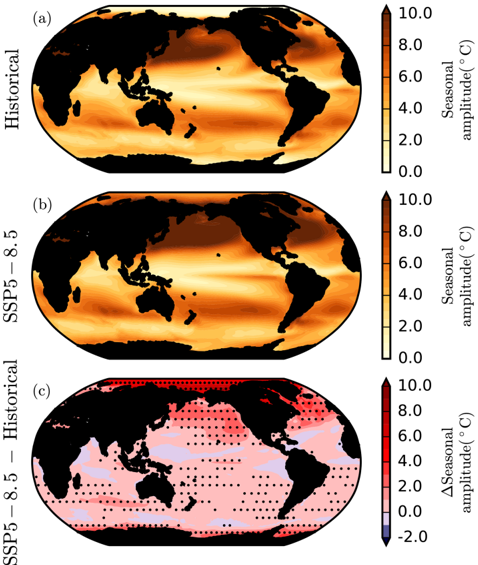
“Ice loss further amplifies the seasonal cycle of SSTs by increasing the seasonal cycle of net surface heat fluxes.”
BackgroundFu, W., Randerson, J. T., & Moore, J. K. (2016) · Biogeosciences · doi:10.5194/bg-13-5151-2016 · Cited by 279 · cited 5×
“The CMIP6 spatial pattern of euphotic-zone NO−3 anomalies is in broad agreement with CMIP5 projections (Fu et al., 2016).”
BackgroundInfluentialMRI MRI-ESM2.0 model output prepared for CMIP6 CMIP
Yukimoto, S., Koshiro, T., Kawai, H., Oshima, N., Yoshida, K., Urakawa, S., Tsujino, H., Deushi, M., Tanaka, T., Hosaka, M., et al. (2019) · Earth System Grid Federation · doi:10.22033/esgf/cmip6.621 · Cited by 279
Self-citationMOHC UKESM1.0-LL model output prepared for CMIP6 CMIP
Tang, Y., Rumbold, S., Ellis, R., Kelley, D., Mulcahy, J. P., Sellar, A., Walton, J. P. R. B., & Jones, C. (2019) · Earth System Grid Federation · doi:10.22033/esgf/cmip6.1569 · Cited by 272
Biogeochemical protocols and diagnostics for the CMIP6 Ocean Model Intercomparison Project (OMIP)
Orr, J. C., Najjar, R. G., Aumont, O., Bopp, L., Bullister, J. L., Danabasoglu, G., Doney, S. C., Dunne, J. P., Dutay, J.-C., Graven, H., et al. (2017) · Geoscientific Model Development · doi:10.5194/gmd-10-2169-2017 · Cited by 266
Self-citationMcBryan, T. L., Anttila, K., Healy, T. M., & Schulte, P. M. (2013) · Integrative and Comparative Biology · doi:10.1093/icb/ict066 · Cited by 261 · cited 2×
“, 2013), while compound exposure to acidification and low oxygen can also have synergistic effects (McBryan et al., 2013) and may reduce the thermal tolerance of certain species (Pörtner, 2010).”
BackgroundUpper ocean O2 trends: 1958–2015
Ito, T., Minobe, S., Long, M. C., & Deutsch, C. (2017) · Geophysical Research Letters · doi:10.1002/2017gl073613 · Cited by 249 · cited 4×
“A recent assessment, based on three different analyses (Helm et al., 2011; Schmidtko et al., 2017; Ito et al., 2017), concluded that the oxygen content over the first 1000 m of the”
BackgroundInfluentialDetecting anthropogenic carbon dioxide uptake and ocean acidification in the North Atlantic Ocean
Bates, N. R., Best, M. H. P., Neely, K., Garley, R., Dickson, A. G., & Johnson, R. J. (2012) · Biogeosciences · doi:10.5194/bg-9-2509-2012 · Cited by 246 · cited 2×
“Enhanced acidification in subsurface mode and intermediate waters has been observed at time series stations (Dore et al., 2009; Byrne et al., 2010; Bates et al., 2012) and in CMIP5 model projections (Resplandy et al., 2013; Bopp et al., 2013; Watanabe and Kawamiya, 2017).”
BackgroundDirect observations of basin‐wide acidification of the North Pacific Ocean
Byrne, R. H., Mecking, S., Feely, R. A., & Liu, X. (2010) · Geophysical Research Letters · doi:10.1029/2009gl040999 · Cited by 242 · cited 2×
“Enhanced acidification in subsurface mode and intermediate waters has been observed at time series stations (Dore et al., 2009; Byrne et al., 2010; Bates et al., 2012) and in CMIP5 model projections (Resplandy et al., 2013; Bopp et al., 2013; Watanabe and Kawamiya, 2017).”
BackgroundTaucher, J., & Oschlies, A. (2011) · Geophysical Research Letters · doi:10.1029/2010gl045934 · Cited by 237 · cited 4×
“…ensembles (Bopp et al., 2013; Krumhardt et al., 2017), in part due to concurrent changes in phytoplankton light and temperature limitation, as well as altered top-down grazing, all of which can compensate for nutrient-driven production declines (Taucher and Oschlies, 2011; Laufkötter et al., 2015).”
BackgroundResultInfluentialBiomass changes and trophic amplification of plankton in a warmer ocean
Chust, G., Allen, J. I., Bopp, L., Schrum, C., Holt, J., Tsiaras, K., Zavatarelli, M., Chifflet, M., Cannaby, H., Dadou, I., et al. (2014) · Global Change Biology · doi:10.1111/gcb.12562 · Cited by 234
Self-citationLatest climate models confirm need for urgent mitigation
Forster, P. M., Maycock, A. C., McKenna, C. M., & Smith, C. J. (2020) · Nature Climate Change · doi:10.1038/s41558-019-0660-0 · Cited by 232 · cited 1×
“This enhanced CMIP6 warming is attributable to generally greater climate sensitivity in the CMIP6 model ensemble relative to the CMIP5 ensemble (Forster et al., 2019).”
BackgroundCabré, A., Marinov, I., Bernardello, R., & Bianchi, D. (2015) · Biogeosciences · doi:10.5194/bg-12-5429-2015 · Cited by 208 · cited 2×
“Earth System model projections consistently show continuing declines in oxygen over the twenty-first century as a function of the employed scenario (Bopp et al., 2013; Cocco et al., 2013), with large uncertainties in the tropics and for the evolution of oxygen minimum zones (Cabré et al., 2015).”
BackgroundStock, C. A., Dunne, J. P., Fan, S., Ginoux, P., John, J., Krasting, J. P., Laufkötter, C., Paulot, F., & Zadeh, N. (2020) · Journal of Advances in Modeling Earth Systems · doi:10.1029/2019ms002043 · Cited by 202 · cited 1×
“(Dunne et al., 2020b; Stock et al., 2020) MOM6, SIS2 COBALTv2 T, pH, O2, NO − 3 , NPP Historical, SSP1-2.”
Self-citationSources of uncertainties in 21st century projections of potential ocean ecosystem stressors
Frölicher, T. L., Rodgers, K. B., Stock, C. A., & Cheung, W. W. L. (2016) · Global Biogeochemical Cycles · doi:10.1002/2015gb005338 · Cited by 201 · cited 3×
“Consequently, we do not assess the role of internal variability in the emergence of climate-related changes in marine ecosystems drivers (e.g. Frölicher et al., 2016; Lovenduski et al., 2016; Krumhardt et al. 2017; Freeman et al., 2018).”
BackgroundSelf-citationNCAR CESM2 model output prepared for CMIP6 CMIP
Gokhan Danabasoglu, C., Lawrence, D., Lindsay, K., Lipscomb, W., & Strand, G. (2019) · Earth System Grid Federation · doi:10.22033/esgf/cmip6.2185 · Cited by 199
MOHC UKESM1.0-LL model output prepared for CMIP6 CMIP historical
Tang, Y., Rumbold, S., Ellis, R., Kelley, D., Mulcahy, J. P., Sellar, A., Walton, J. P. R. B., & Jones, C. (2019) · Earth System Grid Federation · doi:10.22033/esgf/cmip6.6113 · Cited by 196
Emergent constraints on projections of declining primary production in the tropical oceans
Kwiatkowski, L., Bopp, L., Aumont, O., Ciais, P., Cox, P. M., Laufkötter, C., Li, Y., & Séférian, R. (2017) · Nature Climate Change · doi:10.1038/nclimate3265 · Cited by 195 · cited 2×
“…stratification, a key factor influencing changes in ocean impact drivers (Capotondi et al., 2012; Bopp et al., 2013; Laufkötter et al., 2015; Kwiatkowski et al., 2017) and their impact on higher trophic levels (Stock et al., 2014; Chust et al., 2014; Kwiatkowski et al., 2018; Lotze et al.,…”
BackgroundSelf-citationFuture ocean hypercapnia driven by anthropogenic amplification of the natural CO2 cycle
McNeil, B. I., & Sasse, T. P. (2016) · Nature · doi:10.1038/nature16156 · Cited by 193
Strengthening seasonal marine CO2 variations due to increasing atmospheric CO2
Landschützer, P., Gruber, N., Bakker, D. C. E., Stemmler, I., & Six, K. D. (2018) · Nature Climate Change · doi:10.1038/s41558-017-0057-x · Cited by 193 · cited 4×
“, 2013), with associated changes in the seasonal cycles of seawater carbonate chemistry (McNeil and Sasse, 2016; Kwiatkowski and Orr, 2018; Landschützer et al., 2018).”
BackgroundResultInfluentialOcean biogeochemistry in the Norwegian Earth System Model version 2 (NorESM2)
Tjiputra, J. F., Schwinger, J., Bentsen, M., Morée, A. L., Gao, S., Bethke, I., Heinze, C., Goris, N., Gupta, A., He, Y.-C., et al. (2020) · Geoscientific Model Development · doi:10.5194/gmd-13-2393-2020 · Cited by 193
Self-citationBates, N. R., Mathis, J. T., & Cooper, L. W. (2009) · Journal of Geophysical Research Atmospheres · doi:10.1029/2008jc004862 · Cited by 191 · cited 2×
“16 Enhanced acidification in subsurface mode and intermediate waters has been observed at time series stations 605 (Dore et al., 2009; Byrne et al., 2010; Bates et al., 2012) and in CMIP5 model projections (Resplandy et al.”
BackgroundOxygen and indicators of stress for marine life in multi-model global warming projections
Cocco, V., Joos, F., Steinacher, M., Frölicher, T. L., Bopp, L., Dunne, J., Gehlen, M., Heinze, C., Orr, J., Oschlies, A., et al. (2013) · Biogeosciences · doi:10.5194/bg-10-1849-2013 · Cited by 190
Self-citationCNRM-CERFACS CNRM-ESM2-1 model output prepared for CMIP6 CMIP
Séférian, R. (2018) · Earth System Grid Federation · doi:10.22033/esgf/cmip6.1391 · Cited by 186
Self-citationNCAR CESM2-WACCM model output prepared for CMIP6 CMIP
Gokhan Danabasoglu, C. (2019) · Earth System Grid Federation · doi:10.22033/esgf/cmip6.10024 · Cited by 176
MPI-M MPIESM1.2-HR model output prepared for CMIP6 CMIP
Jungclaus, J., Bittner, M., Wieners, K.-H., Wachsmann, F., Schupfner, M., Legutke, S., Giorgetta, M., Reick, C., Gayler, V., Helmuth Haak, G., et al. (2019) · Earth System Grid Federation · doi:10.22033/esgf/cmip6.741 · Cited by 174
Recent and Future Changes in Ocean Carbonate Chemistry
Orr, J. C. (2011) · Ocean Acidification · doi:10.1093/oso/9780199591091.003.0008 · Cited by 173 · cited 6×
“…results from changes in circulation and biological activity (Dore et al., 2009; Byrne et al., 2010), model results indicate that it can be explained by the geochemical effect of rising atmospheric CO2 and the particular carbonate chemistry of these waters (Orr, 2011; Resplandy et al., 2013).”
BackgroundResultInfluentialSelf-citationDiverging seasonal extremes for ocean acidification during the twenty-first century
Kwiatkowski, L., & Orr, J. C. (2018) · Nature Climate Change · doi:10.1038/s41558-017-0054-0 · Cited by 172 · cited 5×
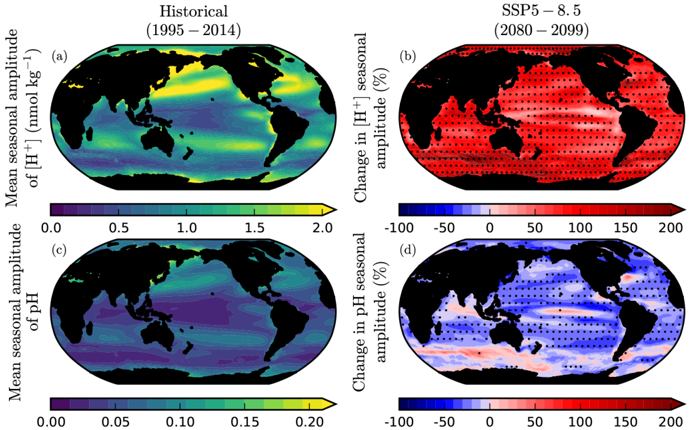
“This affects both the seasonal amplitude of the controlling variables dissolved inorganic carbon and alkalinity, as well the sensitivity of [H+] to seasonal changes in temperature, dissolved inorganic carbon, and alkalinity (Kwiatkowski and Orr, 2018).”
BackgroundResultInfluentialSelf-citationMarine mollusc predator-escape behaviour altered by near-future carbon dioxide levels
Watson, S., Lefevre, S., McCormick, M. I., Domenici, P., Nilsson, G., & Munday, P. L. (2013) · Proceedings of the Royal Society B Biological Sciences · doi:10.1098/rspb.2013.2377 · Cited by 169
Trends and drivers in global surface ocean pH over the past 3 decades
Lauvset, S. K., Gruber, N., Landschützer, P., Olsen, A., & Tjiputra, J. (2015) · Biogeosciences · doi:10.5194/bg-12-1285-2015 · Cited by 168
Self-citationKroeker, K. J., Bell, L. E., Donham, E. M., Hoshijima, U., Lummis, S., Toy, J. A., & Willis‐Norton, E. (2020) · Global Change Biology · doi:10.1111/gcb.14868 · Cited by 163 · cited 1×
“Moreover, the thresholds take no account of regional differences in natural temperature, pH, O2, and NO−3 variability, which may mediate ecosystem responses to changes in mean conditions (e.g. Kroeker et al., 2020).”
BackgroundCabré, A., Marinov, I., & Leung, S. (2015) · Climate Dynamics · doi:10.1007/s00382-014-2374-3 · Cited by 161 · cited 2×
“Earth system model projections consistently show enhanced stratification and associated reductions in euphotic zone nutrient concentrations under scenarios of climate change (Bopp et al., 2001; Sarmiento et al., 2004; Cabré et al., 2014; Fu et al., 2016).”
BackgroundMRI MRI-ESM2.0 model output prepared for CMIP6 CMIP historical
Yukimoto, S., Koshiro, T., Kawai, H., Oshima, N., Yoshida, K., Urakawa, S., Tsujino, H., Deushi, M., Tanaka, T., Hosaka, M., et al. (2019) · Earth System Grid Federation · doi:10.22033/esgf/cmip6.6842 · Cited by 161
Self-citationCCCma CanESM5 model output prepared for CMIP6 CMIP
Swart, N. C., Cole, J. N. S., Kharin, V., Lazare, M., Scinocca, J., Gillett, N. P., Anstey, J., Arora, V. K., Christian, J. R., Jiao, Y., et al. (2019) · Earth System Grid Federation · doi:10.22033/esgf/cmip6.1303 · Cited by 160
Self-citationNCC NorESM2-LM model output prepared for CMIP6 CMIP
Seland, Ø., Bentsen, M., Olivié, D., Toniazzo, T., Gjermundsen, A., Graff, L. S., Debernard, J. B., Gupta, A. K., He, Y., Kirkevåg, A., et al. (2019) · Earth System Grid Federation · doi:10.22033/esgf/cmip6.502 · Cited by 157
Self-citationCCCma CanESM5 model output prepared for CMIP6 ScenarioMIP
Swart, N. C., Cole, J. N. S., Kharin, V., Lazare, M., Scinocca, J., Gillett, N. P., Anstey, J. A., Arora, V. K., Christian, J. R., Jiao, Y., et al. (2019) · Earth System Grid Federation · doi:10.22033/esgf/cmip6.1317 · Cited by 156
Self-citationIPSL IPSL-CM6A-LR model output prepared for CMIP6 CMIP historical
Boucher, O., Denvil, S., Levavasseur, G., Cozic, A., Caubel, A., Foujols, M., Meurdesoif, Y., Cadule, P., Devilliers, M., Ghattas, J., et al. (2018) · Earth System Grid Federation · doi:10.22033/esgf/cmip6.5195 · Cited by 153
Mismatch between observed and modeled trends in dissolved upper-ocean oxygen over the last 50 yr
Stramma, L., Oschlies, A., & Schmidtko, S. (2012) · Biogeosciences · doi:10.5194/bg-9-4045-2012 · Cited by 150 · cited 4×
“These subsurface O2 increases are, however, consistent with previous projections, including those from CMIP5, which have highlighted that coarse-resolution models struggle to reproduce subsurface ventilation pathways in these regions (Stramma et al., 2012; Andrews et al., 2013; Busecke et al., 2019).”
BackgroundResultInfluentialOn the relationship between stratification and primary productivity in the North Atlantic
Lozier, M. S., Dave, A. C., Palter, J. B., Gerber, L. M., & Barber, R. T. (2011) · Geophysical Research Letters · doi:10.1029/2011gl049414 · Cited by 146
Séférian, R., Gehlen, M., Bopp, L., Resplandy, L., Orr, J. C., Marti, O., Dunne, J. P. P., Christian, J. R., Doney, S. C., Ilyina, T., et al. (2016) · Geoscientific model development · doi:10.5194/gmd-9-1827-2016 · Cited by 143
Self-citationNCAR CESM2-WACCM model output prepared for CMIP6 ScenarioMIP
Danabasoglu, G. (2019) · Earth System Grid Federation · doi:10.22033/esgf/cmip6.10026 · Cited by 143
Seamounts as refugia from ocean acidification for cold‐water stony corals
Tittensor, D. P., Baco, A. R., Hall-Spencer, J. M., Orr, J. C., & Rogers, A. D. (2010) · Marine Ecology · doi:10.1111/j.1439-0485.2010.00393.x · Cited by 142 · cited 1×
“Thus, even for bottom waters, CMIP6 projections highlight that intense mitigation strategies can limit ecosystem exposure to potential warming and acidification stress during the twenty-first century (e.g. Tittensor et al., 2010; Levin and Le Bris, 2015).”
BackgroundSelf-citationCSIRO ACCESS-ESM1.5 model output prepared for CMIP6 CMIP
Ziehn, T., Chamberlain, M. A., Lenton, A. A., Law, R. M., Bodman, R. W., Dix, M., Wang, Y., Dobrohotoff, P., Srbinovsky, J., Stevens, L. E., et al. (2019) · Earth System Grid Federation · doi:10.22033/esgf/cmip6.2288 · Cited by 141
Self-citationConsistent trophic amplification of marine biomass declines under climate change
Kwiatkowski, L., Aumont, O., & Bopp, L. (2019) · Global Change Biology · doi:10.1111/gcb.14468 · Cited by 140
Self-citationGattuso, J., & Buddemeier, R. W. (2000) · Nature · doi:10.1038/35030280 · Cited by 139 · cited 1×
“The uptake of carbon by the oceans affects marine chemistry via ocean acidification (Gattuso and Buddemeier, 2000; Orr et al., 2005; Doney et al., 2009), a process that increases seawater concentrations of CO2, H+, and HCO−3 and reduces pH and CO2−3 ion concentrations.”
BackgroundAn anatomy of the projected North Atlantic warming hole in CMIP5 models
Menary, M. B., & Wood, R. (2017) · Climate Dynamics · doi:10.1007/s00382-017-3793-8 · Cited by 136
Reducing uncertainty in projections of terrestrial carbon uptake
Lovenduski, N. S., & Bonan, G. B. (2017) · Environmental Research Letters · doi:10.1088/1748-9326/aa66b8 · Cited by 131 · cited 2×
“…the CMIP6 ensemble two modelling groups contributed two ESMs and within the CMIP5 ensemble three modelling groups contributed two ESMs, which is likely to influence the extent of model independence (Masson and Knutti, 2011; Knutti et al., 2015; Sanderson et al., 2015; Lovenduski and Bonan, 2017).”
MethodSelf-citationIPSL IPSL-CM6A-LR model output prepared for CMIP6 ScenarioMIP
Boucher, O., Denvil, S., Levavasseur, G., Cozic, A., Caubel, A., Foujols, M., Meurdesoif, Y., Cadule, P., Devilliers, M., Dupont, E., et al. (2019) · Earth System Grid Federation · doi:10.22033/esgf/cmip6.1532 · Cited by 130
Dave, A. C., & Lozier, M. S. (2013) · Journal of Geophysical Research Oceans · doi:10.1002/jgrc.20224 · Cited by 126 · cited 1×
“…which show regionally variable coupling between changes in stratification and primary production on interannual timescales (Lozier et al., 2011; Dave and Lozier, 2013), with recent studies demonstrating the additional importance of changes to the horizontal advection of nutrients (Whitt, 2019)…”
BackgroundMPI-M MPI-ESM1.2-HR model output prepared for CMIP6 CMIP historical
Jungclaus, J. H., Bittner, M., Wieners, K., Wachsmann, F., Schupfner, M., Legutke, S., Giorgetta, M. A., Reick, C. H., Gayler, V., Helmuth Haak, G., et al. (2019) · Earth System Grid Federation · doi:10.22033/esgf/cmip6.6594 · Cited by 125
NCC NorESM2-LM model output prepared for CMIP6 CMIP historical
Seland, Ø., Bentsen, M., Olivié, D., et al. (2019) · Earth System Grid Federation · doi:10.22033/esgf/cmip6.8036 · Cited by 115
Drivers of trophic amplification of ocean productivity trends in a changing climate
Stock, C. A., Dunne, J. P., & John, J. G. (2014) · doi:10.5194/bgd-11-11331-2014 · Cited by 114
Self-citationDrivers of trophic amplification of ocean productivity trends in a changing climate
Stock, C. A., Dunne, J. P., & John, J. G. (2014) · Biogeosciences · doi:10.5194/bg-11-7125-2014 · Cited by 113 · cited 4×
“However, declines in phytoplankton primary production are consistently amplified in higher trophic levels such as zooplankton (Chust et al., 2014; Stock et al., 2014; Kwiatkowski et al., 2018) and fish (Lotze et al.”
BackgroundInfluentialSelf-citationCNRM-CERFACS CNRM-ESM2-1 model output prepared for CMIP6 CMIP historical
Séférian, R. (2018) · Earth System Grid Federation · doi:10.22033/esgf/cmip6.4068 · Cited by 112
Self-citationNOAA-GFDL GFDL-CM4 model output
Guo, H., John, J. G., Blanton, C., McHugh, C., Nikonov, S. V., Radhakrishnan, A., Rand, K., Zadeh, N. T., Balaji, V., Durachta, J., et al. (2018) · Earth System Grid Federation · doi:10.22033/esgf/cmip6.1402 · Cited by 110
Self-citationMIROC MIROC-ES2L model output prepared for CMIP6 CMIP
Hajima, T., Abe, M., Arakawa, O., Suzuki, T., Komuro, Y., Ogura, T., Ogochi, K., Watanabe, M., Yamamoto, A., Tatebe, H., et al. (2019) · Earth System Grid Federation · doi:10.22033/esgf/cmip6.902 · Cited by 106
Self-citationIPSL IPSL-CM6A-LR model output prepared for CMIP6 CMIP
Boucher, O., Denvil, S., Levavasseur, G., Cozic, A., Caubel, A., Foujols, M., Meurdesoif, Y., Cadule, P., Devilliers, M., Ghattas, J., et al. (2018) · Earth System Grid Federation · doi:10.22033/esgf/cmip6.1534 · Cited by 100
MOHC UKESM1.0-LL model output prepared for CMIP6 ScenarioMIP
Good, P., Sellar, A., Tang, Y., Rumbold, S., Ellis, R., Kelley, D., Kuhlbrodt, T., & Walton, J. P. R. B. (2019) · Earth System Grid Federation · doi:10.22033/esgf/cmip6.1567 · Cited by 93
Vichi, M., Manzini, E., Fogli, P. G., Alessandri, A., Patara, L., Scoccimarro, E., Masina, S., & Navarra, A. (2011) · Climate Dynamics · doi:10.1007/s00382-011-1079-0 · Cited by 91
Bopp, L., Resplandy, L., Untersee, A., Le Mezo, P., & Kageyama, M. (2017) · Philosophical Transactions of the Royal Society A: Mathematical, Physical and Engineering Sciences · doi:10.1098/rsta.2016.0323 · Cited by 89
Self-citationCNRM-CERFACS CNRM-ESM2-1 model output prepared for CMIP6 ScenarioMIP
Séférian, R. (2019) · Earth System Grid Federation · doi:10.22033/esgf/cmip6.1395 · Cited by 88
Self-citationNCAR CESM2 model output prepared for CMIP6 ScenarioMIP
Danabasoglu, G. (2019) · Earth System Grid Federation · doi:10.22033/esgf/cmip6.2201 · Cited by 86
NOAA-GFDL GFDL-ESM4 model output prepared for CMIP6 CMIP
Krasting, J. P., John, J. G., Blanton, C., McHugh, C., Nikonov, S. V., Radhakrishnan, A., Rand, K., Zadeh, N. T., Balaji, V., Durachta, J., et al. (2018) · Earth System Grid Federation · doi:10.22033/esgf/cmip6.1407 · Cited by 82
Self-citationLovenduski, N. S., McKinley, G. A., Fay, A. R., Lindsay, K., & Long, M. C. (2016) · Global Biogeochemical Cycles · doi:10.1002/2016gb005426 · Cited by 81 · cited 4×
“…ocean pH is well characterised and associated with the identical CO2 forcing used by all ESMs in concentration-driven SSP and RCP projections (Lovenduski et al., 2016), a weak climate–pH feedback (Orr et al., 2005; McNeil and Matear, 2007), limited interannual variability, and consistently…”
BackgroundInfluentialSelf-citationDKRZ MPI-ESM1.2-HR model output prepared for CMIP6 ScenarioMIP
Schupfner, M., Wieners, K.-H., Wachsmann, F., Steger, C., Bittner, M., Jungclaus, J., Früh, B., Pankatz, K., Giorgetta, M., Reick, C., et al. (2019) · Earth System Grid Federation · doi:10.22033/esgf/cmip6.2450 · Cited by 80
The Equatorial Undercurrent and the Oxygen Minimum Zone in the Pacific
Busecke, J. J. M., Resplandy, L., & Dunne, J. P. P. (2019) · Geophysical Research Letters · doi:10.1029/2019gl082692 · Cited by 79 · cited 2×
“These subsurface O2 increases are, however, consistent with previous projections, including those from CMIP5, which have highlighted that coarse-resolution models struggle to reproduce subsurface ventilation pathways in these regions (Stramma et al., 2012; Andrews et al., 2013; Busecke et al., 2019).”
ResultSelf-citationDrivers of future seasonal cycle changes in oceanic p CO 2
Gallego, M. Á., Timmermann, A., Friedrich, T., & Zeebe, R. E. (2018) · Biogeosciences · doi:10.5194/bg-15-5315-2018 · Cited by 77 · cited 2×
“…annual timescales (Orr, 2011), projected increases in the seasonal amplitude of [H+] are in agreement with historical observations (Landschützer et al., 2018) and twenty-first century projections from CMIP5 models (McNeil and Sasse, 2016; Gallego et al., 2018) of increasing pCO2 seasonal amplitude.”
BackgroundResultThe SSP greenhouse gas concentrations and their extensions to 2500Preprint
Meinshausen, M., Nicholls, Z., Lewis, J., Gidden, M., Vogel, E., Freund, M. B., Beyerle, U., Gessner, C., Nauels, A., Bauer, N., et al. (2019) · doi:10.5194/gmd-2019-222 · Cited by 77
Climate change feedbacks on future oceanic acidification
McNeil, B. I., & Matear, R. J. (2007) · Tellus B · doi:10.1111/j.1600-0889.2006.00241.x · Cited by 76
Langenbuch, M., Bock, C., Leibfritz, D., & Pörtner, H. (2006) · Comparative Biochemistry and Physiology Part A Molecular & Integrative Physiology · doi:10.1016/j.cbpa.2006.04.017 · Cited by 74 · cited 1×
“In teleost fish and marine invertebrates, ion exchange is reduced under acidification, depressing protein synthesis and metabolic rates (Langenbuch et al., 2006; Pörtner, 2008).”
BackgroundNighttime dissolution in a temperate coastal ocean ecosystem increases under acidification
Kwiatkowski, L., Gaylord, B., Hill, T. M., Hosfelt, J. D., Kroeker, K. J., Nebuchina, Y., Ninokawa, A. T., Russell, A. D., Rivest, E. B., Sesboüé, M., et al. (2016) · Scientific Reports · doi:10.1038/srep22984 · Cited by 70 · cited 2×
“Calcifying species, such as echinoderms, bryozoans, and cnidarians, exhibit depressed calcification, growth, and survival under acidification (Kroeker et al., 2010; Albright et al., 2016; Kwiatkowski et al., 2016), altering the competitive balance in ecosystems (Kroeker et al.”
BackgroundSelf-citationCSIRO ACCESS-ESM1.5 model output prepared for CMIP6 ScenarioMIP
Ziehn, T., Chamberlain, M. A., Lenton, A. A., Law, R. M., Bodman, R. W., Dix, M., Wang, Y., Dobrohotoff, P., Srbinovsky, J., Stevens, L., et al. (2019) · Earth System Grid Federation · doi:10.22033/esgf/cmip6.2291 · Cited by 68
Self-citationMIROC MIROC-ES2L model output prepared for CMIP6 CMIP historical
Hajima, T., Abe, M., Arakawa, O., et al. (2019) · Earth System Grid Federation · doi:10.22033/esgf/cmip6.5602 · Cited by 67
Avoidable impacts of ocean warming on marine primary production: Insights from the CESM ensembles
Krumhardt, K. M., Lovenduski, N. S., Long, M. C., & Lindsay, K. (2017) · Global Biogeochemical Cycles · doi:10.1002/2016gb005528 · Cited by 66 · cited 3×
“The projected magnitude of net primary production declines is highly uncertain across model ensembles (Bopp et al., 2013; Krumhardt et al., 2017), in part due to concurrent changes in phytoplankton light and temperature limitation, as well as altered top-down grazing, all of which can compensate…”
BackgroundSelf-citationMIROC MIROC-ES2L model output prepared for CMIP6 ScenarioMIP
Tachiiri, K., Abe, M., Hajima, T., Arakawa, O., Suzuki, T., Komuro, Y., Ogochi, K., Watanabe, M., Yamamoto, A., Tatebe, H., et al. (2019) · Earth System Grid Federation · doi:10.22033/esgf/cmip6.936 · Cited by 64
Self-citationDunne, J. P. P., Bociu, I., Bronselaer, B., Guo, H., John, J. G., Krasting, J. P., Stock, C. A. A., Winton, M., & Zadeh, N. (2020) · Journal of Advances in Modeling Earth Systems · doi:10.1029/2019ms002008 · Cited by 62
Self-citationNCC NorESM2-LM model output prepared for CMIP6 ScenarioMIP
Seland, Ø., Bentsen, M., Olivié, D., Toniazzo, T., Gjermundsen, A., Graff, L. S., Debernard, J. B., Gupta, A. K., He, Y., Kirkevåg, A., et al. (2019) · Earth System Grid Federation · doi:10.22033/esgf/cmip6.604 · Cited by 59
Self-citationProjected pH reductions by 2100 might put deep North Atlantic biodiversity at risk
Gehlen, M., Séférian, R., Jones, D. O. B., Roy, T., Roth, R., Barry, J., Bopp, L., Doney, S. C., Dunne, J. P., Heinze, C., et al. (2014) · Biogeosciences · doi:10.5194/bg-11-6955-2014 · Cited by 57
Self-citationImpact of rapid sea-ice reduction in the Arctic Ocean on the rate of ocean acidification
Yamamoto, A., Kawamiya, M., Ishida, A., Yamanaka, Y., & Watanabe, S. (2012) · Biogeosciences · doi:10.5194/bg-9-2365-2012 · Cited by 55 · cited 2×
“Sea ice melt increases anthropogenic carbon uptake and decreases pH by both providing a greater surface area for air–sea gas exchange and simultaneously enhancing air–sea CO2 fluxes by dilution of dissolved inorganic carbon concentrations with freshwater (Yamamoto-Kawai et al., 2009; Yamamoto et al., 2012).”
BackgroundSelf-citationThe seasonal cycle of the Arctic Ocean under climate change
Carton, J. A., Ding, Y., & Arrigo, K. R. (2015) · Geophysical Research Letters · doi:10.1002/2015gl064514 · Cited by 55 · cited 2×
“5 are consistent with previous projections from the CMIP5 models (Carton et al., 2015; Alexander et al., 2018).”
BackgroundMethodThe Variable and Changing Southern Ocean Silicate Front: Insights From the CESM Large Ensemble
Freeman, N. M., Lovenduski, N. S., Munro, D. R., Krumhardt, K. M., Lindsay, K., Long, M. C., & Maclennan, M. L. (2018) · Global Biogeochemical Cycles · doi:10.1029/2017gb005816 · Cited by 51
Self-citationOcean acidification alters predator behaviour and reduces predation rate
Watson, S., Fields, J. B., & Munday, P. L. (2017) · Biology Letters · doi:10.1098/rsbl.2016.0797 · Cited by 49
NOAA-GFDL GFDL-ESM4 model output prepared for CMIP6 ScenarioMIP
John, J. G., Blanton, C., McHugh, C. E., Radhakrishnan, A., Rand, K., Vahlenkamp, H., Wilson, C., Zadeh, N., Dunne, J. P. P., Dussin, R., et al. (2018) · Earth System Grid Federation · doi:10.22033/esgf/cmip6.1414 · Cited by 48
Self-citationMRI MRI-ESM2.0 model output prepared for CMIP6 ScenarioMIP
Yukimoto, S., Koshiro, T., Kawai, H., Oshima, N., Yoshida, K., Urakawa, S., Tsujino, H., Deushi, M., Tanaka, T., Hosaka, M., et al. (2019) · Earth System Grid Federation · doi:10.22033/esgf/cmip6.638 · Cited by 47
Self-citationAndrews, O. D., Bindoff, N. L., Halloran, P. R., Ilyina, T., & Le Quéré, C. (2013) · Biogeosciences · doi:10.5194/bg-10-1799-2013 · Cited by 44 · cited 2×
“These subsurface O2 increases are, however, consistent with previous projections, including those from CMIP5, which have highlighted that coarse-resolution models struggle to reproduce subsurface ventilation pathways in these regions (Stramma et al., 2012; Andrews et al., 2013; Busecke et al., 2019).”
ResultSelf-citationProjected pH reductions by 2100 might put deep North Atlantic biodiversity at risk
Gehlen, M., Séférian, R., Jones, D. O. B., Roy, T., Roth, R., Barry, J., Bopp, L., Doney, S. C., Dunne, J. P., Heinze, C., et al. (2014) · doi:10.5194/bgd-11-8607-2014 · Cited by 41
Self-citationMRI MRI-ESM2.0 model output prepared for CMIP6 ScenarioMIP ssp585
Yukimoto, S., Koshiro, T., Kawai, H., et al. (2019) · Earth System Grid Federation · doi:10.22033/esgf/cmip6.6929 · Cited by 40
Role of mode and intermediate waters in future ocean acidification: Analysis of CMIP5 models
Resplandy, L., Bopp, L., Orr, J. C., & Dunne, J. P. P. (2013) · Geophysical Research Letters · doi:10.1002/grl.50414 · Cited by 38
Self-citationSteiner, N. S., Christian, J. R., Six, K. D., Yamamoto, A., & Yamamoto‐Kawai, M. (2013) · Journal of Geophysical Research Oceans · doi:10.1002/2013jc009069 · Cited by 38 · cited 12×
“Over the same period, the seasonal amplitude of temperature is projected to increase, particularly in the Arctic Ocean.”
BackgroundInfluentialSelf-citationNOAA-GFDL GFDL-CM4 model output prepared for CMIP6 ScenarioMIP
Guo, H., John, J. G., Blanton, C., McHugh, C., Nikonov, S. V., Radhakrishnan, A., Rand, K., Zadeh, N. T., Balaji, V., Durachta, J., et al. (2018) · Earth System Grid Federation · doi:10.22033/esgf/cmip6.9242 · Cited by 38
Self-citationFinding the Fingerprint of Anthropogenic Climate Change in Marine Phytoplankton Abundance
Elsworth, G. W., Lovenduski, N. S., McKinnon, K. A., Krumhardt, K. M., & Brady, R. X. (2020) · Current Climate Change Reports · doi:10.1007/s40641-020-00156-w · Cited by 34 · cited 1×
“Global observations of historical trends in euphotic-zone nitrate concentrations and integrated primary production were deemed insufficiently robust, given the associated interannual–decadal variability, to be assessed in the models (Elsworth et al. 2020).”
BackgroundSelf-citationMOHC UKESM1.0-LL model output prepared for CMIP6 ScenarioMIP ssp585
Good, P., Sellar, A., Tang, Y., Rumbold, S., Ellis, R., Kelley, D., & Kuhlbrodt, T. (2019) · Earth System Grid Federation · doi:10.22033/esgf/cmip6.6405 · Cited by 28
On the Role of the Gulf Stream in the Changing Atlantic Nutrient Circulation During the 21st Century
Whitt, D. B. (2019) · Geophysical monograph · doi:10.1002/9781119428428.ch4 · Cited by 25 · cited 3×
“…on interannual timescales (Lozier et al., 2011; Dave and Lozier, 2013), with recent studies demonstrating the additional importance of changes to the horizontal advection of nutrients (Whitt, 2019) and zooplankton grazing (Laufkötter et al., 2015) in shaping regional primary production responses.”
BackgroundCCCma CanESM5 model output prepared for CMIP6 CMIP piControl
Swart, N. C., Cole, J. N. S., Kharin, V., Lazare, M., Scinocca, J., Gillett, N. P., Anstey, J., Arora, V. K., Christian, J. R., Jiao, Y., et al. (2019) · Earth System Grid Federation · doi:10.22033/esgf/cmip6.3673 · Cited by 25
Self-citationCCCma CanESM5 model output prepared for CMIP6 ScenarioMIP ssp126
Swart, N. C., Cole, J. N. S., Kharin, V., et al. (2019) · Earth System Grid Federation · doi:10.22033/esgf/cmip6.3683 · Cited by 23
DKRZ MPI-ESM1.2-HR model output prepared for CMIP6 ScenarioMIP ssp245
Schupfner, M., Wieners, K., Wachsmann, F., et al. (2019) · Earth System Grid Federation · doi:10.22033/esgf/cmip6.4398 · Cited by 22
NCC NorESM2-LM model output prepared for CMIP6 ScenarioMIP ssp585
Seland, Ø., Bentsen, M., Olivié, D., Toniazzo, T., Gjermundsen, A., Graff, L. S., Debernard, J. B., Gupta, A. K., He, Y., Kirkevåg, A., et al. (2019) · Earth System Grid Federation · doi:10.22033/esgf/cmip6.8319 · Cited by 22
Self-citationTjiputra, J. F., Goris, N., Lauvset, S. K., Heinze, C., Olsen, A. S., Schwinger, J., & Steinfeldt, R. (2018) · Geophysical Research Letters · doi:10.1029/2018gl077096 · Cited by 20 · cited 2×
“…been shown to be predominantly due to warming-driven reductions in solubility, while the heightened AOU declines in the North Pacific and North Atlantic have been primarily attributed to reductions in ventilation and an increase in the age of these waters (Bopp et al., 2017; Tjiputra et al., 2018).”
BackgroundSelf-citationRiche, O. G. J., & Christian, J. R. (2018) · Elementa Science of the Anthropocene · doi:10.1525/elementa.277 · Cited by 19 · cited 2×
“Therefore, further assessment of simultaneous changes in processes such as nutrient advection (e.g. Whitt, 2019), nitrogen fixation (Riche and Christian, 2018), the microbial loop (e.g. Schmittner et al., 2008; Taucher and Oschlies, 2011), and top-down grazing pressure (e.g. Laufkötter et al.,…”
BackgroundSelf-citationNCAR CESM2-WACCM model output prepared for CMIP6 ScenarioMIP ssp245
Gokhan Danabasoglu, C. (2019) · Earth System Grid Federation · doi:10.22033/esgf/cmip6.10101 · Cited by 17
IPSL IPSL-CM6A-LR model output prepared for CMIP6 ScenarioMIP ssp245
Boucher, O., Denvil, S., Levavasseur, G., Cozic, A., Caubel, A., Foujols, M., Meurdesoif, Y., Cadule, P., Devilliers, M., Dupont, E., et al. (2019) · Earth System Grid Federation · doi:10.22033/esgf/cmip6.5264 · Cited by 16
Role of stratospheric dynamics in the ozone–carbon connection in the Southern Hemisphere
Cagnazzo, C., Manzini, E., Fogli, P. G., Vichi, M., & Davini, P. (2013) · Climate Dynamics · doi:10.1007/s00382-013-1745-5 · Cited by 14
CNRM-CERFACS CNRM-ESM2-1 model output prepared for CMIP6 ScenarioMIP ssp245
Voldoire, A. (2019) · Earth System Grid Federation · doi:10.22033/esgf/cmip6.4191 · Cited by 9
CSIRO ACCESS-ESM1.5 model output prepared for CMIP6 CMIP 1pctCO2
Ziehn, T., Chamberlain, M., Lenton, A. A., Law, R., Bodman, R. W., Dix, M., Wang, Y., Dobrohotoff, P., Srbinovsky, J., Stevens, L. E., et al. (2019) · Earth System Grid Federation · doi:10.22033/esgf/cmip6.4231 · Cited by 9
Self-citationWatanabe, M., & Kawamiya, M. (2017) · Journal of Oceanography · doi:10.1007/s10872-017-0431-3 · Cited by 8 · cited 1×
“Enhanced acidification in subsurface mode and intermediate waters has been observed at time series stations (Dore et al., 2009; Byrne et al., 2010; Bates et al., 2012) and in CMIP5 model projections (Resplandy et al., 2013; Bopp et al., 2013; Watanabe and Kawamiya, 2017).”
BackgroundSelf-citationNCAR CESM2-WACCM model output prepared for CMIP6 CMIP 1pctCO2
Gokhan Danabasoglu, C. (2019) · Earth System Grid Federation · doi:10.22033/esgf/cmip6.10028 · Cited by 8
NCAR CESM2 model output prepared for CMIP6 CMIP amip
Gokhan Danabasoglu, C. (2019) · Earth System Grid Federation · doi:10.22033/esgf/cmip6.7522 · Cited by 7
NCAR CESM2 model output prepared for CMIP6 ScenarioMIP ssp370
Gokhan Danabasoglu, C. (2019) · Earth System Grid Federation · doi:10.22033/esgf/cmip6.7753 · Cited by 7
CSIRO ACCESS-ESM1.5 model output prepared for CMIP6 ScenarioMIP ssp126
Ziehn, T., Chamberlain, M., Lenton, A. A., Law, R., Bodman, R. W., Dix, M., Wang, Y., Dobrohotoff, P., Srbinovsky, J., Stevens, L. E., et al. (2019) · Earth System Grid Federation · doi:10.22033/esgf/cmip6.4320 · Cited by 5
Self-citation
Research works printed but not linked: 2
- 11. Bindoff, N. L., Cheung, W. W. L., Kairo, J. G., Arístegui, J., Guin- der, V. A., Hallberg, R., Hilmi, N., Jiao, N., Karim, M. S., Levin, L., O'Donoghue, S., Purca Cuicapusa, S. R., Rinkevich, B., Suga, T., Tagliabue, A., and Williamson, P.: Changing Ocean, Marine Ecosystems, and Dependent Communities. In: IPCC Special Re- port on the Ocean and Cryosphere in a Changing Climate, edited by: Pörtner, H.-O., Roberts, D. C., Masson-Delmotte, V., Zhai, P., Tignor, M., Poloczanska, E., Mintenbeck, K., Alegría, A., Nico- lai, M., Okem, A., Petzold, J., Rama, B., Weyer, N. M., in press., 2020.
- 12. Bindoff, N. L., Willebrand, J., Artale, V., Cazenave, A., Gregory, J. M., Gulev, S., Hanawa, K., Le Quere, C., Levitus, S., Nojiri, Y., Shum, C. K., Talley, L. D., Unnikrishnan, A. S., Josey, S. A., Tamisiea, M., Tsimplis, M., and Woodworth, P.: Observa- tions: oceanic climate change and sea level, in Climate change 2007: the physical science basis. Contribution of Working Group I, edited by: Solomon, S., Qin, D., Manning, M., Chen, Z., Mar- quis, M., Averyt, K. B., Tignor, M., Miller, H. L., Cambridge University Press, Cambridge, pp. 385-428, 2007.
Cited by
Earth beyond six of nine planetary boundaries
Richardson, K., Steffen, W., Lucht, W., Bendtsen, J., Cornell, S. E., Donges, J. F., Drüke, M., Fetzer, I., Bala, G., von Bloh, W., et al. (2023) · Science Advances · doi:10.1126/sciadv.adh2458 · Cited by 3,311
“Models used by the IPCC do not even agree on the direction of change in NPP in response to climate change ( 89 ).”
Ubiquity of human-induced changes in climate variability
Rodgers, K. B., Lee, S.-S., Rosenbloom, N., Timmermann, A., Danabasoglu, G., Deser, C., Edwards, J., Kim, J.-E., Simpson, I. R., Stein, K., et al. (2021) · Earth System Dynamics · doi:10.5194/esd-12-1393-2021 · Cited by 544
Overcoming the coupled climate and biodiversity crises and their societal impacts
Pörtner, H.-O., Scholes, R. J., Arneth, A., Barnes, D. K. A., Burrows, M. T., Diamond, S. E., Duarte, C. M., Kiessling, W., Leadley, P., Managi, S., et al. (2023) · Science · doi:10.1126/science.abl4881 · Cited by 519
“Warming thus constrains the potential of nature-based solutions in terrestrial systems, exacerbated by drought (69, 73–75), and in some ocean systems (71, 76, 77).”
CMIP6 Simulations With the CMCC Earth System Model (CMCC‐ESM2)
Lovato, T., Peano, D., Butenschön, M., Materia, S., Iovino, D., Scoccimarro, E., Fogli, P. G., Cherchi, A., Bellucci, A., Gualdi, S., et al. (2022) · Journal of Advances in Modeling Earth Systems · doi:10.1029/2021ms002814 · Cited by 426
Future phytoplankton diversity in a changing climate
Henson, S. A., Cael, B. B., Allen, S. R., & Dutkiewicz, S. (2021) · Nature Communications · doi:10.1038/s41467-021-25699-w · Cited by 350
Metadata
- Authors
- Kwiatkowski, L., Torres, O., Bopp, L., Aumont, O., Chamberlain, M., Christian, J. R., Dunne, J. P., Gehlen, M., Ilyina, T., John, J. G., Lenton, A., Li, H., Lovenduski, N. S., Orr, J. C., Palmieri, J., Santana-Falcón, Y., Schwinger, J., Séférian, R., Stock, C. A., Tagliabue, A., Takano, Y., Tjiputra, J., Toyama, K., Tsujino, H., Watanabe, M., Yamamoto, A., Yool, A., & Ziehn, T.
- Affiliations
- Centre National de la Recherche Scientifique (FR)
- CSIRO Oceans and Atmosphere (AU)
- Fisheries and Oceans Canada (CA)
- National Oceanic and Atmospheric Administration (US)
- Max Planck Institute for Meteorology (DE)
- Institute of Arctic and Alpine Research (US)
- Bjerknes Centre for Climate Research (NO)
- University of Liverpool (GB)
- Los Alamos National Laboratory (US)
- Japan Meteorological Agency (JP)
- Japan Agency for Marine-Earth Science and Technology (JP)
- National Oceanography Centre (GB)
- Corresponding author
- Kwiatkowski, Lester
- Chamberlain, Matthew
- Gehlen, Marion
- Ilyina, Tatiana
- John, Jasmin G.
- Li, Hongmei
- Lovenduski, Nicole S.
- Orr, James C.
- Schwinger, Jörg
- Tjiputra, Jerry
- Tsujino, Hiroyuki
- Watanabe, Michio
- Yamamoto, Akitomo
- Yool, Andrew
- Ziehn, Tilo
- ORCID
- Kwiatkowski, Lester
- Torres, Olivier
- Bopp, Laurent
- Aumont, Olivier
- Chamberlain, Matthew
- Christian, James R.
- Dunne, John P.
- Gehlen, Marion
- Ilyina, Tatiana
- John, Jasmin G.
- Lenton, Andrew
- Li, Hongmei
- Lovenduski, Nicole S.
- Orr, James C.
- Palmieri, Julien
- Santana-Falcón, Yeray
- Schwinger, Jörg
- Séférian, Roland
- Stock, Charles A.
- Tagliabue, Alessandro
- Takano, Yohei
- Tjiputra, Jerry
- Toyama, Katsuya
- Tsujino, Hiroyuki
- Watanabe, Michio
- Yamamoto, Akitomo
- Yool, Andrew
- Ziehn, Tilo
- Venue
- Biogeosciences
- Publisher
- Copernicus GmbH
- Published
- 2020-07-06
- Volume
- 17
- Issue
- 13
- Pages
- 3439-3470
- ISSN
- 1726-4170 (ISSN-L)
- 1726-4189
- OpenAlex
- W3040588293
- Cited by
- 897
- References
- 178
- Citations by year
- 2026: 107 · 2025: 165 · 2024: 171 · 2023: 211 · 2022: 138 · 2021: 95 · 2020: 9
- FWCI
- 54.34
- Type
- journal article
- Language
- en
- Open access
- gold
- doi.org
- Licence
- Locations
- Biogeosciences (publishedVersion, cc-by)
- UTAS Research Repository (acceptedVersion)
- NERC Open Research Archive (Natural Environment Research Council) (acceptedVersion)
- HAL (submittedVersion, other-oa)
- Acceda (Universidad de Las Palmas de Gran Canaria) (submittedVersion)
- DOAJ (DOAJ: Directory of Open Access Journals) (submittedVersion, cc-by-sa)
- Figshare (submittedVersion)
- NOAA Institutional Repository (submittedVersion)
- NOAA Institutional Repository (submittedVersion, cc-by)
- MPG.PuRe (Max Planck Society) (submittedVersion, other-oa)
- Funders
- Horizon 2020
- National Science Foundation (OCE-1752724, OCE-1558225)
- Agence Nationale de la Recherche (ANR-18-ERC2-0001-01)
- Topics
- Physical Sciences › Earth and Planetary Sciences › Oceanography › Marine Plankton and Biogeochemistry
- Physical Sciences › Earth and Planetary Sciences › Oceanography › Ocean Acidification Effects and Responses
- Physical Sciences › Earth and Planetary Sciences › Oceanography › Oceanographic and Atmospheric Processes
- Keywords
- ocean warming, ocean acidification, ocean deoxygenation, sea surface temperature, surface pH, subsurface oxygen, nitrate, upper ocean stratification, climate sensitivity, Shared Socioeconomic Pathways, SSP5-8.5, SSP1-2.6
About these checks
Registry, retraction, Cites and statistics results are computed, not judged, with one exception: a printed reference that no index lists is read once by a model before it counts as a citation error. Claims are extracted by a model and kept only when their quote appears verbatim in the text; each cited source is then checked, with a model’s help, for whether it says what the claim relies on. Those verdicts can be wrong — read the claim’s quote and the cited source before relying on one.
Statistics and arithmetic are recomputed, not judged.
Confidence bands are shown only for fields calibrated on our annotated test set. None is calibrated yet, so no band is shown.
What counts as a claim ›How we measure confidence ›How we check this ›
Are you an author, or do you see a problem with this page? Request a review
Data sources
Bibliographic data: Semantic Scholar, OpenAlex, Crossref.
Contains information from the Semantic Scholar Academic Graph Datasets, made available under the ODC Attribution License (ODC-BY 1.0).
Semantic Scholar’s data is described in: Kinney, R., et al. (2023). The Semantic Scholar Open Data Platform. arXiv:2301.10140.
