

Climatic history of the northeastern United States during the past 3000 years
Open accessPublished version of a preprint
The DOI matches its Crossref record; 189 of the 189 references it cites were found in a registry or an index; none of the 142 sources its claims cite is checked for support yet.
Abstract
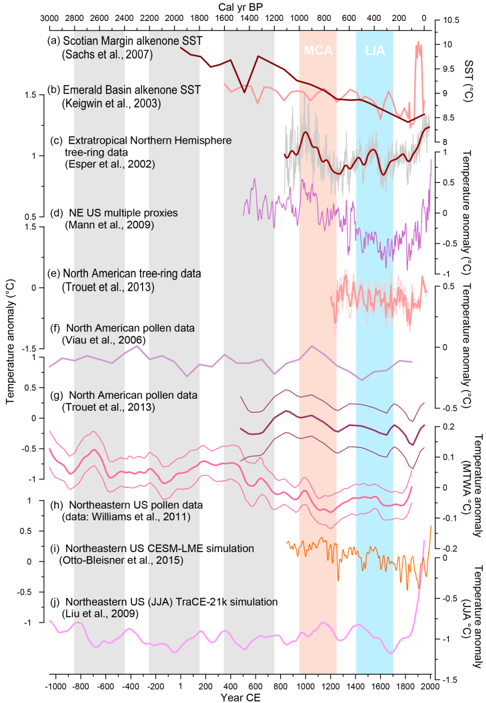
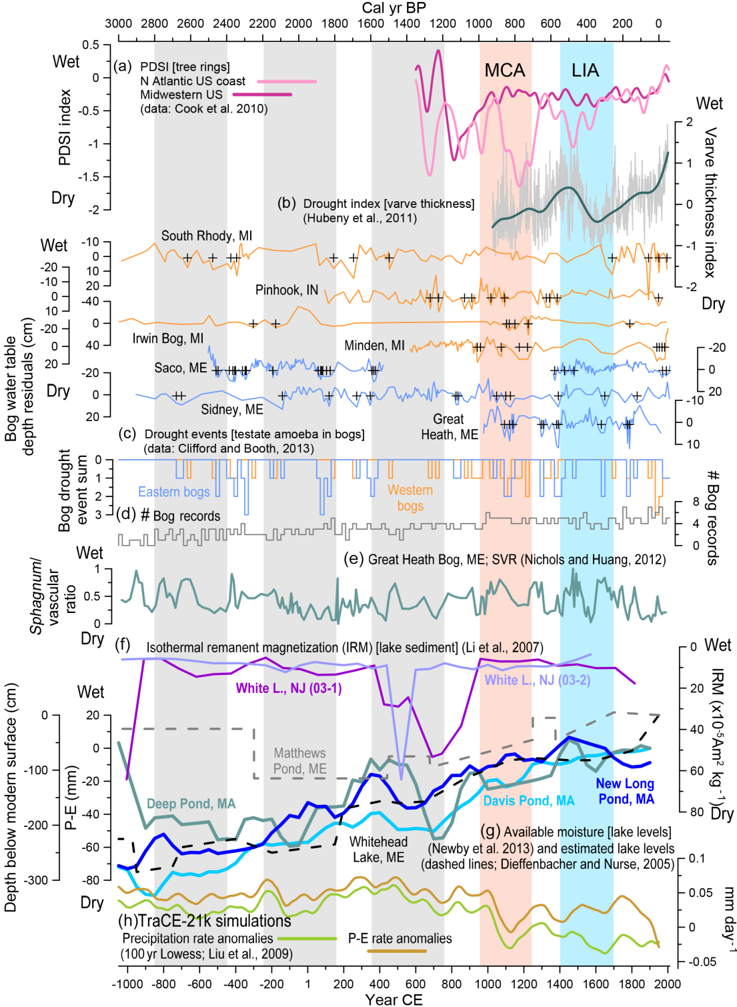
Many ecosystem processes that influence Earth system feedbacks – vegetation growth, water and nutrient cycling, disturbance regimes – are strongly influenced by multidecadal- to millennial-scale climate variations that cannot be directly observed. Paleoclimate records provide information about these variations, forming the basis of our understanding and modeling of them. Fossil pollen records are abundant in the NE US, but cannot simultaneously provide information about paleoclimate and past vegetation in a modeling context because this leads to circular logic. If pollen data are used to constrain past vegetation changes, then the remaining paleoclimate archives in the northeastern US (NE US) are quite limited. Nonetheless, a growing number of diverse reconstructions have been developed but have not yet been examined together. Here we conduct a systematic review, assessment, and comparison of paleotemperature and paleohydrological proxies from the NE US for the last 3000 years. Regional temperature reconstructions (primarily summer) show a long-term cooling trend (1000 BCE–1700 CE) consistent with hemispheric-scale reconstructions, while hydroclimate data show gradually wetter conditions through the present day. Multiple proxies suggest that a prolonged, widespread drought occurred between 550 and 750 CE. Dry conditions are also evident during the Medieval Climate Anomaly, which was warmer and drier than the Little Ice Age and drier than today. There is some evidence for an acceleration of the longer-term wetting trend in the NE US during the past century; coupled with an abrupt shift from decreasing to increasing temperatures in the past century, these changes could have wide-ranging implications for species distributions, ecosystem dynamics, and extreme weather events. More work is needed to gather paleoclimate data in the NE US to make inter-proxy comparisons and to improve estimates of uncertainty in reconstructions.
Overview
CoChat Summary
TL;DR
This paper systematically reviews, assesses, and compares paleotemperature and paleohydrological proxy records from the northeastern United States for the last 3000 years. It finds a long-term preindustrial cooling trend, a gradual wetting trend, notable droughts around 550–750 CE and during the Medieval Climate Anomaly, and recent century-scale reversals in both temperature and moisture trends.
Key findings
- Regional temperature reconstructions (primarily summer) show a long-term cooling trend from 1000 BCE to 1700 CE, consistent with hemispheric-scale reconstructions; most records and simulations show recent warming reversing this trend.
- Hydroclimate records indicate gradually wetter conditions through the present; multiple proxies suggest a prolonged, widespread drought from 550 to 750 CE, and dry conditions during the Medieval Climate Anomaly (ca. 950–1250 CE), which was warmer and drier than the Little Ice Age and drier than today.
- Some evidence indicates acceleration of the longer-term wetting trend in the NE US during the past century; coupled with an abrupt shift from decreasing to increasing temperatures in the past century, these changes could have wide-ranging implications for species distributions, ecosystem dynamics, and extreme weather.
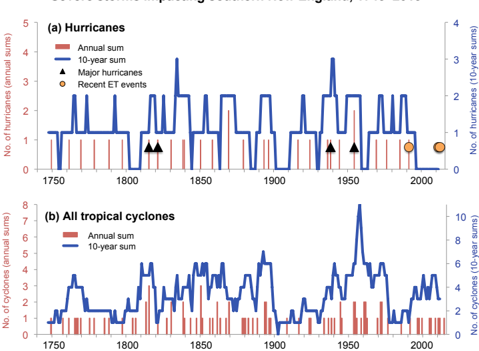
- Modern/historical data show NE US annual temperatures increasing by almost 1.1°C and precipitation by about 12 cm (>10%) over the past century; heavy precipitation events from 1958–2012 increased 37% in the Midwest and 71% in the Northeast. No long-term trend is evident in New England storm frequency, with about 0–2 hurricanes per year since 1743 and major hurricanes very rare.
Methods
- Systematic review, assessment, and comparison of paleotemperature and paleohydrological proxies/archives from the NE US for the last 3000 years, including tree rings, bogs/testate amoebae, lake and marine sediments, varves, organic geochemistry, fossil pollen, diatoms, and historical records.
- Coherence analysis: high-resolution records binned into 5-year steps (pollen 10-year) and smoothed with a 50-year half-window (pollen 100-year) using locally weighted regression; bootstrap confidence intervals from 1000 iterations. Tree-ring NADA and pollen Neotoma records were composited/smoothed; seven testate amoeba records were detrended (500-year half-window), droughts identified as peaks above the 90th percentile and summed; NADA drought area index and EOF analyses of GHCN/NADA were used; New England storm reconstructions used historical data.
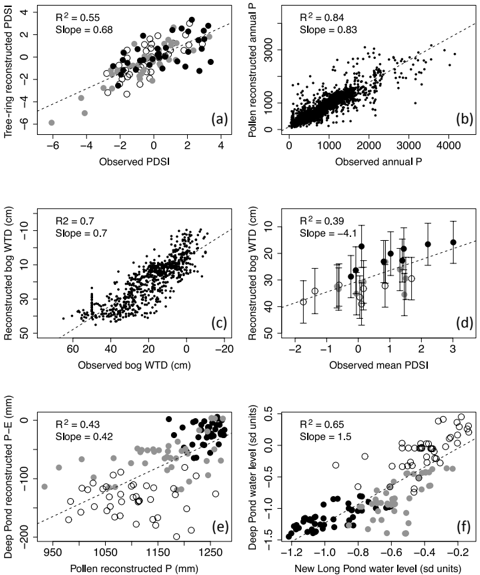
- Calibration examples reported: tree-ring PDSI vs modern New York PDSI R² = 0.55; pollen-based annual precipitation R² = 0.70; testate amoeba water-table depth R² = 0.84; Hole Bog WTD vs instrumental PDSI R² = 0.39; Deep Pond P–E vs pollen precipitation R² = 0.427; two Massachusetts lake-level reconstructions R² = 0.654.
Limitations
- Stated: With the exception of fossil pollen, there are limited NE US paleoclimate archives; more work is needed to gather data for inter-proxy comparisons and improve uncertainty estimates. Pollen cannot be used for both past vegetation and paleoclimate in modeling because of circular logic. Limited paleotemperature data, and the Williams et al. pollen record not adjusted for recent human impacts, make accurate modern–late-Holocene temperature comparison impossible. Testate amoeba records do not reliably record low-frequency trends. Lake-level records are difficult to calibrate against modern observations, radiocarbon dating limits temporal resolution, and multiple cores add uncertainty. Tree-ring records rarely extend beyond the past 500 years, most NE trees are moisture- rather than temperature-sensitive, and only a few species are sensitive enough for temperature reconstructions.
- Stated/evident: Most temperature and hydroclimate proxies may overrepresent growing-season conditions (except lake-level records); bog WTD reconstructions reflect relative rather than absolute moisture and detrending limits inferences to extreme events; recent human influences may disturb water levels in some bogs; data coverage is denser near the coast than inland.
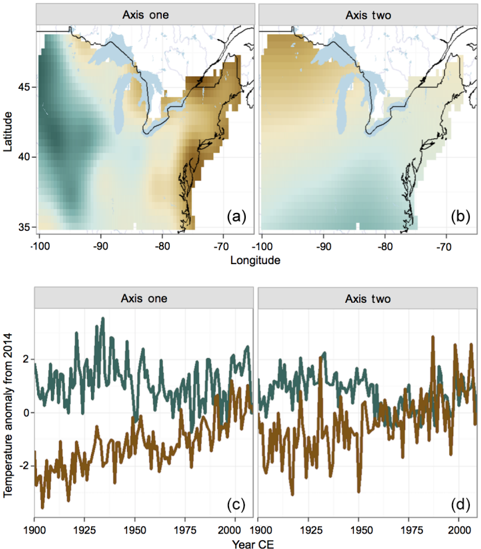
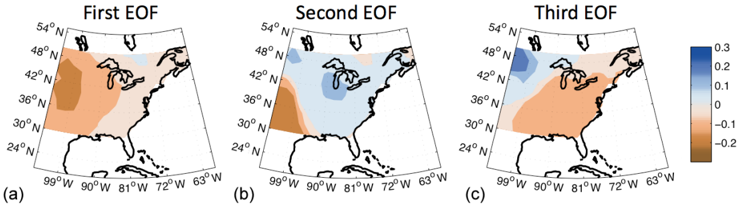
- Evident: EOF patterns explain low variance (GHCN temperature EOFs 16% and 8%; NADA drought EOFs 13%, 9%, and 8%), indicating heterogeneous spatial patterns; different proxies have differing temporal resolutions, seasonalities, and uncertainties, so inter-proxy comparisons cannot fully quantify uncertainty.
Model-written summary. Check it against the paper before relying on it.
Integrity signals
Registry
Cites
Statistics
Figures
Verification
Claims the paper makes
0 Valid · 6 Not valid · 95 Not checked · 90 Own results and interpretations
A result the paper states — it cites no source for it, so there is none to check. The quote shows it is in the paper.
In the paper
“Multiple proxies suggest that a prolonged, widespread drought occurred between 550 and 750 CE.”
§ Climatic history of the northeastern United States during the past 3000 years > Abstract
hedged- Asserted: passes — The authors put it forward as true.
- Checkable: passes — It can be checked against evidence.
- Load-bearing: passes — The paper’s conclusions depend on it.
- Based: passes — The paper gives a reason why it holds.
A result the paper states — it cites no source for it, so there is none to check. The quote shows it is in the paper.
In the paper
“while hydroclimate data show gradually wetter conditions through the present day.”
§ Climatic history of the northeastern United States during the past 3000 years > Abstract
plainstates an association- Asserted: passes — The authors put it forward as true.
- Checkable: passes — It can be checked against evidence.
- Load-bearing: passes — The paper’s conclusions depend on it.
- Based: passes — The paper gives a reason why it holds.
A result the paper states — it cites no source for it, so there is none to check. The quote shows it is in the paper.
In the paper
“Dry conditions are also evident during the Medieval Climate Anomaly”
§ Climatic history of the northeastern United States during the past 3000 years > Abstract
plainstates an association- Asserted: passes — The authors put it forward as true.
- Checkable: passes — It can be checked against evidence.
- Load-bearing: passes — The paper’s conclusions depend on it.
- Based: passes — The paper gives a reason why it holds.
The paper states this without a source or data behind it here, so there is nothing to check it against. The quote shows it is in the paper.
In the paper
“coupled with an abrupt shift from decreasing to increasing temperatures in the past century”
§ Climatic history of the northeastern United States during the past 3000 years > Abstract
plain- Asserted: passes — The authors put it forward as true.
- Checkable: passes — It can be checked against evidence.
- Load-bearing: passes — The paper’s conclusions depend on it.
- Based: unclear — It is unclear why the paper says it holds.
The paper states this without a source or data behind it here, so there is nothing to check it against. The quote shows it is in the paper.
In the paper
“There is some evidence for an acceleration of the longer-term wetting trend in the NE US during the past century”
§ Climatic history of the northeastern United States during the past 3000 years > Abstract
hedgedstates an association- Asserted: passes — The authors put it forward as true.
- Checkable: passes — It can be checked against evidence.
- Load-bearing: passes — The paper’s conclusions depend on it.
- Based: unclear — It is unclear why the paper says it holds.
98 more claims
Create a free account to see all 191 claims and to verify the 119 references still open.
- It may state two separate claims as one. 66
- Probably not a substantial claim. 26
Self-check
Percentages, sums and reported differences re-computed from the paper’s own numbers.
Each contradiction between two passages listed here was confirmed by an independent check.
Rated minor: it would not touch a result — a value no result rests on, a p-value that stays on the same side of the significance level, or a conflict that is clerical, resolved elsewhere in the paper, or outside its own findings.
In the paper
§ Climatic history of the northeastern United States during the past 3000 years > 1 Introduction
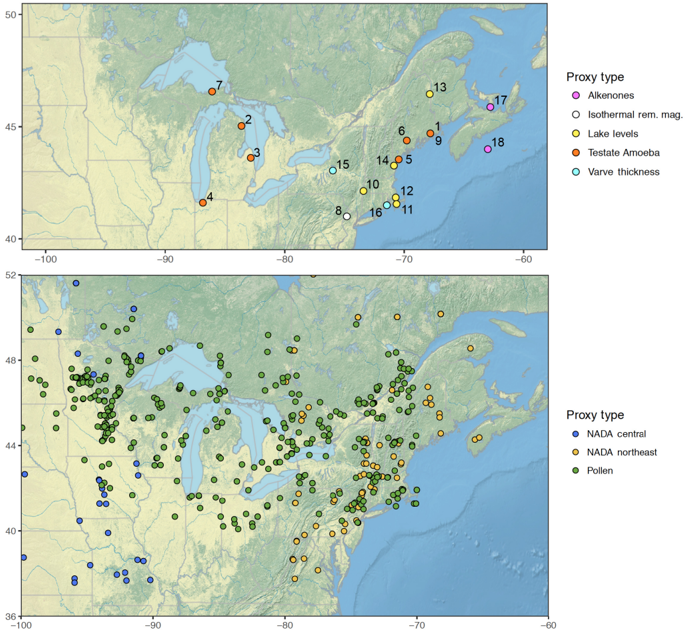
“NE US, defined here as 100-60 • E and 38-52 • N (Fig. 1).”
§ Climatic history of the northeastern United States during the past 3000 years > 4.1 Methods
“Pollen records were compiled from sites between 40 and 50 • latitude and -70 and -100 • longitude (Fig. 1).”
Rated minor: it would not touch a result — a value no result rests on, a p-value that stays on the same side of the significance level, or a conflict that is clerical, resolved elsewhere in the paper, or outside its own findings.
In the paper
§ Climatic history of the northeastern United States during the past 3000 years > 5 Conclusions
“the current warming and wetting trend reflects a reversal of millennial-scale cooling and wetting trends prior to the 1800s”
§ Climatic history of the northeastern United States during the past 3000 years > 4.3 Reconstructed hydroclimate variations in the NE US for the last 3000 years
“In the most recent century, an acceleration of the gradual wetting trend is observed in PDSI records, the varve index, and the lake level reconstruction from Whitehead Lake.”
Citations
Cites
Modern Applied Statistics with S
Venables, W. N., & Ripley, B. D. (2002) · Statistics and Computing · doi:10.1007/978-0-387-21706-2 · Cited by 24,305
Bradley, R. S., & Fritts, H. C. (1978) · Arctic and Alpine Research · doi:10.2307/1550667 · Cited by 4,518
Persistent Solar Influence on North Atlantic Climate During the Holocene
Bond, G., Kromer, B., Beer, J., Muscheler, R., Evans, M. N., Showers, W., Hoffmann, S., Lotti-Bond, R., Hajdas, I., & Bonani, G. (2001) · Science · doi:10.1126/science.1065680 · Cited by 3,441
Eglinton, G., & Hamilton, R. J. (1967) · Science · doi:10.1126/science.156.3780.1322 · Cited by 2,487
Global Signatures and Dynamical Origins of the Little Ice Age and Medieval Climate Anomaly
Mann, M. E., Zhang, Z., Rutherford, S., Bradley, R. S., Hughes, M. K., Shindell, D., Ammann, C., Faluvegi, G., & Ni, F. (2009) · Science · doi:10.1126/science.1177303 · Cited by 2,483
(1990) · Springer eBooks · doi:10.1007/978-94-015-7879-0 · Cited by 2,421
Climate Change Impacts in the United States: The Third National Climate Assessment
(2014) · doi:10.7930/j0z31wj2 · Cited by 2,414
Climate and Plant Distribution
Eyre, S. R., & Woodward, F. I. (1988) · The Geographical Journal · doi:10.2307/633873 · Cited by 1,823
The Recent Increase in Atlantic Hurricane Activity: Causes and Implications
Goldenberg, S. B., Landsea, C. W., Mestas-Nuñez, A. M., & Gray, W. M. (2001) · Science · doi:10.1126/science.1060040 · Cited by 1,769
Methods of Dendrochronology, Applications in the Environmental Sciences
Yamaguchi, D. K., Cook, E. R., & Kairiukstis, L. A. (1991) · Arctic and Alpine Research · doi:10.2307/1551446 · Cited by 1,682
Self-citation
Research works printed but not linked: 5
- Conkey, L. E.: Eastern US Tree-ring Widths and Densities as Indi- cators of Past Climate, PhD thesis, 1982.
- Cook, E. R.: Tree rings as indicators of climatic change and the potential response of forests to the greenhouse effect, Global cli- mate change and life on earth. London, Routledge: Chapman & Hall, 56-64, 1991.
- Hopton, H. M. and Pederson, N.: Climate sensitivity of Atlantic white cedar at its northern range limit, in: Atlantic White Cedar: Ecology, Restoration and Management: Proceedings of the Arlington Echo Symposium. Gen. Tech. Rep. SRS-91.
- Huang, Y., Shuman, B., Wang, Y., and Webb III, T.: Hydrogen iso- tope ratios of palmitic acid in lacustrine sediments record late- Quaternary climate variations, Geology, 30, 1103-1106, 2002. · doi:10.1130/0091-7613(2002)030<1103:hiropa>2.0.co;2
- Williams, J. W., Post, D. M., Cwynar, L. C., Lotter, A. F., and Levesque, A. J.: Rapid and widespread vegetation responses to past climate change in the North Atlantic region, Geology, 30, 971-974, 2002. · DOI · Paper page
Cited by
Finzi, A. C., Giasson, M., Plotkin, A. B., Aber, J. D., Boose, E. R., Davidson, E. A., Dietze, M. C., Ellison, A. M., Frey, S. D., Goldman, E., et al. (2020) · Ecological Monographs · doi:10.1002/ecm.1423 · Cited by 134
Self-citationDynamics, Variability, and Change in Seasonal Precipitation Reconstructions for North America
Stahle, D. W., Cook, E. R., Burnette, D. J., Torbenson, M. C. A., Howard, I. M., Griffin, D., Villanueva‐Díaz, J., Cook, B. I., Williams, P., Watson, E., et al. (2020) · Journal of Climate · doi:10.1175/jcli-d-19-0270.1 · Cited by 112
Self-citationThe human impact on North American erosion, sediment transfer, and storage in a geologic context
Kemp, D. B., Sadler, P. M., & Vanacker, V. (2020) · Nature Communications · doi:10.1038/s41467-020-19744-3 · Cited by 108
What the past can say about the present and future of fire
Marlon, J. R. (2020) · Quaternary Research · doi:10.1017/qua.2020.48 · Cited by 90
Self-citationMiller, D. R., Habicht, M. H., Keisling, B. A., Castañeda, I. S., & Bradley, R. S. (2018) · Climate of the past · doi:10.5194/cp-14-1653-2018 · Cited by 83
Watson, B. I., Williams, J. W., Russell, J. M., Jackson, S. T., Shane, L. C. K., & Lowell, T. V. (2018) · Quaternary Science Reviews · doi:10.1016/j.quascirev.2017.12.011 · Cited by 73
Self-citationShuman, B. N., Routson, C., McKay, N. P., Fritz, S. C., Kaufman, D. S., Kirby, M. E., Nolan, C. J., Pederson, G. T., & St‐Jacques, J. (2018) · Climate of the past · doi:10.5194/cp-14-665-2018 · Cited by 53
Self-citationDaniau, A., Desprat, S., Aleman, J. C., Brémond, L., Davis, B., Fletcher, W. J., Marlon, J. R., Marquer, L., Montade, V., Morales‐Molino, C., et al. (2019) · Revue de Micropaléontologie · doi:10.1016/j.revmic.2019.02.001 · Cited by 44
Self-citationMackay, H., Plunkett, G., Jensen, B. J. L., Aubry, T. J., Corona, C., Kim, W. M., Toohey, M., Sigl, M., Stoffel, M., Anchukaitis, K. J., et al. (2022) · Climate of the past · doi:10.5194/cp-18-1475-2022 · Cited by 35
Self-citationStahle, D. W., Edmondson, J. R., Howard, I. M., Robbins, C. R., Griffin, D., Carl, A. R., Hall, C. B., Stahle, D. K., & Torbenson, M. C. A. (2019) · Environmental Research Communications · doi:10.1088/2515-7620/ab0c4a · Cited by 30
Burke, K., Williams, J. W., Brewer, S., Finsinger, W., Giesecke, T., Lorenz, D. J., & Ordóñez, A. (2019) · Philosophical Transactions of the Royal Society B Biological Sciences · doi:10.1098/rstb.2019.0218 · Cited by 29
Self-citationDeglacial temperature controls on no-analog community establishment in the Great Lakes Region
Fastovich, D., Russell, J. M., Jackson, S. T., & Williams, J. W. (2020) · Quaternary Science Reviews · doi:10.1016/j.quascirev.2020.106245 · Cited by 27
Self-citationDawson, A., Paciorek, C. J., Goring, S. J., Jackson, S. T., McLACHLAN, J. S., & Williams, J. W. (2019) · Ecology · doi:10.1002/ecy.2856 · Cited by 23
Self-citationWilson, J. K., Casajus, N., Hutchinson, R., McFarland, K. P., Kerr, J. T., Berteaux, D., Larrivée, M., & Prudic, K. L. (2021) · Frontiers in Ecology and Evolution · doi:10.3389/fevo.2021.579230 · Cited by 22
Liu, B., Booth, R. K., Escobar, J. H., Wei, Z., Bird, B. W., Pardo, A., Curtis, J. H., & Ouyang, J. (2019) · Quaternary Research · doi:10.1017/qua.2018.143 · Cited by 21
Self-citationSpatial variation of hydroclimate in north-eastern North America during the last millennium
Mackay, H., Amesbury, M. J., Langdon, P. G., Charman, D. J., Magnan, G., van Bellen, S., Garneau, M., Bainbridge, R., & Hughes, P. D. M. (2021) · Quaternary Science Reviews · doi:10.1016/j.quascirev.2021.106813 · Cited by 18
Pearl, J. K., Anchukaitis, K. J., Donnelly, J. P., Pearson, C. L., Pederson, N., Gaylord, M. C. L., McNichol, A. P., Cook, E. R., & Zimmermann, G. L. (2019) · Quaternary Science Reviews · doi:10.1016/j.quascirev.2019.106104 · Cited by 16
Self-citationRamiadantsoa, T., Stegner, M. A., Williams, J. W., & Ives, A. R. (2019) · Ecology · doi:10.1002/ecy.2579 · Cited by 15
Self-citationStager, J. C., Wiltse, B., Hubeny, J. B., Yankowsky, E., Nardelli, D., & Primack, R. B. (2018) · PLoS ONE · doi:10.1371/journal.pone.0191755 · Cited by 15
Self-citationMultivariate Climate Field Reconstructions Using Tree Rings for the Northeastern United States
Pearl, J. K., Anchukaitis, K. J., Pederson, N., & Donnelly, J. P. (2020) · Journal of Geophysical Research Atmospheres · doi:10.1029/2019jd031619 · Cited by 15
Self-citationComparing and improving methods for reconstructing peatland water-table depth from testate amoebae
Nolan, C. J., Tipton, J., Booth, R. K., Hooten, M. B., & Jackson, S. T. (2019) · The Holocene · doi:10.1177/0959683619846969 · Cited by 13
Self-citationKing, K. E., Harley, G. L., Maxwell, J. T., Rayback, S. A., Cook, E. R., Maxwell, R. S., Rochner, M. L., Bergan, E. V., Foley, Z. W., Therrell, M. D., et al. (2024) · Geophysical Research Letters · doi:10.1029/2024gl109099 · Cited by 13
Self-citationFrelich, L. E., Lorimer, C. G., & Stambaugh, M. C. (2021) · Managing forest ecosystems · doi:10.1007/978-3-030-73267-7_7 · Cited by 12
Ibebuchi, C. C., & Lee, C. C. (2023) · Scientific Reports · doi:10.1038/s41598-023-39497-5 · Cited by 12
Sanger, C. E. O., St‐Jacques, J., Peros, M. C., & Schwartz, K. A. (2021) · The Holocene · doi:10.1177/0959683621994642 · Cited by 10
Crossett, C. C., Hodgkins, G. A., Menk, H., Dupigny‐Giroux, L. L., Dudley, R. W., Stampone, M. D., & Hammond, J. C. (2023) · Hydrological Processes · doi:10.1002/hyp.14832 · Cited by 8
A 900-year record of effective moisture in the Laurentian Great Lakes region
Doyle, R. M., Liu, Z., Walker, J. T., Hladyniuk, R., Moser, K. A., & Longstaffe, F. J. (2021) · Quaternary Science Reviews · doi:10.1016/j.quascirev.2021.107174 · Cited by 8
A Natural History of Northern Maine, Usa, since Deglaciation
Davis, R. B., Norton, S. A., Kuhns, C. M., & Halteman, W. A. (2021) · Northeastern Naturalist · doi:10.1656/045.028.m1901 · Cited by 5
Tremblay, M., Stager, J. C., St‐Jacques, J., Murphy, S., Peros, M. C., & Carl, B. S. (2024) · PLoS ONE · doi:10.1371/journal.pone.0314101 · Cited by 4
Gajewski, K., Neil, K., Ponomarenko, E., Георгиевна, Е. Е., Stewart, B., Neily, P. D., & Quigley, E. (2023) · Ecosphere · doi:10.1002/ecs2.4710 · Cited by 4
The Monongahela tradition in “real time”: Bayesian analysis of radiocarbon dates
Hart, J. P., & Means, B. K. (2022) · PLoS ONE · doi:10.1371/journal.pone.0276014 · Cited by 3
Kelly‐Voicu, P., & Frei, A. (2019) · International Journal of Climatology · doi:10.1002/joc.6289 · Cited by 3
Monecke, K., Hubeny, B., McCarthy, F. M. G., Alderson, A., Boyce, J. I., Brabander, D. J., Veresh, R. K., Chen, A. J., Knights, C., Nishimoto, M., et al. (2025) · Journal of Sedimentary Research · doi:10.2110/jsr.2024.110 · Cited by 2
Mackay, H., Plunkett, G., Jensen, B. J. L., Aubry, T. J., Corona, C., Kim, W. M., Toohey, M., Sigl, M., Stoffel, M., Anchukaitis, K. J., et al. (2021) · doi:10.5194/cp-2021-170 · Cited by 2
Self-citationMiller, D. R. (2019) · Scholarworks (University of Massachusetts Amherst) · doi:10.7275/13428743 · Cited by 2
Ebel, J. E., Monecke, K., Hubeny, J. B., McCarthy, F. M. G., Theis, L. J., & Alderson, A. (2026) · Seismological Research Letters · doi:10.1785/0220250310 · Cited by 1
Self-citation1,400 Years of Climate Change in the Northern HemispherePreprint
Morando, M. (2023) · Research Square · doi:10.21203/rs.3.rs-2468091/v1 · Cited by 1
Mackay, H., Plunkett, G., Jensen, B. J. L., et al. (2022) · Climate of the past · doi:10.5194/cp-2021-170-rc1
Mackay, H., Plunkett, G., Jensen, B. J. L., et al. (2022) · Climate of the past · doi:10.5194/cp-2021-170-cc1
Mackay, H., Plunkett, G., Jensen, B. J. L., et al. (2022) · Climate of the past · doi:10.5194/cp-2021-170-rc2
Mackay, H. (2022) · Climate of the past · doi:10.5194/cp-2021-170-ac2
Mackay, H. (2022) · Climate of the past · doi:10.5194/cp-2021-170-ac1
Mackay, H. (2022) · Climate of the past · doi:10.5194/cp-2021-170-ac3
Grote, T., Myers, A., & Stahlman, P. (2025) · Midcontinental Journal of Archaeology · doi:10.5406/23274271.50.2.03
Collins, R., St‐Jacques, J., Kyle, K. A., Cwynar, L. C., & Cogbill, C. V. (2025) · The Holocene · doi:10.1177/09596836251378004
Fulton, A. E., Yansa, C. H., Schaetzl, R. J., Curry, B. B., & Lowell, T. V. (2025) · Quaternary Research · doi:10.1017/qua.2025.10052
Impact of European colonization on the environment of Gatineau (Hull), Quebec, Canada
Gajewski, K. (2026) · Canadian Journal of Earth Sciences · doi:10.1139/cjes-2025-0080
Historic Log Buildings as Archives of Past Forest Ecology
de Graauw, K. K. (2019) · The Research Repository @ WVU (West Virginia University) · doi:10.33915/etd.7442
A high-resolution, two-millennium monthly downscaled climate dataset for North America
Guaita, P., & Crippa, P. (2026) · Scientific Data · doi:10.1038/s41597-026-07572-x
High-Resolution Record of Vegetation and Climate Change During the Holocene in Southwestern Québec
Lagace, A. L. (2019) · uO Research (University of Ottawa) · doi:10.20381/ruor-23856
Temperature Controls on No-Analog Community Establishment in the Great Lakes Region
Fastovich, D. (2018) · Minds at UW (University of Wisconsin)
Forecast Scenarios for Climate Change in the Northern HemispherePreprint
Morando, M. (2025) · Research Square · doi:10.21203/rs.3.rs-8319654/v1
Metadata
- Authors
- Marlon, J. R., Pederson, N., Nolan, C., Goring, S., Shuman, B., Robertson, A., Booth, R., Bartlein, P. J., Berke, M. A., Clifford, M., Cook, E., Dieffenbacher-Krall, A., Dietze, M. C., Hessl, A., Hubeny, J. B., Jackson, S. T., Marsicek, J., McLachlan, J., Mock, C. J., Moore, D. J. P., Nichols, J., Peteet, D., Schaefer, K., Trouet, V., Umbanhowar, C., Williams, J. W., & Yu, Z.
- Affiliations
- Yale University (US)
- Harvard University (US)
- University of Arizona (US)
- University of Wisconsin–Madison (US)
- University of Wyoming (US)
- Lehigh University (US)
- University of Oregon (US)
- University of Notre Dame (US)
- Desert Research Institute (US)
- Lamont-Doherty Earth Observatory (US)
- University of Maine (US)
- Boston University (US)
- West Virginia University (US)
- Salem State University (US)
- United States Geological Survey (US)
- University of South Carolina (US)
- University of Colorado Boulder (US)
- St. Olaf College (US)
- Corresponding author
- Marlon, Jennifer R.
- ORCID
- Marlon, Jennifer R.
- Pederson, Neil
- Nolan, Connor
- Goring, Simon
- Shuman, Bryan
- Bartlein, Patrick J.
- Berke, Melissa A.
- Clifford, Michael
- Cook, Edward
- Dietze, Michael C.
- Hessl, Amy
- Hubeny, J. Bradford
- Jackson, Stephen T.
- Marsicek, Jeremiah
- McLachlan, Jason
- Moore, David J. P.
- Nichols, Jonathan
- Peteet, Dorothy
- Schaefer, Kevin
- Trouet, Valerie
- Umbanhowar, Charles
- Williams, John W.
- Yu, Zicheng
- Venue
- Climate of the Past
- Publisher
- Copernicus GmbH
- Published
- 2017-10-13
- Volume
- 13
- Issue
- 10
- Pages
- 1355-1379
- ISSN
- 1814-9324 (ISSN-L)
- 1814-9332
- OpenAlex
- W2546651733
- Semantic Scholar
- 857e83fc87ac4bbc2f7580d8909e50da3a6b05ae
- Cited by
- 52
- References
- 189
- Citations by year
- 2026: 3 · 2025: 5 · 2024: 2 · 2023: 4 · 2022: 8 · 2021: 7 · 2020: 6 · 2019: 12 · 2018: 5
- FWCI
- 2.63
- Type
- journal article
- Language
- en
- Open access
- gold
- doi.org
- Licence
- Locations
- Climate of the past (publishedVersion, cc-by)
- UA Campus Repository (The University of Arizona) (acceptedVersion, cc-by)
- The Research Repository @ WVU (West Virginia University) (submittedVersion, cc-by)
- The Research Repository @ WVU (West Virginia University) (submittedVersion)
- DOAJ (DOAJ: Directory of Open Access Journals) (submittedVersion, cc-by-sa)
- Funders
- Division of Emerging Frontiers and Multidisciplinary Activities (EF-1065732)
- Topics
- Physical Sciences › Earth and Planetary Sciences › Atmospheric Science › Geology and Paleoclimatology Research
- Physical Sciences › Earth and Planetary Sciences › Atmospheric Science › Tree-ring climate responses
- Physical Sciences › Environmental Science › Global and Planetary Change › Climate variability and models
- Keywords
- paleoclimate, northeastern United States, paleotemperature reconstruction, paleohydroclimate, hydroclimate, Little Ice Age, Medieval Warm Period, drought, long-term cooling trend, wetting trend
About these checks
Registry, retraction, Cites and statistics results are computed, not judged, with one exception: a printed reference that no index lists is read once by a model before it counts as a citation error. Claims are extracted by a model and kept only when their quote appears verbatim in the text; each cited source is then checked, with a model’s help, for whether it says what the claim relies on. Those verdicts can be wrong — read the claim’s quote and the cited source before relying on one.
A language model drew the claims from the paper on 2026-11-21, under version 3 of the claim definition (model deepseek-v4.1-flash, prompt extract-v3).
A second model labelled each claim on 2026-11-21 (model jev-1.13-20260917, definition revision gold-guideline-v0.2).
Statistics and arithmetic are recomputed, not judged.
Confidence bands are shown only for fields calibrated on our annotated test set. None is calibrated yet, so no band is shown.
What counts as a claim ›How we measure confidence ›How we check this ›
Are you an author, or do you see a problem with this page? Request a review
Data sources
Bibliographic data: Semantic Scholar, OpenAlex, Crossref.
Contains information from the Semantic Scholar Academic Graph Datasets, made available under the ODC Attribution License (ODC-BY 1.0).
Semantic Scholar’s data is described in: Kinney, R., et al. (2023). The Semantic Scholar Open Data Platform. arXiv:2301.10140.
