

The DOI matches its Crossref record; 32 of the 32 references it cites were found in a registry or an index.
HOW PUBLIC PROCUREMENT CAN HELP SOCIETIES ACHIEVE SDGs: A CONCEPTUAL MODEL
Open accessAbstract
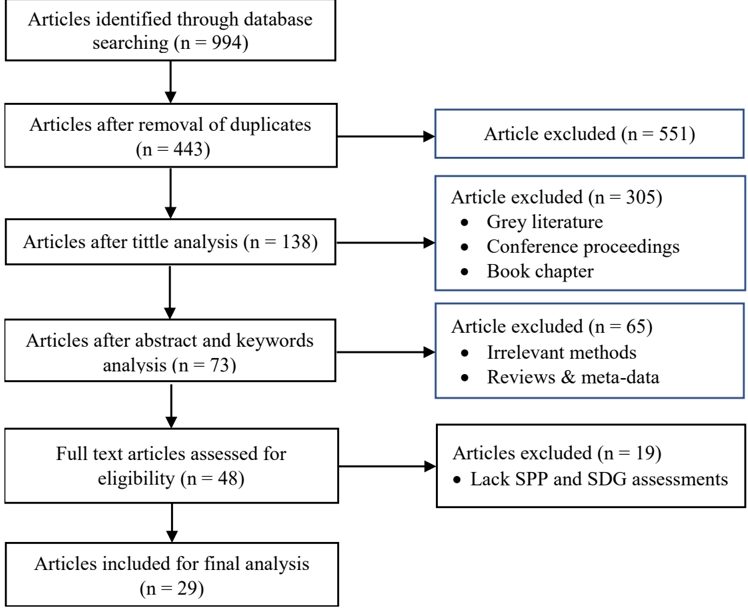
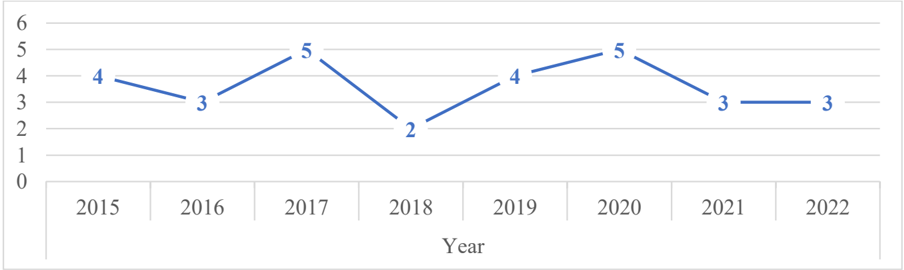
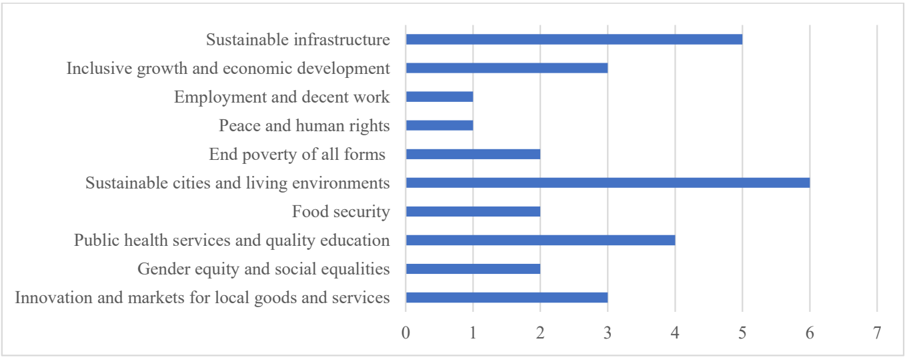
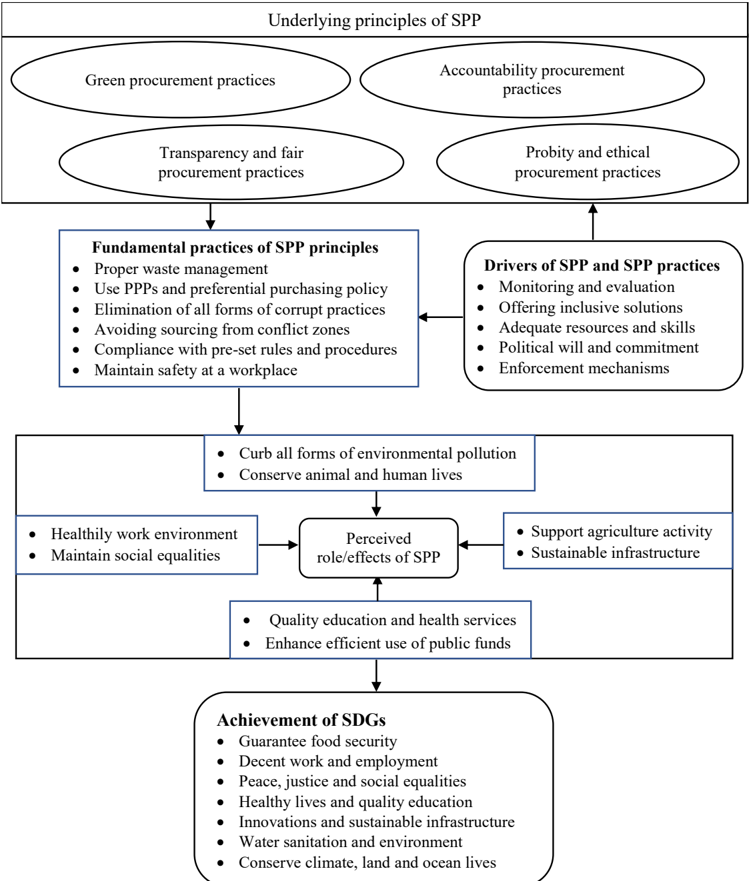
This study draws attention to how public procurement adds value and contributes to the achievement of the United Nation’s sustainable development goals (UN SDGs) based on an extensive literature review. A total of 29 peer-reviewed journal articles published between 2015-2022 with a focus on sustainable public procurement (SPP) practices and SDGs were retrieved from the Web of Science and Emerald databases for analysis. From the reviewed articles, we develop a conceptual model for better illustration and understanding of the link between SPP practices and SDGs. The model indicates that the achievement of SGDs can be influenced by four dimensions, namely: the underlying principles of SPP, the fundamental practices of SPP principles, the drivers of SPP principles, and the perceived roles of SPP practices which are aligned with the targets of UN SDGs. The analysis of the study revealed that SPP can impact up to 70% (12 out of 17) of UN SDGs. It is established that pubic procurement performs important functions in a diligent manner which adds value and delivers core services to societies, thus supporting the achievement of SDGs. Individual commitment and political will, strong enforcement and control mechanisms, continuous monitoring and assessment of the target areas, and offering inclusive solutions and shared visions among actors are identified as the drivers for building resilience in SPP and achievement of SDGs. The developed model could serve as a basis for identifying the deficiencies in SPP and achievement of SDGs for policy implications, reform, and future research domains.
Overview
The claims and statistics of this paper haven’t been checked yet.
Run the check — free, no account needed. It reads the open-access text and checks the sources it cites.
Integrity signals
Registry
Cites
Statistics
Figures
Verification
Claims the paper makes
The claims and statistics of this paper haven’t been checked yet.
Run the check — free, no account needed. It reads the open-access text and checks the sources it cites.
Claims other papers make about this one
Each is checked against this paper’s own text: does it say what the citing paper says it does?
The source backs part of the claim, not all of it — or backs it for a different population, condition or comparison.
In the citing paper
“Through clear delineation of roles and responsibilities, implementation of robust internal control mechanisms such as regular internal audits and independent oversight committees, and the use of sanctions and penalties, deviations or misconduct can be more easily identified and addressed (Paschke et al., 2018;Siwandeti et al., 2023;Saeed et al., 2022).”
From Promoting transparency and accountability towards anti-corruption in pharmaceutical procurement system: does e-procurement play a significant role? (2024) · cites this paper as Siwandeti et al., 2023
Experimental — accuracy not yet measuredThe cited source says what the claim attributes to it.
In the citing paper
“MANM acts as a deterrent against corruption and encourages ethical behaviour amongst individuals involved.”
From Promoting transparency and accountability towards anti-corruption in pharmaceutical procurement system: does e-procurement play a significant role? (2024) · cites this paper as Siwandeti et al., 2023
Self-check
Percentages, sums and reported differences re-computed from the paper’s own numbers.
The self-check needs the paper’s full text.
Citations
Cites
Preferred reporting items for systematic reviews and meta-analyses: The PRISMA statement
Moher, D., Liberati, A., Tetzlaff, J., Altman, D. G., & the PRISMA Group* (2009) · Annals of Internal Medicine · doi:10.7326/0003-4819-151-4-200908180-00135 · Cited by 37,554
Preferred Reporting Items for Systematic Reviews and Meta-Analyses: The PRISMA Statement
Moher, D., Liberati, A., Tetzlaff, J., & Altman, D. G. (2009) · Journal of Clinical Epidemiology · doi:10.1016/j.jclinepi.2009.06.005 · Cited by 19,575
Akter, M. M. K., Haq, U. N., Islam, M. M., & Uddin, M. A. (2022) · Cleaner Environmental Systems · doi:10.1016/j.cesys.2022.100070 · Cited by 276
Adjei‐Bamfo, P., Maloreh‐Nyamekye, T., & Ahenkan, A. (2018) · Resources Conservation and Recycling · doi:10.1016/j.resconrec.2018.12.001 · Cited by 249
Corporate venture capital portfolios and firm innovation
Wadhwa, A., Phelps, C., & Kotha, S. B. (2015) · Journal of Business Venturing · doi:10.1016/j.jbusvent.2015.04.006 · Cited by 249
Environmentally Responsible Behavior and Sustainability Policy Adoption in Green Public Procurement
Lăzăroiu, G., Ionescu, L., Uţă, C., Hurloiu, I., Andronie, M., & Dijmărescu, I. (2020) · Sustainability · doi:10.3390/su12052110 · Cited by 222
Public procurement as a policy tool: using procurement to reach desired outcomes in society
Grandia, J., & Meehan, J. (2017) · International Journal of Public Sector Management · doi:10.1108/ijpsm-03-2017-0066 · Cited by 186
Akomea-Frimpong, I., Jin, X., Osei‐Kyei, R., & Kukah, A. S. K. (2021) · Smart and Sustainable Built Environment · doi:10.1108/sasbe-07-2021-0111 · Cited by 92
Evaluation of integration of sustainable development in higher education in Sweden
Finnveden, G., Friman, E., Mogren, A., Palmer, H., Sund, P., Carstedt, G., Lundberg, S., Robertsson, B., Rodhe, H., & Svärd, L. (2020) · International Journal of Sustainability in Higher Education · doi:10.1108/ijshe-09-2019-0287 · Cited by 87
Improvement Actions for a More Social and Sustainable Public Procurement: A Delphi Analysis
Uribarrena, R. B., San-José, L., & Retolaza, J. L. (2019) · Sustainability · doi:10.3390/su11154069 · Cited by 75
Research works printed but not linked: 3
- Agarchand, N. and Laishram, B. (2017). Sustainable infrastructure development challenges through PPP procurement process: Indian perspective. International Journal of Managing Projects in Business, Vol. 10 No. 3, pp.642-662.
- Guarnieri, P. and Gomes, R.C. (2019). Can public procurement be strategic? A future agenda propositions. Journal of Public Procurement, Vol. 19 No. 4, pp.295-321.
- Patil, N.A. and Laishram, B.S. (2016). Sustainability of Indian PPP procurement process: Development of strategies for enhancement. Built Environment Project and Asset Management, Vol. 6 No. 5, pp.491-507.
Cited by
The role of food industries in sustainability transition: a review
Prasanna, S. R. M., Verma, P., & Bodh, S. (2024) · Environment Development and Sustainability · doi:10.1007/s10668-024-04642-1 · Cited by 91
Mahuwi, L., & Israel, B. (2024) · Management Matters · doi:10.1108/manm-07-2023-0027 · Cited by 25
Worldwide Trends in Public Procurement Efficiency Studies Under the Lens of Award Criteria
Gálvez‐Rodríguez, M. D. M., Godoy, M. L., Saraite-Sariene, L., & Pérez, M. D. C. C. (2024) · SAGE Open · doi:10.1177/21582440241297400 · Cited by 21
Lelo, J. M. (2024) · Jurnal Manajemen Teori dan Terapan | Journal of Theory and Applied Management · doi:10.20473/jmtt.v17i1.54567 · Cited by 18
Mwakolo, A., Siwandeti, M., Mahuwi, L., & Israel, B. (2024) · LBS Journal of Management & Research · doi:10.1108/lbsjmr-08-2023-0027 · Cited by 14
Israel, B. (2024) · Management Decision · doi:10.1108/md-08-2023-1338 · Cited by 14
Rutatola, P. P., Danieli, G. J., & Changalima, I. A. (2024) · African Business Management Journal · doi:10.58548/2024abmj21.5770 · Cited by 10
Kuruneri, J., Dube, M., Chibaro, M., Moabi, O., & Obadire, A. M. (2026) · Frontiers in Sustainability · doi:10.3389/frsus.2026.1746733 · Cited by 5
IDIMT-2025 : ICT in Business : AI Everywhere? Glory and Disgrace of AI
unknown (2025) · University Library Linz repository (Johannes Kepler Universitat Linz) · doi:10.35011/idimt-2025 · Cited by 1
Sustainable Public Procurement of Food (SPPF)
Caranta, R. (2025) · Oxford University Press eBooks · doi:10.1093/obo/9780197764381-0035
Strategy of Improvement Domestic Products in Government Goods/Services Procurement in Bogor Regency
Hidayat, A. I., & Silitonga, M. S. (2025) · International Journal of Economics Development Research (IJEDR) · doi:10.37385/ijedr.v6i3.7827
The missing middle: intermediaries as enablers of HRDD in socially responsible public procurement
Helsen, L., & Huyse, H. (2026) · Journal of Public Procurement · doi:10.1108/jopp-01-2026-0009
Israel, B., Ismail, I. J., & Mchopa, A. D. (2026) · SEDME (Small Enterprises Development Management & Extension Journal) A worldwide window on MSME Studies · doi:10.1177/09708464261484743
Ortiz., A. M., & Llatas, F. D. H. (2026) · Revista Cubana de Salud y Trabajo
Metadata
- Authors
- Department of Procurement and Supply Management, C. O. B. E., MESHACK, S., LETICIA, M., Department of Procurement and Supply Management, C. O. B. E., BARAKA, I., & Department of Procurement and Supply Management, C. O. B. E.
- Venue
- Management of Sustainable Development
- Publisher
- Lucian Blaga University of Sibiu
- Published
- 2023-06-01
- Volume
- 15
- Issue
- 1
- Pages
- 36-46
- ISSN
- 2066-9380 (ISSN-L)
- 2247-0220
- OpenAlex
- W4384834102
- Cited by
- 13
- References
- 32
- Citations by year
- 2026: 4 · 2025: 2 · 2024: 7
- FWCI
- 1.91
- Type
- journal article
- Language
- en
- Open access
- diamond
- doi.org
- Licence
- cc-by
- Locations
- Management of Sustainable Development (publishedVersion, cc-by)
- RePEc: Research Papers in Economics (acceptedVersion)
- DOAJ (DOAJ: Directory of Open Access Journals) (submittedVersion, cc-by-sa)
- Topics
- Social Sciences › Business, Management and Accounting › Strategy and Management › Public Procurement and Policy
- Social Sciences › Business, Management and Accounting › Strategy and Management › Sustainable Supply Chain Management
- Social Sciences › Public Administration › Public Policy and Administration Research
- Keywords
- sustainable public procurement, Sustainable Development Goals, SDG achievement, conceptual model, political will, monitoring and assessment, resilience, public sector sustainability
About these checks
Registry, retraction, Cites and statistics results are computed, not judged, with one exception: a printed reference that no index lists is read once by a model before it counts as a citation error. Claims are extracted by a model and kept only when their quote appears verbatim in the text; each cited source is then checked, with a model’s help, for whether it says what the claim relies on. Those verdicts can be wrong — read the claim’s quote and the cited source before relying on one.
Statistics and arithmetic are recomputed, not judged.
Confidence bands are shown only for fields calibrated on our annotated test set. None is calibrated yet, so no band is shown.
What counts as a claim ›How we measure confidence ›How we check this ›
Are you an author, or do you see a problem with this page? Request a review
Data sources
Bibliographic data: Semantic Scholar, OpenAlex, Crossref.
Contains information from the Semantic Scholar Academic Graph Datasets, made available under the ODC Attribution License (ODC-BY 1.0).
Semantic Scholar’s data is described in: Kinney, R., et al. (2023). The Semantic Scholar Open Data Platform. arXiv:2301.10140.
