

A Synthesis of Year-Round Interdisciplinary Mooring Measurements in the Bering Strait (1990–2014) and the RUSALCA Years (2004–2011)
Open accessThe DOI matches its Crossref record; 80 of the 81 references it cites were found in a registry or an index; none of the 111 sources its claims cite is checked for support yet.
Abstract
Additional ADCP mooring deployed in 1990 ~8 km north of A2-90.
Overview
CoChat Summary
TL;DR
This synthesis compiles 1990–2014 Bering Strait mooring, satellite, and hydrographic observations, emphasizing RUSALCA-era year-round interdisciplinary measurements. It documents large subdaily-to-interannual variability and increasing volume, heat, and freshwater fluxes from 2001 to present, alongside preliminary biogeochemical and marine-mammal records.
Key findings
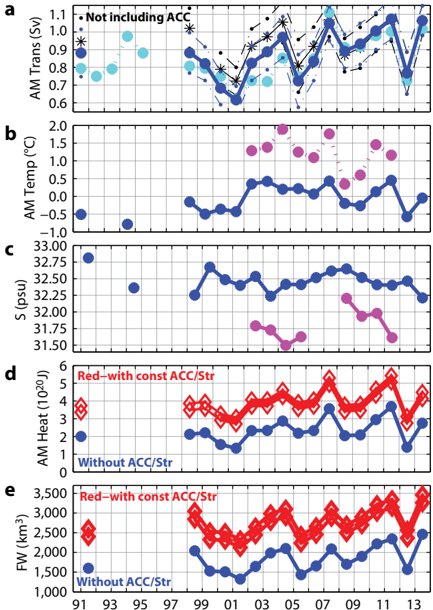
- The Bering Strait is ~85 km wide and ~50 m deep, with typically northward flow of ~0.8 Sv; annual mean volume flux increased from ~0.7 Sv to ~1.1 Sv from 2001 to 2013, an almost 50% increase. Heat flux was ~3–6 × 10^20 J yr−1 (10–20 TW), sufficient to melt 1–2 × 10^6 km2 of 1-m-thick ice; freshwater flux rose from 2,000–2,500 km3 in 2001 to 3,000–3,500 km3 in 2011, with 2013 equaling the record ~3,500 km3.
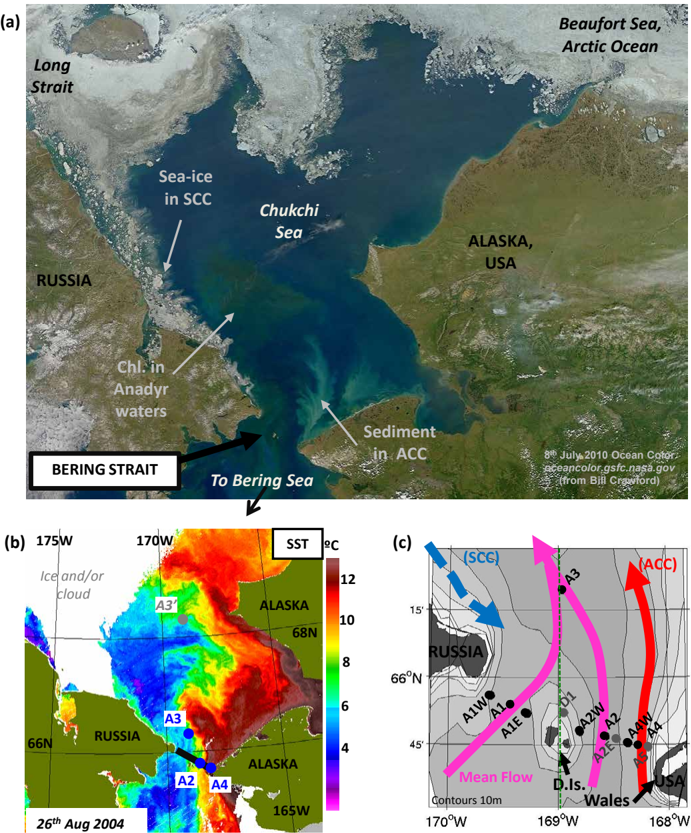
- The Alaskan Coastal Current is warm (>5°C), fresh (>7 psu fresher), ~0.1 Sv, and carries about one-third of the heat and one-quarter of the freshwater flux of the strait. Winter water column homogenizes; sea-ice mean thicknesses vary from <1 m to >2 m, maximum thicknesses exceed 18 m, and winter 2007–2008 ice carried ~140 ± 40 km3 of freshwater northward.
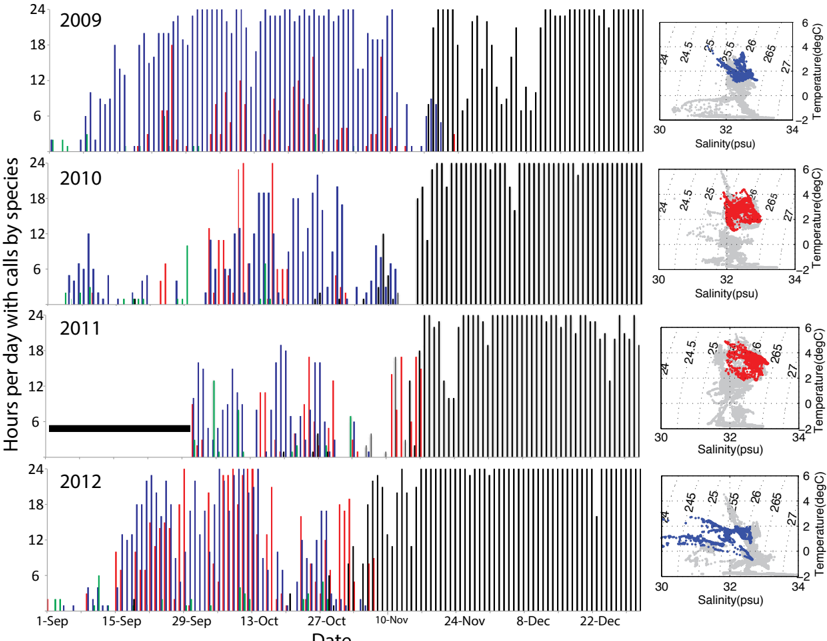
- Nitrate at the near-coastal Russian-channel mooring A1W ranged 8–32 µM over a year; pH was ~8–8.3 in summer and ~8.1 in winter. Sub-Arctic humpback, fin, and killer whales were detected September–December 2009–2012, most often in 2009 and 2012, while bowhead calls occurred nearly hourly from mid-November.
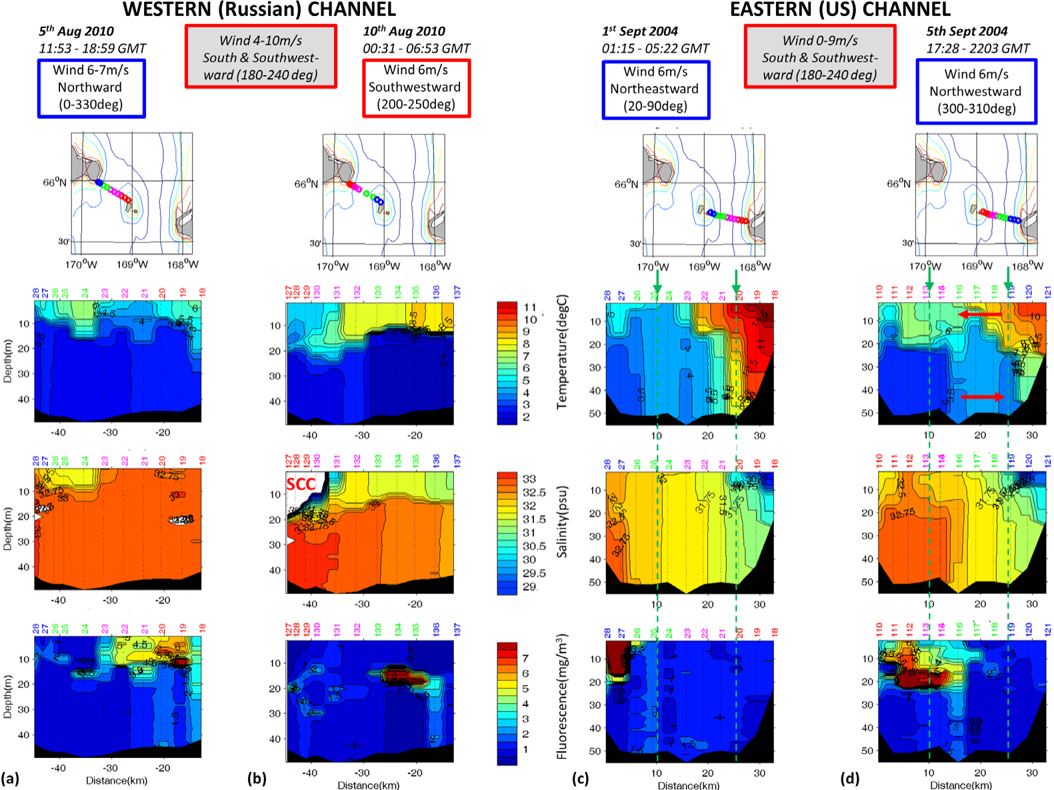
- Island-trapped eddy zones occur in the central strait; flow responds rapidly to local wind, including reversals, and the approximately two-layer summer structure is likely caused largely by “spilling” of Alaskan Coastal Waters. Sections must be run over a few hours, not a day, to be considered synoptic.
Methods
- Synthesis of year-round mooring measurements in the Bering Strait from 1990–2014, including RUSALCA 2004–2011; from summer 2004 to summer 2011 a synoptic array of typically eight, sometimes 11, moorings was deployed, with typically three in Russian waters. US sites A2, A3, and A4 were central to flux estimates; moorings were serviced annually.
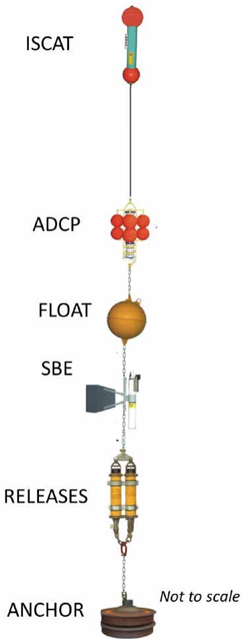
- Instruments included SeaCAT temperature-salinity sensors, Aanderaa current meters, ADCPs, ISCAT upper-water-column sensors, upward-looking sonars, ISUS nitrate meters, bio-optical sensors, prototype pH/pCO2 sensors, and marine mammal acoustic recorders. Data also included satellite SST/ocean color, hydrographic CTD sections from 2000–2014, and Native knowledge.
- Main analysis combined time series and sections to quantify velocity, water properties, volume/heat/freshwater fluxes, sea-ice thickness and flux, nitrate, pH, and whale call occurrence. Heat fluxes were computed relative to −1.9°C and freshwater fluxes relative to 34.8 psu.
Limitations
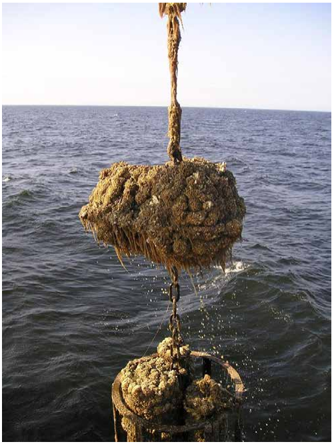
- The paper states that data are sparse from the 1990s; Russian-channel moorings had access issues and were not redeployed until 2014; biofouling and battery issues required annual servicing and degraded data; ISUS appeared sensitive to drift; pH/pCO2 and bio-optical results were preliminary, with instrument issues, and lacking pCO2 measurements prevented calculation of Ω aragonite from mooring pH; oxygen records were dissimilar and neglected without bottle data.
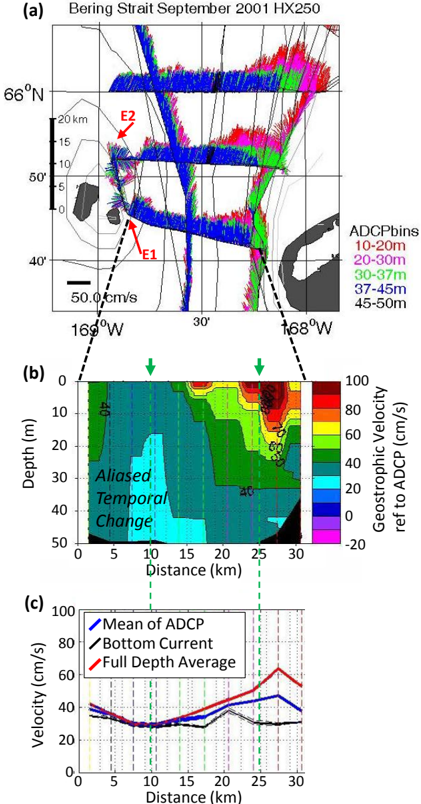
- The paper states that single hydrographic sections can alias temporal change, that year-round interdisciplinary time series are necessary, that mechanisms of interannual flux changes are not fully understood, and that far-field forcing and linkages to Bering Sea water properties remain unclear.
- Evident from the text: this is a synthesis/review relying on heterogeneous, sometimes unpublished or ongoing analyses and preliminary results, rather than a single controlled experiment.
Model-written summary. Check it against the paper before relying on it.
Integrity signals
Registry
Cites
Statistics
Figures

Verification
Claims the paper makes
0 Valid · 6 Not valid · 80 Not checked · 108 Own results and interpretations
A result the paper reports from its own data — it cites no other source for it, so there is none to check. The quote shows it is in the paper.
In the paper
“Ubiquitous to all this work are the rapid and large variations that can occur in the region at times of changing wind (Figure 6).”
plainstates an association- Asserted: passes — The authors put it forward as true.
- Checkable: passes — It can be checked against evidence.
- Load-bearing: passes — The paper’s conclusions depend on it.
- Based: passes — The paper gives a reason why it holds.
A result the paper reports from its own data — it cites no other source for it, so there is none to check. The quote shows it is in the paper.
In the paper
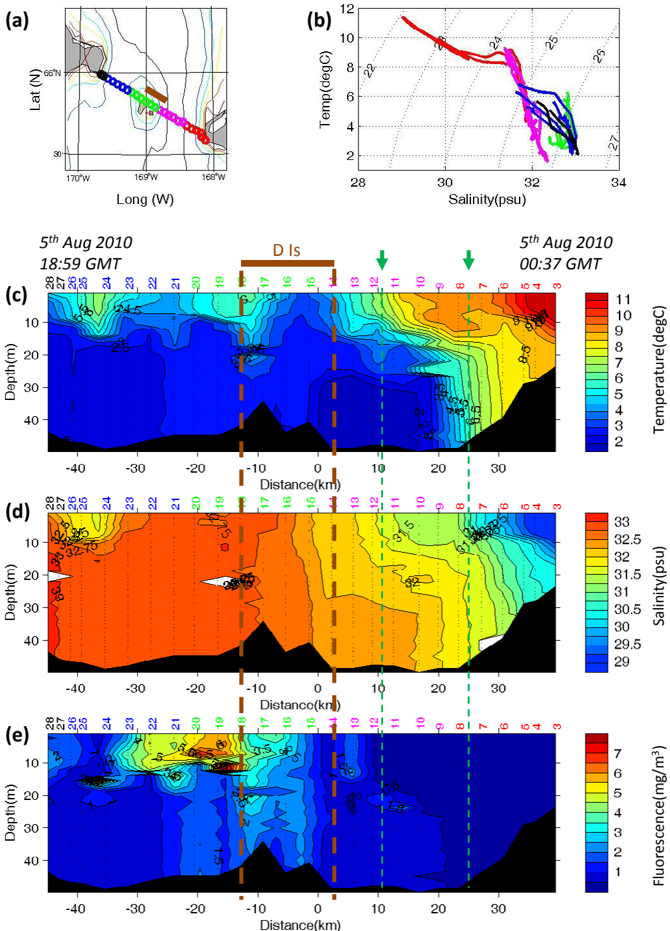
“Our sections are generally not close enough to shore to identify the current nearest Wales, however the middle current matches well the location in our sections of the edge of the ACW and the associated surface intensified velocity (identified from ship's ADCP data or geostrophic velocity, e.g., Figure 5), typically found between ~25-30 km on our sections (equivalent to ~10-15 km off Wales).”
boostedstates an association- Asserted: passes — The authors put it forward as true.
- Checkable: passes — It can be checked against evidence.
- Load-bearing: unclear — It is unclear whether the paper’s conclusions depend on it.
- Based: passes — The paper gives a reason why it holds.
None of the sources cited for this claim have been checked yet.
In the paper
“In terms of water properties, the most dominant feature of the system is warm, fresh waters on the Alaskan coast, waters originating from the ACC (Coachman et al., 1975;Woodgate and Aagaard, 2005).”
What the sources say
- Not checked yetcites Coachman et al., 1975
- Not matchedcites Woodgate and Aagaard, 2005
More than one paper fits this citation.
plainstates a cause- Asserted: passes — The authors put it forward as true.
- Checkable: passes — It can be checked against evidence.
- Load-bearing: unclear — It is unclear whether the paper’s conclusions depend on it.
- Based: passes — The paper gives a reason why it holds.
In the paper
“Mixing caused by eddies shed by flow past an island is known, in suitable circumstances, to cause phytoplankton blooms (e.g., Hasegawa et al., 2009), and in our summer surveys, at least qualitatively, there were larger concentrations of birds in this region compared to in either channel of the strait at comparable distances from the islands.”
What the sources say
- Not checked yetcites Hasegawa et al., 2009 matched to “How islands cause phytoplankton to bloom in their wakes” (2009) source
hedgedstates an association- Asserted: passes — The authors put it forward as true.
- Checkable: passes — It can be checked against evidence.
- Load-bearing: unclear — It is unclear whether the paper’s conclusions depend on it.
- Based: passes — The paper gives a reason why it holds.
A result the paper reports from its own data — it cites no other source for it, so there is none to check. The quote shows it is in the paper.
In the paper
“Under northward wind conditions, the westward extent of the warm Alaskan Coastal Waters (ACW), viz., waters that are or were once part of the dynamically coastally trapped ACC, is remarkably consistent between sections, with extents being typically 10-20 km out into the strait.”
plain- Asserted: passes — The authors put it forward as true.
- Checkable: passes — It can be checked against evidence.
- Load-bearing: unclear — It is unclear whether the paper’s conclusions depend on it.
- Based: passes — The paper gives a reason why it holds.
62 more claims
Create a free account to see all 194 claims and to verify the 68 references still open.
- It may state two separate claims as one. 87
- Probably not a substantial claim. 57
- The quote only partly states this claim. 1
Citations
Cites
Arctic sea ice decline: Faster than forecast
Stroeve, J., Holland, M. M., Meier, W., Scambos, T., & Serreze, M. (2007) · Geophysical Research Letters · doi:10.1029/2007gl029703 · Cited by 1,857
The role of sea ice and other fresh water in the Arctic circulation
Aagaard, K., & Carmack, E. C. (1989) · Journal of Geophysical Research: Oceans · doi:10.1029/jc094ic10p14485 · Cited by 1,635
Descriptive physical oceanography: an introduction
(1983) · Continental Shelf Research · doi:10.1016/0278-4343(83)90030-4 · Cited by 950
A Major Ecosystem Shift in the Northern Bering Sea
Grebmeier, J. M., Overland, J. E., Moore, S. E., Farley, E. V., Carmack, E. C., Cooper, L. W., Frey, K. E., Helle, J. H., McLaughlin, F. A., & McNutt, S. L. (2006) · Science · doi:10.1126/science.1121365 · Cited by 876
Changes in Arctic melt season and implications for sea ice loss
Stroeve, J. C., Markus, T., Boisvert, L., Miller, J., & Barrett, A. (2014) · Geophysical Research Letters · doi:10.1002/2013gl058951 · Cited by 748
The large‐scale freshwater cycle of the Arctic
Serreze, M. C., Barrett, A. P., Slater, A. G., Woodgate, R. A., Aagaard, K., Lammers, R. B., Steele, M., Moritz, R., Meredith, M., & Lee, C. M. (2006) · Journal of Geophysical Research: Oceans · doi:10.1029/2005jc003424 · Cited by 624
Self-citationGrebmeier, J. M., Cooper, L. W., Feder, H. M., & Sirenko, B. I. (2006) · Progress in Oceanography · doi:10.1016/j.pocean.2006.10.001 · Cited by 624
Climate change and control of the southeastern Bering Sea pelagic ecosystem
Hunt Jr, G. L., Stabeno, P., Walters, G., Sinclair, E., Brodeur, R. D., Napp, J. M., & Bond, N. A. (2002) · Deep Sea Research Part II: Topical Studies in Oceanography · doi:10.1016/s0967-0645(02)00321-1 · Cited by 567
Pacific Ocean inflow: Influence on catastrophic reduction of sea ice cover in the Arctic Ocean
Shimada, K., Kamoshida, T., Itoh, M., Nishino, S., Carmack, E., McLaughlin, F., Zimmermann, S., & Proshutinsky, A. (2006) · Geophysical Research Letters · doi:10.1029/2005gl025624 · Cited by 518
The 2007 Bering Strait oceanic heat flux and anomalous Arctic sea‐ice retreat
Woodgate, R. A., Weingartner, T., & Lindsay, R. W. (2010) · Geophysical Research Letters · doi:10.1029/2009gl041621 · Cited by 497
Self-citation
Research works printed but not linked: 3
- Oceana and Kawerak Inc. 2014. Bering Strait Marine Life and Subsistence Use Data Synthesis. Oceana and Kawerak Inc., Juneau, AK, USA, 499 pp, http://oceana.org/news-media/publications/reports/ the-bering-strait-marine-life-and-subsistence- data-synthesis. · DOI
- Paquette, R.G., and R.H. Bourke. 1974. Observations on the coastal current of Arctic Alaska. Journal of Marine Research 32(2):195-207.
- Woodgate, R. 2013. Arctic ocean circulation: Going around at the top of the world. Nature Education Knowledge 4(8):8.
Cited by
Woodgate, R. A. (2018) · Progress in Oceanography · doi:10.1016/j.pocean.2017.12.007 · Cited by 482
Self-citationUnderstanding Arctic Ocean Circulation: A Review of Ocean Dynamics in a Changing Climate
Timmermans, M., & Marshall, J. (2020) · Journal of Geophysical Research: Oceans · doi:10.1029/2018jc014378 · Cited by 371
The Arctic's sea ice cover: trends, variability, predictability, and comparisons to the Antarctic
Serreze, M. C., & Meier, W. N. (2019) · Annals of the New York Academy of Sciences · doi:10.1111/nyas.13856 · Cited by 300
A. Woodgate, R., & Peralta‐Ferriz, C. (2021) · Geophysical Research Letters · doi:10.1029/2021gl092528 · Cited by 194
Self-citationDanielson, S. L., Eisner, L. B., Ladd, C., Mordy, C. W., Sousa, L., & Weingartner, T. J. (2016) · Deep Sea Research Part II Topical Studies in Oceanography · doi:10.1016/j.dsr2.2016.05.024 · Cited by 180
Metadata
- Authors
- Woodgate, R., Stafford, K., & Prahl, F.
- Affiliations
- University of Washington (US)
- Oregon State University (US)
- Venue
- Oceanography
- Publisher
- The Oceanography Society
- Published
- 2015-09-01
- Volume
- 28
- Issue
- 3
- Pages
- 46-67
- ISSN
- 1042-8275 (ISSN-L)
- OpenAlex
- W2267721316
- Cited by
- 180
- References
- 81
- Citations by year
- 2026: 11 · 2025: 4 · 2024: 11 · 2023: 13 · 2022: 19 · 2021: 27 · 2020: 24 · 2019: 20 · 2018: 21 · 2017: 17 · 2016: 9 · 2015: 4
- FWCI
- 8.66
- Type
- journal article
- Language
- en
- Open access
- gold
- doi.org
- Licence
- cc-by
- Locations
- Oceanography (publishedVersion, cc-by)
- Funders
- National Science Foundation (1107106, 1304052, 1023264, 0632154)
- National Oceanic and Atmospheric Administration
- Office of Naval Research (N00014)
- Topics
- Physical Sciences › Earth and Planetary Sciences › Oceanography › Oceanographic and Atmospheric Processes
- Physical Sciences › Earth and Planetary Sciences › Atmospheric Science › Arctic and Antarctic ice dynamics
- Social Sciences › Sociology and Political Science › Arctic and Russian Policy Studies
- Keywords
- Bering Strait, ocean currents, ADCP moorings
About these checks
Registry, retraction, Cites and statistics results are computed, not judged, with one exception: a printed reference that no index lists is read once by a model before it counts as a citation error. Claims are extracted by a model and kept only when their quote appears verbatim in the text; each cited source is then checked, with a model’s help, for whether it says what the claim relies on. Those verdicts can be wrong — read the claim’s quote and the cited source before relying on one.
A language model drew the claims from the paper on 2026-11-24, under version 3 of the claim definition (model deepseek-v4.1-flash, prompt extract-v3).
A second model labelled each claim on 2026-11-24 (model jev-1.13-20260917, definition revision gold-guideline-v0.2).
Statistics and arithmetic are recomputed, not judged.
Confidence bands are shown only for fields calibrated on our annotated test set. None is calibrated yet, so no band is shown.
What counts as a claim ›How we measure confidence ›How we check this ›
Are you an author, or do you see a problem with this page? Request a review
How to cite
Cite CoChat for the checks on this page, and the paper for its own findings.
- This page
- CoChat. (2026). Citation check: A Synthesis of Year-Round Interdisciplinary Mooring Measurements in the Bering Strait (1990–2014) and the RUSALCA Years (2004–2011). https://app.cochat.ai/papers/10.5670/oceanog.2015.57
- The paper
- Woodgate, R., Stafford, K., & Prahl, F. (2015). A Synthesis of Year-Round Interdisciplinary Mooring Measurements in the Bering Strait (1990–2014) and the RUSALCA Years (2004–2011). Oceanography. https://doi.org/10.5670/oceanog.2015.57
Data sources
Bibliographic data: Semantic Scholar, OpenAlex, Crossref.
Contains information from the Semantic Scholar Academic Graph Datasets, made available under the ODC Attribution License (ODC-BY 1.0).
Semantic Scholar’s data is described in: Kinney, R., et al. (2023). The Semantic Scholar Open Data Platform. arXiv:2301.10140.
