

The DOI matches its Crossref record; 59 of the 67 references it cites were found in a registry or an index, and 8 are not checked yet; 3 of the 63 sources its claims cite were checked for support.
Collapse of the oyster population in Apalachicola Bay: cascading social impacts from an ecologically and culturally significant species
Open accessAbstract
Historically fishery-dependent communities can have significant economic, social, and cultural ties to key species, the loss of which can cause cascading impacts throughout the community, extending beyond fishers. Understanding the different ways communities depend on a species, and how the species’ loss may reverberate through the community, is key for holistic ecosystem management approaches. We propose that species that possess significant importance to the economic, cultural, social, and nutritional structuring of a human community be considered “multidimensional foundation species.” This study examines the multi-faceted impacts of oyster population collapse within the Apalachicola Bay region of Florida. We conducted semi-structured interviews with a variety of local community members, exploring the varying types of connections to oysters and how the oyster population collapse impacted community members individually and collectively. Individuals described economic, ecological, cultural, and nutritional impacts within their lives. Economic impacts were most common, but impacts differed substantially for individuals with different connections to oysters. We also documented broader collective changes, particularly loss of cultural ecosystem services tied to oysters, including negative shifts in community identity, individual identities of community members, and social well-being. We found a greater de-coupling between tourism and the fishery than hypothesized, with tourism reported to have increased despite the collapse in oysters, demonstrating the challenges of predicting impacts from the decline of a multidimensional foundation species. This work highlights the need to understand how harvestable foundation species may not only form the base of ecological systems, but also influence the economic, cultural, and social dimensions of human systems. In the face of continual global fishery declines, implementing management actions that consider the far-reaching ecological and social importance of fisheries species will be crucial for promoting community well-being and resilience.
Verified 2026-11-11 · 8 references not checked yet
Overview
AI snapshot
Written from the paper’s full text.
TL;DR
Semi-structured interviews in Apalachicola Bay show that oyster population collapse produced economic, cultural, nutritional, and ecological impacts across community members, with effects varying by connection to oysters. The authors propose oysters as a “multidimensional foundation species” and find tourism increased despite the fishery collapse, contrary to their hypothesis.
Key findings
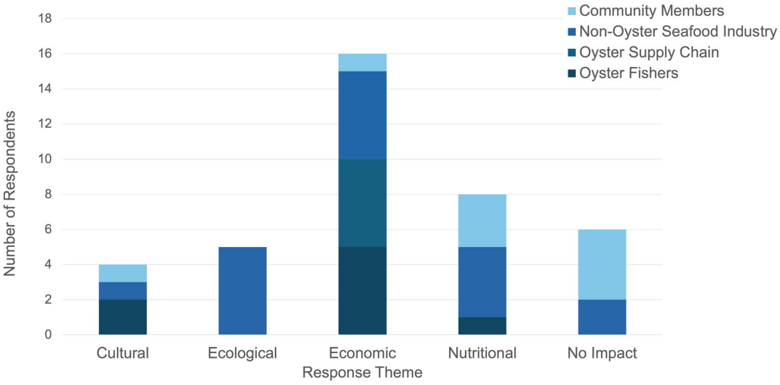
- Economic impacts were the most commonly reported individual impacts (57%, n = 16), including loss of employment (18%, n = 5) and other employment impacts (14%, n = 4); oyster fishers and the oyster supply chain group reported economic impacts most or solely.
- Loss of oysters as a food source was mentioned by 29% of interviewees (n = 8) across three of four connection groups; only the non-oyster seafood industry group reported ecological impacts, including reduced reef-associated species and changed fishing locations.
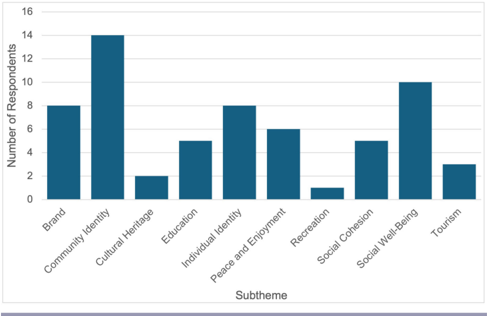
- Collective cultural ecosystem service changes were mentioned by 100% of participants (n = 28); community identity was the most common cultural impact (54%), followed by social well-being, with brand and individual identity tied third. Supporting services were mentioned by 68% (n = 19), regulating by 46% (n = 13), provisioning by 43% (n = 12), and additional collective economic impacts by 79% (n = 22).
- Contrary to the hypothesis that tourism would decline, only 3 participants thought tourism was lower, while 17 reported tourism had grown immensely, attributed to the region being “discovered,” COVID-19, and beach/recreational fishing rather than oysters.
Methods
- Semi-structured interviews were conducted in 2023–2024 with 28 participants: 27 local community members who had lived or worked in the Apalachicola Bay region and one former oyster farmer from nearby Oyster Bay who sold oysters in the region. Recruitment used community events, local newspaper publicity, a county commission meeting, and snowball sampling.
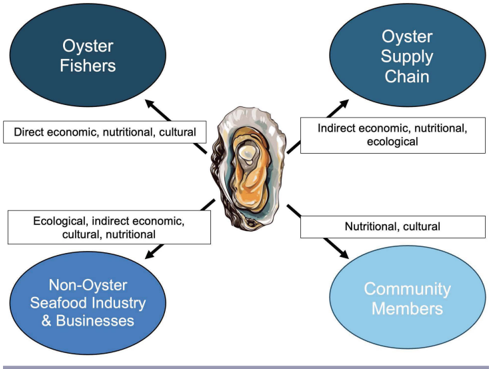
- Participants were categorized post hoc into four connection groups based on their job at the 2013 federal fishery disaster declaration: oyster fishers (25%, n = 7), oyster supply chain (18%, n = 5), non-oyster seafood industry and businesses (29%, n = 8), and community members (29%, n = 8).
- Thematic analysis combined a priori and inductive coding; individual and collective impacts were coded into cultural, ecological, economic, and nutritional themes and ecosystem service categories from the Millennium Ecosystem Assessment and IPBES assessments, then analyzed by connection group.
Limitations
- The paper states that interviewees represent only a small portion of the region’s population; several individuals declined to participate, citing frustration over the fishery closure, and a greater sample size would have provided more insight. The authors also state they could not connect with commercial fishermen of oyster reef-reliant species such as crabs and shrimp, and had only one oyster farmer.
- Evident from the text: snowball sampling and self-selection may bias the perspectives captured, and the study relies on retrospective, self-reported accounts rather than quantitative ecological or economic measurements.
Model-written summary. Check it against the paper before relying on it.
Integrity signals
Registry
Cites
Statistics
Figures
Verification
Claims the paper makes
78 Own result · 20 Not checked yet · 19 Own interpretation · 12 Sources not found · 10 Own method · 6 No basis given · 2 No full text of the sources · 1 Partly supported · accuracy not yet measured
A result the paper reports from its own data — it cites no other source for it, so there is none to check. The quote shows it is in the paper.
In the paper
“Other impacts on employment were expressed by OSC and NOSI group individuals (14%, n = 4).”
§ Collapse of the oyster population in Apalachicola Bay: cascading social impacts from an ecologically and culturally significant species > Individual reliance and impacts of oyster loss
plainn = 4- Asserted: passes — The authors put it forward as true.
- Checkable: passes — It can be checked against evidence.
- Load-bearing: unclear — It is unclear whether the paper’s conclusions depend on it.
- Based: passes — The paper gives a reason why it holds.
- Rests on an assumption: Participants' retrospective self-reports accurately reflect their experiences and the community-level impacts they describe.
- Rests on an assumption: The post hoc four connection groups based on job at the time of the 2013 disaster declaration adequately capture participants' connections to oysters and their resulting impacts.
A result the paper reports from its own data — it cites no other source for it, so there is none to check. The quote shows it is in the paper.
In the paper
“One guide fisher mentioned how the reduction in reef-associated species and the inability to catch fish affected their clients' perceptions of their abilities as fishers, which was classified as an indirect impact on employment because this negative perception could affect client retention.”
§ Collapse of the oyster population in Apalachicola Bay: cascading social impacts from an ecologically and culturally significant species > Individual reliance and impacts of oyster loss
hedgedconditionalSingle case- Asserted: passes — The authors put it forward as true.
- Checkable: passes — It can be checked against evidence.
- Load-bearing: unclear — It is unclear whether the paper’s conclusions depend on it.
- Based: passes — The paper gives a reason why it holds.
- Rests on an assumption: Participants' retrospective self-reports accurately reflect their experiences and the community-level impacts they describe.
A result the paper reports from its own data — it cites no other source for it, so there is none to check. The quote shows it is in the paper.
In the paper
“A common theme within these responses was the change in the certainty of catching fish; there was a shift from guaranteed and easy catch to greater uncertainty and effort needed to catch target species.”
§ Collapse of the oyster population in Apalachicola Bay: cascading social impacts from an ecologically and culturally significant species > Individual reliance and impacts of oyster loss
plaincorrelationaln = 5- Asserted: passes — The authors put it forward as true.
- Checkable: passes — It can be checked against evidence.
- Load-bearing: unclear — It is unclear whether the paper’s conclusions depend on it.
- Based: passes — The paper gives a reason why it holds.
- Rests on an assumption: Participants' retrospective self-reports accurately reflect their experiences and the community-level impacts they describe.
None of the sources cited for this claim have been checked yet.
In the paper
“With the degradation of oyster reefs and thus habitat for these fished species, there were ecological changes within the bay that also affected respondents.”
§ Collapse of the oyster population in Apalachicola Bay: cascading social impacts from an ecologically and culturally significant species > Individual reliance and impacts of oyster loss
plaindirectn = 5- Asserted: passes — The authors put it forward as true.
- Checkable: passes — It can be checked against evidence.
- Load-bearing: passes — The paper’s conclusions depend on it.
- Based: passes — The paper gives a reason why it holds.
- Rests on an assumption: The oyster population collapse and subsequent fishery closure caused the reported social, cultural, and economic impacts, rather than other concurrent factors.
- Rests on an assumption: Participants' retrospective self-reports accurately reflect their experiences and the community-level impacts they describe.
A result the paper reports from its own data — it cites no other source for it, so there is none to check. The quote shows it is in the paper.
In the paper
“OSC group respondents diversified within their field, either changing where they source their product, their clientele, or their business models.”
§ Collapse of the oyster population in Apalachicola Bay: cascading social impacts from an ecologically and culturally significant species > Individual reliance and impacts of oyster loss
plain- Asserted: passes — The authors put it forward as true.
- Checkable: passes — It can be checked against evidence.
- Load-bearing: unclear — It is unclear whether the paper’s conclusions depend on it.
- Based: passes — The paper gives a reason why it holds.
- Rests on an assumption: Participants' retrospective self-reports accurately reflect their experiences and the community-level impacts they describe.
- Rests on an assumption: The post hoc four connection groups based on job at the time of the 2013 disaster declaration adequately capture participants' connections to oysters and their resulting impacts.
A result the paper reports from its own data — it cites no other source for it, so there is none to check. The quote shows it is in the paper.
In the paper
“Additionally, five respondents, all within the NOSI group, noted that there was a reduction in reefassociated species, such as redfish or tripletail, which impacted their livelihoods.”
§ Collapse of the oyster population in Apalachicola Bay: cascading social impacts from an ecologically and culturally significant species > Individual reliance and impacts of oyster loss
plaindirectn = 5- Asserted: passes — The authors put it forward as true.
- Checkable: passes — It can be checked against evidence.
- Load-bearing: unclear — It is unclear whether the paper’s conclusions depend on it.
- Based: passes — The paper gives a reason why it holds.
- Rests on an assumption: Participants' retrospective self-reports accurately reflect their experiences and the community-level impacts they describe.
- Rests on an assumption: The post hoc four connection groups based on job at the time of the 2013 disaster declaration adequately capture participants' connections to oysters and their resulting impacts.
A result the paper reports from its own data — it cites no other source for it, so there is none to check. The quote shows it is in the paper.
In the paper
“Loss of employment was felt by OF group individuals, the oyster fishers who could no longer go out to harvest, resulting in changing jobs or entering early retirement at the time of disaster or time of closure (18%, n = 5).”
§ Collapse of the oyster population in Apalachicola Bay: cascading social impacts from an ecologically and culturally significant species > Individual reliance and impacts of oyster loss
plaindirectn = 5- Asserted: passes — The authors put it forward as true.
- Checkable: passes — It can be checked against evidence.
- Load-bearing: unclear — It is unclear whether the paper’s conclusions depend on it.
- Based: passes — The paper gives a reason why it holds.
- Rests on an assumption: Participants' retrospective self-reports accurately reflect their experiences and the community-level impacts they describe.
- Rests on an assumption: The post hoc four connection groups based on job at the time of the 2013 disaster declaration adequately capture participants' connections to oysters and their resulting impacts.
A result the paper reports from its own data — it cites no other source for it, so there is none to check. The quote shows it is in the paper.
In the paper
“Adaptation of NOSI group respondents included guide fishers who moved offshore or changed where they fished to meet client expectations.”
§ Collapse of the oyster population in Apalachicola Bay: cascading social impacts from an ecologically and culturally significant species > Individual reliance and impacts of oyster loss
plaindirect- Asserted: passes — The authors put it forward as true.
- Checkable: passes — It can be checked against evidence.
- Load-bearing: unclear — It is unclear whether the paper’s conclusions depend on it.
- Based: passes — The paper gives a reason why it holds.
- Rests on an assumption: Participants' retrospective self-reports accurately reflect their experiences and the community-level impacts they describe.
- Rests on an assumption: The post hoc four connection groups based on job at the time of the 2013 disaster declaration adequately capture participants' connections to oysters and their resulting impacts.
A result the paper reports from its own data — it cites no other source for it, so there is none to check. The quote shows it is in the paper.
In the paper
“NOSI and CM group individuals mentioned the loss of an alternative income source, citing that oysters were often a reliable source of supplemental income that would help pay bills, cover income when other jobs were unavailable, or supplement their retirement income.”
§ Collapse of the oyster population in Apalachicola Bay: cascading social impacts from an ecologically and culturally significant species > Individual reliance and impacts of oyster loss
plain- Asserted: passes — The authors put it forward as true.
- Checkable: passes — It can be checked against evidence.
- Load-bearing: passes — The paper’s conclusions depend on it.
- Based: passes — The paper gives a reason why it holds.
- Rests on an assumption: Participants' retrospective self-reports accurately reflect their experiences and the community-level impacts they describe.
- Rests on an assumption: The post hoc four connection groups based on job at the time of the 2013 disaster declaration adequately capture participants' connections to oysters and their resulting impacts.
A result the paper reports from its own data — it cites no other source for it, so there is none to check. The quote shows it is in the paper.
In the paper
“Two seafood dealers mentioned the direct impacts on employment of seafood house workers due to reduction in the availability of product for purchase, both oysters and other local species, resulting in fewer hours for the workers.”
§ Collapse of the oyster population in Apalachicola Bay: cascading social impacts from an ecologically and culturally significant species > Individual reliance and impacts of oyster loss
plaindirect- Asserted: passes — The authors put it forward as true.
- Checkable: passes — It can be checked against evidence.
- Load-bearing: unclear — It is unclear whether the paper’s conclusions depend on it.
- Based: passes — The paper gives a reason why it holds.
- Rests on an assumption: Participants' retrospective self-reports accurately reflect their experiences and the community-level impacts they describe.
A result the paper reports from its own data — it cites no other source for it, so there is none to check. The quote shows it is in the paper.
In the paper
“The loss of oysters as a food source was mentioned by eight of the interviewees (29%), across three of the four connection groups.”
§ Collapse of the oyster population in Apalachicola Bay: cascading social impacts from an ecologically and culturally significant species > Individual reliance and impacts of oyster loss
plain- Asserted: passes — The authors put it forward as true.
- Checkable: passes — It can be checked against evidence.
- Load-bearing: unclear — It is unclear whether the paper’s conclusions depend on it.
- Based: passes — The paper gives a reason why it holds.
- Rests on an assumption: Participants' retrospective self-reports accurately reflect their experiences and the community-level impacts they describe.
- Rests on an assumption: The post hoc four connection groups based on job at the time of the 2013 disaster declaration adequately capture participants' connections to oysters and their resulting impacts.
A result the paper reports from its own data — it cites no other source for it, so there is none to check. The quote shows it is in the paper.
In the paper
“The Oyster Supply Chain group (OSC group) individuals solely reported economic impacts because of the fishery collapse.”
§ Collapse of the oyster population in Apalachicola Bay: cascading social impacts from an ecologically and culturally significant species > Individual reliance and impacts of oyster loss
plaindirect- Asserted: passes — The authors put it forward as true.
- Checkable: passes — It can be checked against evidence.
- Load-bearing: unclear — It is unclear whether the paper’s conclusions depend on it.
- Based: passes — The paper gives a reason why it holds.
- Rests on an assumption: Participants' retrospective self-reports accurately reflect their experiences and the community-level impacts they describe.
- Rests on an assumption: The post hoc four connection groups based on job at the time of the 2013 disaster declaration adequately capture participants' connections to oysters and their resulting impacts.
A result the paper reports from its own data — it cites no other source for it, so there is none to check. The quote shows it is in the paper.
In the paper
“Respondents who had generational ties, or had grown up fishing in the area, also expressed negative sentiments in relation to this loss, including frustration or disbelief in their inability to harvest their own food like they had done previously.”
§ Collapse of the oyster population in Apalachicola Bay: cascading social impacts from an ecologically and culturally significant species > Individual reliance and impacts of oyster loss
plaincorrelational- Asserted: passes — The authors put it forward as true.
- Checkable: passes — It can be checked against evidence.
- Load-bearing: unclear — It is unclear whether the paper’s conclusions depend on it.
- Based: passes — The paper gives a reason why it holds.
- Rests on an assumption: Participants' retrospective self-reports accurately reflect their experiences and the community-level impacts they describe.
A result the paper reports from its own data — it cites no other source for it, so there is none to check. The quote shows it is in the paper.
In the paper
“Many of the experiences and reactions described by participants as economic impacts or changes from the collapse could collectively be grouped under an umbrella of economic diversification, encompassing taking on additional jobs, changing jobs within or outside of their field, and changing business models.”
§ Collapse of the oyster population in Apalachicola Bay: cascading social impacts from an ecologically and culturally significant species > Individual reliance and impacts of oyster loss
hedgedn = 2- Asserted: passes — The authors put it forward as true.
- Checkable: passes — It can be checked against evidence.
- Load-bearing: unclear — It is unclear whether the paper’s conclusions depend on it.
- Based: passes — The paper gives a reason why it holds.
- Rests on an assumption: Participants' retrospective self-reports accurately reflect their experiences and the community-level impacts they describe.
A result the paper reports from its own data — it cites no other source for it, so there is none to check. The quote shows it is in the paper.
In the paper
“Three former oyster fishers discussed how the fishery closure impacted their sense of identity through the loss of their way of life, or the freedom of being their own boss, which we categorized as a cultural impact.”
§ Collapse of the oyster population in Apalachicola Bay: cascading social impacts from an ecologically and culturally significant species > Individual reliance and impacts of oyster loss
plaindirect- Asserted: passes — The authors put it forward as true.
- Checkable: passes — It can be checked against evidence.
- Load-bearing: passes — The paper’s conclusions depend on it.
- Based: passes — The paper gives a reason why it holds.
- Rests on an assumption: Participants' retrospective self-reports accurately reflect their experiences and the community-level impacts they describe.
A result the paper reports from its own data — it cites no other source for it, so there is none to check. The quote shows it is in the paper.
In the paper
“Additional responses on the collective economic impacts of the fishery collapse were made by 79% of interviewees (n = 22).”
§ Collapse of the oyster population in Apalachicola Bay: cascading social impacts from an ecologically and culturally significant species > Collective impacts of loss on community cultural and social identity
plainn = 22- Asserted: passes — The authors put it forward as true.
- Checkable: passes — It can be checked against evidence.
- Load-bearing: unclear — It is unclear whether the paper’s conclusions depend on it.
- Based: passes — The paper gives a reason why it holds.
- Rests on an assumption: Participants' retrospective self-reports accurately reflect their experiences and the community-level impacts they describe.
- Rests on an assumption: The 28 interviews are sufficient to represent the range of relevant community perspectives in Apalachicola Bay.
The paper states this without a source or data behind it here, so there is nothing to check it against. The quote shows it is in the paper.
In the paper
“We highlight that a variety of community members derived ecological, economic, and cultural benefits from oysters.”
§ Collapse of the oyster population in Apalachicola Bay: cascading social impacts from an ecologically and culturally significant species > DISCUSSION
plain- Asserted: passes — The authors put it forward as true.
- Checkable: passes — It can be checked against evidence.
- Load-bearing: passes — The paper’s conclusions depend on it.
- Based: passes — The paper gives a reason why it holds.
A result the paper reports from its own data — it cites no other source for it, so there is none to check. The quote shows it is in the paper.
In the paper
“Ecosystem service loss from oyster population decline and reef degradation as identified by interview participants.”
§ Collapse of the oyster population in Apalachicola Bay: cascading social impacts from an ecologically and culturally significant species > Additional information
plain- Asserted: passes — The authors put it forward as true.
- Checkable: passes — It can be checked against evidence.
- Load-bearing: passes — The paper’s conclusions depend on it.
- Based: passes — The paper gives a reason why it holds.
A result the paper reports from its own data — it cites no other source for it, so there is none to check. The quote shows it is in the paper.
In the paper
“Food 9”
§ Collapse of the oyster population in Apalachicola Bay: cascading social impacts from an ecologically and culturally significant species > Additional information
plainn = 9- Asserted: passes — The authors put it forward as true.
- Checkable: passes — It can be checked against evidence.
- Load-bearing: unclear — It is unclear whether the paper’s conclusions depend on it.
- Based: passes — The paper gives a reason why it holds.
A result the paper reports from its own data — it cites no other source for it, so there is none to check. The quote shows it is in the paper.
In the paper
“As indicated by several participants, tourism seems to be filling the gap as the main industry in the area, replacing the seafood industry.”
§ Collapse of the oyster population in Apalachicola Bay: cascading social impacts from an ecologically and culturally significant species > Collective impacts of loss on community cultural and social identity
hedgeddirect- Asserted: passes — The authors put it forward as true.
- Checkable: passes — It can be checked against evidence.
- Load-bearing: unclear — It is unclear whether the paper’s conclusions depend on it.
- Based: passes — The paper gives a reason why it holds.
- Rests on an assumption: Participants' retrospective self-reports accurately reflect their experiences and the community-level impacts they describe.
A result the paper reports from its own data — it cites no other source for it, so there is none to check. The quote shows it is in the paper.
In the paper
“Some respondents were specifically concerned about the shifting community identity as it relates to tourism.”
§ Collapse of the oyster population in Apalachicola Bay: cascading social impacts from an ecologically and culturally significant species > Collective impacts of loss on community cultural and social identity
plain- Asserted: passes — The authors put it forward as true.
- Checkable: passes — It can be checked against evidence.
- Load-bearing: unclear — It is unclear whether the paper’s conclusions depend on it.
- Based: passes — The paper gives a reason why it holds.
- Rests on an assumption: Participants' retrospective self-reports accurately reflect their experiences and the community-level impacts they describe.
A result the paper reports from its own data — it cites no other source for it, so there is none to check. The quote shows it is in the paper.
In the paper
“Nursery/ Juvenile Habitat Creation 6”
§ Collapse of the oyster population in Apalachicola Bay: cascading social impacts from an ecologically and culturally significant species > Additional information
plainn = 6- Asserted: passes — The authors put it forward as true.
- Checkable: passes — It can be checked against evidence.
- Load-bearing: unclear — It is unclear whether the paper’s conclusions depend on it.
- Based: passes — The paper gives a reason why it holds.
A result the paper reports from its own data — it cites no other source for it, so there is none to check. The quote shows it is in the paper.
In the paper
“Food Security 3”
§ Collapse of the oyster population in Apalachicola Bay: cascading social impacts from an ecologically and culturally significant species > Additional information
plainn = 3- Asserted: passes — The authors put it forward as true.
- Checkable: passes — It can be checked against evidence.
- Load-bearing: unclear — It is unclear whether the paper’s conclusions depend on it.
- Based: passes — The paper gives a reason why it holds.
A result the paper reports from its own data — it cites no other source for it, so there is none to check. The quote shows it is in the paper.
In the paper
“Supporting 19”
§ Collapse of the oyster population in Apalachicola Bay: cascading social impacts from an ecologically and culturally significant species > Additional information
plainn = 19- Asserted: passes — The authors put it forward as true.
- Checkable: passes — It can be checked against evidence.
- Load-bearing: unclear — It is unclear whether the paper’s conclusions depend on it.
- Based: passes — The paper gives a reason why it holds.
The paper states this without a source or data behind it here, so there is nothing to check it against. The quote shows it is in the paper.
In the paper
“As showcased in this study, individual and collective benefits are derived from the oyster populations of Apalachicola Bay.”
§ Collapse of the oyster population in Apalachicola Bay: cascading social impacts from an ecologically and culturally significant species > Implications for management
boosted- Asserted: passes — The authors put it forward as true.
- Checkable: passes — It can be checked against evidence.
- Load-bearing: passes — The paper’s conclusions depend on it.
- Based: passes — The paper gives a reason why it holds.
A result the paper reports from its own data — it cites no other source for it, so there is none to check. The quote shows it is in the paper.
In the paper
“they did not directly state that the reduction of oyster populations impacted these services when asked specifically about the impacts or changes in the Bay from oyster loss or after the disaster declaration.”
§ Collapse of the oyster population in Apalachicola Bay: cascading social impacts from an ecologically and culturally significant species > Additional information
plain- Asserted: passes — The authors put it forward as true.
- Checkable: passes — It can be checked against evidence.
- Load-bearing: unclear — It is unclear whether the paper’s conclusions depend on it.
- Based: passes — The paper gives a reason why it holds.
A result the paper reports from its own data — it cites no other source for it, so there is none to check. The quote shows it is in the paper.
In the paper
“Within cultural services, impacts of oyster loss fell into 11 sub-themes based on participant responses (Fig. 3).”
§ Collapse of the oyster population in Apalachicola Bay: cascading social impacts from an ecologically and culturally significant species > Collective impacts of loss on community cultural and social identity
plainn = 28- Asserted: passes — The authors put it forward as true.
- Checkable: passes — It can be checked against evidence.
- Load-bearing: unclear — It is unclear whether the paper’s conclusions depend on it.
- Based: passes — The paper gives a reason why it holds.
- Rests on an assumption: Participants' retrospective self-reports accurately reflect their experiences and the community-level impacts they describe.
A result the paper reports from its own data — it cites no other source for it, so there is none to check. The quote shows it is in the paper.
In the paper
“Two cultural services were tied for the third most mentioned responses: brand and individual identity.”
§ Collapse of the oyster population in Apalachicola Bay: cascading social impacts from an ecologically and culturally significant species > Collective impacts of loss on community cultural and social identity
plain- Asserted: passes — The authors put it forward as true.
- Checkable: passes — It can be checked against evidence.
- Load-bearing: unclear — It is unclear whether the paper’s conclusions depend on it.
- Based: passes — The paper gives a reason why it holds.
A result the paper reports from its own data — it cites no other source for it, so there is none to check. The quote shows it is in the paper.
In the paper
“Contrary to these expectations, only three participants indicated that they thought there was less tourism in the area than there would be if the oyster fishery were open.”
§ Collapse of the oyster population in Apalachicola Bay: cascading social impacts from an ecologically and culturally significant species > Collective impacts of loss on community cultural and social identity
hedgedn = 3- Asserted: passes — The authors put it forward as true.
- Checkable: passes — It can be checked against evidence.
- Load-bearing: passes — The paper’s conclusions depend on it.
- Based: passes — The paper gives a reason why it holds.
A result the paper reports from its own data — it cites no other source for it, so there is none to check. The quote shows it is in the paper.
In the paper
“These identities were tied to positive sentiments, with participants using terms of love, enjoyment, and satisfaction.”
§ Collapse of the oyster population in Apalachicola Bay: cascading social impacts from an ecologically and culturally significant species > Collective impacts of loss on community cultural and social identity
plaincorrelational- Asserted: passes — The authors put it forward as true.
- Checkable: passes — It can be checked against evidence.
- Load-bearing: unclear — It is unclear whether the paper’s conclusions depend on it.
- Based: passes — The paper gives a reason why it holds.
A result the paper reports from its own data — it cites no other source for it, so there is none to check. The quote shows it is in the paper.
In the paper
“First, there was the physical change within the Bay municipalities along the coast, which was tied to sense of place, cultural heritage values and aesthetic values.”
§ Collapse of the oyster population in Apalachicola Bay: cascading social impacts from an ecologically and culturally significant species > Collective impacts of loss on community cultural and social identity
plaincorrelational- Asserted: passes — The authors put it forward as true.
- Checkable: passes — It can be checked against evidence.
- Load-bearing: passes — The paper’s conclusions depend on it.
- Based: passes — The paper gives a reason why it holds.
- Rests on an assumption: Participants' retrospective self-reports accurately reflect their experiences and the community-level impacts they describe.
A result the paper reports from its own data — it cites no other source for it, so there is none to check. The quote shows it is in the paper.
In the paper
“Provisioning 12”
§ Collapse of the oyster population in Apalachicola Bay: cascading social impacts from an ecologically and culturally significant species > Additional information
plainn = 12- Asserted: passes — The authors put it forward as true.
- Checkable: passes — It can be checked against evidence.
- Load-bearing: unclear — It is unclear whether the paper’s conclusions depend on it.
- Based: passes — The paper gives a reason why it holds.
A result the paper reports from its own data — it cites no other source for it, so there is none to check. The quote shows it is in the paper.
In the paper
“Multiple reasons were given for this shift out of oystering, both related and unrelated to oyster population declines.”
§ Collapse of the oyster population in Apalachicola Bay: cascading social impacts from an ecologically and culturally significant species > DISCUSSION
plaincorrelational- Asserted: passes — The authors put it forward as true.
- Checkable: passes — It can be checked against evidence.
- Load-bearing: unclear — It is unclear whether the paper’s conclusions depend on it.
- Based: passes — The paper gives a reason why it holds.
A result the paper reports from its own data — it cites no other source for it, so there is none to check. The quote shows it is in the paper.
In the paper
“Decline of social well-being within the community was the second most common theme.”
§ Collapse of the oyster population in Apalachicola Bay: cascading social impacts from an ecologically and culturally significant species > Collective impacts of loss on community cultural and social identity
plain- Asserted: passes — The authors put it forward as true.
- Checkable: passes — It can be checked against evidence.
- Load-bearing: unclear — It is unclear whether the paper’s conclusions depend on it.
- Based: passes — The paper gives a reason why it holds.
A result the paper reports from its own data — it cites no other source for it, so there is none to check. The quote shows it is in the paper.
In the paper
“Hazard Regulation 4”
§ Collapse of the oyster population in Apalachicola Bay: cascading social impacts from an ecologically and culturally significant species > Additional information
plainn = 4- Asserted: passes — The authors put it forward as true.
- Checkable: passes — It can be checked against evidence.
- Load-bearing: unclear — It is unclear whether the paper’s conclusions depend on it.
- Based: passes — The paper gives a reason why it holds.
A result the paper reports from its own data — it cites no other source for it, so there is none to check. The quote shows it is in the paper.
In the paper
“Four respondents mentioned changes in the type of tourist that comes to the region.”
§ Collapse of the oyster population in Apalachicola Bay: cascading social impacts from an ecologically and culturally significant species > Collective impacts of loss on community cultural and social identity
plainn = 4- Asserted: passes — The authors put it forward as true.
- Checkable: passes — It can be checked against evidence.
- Load-bearing: unclear — It is unclear whether the paper’s conclusions depend on it.
- Based: passes — The paper gives a reason why it holds.
A result the paper reports from its own data — it cites no other source for it, so there is none to check. The quote shows it is in the paper.
In the paper
“Water Quality 10”
§ Collapse of the oyster population in Apalachicola Bay: cascading social impacts from an ecologically and culturally significant species > Additional information
plainn = 10- Asserted: passes — The authors put it forward as true.
- Checkable: passes — It can be checked against evidence.
- Load-bearing: unclear — It is unclear whether the paper’s conclusions depend on it.
- Based: passes — The paper gives a reason why it holds.
A result the paper reports from its own data — it cites no other source for it, so there is none to check. The quote shows it is in the paper.
In the paper
“We found that community members experience multiple impacts from species loss based on different connections they hold to oysters.”
§ Collapse of the oyster population in Apalachicola Bay: cascading social impacts from an ecologically and culturally significant species > DISCUSSION
plaincorrelational- Asserted: passes — The authors put it forward as true.
- Checkable: passes — It can be checked against evidence.
- Load-bearing: passes — The paper’s conclusions depend on it.
- Based: passes — The paper gives a reason why it holds.
A result the paper reports from its own data — it cites no other source for it, so there is none to check. The quote shows it is in the paper.
In the paper
“However, with the oyster declines, and subsequent closure of both the fishery and the related seafood industry businesses in the area, respondents indicated that this identity is changing along with the landscape.”
§ Collapse of the oyster population in Apalachicola Bay: cascading social impacts from an ecologically and culturally significant species > Collective impacts of loss on community cultural and social identity
hedgeddirect- Asserted: passes — The authors put it forward as true.
- Checkable: passes — It can be checked against evidence.
- Load-bearing: passes — The paper’s conclusions depend on it.
- Based: passes — The paper gives a reason why it holds.
- Rests on an assumption: Participants' retrospective self-reports accurately reflect their experiences and the community-level impacts they describe.
A result the paper reports from its own data — it cites no other source for it, so there is none to check. The quote shows it is in the paper.
In the paper
“By contrast, 17 participants reported that tourism has grown immensely in recent years, including since the closure.”
§ Collapse of the oyster population in Apalachicola Bay: cascading social impacts from an ecologically and culturally significant species > Collective impacts of loss on community cultural and social identity
plainn = 17- Asserted: passes — The authors put it forward as true.
- Checkable: passes — It can be checked against evidence.
- Load-bearing: passes — The paper’s conclusions depend on it.
- Based: passes — The paper gives a reason why it holds.
A result the paper reports from its own data — it cites no other source for it, so there is none to check. The quote shows it is in the paper.
In the paper
“For example, only NOSI group individuals highlighted ecological impacts relevant to them because of the fishery collapse.”
§ Collapse of the oyster population in Apalachicola Bay: cascading social impacts from an ecologically and culturally significant species > DISCUSSION
plain- Asserted: passes — The authors put it forward as true.
- Checkable: passes — It can be checked against evidence.
- Load-bearing: unclear — It is unclear whether the paper’s conclusions depend on it.
- Based: passes — The paper gives a reason why it holds.
A result the paper reports from its own data — it cites no other source for it, so there is none to check. The quote shows it is in the paper.
In the paper
“Additionally, respondents mentioned that they previously raised money for community members in need through the harvest and sale of oysters and other reef-associated seafood with local benefit events.”
§ Collapse of the oyster population in Apalachicola Bay: cascading social impacts from an ecologically and culturally significant species > Collective impacts of loss on community cultural and social identity
plain- Asserted: passes — The authors put it forward as true.
- Checkable: passes — It can be checked against evidence.
- Load-bearing: unclear — It is unclear whether the paper’s conclusions depend on it.
- Based: passes — The paper gives a reason why it holds.
A result the paper reports from its own data — it cites no other source for it, so there is none to check. The quote shows it is in the paper.
In the paper
“Regulating 13”
§ Collapse of the oyster population in Apalachicola Bay: cascading social impacts from an ecologically and culturally significant species > Additional information
plainn = 13- Asserted: passes — The authors put it forward as true.
- Checkable: passes — It can be checked against evidence.
- Load-bearing: unclear — It is unclear whether the paper’s conclusions depend on it.
- Based: passes — The paper gives a reason why it holds.
A result the paper reports from its own data — it cites no other source for it, so there is none to check. The quote shows it is in the paper.
In the paper
“Lack of a negative impact on regional tourism was attributed to participants' belief that visitors to the region are unaware that the fishery is closed, or that the oysters they are eating are not wild caught from the area.”
§ Collapse of the oyster population in Apalachicola Bay: cascading social impacts from an ecologically and culturally significant species > Collective impacts of loss on community cultural and social identity
plain- Asserted: passes — The authors put it forward as true.
- Checkable: passes — It can be checked against evidence.
- Load-bearing: unclear — It is unclear whether the paper’s conclusions depend on it.
- Based: passes — The paper gives a reason why it holds.
None of the sources cited for this claim have been checked yet.
In the paper
“Because of the longevity and historical success of the fishery, and heavy reliance on oysters within this community, Apalachicola Bay provides an excellent case study for understanding how the collapse of an important fishery causes rippling social effects (Russell et al. 2016, Holland and Leonard 2020, Drakopulos and Poe 2023).”
§ Collapse of the oyster population in Apalachicola Bay: cascading social impacts from an ecologically and culturally significant species > METHODS
What the sources say
- Not checked yetcites Russell et al. 2016 source
Checked before — its earlier verdict is held back until a new check runs.
- Not checked yetcites Holland and Leonard 2020 source
Checked before — its earlier verdict is held back until a new check runs.
- Not matchedcites Drakopulos and Poe 2023
Couldn’t be matched to a paper in Crossref, so it can’t be checked.
plaindirect- Asserted: passes — The authors put it forward as true.
- Checkable: passes — It can be checked against evidence.
- Load-bearing: passes — The paper’s conclusions depend on it.
- Based: passes — The paper gives a reason why it holds.
- Not checked yet
None of the sources cited for this claim have been checked yet.
In the paper
“Because oysters are an ecological foundation species, providing structure and habitat for other species, even non-oyster fishers may have had an indirect reliance on oysters (Cranfield et al. 2001).”
§ Collapse of the oyster population in Apalachicola Bay: cascading social impacts from an ecologically and culturally significant species > METHODS
What the sources say
- Not checked yetcites Cranfield et al. 2001 source
Checked before — its earlier verdict is held back until a new check runs.
hedgedconditional- Asserted: passes — The authors put it forward as true.
- Checkable: passes — It can be checked against evidence.
- Load-bearing: passes — The paper’s conclusions depend on it.
- Based: passes — The paper gives a reason why it holds.
- Not checked yet
A conclusion the paper draws from its own results — it cites no other source for it, so there is none to check. The quote shows it is in the paper.
In the paper
“Oyster fishing and the seafood industry supported the identities of community members throughout the region.”
§ Collapse of the oyster population in Apalachicola Bay: cascading social impacts from an ecologically and culturally significant species > Collective impacts of loss on community cultural and social identity
plaindirect- Asserted: passes — The authors put it forward as true.
- Checkable: passes — It can be checked against evidence.
- Load-bearing: passes — The paper’s conclusions depend on it.
- Based: passes — The paper gives a reason why it holds.
A conclusion the paper draws from its own results — it cites no other source for it, so there is none to check. The quote shows it is in the paper.
In the paper
“We found a greater de-coupling between tourism and the fishery than hypothesized, with tourism reported to have increased despite the collapse in oysters, demonstrating the challenges of predicting impacts from the decline of a multidimensional foundation species.”
§ Collapse of the oyster population in Apalachicola Bay: cascading social impacts from an ecologically and culturally significant species > Abstract
boosted- Asserted: passes — The authors put it forward as true.
- Checkable: passes — It can be checked against evidence.
- Load-bearing: passes — The paper’s conclusions depend on it.
- Based: passes — The paper gives a reason why it holds.
A conclusion the paper draws from its own results — it cites no other source for it, so there is none to check. The quote shows it is in the paper.
In the paper
“By utilizing information from local experiences, we found that changes in oyster populations, or oyster harvest regulations, may have resulted in changes within the economic and social landscapes much earlier than the 2010s fishery collapse.”
§ Collapse of the oyster population in Apalachicola Bay: cascading social impacts from an ecologically and culturally significant species > DISCUSSION
hedgedconditional- Asserted: passes — The authors put it forward as true.
- Checkable: passes — It can be checked against evidence.
- Load-bearing: passes — The paper’s conclusions depend on it.
- Based: passes — The paper gives a reason why it holds.
A conclusion the paper draws from its own results — it cites no other source for it, so there is none to check. The quote shows it is in the paper.
In the paper
“These perspectives suggest ecological changes that are affecting not just fishers, but also those reliant on the ecosystem created by the foundation species.”
§ Collapse of the oyster population in Apalachicola Bay: cascading social impacts from an ecologically and culturally significant species > DISCUSSION
hedgeddirect- Asserted: passes — The authors put it forward as true.
- Checkable: passes — It can be checked against evidence.
- Load-bearing: passes — The paper’s conclusions depend on it.
- Based: passes — The paper gives a reason why it holds.
None of the sources cited for this claim have been checked yet.
In the paper
“Building on the foundation species and cultural keystone species concepts (Dayton 1972, Cristancho and Vining 2004, Garibaldi and Turner 2004), we argue that oysters are a multidimensional foundation species within the Apalachicola Bay region.”
§ Collapse of the oyster population in Apalachicola Bay: cascading social impacts from an ecologically and culturally significant species > Implications for management
What the sources say
- Not matchedcites Dayton 1972
Couldn’t be matched to a paper in Crossref, so it can’t be checked.
- Not matchedcites Cristancho and Vining 2004
Couldn’t be matched to a paper in Crossref, so it can’t be checked.
- Not checked yetcites Garibaldi and Turner 2004 source
Checked before — its earlier verdict is held back until a new check runs.
plain- Asserted: passes — The authors put it forward as true.
- Checkable: passes — It can be checked against evidence.
- Load-bearing: passes — The paper’s conclusions depend on it.
- Based: passes — The paper gives a reason why it holds.
- Not matched
What the paper did — it cites no source for this, so there is none to check. The quote shows it is in the paper.
In the paper
“Despite the limited number of respondents, we were able to begin to assess service losses that fell into the cultural ecosystem services category.”
§ Collapse of the oyster population in Apalachicola Bay: cascading social impacts from an ecologically and culturally significant species > DISCUSSION
plain- Asserted: passes — The authors put it forward as true.
- Checkable: passes — It can be checked against evidence.
- Load-bearing: passes — The paper’s conclusions depend on it.
- Based: passes — The paper gives a reason why it holds.
A conclusion the paper draws from its own results — it cites no other source for it, so there is none to check. The quote shows it is in the paper.
In the paper
“We propose that its individual and collective importance to the community demonstrates its role as a “multidimensional foundation species” with ecological, economic, social, and cultural relevance.”
§ Collapse of the oyster population in Apalachicola Bay: cascading social impacts from an ecologically and culturally significant species > INTRODUCTION
boostedcorrelational- Asserted: passes — The authors put it forward as true.
- Checkable: passes — It can be checked against evidence.
- Load-bearing: passes — The paper’s conclusions depend on it.
- Based: passes — The paper gives a reason why it holds.
- Probably not a substantial claim. 51
- It may state two separate claims as one. 63
The cited sources support only part of this claim — read each source’s verdict below.
In the paper
“However, in recent years there has been a concerted effort to include factors of human well-being in studies of climate stress, fisheries participation, and ecosystem management (Breslow et al. 2016, Holland et al. 2020, Moore et al. 2024).”
§ Collapse of the oyster population in Apalachicola Bay: cascading social impacts from an ecologically and culturally significant species > DISCUSSION
What the sources say
- Supportedcites Breslow et al. 2016 source
The Introduction (page unavailable) says human wellbeing is attracting increasing attention in environmental science and marine contexts, and describes the paper’s framework for ecosystem-based management. The Additional information section (page unavailable) lists wellbeing-related projects concerning fishing communities and coral reef fisheries’ vulnerability to climate change, supporting the sentence’s broad characterization. (LLM, conf=0.85)
- Partly supportedcites Holland et al. 2020 sourceExperimental — accuracy not yet measured
The Materials and Methods section measures income and employment impacts of a harmful algal bloom, and the Discussion recognizes emotional and sociocultural impacts on fishing communities. This supports attention to some aspects of human well-being, but the paper does not establish a concerted effort across studies of climate stress, fisheries participation, and ecosystem management. (LLM, conf=0.79)
- Supportedcites Moore et al. 2024 source
The Introduction (page unavailable) describes efforts to incorporate human well-being into ecosystem assessment and fisheries management, including applications in Alaska and Hawaii. The paper also applies a well-being framework to climate-related harmful algal blooms affecting fishing communities, supporting the broad background claim. (LLM, conf=0.88)
plain- Asserted: passes — The authors put it forward as true.
- Checkable: passes — It can be checked against evidence.
- Load-bearing: fails — The paper’s conclusions may not depend on it.
- Based: passes — The paper gives a reason why it holds.
Probably not a substantial claim. The paper’s conclusions may not depend on it.
- Supported
A result the paper reports from its own data — it cites no other source for it, so there is none to check. The quote shows it is in the paper.
In the paper
“The Oyster Fisher group (OF group) individuals most frequently spoke of economic impacts, noting they either retired or found one or more jobs to support them after the fishery closed.”
§ Collapse of the oyster population in Apalachicola Bay: cascading social impacts from an ecologically and culturally significant species > Individual reliance and impacts of oyster loss
plaindirect- Asserted: passes — The authors put it forward as true.
- Checkable: passes — It can be checked against evidence.
- Load-bearing: unclear — It is unclear whether the paper’s conclusions depend on it.
- Based: passes — The paper gives a reason why it holds.
It may state two separate claims as one.
- Rests on an assumption: Participants' retrospective self-reports accurately reflect their experiences and the community-level impacts they describe.
- Rests on an assumption: The post hoc four connection groups based on job at the time of the 2013 disaster declaration adequately capture participants' connections to oysters and their resulting impacts.
A result the paper reports from its own data — it cites no other source for it, so there is none to check. The quote shows it is in the paper.
In the paper
“These impacts were exclusively described by individuals who were previously oyster fishers, however they fell https://www.ecologyandsociety.org/vol30/iss1/art37/into different connection groups based on their jobs at the time of the fishery disaster declaration.”
§ Collapse of the oyster population in Apalachicola Bay: cascading social impacts from an ecologically and culturally significant species > Individual reliance and impacts of oyster loss
plaincorrelational- Asserted: passes — The authors put it forward as true.
- Checkable: passes — It can be checked against evidence.
- Load-bearing: unclear — It is unclear whether the paper’s conclusions depend on it.
- Based: passes — The paper gives a reason why it holds.
It may state two separate claims as one.
- Rests on an assumption: Participants' retrospective self-reports accurately reflect their experiences and the community-level impacts they describe.
- Rests on an assumption: The post hoc four connection groups based on job at the time of the 2013 disaster declaration adequately capture participants' connections to oysters and their resulting impacts.
A result the paper reports from its own data — it cites no other source for it, so there is none to check. The quote shows it is in the paper.
In the paper
“Within non-cultural services, loss of habitat for reef-associated species was the most frequently mentioned impact (64%, n = 18), followed by changes in water quality (36%, n = 10) and changes in food availability derived from oyster reefs (32%, n = 9; Table A1.4).”
§ Collapse of the oyster population in Apalachicola Bay: cascading social impacts from an ecologically and culturally significant species > Collective impacts of loss on community cultural and social identity
plainn = 18- Asserted: passes — The authors put it forward as true.
- Checkable: passes — It can be checked against evidence.
- Load-bearing: unclear — It is unclear whether the paper’s conclusions depend on it.
- Based: passes — The paper gives a reason why it holds.
It may state two separate claims as one.
- Rests on an assumption: Participants' retrospective self-reports accurately reflect their experiences and the community-level impacts they describe.
- Rests on an assumption: The 28 interviews are sufficient to represent the range of relevant community perspectives in Apalachicola Bay.
A result the paper reports from its own data — it cites no other source for it, so there is none to check. The quote shows it is in the paper.
In the paper
“Within OF group individuals this meant they either found other jobs, or in two cases multiple jobs, outside oyster fishing, or entered early retirement.”
§ Collapse of the oyster population in Apalachicola Bay: cascading social impacts from an ecologically and culturally significant species > Individual reliance and impacts of oyster loss
plaindirectn = 2- Asserted: passes — The authors put it forward as true.
- Checkable: passes — It can be checked against evidence.
- Load-bearing: unclear — It is unclear whether the paper’s conclusions depend on it.
- Based: passes — The paper gives a reason why it holds.
It may state two separate claims as one.
- Rests on an assumption: Participants' retrospective self-reports accurately reflect their experiences and the community-level impacts they describe.
- Rests on an assumption: The post hoc four connection groups based on job at the time of the 2013 disaster declaration adequately capture participants' connections to oysters and their resulting impacts.
A result the paper reports from its own data — it cites no other source for it, so there is none to check. The quote shows it is in the paper.
In the paper
“Finally, half of Community Member group (CM group) participants felt no impact of the collapse, while others noted the loss of accessible free food options, loss of potential supplemental income in retirement, and loss of time spent on the water because they no longer can harvest oysters.”
§ Collapse of the oyster population in Apalachicola Bay: cascading social impacts from an ecologically and culturally significant species > Individual reliance and impacts of oyster loss
plain- Asserted: passes — The authors put it forward as true.
- Checkable: passes — It can be checked against evidence.
- Load-bearing: unclear — It is unclear whether the paper’s conclusions depend on it.
- Based: passes — The paper gives a reason why it holds.
It may state two separate claims as one.
- Rests on an assumption: Participants' retrospective self-reports accurately reflect their experiences and the community-level impacts they describe.
- Rests on an assumption: The post hoc four connection groups based on job at the time of the 2013 disaster declaration adequately capture participants' connections to oysters and their resulting impacts.
A result the paper reports from its own data — it cites no other source for it, so there is none to check. The quote shows it is in the paper.
In the paper
“Guide fishing captains noted changes in location and availability of target species, reporting either catching fish in new locations, or only catching fish where they know there are oysters.”
§ Collapse of the oyster population in Apalachicola Bay: cascading social impacts from an ecologically and culturally significant species > Individual reliance and impacts of oyster loss
plaincorrelational- Asserted: passes — The authors put it forward as true.
- Checkable: passes — It can be checked against evidence.
- Load-bearing: passes — The paper’s conclusions depend on it.
- Based: passes — The paper gives a reason why it holds.
It may state two separate claims as one.
- Rests on an assumption: Participants' retrospective self-reports accurately reflect their experiences and the community-level impacts they describe.
A result the paper reports from its own data — it cites no other source for it, so there is none to check. The quote shows it is in the paper.
In the paper
“The oyster fishers group represented 25% of participants (n = 7), supply chain group 18% (n = 5), non-seafood industry and businesses group 29% (n Fig. 1.Connection group framework.Connection to oysters, and impacts felt from the population collapse and fishery closure, were hypothesized to vary among interview respondents.Interviewees were categorized by their relationship to oysters; see Table 1”
§ Collapse of the oyster population in Apalachicola Bay: cascading social impacts from an ecologically and culturally significant species > Interview group categorization
plain- Asserted: passes — The authors put it forward as true.
- Checkable: passes — It can be checked against evidence.
- Load-bearing: fails — The paper’s conclusions may not depend on it.
- Based: passes — The paper gives a reason why it holds.
Probably not a substantial claim. The paper’s conclusions may not depend on it. It may state two separate claims as one.
A result the paper reports from its own data — it cites no other source for it, so there is none to check. The quote shows it is in the paper.
In the paper
“This was one of the main impacts noted by CM group respondents, often while expressing love and enjoyment for eating oysters and frustration in no longer being able to readily harvest and consume them.”
§ Collapse of the oyster population in Apalachicola Bay: cascading social impacts from an ecologically and culturally significant species > Individual reliance and impacts of oyster loss
plaincorrelational- Asserted: passes — The authors put it forward as true.
- Checkable: passes — It can be checked against evidence.
- Load-bearing: unclear — It is unclear whether the paper’s conclusions depend on it.
- Based: passes — The paper gives a reason why it holds.
It may state two separate claims as one.
- Rests on an assumption: Participants' retrospective self-reports accurately reflect their experiences and the community-level impacts they describe.
- Rests on an assumption: The post hoc four connection groups based on job at the time of the 2013 disaster declaration adequately capture participants' connections to oysters and their resulting impacts.
A result the paper reports from its own data — it cites no other source for it, so there is none to check. The quote shows it is in the paper.
In the paper
“The Non-Oyster Seafood Industry (NOSI group) individuals were the most diverse in their responses, with respondents citing impacts across all four categories, while two individuals did not feel there was any impact on them from the collapse.”
§ Collapse of the oyster population in Apalachicola Bay: cascading social impacts from an ecologically and culturally significant species > Individual reliance and impacts of oyster loss
plaincorrelationaln = 2- Asserted: passes — The authors put it forward as true.
- Checkable: passes — It can be checked against evidence.
- Load-bearing: unclear — It is unclear whether the paper’s conclusions depend on it.
- Based: passes — The paper gives a reason why it holds.
It may state two separate claims as one.
- Rests on an assumption: Participants' retrospective self-reports accurately reflect their experiences and the community-level impacts they describe.
- Rests on an assumption: The post hoc four connection groups based on job at the time of the 2013 disaster declaration adequately capture participants' connections to oysters and their resulting impacts.
A result the paper reports from its own data — it cites no other source for it, so there is none to check. The quote shows it is in the paper.
In the paper
“Evaluating responses related to community and collective impacts to ecosystem services, changes in cultural services were most frequently mentioned (100% respondents, n = 28), followed by supporting (68%, n = 19), regulating (46%, n = 13), and provisioning (43%, n = 12) services.”
§ Collapse of the oyster population in Apalachicola Bay: cascading social impacts from an ecologically and culturally significant species > Collective impacts of loss on community cultural and social identity
plainn = 28- Asserted: passes — The authors put it forward as true.
- Checkable: passes — It can be checked against evidence.
- Load-bearing: passes — The paper’s conclusions depend on it.
- Based: passes — The paper gives a reason why it holds.
It may state two separate claims as one.
- Rests on an assumption: Participants' retrospective self-reports accurately reflect their experiences and the community-level impacts they describe.
- Rests on an assumption: The 28 interviews are sufficient to represent the range of relevant community perspectives in Apalachicola Bay.
A result the paper reports from its own data — it cites no other source for it, so there is none to check. The quote shows it is in the paper.
In the paper
“Within NOSI group responses, ecological and economic impacts were the most common with ecological impacts only reported by NOSI group individuals.”
§ Collapse of the oyster population in Apalachicola Bay: cascading social impacts from an ecologically and culturally significant species > Individual reliance and impacts of oyster loss
plain- Asserted: passes — The authors put it forward as true.
- Checkable: passes — It can be checked against evidence.
- Load-bearing: unclear — It is unclear whether the paper’s conclusions depend on it.
- Based: passes — The paper gives a reason why it holds.
It may state two separate claims as one.
- Rests on an assumption: Participants' retrospective self-reports accurately reflect their experiences and the community-level impacts they describe.
- Rests on an assumption: The post hoc four connection groups based on job at the time of the 2013 disaster declaration adequately capture participants' connections to oysters and their resulting impacts.
A result the paper reports from its own data — it cites no other source for it, so there is none to check. The quote shows it is in the paper.
In the paper
“Across all participants, economic impacts were reported most often, and among the connection groups, the distribution of responses varied considerably.”
- Also stated in: § Abstract · plain
“Economic impacts were most common, but impacts differed substantially for individuals with different connections to oysters.”
§ Collapse of the oyster population in Apalachicola Bay: cascading social impacts from an ecologically and culturally significant species > Individual reliance and impacts of oyster loss
plaincorrelational- Asserted: passes — The authors put it forward as true.
- Checkable: passes — It can be checked against evidence.
- Load-bearing: passes — The paper’s conclusions depend on it.
- Based: passes — The paper gives a reason why it holds.
It may state two separate claims as one.
- Rests on an assumption: Participants' retrospective self-reports accurately reflect their experiences and the community-level impacts they describe.
- Rests on an assumption: The post hoc four connection groups based on job at the time of the 2013 disaster declaration adequately capture participants' connections to oysters and their resulting impacts.
- Also stated in: § Abstract · plain
A result the paper reports from its own data — it cites no other source for it, so there is none to check. The quote shows it is in the paper.
In the paper
“Participants reported personal experiences ranging from no impact to many impacts, and mentioned cultural, ecological, economic, and nutritional impacts (Fig. 2, Table 2).”
- Also stated in: § Abstract · plain
“Individuals described economic, ecological, cultural, and nutritional impacts within their lives.”
§ Collapse of the oyster population in Apalachicola Bay: cascading social impacts from an ecologically and culturally significant species > Individual reliance and impacts of oyster loss
plain- Asserted: passes — The authors put it forward as true.
- Checkable: passes — It can be checked against evidence.
- Load-bearing: passes — The paper’s conclusions depend on it.
- Based: passes — The paper gives a reason why it holds.
It may state two separate claims as one.
- Rests on an assumption: Participants' retrospective self-reports accurately reflect their experiences and the community-level impacts they describe.
- Rests on an assumption: The 28 interviews are sufficient to represent the range of relevant community perspectives in Apalachicola Bay.
- Also stated in: § Abstract · plain
A result the paper reports from its own data — it cites no other source for it, so there is none to check. The quote shows it is in the paper.
In the paper
“Adult Habitat Creation 18”
§ Collapse of the oyster population in Apalachicola Bay: cascading social impacts from an ecologically and culturally significant species > Additional information
plainn = 18- Asserted: passes — The authors put it forward as true.
- Checkable: passes — It can be checked against evidence.
- Load-bearing: fails — The paper’s conclusions may not depend on it.
- Based: passes — The paper gives a reason why it holds.
Probably not a substantial claim. The paper’s conclusions may not depend on it.
The paper states this without a source or data behind it here, so there is nothing to check it against. The quote shows it is in the paper.
In the paper
“However, restaurants in the area are still serving oysters on the half shell, harvested from other locations or sourced locally from aquaculture farms.”
§ Collapse of the oyster population in Apalachicola Bay: cascading social impacts from an ecologically and culturally significant species > Collective impacts of loss on community cultural and social identity
plain- Asserted: passes — The authors put it forward as true.
- Checkable: passes — It can be checked against evidence.
- Load-bearing: unclear — It is unclear whether the paper’s conclusions depend on it.
- Based: passes — The paper gives a reason why it holds.
It may state two separate claims as one.
A result the paper reports from its own data — it cites no other source for it, so there is none to check. The quote shows it is in the paper.
In the paper
“Genetic/ Population Resource 0”
§ Collapse of the oyster population in Apalachicola Bay: cascading social impacts from an ecologically and culturally significant species > Additional information
plain- Asserted: passes — The authors put it forward as true.
- Checkable: passes — It can be checked against evidence.
- Load-bearing: fails — The paper’s conclusions may not depend on it.
- Based: passes — The paper gives a reason why it holds.
Probably not a substantial claim. The paper’s conclusions may not depend on it.
A result the paper reports from its own data — it cites no other source for it, so there is none to check. The quote shows it is in the paper.
In the paper
“Although all respondents who spoke about the branding of Apalachicola oysters were in agreement about its recognition and prestige, they were divided on whether it would, and does, continue to hold its recognition with the closure”
§ Collapse of the oyster population in Apalachicola Bay: cascading social impacts from an ecologically and culturally significant species > Collective impacts of loss on community cultural and social identity
plain- Asserted: passes — The authors put it forward as true.
- Checkable: passes — It can be checked against evidence.
- Load-bearing: unclear — It is unclear whether the paper’s conclusions depend on it.
- Based: passes — The paper gives a reason why it holds.
It may state two separate claims as one.
A result the paper reports from its own data — it cites no other source for it, so there is none to check. The quote shows it is in the paper.
In the paper
“Participants in this group such as local guide fishing captains noted they were seeing declines in the size and availability of reef-associated species, resulting in many guides shifting fishing effort off-shore or to areas they know retain oysters.”
§ Collapse of the oyster population in Apalachicola Bay: cascading social impacts from an ecologically and culturally significant species > DISCUSSION
plaindirect- Asserted: passes — The authors put it forward as true.
- Checkable: passes — It can be checked against evidence.
- Load-bearing: unclear — It is unclear whether the paper’s conclusions depend on it.
- Based: passes — The paper gives a reason why it holds.
It may state two separate claims as one.
A result the paper reports from its own data — it cites no other source for it, so there is none to check. The quote shows it is in the paper.
In the paper
“All participants identified a way they benefited from oysters, and thus had a connection to oysters.”
§ Collapse of the oyster population in Apalachicola Bay: cascading social impacts from an ecologically and culturally significant species > IPBES Global Assessment
plaindirect- Asserted: passes — The authors put it forward as true.
- Checkable: passes — It can be checked against evidence.
- Load-bearing: fails — The paper’s conclusions may not depend on it.
- Based: passes — The paper gives a reason why it holds.
Probably not a substantial claim. The paper’s conclusions may not depend on it. It may state two separate claims as one.
A result the paper reports from its own data — it cites no other source for it, so there is none to check. The quote shows it is in the paper.
In the paper
“Every interview participant mentioned at least one change in cultural services during the interviews, and the number of responses ranged from one to seven observations of change.”
§ Collapse of the oyster population in Apalachicola Bay: cascading social impacts from an ecologically and culturally significant species > IPBES Global Assessment
plain- Asserted: passes — The authors put it forward as true.
- Checkable: passes — It can be checked against evidence.
- Load-bearing: unclear — It is unclear whether the paper’s conclusions depend on it.
- Based: passes — The paper gives a reason why it holds.
It may state two separate claims as one.
A result the paper reports from its own data — it cites no other source for it, so there is none to check. The quote shows it is in the paper.
In the paper
“Respondents provided insight into the direct impacts of the oyster loss to them personally, including several individuals who were involved in the oyster industry and left their positions prior to the 2013 disaster declaration.”
§ Collapse of the oyster population in Apalachicola Bay: cascading social impacts from an ecologically and culturally significant species > DISCUSSION
plain- Asserted: passes — The authors put it forward as true.
- Checkable: passes — It can be checked against evidence.
- Load-bearing: passes — The paper’s conclusions depend on it.
- Based: passes — The paper gives a reason why it holds.
It may state two separate claims as one.
A result the paper reports from its own data — it cites no other source for it, so there is none to check. The quote shows it is in the paper.
In the paper
“Shoreline Stabilization 1”
§ Collapse of the oyster population in Apalachicola Bay: cascading social impacts from an ecologically and culturally significant species > Additional information
plainSingle case- Asserted: passes — The authors put it forward as true.
- Checkable: passes — It can be checked against evidence.
- Load-bearing: fails — The paper’s conclusions may not depend on it.
- Based: passes — The paper gives a reason why it holds.
Probably not a substantial claim. The paper’s conclusions may not depend on it.
A result the paper reports from its own data — it cites no other source for it, so there is none to check. The quote shows it is in the paper.
In the paper
“many participants recognized the importance of oysters in providing ecosystem services, and mentioned how oysters provide services to the Bay”
§ Collapse of the oyster population in Apalachicola Bay: cascading social impacts from an ecologically and culturally significant species > Additional information
plain- Asserted: passes — The authors put it forward as true.
- Checkable: passes — It can be checked against evidence.
- Load-bearing: fails — The paper’s conclusions may not depend on it.
- Based: passes — The paper gives a reason why it holds.
Probably not a substantial claim. The paper’s conclusions may not depend on it. It may state two separate claims as one.
A result the paper reports from its own data — it cites no other source for it, so there is none to check. The quote shows it is in the paper.
In the paper
“Interviews with different community members also provided insight into the breadth of impacts.”
§ Collapse of the oyster population in Apalachicola Bay: cascading social impacts from an ecologically and culturally significant species > DISCUSSION
plain- Asserted: passes — The authors put it forward as true.
- Checkable: passes — It can be checked against evidence.
- Load-bearing: fails — The paper’s conclusions may not depend on it.
- Based: passes — The paper gives a reason why it holds.
Probably not a substantial claim. The paper’s conclusions may not depend on it.
A result the paper reports from its own data — it cites no other source for it, so there is none to check. The quote shows it is in the paper.
In the paper
“Both long-time and recent residents mentioned the enjoyment they derived from seeing working boats out on the water, and noted the change in how the Bay looks now.”
§ Collapse of the oyster population in Apalachicola Bay: cascading social impacts from an ecologically and culturally significant species > Collective impacts of loss on community cultural and social identity
plain- Asserted: passes — The authors put it forward as true.
- Checkable: passes — It can be checked against evidence.
- Load-bearing: unclear — It is unclear whether the paper’s conclusions depend on it.
- Based: passes — The paper gives a reason why it holds.
It may state two separate claims as one.
- Rests on an assumption: Participants' retrospective self-reports accurately reflect their experiences and the community-level impacts they describe.
The paper states this without a source or data behind it here, so there is nothing to check it against. The quote shows it is in the paper.
In the paper
“With the closure of oyster harvest within the Apalachicola Bay, stakeholders have felt both an economic and cultural loss.”
§ Collapse of the oyster population in Apalachicola Bay: cascading social impacts from an ecologically and culturally significant species > Implications for management
plaindirect- Asserted: passes — The authors put it forward as true.
- Checkable: passes — It can be checked against evidence.
- Load-bearing: passes — The paper’s conclusions depend on it.
- Based: fails — The paper may give no reason why it holds.
Probably not a substantial claim. The paper may give no reason why it holds. It may state two separate claims as one.
A result the paper reports from its own data — it cites no other source for it, so there is none to check. The quote shows it is in the paper.
In the paper
“Participants cited increases in poverty, food insecurity, drug use tied to loss of employment from the oyster collapse, and lack of additional opportunities or training as contributors to overall decline in social well-being within the region.”
§ Collapse of the oyster population in Apalachicola Bay: cascading social impacts from an ecologically and culturally significant species > Collective impacts of loss on community cultural and social identity
plaindirect- Asserted: passes — The authors put it forward as true.
- Checkable: passes — It can be checked against evidence.
- Load-bearing: passes — The paper’s conclusions depend on it.
- Based: passes — The paper gives a reason why it holds.
It may state two separate claims as one.
A result the paper reports from its own data — it cites no other source for it, so there is none to check. The quote shows it is in the paper.
In the paper
“Participants expressed pride in the Apalachicola oyster brand and highlighted the recognition of it globally.”
§ Collapse of the oyster population in Apalachicola Bay: cascading social impacts from an ecologically and culturally significant species > Collective impacts of loss on community cultural and social identity
plain- Asserted: passes — The authors put it forward as true.
- Checkable: passes — It can be checked against evidence.
- Load-bearing: unclear — It is unclear whether the paper’s conclusions depend on it.
- Based: passes — The paper gives a reason why it holds.
It may state two separate claims as one.
A result the paper reports from its own data — it cites no other source for it, so there is none to check. The quote shows it is in the paper.
In the paper
“Not every community member derives the same benefits from oysters, but our results show that there are some commonalities in the experiences of similarly connected individuals.”
§ Collapse of the oyster population in Apalachicola Bay: cascading social impacts from an ecologically and culturally significant species > DISCUSSION
plaincorrelational- Asserted: passes — The authors put it forward as true.
- Checkable: passes — It can be checked against evidence.
- Load-bearing: unclear — It is unclear whether the paper’s conclusions depend on it.
- Based: passes — The paper gives a reason why it holds.
It may state two separate claims as one.
A result the paper reports from its own data — it cites no other source for it, so there is none to check. The quote shows it is in the paper.
In the paper
“Respondents spoke of the visual change of the landscape as the oyster fishery deteriorated through time.They mentioned the closure of oyster houses along the coastal highway and the lack of boats out on the water.”
§ Collapse of the oyster population in Apalachicola Bay: cascading social impacts from an ecologically and culturally significant species > Collective impacts of loss on community cultural and social identity
plaincorrelational- Asserted: passes — The authors put it forward as true.
- Checkable: passes — It can be checked against evidence.
- Load-bearing: passes — The paper’s conclusions depend on it.
- Based: passes — The paper gives a reason why it holds.
It may state two separate claims as one.
- Rests on an assumption: Participants' retrospective self-reports accurately reflect their experiences and the community-level impacts they describe.
A result the paper reports from its own data — it cites no other source for it, so there is none to check. The quote shows it is in the paper.
In the paper
“Shell Material 2”
§ Collapse of the oyster population in Apalachicola Bay: cascading social impacts from an ecologically and culturally significant species > Additional information
plainn = 2- Asserted: passes — The authors put it forward as true.
- Checkable: passes — It can be checked against evidence.
- Load-bearing: fails — The paper’s conclusions may not depend on it.
- Based: passes — The paper gives a reason why it holds.
Probably not a substantial claim. The paper’s conclusions may not depend on it.
The paper states this without a source or data behind it here, so there is nothing to check it against. The quote shows it is in the paper.
In the paper
“In particular, we show the value of categorizing respondents into groups based on their varying connections with the species.”
§ Collapse of the oyster population in Apalachicola Bay: cascading social impacts from an ecologically and culturally significant species > DISCUSSION
plain- Asserted: passes — The authors put it forward as true.
- Checkable: passes — It can be checked against evidence.
- Load-bearing: passes — The paper’s conclusions depend on it.
- Based: passes — The paper gives a reason why it holds.
Probably not a substantial claim.
The paper states this without a source or data behind it here, so there is nothing to check it against. The quote shows it is in the paper.
In the paper
“Nutritionally, community members currently lack access to oysters, a previously free source of fresh, healthy protein.”
§ Collapse of the oyster population in Apalachicola Bay: cascading social impacts from an ecologically and culturally significant species > Implications for management
plain- Asserted: passes — The authors put it forward as true.
- Checkable: passes — It can be checked against evidence.
- Load-bearing: passes — The paper’s conclusions depend on it.
- Based: fails — The paper may give no reason why it holds.
Probably not a substantial claim. The paper may give no reason why it holds.
A result the paper reports from its own data — it cites no other source for it, so there is none to check. The quote shows it is in the paper.
In the paper
“We also documented broader collective changes, particularly loss of cultural ecosystem services tied to oysters, including negative shifts in community identity, individual identities of community members, and social well-being.”
§ Collapse of the oyster population in Apalachicola Bay: cascading social impacts from an ecologically and culturally significant species > Abstract
plaindirect- Asserted: passes — The authors put it forward as true.
- Checkable: passes — It can be checked against evidence.
- Load-bearing: passes — The paper’s conclusions depend on it.
- Based: passes — The paper gives a reason why it holds.
It may state two separate claims as one.
- Rests on an assumption: Participants' retrospective self-reports accurately reflect their experiences and the community-level impacts they describe.
A result the paper reports from its own data — it cites no other source for it, so there is none to check. The quote shows it is in the paper.
In the paper
“These terms and relationship to identity were cited across connection groups.”
§ Collapse of the oyster population in Apalachicola Bay: cascading social impacts from an ecologically and culturally significant species > Collective impacts of loss on community cultural and social identity
plaincorrelational- Asserted: passes — The authors put it forward as true.
- Checkable: passes — It can be checked against evidence.
- Load-bearing: fails — The paper’s conclusions may not depend on it.
- Based: passes — The paper gives a reason why it holds.
Probably not a substantial claim. The paper’s conclusions may not depend on it.
A result the paper reports from its own data — it cites no other source for it, so there is none to check. The quote shows it is in the paper.
In the paper
“5 participants mentioned changing jobs prior to the 2013 disaster declaration, but cited multiple different reasons for the change.”
§ Collapse of the oyster population in Apalachicola Bay: cascading social impacts from an ecologically and culturally significant species > Implications for management
plainn = 5- Asserted: passes — The authors put it forward as true.
- Checkable: passes — It can be checked against evidence.
- Load-bearing: fails — The paper’s conclusions may not depend on it.
- Based: passes — The paper gives a reason why it holds.
Probably not a substantial claim. The paper’s conclusions may not depend on it. It may state two separate claims as one.
A result the paper reports from its own data — it cites no other source for it, so there is none to check. The quote shows it is in the paper.
In the paper
“The most common impact to cultural ecosystem services mentioned was changes in community identity (54%), related to two key shifts.”
§ Collapse of the oyster population in Apalachicola Bay: cascading social impacts from an ecologically and culturally significant species > Collective impacts of loss on community cultural and social identity
plaincorrelational- Asserted: passes — The authors put it forward as true.
- Checkable: passes — It can be checked against evidence.
- Load-bearing: passes — The paper’s conclusions depend on it.
- Based: passes — The paper gives a reason why it holds.
It may state two separate claims as one.
- Rests on an assumption: Participants' retrospective self-reports accurately reflect their experiences and the community-level impacts they describe.
A result the paper reports from its own data — it cites no other source for it, so there is none to check. The quote shows it is in the paper.
In the paper
“We showcase the extent of the social, cultural, and economic connections to oysters, and illustrate the extent of impact from oyster population declines, elucidating direct impacts on oyster fishers, and direct and indirect effects on individuals throughout the community.”
§ Collapse of the oyster population in Apalachicola Bay: cascading social impacts from an ecologically and culturally significant species > DISCUSSION
plaindirect- Asserted: passes — The authors put it forward as true.
- Checkable: passes — It can be checked against evidence.
- Load-bearing: passes — The paper’s conclusions depend on it.
- Based: passes — The paper gives a reason why it holds.
Probably not a substantial claim. It may state two separate claims as one.
A result the paper reports from its own data — it cites no other source for it, so there is none to check. The quote shows it is in the paper.
In the paper
“Carbon or Nitrogen Storage 0”
§ Collapse of the oyster population in Apalachicola Bay: cascading social impacts from an ecologically and culturally significant species > Additional information
plain- Asserted: passes — The authors put it forward as true.
- Checkable: passes — It can be checked against evidence.
- Load-bearing: fails — The paper’s conclusions may not depend on it.
- Based: passes — The paper gives a reason why it holds.
Probably not a substantial claim. The paper’s conclusions may not depend on it.
A result the paper reports from its own data — it cites no other source for it, so there is none to check. The quote shows it is in the paper.
In the paper
“We found a greater de-coupling between tourism and the fishery than hypothesized, with tourism reported to have increased despite the collapse in oysters, demonstrating the challenges of predicting impacts from the decline of a multidimensional foundation species.”
§ Collapse of the oyster population in Apalachicola Bay: cascading social impacts from an ecologically and culturally significant species > Abstract
boosted- Asserted: passes — The authors put it forward as true.
- Checkable: passes — It can be checked against evidence.
- Load-bearing: passes — The paper’s conclusions depend on it.
- Based: passes — The paper gives a reason why it holds.
It may state two separate claims as one.
- Rests on an assumption: Participants' retrospective self-reports accurately reflect their experiences and the community-level impacts they describe.
A result the paper reports from its own data — it cites no other source for it, so there is none to check. The quote shows it is in the paper.
In the paper
“Several individuals were uninterested in speaking with the authors, citing frustration over the fishery closure and how it was communicated and handled.”
§ Collapse of the oyster population in Apalachicola Bay: cascading social impacts from an ecologically and culturally significant species > DISCUSSION
plaindirect- Asserted: passes — The authors put it forward as true.
- Checkable: passes — It can be checked against evidence.
- Load-bearing: fails — The paper’s conclusions may not depend on it.
- Based: passes — The paper gives a reason why it holds.
Probably not a substantial claim. The paper’s conclusions may not depend on it.
None of the sources cited for this claim have been checked yet.
In the paper
“Oysters are known for their importance in both ecological and social realms; they are important ecological foundation species in estuaries around the world, providing a wide range of ecosystem services (Coen et al. 2007, Grabowski et al. 2012), including water filtration and shoreline stabilization (Thomas et al. 2022) and providing feeding and nursery habitat for many juvenile and adult estuarine”
§ Collapse of the oyster population in Apalachicola Bay: cascading social impacts from an ecologically and culturally significant species > INTRODUCTION
What the sources say
- Not checked yetcites Coen et al. 2007 source
Checked before — its earlier verdict is held back until a new check runs.
- Not checked — no full text of the sourcecites Grabowski et al. 2012 source
- Not checked yetcites Thomas et al. 2022 source
Checked before — its earlier verdict is held back until a new check runs.
boosteddirect- Asserted: passes — The authors put it forward as true.
- Checkable: passes — It can be checked against evidence.
- Load-bearing: fails — The paper’s conclusions may not depend on it.
- Based: passes — The paper gives a reason why it holds.
Probably not a substantial claim. The paper’s conclusions may not depend on it. It may state two separate claims as one.
- Not checked yet
None of the sources cited for this claim have been checked yet.
In the paper
“The Bay once provided 90% of all oysters harvested in Florida and 10% of oysters harvested nationally (Pine et al. 2015).”
§ Collapse of the oyster population in Apalachicola Bay: cascading social impacts from an ecologically and culturally significant species > METHODS
What the sources say
- Not checked yetcites Pine et al. 2015 source
Checked before — its earlier verdict is held back until a new check runs.
plain- Asserted: passes — The authors put it forward as true.
- Checkable: passes — It can be checked against evidence.
- Load-bearing: unclear — It is unclear whether the paper’s conclusions depend on it.
- Based: passes — The paper gives a reason why it holds.
It may state two separate claims as one.
- Not checked yet
What the paper did — it cites no source for this, so there is none to check. The quote shows it is in the paper.
In the paper
“We conducted 28 interviews, 27 with local community members who have at one time lived or worked in the Apalachicola Bay region, and one interview with a former oyster farmer who worked in Oyster Bay located nearby and sold oysters within the Apalachicola Bay region.”
§ Collapse of the oyster population in Apalachicola Bay: cascading social impacts from an ecologically and culturally significant species > Participant identification
plain- Asserted: passes — The authors put it forward as true.
- Checkable: passes — It can be checked against evidence.
- Load-bearing: passes — The paper’s conclusions depend on it.
- Based: passes — The paper gives a reason why it holds.
Probably not a substantial claim. It may state two separate claims as one.
In the paper
“Common response themes were derived from both a priori and inductive approaches (Ryan and Bernard 2003).”
§ Collapse of the oyster population in Apalachicola Bay: cascading social impacts from an ecologically and culturally significant species > Lines of questioning, data collection and thematic analysis
What the sources say
- Not matchedcites Ryan and Bernard 2003
Couldn’t be matched to a paper in Crossref, so it can’t be checked.
plain- Asserted: passes — The authors put it forward as true.
- Checkable: passes — It can be checked against evidence.
- Load-bearing: fails — The paper’s conclusions may not depend on it.
- Based: passes — The paper gives a reason why it holds.
Probably not a substantial claim. The paper’s conclusions may not depend on it.
- Not matched
None of the sources cited for this claim could be matched to a paper in Crossref, so there is nothing to check it against.
In the paper
“Species that are important to the cultural stability and identity of people have been identified as “cultural keystone species” or “cultural foundation species” (Cristancho andVining 2004, Garibaldi andTurner 2004).”
§ Collapse of the oyster population in Apalachicola Bay: cascading social impacts from an ecologically and culturally significant species > INTRODUCTION
What the sources say
- Not matchedcites Cristancho andVining 2004
Couldn’t be matched to a paper in Crossref, so it can’t be checked.
- Not matchedcites Garibaldi andTurner 2004
Couldn’t be matched to a paper in Crossref, so it can’t be checked.
plaincorrelational- Asserted: passes — The authors put it forward as true.
- Checkable: passes — It can be checked against evidence.
- Load-bearing: passes — The paper’s conclusions depend on it.
- Based: passes — The paper gives a reason why it holds.
Probably not a substantial claim.
- Not matched
None of the sources cited for this claim have been checked yet.
In the paper
“The diverse ecosystems supported by the complex oyster reef structures draw fishers targeting a wide range of commercially and recreationally valuable species and generate opportunities for ecotourism (Thomas et al. 2022).”
§ Collapse of the oyster population in Apalachicola Bay: cascading social impacts from an ecologically and culturally significant species > INTRODUCTION
What the sources say
- Not checked yetcites Thomas et al. 2022 source
Checked before — its earlier verdict is held back until a new check runs.
plaindirect- Asserted: passes — The authors put it forward as true.
- Checkable: passes — It can be checked against evidence.
- Load-bearing: unclear — It is unclear whether the paper’s conclusions depend on it.
- Based: passes — The paper gives a reason why it holds.
It may state two separate claims as one.
- Not checked yet
What the paper did — it cites no source for this, so there is none to check. The quote shows it is in the paper.
In the paper
“All interviews were recorded, with one exception, and recordings were transcribed verbatim for coding and analysis.”
§ Collapse of the oyster population in Apalachicola Bay: cascading social impacts from an ecologically and culturally significant species > Lines of questioning, data collection and thematic analysis
plain- Asserted: passes — The authors put it forward as true.
- Checkable: passes — It can be checked against evidence.
- Load-bearing: fails — The paper’s conclusions may not depend on it.
- Based: passes — The paper gives a reason why it holds.
Probably not a substantial claim. The paper’s conclusions may not depend on it. It may state two separate claims as one.
None of the sources cited for this claim have been checked yet.
In the paper
“The exact causes of this decline remain uncertain, and several potential influences have been cited, including lack of freshwater, overharvesting, and impacts from decisions related to the Gulf Horizon oil spill (Camp et al. 2015).”
§ Collapse of the oyster population in Apalachicola Bay: cascading social impacts from an ecologically and culturally significant species > METHODS
What the sources say
- Not checked yetcites Camp et al. 2015 source
Checked before — its earlier verdict is held back until a new check runs.
hedgedconditional- Asserted: passes — The authors put it forward as true.
- Checkable: passes — It can be checked against evidence.
- Load-bearing: fails — The paper’s conclusions may not depend on it.
- Based: passes — The paper gives a reason why it holds.
Probably not a substantial claim. The paper’s conclusions may not depend on it. It may state two separate claims as one.
- Not checked yet
What the paper did — it cites no source for this, so there is none to check. The quote shows it is in the paper.
In the paper
“To elucidate the importance of oysters across the extent of the community of Apalachicola Bay, interviews were conducted with a range of individuals (following a protocol approved by Florida State University -IRB STUDY00003719) between 2023 and 2024.”
§ Collapse of the oyster population in Apalachicola Bay: cascading social impacts from an ecologically and culturally significant species > Participant identification
plain- Asserted: passes — The authors put it forward as true.
- Checkable: passes — It can be checked against evidence.
- Load-bearing: fails — The paper’s conclusions may not depend on it.
- Based: passes — The paper gives a reason why it holds.
Probably not a substantial claim. The paper’s conclusions may not depend on it. It may state two separate claims as one.
None of the sources cited for this claim have been checked yet.
In the paper
“Oyster populations declined in the early 21st century culminating in a fishery collapse (Pine et al. 2015) and subsequent closure.”
§ Collapse of the oyster population in Apalachicola Bay: cascading social impacts from an ecologically and culturally significant species > INTRODUCTION
What the sources say
- Not checked yetcites Pine et al. 2015 source
Checked before — its earlier verdict is held back until a new check runs.
plaindirect- Asserted: passes — The authors put it forward as true.
- Checkable: passes — It can be checked against evidence.
- Load-bearing: passes — The paper’s conclusions depend on it.
- Based: passes — The paper gives a reason why it holds.
It may state two separate claims as one.
- Not checked yet
None of the sources cited for this claim have been checked yet.
In the paper
“Ecological foundation species often create complex habitat for many associated species (Stachowicz 2001, Angelini et al. 2011, Beheshti et al. 2022, Smith et al. 2023) and can have direct and indirect effects on biodiversity and ecosystem processes (Ellison 2019).”
§ Collapse of the oyster population in Apalachicola Bay: cascading social impacts from an ecologically and culturally significant species > INTRODUCTION
What the sources say
- Not checked — no full text of the sourcecites Stachowicz 2001 source
- Not matchedcites Angelini et al. 2011
Couldn’t be matched to a paper in Crossref, so it can’t be checked.
- Not matchedcites Beheshti et al. 2022
Couldn’t be matched to a paper in Crossref, so it can’t be checked.
plaindirect- Asserted: passes — The authors put it forward as true.
- Checkable: passes — It can be checked against evidence.
- Load-bearing: passes — The paper’s conclusions depend on it.
- Based: passes — The paper gives a reason why it holds.
Probably not a substantial claim. It may state two separate claims as one.
None of the sources cited for this claim have been checked yet.
In the paper
“Similarly, human communities can be heavily connected to a single species; as a result, population collapse of that species can have direct and indirect social, cultural, ecological, and/or economic effects that ripple throughout the community (Marshall et al. 2007, McCay et al. 2011, Steneck et al. 2011, Ritzman et al. 2018).”
§ Collapse of the oyster population in Apalachicola Bay: cascading social impacts from an ecologically and culturally significant species > INTRODUCTION
What the sources say
- Not checked — no full text of the sourcecites Marshall et al. 2007 source
- Not matchedcites McCay et al. 2011
Couldn’t be matched to a paper in Crossref, so it can’t be checked.
- Not matchedcites Steneck et al. 2011
Couldn’t be matched to a paper in Crossref, so it can’t be checked.
plaindirect- Asserted: passes — The authors put it forward as true.
- Checkable: passes — It can be checked against evidence.
- Load-bearing: passes — The paper’s conclusions depend on it.
- Based: passes — The paper gives a reason why it holds.
It may state two separate claims as one.
In the paper
“Despite increasingly strict catch limits in the years following the declaration, the oyster population continued to decline until the state issued a five-year closure for the Bay in December 2020 (Florida Administrative Code § 68B-27.0172021).”
§ Collapse of the oyster population in Apalachicola Bay: cascading social impacts from an ecologically and culturally significant species > METHODS
What the sources say
- Not matchedcites Florida Administrative Code § 68B-27.0172021
Couldn’t be matched to a paper in Crossref, so it can’t be checked.
plain- Asserted: passes — The authors put it forward as true.
- Checkable: passes — It can be checked against evidence.
- Load-bearing: passes — The paper’s conclusions depend on it.
- Based: passes — The paper gives a reason why it holds.
It may state two separate claims as one.
- Not matched
What the paper did — it cites no source for this, so there is none to check. The quote shows it is in the paper.
In the paper
“In order to illustrate the extent of impacts and connections within the community, we categorized respondents post hoc into four connection groups for our analysis based on each participant's job and stated connection to oysters, with relatively even representation of each group (Fig. 1, Table 1).”
§ Collapse of the oyster population in Apalachicola Bay: cascading social impacts from an ecologically and culturally significant species > Interview group categorization
plain- Asserted: passes — The authors put it forward as true.
- Checkable: passes — It can be checked against evidence.
- Load-bearing: fails — The paper’s conclusions may not depend on it.
- Based: passes — The paper gives a reason why it holds.
Probably not a substantial claim. The paper’s conclusions may not depend on it. It may state two separate claims as one.
- Rests on an assumption: The post hoc four connection groups based on job at the time of the 2013 disaster declaration adequately capture participants' connections to oysters and their resulting impacts.
None of the sources cited for this claim have been checked yet.
In the paper
“However, after decades of intense harvest, environmental stressors, and other human-related impacts, the fishery declined steeply in 2012, leading to a declaration of a Federal Fisheries Disaster in 2013 (Camp et al. 2015, Pine et al. 2015).”
§ Collapse of the oyster population in Apalachicola Bay: cascading social impacts from an ecologically and culturally significant species > METHODS
What the sources say
plaindirect- Asserted: passes — The authors put it forward as true.
- Checkable: passes — It can be checked against evidence.
- Load-bearing: passes — The paper’s conclusions depend on it.
- Based: passes — The paper gives a reason why it holds.
It may state two separate claims as one.
In the paper
“Apalachicola Bay is located in Franklin County, which has a population of just under 12,500, many of whom rely on seafood harvest directly or indirectly through harvest, sales, and tourism opportunities (Office of Economic and Demographic Research 2024).”
§ Collapse of the oyster population in Apalachicola Bay: cascading social impacts from an ecologically and culturally significant species > METHODS
What the sources say
- Not matchedcites Office of Economic and Demographic Research 2024
Couldn’t be matched to a paper in Crossref, so it can’t be checked.
plaincorrelational- Asserted: passes — The authors put it forward as true.
- Checkable: passes — It can be checked against evidence.
- Load-bearing: passes — The paper’s conclusions depend on it.
- Based: passes — The paper gives a reason why it holds.
It may state two separate claims as one.
- Not matched
A conclusion the paper draws from its own results — it cites no other source for it, so there is none to check. The quote shows it is in the paper.
In the paper
“This highlights that the loss of the oyster industry not only affected people's present day lives, but also the futures they imagined for themselves.”
§ Collapse of the oyster population in Apalachicola Bay: cascading social impacts from an ecologically and culturally significant species > Individual reliance and impacts of oyster loss
plaindirect- Asserted: passes — The authors put it forward as true.
- Checkable: passes — It can be checked against evidence.
- Load-bearing: passes — The paper’s conclusions depend on it.
- Based: passes — The paper gives a reason why it holds.
It may state two separate claims as one.
- Rests on an assumption: Participants' retrospective self-reports accurately reflect their experiences and the community-level impacts they describe.
None of the sources cited for this claim have been checked yet.
In the paper
“Oyster populations within the region fluctuated for decades but began to decline significantly in the mid-2000s and early 2010s (Havens et al. 2013, Camp et al. 2015, Pine et al. 2015, Grizzle et al. 2019).”
§ Collapse of the oyster population in Apalachicola Bay: cascading social impacts from an ecologically and culturally significant species > Interview group categorization
What the sources say
- Not matchedcites Havens et al. 2013
Couldn’t be matched to a paper in Crossref, so it can’t be checked.
- Not checked yetcites Camp et al. 2015 source
Checked before — its earlier verdict is held back until a new check runs.
- Not checked yetcites Pine et al. 2015 source
Checked before — its earlier verdict is held back until a new check runs.
plain- Asserted: passes — The authors put it forward as true.
- Checkable: passes — It can be checked against evidence.
- Load-bearing: passes — The paper’s conclusions depend on it.
- Based: passes — The paper gives a reason why it holds.
It may state two separate claims as one.
- Not matched
None of the sources cited for this claim have been checked yet.
In the paper
“As such, the loss of these species can have cascading effects throughout the system (Ellison et al. 2005, Valiente-Banuet et al. 2015, Sorte et al. 2017, Detmer et al. 2021).”
§ Collapse of the oyster population in Apalachicola Bay: cascading social impacts from an ecologically and culturally significant species > INTRODUCTION
What the sources say
- Not checked yetcites Ellison et al. 2005 source
Checked before — its earlier verdict is held back until a new check runs.
- Not checked yetcites Valiente-Banuet et al. 2015 source
Checked before — its earlier verdict is held back until a new check runs.
- Not matchedcites Sorte et al. 2017
Couldn’t be matched to a paper in Crossref, so it can’t be checked.
plaindirect- Asserted: passes — The authors put it forward as true.
- Checkable: passes — It can be checked against evidence.
- Load-bearing: passes — The paper’s conclusions depend on it.
- Based: passes — The paper gives a reason why it holds.
Probably not a substantial claim.
- Not checked yet
In the paper
“Oyster reefs create crucial habitat and provide food sources for many commercially and recreationally fished species (Coen et al. 1999).”
§ Collapse of the oyster population in Apalachicola Bay: cascading social impacts from an ecologically and culturally significant species > Individual reliance and impacts of oyster loss
What the sources say
- Not matchedcites Coen et al. 1999
Couldn’t be matched to a paper in Crossref, so it can’t be checked.
plaindirect- Asserted: passes — The authors put it forward as true.
- Checkable: passes — It can be checked against evidence.
- Load-bearing: passes — The paper’s conclusions depend on it.
- Based: passes — The paper gives a reason why it holds.
It may state two separate claims as one.
- Not matched
What the paper did — it cites no source for this, so there is none to check. The quote shows it is in the paper.
In the paper
“Although some interviewees reported changing professions or shifting the focus of their jobs prior to the declaration, citing already declining population numbers, 2013 was a significant collective turning point in the fishery when continually restrictive catch limits began, and oyster numbers remained consistently low.”
§ Collapse of the oyster population in Apalachicola Bay: cascading social impacts from an ecologically and culturally significant species > Interview group categorization
plaincorrelational- Asserted: passes — The authors put it forward as true.
- Checkable: passes — It can be checked against evidence.
- Load-bearing: unclear — It is unclear whether the paper’s conclusions depend on it.
- Based: passes — The paper gives a reason why it holds.
It may state two separate claims as one.
In the paper
“Most interview connections were, however, made through snowball sampling, speaking with individuals recommended by previous interviewees (Goodman 1961).”
§ Collapse of the oyster population in Apalachicola Bay: cascading social impacts from an ecologically and culturally significant species > Participant identification
What the sources say
- Not checked yetcites Goodman 1961 source
plain- Asserted: passes — The authors put it forward as true.
- Checkable: passes — It can be checked against evidence.
- Load-bearing: fails — The paper’s conclusions may not depend on it.
- Based: passes — The paper gives a reason why it holds.
Probably not a substantial claim. The paper’s conclusions may not depend on it.
In the paper
“Oysters are a significant fishery species in many locations, including the eastern and southern coasts of the United States (Kirby 2004).”
§ Collapse of the oyster population in Apalachicola Bay: cascading social impacts from an ecologically and culturally significant species > INTRODUCTION
What the sources say
- Not checked — no full text of the sourcecites Kirby 2004 source
plain- Asserted: passes — The authors put it forward as true.
- Checkable: passes — It can be checked against evidence.
- Load-bearing: fails — The paper’s conclusions may not depend on it.
- Based: passes — The paper gives a reason why it holds.
Probably not a substantial claim. The paper’s conclusions may not depend on it.
A conclusion the paper draws from its own results — it cites no other source for it, so there is none to check. The quote shows it is in the paper.
In the paper
“This study highlights the widespread and diverse impacts caused by the loss of an ecological foundation species, revealing how species can also act as multidimensional foundation species.”
§ Collapse of the oyster population in Apalachicola Bay: cascading social impacts from an ecologically and culturally significant species > DISCUSSION
plaindirect- Asserted: passes — The authors put it forward as true.
- Checkable: passes — It can be checked against evidence.
- Load-bearing: passes — The paper’s conclusions depend on it.
- Based: passes — The paper gives a reason why it holds.
It may state two separate claims as one.
In the paper
“Subsistence harvest is important for community well-being and resilience, and should be considered in management and development plans (Poe et al. 2015).”
§ Collapse of the oyster population in Apalachicola Bay: cascading social impacts from an ecologically and culturally significant species > Implications for management
What the sources say
- Not checked — no full text of the sourcecites Poe et al. 2015 source
plaindirect- Asserted: passes — The authors put it forward as true.
- Checkable: passes — It can be checked against evidence.
- Load-bearing: passes — The paper’s conclusions depend on it.
- Based: passes — The paper gives a reason why it holds.
Probably not a substantial claim.
What the paper did — it cites no source for this, so there is none to check. The quote shows it is in the paper.
In the paper
“Of note, we were unable to connect with commercial fishermen of oyster reef-reliant species, such as crabs and shrimp, to further understand how the decline may have impacted their catch and livelihoods directly.”
§ Collapse of the oyster population in Apalachicola Bay: cascading social impacts from an ecologically and culturally significant species > DISCUSSION
plain- Asserted: passes — The authors put it forward as true.
- Checkable: passes — It can be checked against evidence.
- Load-bearing: fails — The paper’s conclusions may not depend on it.
- Based: passes — The paper gives a reason why it holds.
Probably not a substantial claim. The paper’s conclusions may not depend on it.
None of the sources cited for this claim have been checked yet.
In the paper
“Community identity tied to fishing and working waterfronts is common and may persist even in the face of fisheries collapse (Jacob et al. 2001, van Ginkel 2001, Brookfield et al. 2005).”
§ Collapse of the oyster population in Apalachicola Bay: cascading social impacts from an ecologically and culturally significant species > DISCUSSION
What the sources say
- Not matchedcites Jacob et al. 2001
Couldn’t be matched to a paper in Crossref, so it can’t be checked.
- Not checked — no full text of the sourcecites van Ginkel 2001 source
- Not matchedcites Brookfield et al. 2005
Couldn’t be matched to a paper in Crossref, so it can’t be checked.
hedgedconditional- Asserted: passes — The authors put it forward as true.
- Checkable: passes — It can be checked against evidence.
- Load-bearing: fails — The paper’s conclusions may not depend on it.
- Based: passes — The paper gives a reason why it holds.
Probably not a substantial claim. The paper’s conclusions may not depend on it.
- Not matched
A conclusion the paper draws from its own results — it cites no other source for it, so there is none to check. The quote shows it is in the paper.
In the paper
“This seems to be the case within Apalachicola, particularly among tourists who have recently discovered the area, as participants speculated that they may be unaware of the fishery closure.”
§ Collapse of the oyster population in Apalachicola Bay: cascading social impacts from an ecologically and culturally significant species > DISCUSSION
hedged- Asserted: passes — The authors put it forward as true.
- Checkable: passes — It can be checked against evidence.
- Load-bearing: fails — The paper’s conclusions may not depend on it.
- Based: passes — The paper gives a reason why it holds.
Probably not a substantial claim. The paper’s conclusions may not depend on it. It may state two separate claims as one.
In the paper
“Restoration of the Apalachicola Bay oyster reefs is ongoing, and the Florida Fish and Wildlife Conservation Commission is currently considering management scenarios for when the fishery closure ends, currently set for January 2026 (Apalachicola Bay System Initiative Community Advisory Board 2024).”
§ Collapse of the oyster population in Apalachicola Bay: cascading social impacts from an ecologically and culturally significant species > Implications for management
What the sources say
- Not matchedcites Apalachicola Bay System Initiative Community Advisory Board 2024
Couldn’t be matched to a paper in Crossref, so it can’t be checked.
plain- Asserted: passes — The authors put it forward as true.
- Checkable: passes — It can be checked against evidence.
- Load-bearing: fails — The paper’s conclusions may not depend on it.
- Based: passes — The paper gives a reason why it holds.
Probably not a substantial claim. The paper’s conclusions may not depend on it. It may state two separate claims as one.
- Not matched
In the paper
“Subsidized and supported job training can help communities facing fisheries declines (Harper and Sumaila 2019).”
§ Collapse of the oyster population in Apalachicola Bay: cascading social impacts from an ecologically and culturally significant species > Implications for management
What the sources say
- Not matchedcites Harper and Sumaila 2019
Couldn’t be matched to a paper in Crossref, so it can’t be checked.
plaindirect- Asserted: passes — The authors put it forward as true.
- Checkable: passes — It can be checked against evidence.
- Load-bearing: fails — The paper’s conclusions may not depend on it.
- Based: passes — The paper gives a reason why it holds.
Probably not a substantial claim. The paper’s conclusions may not depend on it.
- Not matched
What the paper did — it cites no source for this, so there is none to check. The quote shows it is in the paper.
In the paper
“The interviewees represent only a small portion of the population of the region, thus limiting the viewpoints within the study.”
§ Collapse of the oyster population in Apalachicola Bay: cascading social impacts from an ecologically and culturally significant species > DISCUSSION
plaindirect- Asserted: passes — The authors put it forward as true.
- Checkable: passes — It can be checked against evidence.
- Load-bearing: unclear — It is unclear whether the paper’s conclusions depend on it.
- Based: passes — The paper gives a reason why it holds.
It may state two separate claims as one.
What the paper did — it cites no source for this, so there is none to check. The quote shows it is in the paper.
In the paper
“Although we had a diversity of respondents with differing opinions on the causes of the decline and the necessity of the fishery closure itself, we recognize that a greater sample size would have provided even more insight into the impacts of the oyster decline.”
§ Collapse of the oyster population in Apalachicola Bay: cascading social impacts from an ecologically and culturally significant species > DISCUSSION
hedgedconditional- Asserted: passes — The authors put it forward as true.
- Checkable: passes — It can be checked against evidence.
- Load-bearing: fails — The paper’s conclusions may not depend on it.
- Based: passes — The paper gives a reason why it holds.
Probably not a substantial claim. The paper’s conclusions may not depend on it. It may state two separate claims as one.
A conclusion the paper draws from its own results — it cites no other source for it, so there is none to check. The quote shows it is in the paper.
In the paper
“These responses indicate that the existence of the oyster and seafood industries helped alleviate poverty and mitigate hardships.”
§ Collapse of the oyster population in Apalachicola Bay: cascading social impacts from an ecologically and culturally significant species > Collective impacts of loss on community cultural and social identity
hedgeddirect- Asserted: passes — The authors put it forward as true.
- Checkable: passes — It can be checked against evidence.
- Load-bearing: passes — The paper’s conclusions depend on it.
- Based: passes — The paper gives a reason why it holds.
It may state two separate claims as one.
A conclusion the paper draws from its own results — it cites no other source for it, so there is none to check. The quote shows it is in the paper.
In the paper
“Although our grouping of participants was specific to the setting, broadening the groupings may help future studies apply similar concepts in a reproducible and comparable way.”
§ Collapse of the oyster population in Apalachicola Bay: cascading social impacts from an ecologically and culturally significant species > DISCUSSION
hedgedconditional- Asserted: passes — The authors put it forward as true.
- Checkable: fails — It may be too vague to check against evidence.
- Load-bearing: fails — The paper’s conclusions may not depend on it.
- Based: passes — The paper gives a reason why it holds.
Probably not a substantial claim. It may be too vague to check against evidence. The paper’s conclusions may not depend on it.
None of the sources cited for this claim could be matched to a paper in Crossref, so there is nothing to check it against.
In the paper
“Remote areas that are reliant on fishing for subsistence may have limited low-cost alternative options for protein sources, and seafood subsistence can help promote food security (Loring et al. 2013, Viana et al. 2023).”
§ Collapse of the oyster population in Apalachicola Bay: cascading social impacts from an ecologically and culturally significant species > Implications for management
What the sources say
- Not matchedcites Loring et al. 2013
Couldn’t be matched to a paper in Crossref, so it can’t be checked.
- Not matchedcites Viana et al. 2023
Couldn’t be matched to a paper in Crossref, so it can’t be checked.
hedgedconditional- Asserted: passes — The authors put it forward as true.
- Checkable: passes — It can be checked against evidence.
- Load-bearing: unclear — It is unclear whether the paper’s conclusions depend on it.
- Based: passes — The paper gives a reason why it holds.
It may state two separate claims as one.
- Not matched
A conclusion the paper draws from its own results — it cites no other source for it, so there is none to check. The quote shows it is in the paper.
In the paper
“The use of our multidimensional approach may be beneficial in a number of other settings.”
§ Collapse of the oyster population in Apalachicola Bay: cascading social impacts from an ecologically and culturally significant species > DISCUSSION
hedgedconditional- Asserted: passes — The authors put it forward as true.
- Checkable: fails — It may be too vague to check against evidence.
- Load-bearing: fails — The paper’s conclusions may not depend on it.
- Based: passes — The paper gives a reason why it holds.
Probably not a substantial claim. It may be too vague to check against evidence. The paper’s conclusions may not depend on it.
None of the sources cited for this claim could be matched to a paper in Crossref, so there is nothing to check it against.
In the paper
“Oysters within the Apalachicola Bay were intensely harvested until recently, and are still a significant part of community identity and the community's collective memory (Cristancho andVining 2004, Garibaldi andTurner 2004).”
§ Collapse of the oyster population in Apalachicola Bay: cascading social impacts from an ecologically and culturally significant species > DISCUSSION
What the sources say
- Not matchedcites Cristancho andVining 2004
Couldn’t be matched to a paper in Crossref, so it can’t be checked.
- Not matchedcites Garibaldi andTurner 2004
Couldn’t be matched to a paper in Crossref, so it can’t be checked.
plain- Asserted: passes — The authors put it forward as true.
- Checkable: passes — It can be checked against evidence.
- Load-bearing: passes — The paper’s conclusions depend on it.
- Based: passes — The paper gives a reason why it holds.
It may state two separate claims as one.
- Not matched
None of the sources cited for this claim could be matched to a paper in Crossref, so there is nothing to check it against.
In the paper
“Promoting opportunities for job diversification and/or multi-species harvest could help mitigate the economic impacts of species loss (Smith andMcKelvey 1986, Kasperski andHolland 2013).”
§ Collapse of the oyster population in Apalachicola Bay: cascading social impacts from an ecologically and culturally significant species > Implications for management
What the sources say
- Not matchedcites Smith andMcKelvey 1986
Couldn’t be matched to a paper in Crossref, so it can’t be checked.
- Not matchedcites Kasperski andHolland 2013
Couldn’t be matched to a paper in Crossref, so it can’t be checked.
hedgedconditional- Asserted: passes — The authors put it forward as true.
- Checkable: fails — It may be too vague to check against evidence.
- Load-bearing: fails — The paper’s conclusions may not depend on it.
- Based: passes — The paper gives a reason why it holds.
Probably not a substantial claim. It may be too vague to check against evidence. The paper’s conclusions may not depend on it. It may state two separate claims as one.
- Not matched
A conclusion the paper draws from its own results — it cites no other source for it, so there is none to check. The quote shows it is in the paper.
In the paper
“The sale of farmed oysters, grown in the area and sold with the Apalachicola name, which have replaced wild caught oysters in restaurants and seafood markets, may help retain this branding during the closure.”
§ Collapse of the oyster population in Apalachicola Bay: cascading social impacts from an ecologically and culturally significant species > Collective impacts of loss on community cultural and social identity
hedgedconditional- Asserted: passes — The authors put it forward as true.
- Checkable: passes — It can be checked against evidence.
- Load-bearing: fails — The paper’s conclusions may not depend on it.
- Based: fails — The paper may give no reason why it holds.
Probably not a substantial claim. The paper’s conclusions may not depend on it. The paper may give no reason why it holds.
- Rests on an assumption: Farmed oysters from the region have filled some of the market gap from reduction in wild harvest.
None of the sources cited for this claim have been checked yet.
In the paper
“Globally, consumer knowledge on seafood sourcing and traceability is limited, and many people may presume they are eating local seafood without checking (Zisser et al. 2012, Ryburn et al. 2022, Hirokawa and Thompson 2023).”
§ Collapse of the oyster population in Apalachicola Bay: cascading social impacts from an ecologically and culturally significant species > DISCUSSION
What the sources say
- Not matchedcites Zisser et al. 2012
Couldn’t be matched to a paper in Crossref, so it can’t be checked.
- Not checked yetcites Ryburn et al. 2022 source
Checked before — its earlier verdict is held back until a new check runs.
- Not checked — no full text of the sourcecites Hirokawa and Thompson 2023 source
hedgedconditional- Asserted: passes — The authors put it forward as true.
- Checkable: passes — It can be checked against evidence.
- Load-bearing: fails — The paper’s conclusions may not depend on it.
- Based: passes — The paper gives a reason why it holds.
Probably not a substantial claim. The paper’s conclusions may not depend on it. It may state two separate claims as one.
- Not matched
A conclusion the paper draws from its own results — it cites no other source for it, so there is none to check. The quote shows it is in the paper.
In the paper
“This study shows that oysters are not only important species ecologically, but their significance within the area has created a social, cultural, and economic foundation within the region.”
§ Collapse of the oyster population in Apalachicola Bay: cascading social impacts from an ecologically and culturally significant species > Implications for management
boosteddirect- Asserted: passes — The authors put it forward as true.
- Checkable: passes — It can be checked against evidence.
- Load-bearing: passes — The paper’s conclusions depend on it.
- Based: passes — The paper gives a reason why it holds.
It may state two separate claims as one.
None of the sources cited for this claim have been checked yet.
In the paper
“This region is not alone in its transition from a fishing focus to tourism (Ounanian 2016, Fabinyi et al. 2022).”
§ Collapse of the oyster population in Apalachicola Bay: cascading social impacts from an ecologically and culturally significant species > DISCUSSION
What the sources say
- Not matchedcites Ounanian 2016
Couldn’t be matched to a paper in Crossref, so it can’t be checked.
- Not checked yetcites Fabinyi et al. 2022 source
Checked before — its earlier verdict is held back until a new check runs.
plain- Asserted: passes — The authors put it forward as true.
- Checkable: passes — It can be checked against evidence.
- Load-bearing: fails — The paper’s conclusions may not depend on it.
- Based: passes — The paper gives a reason why it holds.
Probably not a substantial claim. The paper’s conclusions may not depend on it.
- Not matched
In the paper
“Furthermore, place character may develop and be shaped by fishing within regions, as well as the associated physical aesthetic built around and from fishing (Urquhart and Acott 2014).”
§ Collapse of the oyster population in Apalachicola Bay: cascading social impacts from an ecologically and culturally significant species > DISCUSSION
What the sources say
- Not matchedcites Urquhart and Acott 2014
Couldn’t be matched to a paper in Crossref, so it can’t be checked.
hedgedconditional- Asserted: passes — The authors put it forward as true.
- Checkable: passes — It can be checked against evidence.
- Load-bearing: fails — The paper’s conclusions may not depend on it.
- Based: passes — The paper gives a reason why it holds.
Probably not a substantial claim. The paper’s conclusions may not depend on it. It may state two separate claims as one.
- Not matched
A conclusion the paper draws from its own results — it cites no other source for it, so there is none to check. The quote shows it is in the paper.
In the paper
“These lessons can be applied more broadly to areas that are heavily reliant on harvesting a single species, particularly foundation species.”
§ Collapse of the oyster population in Apalachicola Bay: cascading social impacts from an ecologically and culturally significant species > Implications for management
plain- Asserted: passes — The authors put it forward as true.
- Checkable: fails — It may be too vague to check against evidence.
- Load-bearing: passes — The paper’s conclusions depend on it.
- Based: passes — The paper gives a reason why it holds.
Probably not a substantial claim. It may be too vague to check against evidence.
A conclusion the paper draws from its own results — it cites no other source for it, so there is none to check. The quote shows it is in the paper.
In the paper
“Furthermore, the utilization of oyster reefs by other commercial and guide fishers is key for both the seafood and tourism industries within the area.”
§ Collapse of the oyster population in Apalachicola Bay: cascading social impacts from an ecologically and culturally significant species > Implications for management
plaindirect- Asserted: passes — The authors put it forward as true.
- Checkable: passes — It can be checked against evidence.
- Load-bearing: fails — The paper’s conclusions may not depend on it.
- Based: fails — The paper may give no reason why it holds.
Probably not a substantial claim. The paper’s conclusions may not depend on it. The paper may give no reason why it holds.
What the paper did — it cites no source for this, so there is none to check. The quote shows it is in the paper.
In the paper
“Greater representation from oyster farmers (n = 1, Table A1.1) could have provided further insight into any potential increase in demand for aquaculture”
§ Collapse of the oyster population in Apalachicola Bay: cascading social impacts from an ecologically and culturally significant species > DISCUSSION
hedgedconditionalSingle case- Asserted: passes — The authors put it forward as true.
- Checkable: passes — It can be checked against evidence.
- Load-bearing: fails — The paper’s conclusions may not depend on it.
- Based: passes — The paper gives a reason why it holds.
Probably not a substantial claim. The paper’s conclusions may not depend on it.
A conclusion the paper draws from its own results — it cites no other source for it, so there is none to check. The quote shows it is in the paper.
In the paper
“Our findings suggest a similar dynamic within the social system, including cultural and economic shifts within the community.”
§ Collapse of the oyster population in Apalachicola Bay: cascading social impacts from an ecologically and culturally significant species > DISCUSSION
hedgedcorrelational- Asserted: passes — The authors put it forward as true.
- Checkable: passes — It can be checked against evidence.
- Load-bearing: passes — The paper’s conclusions depend on it.
- Based: passes — The paper gives a reason why it holds.
It may state two separate claims as one.
A conclusion the paper draws from its own results — it cites no other source for it, so there is none to check. The quote shows it is in the paper.
In the paper
“Finally, our study contributes to a broader literature on cultural keystone species.”
§ Collapse of the oyster population in Apalachicola Bay: cascading social impacts from an ecologically and culturally significant species > DISCUSSION
plain- Asserted: passes — The authors put it forward as true.
- Checkable: fails — It may be too vague to check against evidence.
- Load-bearing: fails — The paper’s conclusions may not depend on it.
- Based: passes — The paper gives a reason why it holds.
Probably not a substantial claim. It may be too vague to check against evidence. The paper’s conclusions may not depend on it.
None of the sources cited for this claim have been checked yet.
In the paper
“This transition to a tourismcentered economy can bring opportunities for livelihood diversification and high value markets (Fabinyi et al. 2022), but can also bring a changing sense of identity, increased property prices, and greater fishing intensity (Ounanian 2016, Fabinyi 2020, Kimbu et al. 2022, Miller 2022).”
§ Collapse of the oyster population in Apalachicola Bay: cascading social impacts from an ecologically and culturally significant species > DISCUSSION
What the sources say
- Not checked yetcites Fabinyi et al. 2022 source
Checked before — its earlier verdict is held back until a new check runs.
- Not matchedcites Ounanian 2016
Couldn’t be matched to a paper in Crossref, so it can’t be checked.
- Not matchedcites Fabinyi 2020
Couldn’t be matched to a paper in Crossref, so it can’t be checked.
plainconditional- Asserted: passes — The authors put it forward as true.
- Checkable: passes — It can be checked against evidence.
- Load-bearing: unclear — It is unclear whether the paper’s conclusions depend on it.
- Based: passes — The paper gives a reason why it holds.
It may state two separate claims as one.
- Not checked yet
A conclusion the paper draws from its own results — it cites no other source for it, so there is none to check. The quote shows it is in the paper.
In the paper
“This work highlights the need to understand how harvestable foundation species may not only form the base of ecological systems, but also influence the economic, cultural, and social dimensions of human systems.”
§ Collapse of the oyster population in Apalachicola Bay: cascading social impacts from an ecologically and culturally significant species > Abstract
hedgedconditional- Asserted: passes — The authors put it forward as true.
- Checkable: fails — It may be too vague to check against evidence.
- Load-bearing: passes — The paper’s conclusions depend on it.
- Based: passes — The paper gives a reason why it holds.
Probably not a substantial claim. It may be too vague to check against evidence.
In the paper
“Studying these indicators of identity and well-being in the face of fisheries change can help identify adaptation needs and recovery opportunities (Seara et al. 2022).”
§ Collapse of the oyster population in Apalachicola Bay: cascading social impacts from an ecologically and culturally significant species > DISCUSSION
What the sources say
- Not matchedcites Seara et al. 2022
Couldn’t be matched to a paper in Crossref, so it can’t be checked.
plainconditional- Asserted: passes — The authors put it forward as true.
- Checkable: fails — It may be too vague to check against evidence.
- Load-bearing: fails — The paper’s conclusions may not depend on it.
- Based: passes — The paper gives a reason why it holds.
Probably not a substantial claim. It may be too vague to check against evidence. The paper’s conclusions may not depend on it.
- Not matched
None of the sources cited for this claim have been checked yet.
In the paper
“Within ecological systems, loss of foundation species at different frequencies, severities, or time scales can impact how the system reacts in response (Orwig et al. 2013, Castorani et al. 2018).”
§ Collapse of the oyster population in Apalachicola Bay: cascading social impacts from an ecologically and culturally significant species > DISCUSSION
What the sources say
- Not matchedcites Orwig et al. 2013
Couldn’t be matched to a paper in Crossref, so it can’t be checked.
- Not checked — no full text of the sourcecites Castorani et al. 2018 source
plaindirect- Asserted: passes — The authors put it forward as true.
- Checkable: passes — It can be checked against evidence.
- Load-bearing: fails — The paper’s conclusions may not depend on it.
- Based: passes — The paper gives a reason why it holds.
Probably not a substantial claim. The paper’s conclusions may not depend on it.
- Not matched
A conclusion the paper draws from its own results — it cites no other source for it, so there is none to check. The quote shows it is in the paper.
In the paper
“With this influx of tourism, it seems that the consumption of Apalachicola oysters is not as important as was once presumed.”
§ Collapse of the oyster population in Apalachicola Bay: cascading social impacts from an ecologically and culturally significant species > DISCUSSION
hedgedconditional- Asserted: passes — The authors put it forward as true.
- Checkable: passes — It can be checked against evidence.
- Load-bearing: fails — The paper’s conclusions may not depend on it.
- Based: fails — The paper may give no reason why it holds.
Probably not a substantial claim. The paper’s conclusions may not depend on it. The paper may give no reason why it holds.
The paper relies on this without support.
The oyster population collapse and subsequent fishery closure caused the reported social, cultural, and economic impacts, rather than other concurrent factors.
“This study examines the multi-faceted impacts of oyster population collapse within the Apalachicola Bay region of Florida.”
The paper relies on this without support.
Participants' retrospective self-reports accurately reflect their experiences and the community-level impacts they describe.
“We conducted semi-structured interviews with a variety of local community members, exploring the varying types of connections to oysters and how the oyster population collapse impacted community members individually and collectively.”
The paper relies on this without support.
The 28 interviews are sufficient to represent the range of relevant community perspectives in Apalachicola Bay.
“We conducted 28 interviews, 27 with local community members who have at one time lived or worked in the Apalachicola Bay region, and one interview with a former oyster farmer who worked in Oyster Bay located nearby and sold oysters within the Apalachicola Bay region.”
The paper relies on this without support.
The post hoc four connection groups based on job at the time of the 2013 disaster declaration adequately capture participants' connections to oysters and their resulting impacts.
“In order to illustrate the extent of impacts and connections within the community, we categorized respondents post hoc into four connection groups for our analysis based on each participant's job and stated connection to oysters, with relatively even representation of each group (Fig. 1, Table 1).”
The paper relies on this without support.
Farmed oysters from the region have filled some of the market gap from reduction in wild harvest.
“as farmed oysters from the region have filled some of the market gap from reduction in wild harvest.”
The paper relies on this without support.
The region is branded as the Oyster Capital.
“because of the branding of the region as the Oyster Capital”
Self-check
Percentages, sums and reported differences re-computed from the paper’s own numbers.
Each contradiction between two passages listed here was confirmed by an independent check.
Rated minor: it would not touch a result — a value no result rests on, a p-value that stays on the same side of the significance level, or a conflict that is clerical, resolved elsewhere in the paper, or outside its own findings.
In the paper
§ Collapse of the oyster population in Apalachicola Bay: cascading social impacts from an ecologically and culturally significant species > IPBES Global Assessment
“Further definitions for each sub-theme can be found in TableA1.2.”
§ Collapse of the oyster population in Apalachicola Bay: cascading social impacts from an ecologically and culturally significant species > Implications for management
“Table A1.2.Individual impact sub-themes and definitions.”
Rated minor: it would not touch a result — a value no result rests on, a p-value that stays on the same side of the significance level, or a conflict that is clerical, resolved elsewhere in the paper, or outside its own findings.
In the paper
§ Collapse of the oyster population in Apalachicola Bay: cascading social impacts from an ecologically and culturally significant species > Implications for management
“Connection groupings were assigned based on the position held in 2013 and its relation to oyster harvest, as defined in Table 2.”
§ Collapse of the oyster population in Apalachicola Bay: cascading social impacts from an ecologically and culturally significant species > IPBES Global Assessment
“Table: 2 Table 2 . Individual impact response categories.”
Citations
Cites
IPBES (2019) · Zenodo (CERN European Organization for Nuclear Research) · doi:10.5281/zenodo.3831673 · Cited by 4,369
Goodman, L. A. (1961) · The Annals of Mathematical Statistics · doi:10.1214/aoms/1177705148 · Cited by 3,606
Assessing nature's contributions to people
Díaz, S., Pascual, U., Stenseke, M., Martín-López, B., Watson, R. T., Molnár, Z., Hill, R., Chan, K. M. A., Baste, I. A., Brauman, K. A., et al. (2018) · Science · doi:10.1126/science.aap8826 · Cited by 2,885
Quan, S., & Wang, N. (2004) · Tourism Management · doi:10.1016/s0261-5177(03)00130-4 · Cited by 1,721
Rethinking ecosystem services to better address and navigate cultural values
Chan, K. M. A., Satterfield, T. A., & Goldstein, J. (2011) · Ecological Economics · doi:10.1016/j.ecolecon.2011.11.011 · Cited by 1,712
Biodiversity loss threatens human well-being
Díaz, S., Fargione, J., Chapin, F. S., & Tilman, D. (2006) · PLoS Biology · doi:10.1371/journal.pbio.0040277 · Cited by 1,544
Loss of Foundation Species: Consequences for the Structure and Dynamics of Forested Ecosystems
Ellison, A. M., Bank, M. S., Clinton, B. D., Colburn, E. A., Elliott, K., Ford, C. R., Foster, D. R., Kloeppel, B. D., Knoepp, J. D., Lovett, G. M., et al. (2005) · Frontiers in Ecology and the Environment · doi:10.1890/1540-9295(2005)003[0479:lofscf]2.0.co;2 · Cited by 1,248
Cultural Ecosystem Services: A Literature Review and Prospects for Future Research
Horcea‐Milcu, A., Hanspach, J., Abson, D. J., & Fischer, J. (2013) · Ecology and Society · doi:10.5751/es-05790-180344 · Cited by 1,019
Beyond species loss: the extinction of ecological interactions in a changing world
Valiente‐Banuet, A., Aizen, M. A., Alcántara, J. M., Arroyo, J., Cocucci, A., Galetti, M., García, M. B., García, D., Gómez, J. M., Jordano, P., et al. (2015) · Functional Ecology · doi:10.1111/1365-2435.12356 · Cited by 861
Building adaptive capacity to climate change in tropical coastal communities
Cinner, J. E., Adger, W. N., Allison, E. H., Barnes, M. L., Brown, K. M., Cohen, P. J., Gelcich, S., Hicks, C. C., Hughes, T. P., Lau, J. D., et al. (2018) · Nature Climate Change · doi:10.1038/s41558-017-0065-x · Cited by 783
Research works printed but not linked: 19
- Coen, L. D., M. W. Luckenbach, and D. L. Breitburg. 1999. The role of oyster reefs as essential fish habitat: a review of current knowledge and some new perspectives. American Fisheries Society Symposium 22:438-454.
- Cristancho, S., and J. Vining. 2004. Culturally defined keystone species. Human Ecology Review 11:153-164.
- Dayton, P. K. 1972. Toward an understanding of community resilience and the potential effects of enrichments to the benthos at McMurdo Sound, Antarctica. In B. C. Parker, editor. Proceedings of the Colloquium on Conservation Problems in Antarctica.
- Drakopulos, L., and M. Poe. 2023. Facing change: individual and institutional adaptation pathways in West Coast fishing communities. Marine Policy 147:105363. https://doi.org/10.1016/ j.marpol.2022.105363 · DOI
- Holland, D. S., J. K. Abbott, and K. E. Norman. 2020. Fishing to live or living to fish: job satisfaction and identity of West Coast fishermen. Ambio 49(2):628-639. https://doi.org/10.1007/ s13280-019-01206-w · DOI
- Jacob, S., F. Farmer, M. Jepson, and C. Adams. 2001. Landing a definition of fishing dependent communities: potential social science contributions to meeting National Standard 8. Fisheries 26:16-22. https://doi.org/10.1577/1548-8446(2001)026%3C0016: LADOFD%3E2.0.CO;2 · DOI
- Kimbu, A. N., I. Booyens, and A. Winchenbach. 2022. Livelihood diversification through tourism: identity, well-being, and potential in rural coastal communities. Tourism Review International 26:25-40. https://doi.org/10.3727/154427221X162 45632411854 · DOI
- ch23 · DOI
- Ounanian, K. 2016. In place of fishing: coastal communities in transition. Dissertation. University of Rhode Island, Kingston, Rhode Island, USA.
- Ryan, G. W., and H. R. Bernard. 2003. Techniques to identify themes. Field Methods 15:85-109. https://doi.org/10.1177/1525 · DOI
- Smith, C., and R. McKelvey. 1986. Specialist and generalist: roles for coping with variability. North American Journal of Fisheries Management 6:88-99. https://doi.org/10.1577/1548-8659(1986) 6%3C88:SAG%3E2.0.CO;2 · DOI
- Springer, Y. P., C. G. Hays, M. H. Carr, and M. R. Mackey. 2010. Toward ecosystem-based management of marine macroalgae - the Bull Kelp, Nereocystis Luetkeana. Oceanography and Marine Biology 48:1-41.
- Steneck, R. S., T. P. Hughes, J. E. Cinner, W. N. Adger, S. N. Arnold, F. Berkes, S. A. Boudreau, K. Brown, C. Folke, L. Gunderson, P. Olsson, M. Scheffer, E. Stephenson, B. Walker, J. Wilson, and B. Worm. 2011. Creation of a gilded trap by the high economic value of the Maine lobster fishery. Conservation Biology 5:904-912. https://doi.org/10.1111/j.1523-1739.2011.01717. · DOI
- Berg, P.O., Sevón, G., 2014. Food-branding places -A sensory perspective. Place Branding and Public Diplomacy 10, 289-304. https://doi.org/10.1057/pb.2014. · DOI
- Burrell, V., Manzi, J., O'Rourke, C., 1991. Assessment of mechanical transplanting as a means of rehabilitating intertidal oyster beds, in: Proceedings of the 40th Gulf and Caribbean Fisheries Institute.
- Doran, E., 1965. Shell roads in Texas. Geographical review 55, 223-240.
- Tallis, H., Pagiola, S., Zhang, W., Shaikh, S., Nelson, E., Stanton, C., Shyamsundar, P., 2011. Poverty and the distribution of ecosystem services. Natural capital: theory and practice of mapping ecosystem services. Oxford University Press, Oxford 278-293.
- Urquhart, J., Acott, T., 2014. A Sense of Place in Cultural Ecosystem Services: The Case of Cornish Fishing Communities. Society & Natural Resources 27, 3-19. https://doi.org/10.1080/08941920.2013.820811 · DOI
- Waterton, E., Watson, S., 2015. The Palgrave Handbook of Contemporary Heritage Research, 1st ed. Palgrave Macmillan London.
Cited by
Sorted by citations
Camp, E. V., Pine, W. E., Casola, W. R., Benjamin, E. D., Palmer, C., Klizentyte, K., & Lorenzen, K. (2025) · Fisheries Research · doi:10.1016/j.fishres.2025.107627 · Cited by 4
Rogers, N., Pine, W. E., Moore, J. F., Carlson, A., Aufmuth, J., & Camp, E. V. (2026) · Journal of Shellfish Research · doi:10.2983/035.045.0205
Degano, M. E., Böhning-Gaese, K., Kinabo, N. R., Lehnen, L., Martín‐López, B., Schleuning, M., Mueller, T., & Arbieu, U. (2026) · Sustainability Science · doi:10.1007/s11625-026-01875-z
Metadata
- Authors
- Mansfield, E., Lester, S., Rassweiler, A., & Brooke, S.
- Affiliations
- Florida State University (US)
- Venue
- Ecology and Society
- Publisher
- Resilience Alliance, Inc.
- Published
- 2025
- Volume
- 30
- Issue
- 1
- ISSN
- 1708-3087 (ISSN-L)
- OpenAlex
- W4408867406
- Cited by
- 3
- References
- 59
- Citations by year
- 2026: 2 · 2025: 1
- FWCI
- 1.74
- Type
- journal article
- Language
- en
- Open access
- gold
- doi.org
- Licence
- cc-by
- Locations
- Ecology and Society (publishedVersion, cc-by)
- DOAJ (DOAJ: Directory of Open Access Journals) (submittedVersion, cc-by-sa)
- Funders
- Florida State University
- Topics
- Life Sciences › Agricultural and Biological Sciences › Aquatic Science › Marine Bivalve and Aquaculture Studies
- Physical Sciences › Environmental Science › Ecology › Coastal Fisheries and Human Impacts
- Life Sciences › Agricultural and Biological Sciences › Aquatic Science › Marine and fisheries research
- Keywords
- Apalachicola Bay, cultural ecosystem services, community identity, social well-being, community resilience, ecosystem-based management
About these checks
Registry, retraction, Cites and statistics results are computed, not judged, with one exception: a printed reference that no index lists is read once by a model before it counts as a citation error. Claims are extracted by a model and kept only when their quote appears verbatim in the text; each cited source is then checked, with a model’s help, for whether it says what the claim relies on. Those verdicts can be wrong — read the claim’s quote and the cited source before relying on one.
A language model drew the claims from the paper on 2026-11-11, under version 3 of the claim definition (model deepseek-v4.1-flash, prompt extract-v3).
A second model labelled each claim on 2026-11-11 (model jev-1.13-20260917, definition revision gold-guideline-v0.2).
Cited sources are checked with a language model’s help (gpt-6-sol).
Statistics and arithmetic are recomputed, not judged.
Confidence bands are shown only for fields calibrated on our annotated test set. None is calibrated yet, so no band is shown.
What counts as a claim ›How we measure confidence ›How we check this ›
Are you an author, or do you see a problem with this page? Request a review
