

Comprehensive Study of Heat Exchangers with Louvered Fins
Open accessThe DOI matches its Crossref record; 28 of the 28 references it cites were found in a registry or an index; none of the 29 sources its claims cite is checked for support yet.
Abstract
The purpose of this chapter is to describe the basic physical features and the analysis of the thermal-hydraulic performance of the louver fins. The terminology which is used widely in the field of compact heat exchanger with louvered fin is described. The flow phenomenon affected by the operating conditions and the geometric parameters of the louvered fin is examined using the flow visualization techniques found in the literature. A methodology is given to calculate the heat transfer and the friction factor. Stanton number, Colburn j-factor and friction factor are defined as a performance criteria and the variations of these criteria with respect to the Reynolds number and the geometric parameters of the louvered fin. The combinations of these dimensionless number such as area goodness factor (j/f), volume goodness factor (j/f1/3) and JF number related with the volume goodness factor are discussed in terms of overall performance criteria. Finally, the correlations of the louvered fin heat exchanger and their tabulated data was summarized.
Overview
CoChat Summary
TL;DR
This chapter reviews the thermal-hydraulic behavior of louvered-fin heat exchangers, covering flow phenomena, data-reduction methods, performance criteria, and empirical correlations. It synthesizes experimental and numerical literature to show that performance depends strongly on Reynolds number and coupled geometric parameters, so each new heat exchanger design must be evaluated individually.
Key findings
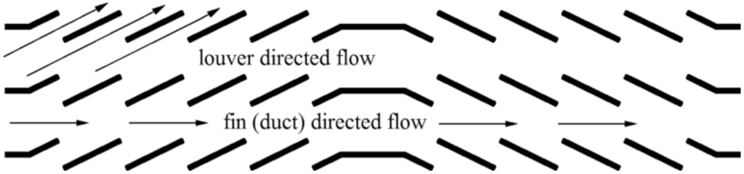
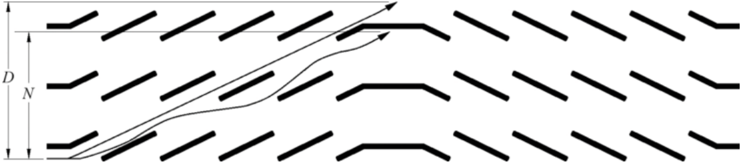
- Louver angle and frontal air velocity determine whether flow is duct-directed or louver-directed; flow efficiency increases with louver-directed flow. Thermal performance increases up to a louver angle of 28.5° and then decreases for all considered louver pitches.
- Average heat transfer coefficient is about 200 W/m²K at the minimum louver pitch of 0.81 mm and decreases to about 185 W/m²K at the maximum louver pitch of 1.4 mm.
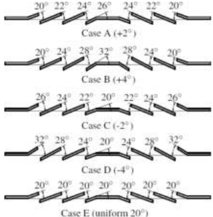
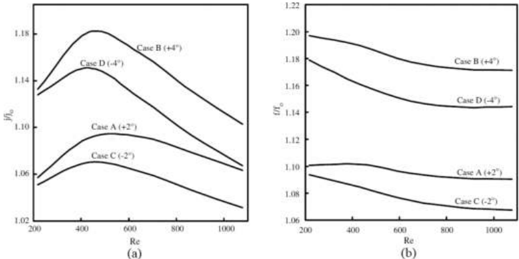
- Non-uniform louver angle patterns can enhance heat transfer: Case B showed 18% heat transfer enhancement relative to Case E at about Re = 440, but had a negative effect of 19% on the friction factor.
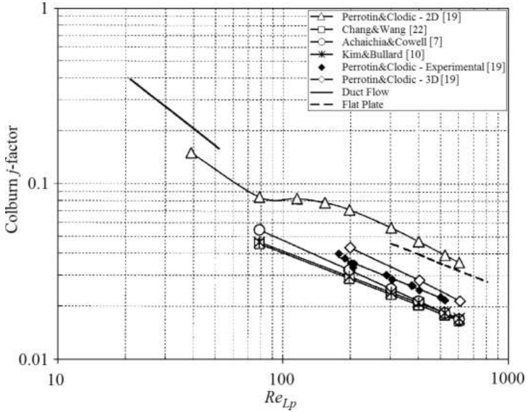
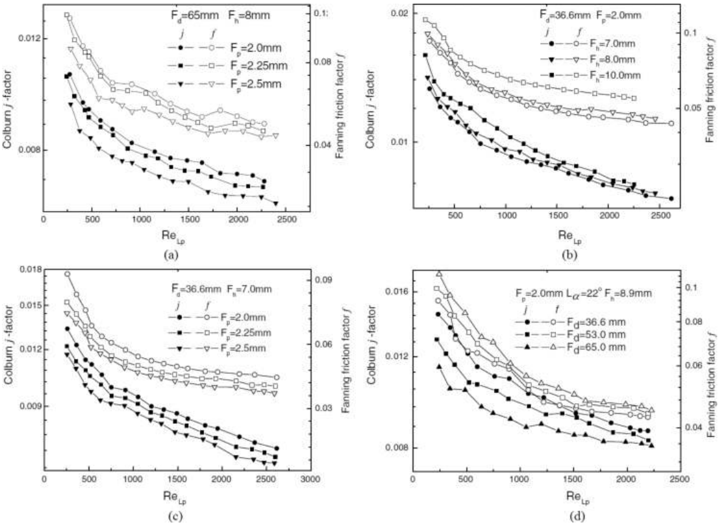
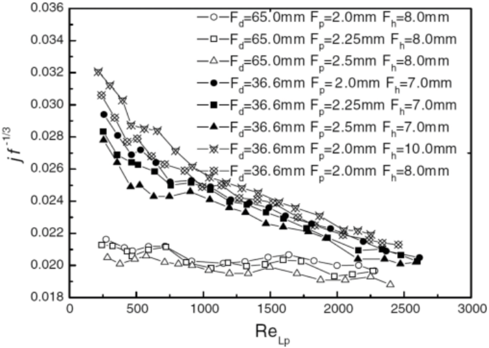
- 2D CFD models overpredicted Colburn j-factor by 80% compared with experimental results, while 3D models are needed to predict both heat transfer coefficient and friction factor sensibly. The maximum reported volume goodness factor was j/f¹ᐟ³ = 0.032 for the smallest flow depth (36.0 mm), smallest fin pitch (2.00 mm), and biggest fin height (10.0 mm).
Methods
- This is a review/synthesis chapter, not a new experimental study: it examines flow visualization, experimental, and numerical studies of louvered-fin heat exchangers from the literature.
- It presents data-reduction methodology using the effectiveness-NTU method and the Kim and Bullard approach to determine external-side heat transfer coefficient, with performance criteria including Stanton number, Colburn j-factor, friction factor, area goodness factor (j/f), volume goodness factor (j/f¹ᐟ³), and JF number.
- It summarizes empirical correlations for Stanton number, Colburn j-factor, and friction factor and tabulates geometrical dimensions from a large database of louvered-fin heat exchangers.
Limitations
- The paper states that 2D numerical models are inadequate to predict heat transfer coefficient because they lack un-finned areas, while 3D models are sensible for both heat transfer coefficient and friction factor.
- The paper states that although correlations cover wide Reynolds-number and geometric ranges, every new heat exchanger must be analyzed individually due to the complexity of combined geometric and operational effects.
- Evident from the text: the chapter is a literature review and correlation summary rather than a new experimental or numerical dataset, so its quantitative findings depend on the cited studies and figures.
Model-written summary. Check it against the paper before relying on it.
Integrity signals
Registry
Cites
Statistics
Figures
Verification
Claims the paper makes
0 Valid · 1 Not valid · 26 Not checked · 42 Own results and interpretations
A result the paper reports from its own data — it cites no other source for it, so there is none to check. The quote shows it is in the paper.
In the paper
“The most important result is the non-monotonic behaviour of the j/f 1/3 ratio with the geometric dimensions.”
- Also stated in: § 6. Concluding remarks · plain
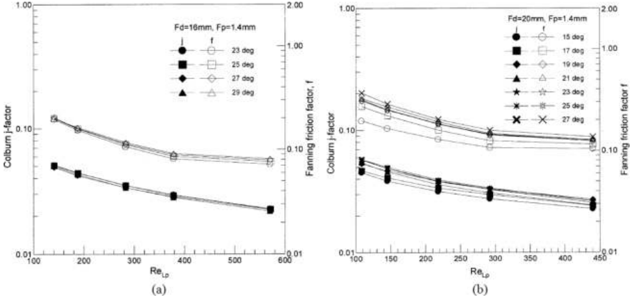
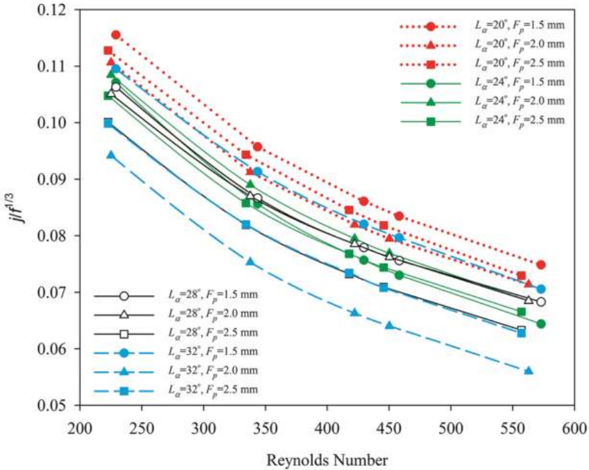
“The area goodness factor (j/f) and the volume goodness factor (j/f 1/3 ) decrease with increasing Reynolds number but they do not have a monotonic relation with the geometric parameters such as fin pitch and louver angle.”
§ Comprehensive Study of Heat Exchangers with Louvered Fins > Figures 12-14
plainstates an association- Asserted: passes — The authors put it forward as true.
- Checkable: passes — It can be checked against evidence.
- Load-bearing: passes — The paper’s conclusions depend on it.
- Based: passes — The paper gives a reason why it holds.
- Also stated in: § 6. Concluding remarks · plain
A result the paper states — it cites no source for it, so there is none to check. The quote shows it is in the paper.
In the paper
“effect of the Reynolds number to the j/f 1/3 ratio decreases with a flow depth of 65.0 mm.”
§ Comprehensive Study of Heat Exchangers with Louvered Fins > Figures 12-14
plainstates a cause- Asserted: passes — The authors put it forward as true.
- Checkable: passes — It can be checked against evidence.
- Load-bearing: unclear — It is unclear whether the paper’s conclusions depend on it.
- Based: passes — The paper gives a reason why it holds.
In the paper
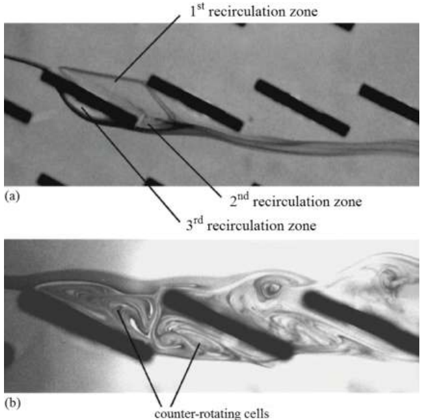
“Two counter-rotating cells are present between the louvers.”
§ Comprehensive Study of Heat Exchangers with Louvered Fins > 3. Flow phenomenon in louvered fin arrays
What the sources say
- Not checked — no full text of the sourcecites [8] DeJong N C, Jacobi A M. Flow, heat transfer, and pressure drop in the near-wall region of louvered-fin arrays. Experimental Thermal and Fluid Science. 2003;27(3):237-250. DOI: 10.1016/S0894-1777(02)00224-8 source
plain- Asserted: passes — The authors put it forward as true.
- Checkable: passes — It can be checked against evidence.
- Load-bearing: unclear — It is unclear whether the paper’s conclusions depend on it.
- Based: passes — The paper gives a reason why it holds.
A conclusion the paper draws from its own results — it cites no other source for it, so there is none to check. The quote shows it is in the paper.
In the paper
“In fact, second half of the fin only causes a pressure loss without any heat transfer at low Reynolds numbers.”
§ Comprehensive Study of Heat Exchangers with Louvered Fins > 5. Performance evaluation criteria of the louvered fin heat exchangers
plainstates a causeSingle case- Asserted: passes — The authors put it forward as true.
- Checkable: passes — It can be checked against evidence.
- Load-bearing: unclear — It is unclear whether the paper’s conclusions depend on it.
- Based: passes — The paper gives a reason why it holds.
In the paper
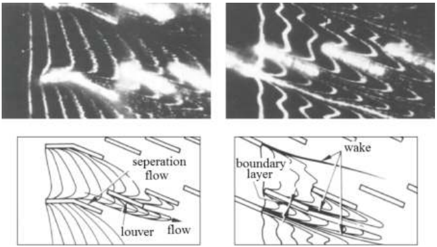
“Flow separation is observed on the back side of the inlet louvers and boundary layer exists on both the upper and lower surfaces of the louvers [3].”
§ Comprehensive Study of Heat Exchangers with Louvered Fins > 3. Flow phenomenon in louvered fin arrays
What the sources say
- Not checked yetcites [3] Webb R L, Trauger P. How structure in the louvered fin heat exchanger geometry. Experimental Thermal and Fluid Science. 1991;4(2):205-217. DOI: 10.1016/0894-1777(91) 90065-Y source
plain- Asserted: passes — The authors put it forward as true.
- Checkable: passes — It can be checked against evidence.
- Load-bearing: unclear — It is unclear whether the paper’s conclusions depend on it.
- Based: passes — The paper gives a reason why it holds.
37 more claims
Create a free account to see all 69 claims and to verify the 24 references still open.
- It may state two separate claims as one. 22
- Probably not a substantial claim. 6
Self-check
Percentages, sums and reported differences re-computed from the paper’s own numbers.
Each contradiction between two passages listed here was confirmed by an independent check.
Rated minor: it would not touch a result — a value no result rests on, a p-value that stays on the same side of the significance level, or a conflict that is clerical, resolved elsewhere in the paper, or outside its own findings.
In the paper
§ Comprehensive Study of Heat Exchangers with Louvered Fins > Figures 12-14
“a large data bank as shown in Table 1 was used by Chang and Wang [20], Chang et al. [22], and Park and Jacobi [27]”
§ Comprehensive Study of Heat Exchangers with Louvered Fins > References
“20. Malapure V P, Mitra S K, Bhattacharya A. Numerical investigation of fluid flow and heat transfer over louvered fins in compact heat exchanger.”
Rated minor: it would not touch a result — a value no result rests on, a p-value that stays on the same side of the significance level, or a conflict that is clerical, resolved elsewhere in the paper, or outside its own findings.
In the paper
§ Comprehensive Study of Heat Exchangers with Louvered Fins > Figures 12-14
“• Chang et al. [22], 100 < Re Lp < 3000”
§ Comprehensive Study of Heat Exchangers with Louvered Fins > References
“22. Chang Y-J, Wang C-C. A generalized heat transfer correlation for Iouver fin geometry.”
Rated minor: it would not touch a result — a value no result rests on, a p-value that stays on the same side of the significance level, or a conflict that is clerical, resolved elsewhere in the paper, or outside its own findings.
In the paper
§ Comprehensive Study of Heat Exchangers with Louvered Fins > 6. Concluding remarks
“A c Heat transfer area of the cold side, m 2”
§ Comprehensive Study of Heat Exchangers with Louvered Fins > 5. Performance evaluation criteria of the louvered fin heat exchangers
“where A c is the minimum free flow area for the external side”
Citations
Cites
(2007) · doi:10.1002/9780470172605 · Cited by 2,813
A generalized heat transfer correlation for Iouver fin geometry
Chang, Y.-J., & Wang, C.-C. (1997) · International Journal of Heat and Mass Transfer · doi:10.1016/0017-9310(96)00116-0 · Cited by 493
Air-side thermal hydraulic performance of multi-louvered fin aluminum heat exchangers
Kim, M.-H., & Bullard, C. W. (2002) · International Journal of Refrigeration · doi:10.1016/s0140-7007(01)00025-1 · Cited by 280
Heat transfer and pressure drop characteristics of flat tube and louvered plate fin surfaces
Achaichia, A., & Cowell, T. A. (1988) · Experimental Thermal and Fluid Science · doi:10.1016/0894-1777(88)90032-5 · Cited by 235
Yun, J.-Y., & Lee, K.-S. (2000) · International Journal of Heat and Mass Transfer · doi:10.1016/s0017-9310(99)00342-7 · Cited by 233
Heat transfer and pressure drop correlations for the multi-louvered fin compact heat exchangers
Dong, J., Chen, J., Chen, Z., Zhang, W., & Zhou, Y. (2007) · Energy Conversion and Management · doi:10.1016/j.enconman.2006.11.023 · Cited by 174
A generalized friction correlation for louver fin geometry
Chang, Y.-J., Hsu, K.-C., Lin, Y.-T., & Wang, C.-C. (2000) · International Journal of Heat and Mass Transfer · doi:10.1016/s0017-9310(99)00289-6 · Cited by 161
Han, H., He, Y., Li, Y., Wang, Y., & Wu, M. (2013) · International Journal of Heat and Mass Transfer · doi:10.1016/j.ijheatmasstransfer.2013.06.049 · Cited by 115
CORRELATIONS FOR HEAT TRANSFER AND FLOW FRICTION CHARACTERISTICS OF LOUVRED FIN
Davenport, C. J., & Cj, D. (1983) · Cited by 109
Flow structure in the louvered fin heat exchanger geometry
Webb, R. L., & Trauger, P. (1991) · Experimental Thermal and Fluid Science · doi:10.1016/0894-1777(91)90065-y · Cited by 100
Research works printed but not linked: 4
- Kays W M, London A L. Compact Heat Exchangers. 3 rd ed. New York: McGraw-Hill; 1984. 335 p.
- Webb R L, Jung S H. Air-side performance of enhanced brazed aluminium heat exchangers. ASHRAE Transactions. 1992;98(2):391-401.
- Rugh J P, Pearson J T, Ramadhyani S. A study of a very compact heat exchanger used for passenger compartment heating in automobiles, in compact heat exchangers for power and process industries. In: ASME Symposium Series, HTD-Vol. 201; New York: ASME; 1992. p. 15-24.
- Sunden B, Svantesson J. Correlation of j-and f-factors for multilouvered heat transfer surfaces. In: 3rd UK National Heat Transfer Conference; London: South Kensington Campus; 1992. p. 805-811.
Cited by
Ajeeb, W., Oliveira, M. S. A., Martins, N. A. D., & Murshed, S. M. S. (2021) · International Communications in Heat and Mass Transfer · doi:10.1016/j.icheatmasstransfer.2021.105495 · Cited by 58
Trends in best-in-class energy-efficient technologies for room air conditioners
Shah, N., Park, W. Y., & Ding, C. (2021) · Energy Reports · doi:10.1016/j.egyr.2021.05.016 · Cited by 48
Wang, Z., Wang, R., Li, Z., Wang, R., & Wan, L. (2023) · Applied Thermal Engineering · doi:10.1016/j.applthermaleng.2023.120726 · Cited by 43
Alshibil, A. M. A., Farkas, I., & Víg, P. (2023) · Energy Reports · doi:10.1016/j.egyr.2023.03.110 · Cited by 41
Ayad, F., Benelmir, R., & Idris, M. (2021) · Applied Thermal Engineering · doi:10.1016/j.applthermaleng.2020.116218 · Cited by 30
Reshaeel, M., Abdelsamie, M. M., & Ali, M. I. H. (2024) · International Journal of Thermofluids · doi:10.1016/j.ijft.2024.100858 · Cited by 29
Ajeeb, W., Oliveira, M. S. A., Martins, N. A. D., & Murshed, S. M. S. (2021) · Thermal Science and Engineering Progress · doi:10.1016/j.tsep.2021.101029 · Cited by 21
Elibol, E. A. (2024) · Applied Thermal Engineering · doi:10.1016/j.applthermaleng.2024.124892 · Cited by 21
Ghaddar, D., Boyina, K. S., Chettiar, K., Wang, S., & Miljkovic, N. (2025) · International Journal of Heat and Mass Transfer · doi:10.1016/j.ijheatmasstransfer.2025.126835 · Cited by 20
Feleke, D. S., Getie, M. Z., & Minale, T. A. (2024) · Heliyon · doi:10.1016/j.heliyon.2024.e27254 · Cited by 18
Thermohydraulic Performance of a Fin and Inclined Flat Tube Heat Exchanger: A Numerical Analysis
Minh, N., & Thao, P. B. (2021) · CFD letters · doi:10.37934/cfdl.13.7.112 · Cited by 16
Evaluation of fin configurations for an air-cooled hybrid photovoltaic-thermal solar collector
Alshibil, A. M. A., Farkas, I., & Víg, P. (2023) · Thermal Science · doi:10.2298/tsci230116084a · Cited by 15
Luo, W., Yang, Z., Jiao, K., Zhang, Y., & Du, Q. (2021) · International Journal of Hydrogen Energy · doi:10.1016/j.ijhydene.2021.10.093 · Cited by 15
Yang, Y., Zou, H., Gu, X., Yang, T., & Tian, C. (2023) · Applied Thermal Engineering · doi:10.1016/j.applthermaleng.2023.121142 · Cited by 13
Doğan, B., Öztürk, M. M., & Erbay, L. B. (2021) · Journal of Thermal Engineering · doi:10.18186/thermal.990795 · Cited by 12
Self-citationEscobar, C., Gong, Z., Silva, C. M. D., Trescases, O., & Amon, C. H. (2022) · I-THERM :/I-THERM - Intersociety Conference on Thermal Phenomena in Electronic Systems · doi:10.1109/itherm54085.2022.9899683 · Cited by 12
Doğan, B., Ozturk, M. M., & Turhan, L. (2025) · Engineering Science and Technology an International Journal · doi:10.1016/j.jestch.2025.102242 · Cited by 7
Self-citationAccorinti, F. (2020) · theses.fr (ABES) · doi:10.70675/dfc44a8azd610z49faza60fze0d97bdb1431 · Cited by 7
García-Castillo, J. L., Picón‐Núñez, M., & Abu-Khader, M. M. (2022) · Energy · doi:10.1016/j.energy.2022.125196 · Cited by 6
Effect of Fin Type on Performance of Compact Heat Exchangers with Mini-Channel
Öztürk, M. M. (2021) · Heat Transfer Engineering · doi:10.1080/01457632.2020.1860522 · Cited by 6
Self-citationThe Sizing of Plate-Fin Exchangers to Fixed Dimensions Within a Volume Design Region
García-Castillo, J. L., & Picón‐Núñez, M. (2020) · Chemical engineering transactions · doi:10.3303/cet2081094 · Cited by 2
Designing, Manufacturing and Testing of New Radiator
Gupta, G., Sidkar, P., & Sharma, B. (2022) · Lecture notes in mechanical engineering · doi:10.1007/978-981-19-2890-1_29 · Cited by 1
Su, T., Xue, G., Javadirad, S., Kundu, A., & Öztekin, A. (2026) · Energy Storage · doi:10.1002/est2.70417 · Cited by 1
Thermal-hydraulic analysis of a louver fin-and-tube radiator for a liquid–cooled PEMFC stack system
Ionescu, V. (2024) · Analele Universităţii "Ovidius" Constanţa. Seria Chimie/"Ovidius" University Annals of Chemistry · doi:10.2478/auoc-2024-0015 · Cited by 1
Optimaal Parameter- en Vinontwerp voor PCM-gebaseerde Thermische Energieopslag
Peremans, B. (2020) · Lirias (KU Leuven)
Reduced Order Numerical Modelling of Electric Commuter Vehicle Battery Thermal Management Systems
Escobar, C. (2022) · TSpace (University of Toronto)
WAHEED, A., Qi, H., & Wu, J. (2026) · SSRN Electronic Journal · doi:10.2139/ssrn.6556541
Ranganayakulu, C. (2026) · Heat Transfer · doi:10.1002/htj.70268
Bobrowski, J., Gutkowski, A., & Łęcki, M. (2026) · International Communications in Heat and Mass Transfer · doi:10.1016/j.icheatmasstransfer.2026.111492
Öztürk, M. M., Doğan, B., & Pat, Ş. (2026) · ACS Omega · doi:10.1021/acsomega.6c05128
Self-citationAnalysis of Heat Transfer in Vehicle Engine Cooling Systems Using Radiators with Fin Variations
Sriwijaya, S. B., & Kristianti, T. (2025) · International Journal of Health Economics and Social Sciences (IJHESS)
Metadata
- Authors
- Erbay, L. B., Doğan, B., & Öztürk, M. M.
- Affiliations
- Eskişehir Osmangazi University (TR)
- Corresponding author
- Erbay, Latife Berrin
- Venue
- Heat Exchangers - Advanced Features and Applications
- Publisher
- InTech
- Published
- 2017-04-26
- OpenAlex
- W2608826248
- Cited by
- 31
- References
- 28
- Citations by year
- 2026: 5 · 2025: 3 · 2024: 4 · 2023: 4 · 2022: 4 · 2021: 6 · 2020: 5
- FWCI
- 4.36
- Type
- book chapter
- Language
- en
- Open access
- hybrid
- doi.org
- Licence
- cc-by
- Locations
- InTech eBooks (publishedVersion, cc-by)
- BiblioBoard Library Catalog (Open Research Library) (submittedVersion, cc-by)
- Contact-less Assessment of In-vivo Body Signals Using Microwave Doppler Radar (InTech) (submittedVersion, cc-by)
- Funders
- Bilim, Sanayi ve Teknoloji Bakanliği
- Topics
- Physical Sciences › Engineering › Mechanical Engineering › Heat Transfer and Optimization
- Physical Sciences › Engineering › Mechanical Engineering › Heat Transfer Mechanisms
- Physical Sciences › Engineering › Mechanical Engineering › Heat Transfer and Boiling Studies
- Keywords
- louvered fins, compact heat exchangers, thermal-hydraulic performance, heat transfer, friction factor, Stanton number, Colburn j-factor, fin geometry, flow visualization
About these checks
Registry, retraction, Cites and statistics results are computed, not judged, with one exception: a printed reference that no index lists is read once by a model before it counts as a citation error. Claims are extracted by a model and kept only when their quote appears verbatim in the text; each cited source is then checked, with a model’s help, for whether it says what the claim relies on. Those verdicts can be wrong — read the claim’s quote and the cited source before relying on one.
A language model drew the claims from the paper on 2026-11-19, under version 3 of the claim definition (model deepseek-v4.1-flash, prompt extract-v3).
A second model labelled each claim on 2026-11-19 (model jev-1.13-20260917, definition revision gold-guideline-v0.2).
Statistics and arithmetic are recomputed, not judged.
Confidence bands are shown only for fields calibrated on our annotated test set. None is calibrated yet, so no band is shown.
What counts as a claim ›How we measure confidence ›How we check this ›
Are you an author, or do you see a problem with this page? Request a review
Data sources
Bibliographic data: Semantic Scholar, OpenAlex, Crossref.
Contains information from the Semantic Scholar Academic Graph Datasets, made available under the ODC Attribution License (ODC-BY 1.0).
Semantic Scholar’s data is described in: Kinney, R., et al. (2023). The Semantic Scholar Open Data Platform. arXiv:2301.10140.
