

Chitosan as a Biological Polymer: Antimicrobial Mechanisms and Therapeutic Applications
Open accessThe DOI matches its Crossref record; 59 of the 68 references it cites were found in a registry or an index; none of the 79 sources its claims cite is checked for support yet.
Abstract
Chitosan is one of the most studied and considered a very promising naturally derived biopolymers with diverse biological properties widely applicable in the biomedical and pharmaceutical areas. Derived from deacetylated chitin, chitosan has a unique cationic structure that promotes electrostatic interaction with biological systems, especially microbial cell membranes. This feature is responsible for its broad-spectrum antimicrobial activity activity against bacteria, fungi and selected viruses. Chitosan can inhibit a wide range of microorganisms and does not select for any particular cell pathway, as with other conventional antimicrobial agents, through membrane integrity disruption, inhibition of function through intracellular entrapment, and limiting nutrient availability through metal ion binding. Chitosan, not only plays an important antimicrobial role, but it is also a very promising drug delivery, wound healing, tissue engineering, and anticancer agent because of its biocompatibility, biodegradability, and low toxicity. However, recent advances in chemical modification and nanotechnology have expanded its clinical relevance and functional performance by overcoming limitations (e.g., solubility). This review discusses the structure feature, antimicrobial mechanism and application of chitosan in treatment, with regard to biological activity-influencing factors and future development of biomedicine.
Overview
CoChat Summary
TL;DR
This narrative review summarizes chitosan's structure, antimicrobial mechanisms, and therapeutic applications, arguing that its cationic, multi-target mode of action makes it a promising alternative to conventional antibiotics. It also surveys chemical modification and nanotechnology strategies for overcoming chitosan's poor solubility at neutral pH.
Key findings
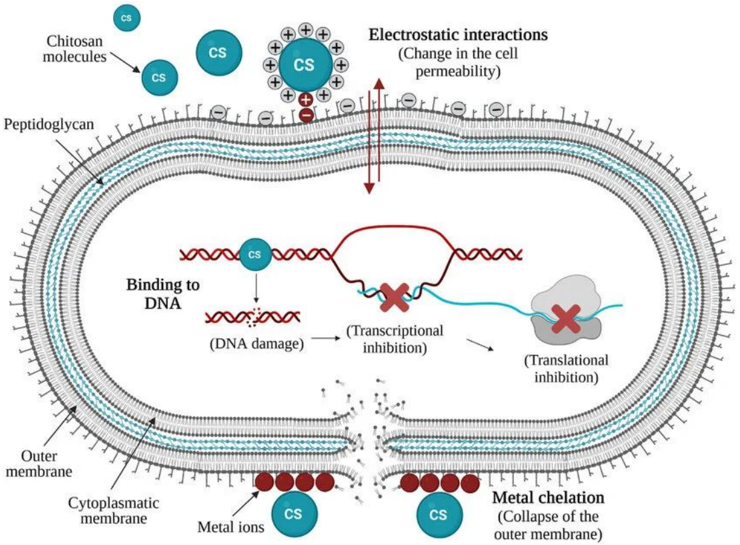
- Chitosan's antimicrobial activity is attributed to multiple simultaneous mechanisms rather than a single pathway: electrostatic disruption of negatively charged microbial membranes with leakage of intracellular contents, penetration of low-molecular-weight chitosan into cells to bind DNA and inhibit transcription/protein synthesis, chelation of metal ions essential for microbial growth, and inhibition of biofilm formation.
- Because it acts through multiple mechanisms, the review argues chitosan is less prone to selecting for resistance than conventional antibiotics, and reports that studies have shown growth inhibition of multidrug-resistant bacteria including methicillin-resistant *Staphylococcus aureus* and resistant *Pseudomonas aeruginosa* strains (no quantitative inhibition data are given).
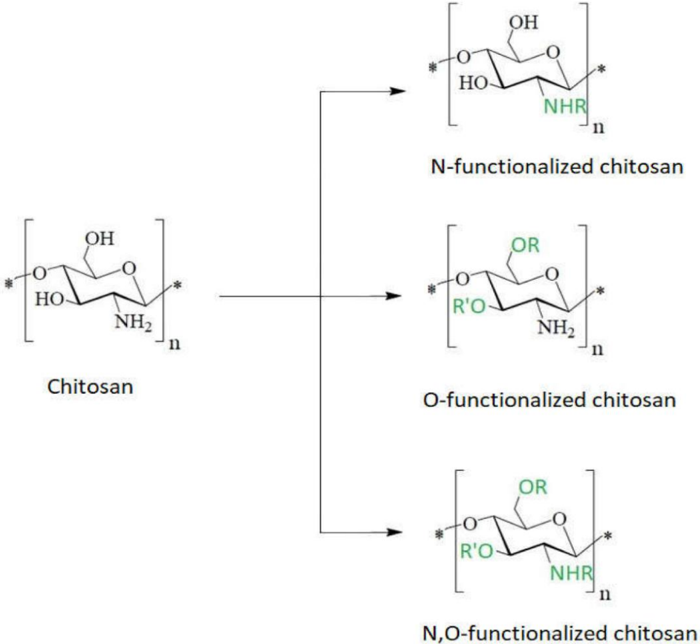
- Chemical modifications are described as expanding functionality: Schiff-base derivatives often show higher antibacterial potency than unmodified chitosan, sulfated chitosan becomes anionic and acquires heparin-like anticoagulant properties, and chitosan–metal complexes (silver, copper, zinc) combine chitosan's membrane disruption with metal ion activity.
- Therapeutic applications discussed include drug delivery (nanoparticles, hydrogels, microspheres; mucoadhesive and penetration-enhancing properties), wound healing (hemostasis via platelet aggregation and clot formation, fibroblast proliferation, collagen production), tissue engineering scaffolds, dentistry, and anticancer activity via apoptosis induction and immune modulation.
Methods
- Design: narrative (non-systematic) review; no stated search strategy, inclusion criteria, or study-selection process.
- Data: no primary data or sample; the paper synthesizes previously published literature on chitosan, citing 60 references.
- Analysis: descriptive/thematic organization into sections on sources and extraction, structural and physicochemical properties, antimicrobial mechanisms, antimicrobial resistance, chemical modification, biomedical applications, challenges, and nanotechnology.
Limitations
- Stated by the paper: chitosan's low solubility at neutral and alkaline pH limits use in physiological environments; chemical modifications intended to fix this may alter biological characteristics and require delicate tuning; variability in molecular weight, degree of deacetylation, and purity across sources and preparation methods produces inconsistent biological activity and impedes standardization; long-term safety and possible immune responses, particularly in systemic settings, remain unclear and require further study.
- Evident from the text: as a narrative review it reports no quantitative outcomes, effect sizes, or comparative data of its own, and several claims (e.g., resistance being harder to develop, anticancer activity) are asserted with reference to other work rather than evaluated systematically; the text also contains typographical and citation-formatting errors, and at least two references are flagged as having unverified DOIs.
Model-written summary. Check it against the paper before relying on it.
Integrity signals
Registry
Cites
Statistics
Figures






Verification
Claims the paper makes
0 Valid · 1 Not valid · 57 Not checked · 21 Own results and interpretations
In the paper
“Chitosan has also been synthesized into nanoparticles, hydrogels and microspheres that can be designed specifically for drug delivery [50].”
§ Chitosan as a Biological Polymer: Antimicrobial Mechanisms and Therapeutic Applications > THERAPEUTIC APPLICATIONS OF CHITOSAN
What the sources say
- Not matchedcites [50]
The reference list we hold has no entry [50].
plainstates a cause- Asserted: passes — The authors put it forward as true.
- Checkable: passes — It can be checked against evidence.
- Load-bearing: unclear — It is unclear whether the paper’s conclusions depend on it.
- Based: passes — The paper gives a reason why it holds.
- Not matched
In the paper
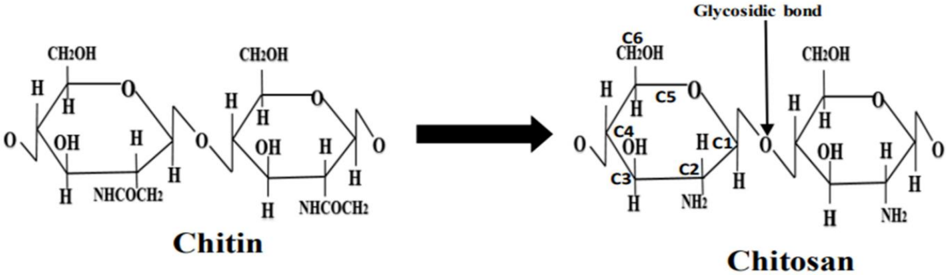
“Chitosan is composed of a linear polymer structure of β-(1→4)-linked glucosamine units with different numbers of N-acetylated residues (figure 1) depending on the degree of deacetylation [8].”
§ Chitosan as a Biological Polymer: Antimicrobial Mechanisms and Therapeutic Applications > STRUCTURAL CHARACTERISTICS AND PHYSICOCHEMICAL PROPERTIES
What the sources say
- Not matchedcites [8]
The reference list we hold has no entry [8].
plainstates an association- Asserted: passes — The authors put it forward as true.
- Checkable: passes — It can be checked against evidence.
- Load-bearing: passes — The paper’s conclusions depend on it.
- Based: passes — The paper gives a reason why it holds.
- Not matched
In the paper
“It has a major disadvantage in that its low solubility at neutral and alkaline pH limits its use in physiological environments [45].”
§ Chitosan as a Biological Polymer: Antimicrobial Mechanisms and Therapeutic Applications > CHALLENGES AND LIMITATIONS
What the sources say
- Not matchedcites [45]
The reference list we hold has no entry [45].
plainstates a cause- Asserted: passes — The authors put it forward as true.
- Checkable: passes — It can be checked against evidence.
- Load-bearing: unclear — It is unclear whether the paper’s conclusions depend on it.
- Based: passes — The paper gives a reason why it holds.
- Not matched
In the paper
“Chitosan has proved to be highly efficient in wound healing due to its role as a hemostatic agent and a promoter of tissue regeneration in the wound site [51].”
§ Chitosan as a Biological Polymer: Antimicrobial Mechanisms and Therapeutic Applications > THERAPEUTIC APPLICATIONS OF CHITOSAN
What the sources say
- Not matchedcites [51]
The reference list we hold has no entry [51].
boostedstates a cause- Asserted: passes — The authors put it forward as true.
- Checkable: passes — It can be checked against evidence.
- Load-bearing: passes — The paper’s conclusions depend on it.
- Based: passes — The paper gives a reason why it holds.
- Not matched
A conclusion the paper draws from its own results — it cites no other source for it, so there is none to check. The quote shows it is in the paper.
In the paper
“This mechanism is particularly important as it targets vital cellular processes, rendering it difficult for the microorganism to become resistant.”
§ Chitosan as a Biological Polymer: Antimicrobial Mechanisms and Therapeutic Applications > ANTIMICROBIAL MECHANISMS OF CHITOSAN
plainstates a cause- Asserted: passes — The authors put it forward as true.
- Checkable: passes — It can be checked against evidence.
- Load-bearing: unclear — It is unclear whether the paper’s conclusions depend on it.
- Based: passes — The paper gives a reason why it holds.
29 more claims
Create a free account to see all 79 claims and every source verdict.
- Probably not a substantial claim. 9
- It may state two separate claims as one. 38
Citations
Cites
Antimicrobial Resistance: A Growing Serious Threat for Global Public Health
Salam, M. A., Al-Amin, M. Y., Salam, M. T., Pawar, J. S., Akhter, N., Rabaan, A. A., & Alqumber, M. A. A. (2023) · Healthcare · doi:10.3390/healthcare11131946 · Cited by 2,338
Chitosan: An Overview of Its Properties and Applications
Aranaz, I., Alcántara, A. R., Civera, M. C., Arias, C., Elorza, B., Heras Caballero, A., & Acosta, N. (2021) · Polymers · doi:10.3390/polym13193256 · Cited by 1,752
Functional Characterization of Chitin and Chitosan
Aranaz, I., Mengibar, M., Harris, R., Panos, I., Miralles, B., Acosta, N., Galed, G., & Heras, A. (2009) · Current Chemical Biology · doi:10.2174/187231309788166415 · Cited by 1,214
Antimicrobial Actions and Applications of Chitosan
Ke, C.-L., Deng, F.-S., Chuang, C.-Y., & Lin, C.-H. (2021) · Polymers · doi:10.3390/polym13060904 · Cited by 949
Ahmed, T., & Aljaeid, B. (2016) · Drug Design, Development and Therapy · doi:10.2147/dddt.s99651 · Cited by 705
Chitosan Composites for Bone Tissue Engineering—An Overview
Venkatesan, J., & Kim, S.-K. (2010) · Marine Drugs · doi:10.3390/md8082252 · Cited by 705
Antimicrobial Properties of Chitosan and Chitosan Derivatives in the Treatment of Enteric Infections
Yan, D., Li, Y., Liu, Y., Li, N., Zhang, X., & Yan, C. (2021) · Molecules · doi:10.3390/molecules26237136 · Cited by 608
Ardean, C., Davidescu, C. M., Nemeş, N. S., Negrea, A., Ciopec, M., Duteanu, N., Negrea, P., Duda-Seiman, D., & Musta, V. (2021) · International Journal of Molecular Sciences · doi:10.3390/ijms22147449 · Cited by 606
Drug release study of the chitosan-based nanoparticles
Herdiana, Y., Wathoni, N., Shamsuddin, S., & Muchtaridi, M. (2022) · Heliyon · doi:10.1016/j.heliyon.2021.e08674 · Cited by 576
A Review of Various Sources of Chitin and Chitosan in Nature
Terkula Iber, B., Azman Kasan, N., Torsabo, D., & Wese Omuwa, J. (2022) · Journal of Renewable Materials · doi:10.32604/jrm.2022.018142 · Cited by 447
Cited by
Still being checked.
Metadata
- Authors
- Daham, R. I., Mahdi, M. A., & Almijbilee, M. M. A.
- Affiliations
- Mustansiriyah University (IQ)
- Venue
- European Journal of Applied Science, Engineering and Technology
- Publisher
- AMO Publisher
- Published
- 2026-06-16
- Volume
- 4
- Issue
- 3
- Pages
- 156-166
- ISSN
- 2786-9342 (ISSN-L)
- OpenAlex
- W7165768754
- Semantic Scholar
- 2f40f3a91bea01074da795d113e8928d5bed9ee7
- Cited by
- 0
- References
- 59
- FWCI
- 0.00
- Type
- journal article
- Language
- en
- Open access
- diamond
- doi.org
- Locations
- European Journal of Applied Science Engineering and Technology (publishedVersion, cc-by)
- HAL (submittedVersion)
- Zenodo (CERN European Organization for Nuclear Research) (submittedVersion, cc-by)
- Topics
- Physical Sciences › Materials Science › Biomaterials › Nanocomposite Films for Food Packaging
- Life Sciences › Immunology and Microbiology › Applied Microbiology and Biotechnology › Antimicrobial agents and applications
- Life Sciences › Pharmacology, Toxicology and Pharmaceutics › Pharmaceutical Science › Advanced Drug Delivery Systems
- Keywords
- chitosan, antimicrobial activity, chitin deacetylation, cationic biopolymers, antifungal activity, antiviral activity, drug delivery, wound healing, tissue engineering, anticancer agents, chemical modification, nanotechnology, biocompatibility, biodegradability
About these checks
Registry, retraction, Cites and statistics results are computed, not judged, with one exception: a printed reference that no index lists is read once by a model before it counts as a citation error. Claims are extracted by a model and kept only when their quote appears verbatim in the text; each cited source is then checked, with a model’s help, for whether it says what the claim relies on. Those verdicts can be wrong — read the claim’s quote and the cited source before relying on one.
A language model drew the claims from the paper on 2026-11-22, under version 3 of the claim definition (model deepseek-v4.1-flash, prompt extract-v3).
A second model labelled each claim on 2026-11-22 (model jev-1.13-20260917, definition revision gold-guideline-v0.2).
Statistics and arithmetic are recomputed, not judged.
Confidence bands are shown only for fields calibrated on our annotated test set. None is calibrated yet, so no band is shown.
What counts as a claim ›How we measure confidence ›How we check this ›
Are you an author, or do you see a problem with this page? Request a review
How to cite
Cite CoChat for the checks on this page, and the paper for its own findings.
- This page
- CoChat. (2026). Citation check: Chitosan as a Biological Polymer: Antimicrobial Mechanisms and Therapeutic Applications. https://app.cochat.ai/papers/10.59324/ejaset.2026.4(3).15
- The paper
- Daham, R. I., Mahdi, M. A., & Almijbilee, M. M. A. (2026). Chitosan as a Biological Polymer: Antimicrobial Mechanisms and Therapeutic Applications. European Journal of Applied Science, Engineering and Technology. https://doi.org/10.59324/ejaset.2026.4(3).15
Data sources
Bibliographic data: Semantic Scholar, OpenAlex, Crossref.
Contains information from the Semantic Scholar Academic Graph Datasets, made available under the ODC Attribution License (ODC-BY 1.0).
Semantic Scholar’s data is described in: Kinney, R., et al. (2023). The Semantic Scholar Open Data Platform. arXiv:2301.10140.
