

A statistical test suite for random and pseudorandom number generators for cryptographic applications
Open accessThe DOI matches its Crossref record; 33 of the 34 references it cites were found in a registry or an index; none of the 14 sources its claims cite is checked for support yet.
Abstract
The Information Technology Laboratory (ITL) at the National Institute of Standards and Technology (NIST) promotes the U.S. economy and public welfare by providing technical leadership for the nation's measurement and standards infrastructure. ITL develops tests, test methods, reference data, proof of concept implementations, and technical analysis to advance the development and productive use of information technology. ITL's responsibilities include the development of technical, physical, administrative, and management standards and guidelines for the cost-effective security and privacy of sensitive unclassified information in Federal computer systems.
Overview
CoChat Summary
TL;DR
This NIST Special Publication 800-22 Revision 1a presents a suite of 15 statistical tests for evaluating whether binary sequences produced by random or pseudorandom number generators are suitable for cryptographic applications. It provides test purposes, mathematical descriptions, examples, and guidance for interpreting P-values, while cautioning that statistical testing is only a first step and cannot replace cryptanalysis.
Key findings
- The suite consists of 15 tests: Frequency (Monobit), Frequency within a Block, Runs, Longest Run of Ones, Binary Matrix Rank, Discrete Fourier Transform (Spectral), Non-overlapping Template Matching, Overlapping Template Matching, Maurer’s “Universal Statistical,” Linear Complexity, Serial, Approximate Entropy, Cumulative Sums, Random Excursions, and Random Excursions Variant. The Frequency test is recommended first because it supplies the most basic evidence of non-randomness.
- Each test uses the null hypothesis \(H_0\) that the sequence is random; if P-value \(\ge \alpha\), the sequence is accepted as random, and if P-value \(<\alpha\), it is rejected. Examples use \(\alpha=0.01\), and NIST recommends \(\alpha\) in the range [0.001, 0.01].
- The document states that no finite set of statistical tests is “complete,” that statistical testing cannot absolutely certify a generator, and that statistical testing cannot serve as a substitute for cryptanalysis.
- Sample data files are 1,000,000 bits (binary expansions of \(e\), \(\pi\), \(\sqrt{2}\), \(\sqrt{3}\), and a G-SHA-1 sequence); reported example P-values include Frequency for \(\pi\) = 0.578211, for \(e\) = 0.953749, and for G-SHA-1 = 0.604458.
Methods
- Design: The NIST Statistical Test Suite is an ANSI C reference implementation of 15 tests; each test defines a test statistic, a reference distribution (e.g., normal, half-normal, chi-square), a P-value, and a decision rule at the 1% level.
- Data or sample: Tests apply to binary sequences from hardware or software RNGs/PRNGs; sample files are 1,000,000 bits, while many worked examples use small illustrative lengths such as \(n=100\).
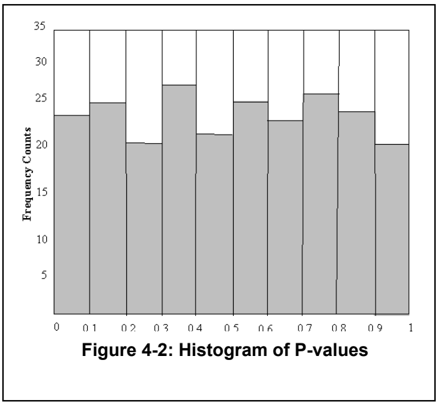
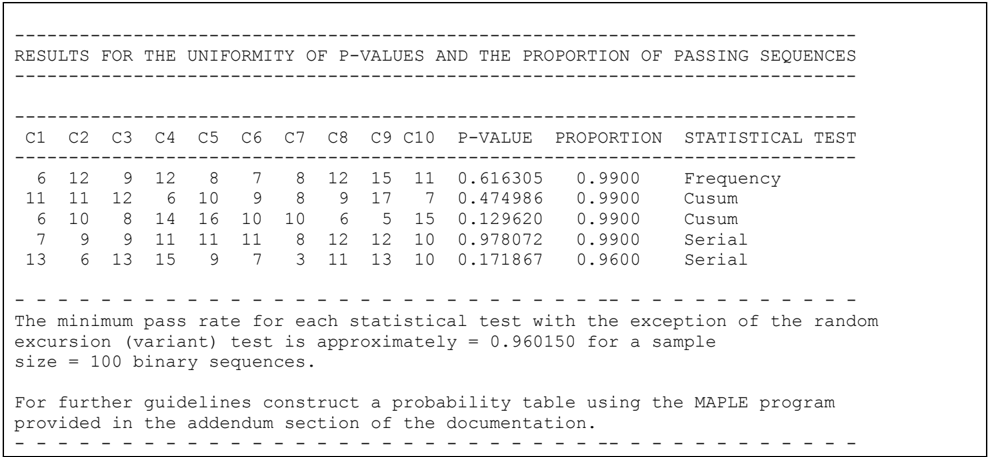
- Main analysis: For each sequence, P-values are computed and compared to \(\alpha\); empirical interpretation examines the proportion of sequences passing a test and the uniformity of P-values. A multiple-test dependence study applied 161 test P-values to Blum-Blum-Shub sequences of length 1,000,000 and used principal components/factor analysis, concluding there was no large redundancy among tests.
Limitations
- The paper states that no set of statistical tests can absolutely certify a generator as appropriate, that statistical testing cannot substitute for cryptanalysis, and that generator design and cryptanalysis are outside its scope.
- The paper states that many examples use small sample sizes for illustration only, e.g., \(n=10\), where the normal approximation is not really applicable; many tests rely on asymptotic reference distributions for large \(n\) (order \(10^3\) to \(10^7\)), and input parameter constraints apply.
- The text makes evident additional limitations: numerical precision can degrade for large incomplete gamma parameter \(a\); Maurer’s variance approximation can make the test 2.67 times more permissive than theoretically admitted; Random Excursions is discontinued if \(J<500\); and multiple tests can yield contradictory conclusions, as in the Random Excursions example where one state gave a non-random result while seven states gave random results.
Model-written summary. Check it against the paper before relying on it.
Integrity signals
Registry
Cites
Statistics
Figures

Verification
Claims the paper makes
0 Valid · 1 Not valid · 11 Not checked · 13 Own results and interpretations
A result the paper reports from its own data — it cites no other source for it, so there is none to check. The quote shows it is in the paper.
In the paper
“The asymptotic distribution of ( Ln -µ n ) / σ n along the sequence of even or odd values of n is that of a discrete random variable obtained via a mixture of two geometric random variables (one of them taking only negative values). Strictly speaking, the asymptotic distribution as such does not exist.”
A result the paper reports from its own data — it cites no other source for it, so there is none to check. The quote shows it is in the paper.
In the paper
“However, no set of statistical tests can absolutely certify a generator as appropriate for usage in a particular application, i.e., statistical testing cannot serve as a substitute for cryptanalysis.”
A result the paper reports from its own data — it cites no other source for it, so there is none to check. The quote shows it is in the paper.
In the paper
“This graph showed that there is no large redundancy among our tests.”
In the paper
“Ueli Maurer of the Department of Computer Science at Princeton University introduced this test in 1992. Maurer's test statistic relates closely to the per-bit entropy of the stream, which its author asserts is 'the correct quality measure for a secret-key source in a cryptographic application.'”
What the sources say
- Not matchedcites Maurer
This doesn’t read as a citation we can look up.
- Not matched
What the paper did — it cites no source for this, so there is none to check. The quote shows it is in the paper.
In the paper
“The test rejects the randomness hypothesis immediately if J is too small, i.e., if the following P-value is small:”
20 more claims
Create a free account to see all 25 claims and every source verdict.
Claims other papers make about this one
Each is checked against this paper’s own text: does it say what the citing paper says it does?
The source backs part of the claim, not all of it — or backs it for a different population, condition or comparison.
In the citing paper
“However, the latest version 2.1.2 [1], released in 2014, does not incorporate several modifications.”
From Checking the quality of approximation of p-values in statistical tests for random number generators by using a three-level test (2019) · cites this paper as [1]
Experimental — accuracy not yet measuredThe source backs part of the claim, not all of it — or backs it for a different population, condition or comparison.
In the citing paper
“The NIST test suite consists of 15 statistical tests for randomness of bit sequences, and its result is a list of 188 p -values.”
From Checking the quality of approximation of p-values in statistical tests for random number generators by using a three-level test (2019) · cites this paper as [1]
Experimental — accuracy not yet measuredThe cited source says what the claim attributes to it.
In the citing paper
“Note that the current implementation of the NIST test suite uses one-level or two-level tests, differently from the above experiments”
From Checking the quality of approximation of p-values in statistical tests for random number generators by using a three-level test (2019) · cites this paper as [1]
The cited source says what the claim attributes to it.
In the citing paper
“NIST SP-800.22 statistical test suite [90] and Die-hard test suite [91] and Test U01 [92] and AIS31 [93] are most common statistical test suites to evaluate their RNGs by researchers.”
From True Random Number Generators Using Electrical Noise (2019) · cites this paper as [90]
Self-check
Percentages, sums and reported differences re-computed from the paper’s own numbers.
Each contradiction between two passages listed here was confirmed by an independent check.
Rated minor: it would not touch a result — a value no result rests on, a p-value that stays on the same side of the significance level, or a conflict that is clerical, resolved elsewhere in the paper, or outside its own findings.
In the paper
§ 2.3.8 Example
“(input) τ = 0.02 (processing) π = 0.42 (processing) Vn(obs) = 52 (output) P-value = 0.500798 (conclusion) Since P-value ≥ 0.01 , accept the sequence as random.”
§ 2.3.4 Test Description
“If it can be shown that π -1 ≥τ , then the 2 Runs test need not be performed (i.e., the test should not have been run because of a failure to pass test 1, the Frequency (Monobit) test). If the test is not applicable, then the P-value is set to 0.0000.”
Rated minor: it would not touch a result — a value no result rests on, a p-value that stays on the same side of the significance level, or a conflict that is clerical, resolved elsewhere in the paper, or outside its own findings.
In the paper
§ 2.7.4 Test Description
“| 8-10 | 010 (hit) | 2 | 110 | 1 |”
§ 2.7.4 Test Description
“For the above example, if m = 3 and the template B = 001, then the examination proceeds as follows:”
Rated minor: it would not touch a result — a value no result rests on, a p-value that stays on the same side of the significance level, or a conflict that is clerical, resolved elsewhere in the paper, or outside its own findings.
In the paper
§ 2.9.3 Test Statistic and Reference Distribution
“f n : The sum of the log2 distances between matching Lbit templates, i.e., the sum of the number of digits in the distance between Lbit templates.”
§ 3.9 Maurer's 'Universal Statistical' Test
“Then it averages over all the expansion lengths by the number of test blocks.”
Rated minor: it would not touch a result — a value no result rests on, a p-value that stays on the same side of the significance level, or a conflict that is clerical, resolved elsewhere in the paper, or outside its own findings.
In the paper
§ Input Parameters:
“The parameters p , q and s are not fixed in code; thus, the user will not be able to reconstruct the original sequence because these values will vary (i.e., they are dependent on the system time).”
§ Input Parameters:
“The input parameters have been fixed so the code will reproduce the same results.”
Rated minor: it would not touch a result — a value no result rests on, a p-value that stays on the same side of the significance level, or a conflict that is clerical, resolved elsewhere in the paper, or outside its own findings.
In the paper
§ 5.5.2 Global Parameters
“| MAXNUMOFTEMPLATES | 40 | Non-overlapping Templates Test | | NUMOFTESTS | 16 | Max number of tests | | NUMOFGENERATORS | 12 | Max number of PRNGs |”
§ A.2 Configuration Information
“| 2. | #define MAXNUMOFTEMPLATES | 148 | | 3. | #define NUMOFTESTS | 15 | | 4. | #define NUMOFGENERATORS | 10 |”
2 more findings
Create a free account to see every finding of this check.
Citations
Cites
Handbook of Mathematical Functions
McQuarrie, D. A. (1966) · American Journal of Physics · doi:10.1119/1.1972842 · Cited by 40,433
Numerical recipes in C: the art of scientific computing
(1993) · Choice Reviews Online · doi:10.5860/choice.30-5638 · Cited by 17,933
Rayward-Smith, V. J. (1991) · Journal of the Operational Research Society · doi:10.1057/jors.1991.155 · Cited by 16,821
Handbook of applied cryptography
(1997) · Choice Reviews Online · doi:10.5860/choice.34-4512 · Cited by 10,357
Handbook of Mathematical Functions
(2018) · A Century of Excellence in MEASUREMENTS, STANDARDS, and TECHNOLOGY · doi:10.1201/9781351069397-39 · Cited by 9,062
A universal algorithm for sequential data compression
Ziv, J., & Lempel, A. (1977) · IEEE Transactions on Information Theory · doi:10.1109/tit.1977.1055714 · Cited by 5,456
The Art of Computer Programming
Worlton, W. J. (1968) · Nuclear Science and Engineering · doi:10.13182/nse68-a19548 · Cited by 2,251
Handbook of Applied Cryptography
Menezes, A. J., van Oorschot, P. C., & Vanstone, S. A. (2018) · CRC Press eBooks · doi:10.1201/9780429466335 · Cited by 1,770
Numerical Recipes in C-The Art of Scientific Computing.
G., W., Press, W. H., Flannery, B. P., Teukolsky, S. A., & Vetterling, W. T. (1989) · Mathematics of Computation · doi:10.2307/2008673 · Cited by 1,513
The Fourier Transform and its Applications
Cattermole, K. W. (1965) · Electronics and Power · doi:10.1049/ep.1965.0268 · Cited by 1,417
Cited by
Items 3,101–3,200 of 3,620
GOD-ICS. ON FUNDAMENTAL INFORMATION FIELD QUEST
Lozovskiy, V. (2011)
STATISTICAL ANALYSIS OF REDUCED ROUND COMPRESSION FUNCTIONS OF SHA-3 FINALISTS
Sulak, F., & Koçak, O. (2013)
A Modular approach on Statistical Randomness Study of bit sequences
Sadique, J. K. M., Saha, S., Choudhury, A. K., & Ghosh, R. (2014)
un generador h´õbrido de n´ aleatorios
SkliarRicardo, O., Monge, E., & Gapper, S. E. (2011)
Lyapunov Exponent: A Qualitative Ranking of Block Cipher Modes of Operation
Machicao, J., Marco, A. G., & Bruno, O. M. (2013) · Springer proceedings in complexity · doi:10.1007/978-3-319-00395-5_117
“We used the 2D Fourier power spectrum analysis to validate our results [12].”
MethodPhysical Random Number Generations and Photonic Integrated Circuits for Chaotic Generators
Ohtsubo, J. (2012) · Springer series in optical sciences/SPringer series in optical sciences · doi:10.1007/978-3-642-30147-6_14
Flexible and Lightweight Cryptographic Engines for Constrained Systems
Gulcan, E. (2015) · VTechWorks (Virginia Tech)
Random Query Answering with the Crowd
Virgilio, R. D., & Maccioni, A. (2015) · Journal on Data Semantics · doi:10.1007/s13740-015-0051-2 · Cited by 1
“Among the existing statistical tests for RNGs, the Diehard battery tests of George Marsaglia30 and the NIST [5] test collection are the most common.”
BackgroundMethodInfluentialOn a Cipher Based on Pseudo-random Walks on Graphs
Foryś, W., Jęda, Ł., & Oprocha, P. (2014) · Communications in computer and information science · doi:10.1007/978-3-662-44893-9_6
Increasing Randomness Using Permutations on BlocksPreprint
Chitikela, S., & Kak, S. C. (2012) · arXiv (Cornell University) · doi:10.48550/arxiv.1202.0200
“There are several ways the randomness of a binary sequence is defined statistically [5] and from a computational complexity point of view [6].”
BackgroundMethodA Low-Cost Lightweight Random Number Generator Implementation
Mitra, M. (2012)
Yeh, Y., Chen, I.-T., & Wang, C.-C. (2005) · Journal of Discrete Mathematical Sciences and Cryptography · doi:10.1080/09720529.2005.10698043
Norwegian Information Security Conference Norsk Informasjonssikkerhetskonferanse
Bours, P., Ntnu, K. G., & Helleseth, T. (2010)
Grein. A New Non-Linear Cryptoprimitive
Thorsen, O. R. (2013) · NORA - Norwegian Open Research Archives
Wu, Y., Wang, T., & Li, J. (2015) · International Conference on Instrumentation and Measurement, Computer, Communication and Control (IMCCC) · doi:10.1109/imccc.2015.337
“igamc is the incomplete gamma function which can be found in [6].”
BackgroundMethodShah, T., & Upadhyay, D. (2016) · Advances in intelligent systems and computing · doi:10.1007/978-981-10-0129-1_37
Pseudo-Random Number Generators for Massively Parallel Discrete-Event Simulation
Freeth, A., Pawlikowski, K., & McNickle, D. C. (2012) · UC Research Repository (University of Canterbury) · doi:10.26021/1926
Design of security primitives for trustworthy integrated circuits
Cao, Y. (2015) · doi:10.32657/10356/65631
“While the maximum number of independent CRPs is intended as the primary assurance of unpredictability, these generated random output bits are also tested by the NIST suite [105].”
MethodEncryption dynamics and avalanche parameter for "delayed dynamics"-based cryptosystemsPreprint
Melchert, O. (2012) · arXiv (Cornell University) · doi:10.48550/arxiv.1201.6159
Research on Quantization Scheme in the Secret Key Extraction from Received Signal Strength
Yang, C., & Jiang, T. (2016) · doi:10.2991/nceece-15.2016.3
Statistical investigation of design Knut Wold TRNG
Avaroğlu, E. (2015) · Signal Processing and Communications Applications Conference (SIU) · doi:10.1109/siu.2015.7130162
Analysis of true random number generation method utilizing FM radio signals
Tanyer, S. G., İnam, S. Ç., & Atalay, K. D. (2015) · Signal Processing and Communications Applications Conference (SIU) · doi:10.1109/siu.2015.7130153
An Efficient Keystream for Cryptographic Applications
SouzaBanegas, G., & Custódio, R. F. (2015) · International Journal of Computer Applications · doi:10.5120/19157-0610
Yue, C., Min, L., & Han, D. (2016) · Annual International Conference on Electronics, Electrical Engineering and Information Science (EEEIS) · doi:10.1142/9789814740135_0048
On the Cryptographic Measures and Chaotic Dynamical Complexity Measures
Hu, H. (2012) · International Journal on Cryptography and Information Security · doi:10.5121/ijcis.2012.2403
“1, the P-value [21] of the linear complexity is as high as 0.”
BackgroundInfluentialDichotomic random number generatorsPreprint
Eschgfäller, J., & Scarpante, A. (2016) · arXiv (Cornell University) · doi:10.48550/arxiv.1603.08500
Novas formas de ataques de distinção a cifradores: caminhos para o futuro
de Lima, A. P., Xexéo, J. A. M., & Gomes, P. R. C. (2009)
CRYPTANALYSIS AND IMPROVEMENT OF A NEW CHAOTIC IMAGE ENCRYPTION SCHEME
Khadem, B., Pazooki, M., & Alizadeh, B. (2015)
Key Stream Generator Based on Combination of FCSR and LFSR
Zijian, D. (2007) · Jisuanji gongcheng
TST: A New Randomness Test Method Based on Coupon Collector’s Problem
Zhang, Q., Liu, Z., Cai, Q., & Xiang, J. (2015) · Lecture notes of the Institute for Computer Sciences, Social Informatics and Telecommunications Engineering · doi:10.1007/978-3-319-23829-6_25 · Cited by 1
BitCryptor: Bit-Serialized Flexible Crypto Engine for Lightweight Applications
Gulcan, E., Aysu, A., & Schaumont, P. R. (2015) · Lecture notes in computer science · doi:10.1007/978-3-319-26617-6_18
Gheorghita, M. O. (2004)
A Novel Key Management for Virtually Limitless Key Size
Omerasevic, D., Behlilović, N., & Mrdović, S. (2015) · Lecture notes in computer science · doi:10.1007/978-3-319-27179-8_8
A Truly Random Number Generator Based on a Pulse Excited Cross Coupled Chaotic Oscillator
Ergün, S. (2010) · Lecture notes in electrical engineering · doi:10.1007/978-90-481-9794-1_77 · Cited by 1
Breaking Another Quasigroup-Based Cryptographic Scheme.
Dichtl, M., & Böffgen, P. (2012)
Two-faced processes and existence of RNG with proven properties.Preprint
Ryabko, B. Y. (2015) · IACR Cryptology ePrint Archive
Security Level Evaluation of Quaternion Based Hash Function
Tomohiro, S., & Nagase, T. (2011) · IEICE Technical Report; IEICE Tech. Rep.
Protecting sensitive data on a PC by a custom algorithm
Skarderud, F. (2005) · NVA (Nasjonalt vitenarkiv)
Analysis of PRNGs with Large State Spaces and Structural Improvements
Spenger, G., & Keller, J. (2014) · International Journal of RFID Security and Cryptography · doi:10.20533/ijrfidsc.2046.3715.2014.0019
Topics on Register Synthesis Problems
Liu, W. (2016) · UKnowledge (University of Kentucky) · doi:10.13023/etd.2016.160
“The linear complexity test has been selected by NIST (National Institute of Standards and Technology) as one of the randomness tests in the statistical test suite for random and pseudorandom number generators for cryptographic applications [57].”
BackgroundMethodHiveSec: security in resource-constrained wireless networks inspired by beehives and bee swarms
Sampangi, R. V., & Sampalli, S. (2016) · International Journal of Information Security · doi:10.1007/s10207-016-0341-1
Wykorzystanie funkcji skrótu do poprawy właściwości statystycznych ciągu liczb losowych
Matuszewski, Ł., Łoza, S., & Jessa, M. (2014) · Pomiary Automatyka Kontrola
More Reliable Approach for Detecting Data Alterations in Communication Networks
Dhawan, V., & Gaba, G. S. (2016) · International Journal of Security and Its Applications · doi:10.14257/ijsia.2016.10.6.07
Dąbal, P., & Pelka, R. (2014) · Pomiary Automatyka Kontrola
Further improving security of Vector Stream Cipher
Iwasaki, A., & Umeno, K. (2017) · Nonlinear Theory and Its Applications IEICE · doi:10.1587/nolta.8.215
Ryabko, B. Y., Astola, J. T., & Malyutov, M. B. (2016) · Springer eBooks · doi:10.1007/978-3-319-32253-7_2
Key Recovery Algorithm for Randomly-Decayed AES Key Bits
Baek, Y.-J. (2016) · 정보보호학회논문지 · doi:10.13089/jkiisc.2016.26.2.327
Wireless Sensor Networks in Support of E-Health Applications
Yu, L. (2016) · University of Hertfordshire Research Archive (University of Hertfordshire) · doi:10.18745/th.17233
Exploration of Physical Layer Security in Underwater Acoustic Communications
Huang, Y. (2016) · OpenCommons at University of Connecticut (University of Connecticut)
An Attack and a Defence in the Context of Hardware Security
Imeson, F. (2013) · UWSpace (University of Waterloo)
A Novel Forgery Detection Mechanism for Sensitive Data
Dhawan, V., & Gaba, G. S. (2016) · International Journal of Security and Its Applications · doi:10.14257/ijsia.2016.10.8.05
“The purpose of applying this test is to measure the number of runs in entire sequence, where run specifies the number of uninterrupted sequence of identical bits [10, 11].”
BackgroundMethodResultInfluentialA practical methodology to validate the statistical behavior of bloom filters
Kottapalli, V., & Khatri, S. P. (2016) · IEEE/ACM/IFIP International Conference on Hardware/Software Codesign and System Synthesis (CODES+ISSS) · doi:10.1145/2968456.2968461
“The NIST test suite [10] is widely used in the world of cryptography.”
BackgroundMethodInfluentialFully Digital Chaotic Oscillators Applied to Pseudo Random Number Generation
Mansingka, A. S. (2012) · King Abdullah University of Science and Technology Repository (King Abdullah University of Science and Technology) · doi:10.25781/kaust-q379q
“The descriptions of these tests have been taken from [89].”
BackgroundMethodInfluentialAnalyses and Measurements of Hardware Generated Random Binary Sequences Modeled as Markov Chains
Leśniewicz, M. (2016) · PRZEGLĄD ELEKTROTECHNICZNY · doi:10.15199/48.2016.11.64
“The first approach that is rather historical and nowadays is commonly put in question is the method of investigations by means of a set of statistic tests [1].”
MethodTOWARDS A METHODOLOGY FOR RANDOMNESS ASSESSMENT: CHALLENGES AND PITFALLS
Márton, K., & Suciu, A. (2015)
Applications of two-faced processes to random number generation
Ryabko, B. Y., & Savina, N. (2016) · doi:10.1109/red.2016.7779347
Alomari, H. Y. (2016) · RIT Scholar Works (Rochester Institute of Technology)
Searching for Patterns among Squares Modulo pPreprint
Bilisoly, R. (2016) · arXiv (Cornell University) · doi:10.48550/arxiv.1612.05852
Pipelined architecture of a chaotic pseudo-random number generator in a Cyclone V SoC device
Dąbal, P., & Pelka, R. (2015)
Silicon Integrated Transmitter for Quantum Key Distribution
Ma, C. (2016) · TSpace (University of Toronto)
On Some Information Geometric Approaches to Cyber Security
Dodson, C. T. J. (2017) · Springer optimization and its applications · doi:10.1007/978-3-319-51500-7_9
IMAGE BASED MULTI-LENGTH RANDOM KEY GENERATOR
Sabir, F. A., & Abdulhussain, S. H. (2011) · Journal of Engineering · doi:10.31026/j.eng.2011.03.11
Digital random bit generators implemented in FPGAs offered by various manufacturers
Kubczak, P., Matuszewski, Ł., Jessa, M., & Łoza, S. (2015) · Pomiary Automatyka Kontrola
Cai, D., Xiao-yong, J., & Pan, J. (2017) · doi:10.2991/icwcsn-16.2017.6
Examination of optimal settings for a Gollman generator
Kostiv, Y., Mandrona, M., Maksymovych, V., et al. (2013) · Electronic Scientific Archive (Lviv Polytechnic)
Interplay between Quantumness, Randomness, and SelftestingPreprint
Yuan, X. (2017) · arXiv (Cornell University) · doi:10.48550/arxiv.1703.00656
“Later, many other statistical tests [89, 90, 91] were developed to examine randomness in the RNG outputs.”
A random number generator using ring oscillators and the Keccak as post-processing
Łoza, S., Matuszewski, Ł., Jessa, M., & Kubczak, P. (2015) · Pomiary Automatyka Kontrola
On Pseudorandomness in Stateless Sources
Skórski, M. (2017) · Lecture notes in computer science · doi:10.1007/978-3-319-56549-1_24
Analysis Randomness Properties of Basic Components of SNOW 3G Cipher in Mobile Systems
Jasim, K. F., & Alshaikhli, I. F. T. (2016) · International Journal on Perceptive and Cognitive Computing · doi:10.31436/ijpcc.v2i2.36
“More comprehensive randomness tests suits have been proposed such as NIST [3], ENT [4], TestU0 [5], and DIEHARD test [6].”
MethodA Design and Implementation of the Light-Weight Random Number Generator Using Sensors
Kang, H., Yoo, T., Yeom, Y., & Kang, J.-S. (2017) · 한국통신학회논문지 · doi:10.7840/kics.2017.42.2.307
Caullery, F., Getmanenko, A., Mandorino, V., et al. (2014) · HAL (Le Centre pour la Communication Scientifique Directe)
MSTg: Cryptographically strong pseudorandom number generator and its realization
Svaba, P., Marquardt, P., & van Trung, T. (2013)
Statistical tests for MIXMAX pseudorandom number generatorPreprint
Martirosyan, N. H., Karyan, G., & Akopov, N. Z. (2017) · arXiv (Cornell University) · doi:10.48550/arxiv.1707.00466
“Many empirical statistical testing packages implement tests for these purposes, some of which are [15–18].”
BackgroundSensor-based smart recognition system For wearable devices
Xu, W. (2017) · The University of Queensland · doi:10.14264/uql.2017.517
New Life of Old Standard: Transition from One-Dimensional Version to 3D
Ivanov, M. A., & Starikovskiy, A. (2017) · Advances in intelligent systems and computing · doi:10.1007/978-3-319-63940-6_38
A PRESCRIBED FREQUENCY AND TESTS OF RANDOMNESS
Rukhin, A. L., & County, B. (2002)
Self-citationThree Party Authentication Scheme for RFID Systems in IoT
Soothar, V. D. (2017) · DalSpace (Dalhousie University)
Cellular automata pseudorandom sequence generation
Acharya, S. (2017) · UVic’s Research and Learning Repository (University of Victoria) · Cited by 1
Diffusion-Confusion Based Light-Weight Security for Item-RFID Tag-Reader Communication
Konidala, D. M., Kim, K., Dwijaksara, M. H., & Kim, D. (2011) · 網際網路技術學刊
CAES Cryptosystem: Advanced Security Tests and Results.
Bouchkaren, S., & Lazaar, S. (2018)
Barrel Shifter Physical Unclonable Function Based EncryptionPreprint
Guo, Y., Dee, T., & Tyagi, A. (2017) · arXiv (Cornell University) · doi:10.48550/arxiv.1711.05332
Cryptographic Sequence on Variant Maps
Yang, Z. (2017) · IEEE/ACM International Conference on Advances in Social Networks Analysis and Mining (ASONAM) · doi:10.1145/3110025.3110152
A Secure Server-Based Pseudorandom Number Generator Protocol for Mobile Devices
Alavizadeh, H., Alavizadeh, H., Dube, K., Kim, D. S., Jang‐Jaccard, J., & Guesgen, H. W. (2017) · Lecture notes in computer science · doi:10.1007/978-3-319-72359-4_54
A kind of chaotic sequence quantization algorithm based on Markov process
Bai, Z., Zhang, X., & Zheng, K. (2017) · IEEE International Conference on Signal Processing, Communications and Computing (ICSPCC) · doi:10.1109/icspcc.2017.8242573
“Based on the runs test of NIST random number test criterion [6], we test the run-length of the sequence generated by BQA and MQA, respectively.”
MethodEnhancing a Shared-Access, Hardware-Based, Random Number Generation System
Wolfer, J. (2018) · Advances in intelligent systems and computing · doi:10.1007/978-3-319-73204-6_78
Pérez-García, O. A. (2018) · IEEE Latin America Transactions · doi:10.1109/tla.2018.8291476
“donde igamc es la función de gamma incompleta [2], resultado que permitiría rechazar o aceptar la hipótesis de partida.”
BackgroundInfluentialAn Introduction to Digital Chaotic Systems Updated by Random Iterations
Wang, Q., Yu, S., & Guyeux, C. (2018) · SpringerBriefs in applied sciences and technology · doi:10.1007/978-3-319-73549-8_1
Круглов, В. И., & Круглов, В. И. (2012) · Математические вопросы криптографии · doi:10.4213/mvk54
Das, M., Goswami, R. S., Dutta, M. P., et al. (2017) · International Conference on Image Information Processing (ICIIP) · doi:10.1109/iciip.2017.8313695
Improvement on Bit Diffusion Analysis of π-Cipher
Sulak, F., Bozdemir, B., Özdemir, B. A., Koçak, N., & Koçak, O. (2017) · Tatra Mountains Mathematical Publications · doi:10.1515/tmmp-2017-0023
“With that aim, NIST published a suite of randomness tests [12] which are used to evaluate the numbers and to compare them to truly random numbers via their probability; that is, the output of the generator should not be distinguished from the random numbers, that is, it should be random looking.”
MethodAN IMPROVED METHOD FOR IDENTIFICATION OF PATTERNS IN THE NON-OVERLAPPING TEMPLATE MATCHING TEST
Takeda, Y., Huzii, M., Watanabe, N., et al. (2017) · Journal of the Japanese Society of Computational Statistics · doi:10.5183/jjscs.1611002_230
“No method is shown in Rukhin et al. (2010).”
BackgroundMethodInfluentialFully photonics-based random number generators
Li, P. (2017) · IEEE/CIC International Conference on Communications in China (ICCC) · doi:10.1109/iccchina.2017.8330364
“Note, the obtained random number stream can successfully pass the NIST randomness standard tests [12] and thus can be used in cryptographic applications.”
MethodTesting Pseudorandom Generators
Kneusel, R. T. (2018) · Springer eBooks · doi:10.1007/978-3-319-77697-2_4
Harmouch, Y., & Kouch, R. E. (2018) · International Journal of Hybrid Intelligent Systems · doi:10.3233/his-180256
Secret Key Generation Via Localization and Mobility in Wireless NetworksPreprint
Güngör, O., Chen, F., & Koksal, C. E. (2011) · arXiv (Cornell University)
Metadata
- Authors
- Bassham, L. E., Rukhin, A. L., Soto, J., Nechvatal, J. R., Smid, M. E., Barker, E. B., Leigh, S. D., Levenson, M., Vangel, M., Banks, D. L., Heckert, N. A., Dray, J. F., & Vo, S.
- Affiliations
- National Institute of Standards and Technology (US)
- Venue
- NIST Special Publication 800-22 Revision 1a
- Published
- 2010
- OpenAlex
- W1517403092
- Semantic Scholar
- 961fc0f6c68303cde94a28fdb24e6eaf3ef040b4
- Cited by
- 3,617
- References
- 34
- Citations by year
- 2026: 128 · 2025: 205 · 2024: 192 · 2023: 208 · 2022: 166 · 2021: 291 · 2020: 290 · 2019: 250 · 2018: 254 · 2017: 207 · 2016: 183 · 2015: 184 · 2014: 201 · 2013: 155 · 2012: 139
- Type
- report
- Language
- en
- Open access
- gold
- doi.org
- Topics
- Physical Sciences › Computer Science › Artificial Intelligence › Cryptographic Implementations and Security
- Physical Sciences › Mathematics › Discrete Mathematics and Combinatorics › Coding theory and cryptography
- Physical Sciences › Computer Science › Computer Vision and Pattern Recognition › Chaos-based Image/Signal Encryption
- Keywords
- random number generators, pseudorandom number generators, cryptographic randomness, NIST SP 800-22, randomness testing
About these checks
Registry, retraction, Cites and statistics results are computed, not judged, with one exception: a printed reference that no index lists is read once by a model before it counts as a citation error. Claims are extracted by a model and kept only when their quote appears verbatim in the text; each cited source is then checked, with a model’s help, for whether it says what the claim relies on. Those verdicts can be wrong — read the claim’s quote and the cited source before relying on one.
A language model drew the claims from the paper on 2026-09-27 (prompt extract-v2).
Statistics and arithmetic are recomputed, not judged.
Confidence bands are shown only for fields calibrated on our annotated test set. None is calibrated yet, so no band is shown.
What counts as a claim ›How we measure confidence ›How we check this ›
Are you an author, or do you see a problem with this page? Request a review
Data sources
Bibliographic data: Semantic Scholar, OpenAlex, Crossref.
Contains information from the Semantic Scholar Academic Graph Datasets, made available under the ODC Attribution License (ODC-BY 1.0).
Semantic Scholar’s data is described in: Kinney, R., et al. (2023). The Semantic Scholar Open Data Platform. arXiv:2301.10140.
