

A statistical test suite for random and pseudorandom number generators for cryptographic applications
Open accessThe DOI matches its Crossref record; 33 of the 34 references it cites were found in a registry or an index; none of the 14 sources its claims cite is checked for support yet.
Abstract
The Information Technology Laboratory (ITL) at the National Institute of Standards and Technology (NIST) promotes the U.S. economy and public welfare by providing technical leadership for the nation's measurement and standards infrastructure. ITL develops tests, test methods, reference data, proof of concept implementations, and technical analysis to advance the development and productive use of information technology. ITL's responsibilities include the development of technical, physical, administrative, and management standards and guidelines for the cost-effective security and privacy of sensitive unclassified information in Federal computer systems.
Overview
CoChat Summary
TL;DR
This NIST Special Publication 800-22 Revision 1a presents a suite of 15 statistical tests for evaluating whether binary sequences produced by random or pseudorandom number generators are suitable for cryptographic applications. It provides test purposes, mathematical descriptions, examples, and guidance for interpreting P-values, while cautioning that statistical testing is only a first step and cannot replace cryptanalysis.
Key findings
- The suite consists of 15 tests: Frequency (Monobit), Frequency within a Block, Runs, Longest Run of Ones, Binary Matrix Rank, Discrete Fourier Transform (Spectral), Non-overlapping Template Matching, Overlapping Template Matching, Maurer’s “Universal Statistical,” Linear Complexity, Serial, Approximate Entropy, Cumulative Sums, Random Excursions, and Random Excursions Variant. The Frequency test is recommended first because it supplies the most basic evidence of non-randomness.
- Each test uses the null hypothesis \(H_0\) that the sequence is random; if P-value \(\ge \alpha\), the sequence is accepted as random, and if P-value \(<\alpha\), it is rejected. Examples use \(\alpha=0.01\), and NIST recommends \(\alpha\) in the range [0.001, 0.01].
- The document states that no finite set of statistical tests is “complete,” that statistical testing cannot absolutely certify a generator, and that statistical testing cannot serve as a substitute for cryptanalysis.
- Sample data files are 1,000,000 bits (binary expansions of \(e\), \(\pi\), \(\sqrt{2}\), \(\sqrt{3}\), and a G-SHA-1 sequence); reported example P-values include Frequency for \(\pi\) = 0.578211, for \(e\) = 0.953749, and for G-SHA-1 = 0.604458.
Methods
- Design: The NIST Statistical Test Suite is an ANSI C reference implementation of 15 tests; each test defines a test statistic, a reference distribution (e.g., normal, half-normal, chi-square), a P-value, and a decision rule at the 1% level.
- Data or sample: Tests apply to binary sequences from hardware or software RNGs/PRNGs; sample files are 1,000,000 bits, while many worked examples use small illustrative lengths such as \(n=100\).
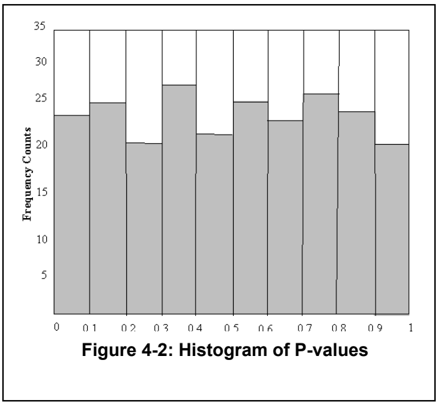
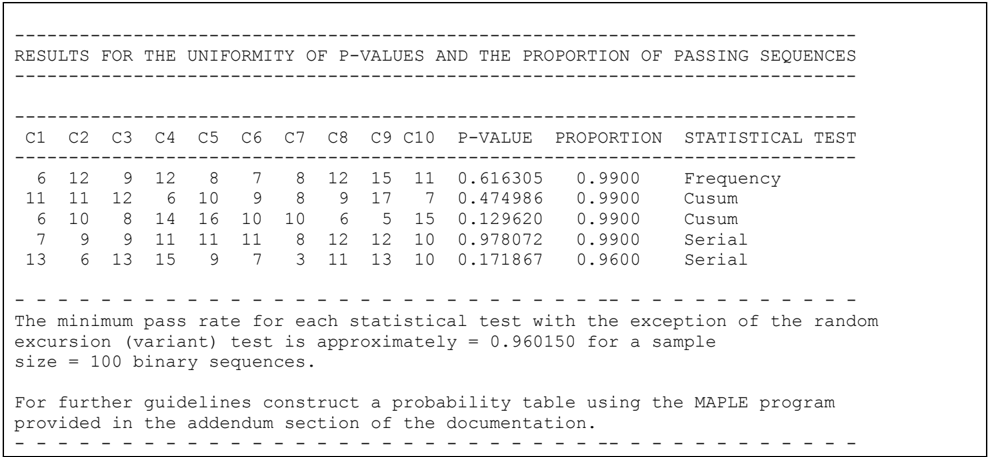
- Main analysis: For each sequence, P-values are computed and compared to \(\alpha\); empirical interpretation examines the proportion of sequences passing a test and the uniformity of P-values. A multiple-test dependence study applied 161 test P-values to Blum-Blum-Shub sequences of length 1,000,000 and used principal components/factor analysis, concluding there was no large redundancy among tests.
Limitations
- The paper states that no set of statistical tests can absolutely certify a generator as appropriate, that statistical testing cannot substitute for cryptanalysis, and that generator design and cryptanalysis are outside its scope.
- The paper states that many examples use small sample sizes for illustration only, e.g., \(n=10\), where the normal approximation is not really applicable; many tests rely on asymptotic reference distributions for large \(n\) (order \(10^3\) to \(10^7\)), and input parameter constraints apply.
- The text makes evident additional limitations: numerical precision can degrade for large incomplete gamma parameter \(a\); Maurer’s variance approximation can make the test 2.67 times more permissive than theoretically admitted; Random Excursions is discontinued if \(J<500\); and multiple tests can yield contradictory conclusions, as in the Random Excursions example where one state gave a non-random result while seven states gave random results.
Model-written summary. Check it against the paper before relying on it.
Integrity signals
Registry
Cites
Statistics
Figures

Verification
Claims the paper makes
0 Valid · 1 Not valid · 11 Not checked · 13 Own results and interpretations
A result the paper reports from its own data — it cites no other source for it, so there is none to check. The quote shows it is in the paper.
In the paper
“The asymptotic distribution of ( Ln -µ n ) / σ n along the sequence of even or odd values of n is that of a discrete random variable obtained via a mixture of two geometric random variables (one of them taking only negative values). Strictly speaking, the asymptotic distribution as such does not exist.”
A result the paper reports from its own data — it cites no other source for it, so there is none to check. The quote shows it is in the paper.
In the paper
“However, no set of statistical tests can absolutely certify a generator as appropriate for usage in a particular application, i.e., statistical testing cannot serve as a substitute for cryptanalysis.”
A result the paper reports from its own data — it cites no other source for it, so there is none to check. The quote shows it is in the paper.
In the paper
“This graph showed that there is no large redundancy among our tests.”
In the paper
“Ueli Maurer of the Department of Computer Science at Princeton University introduced this test in 1992. Maurer's test statistic relates closely to the per-bit entropy of the stream, which its author asserts is 'the correct quality measure for a secret-key source in a cryptographic application.'”
What the sources say
- Not matchedcites Maurer
This doesn’t read as a citation we can look up.
- Not matched
What the paper did — it cites no source for this, so there is none to check. The quote shows it is in the paper.
In the paper
“The test rejects the randomness hypothesis immediately if J is too small, i.e., if the following P-value is small:”
20 more claims
Create a free account to see all 25 claims and every source verdict.
Claims other papers make about this one
Each is checked against this paper’s own text: does it say what the citing paper says it does?
The source backs part of the claim, not all of it — or backs it for a different population, condition or comparison.
In the citing paper
“However, the latest version 2.1.2 [1], released in 2014, does not incorporate several modifications.”
From Checking the quality of approximation of p-values in statistical tests for random number generators by using a three-level test (2019) · cites this paper as [1]
Experimental — accuracy not yet measuredThe source backs part of the claim, not all of it — or backs it for a different population, condition or comparison.
In the citing paper
“The NIST test suite consists of 15 statistical tests for randomness of bit sequences, and its result is a list of 188 p -values.”
From Checking the quality of approximation of p-values in statistical tests for random number generators by using a three-level test (2019) · cites this paper as [1]
Experimental — accuracy not yet measuredThe cited source says what the claim attributes to it.
In the citing paper
“Note that the current implementation of the NIST test suite uses one-level or two-level tests, differently from the above experiments”
From Checking the quality of approximation of p-values in statistical tests for random number generators by using a three-level test (2019) · cites this paper as [1]
The cited source says what the claim attributes to it.
In the citing paper
“NIST SP-800.22 statistical test suite [90] and Die-hard test suite [91] and Test U01 [92] and AIS31 [93] are most common statistical test suites to evaluate their RNGs by researchers.”
From True Random Number Generators Using Electrical Noise (2019) · cites this paper as [90]
Self-check
Percentages, sums and reported differences re-computed from the paper’s own numbers.
Each contradiction between two passages listed here was confirmed by an independent check.
Rated minor: it would not touch a result — a value no result rests on, a p-value that stays on the same side of the significance level, or a conflict that is clerical, resolved elsewhere in the paper, or outside its own findings.
In the paper
§ 2.3.8 Example
“(input) τ = 0.02 (processing) π = 0.42 (processing) Vn(obs) = 52 (output) P-value = 0.500798 (conclusion) Since P-value ≥ 0.01 , accept the sequence as random.”
§ 2.3.4 Test Description
“If it can be shown that π -1 ≥τ , then the 2 Runs test need not be performed (i.e., the test should not have been run because of a failure to pass test 1, the Frequency (Monobit) test). If the test is not applicable, then the P-value is set to 0.0000.”
Rated minor: it would not touch a result — a value no result rests on, a p-value that stays on the same side of the significance level, or a conflict that is clerical, resolved elsewhere in the paper, or outside its own findings.
In the paper
§ 2.7.4 Test Description
“| 8-10 | 010 (hit) | 2 | 110 | 1 |”
§ 2.7.4 Test Description
“For the above example, if m = 3 and the template B = 001, then the examination proceeds as follows:”
Rated minor: it would not touch a result — a value no result rests on, a p-value that stays on the same side of the significance level, or a conflict that is clerical, resolved elsewhere in the paper, or outside its own findings.
In the paper
§ 2.9.3 Test Statistic and Reference Distribution
“f n : The sum of the log2 distances between matching Lbit templates, i.e., the sum of the number of digits in the distance between Lbit templates.”
§ 3.9 Maurer's 'Universal Statistical' Test
“Then it averages over all the expansion lengths by the number of test blocks.”
Rated minor: it would not touch a result — a value no result rests on, a p-value that stays on the same side of the significance level, or a conflict that is clerical, resolved elsewhere in the paper, or outside its own findings.
In the paper
§ Input Parameters:
“The parameters p , q and s are not fixed in code; thus, the user will not be able to reconstruct the original sequence because these values will vary (i.e., they are dependent on the system time).”
§ Input Parameters:
“The input parameters have been fixed so the code will reproduce the same results.”
Rated minor: it would not touch a result — a value no result rests on, a p-value that stays on the same side of the significance level, or a conflict that is clerical, resolved elsewhere in the paper, or outside its own findings.
In the paper
§ 5.5.2 Global Parameters
“| MAXNUMOFTEMPLATES | 40 | Non-overlapping Templates Test | | NUMOFTESTS | 16 | Max number of tests | | NUMOFGENERATORS | 12 | Max number of PRNGs |”
§ A.2 Configuration Information
“| 2. | #define MAXNUMOFTEMPLATES | 148 | | 3. | #define NUMOFTESTS | 15 | | 4. | #define NUMOFGENERATORS | 10 |”
2 more findings
Create a free account to see every finding of this check.
Citations
Cites
Handbook of Mathematical Functions
McQuarrie, D. A. (1966) · American Journal of Physics · doi:10.1119/1.1972842 · Cited by 40,433
Numerical recipes in C: the art of scientific computing
(1993) · Choice Reviews Online · doi:10.5860/choice.30-5638 · Cited by 17,933
Rayward-Smith, V. J. (1991) · Journal of the Operational Research Society · doi:10.1057/jors.1991.155 · Cited by 16,821
Handbook of applied cryptography
(1997) · Choice Reviews Online · doi:10.5860/choice.34-4512 · Cited by 10,357
Handbook of Mathematical Functions
(2018) · A Century of Excellence in MEASUREMENTS, STANDARDS, and TECHNOLOGY · doi:10.1201/9781351069397-39 · Cited by 9,062
A universal algorithm for sequential data compression
Ziv, J., & Lempel, A. (1977) · IEEE Transactions on Information Theory · doi:10.1109/tit.1977.1055714 · Cited by 5,456
The Art of Computer Programming
Worlton, W. J. (1968) · Nuclear Science and Engineering · doi:10.13182/nse68-a19548 · Cited by 2,251
Handbook of Applied Cryptography
Menezes, A. J., van Oorschot, P. C., & Vanstone, S. A. (2018) · CRC Press eBooks · doi:10.1201/9780429466335 · Cited by 1,770
Numerical Recipes in C-The Art of Scientific Computing.
G., W., Press, W. H., Flannery, B. P., Teukolsky, S. A., & Vetterling, W. T. (1989) · Mathematics of Computation · doi:10.2307/2008673 · Cited by 1,513
The Fourier Transform and its Applications
Cattermole, K. W. (1965) · Electronics and Power · doi:10.1049/ep.1965.0268 · Cited by 1,417
Cited by
Digital image steganography: Survey and analysis of current methods
Cheddad, A., Condell, J., Curran, K., & Mc Kevitt, P. (2010) · Signal Processing · doi:10.1016/j.sigpro.2009.08.010 · Cited by 1,704
“26] has answered the question “how random is the noise?” qualitatively there are various methods which estimate randomness quantitatively (see [101]).”
Significant-Loophole-Free Test of Bell’s Theorem with Entangled Photons
Giustina, M., Versteegh, M. A. M., Wengerowsky, S., Handsteiner, J., Hochrainer, A., Phelan, K., Steinlechner, F., Kofler, J., Larsson, J.-Å., Abellán, C., et al. (2015) · Physical Review Letters · doi:10.1103/physrevlett.115.250401 · Cited by 1,529
“[30–35], for more information about the experimental setup and data analysis.”
BackgroundRandom numbers certified by Bell’s theorem
Pironio, S., Acín, A., Massar, S., de la Giroday, A. B., Matsukevich, D. N., Maunz, P., Olmschenk, S., Hayes, D., Luo, L., Manning, T. A., et al. (2010) · Nature · doi:10.1038/nature09008 · Cited by 1,420
Handbook of Monte Carlo Methods
Kroese, D. P., Taimre, T., & Botev, Z. I. (2011) · Wiley Series in Probability and Statistics · doi:10.1002/9781118014967 · Cited by 1,104
“2], and adapted version of the Diehard suite of tests by Marsaglia [28], the ones implemented by the National Institute of Standards and Technology (NIST) [37], and various other tests.”
MethodFast physical random bit generation with chaotic semiconductor lasers
Uchida, A., Amano, K., Inoue, M., Hirano, K., Naito, S., Someya, H., Oowada, I., Kurashige, T., Shiki, M., Yoshimori, S., et al. (2008) · Nature Photonics · doi:10.1038/nphoton.2008.227 · Cited by 1,024
“Efforts are being made to develop faster and more reliable generators and establish better standards for random number generation based on stringent tests of randomnes”
BackgroundTestU01: A C library for empirical testing of random number generators
L'Ecuyer, P., & Simard, R. (2007) · ACM Transactions on Mathematical Software · doi:10.1145/1268776.1268777 · Cited by 1,014
“Besides TestU01, the best-known public-domain statistical testing packages for RNGs are DIEHARD [Marsaglia 1996] and the test suite implemented by the National Institute of Standards and Technology (NIST) of the USA [Rukhin et al. 2001].”
MethodInfluentialPower-Up SRAM State as an Identifying Fingerprint and Source of True Random Numbers
Holcomb, D. E., Burleson, W. P., & Fu, K. (2009) · IEEE Transactions on Computers · doi:10.1109/tc.2008.212 · Cited by 841
“While min-entropy is intended as the primary assurance of randomness for the extracted bits, these bits are also tested using the runs, approximate entropy, and block frequency tests from the NIST suite [37].”
Radio-telepathy: extracting a secret key from an unauthenticated wireless channel
Mathur, S., Trappe, W., Mandayam, N., Ye, C., & Reznik, A. (2008) · Proceedings of the 14th ACM international conference on Mobile computing and networking · doi:10.1145/1409944.1409960 · Cited by 739
Complex photonics: Dynamics and applications of delay-coupled semiconductors lasers
Soriano, M. C., García-Ojalvo, J., Mirasso, C. R., & Fischer, I. (2013) · Reviews of Modern Physics · doi:10.1103/revmodphys.85.421 · Cited by 582
“Prior to the deterministic mechanism as described by Sano (1994), Henry and Kazarinov (1986) had introduced an explanation for the LFF, describing it as a noise-induced escape phenomenon from one of the stable high-gain modes.”
MethodOn the effectiveness of secret key extraction from wireless signal strength in real environments
Jana, S., Premnath, S. N., Clark, M., Kasera, S. K., Patwari, N., & Krishnamurthy, S. V. (2009) · Proceedings of the 15th annual international conference on Mobile computing and networking · doi:10.1145/1614320.1614356 · Cited by 518
Report on the development of the Advanced Encryption Standard (AES)
Nechvatal, J., Barker, E., Bassham, L., Burr, W., Dworkin, M., Foti, J., & Roback, E. (2001) · Journal of Research of the National Institute of Standards and Technology · doi:10.6028/jres.106.023 · Cited by 475
Self-citationPhysically Unclonable Functions: A Study on the State of the Art and Future Research Directions
Maes, R., & Verbauwhede, I. (2010) · Information Security and Cryptography · doi:10.1007/978-3-642-14452-3_1 · Cited by 469
“Two methods which are used to do this are testing the compressibility of the response strings, mostly using the context-tree weighting method [57], and running standardized randomness tests such as the Diehard test and the NIST test [44].”
MethodA novel true random number generator based on a stochastic diffusive memristor
Jiang, H., Belkin, D., Savel’ev, S. E., Lin, S., Wang, Z., Li, Y., Joshi, S., Midya, R., Li, C., Rao, M., et al. (2017) · Nature Communications · doi:10.1038/s41467-017-00869-x · Cited by 459
“To assess the performance of our diffusive memristor TRNG, we carried out randomness testing for 76 million binary bits using the standard statistical testing package developed by the National Institute of Standards and Technology (NIST 800-22 test suite) 32 .”
BackgroundMethodKey Generation From Wireless Channels: A Review
Zhang, J., Duong, T. Q., Marshall, A., & Woods, R. (2016) · IEEE Access · doi:10.1109/access.2016.2521718 · Cited by 451
“A statistical randomness test suite provided by National Institute of Standards and Technology (NIST) [46] is widely used to test the randomness of random number generators (RNGs) and pseudo random number generators (PRNGs).”
BackgroundMethodInfluentialQuantum random number generation
Ma, X., Yuan, X., Cao, Z., Qi, B., & Zhang, Z. (2016) · npj Quantum Information · doi:10.1038/npjqi.2016.21 · Cited by 445
Waruiru, C. (2004) · Archives of Disease in Childhood · doi:10.1136/adc.2003.028449 · Cited by 422
A generator for unique quantum random numbers based on vacuum states
Gabriel, C., Wittmann, C., Sych, D., Dong, R., Mauerer, W., Andersen, U. L., Marquardt, C., & Leuchs, G. (2010) · Nature Photonics · doi:10.1038/nphoton.2010.197 · Cited by 419
High-Rate Uncorrelated Bit Extraction for Shared Secret Key Generation from Channel Measurements
Patwari, N., Croft, J., Jana, S., & Kasera, S. K. (2010) · IEEE Transactions on Mobile Computing · doi:10.1109/tmc.2009.88 · Cited by 416
Li, S., Li, C., Chen, G., Bourbakis, N. G., & Lo, K.-T. (2008) · Signal Processing: Image Communication · doi:10.1016/j.image.2008.01.003 · Cited by 339
Henderson, A. R. (2005) · Clinica Chimica Acta · doi:10.1016/j.cccn.2005.04.002 · Cited by 319
Embedding Covert Channels into TCP/IP
Murdoch, S. J., & Lewis, S. (2005) · Lecture Notes in Computer Science · doi:10.1007/11558859_19 · Cited by 302
An image encryption scheme based on a new hybrid chaotic map and optimized substitution box
Farah, M. A. B., Farah, A., & Farah, T. (2020) · Nonlinear Dynamics · doi:10.1007/s11071-019-05413-8 · Cited by 302
Certified randomness in quantum physics
Acín, A., & Masanes, L. (2016) · Nature · doi:10.1038/nature20119 · Cited by 298
“Concerning the first point, the standard solution consists of running statistical tests [1] on sequences generated by the device.”
Secret Key Extraction from Wireless Signal Strength in Real Environments
Premnath, S. N., Jana, S., Croft, J., Gowda, P. L., Clark, M., Kasera, S. K., Patwari, N., & Krishnamurthy, S. V. (2013) · IEEE Transactions on Mobile Computing · doi:10.1109/tmc.2012.63 · Cited by 297
Memristive Rulkov Neuron Model With Magnetic Induction Effects
Li, K., Bao, H., Li, H., Ma, J., Hua, Z., & Bao, B. (2022) · IEEE Transactions on Industrial Informatics · doi:10.1109/tii.2021.3086819 · Cited by 268
Dynamic Analysis of Digital Chaotic Maps via State-Mapping Networks
Li, C., Feng, B., Li, S., Kurths, J., & Chen, G. (2019) · IEEE Transactions on Circuits and Systems I: Regular Papers · doi:10.1109/tcsi.2018.2888688 · Cited by 270
“4. map. Furthermore, it can work as a coarse visual tool for evaluating their randomness levels, as a complement to all kinds of test indexes enclosed in the standard test suites, e.g. NIST SP 800-22 [52] and TestU01 [53]. For this purpose, the various methods for chaos-based PRNG are classified into the following six…”
MethodIMDGuard: Securing implantable medical devices with the external wearable guardian
Xu, F., Qin, Z., Tan, C. C., Wang, B., & Li, Q. (2011) · 2011 Proceedings IEEE INFOCOM · doi:10.1109/infcom.2011.5934987 · Cited by 267
A novel image encryption algorithm based on a 3D chaotic map
Kanso, A., & Ghebleh, M. (2012) · Communications in Nonlinear Science and Numerical Simulation · doi:10.1016/j.cnsns.2011.11.030 · Cited by 267
Secret key generation exploiting channel characteristics in wireless communications
Ren, K., Su, H., & Wang, Q. (2011) · IEEE Wireless Communications · doi:10.1109/mwc.2011.5999759 · Cited by 262
“The randomness of a bit sequence can be measured using a National Institute of Standards and Technology (NIST) test [15].”
MethodFast and practical secret key extraction by exploiting channel response
Liu, H., Wang, Y., Yang, J., & Chen, Y. (2013) · 2013 Proceedings IEEE INFOCOM · doi:10.1109/infcom.2013.6567117 · Cited by 262
“To ensure that the secret key generated is substantially random, the standard randomness test suite from NIST [20] is”
BackgroundDiscrete Memristor Hyperchaotic Maps
Bao, H., Hua, Z., Li, H., Chen, M., & Bao, B. (2021) · IEEE Transactions on Circuits and Systems I: Regular Papers · doi:10.1109/tcsi.2021.3082895 · Cited by 254
“To test the randomness of the proposed PRNGs, the National Institute of Standards and Technology (NIST) SP800-22 [40] is applied.”
BackgroundMethodInfluentialDepreciating motivation and empirical security analysis of chaos-based image and video encryption
Preishuber, M., Hutter, T., Katzenbeisser, S., & Uhl, A. (2018) · IEEE Transactions on Information Forensics and Security · doi:10.1109/tifs.2018.2812080 · Cited by 256
“One option for assessing chaos-based random number generators by statistical means is to apply the NIST test suite [24] proposed for this purpose (see Section III-C).”
BackgroundMethodInfluentialKatzenbeisser, S., Kocabaş, Ü., Rožić, V., Sadeghi, A.-R., Verbauwhede, I., & Wachsmann, C. (2012) · Lecture Notes in Computer Science · doi:10.1007/978-3-642-33027-8_17 · Cited by 254
“Statistical tests, such as the DIEHARD [23] or NIST [27] test suite, can in principle be used to assess the Table 3: Unpredictability test cases. unpredictability of PUF responses.”
MethodFast and scalable secret key generation exploiting channel phase randomness in wireless networks
Wang, Q., Su, H., Ren, K., & Kim, K. (2011) · 2011 Proceedings IEEE INFOCOM · doi:10.1109/infcom.2011.5934929 · Cited by 251
Parallel random numbers: as easy as 1, 2, 3
Salmon, J. K., Moraes, M. A., Dror, R. O., & Shaw, D. E. (2011) · Proceedings of 2011 International Conference for High Performance Computing, Networking, Storage and Analysis · doi:10.1145/2063384.2063405 · Cited by 227
“[4, 20, 26, 38], but the most comprehensive is TestU01 [24], which provides a consistent framework as well as batteries”
Leem, J. W., Kim, M. S., Choi, S. H., Kim, S.-R., Kim, S.-W., Song, Y. M., Young, R. J., & Kim, Y. L. (2020) · Nature Communications · doi:10.1038/s41467-019-14066-5 · Cited by 218
Gaussian random number generators
Thomas, D. B., Luk, W., Leong, P. H. W., & Villasenor, J. D. (2007) · ACM Computing Surveys · doi:10.1145/1287620.1287622 · Cited by 213
“Sophisticated test suites and procedures are available from the U.S. NIST [Rukhin et al. 2001] and from the Diehard tests developed by Marsaglia [1997].”
MethodInfluentialPhysically unclonable cryptographic primitives using self-assembled carbon nanotubes
Hu, Z., Comeras, J. M. M. L., Park, H., Tang, J., Afzali, A., Tulevski, G. S., Hannon, J. B., Liehr, M., & Han, S.-J. (2016) · Nature Nanotechnology · doi:10.1038/nnano.2016.1 · Cited by 212
(2009) · Springer eBooks · doi:10.1007/978-0-387-71817-0 · Cited by 214
Heart-to-heart (H2H): authentication for implanted medical devices
Rostami, M., Juels, A., & Koushanfar, F. (2013) · Proceedings of the 2013 ACM SIGSAC conference on Computer & communications security - CCS '13 · doi:10.1145/2508859.2516658 · Cited by 210
“We applied the NIST suite of statistical tests [41] to our dataset.”
MethodTrue Random Number Generator Embedded in Reconfigurable Hardware
Fischer, V., & Drutarovský, M. (2003) · Lecture Notes in Computer Science · doi:10.1007/3-540-36400-5_30 · Cited by 209
“Under Gaussian approximation the bias for intrinsic jitter can be computed by where erf() is the Error function [15].”
BackgroundMethodInfluentialAn embedded true random number generator for FPGAs
Kohlbrenner, P., & Gaj, K. (2004) · Proceedings of the 2004 ACM/SIGDA 12th international symposium on Field programmable gate arrays · doi:10.1145/968280.968292 · Cited by 210
“We present results from the US National Institute of Standards and Technology (NIST) Statistical Test Suite for Random and Pseudorandom Number Generators for Cryptographic Applications [18].”
BackgroundMethodInfluentialFast random bit generation with bandwidth-enhanced chaos in semiconductor lasers
Hirano, K., Yamazaki, T., Morikatsu, S., Okumura, H., Aida, H., Uchida, A., Yoshimori, S., Yoshimura, K., Harayama, T., & Davis, P. (2010) · Optics Express · doi:10.1364/oe.18.005512 · Cited by 207
(2008) · The Concise Encyclopedia of Statistics · doi:10.1007/978-0-387-32833-1_341 · Cited by 206
A new chaos-based image encryption system
El Assad, S., & Farajallah, M. (2016) · Signal Processing: Image Communication · doi:10.1016/j.image.2015.10.004 · Cited by 201
Image encryption scheme based on 3D baker with dynamical compound chaotic sequence cipher generator
Tong, X., & Cui, M. (2009) · Signal Processing · doi:10.1016/j.sigpro.2008.09.011 · Cited by 196
Initials-Boosted Coexisting Chaos in a 2-D Sine Map and Its Hardware Implementation
Bao, H., Hua, Z., Wang, N., Zhu, L., Chen, M., & Bao, B. (2021) · IEEE Transactions on Industrial Informatics · doi:10.1109/tii.2020.2992438 · Cited by 192
“According to the calculation in [33], the minimum pass proportions are approximately 0.”
BackgroundMethodA Pseudo Random Bit Generator Based on Chaotic Logistic Map and its Statistical Testing
Patidar, V., Sud, K. K., & Pareek, N. K. (2009) · Informatica · Cited by 244
A novel pseudorandom number generator based on pseudorandomly enhanced logistic map
Murillo-Escobar, M. A., Cruz-Hernández, C., Cardoza-Avendaño, L., & Méndez-Ramírez, R. (2017) · Nonlinear Dynamics · doi:10.1007/s11071-016-3051-3 · Cited by 194
“All these references pass the National Institute of Standards and Technology (NIST) 800-22 statistical tests for random and pseudorandom numbers [32].”
BackgroundPareschi, F., Rovatti, R., & Setti, G. (2012) · IEEE Transactions on Information Forensics and Security · doi:10.1109/tifs.2012.2185227 · Cited by 189
The Frequency Injection Attack on Ring-Oscillator-Based True Random Number Generators
Markettos, A. T., & Moore, S. W. (2009) · Lecture Notes in Computer Science · doi:10.1007/978-3-642-04138-9_23 · Cited by 192
“The statistics were analysed using all the tests in the NIST [12] and Dieharder [13] 2 test suites using 1.56×10 9 bits.”
MethodInfluentialStipčević, M., & Koç, Ç. K. (2014) · Open Problems in Mathematics and Computational Science · doi:10.1007/978-3-319-10683-0_12 · Cited by 186
Color image encryption based on chaotic systems and elliptic curve ElGamal scheme
Wu, J., Liao, X., & Yang, B. (2017) · Signal Processing · doi:10.1016/j.sigpro.2017.04.006 · Cited by 183
Zhang, J., Li, G., Marshall, A., Hu, A., & Hanzo, L. (2020) · IEEE Access · doi:10.1109/access.2020.3012006 · Cited by 169
“The National Institute of Standards and Technology (NIST) random test suite is widely used to evaluate the randomness for random number generators (RNG) and pseudo random number generators (PRNG) [106].”
MethodTrue Random Number Generator With a Metastability-Based Quality Control
Tokunaga, C., Blaauw, D., & Mudge, T. (2008) · IEEE Journal of Solid-State Circuits · doi:10.1109/jssc.2007.910965 · Cited by 172
Illi, E., Qaraqe, M., Althunibat, S., Alhasanat, A., Alsafasfeh, M., de Ree, M., Mantas, G., Rodriguez, J., Aman, W., & Al-Kuwari, S. (2024) · IEEE Communications Surveys & Tutorials · doi:10.1109/comst.2023.3327327 · Cited by 172
An image encryption scheme based on elliptic curve pseudo random and Advanced Encryption System
Toughi, S., Fathi, M. H., & Sekhavat, Y. A. (2017) · Signal Processing · doi:10.1016/j.sigpro.2017.06.010 · Cited by 169
Ultra-fast quantum randomness generation by accelerated phase diffusion in a pulsed laser diode
Abellán, C., Amaya, W., Jofre, M., Curty, M., Acín, A., Capmany, J., Pruneri, V., & Mitchell, M. W. (2014) · Optics Express · doi:10.1364/oe.22.001645 · Cited by 168
“Using suggestions in [24], the proportion of accepted/rejected sequences and the uniform ity of theP-values are computed.”
MethodAnalysis and Enhancement of Random Number Generator in FPGA Based on Oscillator Rings
Wold, K., & Tan, C. H. (2009) · International Journal of Reconfigurable Computing · doi:10.1155/2009/501672 · Cited by 168
A joint resource-aware and medical data security framework for wearable healthcare systems
Pirbhulal, S., Samuel, O. W., Wu, W., Sangaiah, A. K., & Li, G. (2019) · Future Generation Computer Systems · doi:10.1016/j.future.2019.01.008 · Cited by 166
Adaptive chaotic maps and their application to pseudo-random numbers generation
Tutueva, A. V., Nepomuceno, E. G., Karimov, A. I., Andreev, V. S., & Butusov, D. N. (2020) · Chaos, Solitons & Fractals · doi:10.1016/j.chaos.2020.109615 · Cited by 164
A color image encryption with heterogeneous bit-permutation and correlated chaos
Wang, X., & Zhang, H.-L. (2015) · Optics Communications · doi:10.1016/j.optcom.2014.12.043 · Cited by 163
Dong, E., Yuan, M., Du, S., & Chen, Z. (2019) · Applied Mathematical Modelling · doi:10.1016/j.apm.2019.03.037 · Cited by 160
DRAM-Based Intrinsic Physically Unclonable Functions for System-Level Security and Authentication
Tehranipoor, F., Karimian, N., Yan, W., & Chandy, J. A. (2017) · IEEE Transactions on Very Large Scale Integration (VLSI) Systems · doi:10.1109/tvlsi.2016.2606658 · Cited by 161
“To evaluate the randomness of a PUF, statistical tests such as the NIST test [32], machine learning techniques, Shannon entropy, and min-entropy can be applied to the PUF data.”
MethodA chaos-based image encryption algorithm with simple logical functions
Yavuz, E., Yazıcı, R., Kasapbaşı, M. C., & Yamaç, E. (2016) · Computers & Electrical Engineering · doi:10.1016/j.compeleceng.2015.11.008 · Cited by 159
Sahari, M. L., & Boukemara, I. (2018) · Nonlinear Dynamics · doi:10.1007/s11071-018-4390-z · Cited by 159
“01, the binary sequence is accepted as random with a con-fidence of 99%; otherwise, it is considered as non-random [36,40].”
BackgroundMethodA novel color image encryption algorithm based on spatial permutation and quantum chaotic map
Seyedzadeh, S. M., Norouzi, B., Mosavi, M. R., & Mirzakuchaki, S. (2015) · Nonlinear Dynamics · doi:10.1007/s11071-015-2008-2 · Cited by 158
“In order to satisfy these requirements, we utilized ENT test suite [45], NIST SP 800-22 tests [46] and DIEHARD [47], for testing the randomness of the cipher.”
MethodA novel no-equilibrium HR neuron model with hidden homogeneous extreme multistability
Zhang, S., Zheng, J., Wang, X., & Zeng, Z. (2021) · Chaos Solitons & Fractals · doi:10.1016/j.chaos.2021.110761 · Cited by 159
Chaotic image encryption based on circular substitution box and key stream buffer
Zhang, X., Zhao, Z., & Wang, J. (2014) · Signal Processing Image Communication · doi:10.1016/j.image.2014.06.012 · Cited by 158
Generation of wideband chaos with suppressed time-delay signature by delayed self-interference
Wang, A., Yang, Y., Wang, B., Zhang, B., Li, L., & Wang, Y. (2013) · Optics Express · doi:10.1364/oe.21.008701 · Cited by 155
Computational phase-change memory: beyond von Neumann computing
Sebastian, A., Gallo, M. L., & Eleftheriou, E. S. (2019) · Journal of Physics D Applied Physics · doi:10.1088/1361-6463/ab37b6 · Cited by 166
“10 from 100M switching events was presented to evaluate the quality of the randomness of the bitstreams with standard tests such as the NIST test [85].”
MethodA novel image encryption algorithm based on genetic recombination and hyper-chaotic systems
Wang, X., & Zhang, H. (2015) · Nonlinear Dynamics · doi:10.1007/s11071-015-2330-8 · Cited by 155
Li, N., Kim, B., Chizhevsky, V. N., Locquet, A., Bloch, M. R., Citrin, D. S., & Pan, W. (2014) · Optics Express · doi:10.1364/oe.22.006634 · Cited by 161
An efficient and robust image encryption scheme for medical applications
Kanso, A. A., & Ghebleh, M. (2015) · Communications in Nonlinear Science and Numerical Simulation · doi:10.1016/j.cnsns.2014.12.005 · Cited by 162
Pirbhulal, S., Zhang, H., Wu, W., Mukhopadhyay, S. C., & Zhang, Y.-T. (2018) · IEEE Transactions on Biomedical Engineering · doi:10.1109/tbme.2018.2815155 · Cited by 150
“statistical NIST tests are also performed [22]–[24].”
MethodDesigning permutation–substitution image encryption networks with Henon map
Ping, P., Xu, F., Mao, Y., & Wang, Z. (2017) · Neurocomputing · doi:10.1016/j.neucom.2017.12.048 · Cited by 154
A novel image encryption–compression scheme using hyper-chaos and Chinese remainder theorem
Zhu, H., Zhao, C., & Zhang, X. (2013) · Signal Processing Image Communication · doi:10.1016/j.image.2013.02.004 · Cited by 161
Using the Timing Information of Heartbeats as an Entity Identifier to Secure Body Sensor Network
Bao, S., Poon, C. C. Y., Zhang, Y., & Shen, L. (2008) · IEEE Transactions on Information Technology in Biomedicine · doi:10.1109/titb.2008.926434 · Cited by 160
On-chip generation of high-order single-photon W-states
Gräfe, M., Heilmann, R., Perez-Leija, A., Keil, R., Dreisow, F., Heinrich, M., Moya-Cessa, H., Nolte, S., Christodoulides, D. N., & Szameit, A. (2014) · Nature Photonics · doi:10.1038/nphoton.2014.204 · Cited by 148
Liu, H., Yang, J., Wang, Y., Chen, Y. J., & Koksal, C. E. (2014) · IEEE Transactions on Mobile Computing · doi:10.1109/tmc.2014.2310747 · Cited by 142
“The standard NIST test suite is employed to measure the randomness of the generated secret bit string.”
MethodInfluentialA new image encryption scheme based on a chaotic function
François, M., Grosges, T., Barchiesi, D., & Erra, R. (2011) · Signal Processing Image Communication · doi:10.1016/j.image.2011.11.003 · Cited by 160
A fast color image encryption algorithm based on hyper-chaotic systems
Norouzi, B., & Mirzakuchaki, S. (2014) · Nonlinear Dynamics · doi:10.1007/s11071-014-1492-0 · Cited by 151
“In order to satisfy these requirements, we have utilized NIST SP 800-22 tests [54], DIEHARD [55], and ENT test suite for testing the randomness of the cipher.”
MethodImplementation and Testing of High-Speed CMOS True Random Number Generators Based on Chaotic Systems
Pareschi, F., Setti, G., & Rovatti, R. (2010) · IEEE Transactions on Circuits and Systems I: Regular Papers · doi:10.1109/tcsi.2010.2052515 · Cited by 147
Stochastic Memory Devices for Security and Computing
Carboni, R., & Ielmini, D. (2019) · Advanced Electronic Materials · doi:10.1002/aelm.201900198 · Cited by 145
Scalable parallel physical random number generator based on a superluminescent LED
Li, X., Cohen, A. B., Murphy, T. E., & Roy, R. (2011) · Optics Letters · doi:10.1364/ol.36.001020 · Cited by 146
Collaborative secret key extraction leveraging Received Signal Strength in mobile wireless networks
Liu, H., Yang, J., Wang, Y., & Chen, Y. J. (2012) · IEEE Conference on Computer Communications (INFOCOM) · doi:10.1109/infcom.2012.6195843 · Cited by 148
A new four-scroll chaotic attractor and its engineering applications
Akgül, A., Moroz, I. M., Pehlivan, İ., & Vaidyanathan, S. V. (2016) · Optik · doi:10.1016/j.ijleo.2016.02.066 · Cited by 147
Medical image encryption based on improved ElGamal encryption technique
Laiphrakpam, D. S., & Khumanthem, M. S. (2017) · Optik · doi:10.1016/j.ijleo.2017.08.028 · Cited by 147
Rabbit: A New High-Performance Stream Cipher
Boesgaard, M., Vesterager, M., Pedersen, T. B., Christiansen, J., & Scavenius, O. (2003) · Lecture notes in computer science · doi:10.1007/978-3-540-39887-5_23 · Cited by 152
Design and realization of discrete memristive hyperchaotic map with application in image encryption
Lai, Q., Yang, L., & Liu, Y. (2022) · Chaos Solitons & Fractals · doi:10.1016/j.chaos.2022.112781 · Cited by 142
Li, G., Hu, A., Zhang, J., Peng, L., Sun, C. K., & Cao, D. (2018) · IEEE Transactions on Communications · doi:10.1109/tcomm.2018.2814607 · Cited by 148
“We perform 9 NIST statistical tests for 10, 000 trials.”
MethodInfluentialA pseudorandom number generator based on piecewise logistic map
Wang, Y., Liu, Z., Ma, J., & He, H. (2015) · Nonlinear Dynamics · doi:10.1007/s11071-015-2488-0 · Cited by 150
A novel scheme for image encryption based on 2D piecewise chaotic maps
Akhshani, A., Behnia, S., Akhavan, A., Hassan, H. A., & Hassan, Z. (2010) · Optics Communications · doi:10.1016/j.optcom.2010.04.056 · Cited by 147
FPGA Vendor Agnostic True Random Number Generator
Schellekens, D., Preneel, B., & Verbauwhede, I. (2006) · 2006 International Conference on Field Programmable Logic and Applications · doi:10.1109/fpl.2006.311206 · Cited by 140
“The design parameters of most proposals (such as sampling frequency, amount of post-processing, and thus the resulting bitstream throughput) are mainly determined by trial and error until the random bitstream passes the statistical tests provided by the NIST [ 10 ] or DIEHARD [11] test suite.”
MethodZhang, J., Marshall, A., Woods, R., et al. (2016) · IEEE Transactions on Communications · doi:10.1109/tcomm.2016.2552165 · Cited by 140
“In order to focus on the frequency correlation between two binary sequences Kk and Ki, we use a relatively large probing rate, 0.5 s, so there will be little temporal correlation within Kk. NIST randomness test is applied to the new sequence and the results are shown in Table V.”
MethodInfluentialPseudorandom sequence generator based on the Chen chaotic system
Hu, H., Liu, L., & Ding, N. (2012) · Computer Physics Communications · doi:10.1016/j.cpc.2012.11.017 · Cited by 147
“Besides these four tests, the binary sequences generated by our method also pass the SP 800-22 [25] test suite.”
MethodEvaluation Criteria for True (Physical) Random Number Generators Used in Cryptographic Applications
Schindler, W., & Killmann, W. (2003) · Lecture Notes in Computer Science · doi:10.1007/3-540-36400-5_31 · Cited by 135
New High Entropy Element for FPGA Based True Random Number Generators
Varchola, M., & Drutarovský, M. (2010) · Lecture notes in computer science · doi:10.1007/978-3-642-15031-9_24 · Cited by 160
“The final random bit sequence composed of 16 TERO channels xor combination passes the NIST 800-22 tests for every described setup.”
MethodInfluentialLai, Q., Yang, L., & Chen, G. (2023) · IEEE Transactions on Industrial Electronics · doi:10.1109/tie.2023.3299016 · Cited by 140
Analysis and Enhancement of Random Number Generator in FPGA Based on Oscillator Rings
Wold, K., & Tan, C. H. (2008) · 2008 International Conference on Reconfigurable Computing and FPGAs · doi:10.1109/reconfig.2008.17 · Cited by 137
“This experiments indicate that there is probably not necessary to have almost 100% certainty to hit at least one transition region in order to pass the NIST and DIEHARD statistical tests for this kind of TRNG. Table 1 shows the number of resources used for our TRNG in the Altera Cyclone II FPGA.”
MethodInfluential
Metadata
- Authors
- Bassham, L. E., Rukhin, A. L., Soto, J., Nechvatal, J. R., Smid, M. E., Barker, E. B., Leigh, S. D., Levenson, M., Vangel, M., Banks, D. L., Heckert, N. A., Dray, J. F., & Vo, S.
- Affiliations
- National Institute of Standards and Technology (US)
- Venue
- NIST Special Publication 800-22 Revision 1a
- Published
- 2010
- OpenAlex
- W1517403092
- Semantic Scholar
- 961fc0f6c68303cde94a28fdb24e6eaf3ef040b4
- Cited by
- 3,617
- References
- 34
- Citations by year
- 2026: 128 · 2025: 205 · 2024: 192 · 2023: 208 · 2022: 166 · 2021: 291 · 2020: 290 · 2019: 250 · 2018: 254 · 2017: 207 · 2016: 183 · 2015: 184 · 2014: 201 · 2013: 155 · 2012: 139
- Type
- report
- Language
- en
- Open access
- gold
- doi.org
- Topics
- Physical Sciences › Computer Science › Artificial Intelligence › Cryptographic Implementations and Security
- Physical Sciences › Mathematics › Discrete Mathematics and Combinatorics › Coding theory and cryptography
- Physical Sciences › Computer Science › Computer Vision and Pattern Recognition › Chaos-based Image/Signal Encryption
- Keywords
- random number generators, pseudorandom number generators, cryptographic randomness, NIST SP 800-22, randomness testing
About these checks
Registry, retraction, Cites and statistics results are computed, not judged, with one exception: a printed reference that no index lists is read once by a model before it counts as a citation error. Claims are extracted by a model and kept only when their quote appears verbatim in the text; each cited source is then checked, with a model’s help, for whether it says what the claim relies on. Those verdicts can be wrong — read the claim’s quote and the cited source before relying on one.
A language model drew the claims from the paper on 2026-09-27 (prompt extract-v2).
Statistics and arithmetic are recomputed, not judged.
Confidence bands are shown only for fields calibrated on our annotated test set. None is calibrated yet, so no band is shown.
What counts as a claim ›How we measure confidence ›How we check this ›
Are you an author, or do you see a problem with this page? Request a review
Data sources
Bibliographic data: Semantic Scholar, OpenAlex, Crossref.
Contains information from the Semantic Scholar Academic Graph Datasets, made available under the ODC Attribution License (ODC-BY 1.0).
Semantic Scholar’s data is described in: Kinney, R., et al. (2023). The Semantic Scholar Open Data Platform. arXiv:2301.10140.
