

A statistical test suite for random and pseudorandom number generators for cryptographic applications
Open accessThe DOI matches its Crossref record; 33 of the 34 references it cites were found in a registry or an index; none of the 14 sources its claims cite is checked for support yet.
Abstract
The Information Technology Laboratory (ITL) at the National Institute of Standards and Technology (NIST) promotes the U.S. economy and public welfare by providing technical leadership for the nation's measurement and standards infrastructure. ITL develops tests, test methods, reference data, proof of concept implementations, and technical analysis to advance the development and productive use of information technology. ITL's responsibilities include the development of technical, physical, administrative, and management standards and guidelines for the cost-effective security and privacy of sensitive unclassified information in Federal computer systems.
Overview
CoChat Summary
TL;DR
This NIST Special Publication 800-22 Revision 1a presents a suite of 15 statistical tests for evaluating whether binary sequences produced by random or pseudorandom number generators are suitable for cryptographic applications. It provides test purposes, mathematical descriptions, examples, and guidance for interpreting P-values, while cautioning that statistical testing is only a first step and cannot replace cryptanalysis.
Key findings
- The suite consists of 15 tests: Frequency (Monobit), Frequency within a Block, Runs, Longest Run of Ones, Binary Matrix Rank, Discrete Fourier Transform (Spectral), Non-overlapping Template Matching, Overlapping Template Matching, Maurer’s “Universal Statistical,” Linear Complexity, Serial, Approximate Entropy, Cumulative Sums, Random Excursions, and Random Excursions Variant. The Frequency test is recommended first because it supplies the most basic evidence of non-randomness.
- Each test uses the null hypothesis \(H_0\) that the sequence is random; if P-value \(\ge \alpha\), the sequence is accepted as random, and if P-value \(<\alpha\), it is rejected. Examples use \(\alpha=0.01\), and NIST recommends \(\alpha\) in the range [0.001, 0.01].
- The document states that no finite set of statistical tests is “complete,” that statistical testing cannot absolutely certify a generator, and that statistical testing cannot serve as a substitute for cryptanalysis.
- Sample data files are 1,000,000 bits (binary expansions of \(e\), \(\pi\), \(\sqrt{2}\), \(\sqrt{3}\), and a G-SHA-1 sequence); reported example P-values include Frequency for \(\pi\) = 0.578211, for \(e\) = 0.953749, and for G-SHA-1 = 0.604458.
Methods
- Design: The NIST Statistical Test Suite is an ANSI C reference implementation of 15 tests; each test defines a test statistic, a reference distribution (e.g., normal, half-normal, chi-square), a P-value, and a decision rule at the 1% level.
- Data or sample: Tests apply to binary sequences from hardware or software RNGs/PRNGs; sample files are 1,000,000 bits, while many worked examples use small illustrative lengths such as \(n=100\).
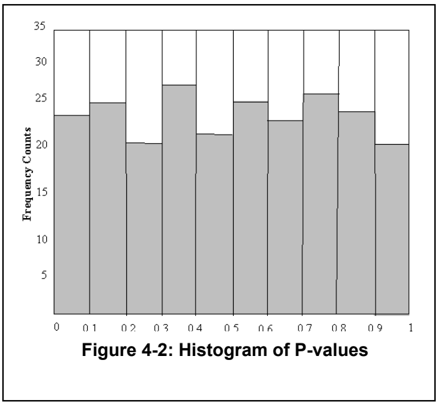
- Main analysis: For each sequence, P-values are computed and compared to \(\alpha\); empirical interpretation examines the proportion of sequences passing a test and the uniformity of P-values. A multiple-test dependence study applied 161 test P-values to Blum-Blum-Shub sequences of length 1,000,000 and used principal components/factor analysis, concluding there was no large redundancy among tests.
Limitations
- The paper states that no set of statistical tests can absolutely certify a generator as appropriate, that statistical testing cannot substitute for cryptanalysis, and that generator design and cryptanalysis are outside its scope.
- The paper states that many examples use small sample sizes for illustration only, e.g., \(n=10\), where the normal approximation is not really applicable; many tests rely on asymptotic reference distributions for large \(n\) (order \(10^3\) to \(10^7\)), and input parameter constraints apply.
- The text makes evident additional limitations: numerical precision can degrade for large incomplete gamma parameter \(a\); Maurer’s variance approximation can make the test 2.67 times more permissive than theoretically admitted; Random Excursions is discontinued if \(J<500\); and multiple tests can yield contradictory conclusions, as in the Random Excursions example where one state gave a non-random result while seven states gave random results.
Model-written summary. Check it against the paper before relying on it.
Integrity signals
Registry
Cites
Statistics
Figures

Verification
Claims the paper makes
0 Valid · 1 Not valid · 11 Not checked · 13 Own results and interpretations
A result the paper reports from its own data — it cites no other source for it, so there is none to check. The quote shows it is in the paper.
In the paper
“The asymptotic distribution of ( Ln -µ n ) / σ n along the sequence of even or odd values of n is that of a discrete random variable obtained via a mixture of two geometric random variables (one of them taking only negative values). Strictly speaking, the asymptotic distribution as such does not exist.”
A result the paper reports from its own data — it cites no other source for it, so there is none to check. The quote shows it is in the paper.
In the paper
“However, no set of statistical tests can absolutely certify a generator as appropriate for usage in a particular application, i.e., statistical testing cannot serve as a substitute for cryptanalysis.”
A result the paper reports from its own data — it cites no other source for it, so there is none to check. The quote shows it is in the paper.
In the paper
“This graph showed that there is no large redundancy among our tests.”
In the paper
“Ueli Maurer of the Department of Computer Science at Princeton University introduced this test in 1992. Maurer's test statistic relates closely to the per-bit entropy of the stream, which its author asserts is 'the correct quality measure for a secret-key source in a cryptographic application.'”
What the sources say
- Not matchedcites Maurer
This doesn’t read as a citation we can look up.
- Not matched
What the paper did — it cites no source for this, so there is none to check. The quote shows it is in the paper.
In the paper
“The test rejects the randomness hypothesis immediately if J is too small, i.e., if the following P-value is small:”
20 more claims
Create a free account to see all 25 claims and every source verdict.
Claims other papers make about this one
Each is checked against this paper’s own text: does it say what the citing paper says it does?
The source backs part of the claim, not all of it — or backs it for a different population, condition or comparison.
In the citing paper
“However, the latest version 2.1.2 [1], released in 2014, does not incorporate several modifications.”
From Checking the quality of approximation of p-values in statistical tests for random number generators by using a three-level test (2019) · cites this paper as [1]
Experimental — accuracy not yet measuredThe source backs part of the claim, not all of it — or backs it for a different population, condition or comparison.
In the citing paper
“The NIST test suite consists of 15 statistical tests for randomness of bit sequences, and its result is a list of 188 p -values.”
From Checking the quality of approximation of p-values in statistical tests for random number generators by using a three-level test (2019) · cites this paper as [1]
Experimental — accuracy not yet measuredThe cited source says what the claim attributes to it.
In the citing paper
“Note that the current implementation of the NIST test suite uses one-level or two-level tests, differently from the above experiments”
From Checking the quality of approximation of p-values in statistical tests for random number generators by using a three-level test (2019) · cites this paper as [1]
The cited source says what the claim attributes to it.
In the citing paper
“NIST SP-800.22 statistical test suite [90] and Die-hard test suite [91] and Test U01 [92] and AIS31 [93] are most common statistical test suites to evaluate their RNGs by researchers.”
From True Random Number Generators Using Electrical Noise (2019) · cites this paper as [90]
Self-check
Percentages, sums and reported differences re-computed from the paper’s own numbers.
Each contradiction between two passages listed here was confirmed by an independent check.
Rated minor: it would not touch a result — a value no result rests on, a p-value that stays on the same side of the significance level, or a conflict that is clerical, resolved elsewhere in the paper, or outside its own findings.
In the paper
§ 2.3.8 Example
“(input) τ = 0.02 (processing) π = 0.42 (processing) Vn(obs) = 52 (output) P-value = 0.500798 (conclusion) Since P-value ≥ 0.01 , accept the sequence as random.”
§ 2.3.4 Test Description
“If it can be shown that π -1 ≥τ , then the 2 Runs test need not be performed (i.e., the test should not have been run because of a failure to pass test 1, the Frequency (Monobit) test). If the test is not applicable, then the P-value is set to 0.0000.”
Rated minor: it would not touch a result — a value no result rests on, a p-value that stays on the same side of the significance level, or a conflict that is clerical, resolved elsewhere in the paper, or outside its own findings.
In the paper
§ 2.7.4 Test Description
“| 8-10 | 010 (hit) | 2 | 110 | 1 |”
§ 2.7.4 Test Description
“For the above example, if m = 3 and the template B = 001, then the examination proceeds as follows:”
Rated minor: it would not touch a result — a value no result rests on, a p-value that stays on the same side of the significance level, or a conflict that is clerical, resolved elsewhere in the paper, or outside its own findings.
In the paper
§ 2.9.3 Test Statistic and Reference Distribution
“f n : The sum of the log2 distances between matching Lbit templates, i.e., the sum of the number of digits in the distance between Lbit templates.”
§ 3.9 Maurer's 'Universal Statistical' Test
“Then it averages over all the expansion lengths by the number of test blocks.”
Rated minor: it would not touch a result — a value no result rests on, a p-value that stays on the same side of the significance level, or a conflict that is clerical, resolved elsewhere in the paper, or outside its own findings.
In the paper
§ Input Parameters:
“The parameters p , q and s are not fixed in code; thus, the user will not be able to reconstruct the original sequence because these values will vary (i.e., they are dependent on the system time).”
§ Input Parameters:
“The input parameters have been fixed so the code will reproduce the same results.”
Rated minor: it would not touch a result — a value no result rests on, a p-value that stays on the same side of the significance level, or a conflict that is clerical, resolved elsewhere in the paper, or outside its own findings.
In the paper
§ 5.5.2 Global Parameters
“| MAXNUMOFTEMPLATES | 40 | Non-overlapping Templates Test | | NUMOFTESTS | 16 | Max number of tests | | NUMOFGENERATORS | 12 | Max number of PRNGs |”
§ A.2 Configuration Information
“| 2. | #define MAXNUMOFTEMPLATES | 148 | | 3. | #define NUMOFTESTS | 15 | | 4. | #define NUMOFGENERATORS | 10 |”
2 more findings
Create a free account to see every finding of this check.
Citations
Cites
Handbook of Mathematical Functions
McQuarrie, D. A. (1966) · American Journal of Physics · doi:10.1119/1.1972842 · Cited by 40,433
Numerical recipes in C: the art of scientific computing
(1993) · Choice Reviews Online · doi:10.5860/choice.30-5638 · Cited by 17,933
Rayward-Smith, V. J. (1991) · Journal of the Operational Research Society · doi:10.1057/jors.1991.155 · Cited by 16,821
Handbook of applied cryptography
(1997) · Choice Reviews Online · doi:10.5860/choice.34-4512 · Cited by 10,357
Handbook of Mathematical Functions
(2018) · A Century of Excellence in MEASUREMENTS, STANDARDS, and TECHNOLOGY · doi:10.1201/9781351069397-39 · Cited by 9,062
A universal algorithm for sequential data compression
Ziv, J., & Lempel, A. (1977) · IEEE Transactions on Information Theory · doi:10.1109/tit.1977.1055714 · Cited by 5,456
The Art of Computer Programming
Worlton, W. J. (1968) · Nuclear Science and Engineering · doi:10.13182/nse68-a19548 · Cited by 2,251
Handbook of Applied Cryptography
Menezes, A. J., van Oorschot, P. C., & Vanstone, S. A. (2018) · CRC Press eBooks · doi:10.1201/9780429466335 · Cited by 1,770
Numerical Recipes in C-The Art of Scientific Computing.
G., W., Press, W. H., Flannery, B. P., Teukolsky, S. A., & Vetterling, W. T. (1989) · Mathematics of Computation · doi:10.2307/2008673 · Cited by 1,513
The Fourier Transform and its Applications
Cattermole, K. W. (1965) · Electronics and Power · doi:10.1049/ep.1965.0268 · Cited by 1,417
Cited by
Items 2,801–2,900 of 3,620
An Efficiency Optimization Scheme for the On-the-Fly Statistical Randomness Test
Chen, T., Ma, Y., Lin, J., Wang, Z., & Jing, J. (2015) · IEEE International Conference on Cyber Security and Cloud Computing (CSCloud) · doi:10.1109/cscloud.2015.10 · Cited by 1
Evaluation Of Cryptographic Algorithms
Andraşiu, M., & Simion, E. (2011) · RePEc: Research Papers in Economics · Cited by 1
Discrete Chaos Circuit Random Characteristic Analysis
Li, W., Song, B., & Ding, Q. (2015) · International Conference on Robot, Vision and Signal Processing · doi:10.1109/rvsp.2015.74 · Cited by 1
Statistical Properties Analysis of Key Schedule Modification in Block Cipher PP-1
Apolinarski, M. (2015) · Advances in intelligent systems and computing · doi:10.1007/978-3-319-15147-2_22 · Cited by 1
A Novel Keystream Generator with Cryptographic Purpose
Nikolov, N., & Stoianov, N. (2012) · Communications in computer and information science · doi:10.1007/978-3-642-30721-8_26 · Cited by 1
Security aspects of PRNGs with large state spaces
Spenger, G., & Keller, J. (2015) · International Conference for Internet Technology and Secured Transactions · doi:10.1109/icitst.2015.7412084 · Cited by 1
Cryptanalysis of Sulma, An Ultralightweight Mutual Authentication Protocol for Low-Cost RFID Tags
Azizi, M., & Bagheri, N. (2011) · International Journal of UbiComp · doi:10.5121/iju.2011.2402 · Cited by 1
Vujošević, M. (2014) · International Scientific Conference Sinteza · doi:10.15308/sinteza-2014-990-994 · Cited by 1
“[8] A.”
Cipher Image Damage: An Application of Filters
Flores-Carapia, R., Silva-García, V. M., Luna-Benoso, B., & Rentería-Márquez, C. (2015) · Polibits · doi:10.17562/pb-52-7
Searching for Random Data in File System During Forensic Expertise
Matveeva, V., & Epishkina, A. V. (2015) · Biosciences Biotechnology Research Asia · doi:10.13005/bbra/1720 · Cited by 2
Cryptography-Based Chaos via Geometric Undersampling of Ring-Coupled Attractors
Lozi, R. (2015) · Industrial and applied mathematics · doi:10.1007/978-981-287-973-8_1 · Cited by 1
CTM-sp: A Family of Cryptographic Hash Functions from Chaotic Tent Maps
Yi, X., Yang, X., Feng, Y., Han, F., & van Schyndel, R. (2016) · Lecture notes in computer science · doi:10.1007/978-3-319-40253-6_20 · Cited by 1
Cryptographic Techniques Based on Bio-Inspired Systems
Anghelescu, P. (2015) · Advances in computational intelligence and robotics book series · doi:10.4018/978-1-4666-9474-3.ch003 · Cited by 1
BITMIX: A hardware accelerated randomized symmetric encryption method
Lukács, S., Coleşa, A., & Sebestyen, G. (2016) · IEEE International Conference on Automation, Quality and Testing, Robotics (AQTR) · doi:10.1109/aqtr.2016.7501282 · Cited by 1
“The NIST test suite [13] used for our tests was version 2.”
Method3D Array Block Rotation Cipher : An Improvement using shift
Suri, P. R., & Deora, S. S. (2011) · Cited by 1
Miller, B. N. (2016) · Cited by 3
Finite length white noise generation with an immuno inspired algorithm
Giesbrecht, M., & Bottura, C. P. (2016) · Expert Systems with Applications · doi:10.1016/j.eswa.2016.10.023 · Cited by 1
Investigation and design of the efficient hardware-based RNG for cryptographic applications
Razy, A. F. M., Naziri, S. Z. M., Ismail, R. C., & Idris, N. (2014) · International Conference on Electronic Design · doi:10.1109/iced.2014.7015809 · Cited by 1
Перевірка незалежності статистичних тестів, призначених для оцінки криптографічних якостей гвп.
Ковальчук, Л. В., & Бездітний, В. Т. (2006) · Ukrainian Information Security Research Journal · doi:10.18372/2410-7840.8.4944 · Cited by 2
Development of Tools for Practical Research on Cybersecurity in MSc Theses
Zhukovyts’kyy, I., & Ostapec, D. (2016) · doi:10.11610/isij.3504 · Cited by 1
Security Assessment of Cryptographic Algorithms
Niemiec, M., & Francikiewicz, M. (2017) · Lecture notes in computer science · doi:10.1007/978-3-319-65127-9_24 · Cited by 1
Netto, G. M., & Fernandes, L. A. F. (2017) · Proceedings - International Conference on Image Processing · doi:10.1109/icip.2017.8296796 · Cited by 1
“The NIST Test Suite [20] is a statistical package consisting of 15 tests to evaluate the randomness of long binary sequences produced by PRNGs or TRNGs.”
BackgroundMethodInfluentialFull digital implementation of a chaotic time-delay sampled-data system
Yeniçeri, R., Vardar, A., & Yalçm, M. E. (2017) · IEEE International Symposium on Circuits and Systems proceedings · doi:10.1109/iscas.2017.8050862 · Cited by 2
A Method to Assess the Accuracy of Pseudo-Random Number Sampling Methods from Evacuation Datasets
Cuesta, A., Alvear, D., Abreu, O., et al. (2018) · Fire Technology · doi:10.1007/s10694-017-0697-4 · Cited by 1
“It is well known that the applications for random numbers cover several fields such as simulation [24], chemistry [25] or cryptography [26].”
BackgroundMethodUltra-low-power ring oscillator based true random number generator for passive UHF RFID tags
Saxl, G., Ferdik, M., & Ussmueller, T. (2018) · IEEE Topical Conference on Wireless Sensors and Sensor Networks (WiSNeT) · doi:10.1109/wisnet.2018.8311575 · Cited by 1
“The NIST Statistical Test Suite[9] is used to evaluate the randomness of the generated bit streams.”
MethodSpectrum sensing+PUEA mitigation=>effective E-health management
Jayapalan, A., Savarinathan, P., Udayakumar, V., et al. (2018) · Biomedical Research - India · doi:10.4066/biomedicalresearch.29-17-3540 · Cited by 1
A novel physical layer error correction and encryption method based on chaotic sequence
Li, X., Li, W., Lei, J., et al. (2017) · IEEE International Conference on Communication Technology (ICCT) · doi:10.1109/icct.2017.8359603 · Cited by 1
“National institute of standards and technology (NIST) randomness test is developed by the American national standards institute [16].”
BackgroundIoT Implementation of SGCA Stream Cipher Algorithm on 8-Bits AVR Microcontroller
Shemaili, M. A. B., Yeun, C. Y., Zemerly, M. J., Mubarak, K. A. H., Yeun, H. K., Hammadi, Y. A., & Chang, Y. (2018) · Studies in computational intelligence · doi:10.1007/978-3-319-98881-8_12 · Cited by 1
Using Information Entropy to Measure Stationary Randomness of Quantum Random Sequences
Yang, W., Luo, Y., Li, Z., et al. (2018) · Springer eBooks · doi:10.1007/978-981-13-2282-2_21 · Cited by 1
Secure Key Distribution based on Chaos Synchronization and Alternating Step Algorithm
Zhao, X., Jiang, N., Wang, H., et al. (2018) · Asia Communications and Photonics Conference · doi:10.1109/acp.2018.8596201 · Cited by 1
“Therefore, the randomness of the final key are tested by the well-known international test toolbox NIST 800-22 [16].”
MethodDesign of a True Random Number Generator Based on Low Power Oscillator with Increased Jitter
Derlecki, M., Siwiec, K., Narczyk, P., & Pleskacz, W. A. (2019) · IEEE International Symposium on Design and Diagnostics of Electronic Circuits & Systems (DDECS) · doi:10.1109/ddecs.2019.8724643 · Cited by 2
Methods of statistical tests independence verification
Kovalchuk, L., & Kuchynska, N. (2017) · Collection Information technology and security · doi:10.20535/2411-1031.2017.5.2.136941 · Cited by 1
Impact of a discretization unit on binary representation of exchange rate
Stasiak, M. D., & Wójcicka, A. (2018) · Cited by 1
Enhanced Stream Cipher Algorithm using Consecutive Nonlinear Functions
Hisham, S., Talaat, A., Hafez, A., et al. (2015) · International Journal of Computer Applications · doi:10.5120/ijca2015905546 · Cited by 1
Satpute, V. R., Bhatia, P., & Salian, S. (2019) · TEQIP III Sponsored International Conference on Microwave Integrated Circuits, Photonics and Wireless Networks (IMICPW) · doi:10.1109/imicpw.2019.8933209 · Cited by 1
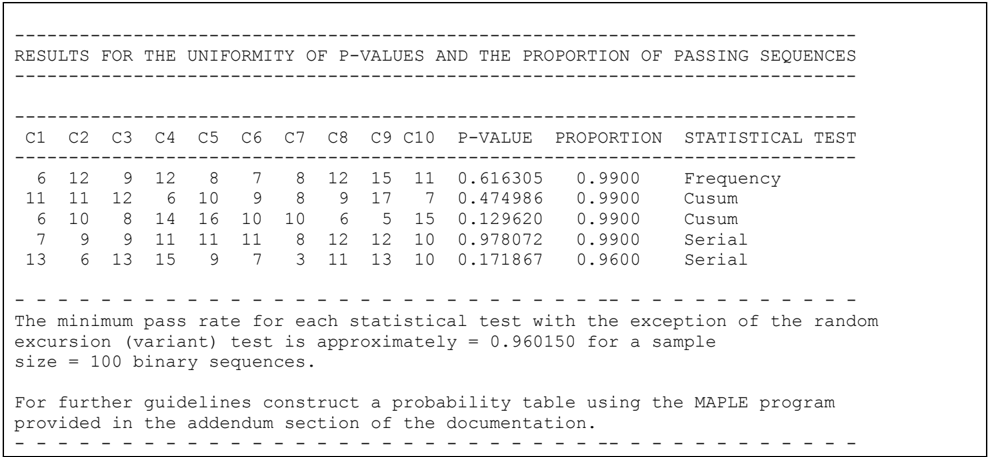
“The minimum pass rate for each statistical test with the exception of the random excursion (variant) test is approximately = 8 for a sample size = 10 binary sequences [4].”
BackgroundMethodInfluentialPSEUDO RANDOM NUMBER GENERATION USING EYE BRIGHTNESS RESPONSE
Sivakumar, T., & Anusha, T. (2018) · ICTACT Journal on Communication Technology · doi:10.21917/ijct.2018.0259 · Cited by 1
“(6) give the formula to compute and verify the runs test [14].”
BackgroundA Hypothesis Testing Approach to Sharing Logs with Confidence
Long, Y., Xu, L., & Gunter, C. A. (2020) · ACM Conference on Data and Application Security and Privacy (CODASPY) · doi:10.1145/3374664.3375743 · Cited by 2
“Similar to a randomness test suite [34], an indistinguishability test suite consists of multiple tests that cover different aspects of a log file.”
BackgroundMethodInfluentialIn-situ Extraction of Randomness from Computer Architecture Through Hardware Performance Counters
Alam, M., Singh, A., Bhattacharya, S., Pratihar, K., & Mukhopadhyay, D. (2020) · Lecture notes in computer science · doi:10.1007/978-3-030-42068-0_1 · Cited by 1
A Novel Secure and Robust Encryption Scheme for Medical Images
Chirakkarottu, S., & Mathew, S. (2020) · Current Medical Imaging Formerly Current Medical Imaging Reviews · doi:10.2174/1573405616666200425215702 · Cited by 1
Design Random Number Generator Utilizing The Futoshiki Puzzle.
Mahmood, A. S. (2019) · J. Inf. Hiding Multim. Signal Process. · Cited by 1
Statistical Testing of Randomness
Ryabko, B. Y. (2020) · International Symposium on Information Theory and its Applications · Cited by 1
SecretStore: A Secrecy as a Service model to enable the Cloud Storage to store user's secret data
Patgiri, R., Borah, M. D., & Singh, L. D. (2021) · Asia-Pacific Conference on Communications (APCC) · doi:10.1109/apcc49754.2021.9609895 · Cited by 1
“For instance, the size of the alphabet and symbol array can be 11 , 13 , 17 , 19 , and 23 , but both the array’s size should not be equal.”
BackgroundMatos-Rodríguez, Y., Madarro-Capó, E. J., Legón-Pérez, C. M., et al. (2021) · Theoretical Computer Science · doi:10.1016/j.tcs.2021.12.006 · Cited by 1
Monolithic Implementation of Chaos Modulated VCO-based Random Number Generator
Gungor, O. F., & Ergün, S. (2021) · IEEE Asia Pacific Conference on Circuits and Systems (APCCAS) · doi:10.1109/apccas51387.2021.9687782 · Cited by 1
Codesign for Generation of Large Random Sequences on Zynq FPGA
Hernández-Morales, B. M., Díaz-Santiago, S., & Mancillas-López, C. (2022) · IEEE Embedded Systems Letters · doi:10.1109/les.2022.3184653 · Cited by 1
“In the case of cryptography, these numbers or bit strings are required to be sufficiently random (validated through the various National Institute of Standards and Technology (NIST) tests [2]) to maintain the integrity of the cryptographic primitives.”
BackgroundAn Entropy Source based on the Bluetooth Received Signal Strength Indicator
Giron, A. A., & Custódio, R. F. (2020) · doi:10.5753/sbseg.2020.19231 · Cited by 1
“This proportion is defined as the number of binary sequences that passed over the total number of sequences [Bassham et al. 2010].”
BackgroundMethodInfluentialHybrid encryption technique: Integrating the neural network with distortion techniques
Zitar, R. A., & Al-Muhammed, M. J. (2022) · PLoS ONE · doi:10.1371/journal.pone.0274947 · Cited by 3
“The most effective randomness tests for encryption techniques are those created by the National Institute for Standards and Technology—NIST [54, 55].”
BackgroundMethodInfluentialsymKrypt: A Lightweight Symmetric-Key Cryptography for Diverse Applications
Patgiri, R. (2022) · Studies in computational intelligence · doi:10.1007/978-3-031-12127-2_1 · Cited by 1
Novel Innovations that Failed to Improve Weak PRNGs
Williams, B., Carlson, A. H., & Hiromoto, R. E. (2022) · International Conference on Computing, Communication and Networking Technologies (ICCCNT) · doi:10.1109/icccnt54827.2022.9984517 · Cited by 1
“Dieharder combines many of the original Diehard tests [4], some of the NIST tests [5], and a number of other tests.”
BackgroundAnalysis of Partially Deterministic Waveforms in Noise Radar Applications
Stove, A., Lukin, K. A., & Orlenko, V. M. (2022) · International Radar Symposium · doi:10.23919/irs54158.2022.9904992 · Cited by 1
A Novel Cross-Platform Physically Unclonable Function for Emerging FPGA-based IoT Devices
Das, D., Roy, S., Mahalat, M. H., et al. (2022) · Asian Hardware Oriented Security and Trust Symposium (AsianHOST) · doi:10.1109/asianhost56390.2022.10022185 · Cited by 1
GPS-free synchronized pseudo-random number generators for internet-of-things
Rahman, M., & Chakrabartty, S. (2023) · Frontiers in Computer Science · doi:10.3389/fcomp.2023.1157629 · Cited by 1
ERÖZ, E., Tanyıldızı, E., & Özkaynak, F. (2023) · International Conference on Computational Intelligence and Knowledge Economy (ICCIKE) · doi:10.1109/iccike58312.2023.10131768 · Cited by 1
Physical Unclonable Functions (PUFs)
Tehranipoor, M. M., Anandakumar, N. N., & Farahmandi, F. (2023) · Springer eBooks · doi:10.1007/978-3-031-31034-8_1 · Cited by 1
Performance Analysis of Encryption Capabilities of ARM-based Single Board Microcomputers
Répás, R. S. (2023) · Híradástechnika/Infocommunications journal · doi:10.36244/icj.2023.2.6 · Cited by 1
Klement, F., Takebuchi, S., Arul, T., et al. (2023) · International Conference on Wireless and Mobile Computing, Networking and Communications (WiMob) · doi:10.1109/wimob58348.2023.10187881 · Cited by 1
“As our decision rule, we adopt the 1% level specified by the NIST in [17], wherein a significance level of α = 0.”
MethodPerformance evaluation of TRNG based on Ring Oscillators implemented on FPGA
Matos, G., Correia, P., Rocha, J., Casaleiro, J. C. F. D. A., & Oliveira, L. B. (2023) · International Young Engineers Forum (YEF-ECE) · doi:10.1109/yef-ece58420.2023.10209326 · Cited by 3
FPGA-based tunable Keccak core
Maache, A., & Kalache, A. (2023) · International Conference on Smart Applications, Communications and Networking (SmartNets) · doi:10.1109/smartnets58706.2023.10215714 · Cited by 1
“For consistency and simplicity, the general nature NIST statistical test suite are used to assess the randomness of the generated random sequence [6].”
MethodSandomirskii, M., Ponkratova, E. Y., Petrova, E. A., Kustov, P., Larin, A. O., Игоревич, А. Э., & Zuev, D. A. (2023) · IEEE International Conference on Nanotechnology (IEEE-NANO) · doi:10.1109/nano58406.2023.10231269 · Cited by 1
Design of an Advanced System-on-Chip Architecture for Chaotic Image Encryption
Lima, A. M., Nardo, L. G., Nepomuceno, E. G., Arias-García, J., & Yudi, J. (2023) · Symposium on Integrated Circuits and Systems Design · doi:10.1109/sbcci60457.2023.10261963 · Cited by 2
“Then, using the NIST test suite [15], from a keystream length of 1000000 bits and a significance level α = 0 .”
MethodKılıç, H. (2023) · Gazi Üniversitesi Mühendislik-Mimarlık Fakültesi Dergisi · doi:10.17341/gazimmfd.989265 · Cited by 3
Let’s shake on it: Extracting secure shared keys from Wi-Fi CSI
Avrahami, T., Amrani, O., & Wool, A. (2023) · IEEE International Conference on Mobile Ad-Hoc and Smart Systems (MASS) · doi:10.1109/mass58611.2023.00065 · Cited by 1
“Note that it is not informative to run empirical tests of randomness such as the NIST test suite [12] on the resulting PSK: such tests would only measure the effectiveness of the cryptographic hash function—the output of a good hash function like SHA-256 will always pass all such tests, regardless…”
BackgroundLượng, T. T. (2023) · International Conference on Knowledge and Systems Engineering/Proceedings · doi:10.1109/kse59128.2023.10299470 · Cited by 1
“In this section, we perform an evaluation of the NIST statistical criteria [25] of the dynamic AES block cipher.”
MethodHardware Embedded Encryption System based on Programmable Cellular Automata
Stănică, G. C., Anghelescu, P., & Stănică, Ş. O. (2023) · CAS proceedings · doi:10.1109/cas59036.2023.10303686 · Cited by 1
Chaos-based Stream Cipher for Embedded Systems
Quang, T., Anh, T. T. V., Quyen, N. X., et al. (2023) · International Conference on Advanced Technologies for Communications · doi:10.1109/atc58710.2023.10318882 · Cited by 1
“The statistical test produced to evaluate the randomness of the binary key streams is the NIST SP800-22 [22] as known as the most effective standard for investigating the Pseudo Random Number Generator.”
MethodZhang, M.-M., Raghunath, A. S., Zhao, A., & Eral, H. B. (2023) · Heliyon · doi:10.1016/j.heliyon.2023.e22895 · Cited by 1
“For the first level of testing, the 𝛼 value is set to 0.01, whereas for the second level, it is set to 0.0001, as per the NIST guidelines [53].”
MethodInfluentialPseudorandom Number Generator Based on Two-Dimensional Improved Modular Chaotic Map
Wong, K.-W., Yap, W., Goi, B., & Wong, D. C.-K. (2023) · International Conference on Computer Technologies (ICCTech) · doi:10.1109/icctech57499.2023.00011 · Cited by 1
A Hardware Validation Framework for a Networked Dynamic Multi-factor Security Protocol
Lee, C., Scott, K. R., Khatri, S. P., & Ghrayeb, A. (2023) · International Conference on Advanced Communication Technologies and Networking (CommNet) · doi:10.1109/commnet60167.2023.10365286 · Cited by 1
“This HWRNG is a TRNG and has been verified to provide high-quality randomness characteristic [17] based on experiments conducted using the NIST test suite [18].”
MethodMoy, C., Dimoulas, C., & Felleisen, M. (2024) · Proceedings of the ACM on Programming Languages · doi:10.1145/3632930 · Cited by 5
“According to p_gen_c_v2 , the p_gen function is responsible only for ensuring that its code does not perform forbidden effects directly, or indirectly by calling other functions.”
BackgroundCrypto-Coding Scheme via Dynamic Interleaver for New Communication Standards
Lopresti, R. E., Moreira, J. C., & Micco, L. D. (2024) · IEEE Embedded Systems Letters · doi:10.1109/les.2024.3371371 · Cited by 1
Mavkov, D. A., Sibgatullin, M. E., Gilyazov, L. R., et al. (2023) · Russian Microelectronics · doi:10.1134/s106373972360070x · Cited by 1
MRMM-Based Keystream Generators for Information Security
Bishoi, S. K., & Matyáš, V. (2024) · Springer tracts in electrical and electronics engineering · doi:10.1007/978-981-97-0407-1_9 · Cited by 2
Pseudo Random Number Generators Employing Three Numerical Solvers of Chaotic Generators
Yacoub, M. H., Sharobim, B. K., Fetteha, M. A., et al. (2023) · International Japan-Africa Conference on Electronics, Communications, and Computations (JAC-ECC) · doi:10.1109/jac-ecc61002.2023.10479604 · Cited by 1
“National Institute of Standards and Technology (NIST) SP-800-22 statistical test suite is a group of tests that are widely used in literature to assess the randomness of the produced bits from PRNGs used in cryptographic applications [15].”
BackgroundAnalysis of cryptographic authentication and manipulation detection methods for big data
Havrylova, A. (2024) · Modern information security · doi:10.31673/2409-7292.2024.010011 · Cited by 1
Software and hardware realizations for different designs of chaos-based secret image sharing systems
Sharobim, B. K., Hosam, M., Abd–El–Hafiz, S. K., et al. (2024) · Journal of Real-Time Image Processing · doi:10.1007/s11554-024-01450-8 · Cited by 1
Double Visual Cryptography Using Generalized Tent Map, Rotation, and Image Filtering
Sharobim, B. K., Abd–El–Hafiz, S. K., & Radwan, A. G. (2023) · International Conference on Engineering and Emerging Technologies (ICEET) · doi:10.1109/iceet60227.2023.10525829 · Cited by 1
“The National Institute of Standards and Technology (NIST) SP-800-22 statistical test suite is a group of fifteen tests widely used to test the randomness [21].”
MethodHolubnychiy, D. Y., Kandii, S., Yesina, M. V., & Gorbenko, D. Y. (2024) · Radiotekhnika · doi:10.30837/rt.2024.1.216.02 · Cited by 1
Kovalchuk, L., Koriakov, I. V., & Bespalov, O. Y. (2024) · Èlektronnoe modelirovanie · doi:10.15407/emodel.46.03.022 · Cited by 2
STATISTICAL PROPERTIES OF THE PSEUDORANDOM SEQUENCE GENERATION ALGORITHM
Хомпыш, А., Algazy, K. T., Kapalova, N. A., Sakan, K., & Dyusenbayev, D. (2024) · Scientific Journal of Astana IT University · doi:10.37943/18lycw2723 · Cited by 1
An Improved Implementation of Rip van Winkle Cipher Using Satellite TV Broadcast Transmissions
Matić, L., Draženović, K., Šunde, V., & Ban, Ž. (2024) · IEEE Access · doi:10.1109/access.2024.3460048 · Cited by 1
A Variation-Aware and Energy-Efficient Spintronic True Random Number Generator
Mehri, S., Amirany, A., Nasab, M. T., et al. (2024) · IEEE Computer Society Annual Symposium on VLSI · doi:10.1109/isvlsi61997.2024.00153 · Cited by 1
“To assess the quality and reliability of the generated random bits, the National Institute of Standards and Technology (NIST) statistical tests [18] are executed, serving as a benchmark for assessing the randomness of generated sequences.”
MethodInfluentialEnhancing Cryptographic Security through Recurrent Neural Networks
Maram, B., Mandale, A., Pilli, R., Sharma, N., Gutla, J. K., & Babu, G. C. (2024) · International Conference on Smart Electronics and Communication (ICOSEC) · doi:10.1109/icosec61587.2024.10722049 · Cited by 1
“In contrast, the RNN model reduced the time required for cryptanalysis by approximately 40%, to its ability to learn and predict patterns without the need for exhaustive searching [21].”
BackgroundBelazi, A., & Migallón, H. (2024) · Mathematics · doi:10.3390/math12223602 · Cited by 6
Performance Analysis for RC6 and PRESENT Encryption Algorithms in Cloud Environment
Salman, D. S., & Ali, H. H. (2024) · Journal of Al-Qadisiyah for Computer Science and Mathematics · doi:10.29304/jqcsm.2024.16.41775 · Cited by 1
“It is essential to ascertain that encryption methods comply with these protocols to maintain strong data security [4],[5].”
Optimality Gap of Decentralized Submodular Maximization under Probabilistic Communication
Vendrell, J., & Kia, S. S. (2024) · Proceedings of the IEEE Conference on Decision & Control, including the Symposium on Adaptive Processes · doi:10.1109/cdc56724.2024.10886660 · Cited by 1
Random Number Generation from Image Data and LFSR
Ichikawa, S. (2025) · IEEJ Transactions on Industry Applications · doi:10.1541/ieejias.145.192 · Cited by 1
Kim, H., Jee, D., & Lee, J. (2025) · Electronics Letters · doi:10.1049/ell2.70357 · Cited by 1
Self-Destructible 3-nm Pre-Amplifier Physical Unclonable Function With “Zero” Bit Error Rate
Hunt-Schroeder, E., Degada, A., & Xia, T. (2025) · IEEE Transactions on Circuits and Systems I Regular Papers · doi:10.1109/tcsi.2025.3593193 · Cited by 1
Enhanced cryptosystem for resource-constrained devices with streamlined randomness analysis
Kumar, K. J. J., Bhuvaneshwari, A. J., & Kaythry, P. (2025) · Cogent Engineering · doi:10.1080/23311916.2025.2565364 · Cited by 2
UWBKey: Using Contrastive Learning for Efficient Secure Key Generation in UWB
Chen, H., & Dhekne, A. (2025) · Proceedings of the ACM on Interactive Mobile Wearable and Ubiquitous Technologies · doi:10.1145/3770630 · Cited by 2
“We further test the randomness of the binary keys generated in the unseen environments using the NIST Statistical Testing Suite for Random Number Generator [6], which is the standard toolbox for evaluating the quality of random number generators.”
Exploiting Read Noise of Filamentary VCM ReRAM for Robust TRNG
Schnieders, K., Bai, P., Wang, Y., Kempen, T., Sarantopoulos, A., Wouters, D., Rana, V., Dittmann, R., Waser, R. M., Menzel, S., et al. (2025) · IEEE Transactions on Electron Devices · doi:10.1109/ted.2025.3611916
An improvement of a cryptanalysis algorithm
Benamara, O., Merazka, F., & Betina, K. (2015) · Information Processing Letters · doi:10.1016/j.ipl.2015.08.002 · Cited by 1
Biomimetic Metamorphic Framework for Security in Resource-Constrained Wireless Networks
Sampangi, R. V. (2015) · Cited by 1
Pseudorandom Sequences in Spread-Spectrum Communications Generated by Cellular Automata
Ordaz‐Salazar, F. C., González-Salas, J. S., Campos-Cantón, E., & Rosu, H. C. (2012) · Journal of Applied Research and Technology · doi:10.22201/icat.16656423.2012.10.5.373 · Cited by 1
Parallel implementation of the matrix rank test for randomness assessment
Marton, K., Baja, V., & Suciu, A. (2014) · IEEE International Conference on Intelligent Computer Communication and Processing (ICCP) · doi:10.1109/iccp.2014.6937015 · Cited by 1
“EXPERIMENTAL RESULTS In order to benchmark the enhanced and parallel version of the Binary Matrix Rank Test we turned to comparatively evaluate the original NIST STS implementation of the test, and the improved sequential and parallel versions with input sequences of different sizes and several matrix dimensions.”
MethodResultInfluentialHardware implementation of a secure random number generator
Jin-ping, L., Shan, J., Wang, L., & Chen, M. (2014) · IEEE International Conference on Electronics, Circuits and Systems (ICECS) · doi:10.1109/icecs.2014.7049910 · Cited by 1
Detection of Encrypted Data Based on Support Vector Data Description
Meng, J., Zhou, Y., & Pan, Z. (2013) · International Conference on Advanced Cloud and Big Data · doi:10.1109/cbd.2013.17 · Cited by 1
“Each module functions as follows: 1) NIST Randomness test: According to NIST SP800-22 standard[8], randomness test includes a total of 15 kinds of tests.”
MethodAnalysis of Randomness of Runs and Its Application for Statistical Tests
Dakhilalian, M., Jazi, E. M., & Taghiyar, M. J. (2009) · Cited by 1
Zhang, H., Hou, R., Yi, L., et al. (2016) · Proceedings of SPIE, the International Society for Optical Engineering/Proceedings of SPIE · doi:10.1117/12.2242369 · Cited by 1
“[8] Rukhin, Andrew, Juan Soto, James Nechvatal, Miles Smid, and Elaine Barker.”
BackgroundSynchronous multi-signal acquisition for WBSNs using gold-code based joint-compressive sensing
Rahimi, A. A., Carreira, L. B., & Gupta, S. (2016) · IEEE Biomedical Circuits and Systems Conference (BioCAS) · doi:10.1109/biocas.2016.7833775 · Cited by 1
Metadata
- Authors
- Bassham, L. E., Rukhin, A. L., Soto, J., Nechvatal, J. R., Smid, M. E., Barker, E. B., Leigh, S. D., Levenson, M., Vangel, M., Banks, D. L., Heckert, N. A., Dray, J. F., & Vo, S.
- Affiliations
- National Institute of Standards and Technology (US)
- Venue
- NIST Special Publication 800-22 Revision 1a
- Published
- 2010
- OpenAlex
- W1517403092
- Semantic Scholar
- 961fc0f6c68303cde94a28fdb24e6eaf3ef040b4
- Cited by
- 3,617
- References
- 34
- Citations by year
- 2026: 128 · 2025: 205 · 2024: 192 · 2023: 208 · 2022: 166 · 2021: 291 · 2020: 290 · 2019: 250 · 2018: 254 · 2017: 207 · 2016: 183 · 2015: 184 · 2014: 201 · 2013: 155 · 2012: 139
- Type
- report
- Language
- en
- Open access
- gold
- doi.org
- Topics
- Physical Sciences › Computer Science › Artificial Intelligence › Cryptographic Implementations and Security
- Physical Sciences › Mathematics › Discrete Mathematics and Combinatorics › Coding theory and cryptography
- Physical Sciences › Computer Science › Computer Vision and Pattern Recognition › Chaos-based Image/Signal Encryption
- Keywords
- random number generators, pseudorandom number generators, cryptographic randomness, NIST SP 800-22, randomness testing
About these checks
Registry, retraction, Cites and statistics results are computed, not judged, with one exception: a printed reference that no index lists is read once by a model before it counts as a citation error. Claims are extracted by a model and kept only when their quote appears verbatim in the text; each cited source is then checked, with a model’s help, for whether it says what the claim relies on. Those verdicts can be wrong — read the claim’s quote and the cited source before relying on one.
A language model drew the claims from the paper on 2026-09-27 (prompt extract-v2).
Statistics and arithmetic are recomputed, not judged.
Confidence bands are shown only for fields calibrated on our annotated test set. None is calibrated yet, so no band is shown.
What counts as a claim ›How we measure confidence ›How we check this ›
Are you an author, or do you see a problem with this page? Request a review
Data sources
Bibliographic data: Semantic Scholar, OpenAlex, Crossref.
Contains information from the Semantic Scholar Academic Graph Datasets, made available under the ODC Attribution License (ODC-BY 1.0).
Semantic Scholar’s data is described in: Kinney, R., et al. (2023). The Semantic Scholar Open Data Platform. arXiv:2301.10140.
