

The DOI matches its Crossref record; 24 of the 24 references it cites were found in a registry or an index; none of the 20 sources its claims cite is checked for support yet.
Recommendation for the Entropy Sources Used for Random Bit Generation
Open accessAbstract
Reports on Computer Systems TechnologyThe Information Technology Laboratory (ITL) at the National Institute of Standards and Technology (NIST) promotes the U.S. economy and public welfare by providing technical leadership for the Nation's measurement and standards infrastructure.ITL develops tests, test methods, reference data, proof of concept implementations, and technical analyses to advance the development and productive use of information technology.ITL's responsibilities include the development of management, administrative, technical, and physical standards and guidelines for the cost-effective security and privacy of other than national security-related information in Federal information systems.The Special Publication 800-series reports on ITL's research, guidelines, and outreach efforts in information system security, and its collaborative activities with industry, government, and academic organizations.
Overview
CoChat Summary
TL;DR
NIST SP 800-90B specifies design principles, requirements, and validation tests for entropy sources used by Random Bit Generators, including health tests, IID testing, and min-entropy estimators. It defines separate IID and non-IID validation tracks and provides approved continuous health tests and entropy estimation methods.
Key findings
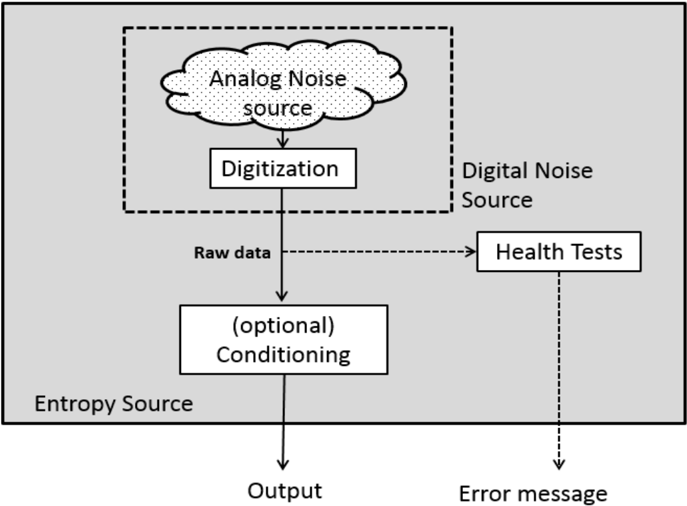
- The entropy source model consists of a noise source, an optional conditioning component, and health tests; validation requires at least 1,000,000 sequential noise-source samples, and restart tests use 1000 restarts × 1000 consecutive samples in a 1000×1000 matrix.
- Two approved continuous health tests are specified: the Repetition Count test and the Adaptive Proportion test; the recommended false positive probability is between 2^-20 and 2^-40, startup tests run continuous tests over at least 1024 consecutive samples, and for α = 2^-20 and H = 2.0 bits per sample the Repetition Count cutoff is C = 11.
- The IID track uses the Most Common Value estimate; the non-IID track requires taking the minimum of ten estimators: Most Common Value, Collision, Markov, Compression, t-Tuple, Longest Repeated Substring, Multi Most Common in Window, Lag, MultiMMC, and LZ78Y; Collision, Markov, and Compression are applied only to binary inputs.
- IID testing uses permutation testing with 10,000 permutations plus chi-square tests, with type I error 0.001; vetted conditioning components include HMAC, CMAC, CBC-MAC, approved hash functions, Hash_df, and Block_Cipher_df.
Methods
- Design and validation framework: entropy source validation is performed by an NVLAP-accredited laboratory with CAVP/CMVP review, based on documentation, data collection, restart tests, and conditioning-component entropy assessment.
- Statistical analysis: IID assumption is tested via permutation and chi-square procedures; entropy is estimated using the IID Most Common Value estimate or the non-IID battery of ten estimators; health testing uses the Repetition Count and Adaptive Proportion tests or developer-defined alternatives.
- Data and sample requirements: a sequential dataset of at least 1,000,000 samples is required, a conditioned sequential dataset of at least 1,000,000 outputs is required for non-vetted conditioning components, restart data form a 1000×1000 matrix, and alphabets larger than 256 symbols are reduced to at most 256 symbols.
Limitations
- Stated: the testing approach assumes the developer understands the behavior of the randomness source and has made a good-faith effort to produce a suitable entropy source; the entropy estimation methods rely on statistical assumptions that may not hold for all noise sources and should not replace in-depth analysis.
- Stated: continuous health tests are resource-constrained and usually detect only gross failures; the Repetition Count test detects only catastrophic failures, and continuous tests may allow poor entropy outputs before an alarm is signaled.
- Evident from the text: this is a recommendation/specification rather than an empirical study, and validation depends on submitter documentation and laboratory testing; some requirements may be out-of-scope for CAVP or CMVP validation testing.
Model-written summary. Check it against the paper before relying on it.
Integrity signals
Registry
Cites
Statistics
Figures


Verification
Claims the paper makes
0 Valid · 2 Not valid · 15 Not checked · 96 Own results and interpretations
A result the paper states — it cites no source for it, so there is none to check. The quote shows it is in the paper.
In the paper
“For example, a noise source evaluated at eight bits of min-entropy per sample has a cutoff value of six repetitions to ensure a false-positive rate of approximately once per 10 12 samples generated.”
plainstates a cause- Asserted: passes — The authors put it forward as true.
- Checkable: passes — It can be checked against evidence.
- Load-bearing: unclear — It is unclear whether the paper’s conclusions depend on it.
- Based: passes — The paper gives a reason why it holds.
A result the paper states — it cites no source for it, so there is none to check. The quote shows it is in the paper.
In the paper
“If that noise source somehow failed to the point that each sample had a 1/16 probability of being the same as the previous sample, so that it was providing only four bits of min-entropy per sample, it would still be expected to take about one million samples before the repetition count test would notice the problem.”
hedgedstates a cause- Asserted: passes — The authors put it forward as true.
- Checkable: passes — It can be checked against evidence.
- Load-bearing: unclear — It is unclear whether the paper’s conclusions depend on it.
- Based: passes — The paper gives a reason why it holds.
In the paper
“While the estimators (except for the Markov) were originally designed for application to independent outputs, the tests have performed well when applied to data with dependencies.”
What the sources say
- Not matchedcites [HD12]
Couldn’t be matched to a paper in Crossref, so it can’t be checked.
boosted- Asserted: passes — The authors put it forward as true.
- Checkable: passes — It can be checked against evidence.
- Load-bearing: unclear — It is unclear whether the paper’s conclusions depend on it.
- Based: passes — The paper gives a reason why it holds.
- Not matched
A conclusion the paper draws from its own results — it cites no other source for it, so there is none to check. The quote shows it is in the paper.
In the paper
“However, the conditioning component may reduce the entropy of the output.”
hedgedstates a possible cause- Asserted: passes — The authors put it forward as true.
- Checkable: passes — It can be checked against evidence.
- Load-bearing: passes — The paper’s conclusions depend on it.
- Based: passes — The paper gives a reason why it holds.
A conclusion the paper draws from its own results — it cites no other source for it, so there is none to check. The quote shows it is in the paper.
In the paper
“The entropy estimate of a noise source, calculated from a single, long-output sequence, might provide an overestimate if the noise source generates correlated sequences after restarts.”
hedgedstates a possible cause- Asserted: passes — The authors put it forward as true.
- Checkable: passes — It can be checked against evidence.
- Load-bearing: passes — The paper’s conclusions depend on it.
- Based: passes — The paper gives a reason why it holds.
35 more claims
Create a free account to see all 113 claims and every source verdict.
- Probably not a substantial claim. 60
- It may state two separate claims as one. 23
Self-check
Percentages, sums and reported differences re-computed from the paper’s own numbers.
Each contradiction between two passages listed here was confirmed by an independent check.
Rated minor: it would not touch a result — a value no result rests on, a p-value that stays on the same side of the significance level, or a conflict that is clerical, resolved elsewhere in the paper, or outside its own findings.
In the paper
§ 6.3.1 The Most Common Value Estimate
“𝑝𝑝 𝑢𝑢 = 0.4 + 2.576 √ 0.012 = 0.6895.”
§ 6.3.1 The Most Common Value Estimate
“The min-entropy estimate is -log2 (0.6822) = 0.5363.”
Citations
Cites
A tutorial on hidden Markov models and selected applications in speech recognition
Rabiner, L. R. (1989) · Proceedings of the IEEE · doi:10.1109/5.18626 · Cited by 22,743
Bellman, R. E. (2010) · doi:10.1515/9781400835386 · Cited by 14,588
Prediction and Entropy of Printed English
Shannon, C. E. (1951) · Bell System Technical Journal · doi:10.1002/j.1538-7305.1951.tb01366.x · Cited by 2,686
Data Compression: The Complete Reference
(2009) · Kybernetes · doi:10.1108/k.2009.06738eae.001 · Cited by 1,591
An Introduction to Probability Theory and its Applications.
Kendall, D. G., & Feller, W. (1951) · Journal of the Royal Statistical Society. Series A (General) · doi:10.2307/2980979 · Cited by 1,283
SHA-3 standard: permutation-based hash and extendable-output functions
National Institute of Standards and Technology (US) (2015) · doi:10.6028/nist.fips.202 · Cited by 783
Advanced Encryption Standard (AES)
National Institute of Standards and Technology (US) (2001) · doi:10.6028/nist.fips.197 · Cited by 642
“Balls into Bins” — A Simple and Tight Analysis
Raab, M., & Steger, A. (1998) · Lecture Notes in Computer Science · doi:10.1007/3-540-49543-6_13 · Cited by 455
Recommendation for Key Management Part 1: General
Barker, E. (2016) · doi:10.6028/nist.sp.800-57pt1r4 · Cited by 396
Self-citationNational Institute of Standards and Technology (US) (2015) · doi:10.6028/nist.fips.180-4 · Cited by 350
Cited by
Quantum random number generators
Herrero-Collantes, M., & Garcia-Escartin, J. C. (2017) · Reviews of Modern Physics · doi:10.1103/revmodphys.89.015004 · Cited by 791
“Other approaches to CSPRNGs use cryptographic protocols such as DES or AES as blocks that transform a string of bits using as their secret key a processed seed from the computer’s entropy pool.”
BackgroundMethodInfluentialMcGrath, T., Bagci, I. E., Wang, Z. M., Roedig, U., & Young, R. J. (2019) · Applied Physics Reviews · doi:10.1063/1.5079407 · Cited by 353
“Since the PUF can be considered as the generation and then permanent storage of a randomly generated key, pre-existing work on the standardisation of dedicated random number generators 98 may be a useful source to help define these areas.”
BackgroundRecommendation for Random Number Generation Using Deterministic Random Bit Generators
Barker, E. B., & Kelsey, J. M. (2015) · doi:10.6028/nist.sp.800-90ar1 · Cited by 304
Self-citationModule-Lattice-Based Key-Encapsulation Mechanism Standard
National Institute of Standards and Technology (US) (2024) · doi:10.6028/nist.fips.203 · Cited by 268
Recommendation for key management: part 1 - general
Barker, E. (2020) · doi:10.6028/nist.sp.800-57pt1r5 · Cited by 271
Self-citationAuthenticated Key Exchange from Ideal Lattices
Zhang, J., Zhang, Z., Ding, J., Snook, M., & Dagdelen, Ö. (2015) · Lecture Notes in Computer Science · doi:10.1007/978-3-662-46803-6_24 · Cited by 177
Stateless Hash-Based Digital Signature Standard
National Institute of Standards and Technology (US) (2024) · doi:10.6028/nist.fips.205 · Cited by 131
Machine Learning Based File Entropy Analysis for Ransomware Detection in Backup Systems
Lee, K., Lee, S., & Yim, K. (2019) · IEEE Access · doi:10.1109/access.2019.2931136 · Cited by 139
Mannalath, V., Mishra, S., & Pathak, A. (2023) · Quantum Information Processing · doi:10.1007/s11128-023-04175-y · Cited by 125
“So, some form of testing system should be in place to verify the output sequence of the random number generator [171].”
BackgroundMathew, S. K., Johnston, D., Satpathy, S., Suresh, V., Newman, P., Anders, M. A., Kaul, H., Agarwal, A., Hsu, S. K., Chen, G., et al. (2016) · IEEE Journal of Solid-State Circuits · doi:10.1109/jssc.2016.2558490 · Cited by 102
“The Markov test from NIST SP800–90B [26] measures dependencies between consecutive μRNG outputs by estimating the min-entropy present in a given k-long chain of output bits.”
MethodHomodyne-based quantum random number generator at 2.9 Gbps secure against quantum side-information
Gehring, T., Lupo, C., Kordts, A., Nikolic, D. S., Jain, N., Rydberg, T., Pedersen, T. B., Pirandola, S., & Andersen, U. L. (2021) · Nature Communications · doi:10.1038/s41467-020-20813-w · Cited by 112
Recommendation for Stateful Hash-Based Signature Schemes
Cooper, D. A., Apon, D., Dang, Q. H., Davidson, M. S., Dworkin, M. J., & Miller, C. A. (2020) · doi:10.6028/nist.sp.800-208 · Cited by 206
Hardware Designs for Security in Ultra-Low-Power IoT Systems: An Overview and Survey
Yang, K., Blaauw, D. T., & Sylvester, D. (2017) · IEEE Micro · doi:10.1109/mm.2017.4241357 · Cited by 106
Module-Lattice-Based Key-Encapsulation Mechanism Standard
(2023) · doi:10.6028/nist.fips.203.ipd · Cited by 109
RetractedFPGA-based Physical Unclonable Functions: A comprehensive overview of theory and architectures
Anandakumar, N. N., Hashmi, M., & Tehranipoor, M. M. (2021) · Integration · doi:10.1016/j.vlsi.2021.06.001 · Cited by 87
Recommendation for pair-wise key establishment using integer factorization cryptography
Barker, E., Chen, L., Roginsky, A., Vassilev, A., Davis, R., & Simon, S. (2019) · doi:10.6028/nist.sp.800-56br2 · Cited by 81
Self-citationRecommendation for Key Management Part 3: Application-Specific Key Management Guidance
Barker, E. B., & Dang, Q. H. (2015) · doi:10.6028/nist.sp.800-57pt3r1 · Cited by 96
Self-citationModule-Lattice-Based Digital Signature Standard
(2023) · doi:10.6028/nist.fips.204.ipd · Cited by 90
RetractedIn-Memory Unified TRNG and Multi-Bit PUF for Ubiquitous Hardware Security
Taneja, S., Rajanna, V. K., & Alioto, M. (2021) · IEEE Journal of Solid-State Circuits · doi:10.1109/jssc.2021.3125255 · Cited by 78
True Random Number Generator Based on Fibonacci-Galois Ring Oscillators for FPGA
Nannipieri, P., Matteo, S. D., Baldanzi, L., Crocetti, L., Belli, J., Fanucci, L., & Saponara, S. (2021) · Applied Sciences · doi:10.3390/app11083330 · Cited by 78
“These tests are proposed and described in [29], while a test suite, based on these specifications, was provided by NIST itself and is openly available in [30].”
MethodA Unified PUF and TRNG Design Based on 40-nm RRAM With High Entropy and Robustness for IoT Security
Gao, B., Lin, B., Li, X., Tang, J., Qian, H., & Wu, H. (2022) · IEEE Transactions on Electron Devices · doi:10.1109/ted.2021.3138365 · Cited by 73
Grujić, M., & Verbauwhede, I. M. R. (2022) · IEEE Transactions on Circuits and Systems I Regular Papers · doi:10.1109/tcsi.2022.3158022 · Cited by 76
“To confirm the validity of the min-entropy estimations, we applied the entropy estimators from NIST SP 800-90B [3] on the raw random bit sequences obtained for 20 different values of t acc between 8 ns and 160 ns in steps of T CLK = 8 ns.”
BackgroundMethodInfluentialQuantum technologies in the telecommunications industry
Martin, V., Brito, J. P., Escribano, C., Menchetti, M., White, C., Lord, A., Wissel, F., Gunkel, M., Gavignet, P., Genay, N., et al. (2021) · EPJ Quantum Technology · doi:10.1140/epjqt/s40507-021-00108-9 · Cited by 83
“Similar approaches are being described in different domains, following NIST’s Entropy-as-a-Service architecture [58].”
ES-TRNG: A High-throughput, Low-area True Random Number Generator based on Edge Sampling
Yang, B., Rožić, V., Grujić, M., Mentens, N., & Verbauwhede, I. M. R. (2018) · IACR Transactions on Cryptographic Hardware and Embedded Systems · doi:10.46586/tches.v2018.i3.267-292 · Cited by 79
Recursive Self-Improvement Stability under Endogenous Yardstick DriftPreprint
Takahashi, K. (2026) · Zenodo (CERN European Organization for Nuclear Research) · doi:10.5281/zenodo.19044633 · Cited by 63
High-Throughput FPGA-Compatible TRNG Architecture Exploiting Multistimuli Metastable Cells
Sala, R. D., Bellizia, D., & Scotti, G. (2022) · IEEE Transactions on Circuits and Systems I Regular Papers · doi:10.1109/tcsi.2022.3199218 · Cited by 66
“5 as required by many cryptographic applications [25], [26], [27].”
BackgroundMethodChannel State Information-Based Cryptographic Key Generation for Intelligent Transportation Systems
Ribouh, S., Phan, K. H.-T., Malawade, A. V., Hillali, Y. E., Rivenq, A., & Faruque, M. A. A. (2020) · IEEE Transactions on Intelligent Transportation Systems · doi:10.1109/tits.2020.3003577 · Cited by 54
“From NIST recommendations [41] the entropy source model for NRBGs is shown in Figure 12.”
MethodGuideline for Using Cryptographic Standards in the Federal Government: Cryptographic Mechanisms
Barker, E. B. (2016) · doi:10.6028/nist.sp.800-175b · Cited by 66
Self-citationRecommendation for Random Bit Generator (RBG) Constructions
Barker, E. B., Kelsey, J. M., McKay, K. A., Roginsky, A. L., & Turan, M. S. (2022) · doi:10.6028/nist.sp.800-90c.3pd · Cited by 58
Self-citationRetractedMcKay, K. A., & Cooper, D. A. (2019) · doi:10.6028/nist.sp.800-52r2 · Cited by 94
Self-citationStateless Hash-Based Digital Signature Standard
(2023) · doi:10.6028/nist.fips.205.ipd · Cited by 58
RetractedPUF-Based Secure Chaotic Random Number Generator Design Methodology
Kalanadhabhatta, S., Kumar, D., Anumandla, K. K., et al. (2020) · IEEE Transactions on Very Large Scale Integration (VLSI) Systems · doi:10.1109/tvlsi.2020.2979269 · Cited by 51
Implementation of Efficient XOR Arbiter PUF on FPGA With Enhanced Uniqueness and Security
Anandakumar, N. N., Hashmi, M., & Chaudhary, M. A. (2022) · IEEE Access · doi:10.1109/access.2022.3228635 · Cited by 49
“This method is commonly used in the literature and is outlined in NIST-SP800-90B specification for estimating the min-entropy of a binary source [56].”
MethodZhang, R., Wang, X., Liu, K., & Shinohara, H. (2022) · IEEE Journal of Solid-State Circuits · doi:10.1109/jssc.2021.3137312 · Cited by 50
A High-Performance and Secure TRNG Based on Chaotic Cellular Automata Topology
Luo, Y., Wang, W., Best, S., Wang, Y., & Xu, X. (2020) · IEEE Transactions on Circuits and Systems I Regular Papers · doi:10.1109/tcsi.2020.3019030 · Cited by 51
“on the definition in [38], the random numbers generated by TRNG test chips are IID.”
BackgroundMethodInfluentialRandom Number Generators: Principles and Applications
Bikos, A. N., Nastou, P. E., Petroudis, G., & Stamatiou, Y. C. (2023) · Cryptography · doi:10.3390/cryptography7040054 · Cited by 40
NIST First Call for Multi-Party Threshold Schemes
Peralta, R., & Brandão, L. T. A. N. (2023) · doi:10.6028/nist.ir.8214c.ipd · Cited by 46
RetractedA memristor-based unified PUF and TRNG chip with a concealable ability for advanced edge security
Li, X., Lin, B., Gao, B., Lu, Y., Yang, S., Su, Z., Shen, T.-Y., Tang, J., Qian, H., & Wu, H. (2025) · Science Advances · doi:10.1126/sciadv.adr0112 · Cited by 46
Multiplexed Quantum Random Number Generation
Haylock, B., Peace, D., Lenzini, F., Weedbrook, C., & Lobino, M. (2019) · Quantum · doi:10.22331/q-2019-05-13-141 · Cited by 44
FPGA implementation of SRAM PUFs based cryptographically secure pseudo-random number generator
Chen, S., Li, B., & Zhou, C. (2018) · Microprocessors and Microsystems · doi:10.1016/j.micpro.2018.02.001 · Cited by 38
“Entropy is defined relative to one’s knowledge of a random variable prior to an observation, and reflects the uncertainty associated with predicting its value – the larger the entropy, the greater the uncertainty in predicting the value of an observation [19].”
BackgroundA Unified Multibit PUF and TRNG Based on Ring Oscillators for Secure IoT Devices
Baturone, I., Román, R., & Corbacho, Á. (2022) · IEEE Internet of Things Journal · doi:10.1109/jiot.2022.3224298 · Cited by 39
“An issue to consider in the design of the multibit-RO-PUF-TRNG proposed are the recommendations in [41], which state that the raw data (before any possible conditioning) provided by a TRNG should be tested to detect quickly and with a high probability any failure in the noise source.”
BackgroundMethodPhysical-Layer-Security Box: a concept for time-frequency channel-reciprocity key generation
Zoli, M., Barreto, A. N., Köpsell, S., Sen, P., & Fettweis, G. P. (2020) · EURASIP Journal on Wireless Communications and Networking · doi:10.1186/s13638-020-01712-6 · Cited by 45
Recommendation for cryptographic key generation
Barker, E. B., & Roginsky, A. L. (2019) · doi:10.6028/nist.sp.800-133r1 · Cited by 36
Self-citationDesign and Analysis of FPGA-based PUFs with Enhanced Performance for Hardware-oriented Security
Anandakumar, N. N., Hashmi, M., & Sanadhya, S. K. (2022) · ACM Journal on Emerging Technologies in Computing Systems · doi:10.1145/3517813 · Cited by 34
“The commonly used method in the literature to calculate this employs the method outlined in the NIST-SP800-90B [56] specification for evaluating the min-entropy (i.e., lower bound of entropy) of a binary source.”
MethodA fully CMOS true random number generator based on hidden attractor hyperchaotic system
Nguyen, N., Kaddoum, G., Pareschi, F., Rovatti, R., & Setti, G. (2020) · Nonlinear Dynamics · doi:10.1007/s11071-020-06017-3 · Cited by 33
Signal design and processing for noise radar
Galati, G., Pavan, G., & Wasserzier, C. (2022) · EURASIP Journal on Advances in Signal Processing · doi:10.1186/s13634-022-00884-1 · Cited by 32
Sala, R. D., & Scotti, G. (2023) · IEEE Access · doi:10.1109/access.2023.3304901 · Cited by 34
“This solution is effective and the obtained random sequence is able to pass National Institute of Standards and Technology (NIST) [73], [74] tests also under environmental variations.”
BackgroundMethodLightweight Hybrid Entropy Source True Random Number Generator Based on Jitter and Metastability
Yang, S., Liang, H., Hu, R., et al. (2024) · IEEE Transactions on Circuits & Systems II Express Briefs · doi:10.1109/tcsii.2024.3363015 · Cited by 30
“The quality of random number sequences is demonstrated in detail with the help of tools such as the randomness test suite published by the National Institute of Standards and Technology [10], [11], [12] and random digraphs.”
MethodIoT: Source of test challenges
Marinissen, E. J., Zorian, Y., Konijnenburg, M., Huang, C.-T., Hsieh, P.-H., Cockburn, P., Delvaux, J., Rožić, V., Yang, B., Singelée, D., et al. (2016) · IEEE European Test Symposium (ETS) · doi:10.1109/ets.2016.7519331 · Cited by 31
“According to NIST SP800-90B [26] and AIS31 [27] recommendations, online testing should be applied on the raw random numbers because statistical defects caused by faults and attacks can be masked by the post-processing algorithm, making the attack detection more difficult.”
MethodHagerstrom, A. M., Murphy, T. E., & Roy, R. (2015) · Proceedings of the National Academy of Sciences · doi:10.1073/pnas.1506600112 · Cited by 30
Hussain, S. U., Majzoobi, M., & Koushanfar, F. (2016) · IEEE Transactions on Multi-Scale Computing Systems · doi:10.1109/tmscs.2016.2519902 · Cited by 35
“IID Test The NIST recommended test for iid in [16] requires complex calculation and most importantly a large amount of data to be stored on chip.”
BackgroundMethodInfluentialDeep Learning-Based Security Verification for a Random Number Generator Using White Chaos
Cai, L., Zhang, J., Sang, L., Gong, L., Wang, L., Wang, A., & Wang, Y. (2020) · Entropy · doi:10.3390/e22101134 · Cited by 30
“= 1, … , k is described In NIST Special Publication 800-90B [42], the min-entropy of an independent discrete variable X that takes values from a set A = ( x 1 , x 2 , . . . as: log max = H p , , x k ) with probability Pr ( X = x i ) = p i , for i = 1, . . . , k is described as: = log 2 ( P b ) .”
BackgroundA Lightweight True Random Number Generator for Root of Trust Applications
Rajski, J., Trawka, M., Tyszer, J., & Włodarczak, B. (2023) · IEEE Transactions on Computer-Aided Design of Integrated Circuits and Systems · doi:10.1109/tcad.2023.3237957 · Cited by 36
“According to [62], all tests use a cutoff value of 5 in such a way that if C0 + C1 ≤ 5 or C1 + C2 ≤ 5, then a test fails.”
BackgroundMethodInfluentialPractical True Random Number Generator Using CMOS Image Sensor Dark Noise
Park, B. K., Park, H., Kim, Y., Kang, J.-S., Yeom, Y., Ye, C., Moon, S., & Han, S.-W. (2019) · IEEE Access · doi:10.1109/access.2019.2926825 · Cited by 29
“HMAC is the one of CMVP approved post-processing methods, also known as conditioning component [29].”
MethodOn the Analysis and Improvement of Min-Entropy Estimation on Time-Varying Data
Zhu, S., Ma, Y., Li, X., Yang, J., Lin, J., & Jing, J. (2019) · IEEE Transactions on Information Forensics and Security · doi:10.1109/tifs.2019.2947871 · Cited by 29
“The users can only get the outputs after post-processing such as hashing [4].”
BackgroundMethodInfluentialA 3.3-Gb/s SPAD-Based Quantum Random Number Generator
Keshavarzian, P., Ramu, K., Tang, D., Weill, C., Gramuglia, F., Tan, S. S., Tng, M., Lim, L., Quek, E. K.-B., Mandich, D., et al. (2023) · IEEE Journal of Solid-State Circuits · doi:10.1109/jssc.2023.3274692 · Cited by 37
“H∞, while the NIST SP 800 90-B [42] test is used to characterize min entropy of the final generated bit string (Section VI).”
MethodEntropy harvesting from physical sensors
Hennebert, C., Hossayni, H., & Lauradoux, C. (2013) · ACM Conference on Security and Privacy in Wireless and Mobile Networks (WiSec) · doi:10.1145/2462096.2462122 · Cited by 28
Robust, low-cost, auditable random number generation for embedded system security
Lampert, B., Wahby, R. S., Leonard, S., & Levis, P. (2016) · Proceedings of the 14th ACM Conference on Embedded Networked Sensor Systems CD-ROM · doi:10.1145/2994551.2994568 · Cited by 27
INTEGRATION OF HARDWARE SECURITY MODULES INTO A DEEPLY EMBEDDED TLS STACK
Kehret, O., Walz, A., & Sikora, A. (2016) · International Journal of Computing · doi:10.47839/ijc.15.1.827 · Cited by 27
“Hardware-based TRNGs [38], providing much more entropy compared to software solutions are a huge plus, as high-quality random numbers are required for basically every cryptographic algorithm used in TLS. Weak random numbers are often the reason of breaches in cryptographic protocols [39].”
BackgroundApplication of a MEMS-Based TRNG in a Chaotic Stream Cipher
Garcia-Bosque, M., Pérez-Resa, A., Sánchez‐Azqueta, C., & Celma, S. (2017) · Sensors · doi:10.3390/s17030646 · Cited by 27
“Further study is needed in order to determine the best solution for each application.”
BackgroundMethodEncryption by Heart (EbH)—Using ECG for time-invariant symmetric key generation
González‐Manzano, L., Fuentes, J. M. D., Lopez, P. P., & Cámara, C. (2017) · Future Generation Computer Systems · doi:10.1016/j.future.2017.07.018 · Cited by 27
“Second, the seed randomness, which is measured by minentropy [17].”
BackgroundA Fully Digital True Random Number Generator With Entropy Source Based in Frequency Collapse
Serrano, R., Duran, C., Hoang, T.-T., Sarmiento, M., Nguyen, K.-D., Tsukamoto, A., Suzaki, K., & Pham, C. (2021) · IEEE Access · doi:10.1109/access.2021.3099534 · Cited by 27
“First, the entropy source’s quality is evaluated using the estimators described in NIST SP800-90B [19].”
MethodAn Efficient and Reliable Chaos-Based IoT Security Core for UDP/IP Wireless Communication
Benkhaddra, I., Senouci, M. R., Senouci, A., Tanougast, C., Sadoudi, S., & Lei, H. (2022) · IEEE Access · doi:10.1109/access.2022.3173338 · Cited by 34
“Several sets of statistical tests exist in the literature; the best known are those of NIST SP800-22 [76], [77], DIEHARD [78], AIS20/31 [79]–[81], TestU01 [82], NIST SP800-90B [83], ENT [84], and FIPS 140-2.”
MethodMarangon, D. G., Smith, P. R., Walk, N., Paraïso, T. K., Dynes, J. F., Lovic, V., Sanzaro, M., Roger, T., Marco, I. D., Lucamarini, M., et al. (2024) · Nature Electronics · doi:10.1038/s41928-024-01140-0 · Cited by 28
Ni, T., Peng, Q., Bian, J., Yao, L., Huang, Z., Yan, A., Wang, S., & Wen, X. (2023) · IEEE Transactions on Circuits and Systems I Regular Papers · doi:10.1109/tcsi.2023.3287162 · Cited by 28
“…is below 0.01, it indicates that the random sequence is poorly The non-independent identical distribution test of the NIST SP800-90B test evaluates the randomness of the data by ten minimum entropy estimators and finally uses the smallest value among all estimators as the minimum entropy [22].”
MethodInfluentialTOTAL: TRNG On-the-fly Testing for Attack Detection using Lightweight Hardware
Yang, B., Rožić, V., Mentens, N., et al. (2016) · Design, Automation, and Test in Europe · doi:10.3850/9783981537079_0284 · Cited by 26
“If the maximal allowed error rate is once in a lifetime of the product (for example when a manual reset is required whenever an alarm signal is detected), as required by [13], then a robust test with very low error rate should be implemented.”
BackgroundSecuring Wireless Neurostimulators
Marin, E., Singelée, D., Yang, B., Volski, V. A., Vandenbosch, G. A. E., Nuttin, B., & Preneel, B. (2018) · ACM Conference on Data and Application Security and Privacy (CODASPY) · doi:10.1145/3176258.3176310 · Cited by 29
“Following the test suites from NIST 80090B [12], we estimated that the Shannon-entropy is around 0.”
MethodAn FPGA-Compatible TRNG with Ultra-High Throughput and Energy Efficiency
Lu, Z., Qidiao, H., Chen, Q., Liu, Z., & Zhang, J. (2023) · ACM/IEEE Design Automation Conference (DAC) · doi:10.1109/dac56929.2023.10247746 · Cited by 28
“The NIST SP800-90B test [15] is the most complex and rigorous standard among the entropy estimation tests.”
MethodA Compact TRNG Design for FPGA Based on the Metastability of RO-driven Shift Registers
Peng, Q., Bian, J., Huang, Z., Wang, S., & Yan, A. (2023) · ACM Transactions on Design Automation of Electronic Systems · doi:10.1145/3610295 · Cited by 26
“5 NIST SP 800-90B Test NIST SP 800-90B Test is a new random number test proposed by NIST that provides a standardized method for estimating the quality of entropy sources [29].”
MethodA Highly-Portable True Random Number Generator Based on Coherent Sampling
Peetermans, A., Rožić, V., & Verbauwhede, I. M. R. (2019) · International Conference on Field Programmable Logic and Applications (FPL) · doi:10.1109/fpl.2019.00041 · Cited by 24
“According to both standards [6], [8], an on-line testing module is a necessary requirement for certification and therefore increases the area usage of the other designs.”
BackgroundMethodInfluentialDynamic ransomware protection using deterministic random bit generator
Kim, H., Yoo, D., Kang, J.-S., & Yeom, Y. (2017) · 2017 IEEE Conference on Application, Information and Network Security (AINS) · doi:10.1109/ains.2017.8270426 · Cited by 24
“Microsoft’s Crypto API [7] supports public key and symmetric key encryptions and works with several Cryptographic Service Providers.”
BackgroundAn Analysis of NIST SP 800-90A
Woodage, J., & Shumow, D. (2019) · Lecture notes in computer science · doi:10.1007/978-3-030-17656-3_6 · Cited by 23
Improvement of Min-Entropy Evaluation Based on Pruning and Quantized Deep Neural Network
Li, H., Zhang, J., Li, Z., Liu, J., & Wang, Y. (2023) · IEEE Transactions on Information Forensics and Security · doi:10.1109/tifs.2023.3240859 · Cited by 26
“In this paper, we calculate the min-entropy based on the prediction results and compared it with several estimators in final version of 90B officially published in 2018 [28].”
BackgroundMethodASIC implementation of random number generators using SR latches and its evaluation
Torii, N., Kokubo, H., Yamamoto, D., Itoh, K., Takenaka, M., & Matsumoto, T. (2016) · EURASIP Journal on Information Security · doi:10.1186/s13635-016-0036-1 · Cited by 26
FPGA Based True Random Number Generators Using Non-Linear Feedback Ring Oscillators
Tao, S., Yu, Y., & Dubrova, E. (2018) · IEEE International New Circuits and Systems Conference (NEWCAS) · doi:10.1109/newcas.2018.8585569 · Cited by 25
A New Class of Digital Circuits for the Design of Entropy Sources in Programmable Logic
Addabbo, T., Fort, A., Moretti, R., Mugnaini, M., Takaloo, H., & Vignoli, V. (2020) · IEEE Transactions on Circuits and Systems I Regular Papers · doi:10.1109/tcsi.2020.2977920 · Cited by 23
Iterating Von Neumann's post-processing under hardware constraints
Rožić, V., Yang, B., Dehaene, W., & Verbauwhede, I. M. R. (2016) · IEEE International Symposium on Hardware Oriented Security and Trust (HOST) · doi:10.1109/hst.2016.7495553 · Cited by 21
“Special publication by the National institute of Standards and Technology (NIST) SP 800-90B [1] provides guidelines for TRNG design and evaluation.”
MethodRecommendation for Stateful Hash-Based Signature SchemesPreprint
Cooper, D. A. (2019) · doi:10.6028/nist.sp.800-208-draft · Cited by 25
Fully Synthesizable Unified True Random Number Generator and Cryptographic Core
Taneja, S., & Alioto, M. (2021) · IEEE Journal of Solid-State Circuits · doi:10.1109/jssc.2021.3090247 · Cited by 24
Metropolitan single-photon distribution at 1550 nm for random number generation
Gyger, S., Zeuner, K. D., Lettner, T., Bensoussan, S., Carlnäs, M., Ekemar, L., Schweickert, L., Reuterskiöld-Hedlund, C., Hammar, M., Nilsson, T., et al. (2022) · Applied Physics Letters · doi:10.1063/5.0112939 · Cited by 24
“The quality of the randomness source is determined by computing the lower bound on the entropy H min using the NIST SP 800–90B 28 test suite for independent and identically distributed (IID) and non-IID random numbers.”
MethodHigh-efficiency TRNG Design Based on Multi-bit Dual-ring Oscillator
Lu, Y., Yang, Y., Hu, R., Liang, H., Yi, M., Huang, Z., Yanyang, M. A., Chen, T., & Yao, L. (2023) · ACM Transactions on Reconfigurable Technology and Systems · doi:10.1145/3624991 · Cited by 23
“However, traditional RO-based TRNG often fails to consider both resources and benefits in exchange for a random sequence meeting some random number evaluation criteria, such as NIST [11] [12], FIPS [13], and AIS [14].”
BackgroundA 10-Gb/s True Random Number Generator Using ML-Resistant Middle Square Method
Kim, J., & Chae, H. (2024) · IEEE Journal of Solid-State Circuits · doi:10.1109/jssc.2023.3346428 · Cited by 23
“NIST SP 800-22 and 800-90B tests [19], [20] were also conducted to test the randomness under all mentioned conditions, including the most challenging one with a 0.4-Vpp attack, 0.7-”
MethodInfluentialPhysical-layer key distribution using synchronous complex dynamics of DBR semiconductor lasers
Wang, A., Du, Y., Li, Q., Wang, L., Jia, Z., Qin, Y., & Wang, Y. (2024) · APL Photonics · doi:10.1063/5.0187742 · Cited by 22
“Last, we examined the randomness of intensity waveform of the DBR laser by using NIST SP 800-90B test, which is the recommendation for entropy sources used for random bit generation [29].”
MethodRecommendation for cryptographic key generation
Barker, E. B., Roginsky, A. L., & Davis, R. (2020) · doi:10.6028/nist.sp.800-133r2 · Cited by 40
Self-citationStatistical Testing of Random Number Generators and Their Improvement Using Randomness Extraction
Foreman, C., Yeung, R. W. K., & Curchod, F. J. (2024) · Entropy · doi:10.3390/e26121053 · Cited by 34
“One could use, for example, vetted conditioning components from NIST [57] and compare their results to the ones obtained using information-theoretic randomness extractors.”
Effective Ransomware Detection Using Entropy Estimation of Files for Cloud Services
Lee, K., Lee, J., Lee, S., & Yim, K. (2023) · Sensors · doi:10.3390/s23063023 · Cited by 20
“In addition, NIST provides methods and tools for measuring entropy published as NIST 800-90b [22].”
MethodDesign and implementation of true random number generators based on semiconductor superlattice chaos
Wu, H., Yin, Z., Xie, J., Ding, P., Liu, P., Song, H., Chen, X., Xu, S., Liu, W., & Zhang, Y. (2021) · Microelectronics Journal · doi:10.1016/j.mejo.2021.105119 · Cited by 20
On-chip jitter measurement for true random number generators
Yang, B., Rožić, V., Grujić, M., et al. (2017) · Asian Hardware Oriented Security and Trust Symposium (AsianHOST) · doi:10.1109/asianhost.2017.8354001 · Cited by 19
“The special publication SP 800-90B [4] by the National Institute for Standards and Technology (NIST) presents requirements for the design and evaluation of TRNGs.”
BackgroundDesign and testing methodologies for true random number generators towards industry certification
Balasch, J., Bernard, F., Fischer, V., et al. (2018) · Proceedings/Proceedings - European Test Workshop · doi:10.1109/ets.2018.8400697 · Cited by 19
“Part A deals with recommendations for random number generation using deterministic random bit generators [10], Part B gives recommendations for the (physical and non-physical) entropy sources [8], and Part C specifies random bit generation constructions, describing how to connect two above mentioned generators to a ro…”
BackgroundMethodOn the Entropy of Oscillator-Based True Random Number Generators under Ionizing Radiation
Martín, H., Holgado, P. M., Lopez, P. P., Morilla, Y., & Entrena, L. (2018) · Entropy · doi:10.3390/e20070513 · Cited by 20
Jitter-based Adaptive True Random Number Generation for FPGAs in the Cloud
Li, X., Stanwicks, P., Provelengios, G., Tessier, R., & Holcomb, D. E. (2020) · International Conference on Field-Programmable Technology (FPT) · doi:10.1109/icfpt51103.2020.00024 · Cited by 19
“Next, to check our stochastic model, we apply the NIST SP800-90B entropy assessment suite [13] to obtain an independently calculated estimate of min-entropy.”
MethodA High Throughput STR-based TRNG by Jitter Precise Quantization Superposing
Zhang, Y., & Zhang, J. (2023) · ACM Transactions on Design Automation of Electronic Systems · doi:10.1145/3606373 · Cited by 21
“Different from NIST SP 800-22, NIST SP 800-90B focuses on testing the zero hypotheses 6:14 Y. Zhang and J. Zhang of a digital sequence and uses a different method to estimate the statistical distribution and minimum entropy of the random sequences [41].”
MethodEfficient Implementation of AES and CTR_DRBG on 8-Bit AVR-Based Sensor Nodes
Kim, Y., & Seo, S. C. (2021) · IEEE Access · doi:10.1109/access.2021.3059623 · Cited by 19
“These non-deterministic parts require at least 112-bit data [15].”
BackgroundInfluentialNDSTRNG: Non-Deterministic Sampling-Based True Random Number Generator on SoC FPGA Systems
Chen, Y., Tian, Y., Zhou, R., et al. (2024) · IEEE Transactions on Computers · doi:10.1109/tc.2024.3365955 · Cited by 17
“In each round, the Fisher–Yates shuffling algo-rithm, as described in the literature [40], is applied to shuffle the original binary sequence randomly.”
BackgroundMethodThe Impact of Quantum Computing on Cybersecurity
Emmanni, P. S. (2023) · Journal of Mathematical & Computer Applications · doi:10.47363/jmca/2023(2)140 · Cited by 28
“This includes updating encryption standards, securing critical infrastructure, and implementing quantum-safe protocols across all levels of digital communication [16].”
Auto-Calibrated Ring Oscillator TRNG Based on Jitter Accumulation
Prada-Delgado, M. Á., Martínez-Gómez, C., & Baturone, I. (2020) · IEEE International Symposium on Circuits and Systems proceedings · doi:10.1109/iscas45731.2020.9180598 · Cited by 17
Cao, Y., Liu, W., Zheng, Y., Chen, S., Ye, J., Qian, L., & Chang, C.-H. (2023) · IEEE Transactions on Circuits and Systems I Regular Papers · doi:10.1109/tcsi.2023.3316890 · Cited by 17
On-the-fly tests for non-ideal true random number generators
Yang, B., Rožić, V., Mentens, N., et al. (2015) · IEEE International Symposium on Circuits and Systems proceedings · doi:10.1109/iscas.2015.7169072 · Cited by 16
Hardware-Efficient Post-Processing Architectures for True Random Number Generators
Rožić, V., & Verbauwhede, I. M. R. (2018) · IEEE Transactions on Circuits & Systems II Express Briefs · doi:10.1109/tcsii.2018.2881559 · Cited by 16
“Today’s certification authorities [6], [7] require a theoretical explanation for the unpredictability of generated data.”
BackgroundMethodPawlowski, M., Jara, A., & Ogorzalek, M. (2015) · Sensors · doi:10.3390/s151026838 · Cited by 15
Metadata
- Authors
- Turan, M. S., Barker, E., Kelsey, J., McKay, K. A., Baish, M. L., & Boyle, M.
- Venue
- NIST Special Publication 800-90B
- Published
- 2018-01
- OpenAlex
- W2784781042
- Cited by
- 489
- References
- 24
- Citations by year
- 2026: 59 · 2025: 63 · 2024: 64 · 2023: 66 · 2022: 58 · 2021: 38 · 2020: 41 · 2019: 34 · 2018: 17
- Type
- report
- Language
- en
- Open access
- gold
- doi.org
- Funders
- Information Technology Laboratory
- Topics
- Physical Sciences › Computer Science › Artificial Intelligence › Cryptographic Implementations and Security
- Physical Sciences › Physics and Astronomy › Atomic and Molecular Physics, and Optics › Quantum Information and Cryptography
- Physical Sciences › Computer Science › Hardware and Architecture › Physical Unclonable Functions (PUFs) and Hardware Security
- Keywords
- entropy source, random bit generation, random number generation, cryptographic randomness, entropy estimation
About these checks
Registry, retraction, Cites and statistics results are computed, not judged, with one exception: a printed reference that no index lists is read once by a model before it counts as a citation error. Claims are extracted by a model and kept only when their quote appears verbatim in the text; each cited source is then checked, with a model’s help, for whether it says what the claim relies on. Those verdicts can be wrong — read the claim’s quote and the cited source before relying on one.
A language model drew the claims from the paper on 2026-09-28, under version 3 of the claim definition (model deepseek-v4.1-flash, prompt extract-v3).
A second model labelled each claim on 2026-09-28 (model jev-1.13-20260917, definition revision gold-guideline-v0.2).
Statistics and arithmetic are recomputed, not judged.
Confidence bands are shown only for fields calibrated on our annotated test set. None is calibrated yet, so no band is shown.
What counts as a claim ›How we measure confidence ›How we check this ›
Are you an author, or do you see a problem with this page? Request a review
Data sources
Bibliographic data: Semantic Scholar, OpenAlex, Crossref.
Contains information from the Semantic Scholar Academic Graph Datasets, made available under the ODC Attribution License (ODC-BY 1.0).
Semantic Scholar’s data is described in: Kinney, R., et al. (2023). The Semantic Scholar Open Data Platform. arXiv:2301.10140.
