

The DOI matches its Crossref record; 66 of the 66 references it cites were found in a registry or an index.
Pro-social behavior in rats is modulated by social experience
Open accessAbstract
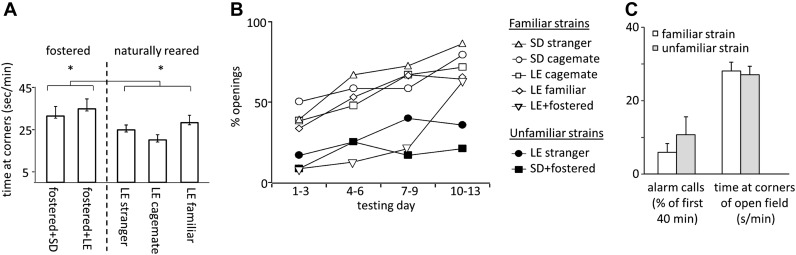
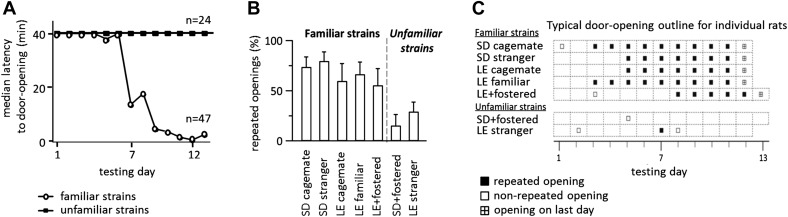
In mammals, helping is preferentially provided to members of one’s own group. Yet, it remains unclear how social experience shapes pro-social motivation. We found that rats helped trapped strangers by releasing them from a restrainer, just as they did cagemates. However, rats did not help strangers of a different strain, unless previously housed with the trapped rat. Moreover, pair-housing with one rat of a different strain prompted rats to help strangers of that strain, evidence that rats expand pro-social motivation from one individual to phenotypically similar others. To test if genetic relatedness alone can motivate helping, rats were fostered from birth with another strain and were not exposed to their own strain. As adults, fostered rats helped strangers of the fostering strain but not rats of their own strain. Thus, strain familiarity, even to one’s own strain, is required for the expression of pro-social behavior.
Overview
The claims and statistics of this paper haven’t been checked yet.
Run the check — free, no account needed. It reads the open-access text and checks the sources it cites.
Integrity signals
Registry
Cites
Statistics
Figures
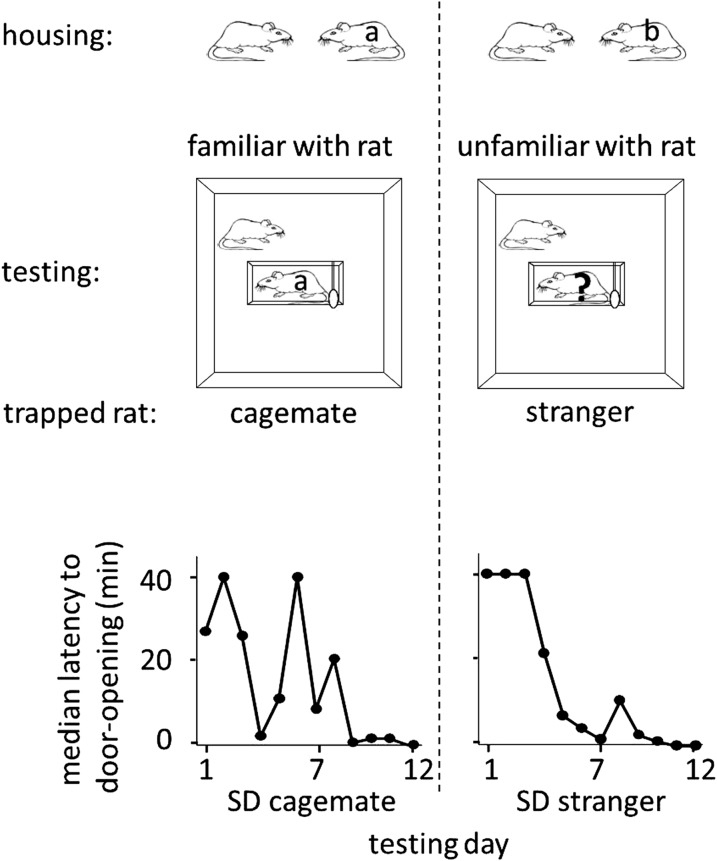
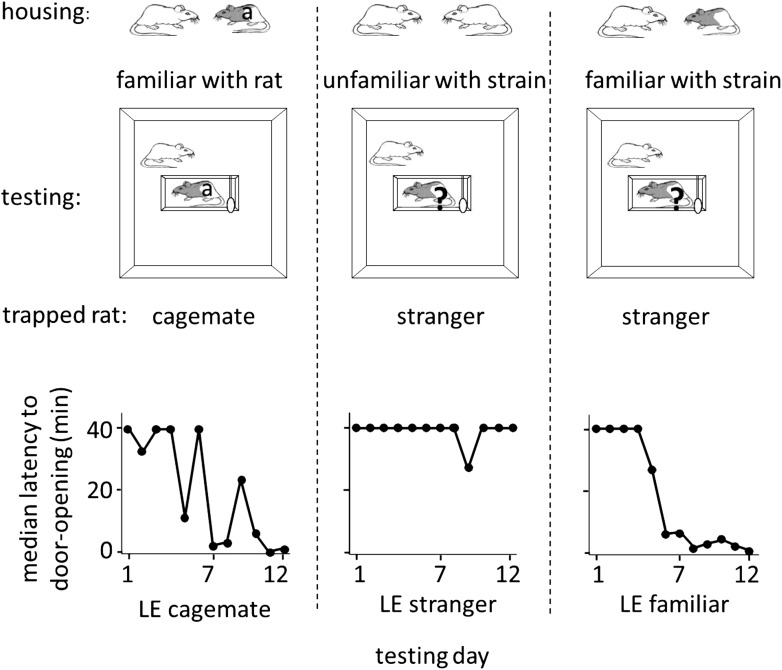
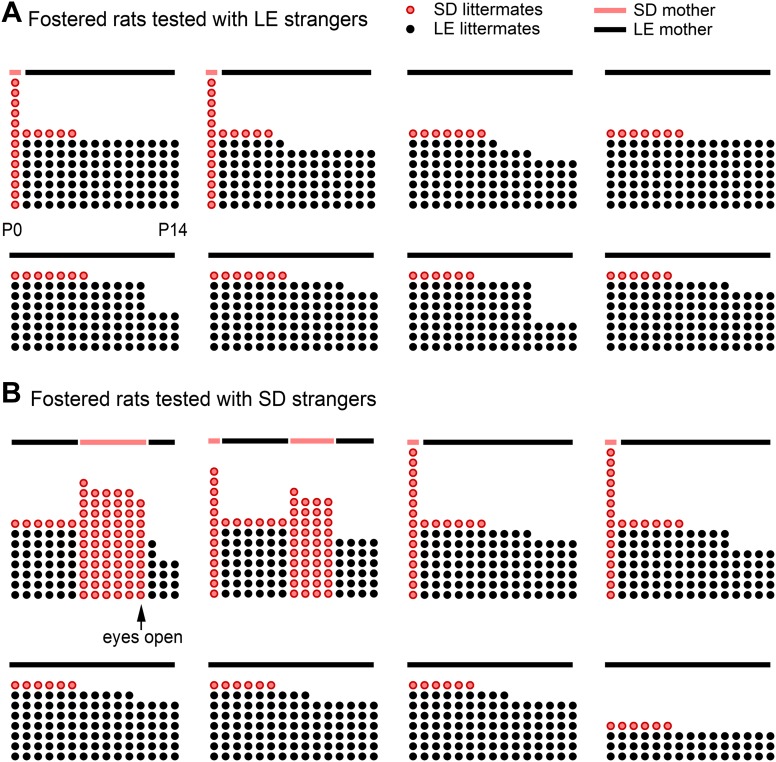
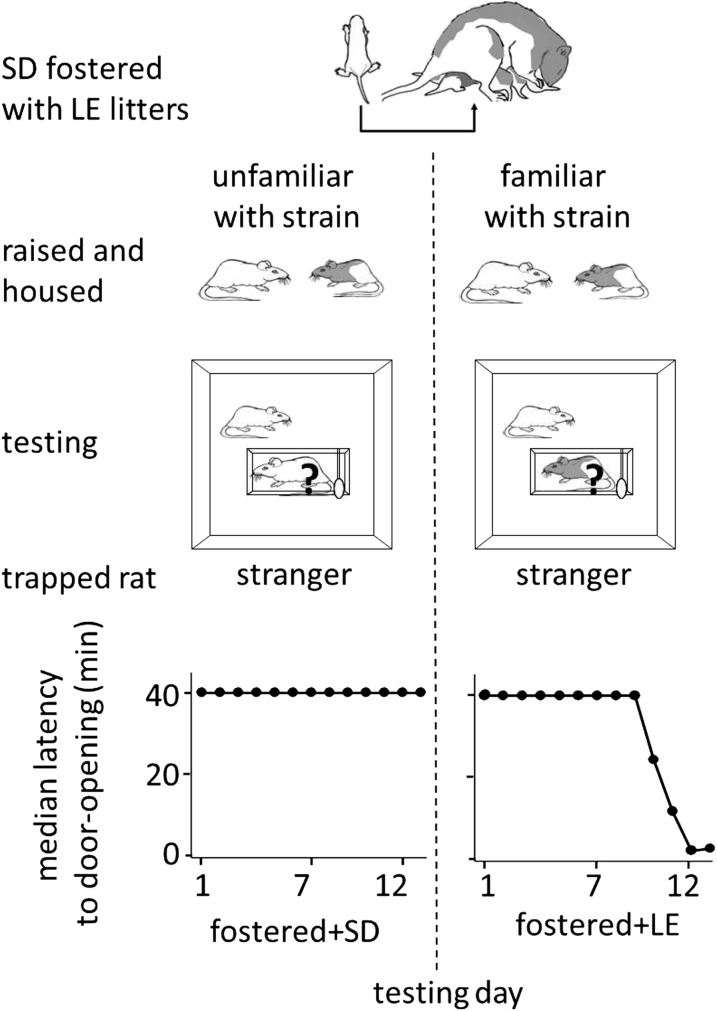
Verification
Claims the paper makes
The claims and statistics of this paper haven’t been checked yet.
Run the check — free, no account needed. It reads the open-access text and checks the sources it cites.
Claims other papers make about this one
Each is checked against this paper’s own text: does it say what the citing paper says it does?
In the citing paper
“First, prosocial effects are evident in pair-bonded voles and familiar female mice, but not between strangers or in male mice; this may also generalize to rats42 (but see25).”
From Insular cortex mediates approach and avoidance responses to social affective stimuli (2018) · cites this paper as [42]
In the citing paper
“Various factors of social context are involved in empathy (Bartal et al., 2014; Yamagishi et al., 2019).”
From Helping behavior in prairie voles: a model of empathy and the importance of oxytocin (2022) · cites this paper as Bartal et al., 2014
In the citing paper
“Rats display as much helping behavior toward strangers as toward cagemates (Bartal et al., 2014; Yamagishi et al., 2019).”
From Helping behavior in prairie voles: a model of empathy and the importance of oxytocin (2022) · cites this paper as Bartal et al., 2014
Self-check
Percentages, sums and reported differences re-computed from the paper’s own numbers.
The self-check needs the paper’s full text.
Citations
Cites
The genetical evolution of social behaviour. I
Hamilton, W. D. (1964) · Journal of Theoretical Biology · doi:10.1016/0022-5193(64)90038-4 · Cited by 15,725
Calamita, E., Schmid, M., Kunz, M., Ndebele-Murisa, M. R., Magadza, C. H. D., Nyambe, I., & Wehrli, B. (2019) · Figshare · doi:10.26181/6153922fe919c · Cited by 4,239
Empathy: its ultimate and proximate bases
Preston, S. D., & de Waal, F. B. M. (2002) · Behavioral and Brain Sciences · doi:10.1017/s0140525x02000018 · Cited by 4,126
The relation of empathy to prosocial and related behaviors
Eisenberg, N., & Miller, P. A. (1987) · Psychological Bulletin · doi:10.1037/0033-2909.101.1.91 · Cited by 2,672
Altruistic Helping in Human Infants and Young Chimpanzees
Warneken, F., & Tomasello, M. (2006) · Science · doi:10.1126/science.1121448 · Cited by 1,743
Reinterpreting the empathy-altruism relationship: When one into one equals oneness.
Cialdini, R. B., Brown, S. L., Lewis, B. P., Luce, C. L., & Neuberg, S. L. (1997) · Journal of Personality and Social Psychology · doi:10.1037/0022-3514.73.3.481 · Cited by 1,467
Reciprocal food sharing in the vampire bat
Wilkinson, G. S. (1984) · Nature · doi:10.1038/308181a0 · Cited by 1,029
Champagne, F. A., Francis, D. D., Mar, A., & Meaney, M. J. (2003) · Physiology & Behavior · doi:10.1016/s0031-9384(03)00149-5 · Cited by 1,021
Levine, M., Prosser, A. L., Evans, D. J., & Reicher, S. D. (2005) · Personality and Social Psychology Bulletin · doi:10.1177/0146167204271651 · Cited by 984
Empathy and pro-social behavior in rats
Bartal, I. B.-A., Decety, J., & Mason, P. (2011) · Science · doi:10.1126/science.1210789 · Cited by 934
Self-citation
Research works printed but not linked: 1
- Hornstein, 1978, Promotive tension and prosocial behavior: a Lewinian analysis, 177
Cited by
Sorted by citations
Empathy: Gender effects in brain and behavior
Christov-Moore, L., Simpson, E. A., Coudé, G., Grigaityte, K., Iacoboni, M., & Ferrari, P. F. (2014) · Neuroscience & Biobehavioral Reviews · doi:10.1016/j.neubiorev.2014.09.001 · Cited by 1,137
Decety, J., Bartal, I. B.-A., Uzefovsky, F., & Knafo-Noam, A. (2016) · Philosophical Transactions of the Royal Society B Biological Sciences · doi:10.1098/rstb.2015.0077 · Cited by 740
Stress, social behavior, and resilience: Insights from rodents
Beery, A. K., & Kaufer, D. (2014) · Neurobiology of Stress · doi:10.1016/j.ynstr.2014.10.004 · Cited by 395
Decety, J., & Cowell, J. M. (2014) · Perspectives on Psychological Science · doi:10.1177/1745691614545130 · Cited by 364
The neural pathways, development and functions of empathy
Decety, J. (2014) · Current Opinion in Behavioral Sciences · doi:10.1016/j.cobeha.2014.12.001 · Cited by 323
Insular cortex mediates approach and avoidance responses to social affective stimuli
Rogers-Carter, M. M., Varela, J. A., Gribbons, K. B., Pierce, A. F., McGoey, M. T., Ritchey, M., & Christianson, J. P. (2018) · Nature Neuroscience · doi:10.1038/s41593-018-0071-y · Cited by 277
Rats demonstrate helping behavior toward a soaked conspecific
Sato, N., Tan, L., Tate, K., & Okada, M. (2015) · Animal Cognition · doi:10.1007/s10071-015-0872-2 · Cited by 224
Stern, J. A., & Cassidy, J. (2018) · Developmental Review · doi:10.1016/j.dr.2017.09.002 · Cited by 222
Ko, J. (2017) · Frontiers in Neural Circuits · doi:10.3389/fncir.2017.00041 · Cited by 229
Empathy, Justice, and Moral Behavior
Jean Decety, A., & Cowell, J. M. (2015) · AJOB Neuroscience · doi:10.1080/21507740.2015.1047055 · Cited by 220
Brown, S. L., & Brown, R. M. (2015) · Neuroscience & Biobehavioral Reviews · doi:10.1016/j.neubiorev.2015.04.004 · Cited by 212
The roots of empathy: Through the lens of rodent models
Meyza, K. Z., Bartal, I. B.-A., Monfils, M., Panksepp, J. B., & Knapska, E. (2016) · Neuroscience & Biobehavioral Reviews · doi:10.1016/j.neubiorev.2016.10.028 · Cited by 172
The social life of Norway rats (Rattus norvegicus)
Schweinfurth, M. K. (2020) · eLife · doi:10.7554/elife.54020 · Cited by 176
Oxytocin enhances observational fear in mice
Pisansky, M. T., Hanson, L. R., Gottesman, I. I., & Gewirtz, J. C. (2017) · Nature Communications · doi:10.1038/s41467-017-02279-5 · Cited by 167
Marsh, A. A. (2018) · Annual Review of Psychology · doi:10.1146/annurev-psych-010418-103010 · Cited by 171
The neural circuitry of social homeostasis: Consequences of acute versus chronic social isolation
Lee, C. R., Chen, A., & Tye, K. M. (2021) · Cell · doi:10.1016/j.cell.2021.02.028 · Cited by 146
Comparative studies of social buffering: A consideration of approaches, terminology, and pitfalls
Kiyokawa, Y., & Hennessy, M. B. (2017) · Neuroscience & Biobehavioral Reviews · doi:10.1016/j.neubiorev.2017.12.005 · Cited by 136
Anxiolytic Treatment Impairs Helping Behavior in Rats
Ben-Ami Bartal, I., Shan, H., Molasky, N. M. R., Murray, T. M., Williams, J. Z., Decety, J., & Mason, P. (2016) · Frontiers in Psychology · doi:10.3389/fpsyg.2016.00850 · Cited by 143
Self-citationAn insular view of the social decision-making network
Rogers-Carter, M. M., & Christianson, J. P. (2019) · Neuroscience & Biobehavioral Reviews · doi:10.1016/j.neubiorev.2019.06.005 · Cited by 121
Emotional contagion and prosocial behavior in rodents
Keysers, C., Knapska, E., Moita, M. A. P., & Gazzola, V. (2022) · Trends in Cognitive Sciences · doi:10.1016/j.tics.2022.05.005 · Cited by 130
Understanding others: Emotion recognition in humans and other animals
Ferretti, V., & Papaleo, F. (2018) · Genes Brain & Behavior · doi:10.1111/gbb.12544 · Cited by 142
Rats prefer mutual rewards in a prosocial choice task
Hernandez-Lallement, J., van Wingerden, M., Marx, C., Srejic, M., & Kalenscher, T. (2015) · Frontiers in Neuroscience · doi:10.3389/fnins.2014.00443 · Cited by 123
Huber, A., Barber, A. L. A., Faragó, T., Müller, C. A., & Huber, L. (2017) · Animal Cognition · doi:10.1007/s10071-017-1092-8 · Cited by 123
Behavioral and mechanistic insight into rodent empathy
Sivaselvachandran, S., Acland, E. L., Abdallah, S., & Martin, L. J. (2018) · Neuroscience & Biobehavioral Reviews · doi:10.1016/j.neubiorev.2016.06.007 · Cited by 114
Chimpanzees empathize with group mates and humans, but not with baboons or unfamiliar chimpanzees
Campbell, M., & de Waal, F. Β. Μ. (2014) · Proceedings of the Royal Society B Biological Sciences · doi:10.1098/rspb.2014.0013 · Cited by 106
Li, Z., Lü, Y.-F., Li, C.-L., Wang, Y., Sun, W., He, T., Chen, X.-F., Wang, X., & Chen, J. (2014) · Pain · doi:10.1016/j.pain.2014.03.019 · Cited by 105
Empathy for Distress in Humans and Rodents
Chen, J. (2017) · Neuroscience Bulletin · doi:10.1007/s12264-017-0135-0 · Cited by 102
Prosocial Choice in Rats Depends on Food-Seeking Behavior Displayed by Recipients
Márquez, C., Rennie, S. M., Costa, D. F., & Moita, M. A. P. (2015) · Current Biology · doi:10.1016/j.cub.2015.05.018 · Cited by 100
Be kind to others: Prosocial behaviours and their implications for animal welfare
Rault, J. (2018) · Applied Animal Behaviour Science · doi:10.1016/j.applanim.2018.10.015 · Cited by 98
Pérez‐Manrique, A., & Gomila, A. (2017) · Biological reviews/Biological reviews of the Cambridge Philosophical Society · doi:10.1111/brv.12342 · Cited by 101
Harm to Others Acts as a Negative Reinforcer in Rats
Hernandez-Lallement, J., Attah, A. T., Soyman, E., Pinhal, C. M., Gazzola, V., & Keysers, C. (2020) · Current Biology · doi:10.1016/j.cub.2020.01.017 · Cited by 95
Parsons, M. H., Banks, P. B., Deutsch, M. A., Corrigan, R. M., & Munshi‐South, J. (2017) · Journal of Urban Ecology · doi:10.1093/jue/jux005 · Cited by 82
A Comparative Perspective on the Evolution of Moral Behavior
Hall, K., & Brosnan, S. F. (2015) · Evolutionary psychology · doi:10.1007/978-3-319-19671-8_8 · Cited by 83
Goumon, S., & Špinka, M. (2016) · Animal Cognition · doi:10.1007/s10071-015-0950-5 · Cited by 78
Emotional Contagion From Humans to Dogs Is Facilitated by Duration of Ownership
Katayama, M., Kubo, T., Yamakawa, T., Fujiwara, K., Nomoto, K., Ikeda, K., Mogi, K., Nagasawa, M., & Kikusui, T. (2019) · Frontiers in Psychology · doi:10.3389/fpsyg.2019.01678 · Cited by 70
Pereira, M., & Ferreira, A. (2015) · Hormones and Behavior · doi:10.1016/j.yhbeh.2015.08.005 · Cited by 74
Neural correlates of ingroup bias for prosociality in rats
Bartal, I. B.-A., Breton, J., Sheng, H., Long, K. L. P., Chen, S., Halliday, A., Kenney, J. W., Wheeler, A. L., Frankland, P. W., Shilyansky, C., et al. (2021) · eLife · doi:10.7554/elife.65582 · Cited by 66
Rodent models for studying empathy
Keum, S., & Shin, H. (2016) · Neurobiology of Learning and Memory · doi:10.1016/j.nlm.2016.07.022 · Cited by 64
Hawkins, R. D., & Williams, J. M. (2016) · Anthrozoös · doi:10.1080/08927936.2016.1189749 · Cited by 67
Sakaguchi, T., Iwasaki, S., Okada, M., Okamoto, K., & Ikegaya, Y. (2018) · Nature Communications · doi:10.1038/s41467-018-05894-y · Cited by 63
Animal Morality: What It Means and Why It Matters
Monsó, S., Benz-Schwarzburg, J., & Bremhorst, A. (2018) · The Journal of Ethics · doi:10.1007/s10892-018-9275-3 · Cited by 71
Perception of emotional valence in horse whinnies
Briefer, E. F., Mandel, R., Maigrot, A.-L., Freymond, S. B., Bachmann, I., & Hillmann, E. (2017) · Frontiers in Zoology · doi:10.1186/s12983-017-0193-1 · Cited by 62
Validating Rat Model of Empathy for Pain: Effects of Pain Expressions in Social Partners
Li, C.-L., Yang, Y., He, T., Wang, R.-R., Geng, K.-W., Du, R., Luo, W.-J., Wei, N., Wang, X., Wang, Y., et al. (2018) · Frontiers in Behavioral Neuroscience · doi:10.3389/fnbeh.2018.00242 · Cited by 63
Dynamic influences on the neural encoding of social valence
Padilla-Coreano, N., Tye, K. M., & Zelikowsky, M. (2022) · Nature reviews. Neuroscience · doi:10.1038/s41583-022-00609-1 · Cited by 59
Bidirectional cingulate-dependent danger information transfer across rats
Han, Y., Bruls, R., Soyman, E., Thomas, R. M., Pentaraki, V., Jelinek, N., Heinemans, M., Bassez, I., Verschooren, S., Pruis, I., et al. (2019) · PLoS Biology · doi:10.1371/journal.pbio.3000524 · Cited by 55
Anterior Cingulate Cortex Signals Attention in a Social Paradigm that Manipulates Reward and Shock
Schneider, K. N., Sciarillo, X. A., Nudelman, J. L., Cheer, J. F., & Roesch, M. R. (2020) · Current Biology · doi:10.1016/j.cub.2020.07.039 · Cited by 58
Body language signals for rodent social communication
Ebbesen, C. L., & Froemke, R. C. (2021) · Current Opinion in Neurobiology · doi:10.1016/j.conb.2021.01.008 · Cited by 56
Rudimentary empathy in macaques’ social decision-making
Ballesta, S., & Duhamel, J. (2015) · Proceedings of the National Academy of Sciences · doi:10.1073/pnas.1504454112 · Cited by 57
Familiarity modulates social approach toward stressed conspecifics in female rats
Rogers-Carter, M. M., Djerdjaj, A., Culp, A. R., Elbaz, J. A., & Christianson, J. P. (2018) · PLoS ONE · doi:10.1371/journal.pone.0200971 · Cited by 53
Rats display empathic behavior independent of the opportunity for social interaction
Cox, S. S., & Reichel, C. M. (2019) · Neuropsychopharmacology · doi:10.1038/s41386-019-0572-8 · Cited by 51
Acute social isolation evokes midbrain craving responses similar to hungerPreprint
Tomova, L., Wang, K. L., Thompson, T. W., Matthews, G. A., Takahashi, A., Tye, K. M., & Saxe, R. R. (2020) · bioRxiv (Cold Spring Harbor Laboratory) · doi:10.1101/2020.03.25.006643 · Cited by 67
Social modulation of drug use and drug addiction
Pelloux, Y., Giorla, E., Montanari, C., & Baunez, C. (2019) · Neuropharmacology · doi:10.1016/j.neuropharm.2019.02.027 · Cited by 54
The ties that bind: Group membership shapes the neural correlates of in-group favoritism
Telzer, E. H., Ichien, N., & Qu, Y. (2015) · NeuroImage · doi:10.1016/j.neuroimage.2015.04.035 · Cited by 47
Laviola, G., Zoratto, F., Ingiosi, D., Carito, V., Huzard, D., Fiore, M., & Macrı̀, S. (2017) · PLoS ONE · doi:10.1371/journal.pone.0188907 · Cited by 47
Helping-Like Behaviour in Mice Towards Conspecifics Constrained Inside Tubes
Ueno, H., Suemitsu, S., Murakami, S., Kitamura, N., Wani, K., Matsumoto, Y., Okamoto, M., & Ishihara, T. (2019) · Scientific Reports · doi:10.1038/s41598-019-42290-y · Cited by 46
Empathic Contagious Pain and Consolation in Laboratory Rodents: Species and Sex Comparisons
Du, R., Luo, W.-J., Geng, K.-W., Li, C.-L., Yang, Y., He, T., Chen, J., & Chen, J. (2020) · Neuroscience Bulletin · doi:10.1007/s12264-020-00465-y · Cited by 45
Similar levels of emotional contagion in male and female rats
Han, Y., Sichterman, B., Carrillo, M., Gazzola, V., & Keysers, C. (2020) · Scientific Reports · doi:10.1038/s41598-020-59680-2 · Cited by 46
Long-term consistency in chimpanzee consolation behaviour reflects empathetic personalities
Webb, C. E., Romero, T., Franks, B., & de Waal, F. Β. Μ. (2017) · Nature Communications · doi:10.1038/s41467-017-00360-7 · Cited by 43
Functional analysis of mutual behavior in laboratory rats (Rattus norvegicus).
Tan, L., & Hackenberg, T. D. (2015) · Journal of comparative psychology · doi:10.1037/com0000015 · Cited by 42
Perez, E. C., Elie, J. E., Boucaud, I. C. A., Crouchet, T., Soulage, C. O., Soula, H. A., Theunissen, F. E., & Vignal, C. (2015) · Hormones and Behavior · doi:10.1016/j.yhbeh.2015.09.002 · Cited by 42
Lessons from helping behavior in rats
Mason, P. (2021) · Current Opinion in Neurobiology · doi:10.1016/j.conb.2021.01.001 · Cited by 41
Self-citationThe Cambridge Handbook of Animal Cognition
(2021) · Cambridge University Press eBooks · doi:10.1017/9781108564113 · Cited by 41
Timmy’s in the well: Empathy and prosocial helping in dogs
Sanford, E. M., Burt, E. R., & Meyers-Manor, J. E. (2018) · Learning & Behavior · doi:10.3758/s13420-018-0332-3 · Cited by 41
The neuroscience of unmet social needs
Tomova, L., Tye, K., & Saxe, R. (2021) · Social Neuroscience · doi:10.1080/17470919.2019.1694580 · Cited by 48
Personal distress and the influence of bystanders on responding to an emergency
Hortensius, R., Schutter, D. J. L. G., & de Gelder, B. (2016) · Cognitive Affective & Behavioral Neuroscience · doi:10.3758/s13415-016-0423-6 · Cited by 41
What can rodents teach us about empathy?
Meyza, K. Z., & Knapska, E. (2018) · Current Opinion in Psychology · doi:10.1016/j.copsyc.2018.03.002 · Cited by 40
Hackenberg, T. D., Vanderhooft, L., Huang, J., Wagar, M., Alexander, J. D., & Tan, L. (2021) · Journal of the Experimental Analysis of Behavior · doi:10.1002/jeab.686 · Cited by 38
Vicarious Emotions of Fear and Pain in Rodents
Keysers, C., & Gazzola, V. (2023) · Affective Science · doi:10.1007/s42761-023-00198-x · Cited by 36
Panksepp, J. B., & Lahvis, G. P. (2016) · Behavioral Neuroscience · doi:10.1037/bne0000133 · Cited by 37
Small prey species’ behaviour and welfare: implications for veterinary professionals
McBride, E. A. (2017) · Journal of Small Animal Practice · doi:10.1111/jsap.12681 · Cited by 42
Observation of rescue behaviour in wild boar (Sus scrofa)
Masilkova, M., Ježek, M., Silovský, V., Faltusová, M., Rohla, J., Kušta, T., & Burda, H. (2021) · Scientific Reports · doi:10.1038/s41598-021-95682-4 · Cited by 37
Norway rats (Rattus norvegicus) communicate need, which elicits donation of food.
Schweinfurth, M. K., & Michael Taborsky, A. (2018) · Journal of comparative psychology · doi:10.1037/com0000102 · Cited by 38
To free, or not to free: Social reinforcement effects in the social release paradigm with rats
Hiura, L. C., Tan, L., & Hackenberg, T. D. (2018) · Behavioural Processes · doi:10.1016/j.beproc.2018.03.014 · Cited by 35
Effects of heroin on rat prosocial behavior
Tomek, S. E., Stegmann, G., & Olive, M. F. (2018) · Addiction Biology · doi:10.1111/adb.12633 · Cited by 37
Multimodal cues displayed by submissive rats promote prosocial choices by dominants
Gachomba, M. J. M., Esteve-Agraz, J., Caref, K., Maroto, A. S., Bortolozzo-Gleich, M. H., Laplagne, D. A., & Márquez, C. (2022) · Current Biology · doi:10.1016/j.cub.2022.06.026 · Cited by 35
Oxytocin administration modulates rats’ helping behavior depending on social context
Yamagishi, A., Okada, M., Masuda, M., & Sato, N. (2020) · Neuroscience Research · doi:10.1016/j.neures.2019.04.001 · Cited by 33
Abnormal empathy-like pro-social behaviour in the valproic acid model of autism spectrum disorder
Fontes‐Dutra, M., Nunes, G. D., Santos‐Terra, J., Nunes, W. S., Bauer‐Negrini, G., Hirsch, M. M., Green, L., Riesgo, R. D. S., Gottfried, C., & Bambini-Júnior, V. (2019) · Behavioural Brain Research · doi:10.1016/j.bbr.2019.01.034 · Cited by 33
The strain of an accompanying conspecific affects the efficacy of social buffering in male rats
Nakamura, K., Ishii, A., Kiyokawa, Y., Takeuchi, Y., & Mori, Y. (2016) · Hormones and Behavior · doi:10.1016/j.yhbeh.2016.05.003 · Cited by 34
Helping behavior in prairie voles: a model of empathy and the importance of oxytocin
Kitano, K., Yamagishi, A., Horie, K., Nishimori, K., & Sato, N. (2022) · iScience · doi:10.1016/j.isci.2022.103991 · Cited by 31
Oh, D. Y., Barr, I., & Hurt, A. C. (2015) · PLoS ONE · doi:10.1371/journal.pone.0118780 · Cited by 31
Quinn, L. K., Schuster, L., Aguilar‐Rivera, M., Arnold, J., Ball, D., Gygi, E., Holt, J. R., Lee, D. J., Taufatofua, J., Wiles, J., et al. (2018) · Animal Behavior and Cognition · doi:10.26451/abc.05.04.04.2018 · Cited by 34
Kietzman, H. W., & Gourley, S. L. (2023) · Neuroscience & Biobehavioral Reviews · doi:10.1016/j.neubiorev.2023.105075 · Cited by 34
Keller, B. A., Finger, J. S., Gruber, S. H., Abel, D. C., & Guttridge, T. L. (2017) · Journal of Experimental Marine Biology and Ecology · doi:10.1016/j.jembe.2017.01.004 · Cited by 28
Kim, J., Ko, M. J., Gonzales, E. L., Kang, R. J., Kim, D. G., Kim, Y., Seung, H., Oh, H. A., Eun, P. H., & Shin, C. Y. (2018) · Scientific Reports · doi:10.1038/s41598-018-30524-4 · Cited by 29
The Developmental Origins of the Social Brain: Empathy, Morality, and Justice
Chen, C., Martínez, R. M., & Cheng, Y. (2018) · Frontiers in Psychology · doi:10.3389/fpsyg.2018.02584 · Cited by 30
Prosocial behaviors in rodents
Gachomba, M. J. M., Esteve-Agraz, J., & Márquez, C. (2024) · Neuroscience & Biobehavioral Reviews · doi:10.1016/j.neubiorev.2024.105776 · Cited by 28
The complex affective and cognitive capacities of rats
Bartal, I. B.-A. (2024) · Science · doi:10.1126/science.adq6217 · Cited by 27
Havlik, J. L., Sugano, Y. Y. V., Jacobi, M. C., Kukreja, R. R., Jacobi, J. H., & Mason, P. (2020) · Science Advances · doi:10.1126/sciadv.abb4205 · Cited by 26
Self-citationCezar, G. B., Carmona, I. M., Baptista‐de‐Souza, D., Nunes‐de‐Souza, R. L., & Canto‐de‐Souza, A. (2020) · Neuropharmacology · doi:10.1016/j.neuropharm.2020.108413 · Cited by 27
Ability to share emotions of others as a foundation of social learning
Puścian, A., Bryksa, A., Kondrakiewicz, L., Kostecki, M., Winiarski, M., & Knapska, E. (2021) · Neuroscience & Biobehavioral Reviews · doi:10.1016/j.neubiorev.2021.11.022 · Cited by 28
Neural activation associated with outgroup helping in adolescent rats
Breton, J., Eisner, J. S., Gandhi, V. S., Musick, N., Zhang, A., Long, K. L. P., Perloff, O. S., Hu, K. Y., Pham, C. M., Lalchandani, P., et al. (2022) · iScience · doi:10.1016/j.isci.2022.104412 · Cited by 26
The mere physical presence of another person reduces human autonomic responses to aversive sounds
Qi, Y., Herrmann, M. J., Bell, L., Fackler, A., Han, S., Deckert, J., & Hein, G. (2020) · Proceedings of the Royal Society B Biological Sciences · doi:10.1098/rspb.2019.2241 · Cited by 27
Are There Multiple Motivators for Helping Behavior in Rats?
Silva, P. R. R., Silva, R. H., Lima, R. H., Meurer, Y. D. S. R., Ceppi, B., & Yamamoto, M. E. (2020) · Frontiers in Psychology · doi:10.3389/fpsyg.2020.01795 · Cited by 26
Social Reward and Empathy as Proximal Contributions to Altruism: The Camaraderie Effect
Lahvis, G. P. (2016) · Current topics in behavioral neurosciences · doi:10.1007/7854_2016_449 · Cited by 28
Kentrop, J., Kalamari, A., Danesi, C. H., Kentrop, J. J., van IJzendoorn, M. H., Bakermans‐Kranenburg, M. J., Joëls, M., & van der Veen, R. (2020) · Developmental Cognitive Neuroscience · doi:10.1016/j.dcn.2020.100827 · Cited by 23
Stryjek, R., Parsons, M. H., Fendt, M., Święcicki, J., & Bębas, P. (2021) · Journal of Neuroscience Methods · doi:10.1016/j.jneumeth.2021.109303 · Cited by 24
The cognitive challenges of cooperation in human and nonhuman animals
Melis, A. P., & Raihani, N. (2023) · Nature Reviews Psychology · doi:10.1038/s44159-023-00207-7 · Cited by 28
A Social Reinforcement Learning Hypothesis of Mutual Reward Preferences in Rats
Hernandez-Lallement, J., van Wingerden, M., Schäble, S., & Kalenscher, T. (2016) · Current topics in behavioral neurosciences · doi:10.1007/7854_2016_436 · Cited by 23
Shedding Light on Social Reward Circuitry: (Un)common Blueprints in Humans and Rodents
Grimm, C., Balsters, J. H., & Zerbi, V. (2020) · The Neuroscientist · doi:10.1177/1073858420923552 · Cited by 26
Mediodorsal thalamus-projecting anterior cingulate cortex neurons modulate helping behavior in mice
Song, D. F., Wang, C., Jin, Y., Deng, Y., Yan, Y., Wang, D., Zhu, Z., Ke, Z., Wang, Z., Wu, Y., et al. (2023) · Current Biology · doi:10.1016/j.cub.2023.08.070 · Cited by 24
Metadata
- Authors
- Ben-Ami Bartal, I., Rodgers, D. A., Bernardez Sarria, M. S., Decety, J., & Mason, P.
- Affiliations
- Department of Neurobiology, University of Chicago, Chicago, United States
- University of Chicago (US)
- Department of Psychology, University of Chicago, Chicago, United States
- Corresponding author
- Mason, Peggy
- ORCID
- Mason, Peggy
- Venue
- eLife
- Publisher
- eLife Sciences Publications, Ltd
- Published
- 2014-01-14
- Volume
- 3
- Pages
- e01385-e01385
- ISSN
- 2050-084X (ISSN-L)
- PMC
- PMC3884117
- OpenAlex
- W2115556017
- Cited by
- 286
- References
- 66
- Citations by year
- 2026: 11 · 2025: 14 · 2024: 26 · 2023: 29 · 2022: 26 · 2021: 32 · 2020: 23 · 2019: 21 · 2018: 29 · 2017: 22 · 2016: 23 · 2015: 19 · 2014: 9
- FWCI
- 35.80
- Type
- journal article
- Language
- en
- Open access
- gold
- doi.org
- Licence
- Locations
- eLife (publishedVersion, cc-by)
- Europe PMC (PubMed Central) (publishedVersion, cc-by)
- PubMed Central (publishedVersion, cc-by)
- PubMed (publishedVersion)
- Knowledge@UChicago (University of Chicago) (submittedVersion, cc-by-nc-nd)
- DOAJ (DOAJ: Directory of Open Access Journals) (submittedVersion, cc-by-sa)
- University of Chicago (cc-by)
- Funders
- National Institutes of Health (DA022978, DA022429)
- Topics
- Life Sciences › Neuroscience › Endocrine and Autonomic Systems › Neuroendocrine regulation and behavior
- Life Sciences › Agricultural and Biological Sciences › Ecology, Evolution, Behavior and Systematics › Primate Behavior and Ecology
- Life Sciences › Agricultural and Biological Sciences › Ecology, Evolution, Behavior and Systematics › Animal Behavior and Reproduction
- Keywords
- prosocial behavior, helping behavior, social experience, genetic relatedness, foster rearing, kin selection, rats
- MeSH terms
- Animals, Social Behavior, Rats
About these checks
Registry, retraction, Cites and statistics results are computed, not judged, with one exception: a printed reference that no index lists is read once by a model before it counts as a citation error. Claims are extracted by a model and kept only when their quote appears verbatim in the text; each cited source is then checked, with a model’s help, for whether it says what the claim relies on. Those verdicts can be wrong — read the claim’s quote and the cited source before relying on one.
Statistics and arithmetic are recomputed, not judged.
Confidence bands are shown only for fields calibrated on our annotated test set. None is calibrated yet, so no band is shown.
What counts as a claim ›How we measure confidence ›How we check this ›
Are you an author, or do you see a problem with this page? Request a review
