Cited by 286Neuroendocrine regulation and behaviorPrimate Behavior and EcologyAnimal Behavior and Reproduction

The DOI matches its Crossref record; 66 of the 66 references it cites were found in a registry or an index.

Pro-social behavior in rats is modulated by social experience

Open access
Ben-Ami Bartal, Inbal, Rodgers, David A, Bernardez Sarria, Maria Sol, Decety, Jean, Mason, Peggy·2014·eLife

Abstract

In mammals, helping is preferentially provided to members of one’s own group. Yet, it remains unclear how social experience shapes pro-social motivation. We found that rats helped trapped strangers by releasing them from a restrainer, just as they did cagemates. However, rats did not help strangers of a different strain, unless previously housed with the trapped rat. Moreover, pair-housing with one rat of a different strain prompted rats to help strangers of that strain, evidence that rats expand pro-social motivation from one individual to phenotypically similar others. To test if genetic relatedness alone can motivate helping, rats were fostered from birth with another strain and were not exposed to their own strain. As adults, fostered rats helped strangers of the fostering strain but not rats of their own strain. Thus, strain familiarity, even to one’s own strain, is required for the expression of pro-social behavior.

Overview

The claims and statistics of this paper haven’t been checked yet.

Run the check — free, no account needed. It reads the open-access text and checks the sources it cites.

A few free checks a day · papers already verified open instantly · results are public

Integrity signals

Registry

Crossref · 10.7554/elife.01385

Cites

66 of 66 references verified0 citation errors · 0 not checkable

Statistics

Figures

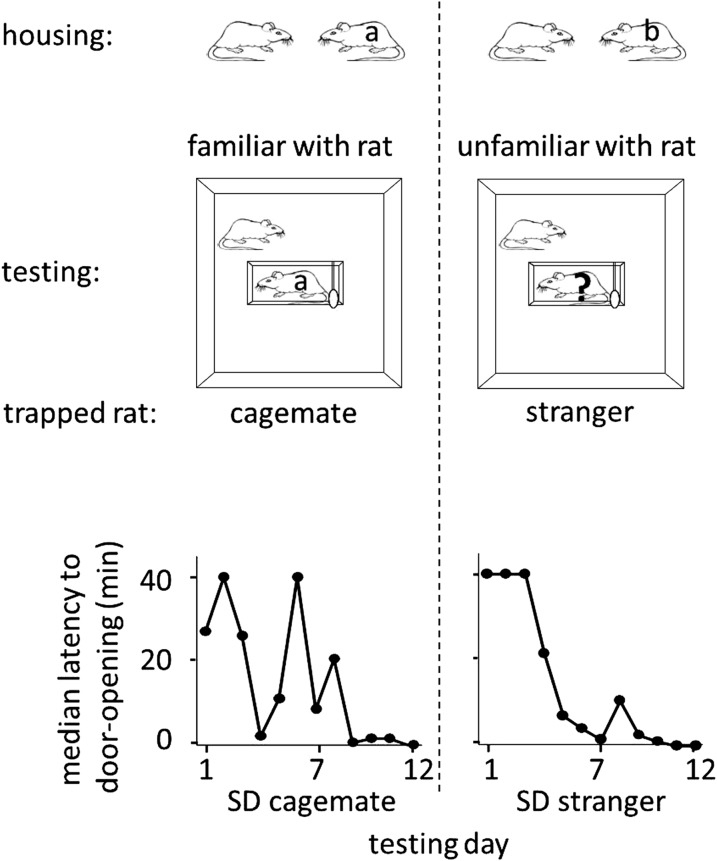
Figure 1. Rats were as motivated to help strangers of the same strain (SD stranger; right) as they were to help cagemates (SD cagemate; left). In both experimental conditions (diagrammed at top), SD rats were housed with another SD rat. However in the cagemate condition, the cagemate served as the trapped rat (‘a’) whereas in the stranger condition, the trapped rat was a stranger (‘?’) and not the cagemate (‘b’). Across the days of testing, the median latency to door-opening (bottom) decreased for both conditions. DOI: http://dx.doi.org/10.7554/eLife.01385.003
Figure 1. Rats were as motivated to help strangers of the same strain (SD stranger; right) as they were to help cagemates (SD cagemate; left). In both experimental conditions (diagrammed at top), SD rats were housed with another SD rat. However in the cagemate condition, the cagemate served as the trapped rat (‘a’) whereas in the stranger condition, the trapped rat was a stranger (‘?’) and not the cagemate (‘b’). Across the days of testing, the median latency to door-opening (bottom) decreased for both conditions. DOI: http://dx.doi.org/10.7554/eLife.01385.003CC BY · PubMed Central
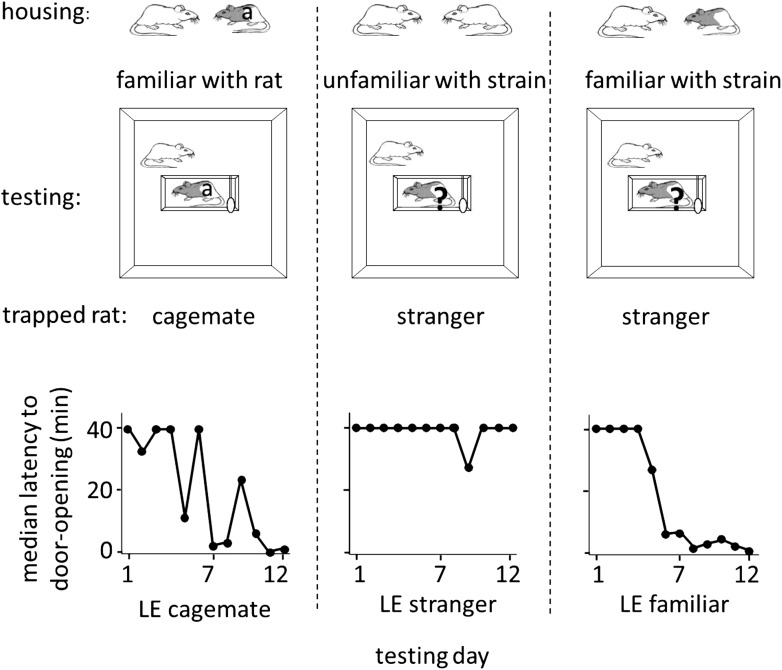
Figure 2. Rats of the SD strain helped trapped rats of the LE strain only if they were familiar with an LE individual. Three experimental conditions are diagrammed at top. The free rat was always from the SD strain and was housed with a cagemate, denoted at top, from either the SD (white) or LE (black and white) strain. The free rat was then tested with an LE rat that was either the cagemate (‘a’) or a stranger (‘?’). Note that in the LE familiar condition (right), rats had previously housed with an LE rat (illustrated) but were housed with an SD rat (not illustrated) at the time of testing. Across the days of testing, the median latency to door-opening (bottom) decreased for SD rats tested with trapped LE cagemates (left), but not those tested with LE strangers (middle). Like rats in the LE cagemate condtion, rats in the LE familiar condition (right) also became openers. DOI: http://dx.doi.org/10.7554/eLife.01385.004
Figure 2. Rats of the SD strain helped trapped rats of the LE strain only if they were familiar with an LE individual. Three experimental conditions are diagrammed at top. The free rat was always from the SD strain and was housed with a cagemate, denoted at top, from either the SD (white) or LE (black and white) strain. The free rat was then tested with an LE rat that was either the cagemate (‘a’) or a stranger (‘?’). Note that in the LE familiar condition (right), rats had previously housed with an LE rat (illustrated) but were housed with an SD rat (not illustrated) at the time of testing. Across the days of testing, the median latency to door-opening (bottom) decreased for SD rats tested with trapped LE cagemates (left), but not those tested with LE strangers (middle). Like rats in the LE cagemate condtion, rats in the LE familiar condition (right) also became openers. DOI: http://dx.doi.org/10.7554/eLife.01385.004CC BY · PubMed Central
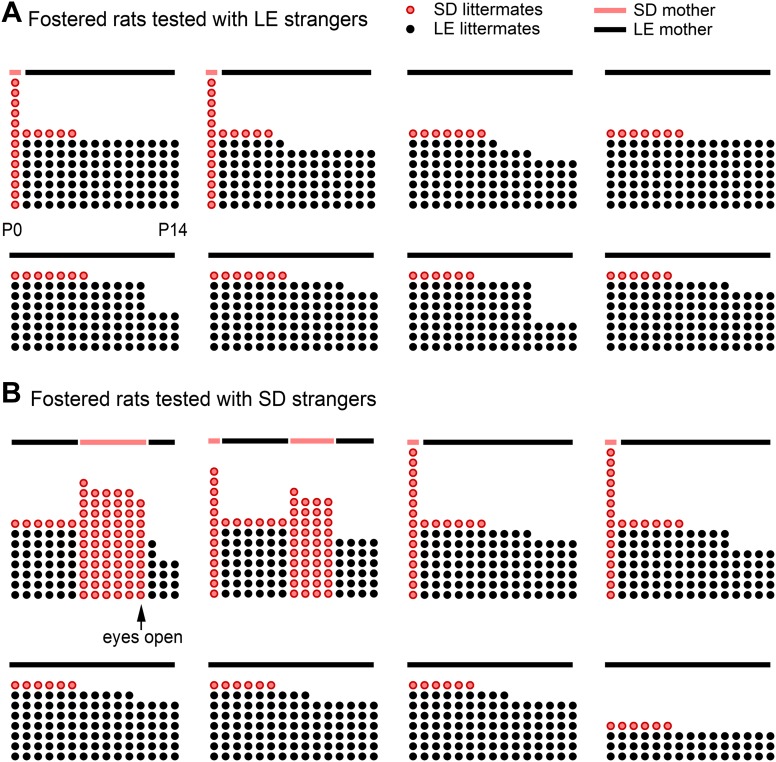
Figure 3. Fostered SD rats were minimally exposed to other SD rats from birth. This diagram indicates how many LE pups (black dots) and SD pups (red dots) were present in each litter during postnatal (P) days 0–14 (x-axis) for rats in the fostered+LE (A) and fostered+SD (B) conditions (see Figure 4). On P0–P1, two SD pups (n = 32) were transferred into each LE litter (n = 16). If both pups survived one of the two SD pups was removed at P6, leaving a single SD pup with an LE dam and LE littermates. As red dots indicate other SD pups, the number of red dots is representative of the amount of exposure each fostered SD rat had to other SD pups during their lives. Individual rats are arranged from the most exposure to SD rats (upper left in each group) to the least exposure (bottom right). Following P11, no fostered rat was exposed to other SD rats until testing. In two cases (both in the fostered+SD condition illustrated in B), the SD pup in the LE litter died at a later date (P11, P12). In these cases, an SD male who had been removed from an LE litter 5 or 7 days before was then re-added to the LE litter. Note that only one animal (upper left in B) was exposed to SD rats with his eyes open; this rat proved to be the only door-opener in the fostered+SD condition. Lines above the dots represent the strain of the dam (red: SD; black: LE). DOI: http://dx.doi.org/10.7554/eLife.01385.006
Figure 3. Fostered SD rats were minimally exposed to other SD rats from birth. This diagram indicates how many LE pups (black dots) and SD pups (red dots) were present in each litter during postnatal (P) days 0–14 (x-axis) for rats in the fostered+LE (A) and fostered+SD (B) conditions (see Figure 4). On P0–P1, two SD pups (n = 32) were transferred into each LE litter (n = 16). If both pups survived one of the two SD pups was removed at P6, leaving a single SD pup with an LE dam and LE littermates. As red dots indicate other SD pups, the number of red dots is representative of the amount of exposure each fostered SD rat had to other SD pups during their lives. Individual rats are arranged from the most exposure to SD rats (upper left in each group) to the least exposure (bottom right). Following P11, no fostered rat was exposed to other SD rats until testing. In two cases (both in the fostered+SD condition illustrated in B), the SD pup in the LE litter died at a later date (P11, P12). In these cases, an SD male who had been removed from an LE litter 5 or 7 days before was then re-added to the LE litter. Note that only one animal (upper left in B) was exposed to SD rats with his eyes open; this rat proved to be the only door-opener in the fostered+SD condition. Lines above the dots represent the strain of the dam (red: SD; black: LE). DOI: http://dx.doi.org/10.7554/eLife.01385.006CC BY · PubMed Central
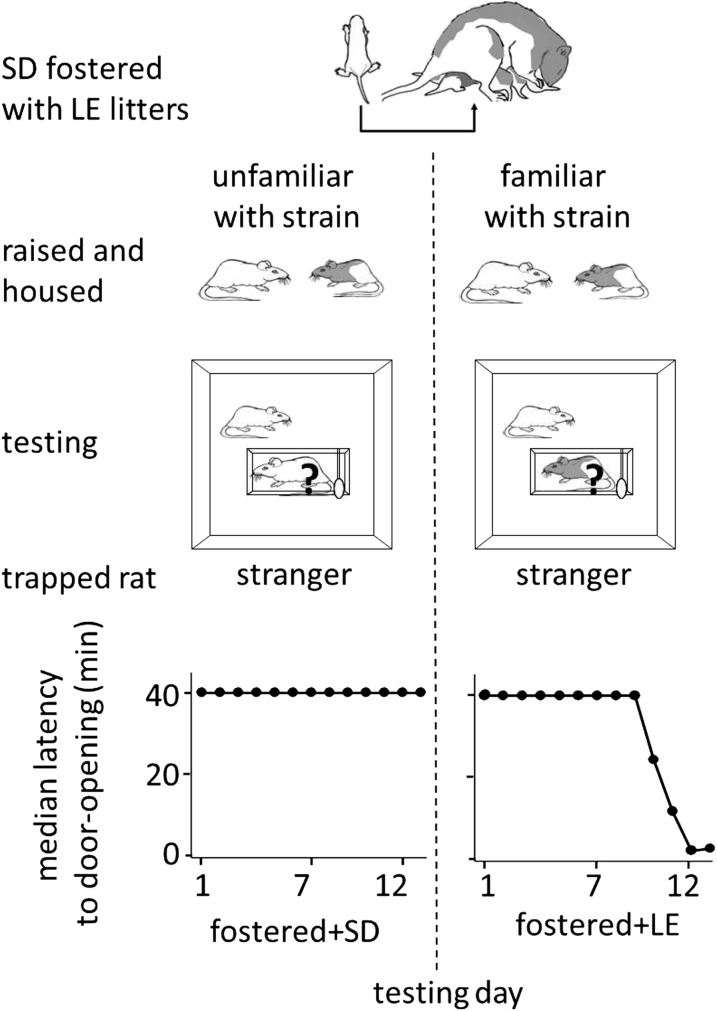
Figure 4. Strain familiarity, even to one’s own strain, is required for the expression of helping behavior. Fostered SD rats were raised with LE rats from birth (top diagram) and were not exposed to or able to interact with other SD rats prior to testing. When fostered SD rats were adults, they were tested with trapped stranger rats (‘?’) of either the SD (left) or LE (right) strain. Fostered SD rats did not help trapped SD strangers. In contrast, fostered SD rats helped trapped LE strangers. DOI: http://dx.doi.org/10.7554/eLife.01385.007
Figure 4. Strain familiarity, even to one’s own strain, is required for the expression of helping behavior. Fostered SD rats were raised with LE rats from birth (top diagram) and were not exposed to or able to interact with other SD rats prior to testing. When fostered SD rats were adults, they were tested with trapped stranger rats (‘?’) of either the SD (left) or LE (right) strain. Fostered SD rats did not help trapped SD strangers. In contrast, fostered SD rats helped trapped LE strangers. DOI: http://dx.doi.org/10.7554/eLife.01385.007CC BY · PubMed Central
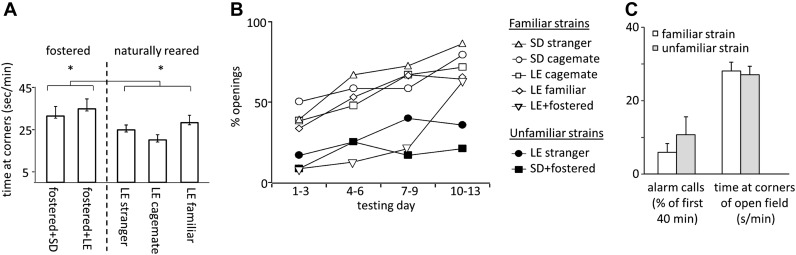
Figure 5. (A) Fostered rats (left of dashed line) spent more time at the arena corners during open field testing than naturally reared animals (right of dashed line). (B) The proportion of rats that opened increased across the testing sessions for rats tested with familiar strains (open markers) but not for those tested with unfamiliar strains (filled markers). (C) No differences between rats tested with trapped rats from familiar strains (white bars) and those tested with rats from unfamiliar strains (gray bars) were observed in the average number of alarm calls or the amount of time spent at corners during open field testing. DOI: http://dx.doi.org/10.7554/eLife.01385.009
Figure 5. (A) Fostered rats (left of dashed line) spent more time at the arena corners during open field testing than naturally reared animals (right of dashed line). (B) The proportion of rats that opened increased across the testing sessions for rats tested with familiar strains (open markers) but not for those tested with unfamiliar strains (filled markers). (C) No differences between rats tested with trapped rats from familiar strains (white bars) and those tested with rats from unfamiliar strains (gray bars) were observed in the average number of alarm calls or the amount of time spent at corners during open field testing. DOI: http://dx.doi.org/10.7554/eLife.01385.009CC BY · PubMed Central
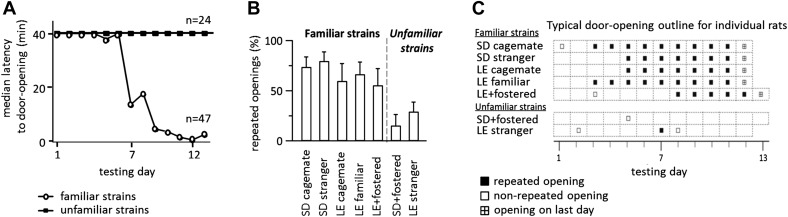
Figure 6. Rats experience helping rats of a familiar strain as rewarding. (A) The latency to door-opening decreased along the days of testing for rats tested with familiar strains (open circles) but not for those tested with unfamiliar strains (filled squares). (B) The proportion of openings that were followed by a repeated opening on the next day of testing was higher for trapped rats from familiar strains (left of dashed line) than from unfamiliar strains (right of dashed line). (C) Opening data from representative rats of each condition are illustrated. Fostered SD rats were tested for 13 days. DOI: http://dx.doi.org/10.7554/eLife.01385.010
Figure 6. Rats experience helping rats of a familiar strain as rewarding. (A) The latency to door-opening decreased along the days of testing for rats tested with familiar strains (open circles) but not for those tested with unfamiliar strains (filled squares). (B) The proportion of openings that were followed by a repeated opening on the next day of testing was higher for trapped rats from familiar strains (left of dashed line) than from unfamiliar strains (right of dashed line). (C) Opening data from representative rats of each condition are illustrated. Fostered SD rats were tested for 13 days. DOI: http://dx.doi.org/10.7554/eLife.01385.010CC BY · PubMed Central
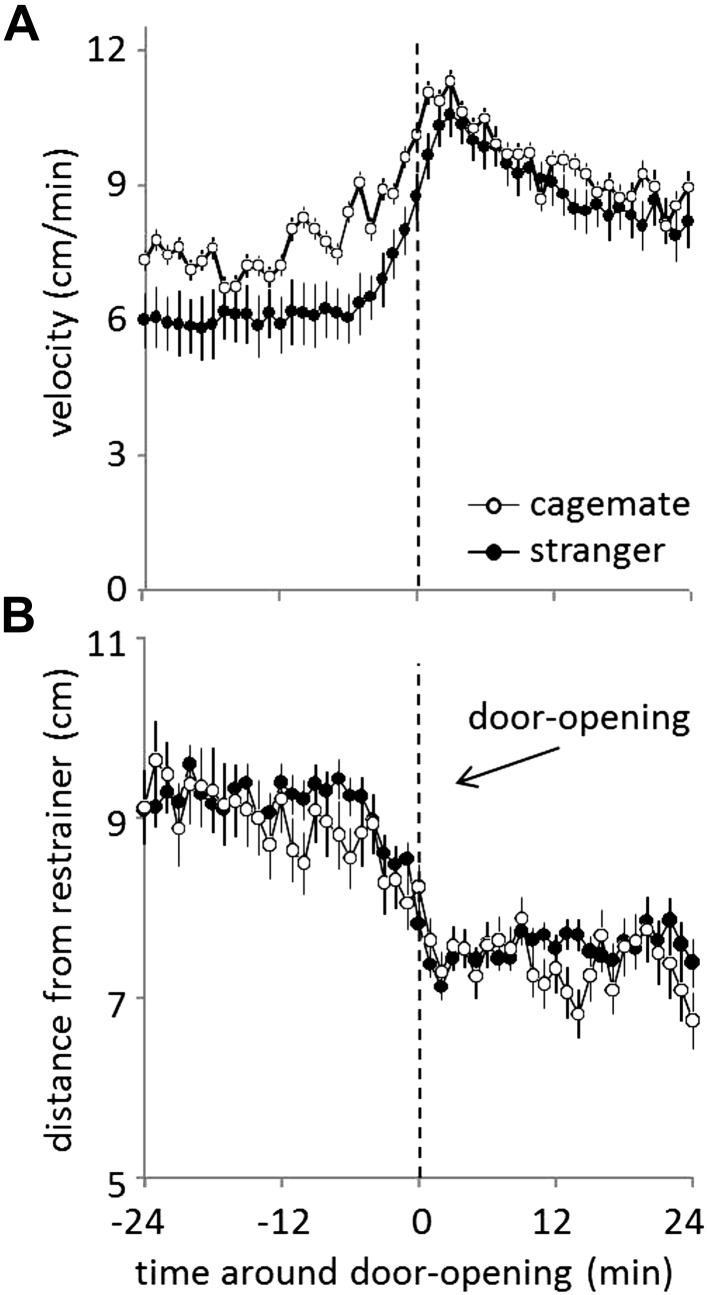
Figure 7. Prior to door-opening, rats are equally motivated to help, but show more activity for trapped cagemates than for strangers from a familiar strain. (A) Across conditions and testing days, rats tested with cagemates (white circles) were more active in the period before door-opening than were rats tested with strangers from a familiar strain (black circles). (B) The distance from the restrainer was not different for rats tested with cagemates (white circles) and strangers from a familiar strain (black circles). DOI: http://dx.doi.org/10.7554/eLife.01385.011
Figure 7. Prior to door-opening, rats are equally motivated to help, but show more activity for trapped cagemates than for strangers from a familiar strain. (A) Across conditions and testing days, rats tested with cagemates (white circles) were more active in the period before door-opening than were rats tested with strangers from a familiar strain (black circles). (B) The distance from the restrainer was not different for rats tested with cagemates (white circles) and strangers from a familiar strain (black circles). DOI: http://dx.doi.org/10.7554/eLife.01385.011CC BY · PubMed Central
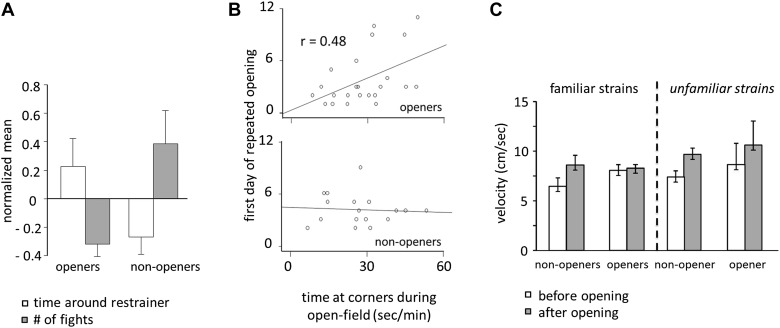
Figure 8. Openers showed an affiliative behavioral pattern. (A) Rats that became openers (left) spent more time around the closed restrainer (open bars) and fought less with the trapped rat (gray bars) than did non-openers (right). (B) The first day of repeated opening was correlated with time spent at the corners during open-field testing for openers (top) but not for non-openers (bottom). (C) Averaged across the 12 days of testing and regardless of strain familiarity, non-openers were less active when the restrainer was closed (white bars) than when it was open (gray bars). DOI: http://dx.doi.org/10.7554/eLife.01385.012
Figure 8. Openers showed an affiliative behavioral pattern. (A) Rats that became openers (left) spent more time around the closed restrainer (open bars) and fought less with the trapped rat (gray bars) than did non-openers (right). (B) The first day of repeated opening was correlated with time spent at the corners during open-field testing for openers (top) but not for non-openers (bottom). (C) Averaged across the 12 days of testing and regardless of strain familiarity, non-openers were less active when the restrainer was closed (white bars) than when it was open (gray bars). DOI: http://dx.doi.org/10.7554/eLife.01385.012CC BY · PubMed Central

Verification

Claims the paper makes

The claims and statistics of this paper haven’t been checked yet.

Run the check — free, no account needed. It reads the open-access text and checks the sources it cites.

A few free checks a day · papers already verified open instantly · results are public

Claims other papers make about this one

Each is checked against this paper’s own text: does it say what the citing paper says it does?

Self-check

Percentages, sums and reported differences re-computed from the paper’s own numbers.

The self-check needs the paper’s full text.

Citations

Cites

Show all 66 references

Research works printed but not linked: 1

  1. Hornstein, 1978, Promotive tension and prosocial behavior: a Lewinian analysis, 177

Cited by

Sorted by citations

See all 286

Metadata

Authors
Ben-Ami Bartal, I., Rodgers, D. A., Bernardez Sarria, M. S., Decety, J., & Mason, P.
Affiliations
  • Department of Neurobiology, University of Chicago, Chicago, United States
  • University of Chicago (US)
  • Department of Psychology, University of Chicago, Chicago, United States
Corresponding author
Mason, Peggy
Venue
eLife
Published
2014-01-14
Volume
3
Pages
e01385-e01385
ISSN
2050-084X (ISSN-L)
OpenAlex
W2115556017
Cited by
286
References
66
Citations by year
2026: 11 · 2025: 14 · 2024: 26 · 2023: 29 · 2022: 26 · 2021: 32 · 2020: 23 · 2019: 21 · 2018: 29 · 2017: 22 · 2016: 23 · 2015: 19 · 2014: 9
FWCI
35.80
Type
journal article
Language
en
Open access
Locations
  • eLife (publishedVersion, cc-by)
  • Europe PMC (PubMed Central) (publishedVersion, cc-by)
  • PubMed Central (publishedVersion, cc-by)
  • PubMed (publishedVersion)
  • Knowledge@UChicago (University of Chicago) (submittedVersion, cc-by-nc-nd)
  • DOAJ (DOAJ: Directory of Open Access Journals) (submittedVersion, cc-by-sa)
  • University of Chicago (cc-by)
Funders
National Institutes of Health (DA022978, DA022429)
Topics
  • Life Sciences › Neuroscience › Endocrine and Autonomic Systems › Neuroendocrine regulation and behavior
  • Life Sciences › Agricultural and Biological Sciences › Ecology, Evolution, Behavior and Systematics › Primate Behavior and Ecology
  • Life Sciences › Agricultural and Biological Sciences › Ecology, Evolution, Behavior and Systematics › Animal Behavior and Reproduction
Keywords
prosocial behavior, helping behavior, social experience, genetic relatedness, foster rearing, kin selection, rats
MeSH terms
Animals, Social Behavior, Rats

About these checks

Registry, retraction, Cites and statistics results are computed, not judged, with one exception: a printed reference that no index lists is read once by a model before it counts as a citation error. Claims are extracted by a model and kept only when their quote appears verbatim in the text; each cited source is then checked, with a model’s help, for whether it says what the claim relies on. Those verdicts can be wrong — read the claim’s quote and the cited source before relying on one.

Statistics and arithmetic are recomputed, not judged.

Confidence bands are shown only for fields calibrated on our annotated test set. None is calibrated yet, so no band is shown.

What counts as a claim ›How we measure confidence ›How we check this ›

Are you an author, or do you see a problem with this page? Request a review