

The DOI matches its Crossref record; 103 of the 106 references it cites were found in a registry or an index, and 3 are not checked yet.
Support for a clade of Placozoa and Cnidaria in genes with minimal compositional bias
Open accessPublished version of a preprint
Abstract
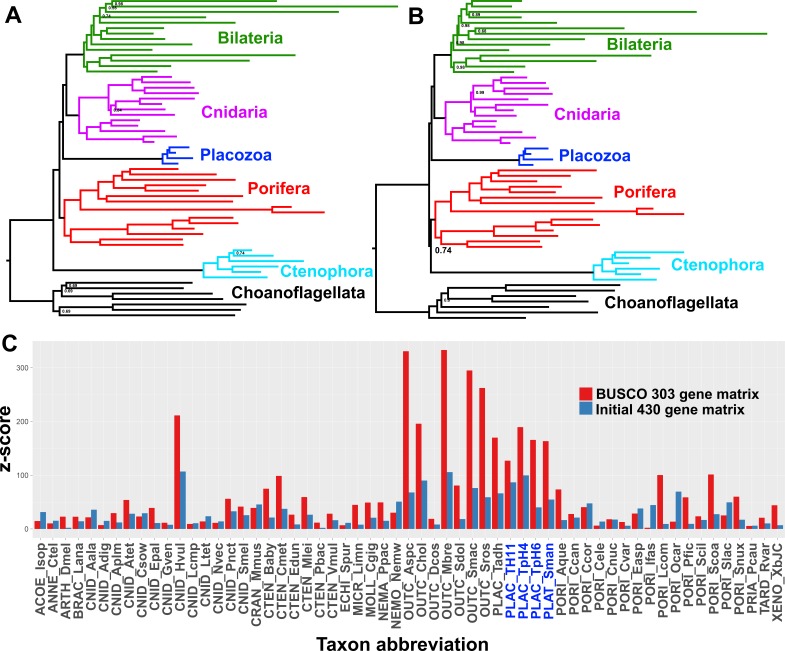
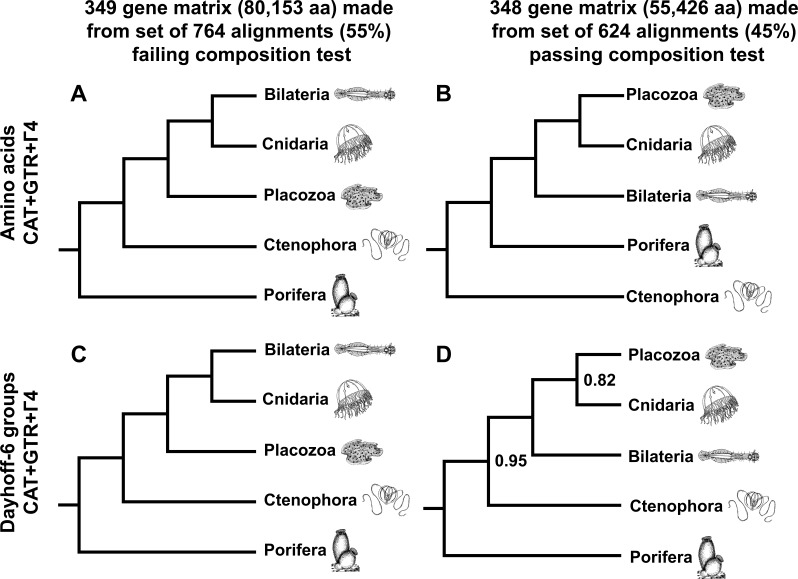
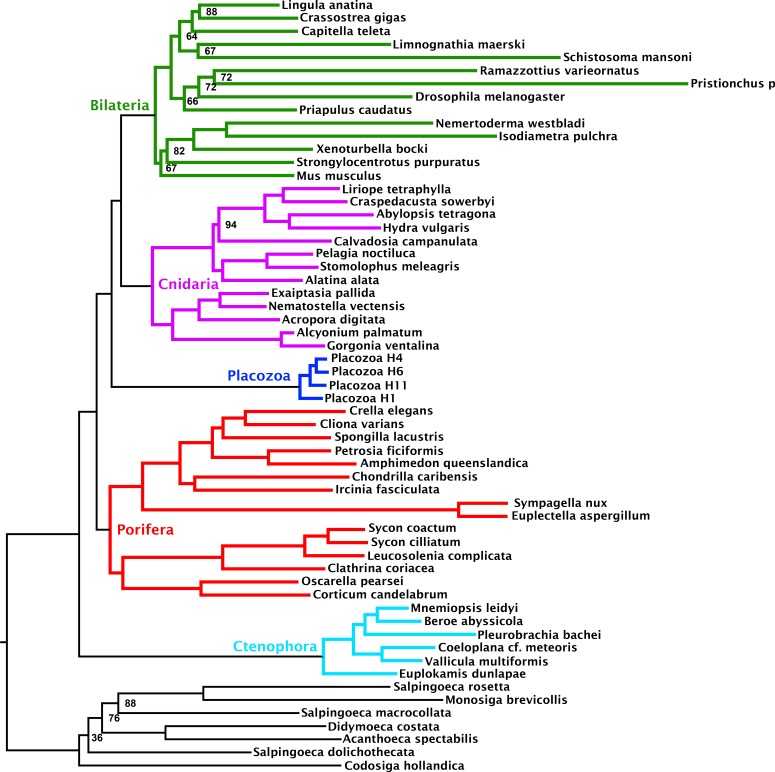
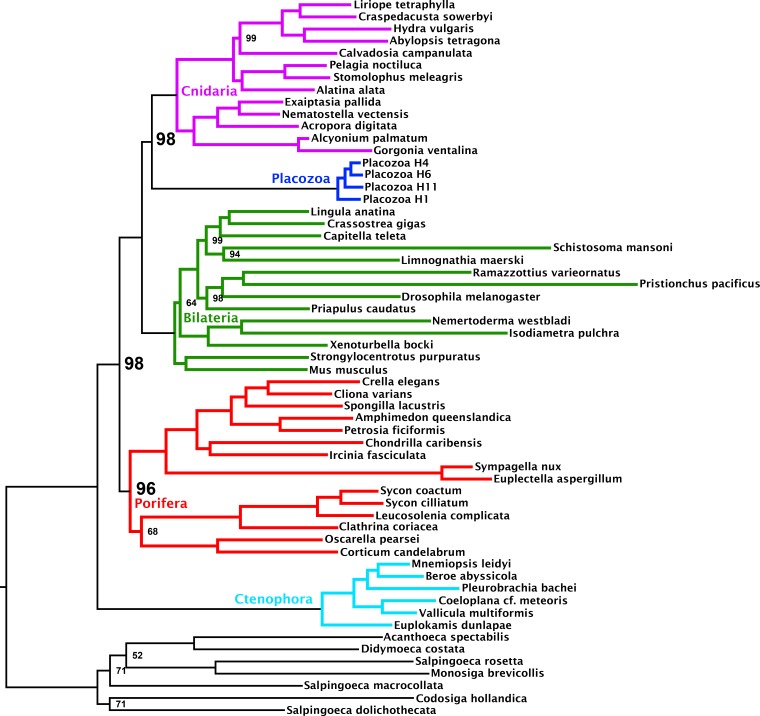
The phylogenetic placement of the morphologically simple placozoans is crucial to understanding the evolution of complex animal traits. Here, we examine the influence of adding new genomes from placozoans to a large dataset designed to study the deepest splits in the animal phylogeny. Using site-heterogeneous substitution models, we show that it is possible to obtain strong support, in both amino acid and reduced-alphabet matrices, for either a sister-group relationship between Cnidaria and Placozoa, or for Cnidaria and Bilateria as seen in most published work to date, depending on the orthologues selected to construct the matrix. We demonstrate that a majority of genes show evidence of compositional heterogeneity, and that support for the Cnidaria + Bilateria clade can be assigned to this source of systematic error. In interpreting these results, we caution against a peremptory reading of placozoans as secondarily reduced forms of little relevance to broader discussions of early animal evolution.
Overview
The claims and statistics of this paper haven’t been checked yet.
Run the check — free, no account needed. It reads the open-access text and checks the sources it cites.
Integrity signals
Registry
Cites
Statistics
Figures
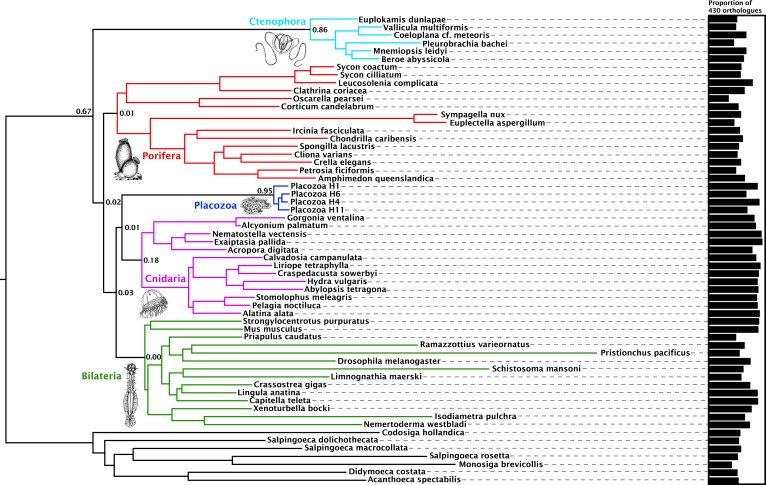
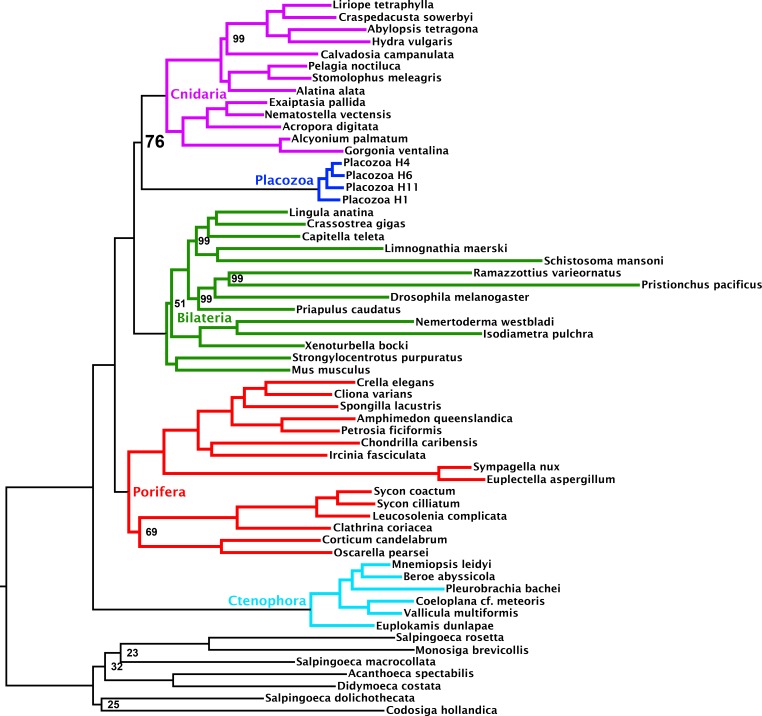
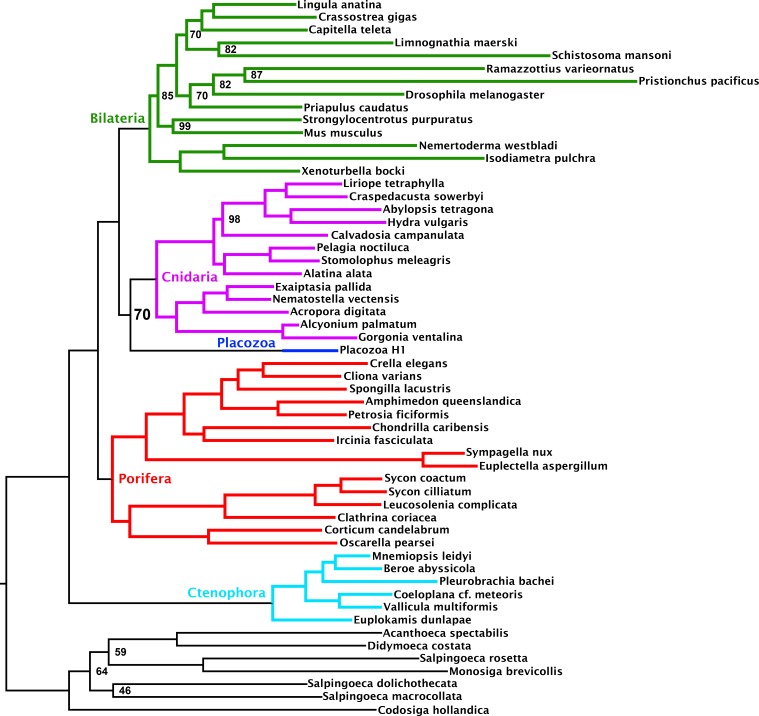
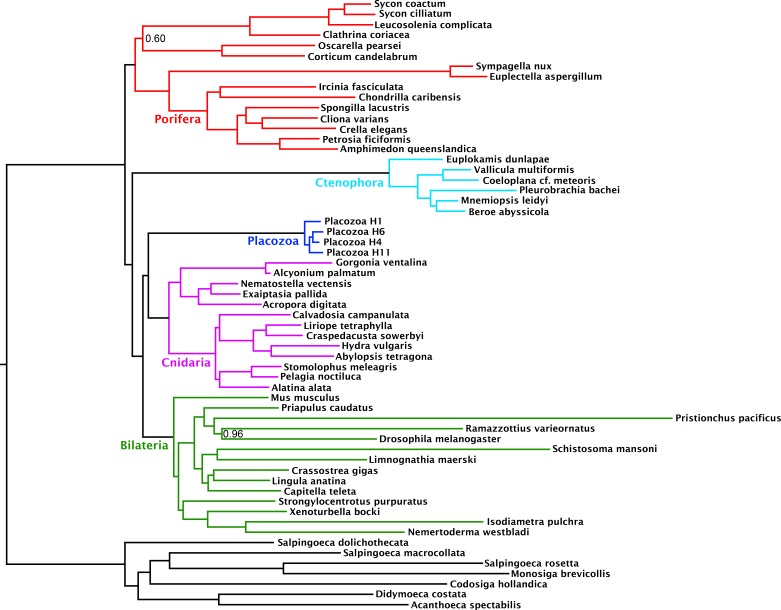
Verification
Claims the paper makes
The claims and statistics of this paper haven’t been checked yet.
Run the check — free, no account needed. It reads the open-access text and checks the sources it cites.
Claims other papers make about this one
Each is checked against this paper’s own text: does it say what the citing paper says it does?
The cited source says what the claim attributes to it.
In the citing paper
“The RL2 findings also support recent efforts pairing recoding and site-heterogeneous models to resolve difficult, ancient nodes in animal phylogeny5,9,24,33, despite the erosion of data relevant to more shallow nodes.”
From Evidence for sponges as sister to all other animals from partitioned phylogenomics with mixture models and recoding (2021) · cites this paper as [33]
The cited source says what the claim attributes to it.
In the citing paper
“We also recovered Placozoa as sister to Cnidaria in our recoded analyses of the WEA15 dataset (RL1 UFBOOT = 54%; RL2 UFBOOT = 90%) (Supplementary Fig. 22), in-line with the proposal that compositional heterogeneity obscures this relationship33.”
From Evidence for sponges as sister to all other animals from partitioned phylogenomics with mixture models and recoding (2021) · cites this paper as [33]
The cited source says what the claim attributes to it.
In the citing paper
“Interestingly, some recent studies have reported Placozoa as sister to Cnidaria (sometimes paired with Ctenophora second) when minimizing compositional heterogeneity5,33, and we have also recovered some support for this (RL2 analysis of WEA15 dataset) (Fig. 3c).”
From Evidence for sponges as sister to all other animals from partitioned phylogenomics with mixture models and recoding (2021) · cites this paper as [33]
Self-check
Percentages, sums and reported differences re-computed from the paper’s own numbers.
The self-check needs the paper’s full text.
Citations
Cites
STAR: ultrafast universal RNA-seq aligner
Dobin, A., Davis, C. A., Schlesinger, F., Drenkow, J., Zaleski, C., Jha, S., Batut, P., Chaisson, M., & Gingeras, T. R. (2013) · Bioinformatics · doi:10.1093/bioinformatics/bts635 · Cited by 51,709
SPAdes: A New Genome Assembly Algorithm and Its Applications to Single-Cell Sequencing
Bankevich, A., Nurk, S., Antipov, D., Gurevich, A. A., Dvorkin, M. V., Kulikov, A. S., Lesin, V. M., Nikolenko, S., Pham, S., Prjibelski, A. D., et al. (2012) · Journal of Computational Biology · doi:10.1089/cmb.2012.0021 · Cited by 26,312
FastTree 2 – Approximately Maximum-Likelihood Trees for Large Alignments
Price, M. N., Dehal, P. S., & Arkin, A. P. (2010) · PLoS ONE · doi:10.1371/journal.pone.0009490 · Cited by 14,894
BUSCO: assessing genome assembly and annotation completeness with single-copy orthologs
Simão, F. A., Waterhouse, R. M., Ioannidis, P., Kriventseva, E. V., & Zdobnov, E. M. (2015) · Bioinformatics · doi:10.1093/bioinformatics/btv351 · Cited by 13,344
QUAST: quality assessment tool for genome assemblies
Gurevich, A., Saveliev, V., Vyahhi, N., & Tesler, G. (2013) · Bioinformatics · doi:10.1093/bioinformatics/btt086 · Cited by 11,172
UFBoot2: Improving the Ultrafast Bootstrap Approximation
Hoang, D. T., Chernomor, O., von Haeseler, A., Minh, B. Q., & Vinh, L. S. (2018) · Molecular Biology and Evolution · doi:10.1093/molbev/msx281 · Cited by 10,881
Haas, B. J., Papanicolaou, A., Yassour, M., Grabherr, M., Blood, P. D., Bowden, J., Couger, M. B., Eccles, D., Li, B., Lieber, M., et al. (2013) · Nature Protocols · doi:10.1038/nprot.2013.084 · Cited by 8,464
Emms, D. M., & Kelly, S. (2015) · Genome Biology · doi:10.1186/s13059-015-0721-2 · Cited by 3,408
Animals in a bacterial world, a new imperative for the life sciences
McFall‐Ngai, M., Hadfield, M. G., Bosch, T. C. G., Carey, H. V., Domazet‐Lošo, T., Douglas, A. E., Dubilier, N., Eberl, G., Fukami, T., Gilbert, S. F., et al. (2013) · Proceedings of the National Academy of Sciences · doi:10.1073/pnas.1218525110 · Cited by 2,879
Self-citation
Research works printed but not linked: 3
- Bütschli, 1884, Bemerkungen zur Gastraea-Theorie, Morphologisches Jahrbuch, 9, 415
- Grell, 1971, Die Ultrastruktur Von Trichoplax adhaerens F. E. Schultze, Cytobiologie, 4, 216
- Grell, 1991, Placozoa. in Microscopic Anatomy of Invertebrates
Cited by
Sorted by citations
Revisiting metazoan phylogeny with genomic sampling of all phyla
Laumer, C. E., Fernández, R., Lemer, S., Combosch, D., Kocot, K. M., Riesgo, A., Andrade, S. C. S., Sterrer, W., Sørensen, M. V., & Giribet, G. (2019) · Proceedings of the Royal Society B: Biological Sciences · doi:10.1098/rspb.2019.0831 · Cited by 360
Self-citationIncongruence in the phylogenomics era
Steenwyk, J. L., Li, Y., Zhou, X., Shen, X., & Rokas, A. (2023) · Nature Reviews Genetics · doi:10.1038/s41576-023-00620-x · Cited by 292
Gene gain and loss across the metazoan tree of life
Fernández, R., & Gabaldón, T. (2020) · Nature Ecology & Evolution · doi:10.1038/s41559-019-1069-x · Cited by 165
Ballesteros, J. A., & Sharma, P. P. (2019) · Systematic Biology · doi:10.1093/sysbio/syz011 · Cited by 167
Redmond, A. K., & McLysaght, A. (2021) · Nature Communications · doi:10.1038/s41467-021-22074-7 · Cited by 139
Metadata
- Authors
- Laumer, C. E., Gruber-Vodicka, H., Hadfield, M. G., Pearse, V. B., Riesgo, A., Marioni, J. C., & Giribet, G.
- Affiliations
- European Bioinformatics Institute (GB)
- Max Planck Institute for Marine Microbiology, Bremen, Germany
- University of Hawaiʻi at Mānoa (US)
- University of California, Santa Cruz (US)
- Natural History Museum (GB)
- Harvard University (US)
- Corresponding author
- Laumer, Christopher E
- ORCID
- Venue
- eLife
- Publisher
- eLife Sciences Publications, Ltd
- Published
- 2018-10-30
- Volume
- 7
- ISSN
- 2050-084X (ISSN-L)
- PMC
- PMC6277202
- OpenAlex
- W2898892386
- Cited by
- 112
- References
- 104
- Citations by year
- 2026: 5 · 2025: 11 · 2024: 9 · 2023: 13 · 2022: 13 · 2021: 27 · 2020: 18 · 2019: 14 · 2018: 2
- FWCI
- 11.22
- Type
- journal article
- Language
- en
- Open access
- gold
- doi.org
- Licence
- Locations
- eLife (publishedVersion, cc-by)
- bioRxiv (Cold Spring Harbor Laboratory) (acceptedVersion, cc-by-nc)
- Europe PMC (PubMed Central) (publishedVersion, cc-by)
- PubMed Central (publishedVersion, cc-by)
- PubMed (publishedVersion)
- DOAJ (DOAJ: Directory of Open Access Journals) (submittedVersion, cc-by-sa)
- MPG.PuRe (Max Planck Society) (submittedVersion, other-oa)
- Apollo (University of Cambridge) (submittedVersion, cc-by)
- Apollo (cc-by)
- Funders
- Max-Planck-Institut fuer Marine Microbiologie
- European Bioinformatics Institute
- Harvard University (Faculty of Arts and Sciences)
- Topics
- Life Sciences › Agricultural and Biological Sciences › Animal Science and Zoology › Marine Invertebrate Physiology and Ecology
- Life Sciences › Biochemistry, Genetics and Molecular Biology › Molecular Biology › Genomics and Phylogenetic Studies
- Life Sciences › Agricultural and Biological Sciences › Ecology, Evolution, Behavior and Systematics › Protist diversity and phylogeny
- Keywords
- Placozoa, Cnidaria, animal phylogeny, compositional heterogeneity, early animal evolution, sister group relationships
- MeSH terms
- Animals, Base Composition, Bayes Theorem, Cnidaria, Models, Genetic, Phylogeny, Bias, Likelihood Functions, Metagenome, Placozoa
About these checks
Registry, retraction, Cites and statistics results are computed, not judged, with one exception: a printed reference that no index lists is read once by a model before it counts as a citation error. Claims are extracted by a model and kept only when their quote appears verbatim in the text; each cited source is then checked, with a model’s help, for whether it says what the claim relies on. Those verdicts can be wrong — read the claim’s quote and the cited source before relying on one.
Statistics and arithmetic are recomputed, not judged.
Confidence bands are shown only for fields calibrated on our annotated test set. None is calibrated yet, so no band is shown.
What counts as a claim ›How we measure confidence ›How we check this ›
Are you an author, or do you see a problem with this page? Request a review
