Cited by 10

The DOI matches its Crossref record; 1 of the 1 references it cites were found in a registry or an index.

Widespread mermithid nematode parasitism of Cretaceous insects

Luo, Cihang, Poinar, George O, Xu, Chunpeng, Zhuo, De, Jarzembowski, Edmund A, Wang, Bo·2023·eLife

Published version of a preprint

Abstract

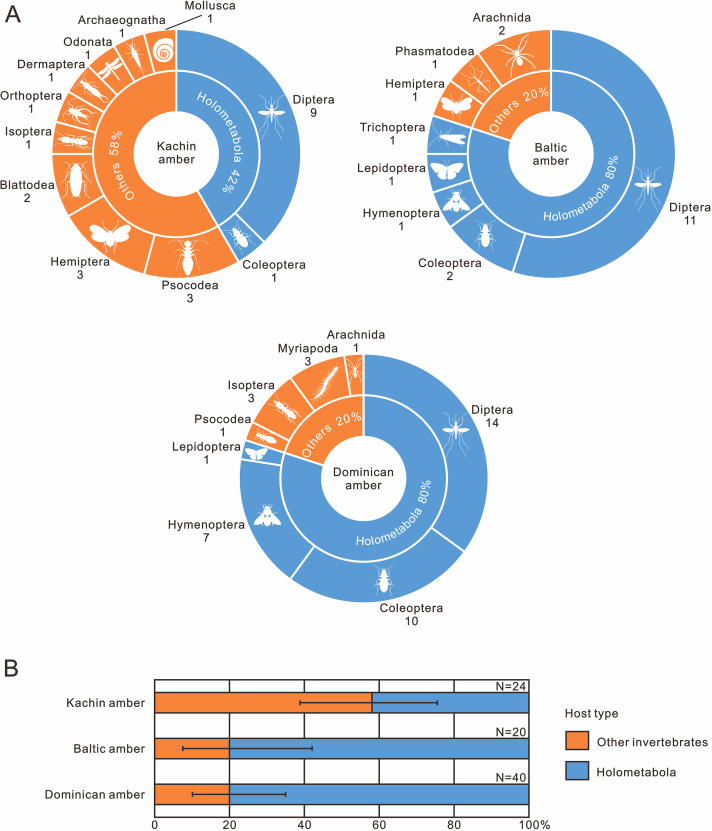
Mermithid nematodes are obligate invertebrate parasites dating back to the Early Cretaceous. Their fossil record is sparse, especially before the Cenozoic, thus little is known about their early host associations. This study reports 16 new mermithids associated with their insect hosts from mid-Cretaceous Kachin amber, 12 of which include previously unknown hosts. These fossils indicate that mermithid parasitism of invertebrates was already widespread and played an important role in the mid-Cretaceous terrestrial ecosystem. Remarkably, three hosts (bristletails, barklice, and perforissid planthoppers) were previously unknown to be parasitized by mermithids both past and present. Furthermore, our study shows that in contrast to their Cenozoic counterparts, Cretaceous nematodes including mermithids are more abundant in non-holometabolous insects. This result suggests that nematodes had not completely exploited the dominant Holometabola as their hosts until the Cenozoic. This study reveals what appears to be a vanished history of nematodes that parasitized Cretaceous insects.

Overview

The claims and statistics of this paper haven’t been checked yet.

Run the check — free, no account needed. It reads the open-access text and checks the sources it cites.

A few free checks a day · papers already verified open instantly · results are public

Integrity signals

Registry

Crossref · 10.7554/elife.86283

Cites

1 of 1 references verified0 citation errors · 0 not checkable

Statistics

Figures

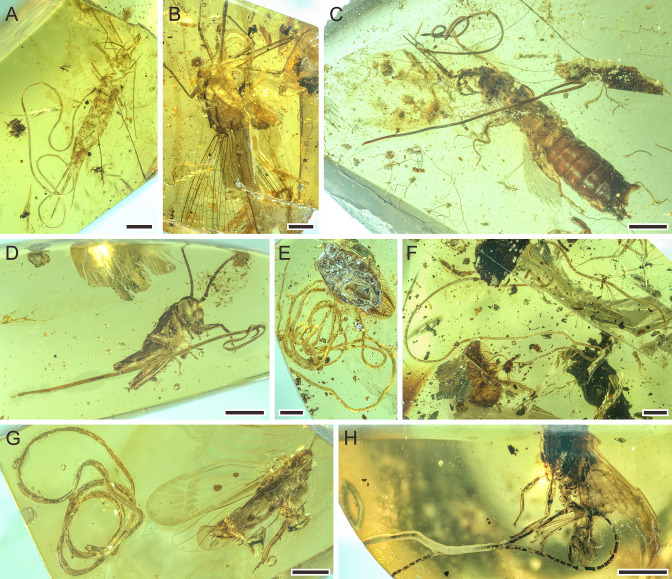
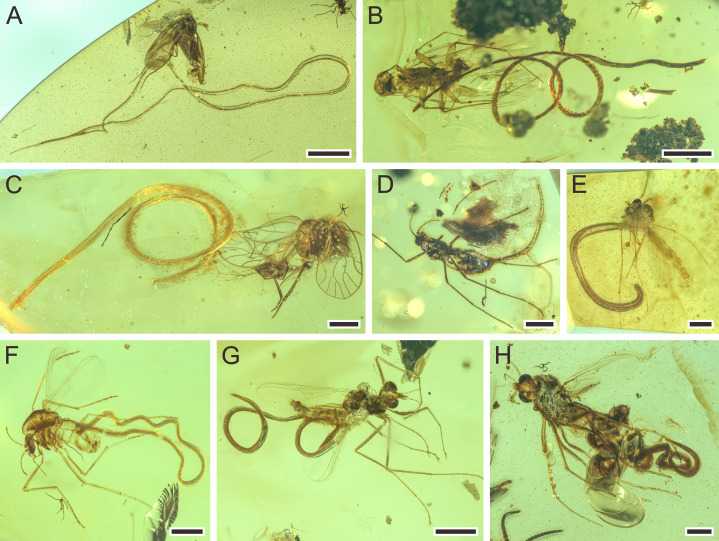
Figure 1. Mermithids and their insect hosts from mid-Cretaceous Kachin amber (~99 Ma; million years ago). (A) Cretacimermis incredibilis sp. nov. (holotype) adjacent to its bristletail host. (B) Cretacimermis calypta sp. nov. (holotype) adjacent to its damselfly host. (C) Two separate specimens of Cretacimermis adelphe sp. nov. (upper specimen is holotype) that have emerged from their earwig host. (D) Cretacimermis directa sp. nov. (holotype) adjacent to its cricket host. (E) Cretacimermis longa sp. nov. (holotype) adjacent to its adult cockroach host. (F) Cretacimermis longa sp. nov. (paratype) adjacent to its juvenile cockroach host. (G) Cretacimermis perforissi sp. nov. (holotype) adjacent to its perforissid planthopper host. (H) Cretacimeris perforissi sp. nov. (paratype) adjacent to second perforissid planthopper. Scale bars = 2.0 mm (B, E, F), 1.0 mm (A, C, D, G), 0.5 mm (H).
Figure 1. Mermithids and their insect hosts from mid-Cretaceous Kachin amber (~99 Ma; million years ago). (A) Cretacimermis incredibilis sp. nov. (holotype) adjacent to its bristletail host. (B) Cretacimermis calypta sp. nov. (holotype) adjacent to its damselfly host. (C) Two separate specimens of Cretacimermis adelphe sp. nov. (upper specimen is holotype) that have emerged from their earwig host. (D) Cretacimermis directa sp. nov. (holotype) adjacent to its cricket host. (E) Cretacimermis longa sp. nov. (holotype) adjacent to its adult cockroach host. (F) Cretacimermis longa sp. nov. (paratype) adjacent to its juvenile cockroach host. (G) Cretacimermis perforissi sp. nov. (holotype) adjacent to its perforissid planthopper host. (H) Cretacimeris perforissi sp. nov. (paratype) adjacent to second perforissid planthopper. Scale bars = 2.0 mm (B, E, F), 1.0 mm (A, C, D, G), 0.5 mm (H).CC BY · PubMed Central
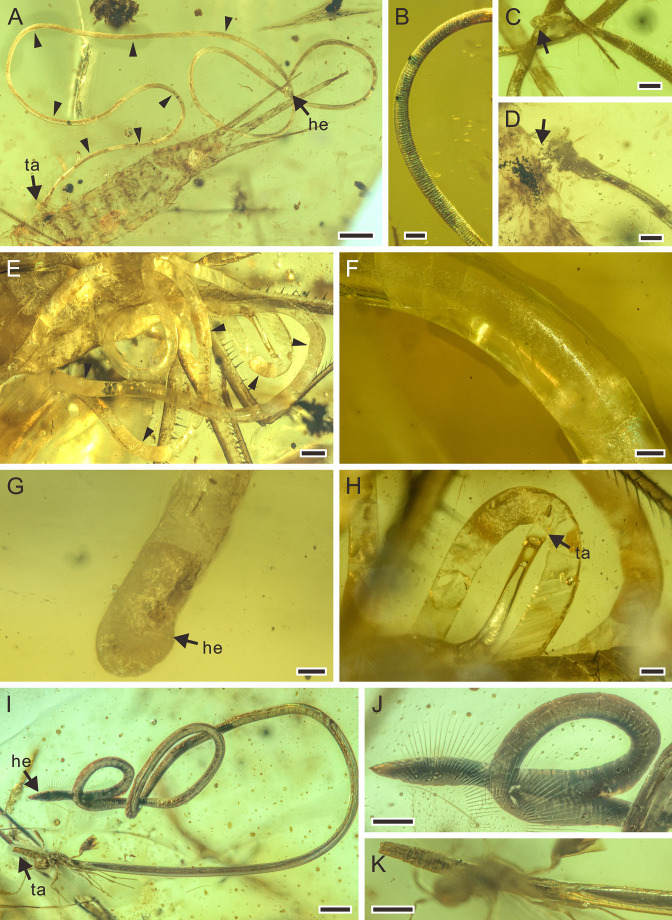
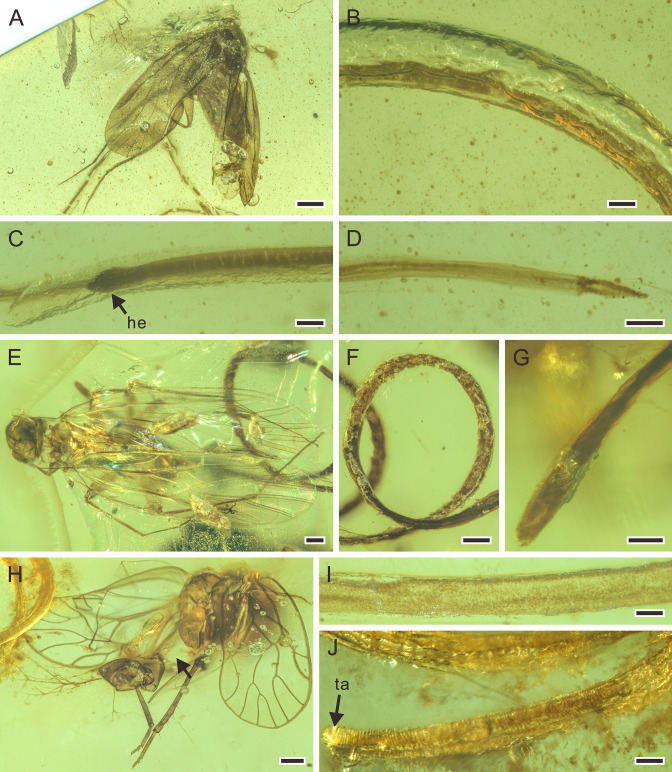
Figure 2. Detailed photographs of Cretacimermis incredibilis sp. nov., holotype, NIGP201872 (A–D), Cretacimermis calypta sp. nov., holotype, NIGP201870 (E–H), and Cretacimermis adelphe sp. nov. (upper specimen is holotype and lower specimen is paratype), NIGP201876 (I–K). (A) Habitus of C. incredibilis, some trophosome remains are marked by triangular black arrows. (B) Fine ridges in areas of body bends. (C) Head (arrowed). (D) Tail and the exit wound on the host (arrowed). (E) Habitus except head part of C. calypta, some trophosome remains are marked by triangular black arrows. (F) Detail of body. (G) Head. (H) Tail. (I) Habitus of upper specimen (holotype), opaque body and pointed head. (J) Detail of head. (K) Detail of tail. Scale bars = 0.5 mm (A, E), 0.2 mm (H, I), 0.1 mm (B–D, F, G, J, K). Abbreviations: he, head; ta, tail.
Figure 2. Detailed photographs of Cretacimermis incredibilis sp. nov., holotype, NIGP201872 (A–D), Cretacimermis calypta sp. nov., holotype, NIGP201870 (E–H), and Cretacimermis adelphe sp. nov. (upper specimen is holotype and lower specimen is paratype), NIGP201876 (I–K). (A) Habitus of C. incredibilis, some trophosome remains are marked by triangular black arrows. (B) Fine ridges in areas of body bends. (C) Head (arrowed). (D) Tail and the exit wound on the host (arrowed). (E) Habitus except head part of C. calypta, some trophosome remains are marked by triangular black arrows. (F) Detail of body. (G) Head. (H) Tail. (I) Habitus of upper specimen (holotype), opaque body and pointed head. (J) Detail of head. (K) Detail of tail. Scale bars = 0.5 mm (A, E), 0.2 mm (H, I), 0.1 mm (B–D, F, G, J, K). Abbreviations: he, head; ta, tail.CC BY · PubMed Central
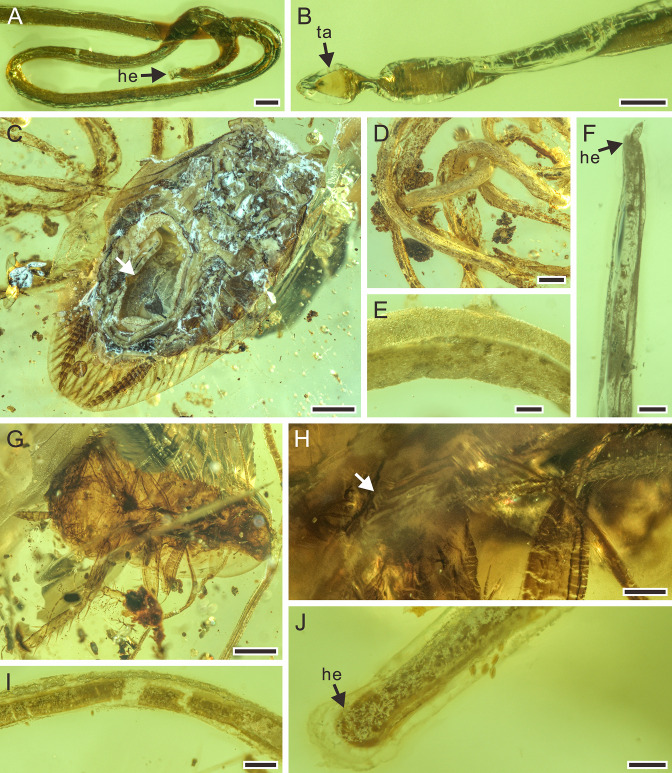
Figure 3. Detailed photographs of Cretacimermis directa sp. nov., holotype, NIGP201873 (A, B) and Cretacimermis longa sp. nov., holotype, NIGP201875 (C–F), paratype, NIGP201877 (G–J). (A) Detail of head. (B) Detail of tail. (C) Host, an adult of Mesoblattinidae (Blattodea), note the hollow abdomen (arrowed) that probably contained the developing nematode. (D) Detail of body. (E) Enlarged details of body. (F) Head. (G) Host, a juvenile of Mesoblattinidae (Blattodea). (H) The termination of the nematode, note the mermithid was in the process of emerging from the host’s body (arrowed). (I) Detail of body. (J) Head, showing loose outer cuticle. Scale bars = 1.0 mm (C, G), 0.5 mm (D), 0.2 mm (H, I), 0.1 mm (A, B, E, F, J). Abbreviations: he, head; ta, tail.
Figure 3. Detailed photographs of Cretacimermis directa sp. nov., holotype, NIGP201873 (A, B) and Cretacimermis longa sp. nov., holotype, NIGP201875 (C–F), paratype, NIGP201877 (G–J). (A) Detail of head. (B) Detail of tail. (C) Host, an adult of Mesoblattinidae (Blattodea), note the hollow abdomen (arrowed) that probably contained the developing nematode. (D) Detail of body. (E) Enlarged details of body. (F) Head. (G) Host, a juvenile of Mesoblattinidae (Blattodea). (H) The termination of the nematode, note the mermithid was in the process of emerging from the host’s body (arrowed). (I) Detail of body. (J) Head, showing loose outer cuticle. Scale bars = 1.0 mm (C, G), 0.5 mm (D), 0.2 mm (H, I), 0.1 mm (A, B, E, F, J). Abbreviations: he, head; ta, tail.CC BY · PubMed Central
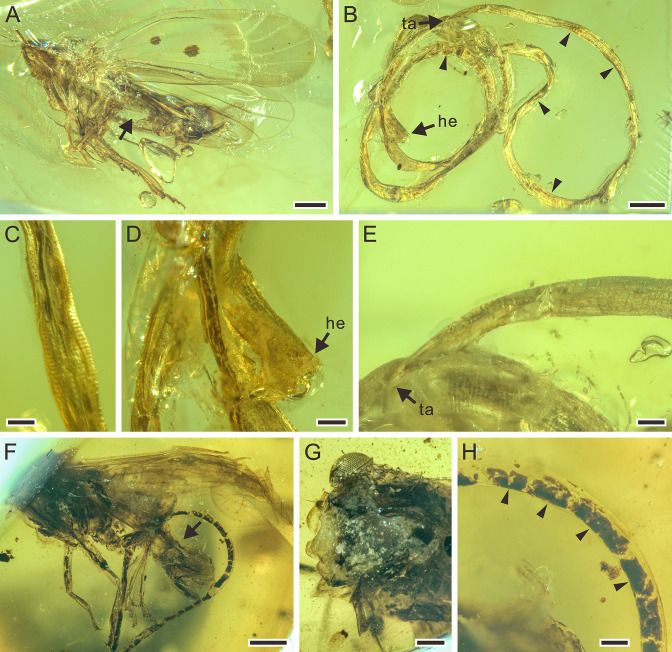
Figure 4. Detailed photographs of Cretacimermis perforissi sp. nov., holotype, NIGP201868 (A–E) and paratype, NIGP201878 (F–H). (A) Host, Perforissidae (Hemiptera: Fulgoromorpha), note the hollow abdomen (arrowed) which probably contained the developing nematode. (B) Habitus of the coiled body of C. perforissi, some trophosome remains are marked by triangular black arrows. (C) Detail of body, note artefact ridges on cuticle. (D) Head. (E) Tail. (F) Host, Perforissidae (Hemiptera: Fulgoromorpha), note the broken abdomen that is probably due to the emergence of the mermithid. (G) Front view of host, indicating it is a perforissid planthopper. (H) Detail of body, showing smooth cuticle and dark, fractured trophosomes (arrowed). Scale bars = 0.5 mm (A, B, F), 0.2 mm (G), 0.1 mm (C–E, H). Abbreviations: he, head; ta, tail.
Figure 4. Detailed photographs of Cretacimermis perforissi sp. nov., holotype, NIGP201868 (A–E) and paratype, NIGP201878 (F–H). (A) Host, Perforissidae (Hemiptera: Fulgoromorpha), note the hollow abdomen (arrowed) which probably contained the developing nematode. (B) Habitus of the coiled body of C. perforissi, some trophosome remains are marked by triangular black arrows. (C) Detail of body, note artefact ridges on cuticle. (D) Head. (E) Tail. (F) Host, Perforissidae (Hemiptera: Fulgoromorpha), note the broken abdomen that is probably due to the emergence of the mermithid. (G) Front view of host, indicating it is a perforissid planthopper. (H) Detail of body, showing smooth cuticle and dark, fractured trophosomes (arrowed). Scale bars = 0.5 mm (A, B, F), 0.2 mm (G), 0.1 mm (C–E, H). Abbreviations: he, head; ta, tail.CC BY · PubMed Central
Figure 5. Mermithids and their insect hosts from mid-Cretaceous Kachin amber. Part II. (A) Cretacimermis manicapsoci sp. nov. (holotype) adjacent to its manicapsocid barklouse host. (B) Cretacimermis manicapsoci sp. nov. (paratype) adjacent to second manicapsocid barklouse host. (C) Cretacimermis psoci sp. nov. (holotype) adjacent to its compsocid barklouse host. (D) Cretacimermis cecidomyiae sp. nov. (holotype) emerging from its gall midge (cecidomyiid) host. (E–H) Four specimens of Cretacimermis chironomae Poinar, 2011 emerging from their chironomid hosts. Scale bars = 2.0 mm (A), 1.0 mm (B), 0.5 mm (C–H).
Figure 5. Mermithids and their insect hosts from mid-Cretaceous Kachin amber. Part II. (A) Cretacimermis manicapsoci sp. nov. (holotype) adjacent to its manicapsocid barklouse host. (B) Cretacimermis manicapsoci sp. nov. (paratype) adjacent to second manicapsocid barklouse host. (C) Cretacimermis psoci sp. nov. (holotype) adjacent to its compsocid barklouse host. (D) Cretacimermis cecidomyiae sp. nov. (holotype) emerging from its gall midge (cecidomyiid) host. (E–H) Four specimens of Cretacimermis chironomae Poinar, 2011 emerging from their chironomid hosts. Scale bars = 2.0 mm (A), 1.0 mm (B), 0.5 mm (C–H).CC BY · PubMed Central
Figure 6. Detailed photographs of Cretacimermis manicapsoci sp. nov., holotype, NIGP201879 (A–D), paratype, NIGP201880 (E–G), and Cretacimermis psoci sp. nov., holotype, NIGP201874 (H–J). (A) Barklouse host, Manicapsocidae (Psocoptera). (B) Detail of body. (C) Head. (D) Tail. (E) Barklouse host, Manicapsocidae. (F) Coiled body. (G) Head. (H) Barklouse host, Compsocidae (Psocoptera), note the broken abdomen that is probably due to the emergence of the mermithid. (I) Detail of body. (J) Tail, note artefactual cuticular ridges. Scale bars = 0.5 mm (A), 0.2 mm (E, F, H), 0.1 mm (B–D, G, I, J). Abbreviations: he, head; ta, tail.
Figure 6. Detailed photographs of Cretacimermis manicapsoci sp. nov., holotype, NIGP201879 (A–D), paratype, NIGP201880 (E–G), and Cretacimermis psoci sp. nov., holotype, NIGP201874 (H–J). (A) Barklouse host, Manicapsocidae (Psocoptera). (B) Detail of body. (C) Head. (D) Tail. (E) Barklouse host, Manicapsocidae. (F) Coiled body. (G) Head. (H) Barklouse host, Compsocidae (Psocoptera), note the broken abdomen that is probably due to the emergence of the mermithid. (I) Detail of body. (J) Tail, note artefactual cuticular ridges. Scale bars = 0.5 mm (A), 0.2 mm (E, F, H), 0.1 mm (B–D, G, I, J). Abbreviations: he, head; ta, tail.CC BY · PubMed Central
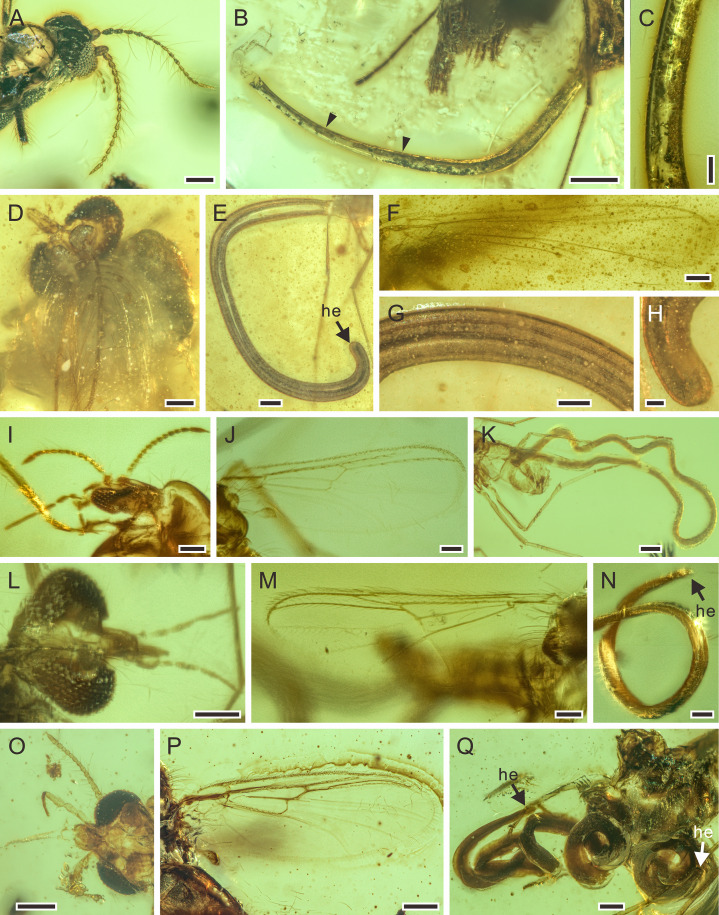
Figure 7. Mermithids and their Diptera hosts from mid-Cretaceous Kachin amber. (A–C) Cretacimermis cecidomyiae sp. nov., holotype, NIGP201871. (A) Head of cecidomyiid host. (B) Habitus of nematode, some trophosome remains are marked by triangular black arrows. (C) Detail of body. (D–H) First piece with Cretacimermis chironomae Poinar, 2011, NIGP201869. (D) Detail of head of host. (E) Habitus of nematode. (F) Forewing venation of host. (G) Detail of body. (H) Detail of head. (I–K) Second piece of C. chironomae, LYD-MD-NG001. (I) Detail of head of host. (J) Forewing venation of host. (K) Habitus of nematode, note that a portion of the mermithid is still in the host’s abdomen. (L–N) Third piece with C. chironomae, LYD-MD-NG002. (L) Detail of head of host. (M) Forewing venation of host. (N) Detail of head and body. (O–Q) Fourth piece with C. chironomae, NIGP201881. (O) Detail of head of host. (P) Forewing venation of host. (Q) Habitus of two nematodes. Scale bars = 0.2 mm (B, E, K, O–Q), 0.1 mm (A, D, F, G, I, J, L–N), 50 μm (C, H). Abbreviation: he, head.
Figure 7. Mermithids and their Diptera hosts from mid-Cretaceous Kachin amber. (A–C) Cretacimermis cecidomyiae sp. nov., holotype, NIGP201871. (A) Head of cecidomyiid host. (B) Habitus of nematode, some trophosome remains are marked by triangular black arrows. (C) Detail of body. (D–H) First piece with Cretacimermis chironomae Poinar, 2011, NIGP201869. (D) Detail of head of host. (E) Habitus of nematode. (F) Forewing venation of host. (G) Detail of body. (H) Detail of head. (I–K) Second piece of C. chironomae, LYD-MD-NG001. (I) Detail of head of host. (J) Forewing venation of host. (K) Habitus of nematode, note that a portion of the mermithid is still in the host’s abdomen. (L–N) Third piece with C. chironomae, LYD-MD-NG002. (L) Detail of head of host. (M) Forewing venation of host. (N) Detail of head and body. (O–Q) Fourth piece with C. chironomae, NIGP201881. (O) Detail of head of host. (P) Forewing venation of host. (Q) Habitus of two nematodes. Scale bars = 0.2 mm (B, E, K, O–Q), 0.1 mm (A, D, F, G, I, J, L–N), 50 μm (C, H). Abbreviation: he, head.CC BY · PubMed Central
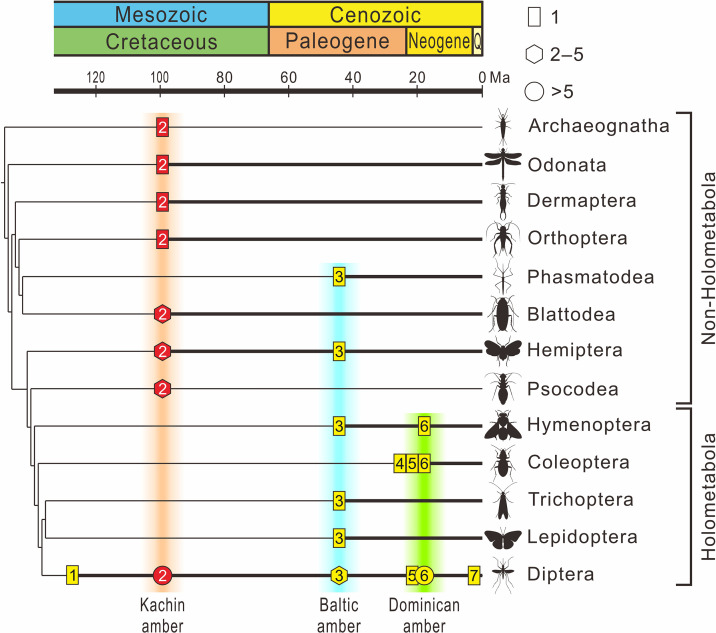
Figure 8. The fossil record of Mermithidae plotted on the phylogenetic tree of insects. The chronogram of the insect tree is modified from Misof et al., 2014 (thin black line); insect orders without a fossil record of mermithid parasitism are excluded. Thick black lines indicate the presence of mermithid parasitism. Rectangles represent the fossil number of species of mermithid not exceeding one, hexagons represent the fossil number of mermithids between two and five (inclusively), and circles represent the fossil number of mermithids more than five. Yellow coloration within the symbols represents previous records, red coloration within the symbols represents records in this paper. 1 – Lebanese amber, Early Cretaceous, approximately 135 Ma; 2 – Kachin amber, mid-Cretaceous, approximately 99 Ma; 3 – Baltic amber, Eocene, approximately 45 Ma; 4 – Rhine lignite (brown coal), Oligocene/Miocene, approximately 24 Ma; 5 – Mexican amber, Early Miocene, approximately 20 Ma; 6 – Dominican amber, Miocene, approximately 18 Ma. 7 – Willershausen, Kreis Osterode, Germany, Late Pliocene, approximately 3 Ma.
Figure 8. The fossil record of Mermithidae plotted on the phylogenetic tree of insects. The chronogram of the insect tree is modified from Misof et al., 2014 (thin black line); insect orders without a fossil record of mermithid parasitism are excluded. Thick black lines indicate the presence of mermithid parasitism. Rectangles represent the fossil number of species of mermithid not exceeding one, hexagons represent the fossil number of mermithids between two and five (inclusively), and circles represent the fossil number of mermithids more than five. Yellow coloration within the symbols represents previous records, red coloration within the symbols represents records in this paper. 1 – Lebanese amber, Early Cretaceous, approximately 135 Ma; 2 – Kachin amber, mid-Cretaceous, approximately 99 Ma; 3 – Baltic amber, Eocene, approximately 45 Ma; 4 – Rhine lignite (brown coal), Oligocene/Miocene, approximately 24 Ma; 5 – Mexican amber, Early Miocene, approximately 20 Ma; 6 – Dominican amber, Miocene, approximately 18 Ma. 7 – Willershausen, Kreis Osterode, Germany, Late Pliocene, approximately 3 Ma.CC BY · PubMed Central
Figure 9. The occurrence frequency of invertebrate–nematode associations from mid-Cretaceous Kachin amber (~99 Ma), Eocene Baltic amber (~45 Ma) and Miocene Dominican amber (~18 Ma). (A) Pie diagrams, the quantity of fossil species is indicated below the orders. (B) Stacked bar plots, error bars represent 95% binomial confidence intervals (for data, see also Table 1).
Figure 9. The occurrence frequency of invertebrate–nematode associations from mid-Cretaceous Kachin amber (~99 Ma), Eocene Baltic amber (~45 Ma) and Miocene Dominican amber (~18 Ma). (A) Pie diagrams, the quantity of fossil species is indicated below the orders. (B) Stacked bar plots, error bars represent 95% binomial confidence intervals (for data, see also Table 1).CC BY · PubMed Central

Verification

Claims the paper makes

The claims and statistics of this paper haven’t been checked yet.

Run the check — free, no account needed. It reads the open-access text and checks the sources it cites.

A few free checks a day · papers already verified open instantly · results are public

Claims other papers make about this one

Each is checked against this paper’s own text: does it say what the citing paper says it does?

Self-check

Percentages, sums and reported differences re-computed from the paper’s own numbers.

The self-check needs the paper’s full text.

Citations

Cites

Show all 1 references

Research works printed but not linked: 45

  1. Choo, 1989, Agamermis Unka (Mermithidae) Parasitism of Nilaparvata Lugens in rice fields in Korea, Journal of Nematology, 21, 254
  2. De Baets, 2015, The importance of fossils in understanding the evolution of parasites and their vectors, Advances in Parasitology, 90, 1, 10.1016/bs.apar.2015.07.001 · DOI
  3. De Baets, 2021, The Evolution and Fossil Record of Parasitism: Identification and Macroevolution of Parasites, 231, 10.1007/978-3-030-42484-8 · DOI
  4. De Baets, 2021, The Evolution and Fossil Record of Parasitism: Coevolution and Paleoparasitological Techniques, 1, 10.1007/978-3-030-52233-9 · DOI
  5. Grimaldi, 2002, Fossiliferous Cretaceous amber from Myanmar (Burma): its rediscovery, biotic diversity, and paleontological significance, American Museum Novitates, 3361, 1, 10.1206/0003-0082(2002)361<0001:FCAFMB>2.0.CO;2 · DOI
  6. Helden, 2008, First extant records of mermithid nematode parasitism of Auchenorrhyncha in Europe, Journal of Invertebrate Pathology, 99, 351, 10.1016/j.jip.2008.05.005 · DOI
  7. Hsieh, 2020, The representation of animal behaviour in the fossil record, Animal Behaviour, 169, 65, 10.1016/j.anbehav.2020.09.010 · DOI
  8. International Commission on Zoological Nomenclature, 1999, International Code of Zoological Nomenclature, 10.5962/bhl.title.50608 · DOI
  9. Labandeira, 1993, Insect diversity in the fossil record, Science, 261, 310, 10.1126/science.11536548 · DOI
  10. Labandeira, 2005, The Evolutionary Biology of Flies, 217
  11. Leung, 2017, Fossils of parasites: what can the fossil record tell us about the evolution of parasitism, Biological Reviews, 92, 410, 10.1111/brv.12238 · DOI
  12. Leung, 2021, The Evolution and Fossil Record of Parasitism: Identification and Macroevolution of Parasites, 1, 10.1007/978-3-030-42484-8 · DOI
  13. Lorenzen, 1994, The Phylogenetic Systematics of Freeliving Nematodes
  14. Misof, 2014, Phylogenomics resolves the timing and pattern of insect evolution, Science, 346, 763, 10.1126/science.1257570 · DOI · Paper page
  15. Nickle, 1972, A contribution to our knowledge of the Mermithidae (Nematoda), Journal of Nematology, 4, 113
  16. Peters, 2017, Evolutionary history of the Hymenoptera, Current Biology, 27, 1013, 10.1016/j.cub.2017.01.027 · DOI
  17. Petersen, 1985, Advances in Parasitology, 307, 10.1016/s0065-308x(08)60565-5 · DOI
  18. Poinar, 1974, Evidence of four Molts in the Mermithidae, Nematologica, 20, 10.1163/187529274X00456 · DOI
  19. Poinar, 1975, Entomogenous Nematodes: A Manual and Host List of Insect-Nematode Associations, 10.1163/9789004630888 · DOI
  20. Poinar, 1979, Nematodes for Biological Control of Insects
  21. Poinar, 1983, The Natural History of Nematodes
  22. Poinar, 1994, Earliest fossil nematode (Mermithidae) in Cretaceous Lebanese amber, Fundamental and Applied Nematology, 17, 475
  23. Poinar, 2001, Heydenius brownii sp. n. (Nematoda: Mermithidae) parasitising a planthopper (Homoptera: Achilidae) in Baltic amber, Nematology, 3, 753, 10.1163/156854101753625263 · DOI
  24. Poinar, 2001, Ecology and Classification of North American Freshwater Invertebrates, 255, 10.1016/B978-0-12-374855-3.00009-1 · DOI
  25. Poinar, 2006, Nematode (Nematoda: Mermithidae) and hairworm (Nematomorpha: Chordodidae) parasites in early Cretaceous amber, Journal of Invertebrate Pathology, 93, 36, 10.1016/j.jip.2006.04.006 · DOI
  26. Poinar, 2008, Palaeonema phyticum gen. n., sp. n. (Nematoda: Palaeonematidae fam. n.), a Devonian nematode associated with early land plants, Nematology, 10, 9, 10.1163/156854108783360159 · DOI
  27. Poinar, 2008, Mermithids (Nematoda: Mermithidae) of biting midges (Diptera: Ceratopogonidae): Heleidomermis cataloniensis n. sp. from Culicoides circumscriptus Kieffer in Spain and a species of Cretacimermis Poinar, 2001 from a ceratopogonid in Burmese amber, Systematic Parasitology, 69, 13, 10.1007/s11230-007-9091-9 · DOI
  28. Poinar, 2011, The Evolutionary History of Nematodes: As Revealed in Stone, Amber and Mummies, 10.1163/9789047428664 · DOI
  29. Poinar, 2015, Thorp and Covich’s Freshwater Invertebrates, 273, 10.1016/B978-0-12-385026-3.00014-0 · DOI
  30. Poinar, 2015, The geological record of parasitic nematode evolution, Advances in Parasitology, 90, 53, 10.1016/bs.apar.2015.03.002 · DOI · Paper page
  31. Poinar, 2017, A mermithid nematode, Cretacimermis aphidophilus sp. n. (Nematoda: Mermithidae), parasitising an aphid (Hemiptera: Burmitaphididae) in Myanmar amber: a 100 million year association, Nematology, 19, 509, 10.1163/15685411-00003063 · DOI
  32. Poinar, 2021, The Evolution and Fossil Record of Parasitism: Identification and Macroevolution of Parasites, 29, 10.1007/978-3-030-42484-8 · DOI
  33. Ross, 2023, Supplement to the Burmese (Myanmar) amber checklist and bibliography, 2022, Palaeoentomology, 6, 22, 10.11646/palaeoentomology.6.1.6 · DOI
  34. Shi, 2012, Age constraint on Burmese amber based on U–PB dating of zircons, Cretaceous Research, 37, 155, 10.1016/j.cretres.2012.03.014 · DOI
  35. Sohn, 2015, The fossil record and taphonomy of butterflies and moths (Insecta, Lepidoptera): implications for evolutionary diversity and divergence-time estimates, BMC Evolutionary Biology, 15, 10.1186/s12862-015-0290-8 · DOI
  36. Stoffolano, 1973, Host specificity of entomophilic nematodes—A review, Experimental Parasitology, 33, 263, 10.1016/0014-4894(73)90033-7 · DOI
  37. Szwedo, 2020, International Palaeoentomological Society Statement, Palaeoentomology, 3, 221, 10.11646/palaeoentomology.3.3.1 · DOI
  38. Thomas, 2020, A multigene phylogeny and timeline for Trichoptera (Insecta), Systematic Entomology, 45, 670, 10.1111/syen.12422 · DOI
  39. Thu, 2017, Myanmar: Geology, Resources and Tectonics, 497, 10.1144/M48.23 · DOI
  40. van den Hoogen, 2019, Soil nematode abundance and functional group composition at a global scale, Nature, 572, 194, 10.1038/s41586-019-1418-6 · DOI
  41. Wang, 2022, Ecological radiations of insects in the Mesozoic, Trends in Ecology & Evolution, 37, 529, 10.1016/j.tree.2022.02.007 · DOI
  42. Yeates, 2009, Nematodes as Environmental Indicators, 1, 10.1079/9781845933852.0000 · DOI
  43. Yu, 2019, An ammonite trapped in Burmese amber, PNAS, 116, 11345, 10.1073/pnas.1821292116 · DOI
  44. Zhang, 2018, Evolutionary history of Coleoptera revealed by extensive sampling of genes and species, Nature Communications, 9, 10.1038/s41467-017-02644-4 · DOI
  45. Zhang, 2020, Fungi-nematode interactions: diversity, ecology, and biocontrol prospects in agriculture, Journal of Fungi, 6, 10.3390/jof6040206 · DOI

Cited by

Sorted by citations

Metadata

Authors
Luo, C., Poinar, G. O., Xu, C., Zhuo, D., Jarzembowski, E. A., & Wang, B.
Venue
eLife
Published
2023-07-14
Volume
12
ISSN
2050-084X
Cited by
10
References
1
Language
en
Funders
  • National Natural Science Foundation of China (42125201)
  • Chinese Academy of Sciences (Strategic Priority Research Program XDB26000000)
  • Second Tibetan Plateau Scientific Expedition and Research (2019QZKK0706)
  • CAS President's International Fellowship Initiative
  • UNESCO-IUGS (IGCP Project 679)

About these checks

Registry, retraction, Cites and statistics results are computed, not judged, with one exception: a printed reference that no index lists is read once by a model before it counts as a citation error. Claims are extracted by a model and kept only when their quote appears verbatim in the text; each cited source is then checked, with a model’s help, for whether it says what the claim relies on. Those verdicts can be wrong — read the claim’s quote and the cited source before relying on one.

Statistics and arithmetic are recomputed, not judged.

Confidence bands are shown only for fields calibrated on our annotated test set. None is calibrated yet, so no band is shown.

What counts as a claim ›How we measure confidence ›How we check this ›

Are you an author, or do you see a problem with this page? Request a review