

The DOI matches its Crossref record; 1 of the 1 references it cites were found in a registry or an index.
Widespread mermithid nematode parasitism of Cretaceous insects
Published version of a preprint
Abstract
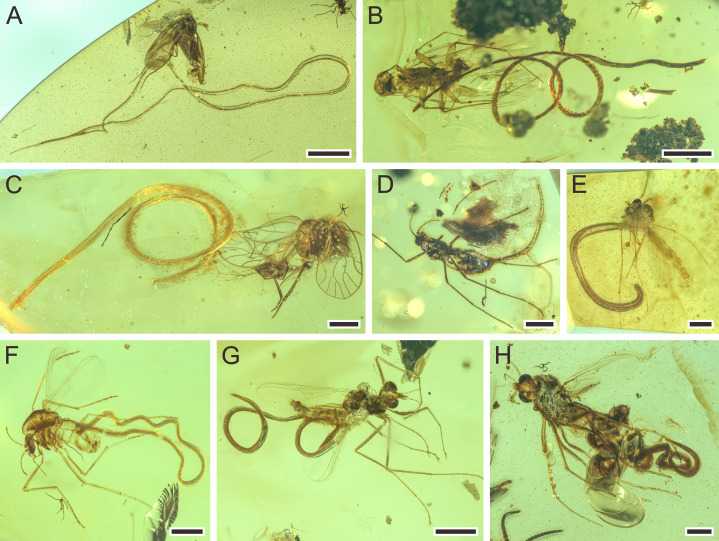
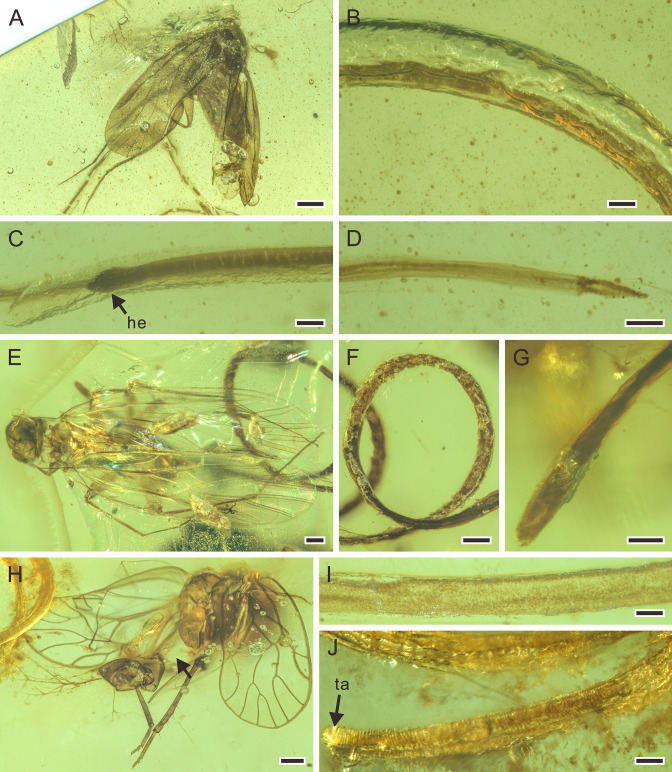
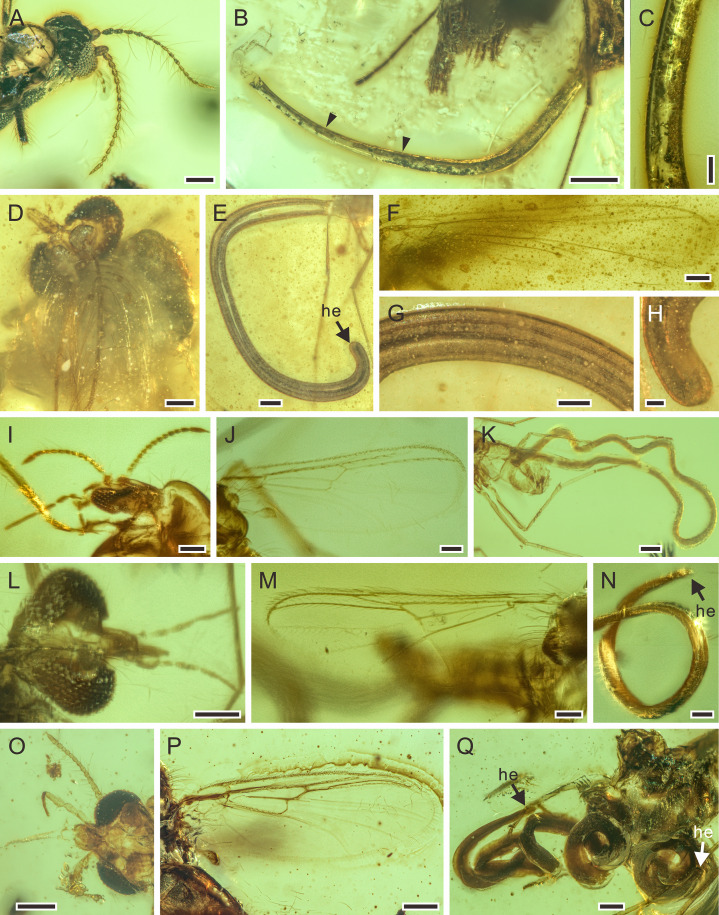
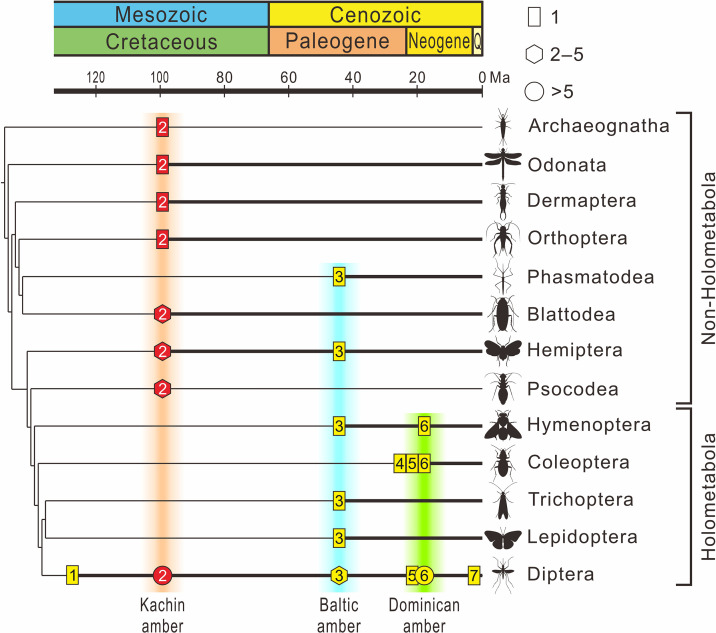
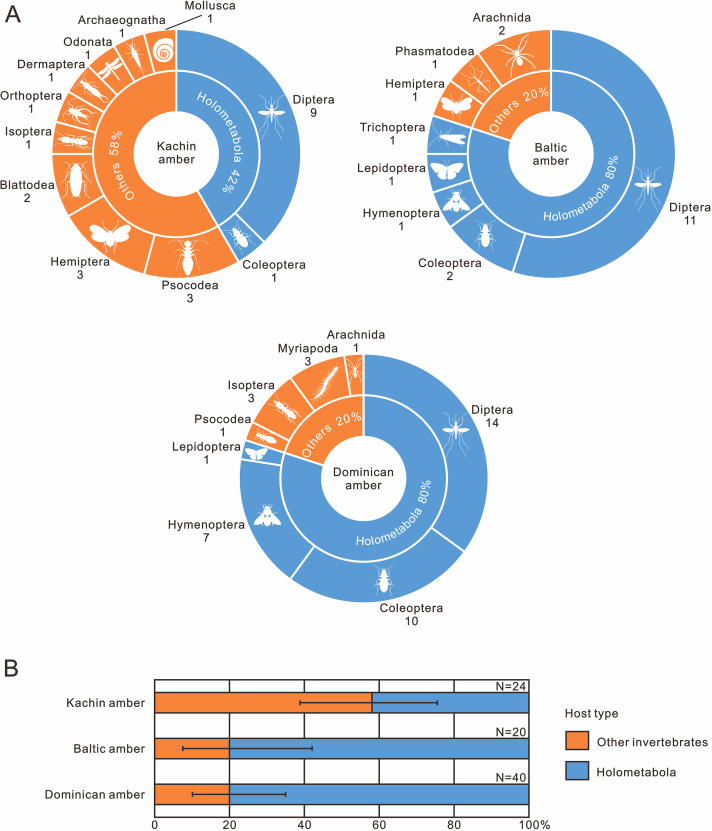
Mermithid nematodes are obligate invertebrate parasites dating back to the Early Cretaceous. Their fossil record is sparse, especially before the Cenozoic, thus little is known about their early host associations. This study reports 16 new mermithids associated with their insect hosts from mid-Cretaceous Kachin amber, 12 of which include previously unknown hosts. These fossils indicate that mermithid parasitism of invertebrates was already widespread and played an important role in the mid-Cretaceous terrestrial ecosystem. Remarkably, three hosts (bristletails, barklice, and perforissid planthoppers) were previously unknown to be parasitized by mermithids both past and present. Furthermore, our study shows that in contrast to their Cenozoic counterparts, Cretaceous nematodes including mermithids are more abundant in non-holometabolous insects. This result suggests that nematodes had not completely exploited the dominant Holometabola as their hosts until the Cenozoic. This study reveals what appears to be a vanished history of nematodes that parasitized Cretaceous insects.
Overview
The claims and statistics of this paper haven’t been checked yet.
Run the check — free, no account needed. It reads the open-access text and checks the sources it cites.
Integrity signals
Registry
Cites
Statistics
Figures
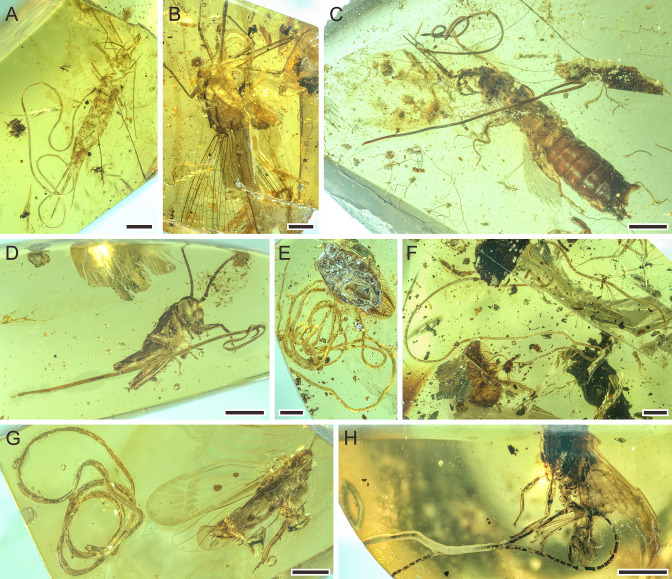
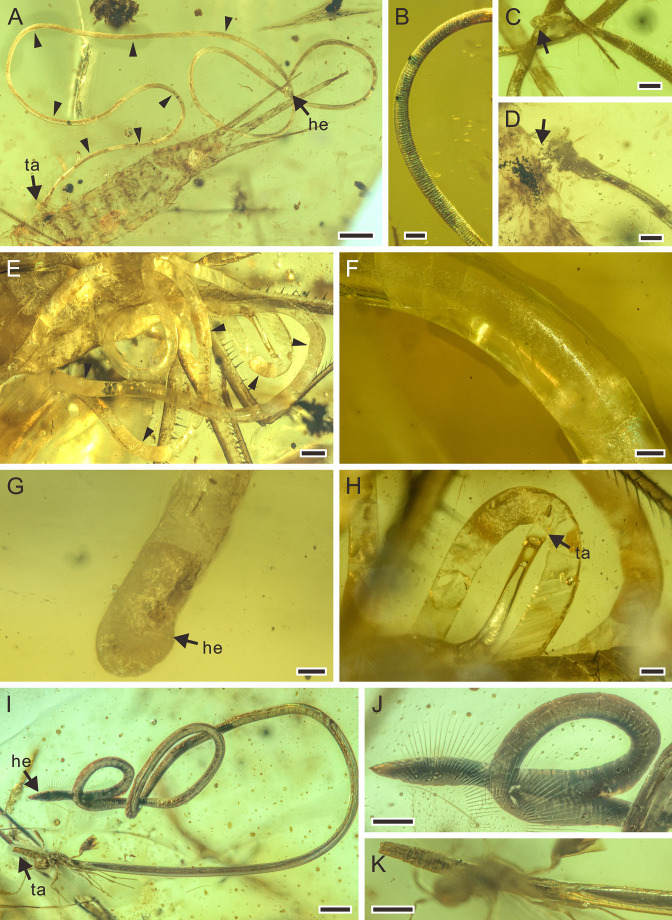
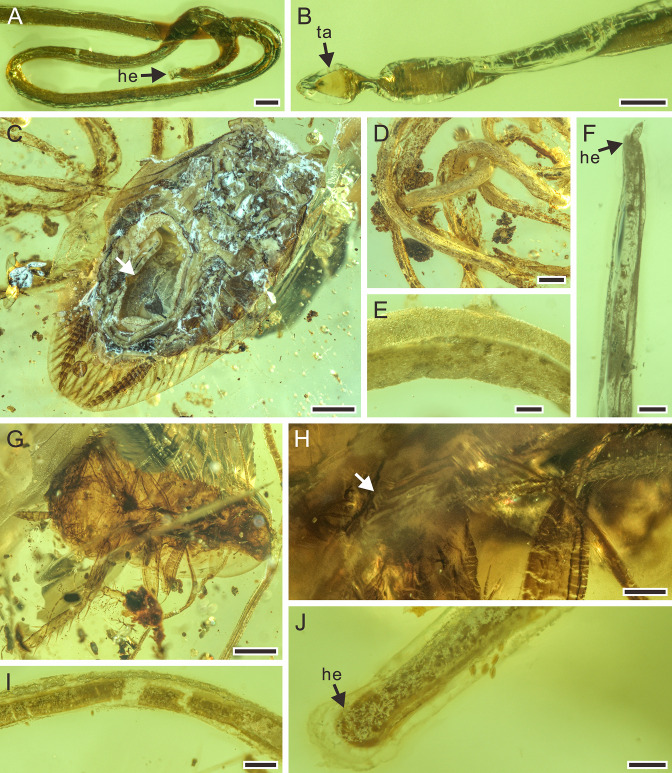
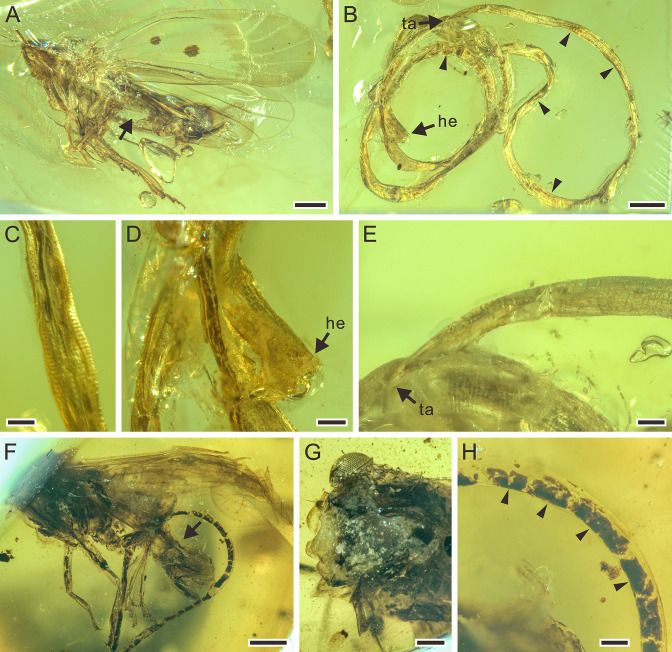
Verification
Claims the paper makes
The claims and statistics of this paper haven’t been checked yet.
Run the check — free, no account needed. It reads the open-access text and checks the sources it cites.
Claims other papers make about this one
Each is checked against this paper’s own text: does it say what the citing paper says it does?
In the citing paper
“In this context, IgE-mediated itch and local wheal-and-flare reactions may be interpreted not only as pathological allergic manifestations but also as protective responses that promote grooming, avoidance behavior, and parasite removal (Luo et al. 2023; Moats et al. 2016; Poinar 2015).”
From Parasites and allergies: a complex bidirectional relationship from evolutionary origins to modern therapeutics (2026) · cites this paper as Luo et al. 2023
Self-check
Percentages, sums and reported differences re-computed from the paper’s own numbers.
The self-check needs the paper’s full text.
Citations
Cites
Parry, L. A., Boggiani, P. C., Condon, D. J., Garwood, R. J., Leme, J. D. M., McIlroy, D., Brasier, M. D., Trindade, R., Campanha, G. A. C., Pacheco, M. L. A. F., et al. (2017) · Nature Ecology & Evolution · doi:10.1038/s41559-017-0301-9 · Cited by 160
Research works printed but not linked: 45
- Choo, 1989, Agamermis Unka (Mermithidae) Parasitism of Nilaparvata Lugens in rice fields in Korea, Journal of Nematology, 21, 254
- De Baets, 2015, The importance of fossils in understanding the evolution of parasites and their vectors, Advances in Parasitology, 90, 1, 10.1016/bs.apar.2015.07.001 · DOI
- De Baets, 2021, The Evolution and Fossil Record of Parasitism: Identification and Macroevolution of Parasites, 231, 10.1007/978-3-030-42484-8 · DOI
- De Baets, 2021, The Evolution and Fossil Record of Parasitism: Coevolution and Paleoparasitological Techniques, 1, 10.1007/978-3-030-52233-9 · DOI
- Grimaldi, 2002, Fossiliferous Cretaceous amber from Myanmar (Burma): its rediscovery, biotic diversity, and paleontological significance, American Museum Novitates, 3361, 1, 10.1206/0003-0082(2002)361<0001:FCAFMB>2.0.CO;2 · DOI
- Helden, 2008, First extant records of mermithid nematode parasitism of Auchenorrhyncha in Europe, Journal of Invertebrate Pathology, 99, 351, 10.1016/j.jip.2008.05.005 · DOI
- Hsieh, 2020, The representation of animal behaviour in the fossil record, Animal Behaviour, 169, 65, 10.1016/j.anbehav.2020.09.010 · DOI
- International Commission on Zoological Nomenclature, 1999, International Code of Zoological Nomenclature, 10.5962/bhl.title.50608 · DOI
- Labandeira, 1993, Insect diversity in the fossil record, Science, 261, 310, 10.1126/science.11536548 · DOI
- Labandeira, 2005, The Evolutionary Biology of Flies, 217
- Leung, 2017, Fossils of parasites: what can the fossil record tell us about the evolution of parasitism, Biological Reviews, 92, 410, 10.1111/brv.12238 · DOI
- Leung, 2021, The Evolution and Fossil Record of Parasitism: Identification and Macroevolution of Parasites, 1, 10.1007/978-3-030-42484-8 · DOI
- Lorenzen, 1994, The Phylogenetic Systematics of Freeliving Nematodes
- Misof, 2014, Phylogenomics resolves the timing and pattern of insect evolution, Science, 346, 763, 10.1126/science.1257570 · DOI · Paper page
- Nickle, 1972, A contribution to our knowledge of the Mermithidae (Nematoda), Journal of Nematology, 4, 113
- Peters, 2017, Evolutionary history of the Hymenoptera, Current Biology, 27, 1013, 10.1016/j.cub.2017.01.027 · DOI
- Petersen, 1985, Advances in Parasitology, 307, 10.1016/s0065-308x(08)60565-5 · DOI
- Poinar, 1974, Evidence of four Molts in the Mermithidae, Nematologica, 20, 10.1163/187529274X00456 · DOI
- Poinar, 1975, Entomogenous Nematodes: A Manual and Host List of Insect-Nematode Associations, 10.1163/9789004630888 · DOI
- Poinar, 1979, Nematodes for Biological Control of Insects
- Poinar, 1983, The Natural History of Nematodes
- Poinar, 1994, Earliest fossil nematode (Mermithidae) in Cretaceous Lebanese amber, Fundamental and Applied Nematology, 17, 475
- Poinar, 2001, Heydenius brownii sp. n. (Nematoda: Mermithidae) parasitising a planthopper (Homoptera: Achilidae) in Baltic amber, Nematology, 3, 753, 10.1163/156854101753625263 · DOI
- Poinar, 2001, Ecology and Classification of North American Freshwater Invertebrates, 255, 10.1016/B978-0-12-374855-3.00009-1 · DOI
- Poinar, 2006, Nematode (Nematoda: Mermithidae) and hairworm (Nematomorpha: Chordodidae) parasites in early Cretaceous amber, Journal of Invertebrate Pathology, 93, 36, 10.1016/j.jip.2006.04.006 · DOI
- Poinar, 2008, Palaeonema phyticum gen. n., sp. n. (Nematoda: Palaeonematidae fam. n.), a Devonian nematode associated with early land plants, Nematology, 10, 9, 10.1163/156854108783360159 · DOI
- Poinar, 2008, Mermithids (Nematoda: Mermithidae) of biting midges (Diptera: Ceratopogonidae): Heleidomermis cataloniensis n. sp. from Culicoides circumscriptus Kieffer in Spain and a species of Cretacimermis Poinar, 2001 from a ceratopogonid in Burmese amber, Systematic Parasitology, 69, 13, 10.1007/s11230-007-9091-9 · DOI
- Poinar, 2011, The Evolutionary History of Nematodes: As Revealed in Stone, Amber and Mummies, 10.1163/9789047428664 · DOI
- Poinar, 2015, Thorp and Covich’s Freshwater Invertebrates, 273, 10.1016/B978-0-12-385026-3.00014-0 · DOI
- Poinar, 2015, The geological record of parasitic nematode evolution, Advances in Parasitology, 90, 53, 10.1016/bs.apar.2015.03.002 · DOI · Paper page
- Poinar, 2017, A mermithid nematode, Cretacimermis aphidophilus sp. n. (Nematoda: Mermithidae), parasitising an aphid (Hemiptera: Burmitaphididae) in Myanmar amber: a 100 million year association, Nematology, 19, 509, 10.1163/15685411-00003063 · DOI
- Poinar, 2021, The Evolution and Fossil Record of Parasitism: Identification and Macroevolution of Parasites, 29, 10.1007/978-3-030-42484-8 · DOI
- Ross, 2023, Supplement to the Burmese (Myanmar) amber checklist and bibliography, 2022, Palaeoentomology, 6, 22, 10.11646/palaeoentomology.6.1.6 · DOI
- Shi, 2012, Age constraint on Burmese amber based on U–PB dating of zircons, Cretaceous Research, 37, 155, 10.1016/j.cretres.2012.03.014 · DOI
- Sohn, 2015, The fossil record and taphonomy of butterflies and moths (Insecta, Lepidoptera): implications for evolutionary diversity and divergence-time estimates, BMC Evolutionary Biology, 15, 10.1186/s12862-015-0290-8 · DOI
- Stoffolano, 1973, Host specificity of entomophilic nematodes—A review, Experimental Parasitology, 33, 263, 10.1016/0014-4894(73)90033-7 · DOI
- Szwedo, 2020, International Palaeoentomological Society Statement, Palaeoentomology, 3, 221, 10.11646/palaeoentomology.3.3.1 · DOI
- Thomas, 2020, A multigene phylogeny and timeline for Trichoptera (Insecta), Systematic Entomology, 45, 670, 10.1111/syen.12422 · DOI
- Thu, 2017, Myanmar: Geology, Resources and Tectonics, 497, 10.1144/M48.23 · DOI
- van den Hoogen, 2019, Soil nematode abundance and functional group composition at a global scale, Nature, 572, 194, 10.1038/s41586-019-1418-6 · DOI
- Wang, 2022, Ecological radiations of insects in the Mesozoic, Trends in Ecology & Evolution, 37, 529, 10.1016/j.tree.2022.02.007 · DOI
- Yeates, 2009, Nematodes as Environmental Indicators, 1, 10.1079/9781845933852.0000 · DOI
- Yu, 2019, An ammonite trapped in Burmese amber, PNAS, 116, 11345, 10.1073/pnas.1821292116 · DOI
- Zhang, 2018, Evolutionary history of Coleoptera revealed by extensive sampling of genes and species, Nature Communications, 9, 10.1038/s41467-017-02644-4 · DOI
- Zhang, 2020, Fungi-nematode interactions: diversity, ecology, and biocontrol prospects in agriculture, Journal of Fungi, 6, 10.3390/jof6040206 · DOI
Cited by
Sorted by citations
Packi, K., Świerczewski, D., Klimczak, S., Ochab, D., Gałęziewska, J., Gromek, P., Kruczkowska, W., Płuciennik, E., Kałuzińska-Kołat, Ż., & Kołat, D. (2026) · Antonie van Leeuwenhoek · doi:10.1007/s10482-026-02425-4
Metadata
- Authors
- Luo, C., Poinar, G. O., Xu, C., Zhuo, D., Jarzembowski, E. A., & Wang, B.
- Venue
- eLife
- Publisher
- eLife Sciences Publications, Ltd
- Published
- 2023-07-14
- Volume
- 12
- ISSN
- 2050-084X
- PMC
- PMC10348742
- Cited by
- 10
- References
- 1
- Language
- en
- Licence
- Funders
- National Natural Science Foundation of China (42125201)
- Chinese Academy of Sciences (Strategic Priority Research Program XDB26000000)
- Second Tibetan Plateau Scientific Expedition and Research (2019QZKK0706)
- CAS President's International Fellowship Initiative
- UNESCO-IUGS (IGCP Project 679)
About these checks
Registry, retraction, Cites and statistics results are computed, not judged, with one exception: a printed reference that no index lists is read once by a model before it counts as a citation error. Claims are extracted by a model and kept only when their quote appears verbatim in the text; each cited source is then checked, with a model’s help, for whether it says what the claim relies on. Those verdicts can be wrong — read the claim’s quote and the cited source before relying on one.
Statistics and arithmetic are recomputed, not judged.
Confidence bands are shown only for fields calibrated on our annotated test set. None is calibrated yet, so no band is shown.
What counts as a claim ›How we measure confidence ›How we check this ›
Are you an author, or do you see a problem with this page? Request a review
