

The DOI matches its Crossref record; 92 of the 92 references it cites were found in a registry or an index; none of the 75 sources its claims cite is checked for support yet.
The αC-β4 loop controls the allosteric cooperativity between nucleotide and substrate in the catalytic subunit of protein kinase A
Open accessPublished version of a preprint
Abstract
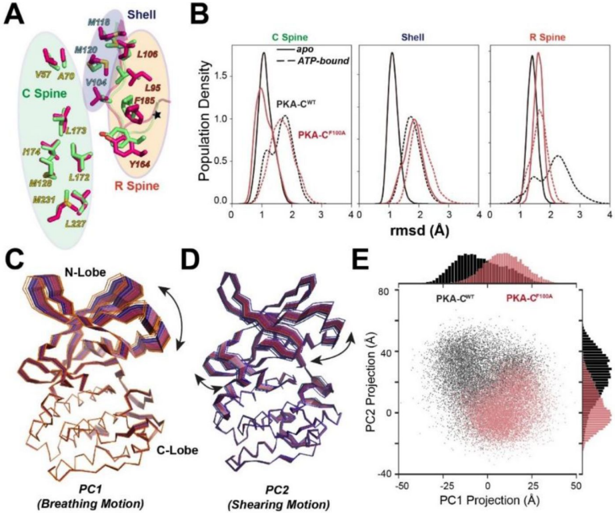
Allosteric cooperativity between ATP and substrates is a prominent characteristic of the cAMP-dependent catalytic subunit of protein kinase A (PKA-C). This long-range synergistic action is involved in substrate recognition and fidelity, and it may also regulate PKA’s association with regulatory subunits and other binding partners. To date, a complete understanding of this intramolecular mechanism is still lacking. Here, we integrated NMR(Nuclear Magnetic Resonance)-restrained molecular dynamics simulations and a Markov State Model to characterize the free energy landscape and conformational transitions of PKA-C. We found that the apoenzyme populates a broad free energy basin featuring a conformational ensemble of the active state of PKA-C (ground state) and other basins with lower populations (excited states). The first excited state corresponds to a previously characterized inactive state of PKA-C with the αC helix swinging outward. The second excited state displays a disrupted hydrophobic packing around the regulatory (R) spine, with a flipped configuration of the F100 and F102 residues at the αC-β4 loop. We validated the second excited state by analyzing the F100A mutant of PKA-C, assessing its structural response to ATP and substrate binding. While PKA-C F100A preserves its catalytic efficiency with Kemptide, this mutation rearranges the αC-β4 loop conformation, interrupting the coupling of the two lobes and abolishing the allosteric binding cooperativity. The highly conserved αC-β4 loop emerges as a pivotal element to control the synergistic binding of nucleotide and substrate, explaining how mutations or insertions near or within this motif affect the function and drug sensitivity in homologous kinases.
Overview
CoChat Summary
TL;DR
NMR-restrained molecular dynamics and Markov State Models identify a previously uncharacterized excited state (ES2) of PKA-C in which the αC-β4 loop is disrupted, and the F100A mutation validates this loop as a control element for ATP–substrate binding cooperativity. F100A preserves near-wild-type catalytic efficiency but abolishes cooperative binding between nucleotide and pseudosubstrate.
Key findings
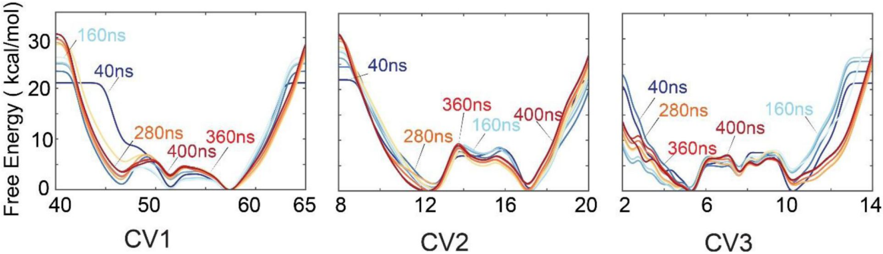
- The apo PKA-C free-energy landscape contains a dominant ground state plus low-populated excited states; MSM identifies GS, ES1 (inactive-like with αC helix swung outward), and ES2 (disrupted hydrophobic packing around the R spine, with flipped F100/F102 at the αC-β4 loop). ES2 population is 6 ± 2% by MSM, consistent with 5 ± 1% from NMR.
- Predicted methyl ¹³C chemical-shift differences between ES2 and GS agree with CEST/CPMG data: Val104 Δω Pred = 0.87 ± 0.02 ppm vs Δω Exp = 1.10 ± 0.06 ppm; Ile150 Δω Pred = 0.85 ± 0.02 ppm vs Δω Exp = 0.94 ± 0.09 ppm; linear fit slope = 0.86, R² = 0.82.
- F100A slightly reduces catalytic efficiency with Kemptide (kcat/KM = 0.50 ± 0.04 for WT vs 0.41 ± 0.08 for F100A) and has similar ATPγN affinity (Kd = 83 ± 8 μM WT vs 73 ± 2 μM F100A), but increases apo PKI5-24 affinity 3-fold (Kd = 5 ± 1 μM F100A vs 17 ± 2 μM WT). Upon ATPγN saturation, F100A shows a 12-fold reduction in PKI5-24 affinity, giving cooperativity σ ≈ 3 vs WT σ > 100.
- NMR CSP and CHESCA analyses show F100A rearranges the αC-β4 loop, attenuates ligand-induced chemical-shift responses, and produces sparser/attenuated inter-residue and community correlations, indicating disrupted allosteric communication between the N- and C-lobes.
Methods
- Computational: NMR-restrained replica-averaged metadynamics (RAM) with four replicas and backbone chemical-shift restraints, unbiased MD, adaptive sampling, Markov State Models with tICA, and kinetic Monte Carlo; simulated apo, ATP-bound, and ATP/PKI5-24-bound PKA-C starting from PDB 1ATP. Trajectories included 100 μs for apo and binary forms and 60 μs for the ternary complex; MSM used hydrophobic-core residues L95, V104, L106, M118, M120, Y164, and F185.
- Experimental: recombinant human PKA-Cα F100A was expressed and purified; ITC measured ATPγN and PKI5-24 binding; steady-state coupled enzyme assays used Kemptide; solution NMR used [¹H,¹⁵N]-WADE-TROSY-HSQC at 600/850 MHz, with CSP, CONCISE, and CHESCA analyses.
- Samples/peptides: PKA-C WT and F100A; Kemptide (LRRASLG) and PKI5-24 (TTYADFIASGRTGRRNAIHD).
Limitations
- Stated in the author response: state-of-the-art simulations fall short in sampling slow conformational interconversions, and SHIFTX prediction uncertainty for ¹³C methyl chemical shifts is large, limiting quantitative agreement between experimental and simulated excited-state chemical shifts.
- Stated in the author response: MD trajectories (>500 GB) could not be deposited in the University of Minnesota repository and are available upon request, limiting public access/reproducibility.
- Evident from the text and appended peer review: the manuscript is difficult to read even for kinase experts, and the F100A mutation does not drive the kinase into a completely inactive state (ES2) but is sufficient to abolish inter-lobe structural coupling.
Model-written summary. Check it against the paper before relying on it.
Integrity signals
Registry
Cites
Statistics
Figures






Verification
Claims the paper makes
0 Valid · 3 Not valid · 48 Not checked · 121 Own results and interpretations
A result the paper reports from its own data — it cites no other source for it, so there is none to check. The quote shows it is in the paper.
In the paper
“interrupting the structural coupling of the two lobes”
- Also stated in: § Introduction · plain
“interrupts the allosteric communication between the two lobes of the enzyme.”
§ The αC-β4 loop controls the allosteric cooperativity between nucleotide and substrate in the catalytic subunit of protein kinase A > Abstract
plainstates a cause- Asserted: passes — The authors put it forward as true.
- Checkable: passes — It can be checked against evidence.
- Load-bearing: passes — The paper’s conclusions depend on it.
- Based: passes — The paper gives a reason why it holds.
- Also stated in: § Introduction · plain
A result the paper reports from its own data — it cites no other source for it, so there is none to check. The quote shows it is in the paper.
In the paper
“This reduction is apparent for residues in the N-lobe (β2-β3 region), around the mutation site (β4), and at the C-terminal tail.”
§ The αC-β4 loop controls the allosteric cooperativity between nucleotide and substrate in the catalytic subunit of protein kinase A > NMR mapping of nucleotide/pseudosubstrate binding response
plainstates an association- Asserted: passes — The authors put it forward as true.
- Checkable: passes — It can be checked against evidence.
- Load-bearing: passes — The paper’s conclusions depend on it.
- Based: passes — The paper gives a reason why it holds.
A result the paper reports from its own data — it cites no other source for it, so there is none to check. The quote shows it is in the paper.
In the paper
“The MSM shows that the hydrophobic core of the apo PKA-C accesses three major basins.”
§ The αC-β4 loop controls the allosteric cooperativity between nucleotide and substrate in the catalytic subunit of protein kinase A > MSM reveals the conformational transitions of PKA-C from ground to high free energy (excited) states
plain- Asserted: passes — The authors put it forward as true.
- Checkable: passes — It can be checked against evidence.
- Load-bearing: passes — The paper’s conclusions depend on it.
- Based: passes — The paper gives a reason why it holds.
A result the paper reports from its own data — it cites no other source for it, so there is none to check. The quote shows it is in the paper.
In the paper
“Also, the maximum of the probability density for the ternary complex is shifted toward the left, indicating that the mutant adopts a more open structure than the corresponding wild-type enzyme.”
§ The αC-β4 loop controls the allosteric cooperativity between nucleotide and substrate in the catalytic subunit of protein kinase A > NMR mapping of nucleotide/pseudosubstrate binding response
hedgedstates a cause- Asserted: passes — The authors put it forward as true.
- Checkable: passes — It can be checked against evidence.
- Load-bearing: passes — The paper’s conclusions depend on it.
- Based: passes — The paper gives a reason why it holds.
A result the paper reports from its own data — it cites no other source for it, so there is none to check. The quote shows it is in the paper.
In the paper
“The first excited state (ES1) features a disrupted hydrophobic packing of L95, V104, and F185.”
§ The αC-β4 loop controls the allosteric cooperativity between nucleotide and substrate in the catalytic subunit of protein kinase A > MSM reveals the conformational transitions of PKA-C from ground to high free energy (excited) states
plain- Asserted: passes — The authors put it forward as true.
- Checkable: passes — It can be checked against evidence.
- Load-bearing: passes — The paper’s conclusions depend on it.
- Based: passes — The paper gives a reason why it holds.
97 more claims
Create a free account to see all 172 claims and every source verdict.
- It may state two separate claims as one. 46
- Probably not a substantial claim. 30
- The quote only partly states this claim. 3
Claims other papers make about this one
Each is checked against this paper’s own text: does it say what the citing paper says it does?
In the citing paper
“F100 is part of the αC-β4 loop and forms a critical allosteric node connecting PKA-C’s binding sites (Figure 1a) [29].”
From Allosteric binding cooperativity in kinases signaling, signalopathies, and drug development (2025) · cites this paper as [29]
In the citing paper
“A similar effect was found for the Phe100Ala mutation (PKA-CF100A).”
From Allosteric binding cooperativity in kinases signaling, signalopathies, and drug development (2025) · cites this paper as [29]
In the citing paper
“Removing the benzyl ring perturbs the kinase’s hydrophobic core and interrupts the coupling between the two lobes of PKA-C, which disrupts the binding cooperativity [29,30].”
From Allosteric binding cooperativity in kinases signaling, signalopathies, and drug development (2025) · cites this paper as [29]
Self-check
Percentages, sums and reported differences re-computed from the paper’s own numbers.
Each contradiction between two passages listed here was confirmed by an independent check.
Rated minor: it would not touch a result — a value no result rests on, a p-value that stays on the same side of the significance level, or a conflict that is clerical, resolved elsewhere in the paper, or outside its own findings.
In the paper
§ The αC-β4 loop controls the allosteric cooperativity between nucleotide and substrate in the catalytic subunit of protein kinase A > MSM reveals the conformational transitions of PKA-C from ground to high free energy (excited) states
“e.g., V103 and F185”
§ The αC-β4 loop controls the allosteric cooperativity between nucleotide and substrate in the catalytic subunit of protein kinase A > Direct correspondence between the conformationally excited states identified by MD simulations and NMR data
“We analyzed the methyl groups of L103, V104, I150, L172, and I180”
Rated minor: it would not touch a result — a value no result rests on, a p-value that stays on the same side of the significance level, or a conflict that is clerical, resolved elsewhere in the paper, or outside its own findings.
In the paper
§ The αC-β4 loop controls the allosteric cooperativity between nucleotide and substrate in the catalytic subunit of protein kinase A > IV. Replica-averaged metadynamics (RAM) simulations
“(CVII) the ϕ angles of the backbone of all the loops that are in contact with ATP (Back-close)”
§ The αC-β4 loop controls the allosteric cooperativity between nucleotide and substrate in the catalytic subunit of protein kinase A > CHEmical Shift Covariance Analysis (CHESCA)
“(B) Backbone ψ angles of loops in contact with ATP (Back-close).”
Rated minor: it would not touch a result — a value no result rests on, a p-value that stays on the same side of the significance level, or a conflict that is clerical, resolved elsewhere in the paper, or outside its own findings.
In the paper
§ The αC-β4 loop controls the allosteric cooperativity between nucleotide and substrate in the catalytic subunit of protein kinase A > MSM reveals the conformational transitions of PKA-C from ground to high free energy (excited) states
“we performed several short simulations (10 -20 ns)”
§ The αC-β4 loop controls the allosteric cooperativity between nucleotide and substrate in the catalytic subunit of protein kinase A > VII. Adaptive sampling
“whereas for the binary, each simulation lasted 30 ns”
Citations
Cites
Comparison of simple potential functions for simulating liquid water
Jorgensen, W. L., Chandrasekhar, J., Madura, J. D., Impey, R. W., & Klein, M. L. (1983) · The Journal of Chemical Physics · doi:10.1063/1.445869 · Cited by 41,298
Particle mesh Ewald: An N ⋅log( N ) method for Ewald sums in large systems
Darden, T., York, D., & Pedersen, L. (1993) · The Journal of Chemical Physics · doi:10.1063/1.464397 · Cited by 30,546
LINCS: A linear constraint solver for molecular simulations
Hess, B., Bekker, H., Berendsen, H. J. C., & Fraaije, J. G. E. M. (1997) · Journal of Computational Chemistry · doi:10.1002/(sici)1096-987x(199709)18:12<1463::aid-jcc4>3.0.co;2-h · Cited by 18,260
The PyMOL Molecular Graphics System
DeLano, W. L. (2002) · Medical Entomology and Zoology · Cited by 18,147
Canonical sampling through velocity rescaling
Bussi, G., Donadio, D., & Parrinello, M. (2007) · The Journal of Chemical Physics · doi:10.1063/1.2408420 · Cited by 18,089
NMRPipe: A multidimensional spectral processing system based on UNIX pipes
Delaglio, F., Grzesiek, S., Vuister, G., Zhu, G., Pfeifer, J., & Bax, A. (1995) · Journal of Biomolecular NMR · doi:10.1007/bf00197809 · Cited by 15,965
GROMACS 4: Algorithms for Highly Efficient, Load-Balanced, and Scalable Molecular Simulation
Hess, B., Kutzner, C., van der Spoel, D., & Lindahl, E. (2008) · Journal of Chemical Theory and Computation · doi:10.1021/ct700301q · Cited by 15,908
The protein kinase complement of the human genome
Manning, G., Whyte, D. B., Martinez, R., Hunter, T., & Sudarsanam, S. (2002) · Science · doi:10.1126/science.1075762 · Cited by 8,145
Best, R. B., Zhu, X., Shim, J., Lopes, P. E. M., Mittal, J., Feig, M., & MacKerell, A. D. (2012) · Journal of Chemical Theory and Computation · doi:10.1021/ct300400x · Cited by 4,532
Crystal Structure and Pair Potentials: A Molecular-Dynamics Study
Parrinello, M., & Rahman, A. (1980) · Physical Review Letters · doi:10.1103/physrevlett.45.1196 · Cited by 3,701
Cited by
Role of the αC-β4 loop in protein kinase structure and dynamics
Wu, J., Jonniya, N. A., Hirakis, S. P., Olivieri, C., Veglia, G., Kornev, A. P., & Taylor, S. S. (2024) · eLife · doi:10.7554/elife.91980.3 · Cited by 17
Self-citationConformational landscape adaptations enable processive phosphorylation by Src family kinases
Cui, Y., Ali, R., Clay, M. C., Rossi, P., Liu, A., Yang, D., Gough, N. R., Geiger, T. L., & Kalodimos, C. G. (2025) · Science · doi:10.1126/science.adw8310 · Cited by 13
Structure and Dynamics of the Misfolding Intermediate in the Pathogenic T183A Prion Protein Mutant
Biancaniello, C., Emendato, A., & Simone, A. D. (2025) · Journal of Chemical Theory and Computation · doi:10.1021/acs.jctc.5c00742 · Cited by 5
Diverse conformational ensembles define the shared folding-allosteric landscapes of protein kinases
Chaurasiya, D. K., & Naganathan, A. N. (2025) · Biophysical Journal · doi:10.1016/j.bpj.2025.09.035 · Cited by 4
Allosteric activation of the co-receptor BAK1 by the EFR receptor kinase initiates immune signaling
Mühlenbeck, H., Tsutsui, Y., Lemmon, M. A., Bender, K. W., & Zipfel, C. (2023) · doi:10.1101/2023.08.23.554490 · Cited by 3
Metadata
- Authors
- Olivieri, C., Wang, Y., Walker, C., Subrahmanian, M. V., Ha, K. N., Bernlohr, D., Gao, J., Camilloni, C., Vendruscolo, M., Taylor, S. S., & Veglia, G.
- Affiliations
- University of Minnesota (US)
- St. Catherine University (US)
- University of Cambridge (GB)
- University of California San Diego (US)
- Corresponding author
- Veglia, Gianluigi
- ORCID
- Venue
- eLife
- Publisher
- eLife Sciences Publications, Ltd
- Published
- 2024-06-24
- Volume
- 12
- ISSN
- 2050-084X (ISSN-L)
- PMC
- PMC11196109
- OpenAlex
- W4386763235
- Cited by
- 18
- References
- 92
- Citations by year
- 2026: 6 · 2025: 5 · 2024: 3
- FWCI
- 1.29
- Type
- journal article
- Language
- en
- Open access
- gold
- doi.org
- Licence
- cc-by
- creativecommons.org/licenses/by/4.0/ (vor)
- creativecommons.org/licenses/by/4.0/ (am)
- creativecommons.org/licenses/by/4.0/ (tdm)
- Locations
- eLife (publishedVersion, cc-by)
- eLife (submittedVersion, cc-by)
- bioRxiv (Cold Spring Harbor Laboratory) (submittedVersion, cc-by)
- PubMed Central (publishedVersion, cc-by)
- PubMed (publishedVersion)
- Archivio Istituzionale della Ricerca (Universita Degli Studi Di Milano) (submittedVersion, other-oa)
- PubMed Central (submittedVersion, cc-by)
- PubMed (submittedVersion)
- DOAJ (DOAJ: Directory of Open Access Journals) (submittedVersion)
- Apollo (University of Cambridge) (submittedVersion, cc-by)
- Funders
- National Institute of General Medical Sciences (GM100310)
- National Heart, Lung, and Blood Institute (NHLBI)
- Guangdong Pearl River Talent Program (2021QN02Y618)
- National Natural Science Foundation of China-China Academy of General Technology Joint Fund for Basic Research (22007069, 92269102)
- National Institutes of Health (100310, 144130)
- Topics
- Life Sciences › Biochemistry, Genetics and Molecular Biology › Molecular Biology › Protein Structure and Dynamics
- Life Sciences › Biochemistry, Genetics and Molecular Biology › Molecular Biology › Protein Kinase Regulation and GTPase Signaling
- Life Sciences › Biochemistry, Genetics and Molecular Biology › Molecular Biology › Receptor Mechanisms and Signaling
- Keywords
- protein kinase A catalytic subunit, allosteric cooperativity, ATP binding, substrate binding, free energy landscape, conformational change, excited states, Kemptide, kinase substrate recognition
- MeSH terms
- Adenosine Triphosphate, Allosteric Regulation, Nucleotides, Protein Binding, Protein Conformation, Substrate Specificity, Cyclic AMP-Dependent Protein Kinases, Catalytic Domain, Cyclic AMP-Dependent Protein Kinase Catalytic Subunits, Molecular Dynamics Simulation
About these checks
Registry, retraction, Cites and statistics results are computed, not judged, with one exception: a printed reference that no index lists is read once by a model before it counts as a citation error. Claims are extracted by a model and kept only when their quote appears verbatim in the text; each cited source is then checked, with a model’s help, for whether it says what the claim relies on. Those verdicts can be wrong — read the claim’s quote and the cited source before relying on one.
A language model drew the claims from the paper on 2026-11-18, under version 3 of the claim definition (model deepseek-v4.1-flash, prompt extract-v3).
A second model labelled each claim on 2026-11-18 (model jev-1.13-20260917, definition revision gold-guideline-v0.2).
Statistics and arithmetic are recomputed, not judged.
Confidence bands are shown only for fields calibrated on our annotated test set. None is calibrated yet, so no band is shown.
What counts as a claim ›How we measure confidence ›How we check this ›
Are you an author, or do you see a problem with this page? Request a review
How to cite
Cite CoChat for the checks on this page, and the paper for its own findings.
- This page
- CoChat. (2026). Citation check: The αC-β4 loop controls the allosteric cooperativity between nucleotide and substrate in the catalytic subunit of protein kinase A. https://app.cochat.ai/papers/10.7554/elife.91506.3
- The paper
- Olivieri, C., Wang, Y., Walker, C., Subrahmanian, M. V., Ha, K. N., Bernlohr, D., Gao, J., Camilloni, C., Vendruscolo, M., Taylor, S. S., & Veglia, G. (2024). The αC-β4 loop controls the allosteric cooperativity between nucleotide and substrate in the catalytic subunit of protein kinase A. eLife. https://doi.org/10.7554/elife.91506.3
Data sources
Bibliographic data: Semantic Scholar, OpenAlex, Crossref.
Contains information from the Semantic Scholar Academic Graph Datasets, made available under the ODC Attribution License (ODC-BY 1.0).
Semantic Scholar’s data is described in: Kinney, R., et al. (2023). The Semantic Scholar Open Data Platform. arXiv:2301.10140.
