

Virtual care use before and during the COVID-19 pandemic: a repeated cross-sectional study
Open accessThe DOI matches its Crossref record; 24 of the 24 references it cites were found in a registry or an index.
Abstract
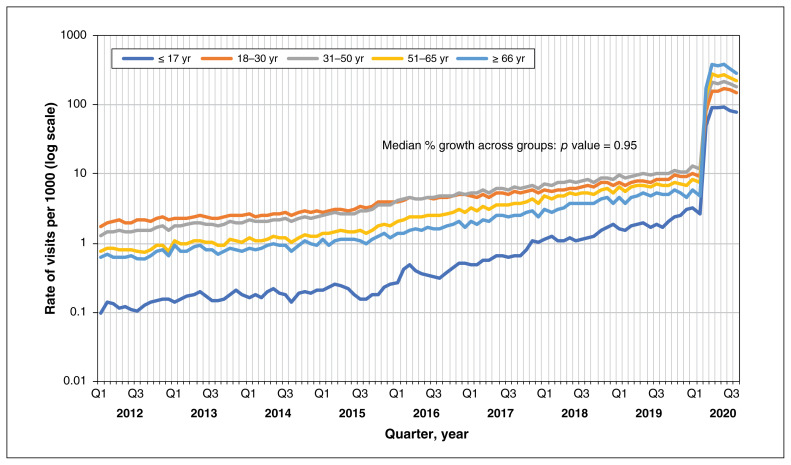
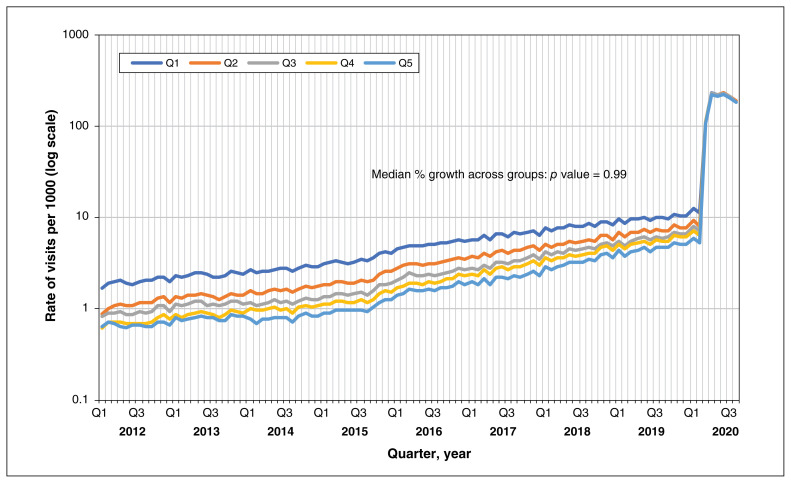
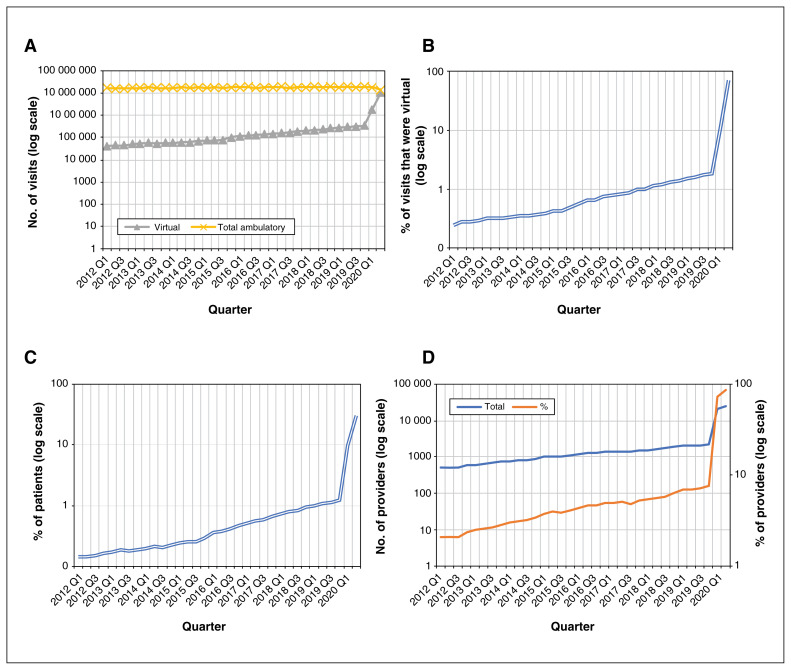
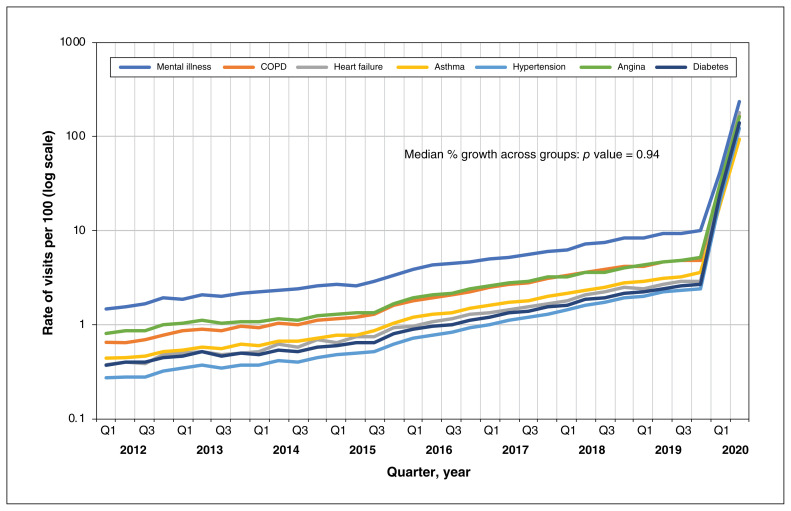
BACKGROUND: The coronavirus disease 2019 (COVID-19) pandemic is thought to have increased use of virtual care, but population-based studies are lacking. We aimed to assess the uptake of virtual care during the COVID-19 pandemic using comprehensive population-based data from Ontario. METHODS: This was a repeated cross-sectional study design. We used administrative data to evaluate changes in in-person and virtual visits among all residents of Ontario before (2012-2019) and during (January-August 2020) the COVID-19 pandemic. We included all patients who had an ambulatory care visit in Ontario. We excluded claims for patients who were not Ontario residents or had an invalid or missing health card number. We compared monthly or quarterly virtual care use across age groups, neighbourhood income quintiles and chronic disease subgroups. We also examined physician characteristics that may have been associated with virtual care use. RESULTS: Among all residents of Ontario (population 14.6 million), virtual care increased from 1.6% of total ambulatory visits in the second quarter of 2019 to 70.6% in the second quarter of 2020. The proportion of physicians who provided 1 or more virtual visits per year increased from 7.0% in the second quarter of 2019 to 85.9% in the second quarter of 2020. The proportion of Ontarians who had a virtual visit increased from 1.3% in 2019 to 29.2% in 2020. Older patients were the highest users of virtual care. The proportion of total virtual visits that were provided to patients residing in rural areas (v. urban areas) declined significantly between 2012 and 2020, reflecting a shift in virtual care to a service increasingly used in urban centres. The rates of virtual care use increased similarly across all conditions and across all income quintiles. INTERPRETATION: Our findings show that Ontario's approach to virtual care led to broad adoption across all provider groups, patient age, types of chronic diseases and neighborhood income. These findings have policy implications, including use of virtual care billing codes, for the ongoing use of virtual care during the second wave of the pandemic and beyond.
Overview
The claims and statistics of this paper haven’t been checked yet.
Free: it reads the open-access text and checks the first 5 claims that cite a source we can check. Create a free account to check every claim.
Integrity signals
Registry
Cites
Statistics
Figures
Verification
Claims the paper makes
The claims and statistics of this paper haven’t been checked yet.
Free: it reads the open-access text and checks the first 5 claims that cite a source we can check. Create a free account to check every claim.
Claims other papers make about this one
Each is checked against this paper’s own text: does it say what the citing paper says it does?
The source backs part of the claim, not all of it — or backs it for a different population, condition or comparison.
In the citing paper
“According to a study, the number of people using telehealth in Ontario went from 1.6% in the second quarter of 2019 to 70.6% in the second quarter of 2020 [51].”
From Telehealth and COVID-19 Pandemic: An Overview of the Telehealth Use, Advantages, Challenges, and Opportunities during COVID-19 Pandemic (2022) · cites this paper as [51]
Experimental — accuracy not yet measuredThe source backs part of the claim, not all of it — or backs it for a different population, condition or comparison.
In the citing paper
“In Australia, a national study suggests that the COVID-19 pandemic considerably encouraged and promoted the use of telehealth and thanks to this window of opportunity, a lot of progress was made in the domain that, without that progress, telehealth use would have remained infrequent [50,51,52,53,54,55,56,57,58].”
From Telehealth and COVID-19 Pandemic: An Overview of the Telehealth Use, Advantages, Challenges, and Opportunities during COVID-19 Pandemic (2022) · cites this paper as [51]
Experimental — accuracy not yet measuredThe source backs part of the claim, not all of it — or backs it for a different population, condition or comparison.
In the citing paper
“During the COVID-19 pandemic, Canada also saw a rise in the use of telehealth services.”
From Telehealth and COVID-19 Pandemic: An Overview of the Telehealth Use, Advantages, Challenges, and Opportunities during COVID-19 Pandemic (2022) · cites this paper as [51]
Experimental — accuracy not yet measuredThe check wasn’t confident either way, so it gives no verdict — never disputed.
In the citing paper
“Again in China, a study among physicians showed a 94.6% use of telemedicine during the pandemic, with 34.1% of them having never used telemedicine before; additionally, they believed that they would never have thought of using telehealth without the obligations of COVID-19 and they were willing to continue using it [50,51].”
From Telehealth and COVID-19 Pandemic: An Overview of the Telehealth Use, Advantages, Challenges, and Opportunities during COVID-19 Pandemic (2022) · cites this paper as [51]
Experimental — accuracy not yet measuredIn the citing paper
“Again in China, a study among physicians showed a 94.6% use of telemedicine during the pandemic, with 34.1% of them having never used telemedicine before; additionally, they believed that they would never have thought of using telehealth without the obligations of COVID-19 and they were willing to continue using it [50,51].”
From Telehealth and COVID-19 Pandemic: An Overview of the Telehealth Use, Advantages, Challenges, and Opportunities during COVID-19 Pandemic (2022) · cites this paper as [51]
Self-check
Percentages, sums and reported differences re-computed from the paper’s own numbers.
The self-check needs the paper’s full text.
Citations
Cites
Hux, J. E., Ivis, F., Flintoft, V., & Bica, A. (2002) · Diabetes Care · doi:10.2337/diacare.25.3.512 · Cited by 1,290
Eberly, L. A., Kallan, M. J., Julien, H. M., Haynes, N., Khatana, S. A. M., Nathan, A. S., Snider, C., Chokshi, N. P., Eneanya, N. D., Takvorian, S. U., et al. (2020) · JAMA Network Open · doi:10.1001/jamanetworkopen.2020.31640 · Cited by 740 · cited 1×
“23 Our finding suggests otherwise.”
The Quadruple Aim: care, health, cost and meaning in work
Sikka, R., Morath, J. M., & Leape, L. (2015) · BMJ Quality & Safety · doi:10.1136/bmjqs-2015-004160 · Cited by 686
Accuracy of administrative databases in identifying patients with hypertension.
Tu, K., Campbell, N. R. C., Chen, Z., Cauch‐Dudek, K., & McAlister, F. A. (2007) · PubMed Central · Cited by 553
Twenty years of telemedicine in chronic disease management – an evidence synthesis
Wootton, R. (2012) · Journal of Telemedicine and Telecare · doi:10.1258/jtt.2012.120219 · Cited by 545 · cited 1×
“20 The observed higher use of telephone visits over video visits is in keeping with the literature, 2,21 and, in health care systems that rely on large virtual care programs, telephone calls and asynchronous messaging still represent the bulk of the virtual care provided.”
Sim, I. (2019) · New England Journal of Medicine · doi:10.1056/nejmra1806949 · Cited by 491
Alexander, G. C., Tajanlangit, M., Heyward, J., Mansour, O., Qato, D. M., & Stafford, R. S. (2020) · JAMA Network Open · doi:10.1001/jamanetworkopen.2020.21476 · Cited by 468
Kruse, C., Fohn, J., Wilson, N., Nunez Patlan, E., Zipp, S., & Mileski, M. (2020) · JMIR Medical Informatics · doi:10.2196/20359 · Cited by 295 · cited 1×
“24 Our finding that virtual care use increased similarly for all health conditions during the COVID-19 pandemic is also noteworthy.”
Reduced In-Person and Increased Telehealth Outpatient Visits During the COVID-19 Pandemic
Baum, A., Kaboli, P. J., & Schwartz, M. D. (2021) · Annals of Internal Medicine · doi:10.7326/m20-3026 · Cited by 257
Telehealthcare in COPD: a systematic review and meta-analysis on physical outcomes and dyspnea.
Lundell, S., Holmner, Å., Rehn, B., Nyberg, A., & Wadell, K. (2015) · Respiratory Medicine · doi:10.1016/j.rmed.2014.10.008 · Cited by 203
Validation of a Population-Based Algorithm to Detect Chronic Psychotic Illness
Kurdyak, P., Lin, E., Green, D., & Vigod, S. (2015) · The Canadian Journal of Psychiatry · doi:10.1177/070674371506000805 · Cited by 203
Telehealthcare for chronic obstructive pulmonary disease: Cochrane Review and meta-analysis
McLean, S., Nurmatov, U., Liu, J. L., Pagliari, C., Car, J., & Sheikh, A. (2012) · British Journal of General Practice · doi:10.3399/bjgp12x658269 · Cited by 195
Shaw, J., Jamieson, T., Agarwal, P., Griffin, B., Wong, I., & Bhatia, R. S. (2018) · Journal of Telemedicine and Telecare · doi:10.1177/1357633x17730444 · Cited by 175
Self-citationPearl, R. (2014) · Health Affairs · doi:10.1377/hlthaff.2013.1005 · Cited by 119
Telemedicine in Complex Diabetes Management
McDonnell, M. E. (2018) · Current Diabetes Reports · doi:10.1007/s11892-018-1015-3 · Cited by 104
Value of Telemonitoring and Telemedicine in Heart Failure Management
Gensini, G. F., Digital SIT (Italian Telemedicine Society), Alderighi, C., Rasoini, R., Mazzanti, M., & Casolo, G. (2017) · Cardiac failure review · doi:10.15420/cfr.2017:6:2 · Cited by 96
Ivers, N. M., Schwalm, J.-D., Bouck, Z., McCready, T., Taljaard, M., Grace, S. L., Cunningham, J., Bosiak, B., Presseau, J., Witteman, H. O., et al. (2020) · BMJ · doi:10.1136/bmj.m1731 · Cited by 77
Self-citationStamenova, V., Agarwal, P., Kelley, L., Fujioka, J., Nguyen, M., Phung, M., Wong, I., Onabajo, N., Bhatia, R. S., & Bhattacharyya, O. (2020) · BMJ Open · doi:10.1136/bmjopen-2020-037064 · Cited by 70 · cited 1×
“20 The observed higher use of telephone visits over video visits is in keeping with the literature, 2,21 and, in health care systems that rely on large virtual care programs, telephone calls and asynchronous messaging still represent the bulk of the virtual care provided.”
Self-citationCost of contact: redesigning healthcare in the age of COVID
Bhatia, R. S., Shojania, K. G., & Levinson, W. S. (2020) · BMJ Quality & Safety · doi:10.1136/bmjqs-2020-011624 · Cited by 39
Self-citationTelephone Visits Surge During the Pandemic, but Will They Last?
Jaklevic, M. C. (2020) · JAMA · doi:10.1001/jama.2020.17201 · Cited by 36
A Spatial Analysis of Asthma Prevalence in Ontario
Crighton, E., Feng, J. B., Gershon, A. S., Guan, J., & To, T. M. (2012) · Canadian Journal of Public Health · doi:10.1007/bf03404447 · Cited by 27
Simpson, A. T., Doarn, C. R., & Garber, S. J. (2020) · Journal of Policy History · doi:10.1017/s0898030619000265 · Cited by 16
Incidence of Heart Failure Among Immigrants to Ontario, Canada: A CANHEART Immigrant Study
Giuseppe, G. D., Chu, A., Tu, J. V., Shanmugasegaram, S., Liu, P. X., & Lee, D. S. (2019) · Journal of Cardiac Failure · doi:10.1016/j.cardfail.2019.03.006 · Cited by 14
General practice by smartphone
Roland, M. O. (2019) · BMJ · doi:10.1136/bmj.l4713 · Cited by 9
Cited by
The COVID-19 Pandemic and the Future of Telemedicine
OECD (2023) · OECD Health Policy Studies · doi:10.1787/ac8b0a27-en · Cited by 437
Omboni, S., Padwal, R. S., Alessa, T., Benczúr, B., Green, B. B., Hubbard, I., Kario, K., Khan, N. A., Konradi, A., Logan, A. G., et al. (2022) · Connected Health · doi:10.20517/ch.2021.03 · Cited by 370
Modifying UTAUT2 for a cross-country comparison of telemedicine adoption
Schmitz, A., Díaz-Martín, A. M., & Yagüe Guillén, M. J. (2022) · Computers in Human Behavior · doi:10.1016/j.chb.2022.107183 · Cited by 149
Rural telemedicine use before and during the COVID-19 pandemic: repeated cross-sectional study.
Chu, C., Cram, P., Pang, A., Stamenova, V., Tadrous, M., & Bhatia, R. S. (2021) · Journal of Medical Internet Research · doi:10.2196/26960 · Cited by 183
Self-citationBouabida, K., Lebouché, B., & Pomey, M.-P. (2022) · Healthcare · doi:10.3390/healthcare10112293 · Cited by 179
“…physicians showed a 94.6% use of telemedicine during the pandemic, with 34.1% of them having never used telemedicine before; additionally, they believed that they would never have thought of using telehealth without the obligations of COVID-19 and they were willing to continue using it [50,51].”
BackgroundInfluential
Metadata
- Authors
- Bhatia, R. S., Chu, C., Pang, A., Tadrous, M., Stamenova, V., & Cram, P.
- Affiliations
- University Health Network (CA)
- Corresponding author
- Bhatia, R. Sacha
- Venue
- CMAJ Open
- Publisher
- CMA Impact Inc.
- Published
- 2021-01
- Volume
- 9
- Issue
- 1
- Pages
- E107-E114
- ISSN
- 2291-0026 (ISSN-L)
- PMC
- PMC8034297
- OpenAlex
- W3130222794
- Cited by
- 272
- References
- 24
- Citations by year
- 2026: 27 · 2025: 29 · 2024: 61 · 2023: 57 · 2022: 74 · 2021: 23
- FWCI
- 46.49
- Type
- journal article
- Language
- en
- Open access
- diamond
- doi.org
- Licence
- cc-by-nc-nd
- Locations
- CMAJ Open (publishedVersion, cc-by-nc-nd)
- PubMed Central (publishedVersion, cc-by-nc-nd)
- PubMed (publishedVersion)
- Funders
- Ontario Ministry of Health and Long-Term Care
- National Institute on Aging (R01AG058878)
- Topics
- Health Sciences › Medicine › Public Health, Environmental and Occupational Health › Telemedicine and Telehealth Implementation
- Health Sciences › Medicine › Oncology › COVID-19 and healthcare impacts
- Health Sciences › Medicine › Public Health, Environmental and Occupational Health › Healthcare Systems and Technology
- Keywords
- virtual care, telemedicine, COVID-19 pandemic, outpatient visits, in-person visits, urban-rural differences, neighborhood income, chronic disease, elderly patients, Ontario
- MeSH terms
- COVID-19, Adolescent, Adult, Age Factors, Aged, Aged, 80 and over, Ambulatory Care, Cross-Sectional Studies, Female, Humans, Income, Male, Middle Aged, Ontario, Residence Characteristics, Rural Population, Urban Population, Telemedicine, Young Adult
About these checks
Registry, retraction, Cites and statistics results are computed, not judged, with one exception: a printed reference that no index lists is read once by a model before it counts as a citation error. Claims are extracted by a model and kept only when their quote appears verbatim in the text; each cited source is then checked, with a model’s help, for whether it says what the claim relies on. Those verdicts can be wrong — read the claim’s quote and the cited source before relying on one.
Statistics and arithmetic are recomputed, not judged.
Confidence bands are shown only for fields calibrated on our annotated test set. None is calibrated yet, so no band is shown.
What counts as a claim ›How we measure confidence ›How we check this ›
Are you an author, or do you see a problem with this page? Request a review
Data sources
Bibliographic data: Semantic Scholar, OpenAlex, Crossref.
Contains information from the Semantic Scholar Academic Graph Datasets, made available under the ODC Attribution License (ODC-BY 1.0).
Semantic Scholar’s data is described in: Kinney, R., et al. (2023). The Semantic Scholar Open Data Platform. arXiv:2301.10140.
