

The DOI matches its Crossref record; 40 of the 41 references it cites were found in a registry or an index.
Association of Racial/Ethnic and Gender Concordance Between Patients and Physicians With Patient Experience Ratings
Open accessAbstract
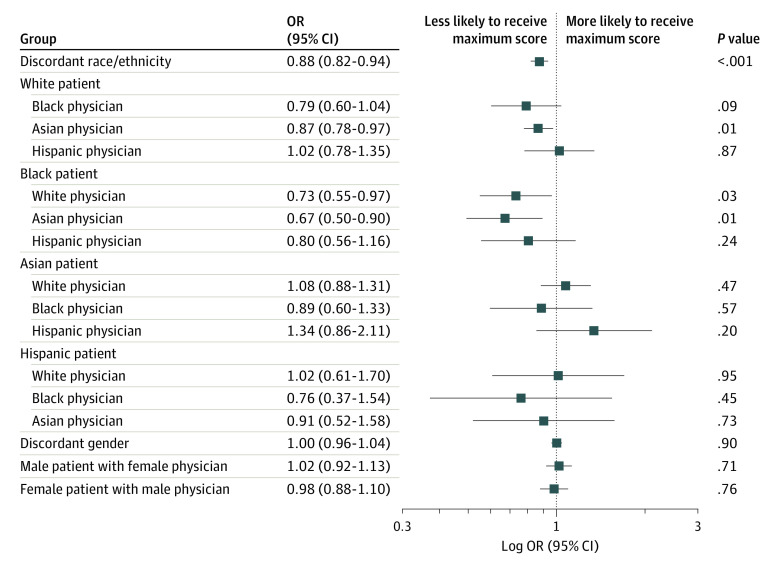
Importance: The Press Ganey Outpatient Medical Practice Survey is used to measure the patient experience. An understanding of the patient- and physician-related determinants of the patient experience may help identify opportunities to improve health care delivery and physician ratings. Objective: To evaluate the associations between the patient experience as measured by scores on the Press Ganey survey and patient-physician racial/ethnic and gender concordance. Design, Setting, and Participants: A cross-sectional analysis of Press Ganey surveys returned for outpatient visits within the University of Pennsylvania Health System between 2014 and 2017 was performed. Participants included adult patient and physician dyads for whom surveys were returned. Data analysis was performed from January to June 2019. Exposures: Patient-physician racial/ethnic and gender concordance. Main Outcomes and Measures: The primary outcome was receipt of the maximum score for the "likelihood of your recommending this care provider to others" question in the Care Provider domain of the Press Ganey survey. Secondary outcomes included each of the remaining 9 questions in the Care Provider domain. Generalized estimating equations clustering on physicians with exchangeable intracluster correlations and cluster-robust standard errors were used to investigate associations between the outcomes and patient-physician racial/ethnic and gender concordance. Results: In total, 117 589 surveys were evaluated, corresponding to 92 238 unique patients (mean [SD] age, 57.7 [15.6] years; 37 002 men [40.1%]; 75 307 White patients [81.6%]) and 747 unique physicians (mean [SD] age 45.5 [10.6] years; 472 men [63.2%]; 533 White physicians [71.4%]). Compared with racially/ethnically concordant patient-physician dyads, discordance was associated with a lower likelihood of physicians receiving the maximum score (adjusted odds ratio [OR], 0.88; 95% CI, 0.82-0.94; P < .001). Black (adjusted OR, 0.73; 95% CI, 0.68-0.78; P < .001) and Asian (adjusted OR, 0.55; 95% CI, 0.50-0.60; P < .001) patient race were both associated with lower patient experience ratings. Patient-physician gender concordance was not associated with Press Ganey scores (adjusted OR, 1.00; 95% CI, 0.96-1.04; P = .90). Conclusions and Relevance: In this study, higher Press Ganey survey scores were associated with racial/ethnic concordance between patients and their physicians. Efforts to improve physician workforce diversity are imperative. Delivery of health care in a culturally mindful manner between racially/ethnically discordant patient-physician dyads is also essential. Furthermore, Press Ganey scores may differ by a physician's patient demographic mix; thus, care must be taken when publicly reporting or using Press Ganey scores to evaluate physicians on an individual level.
Overview
The claims and statistics of this paper haven’t been checked yet.
Run the check — free, no account needed. It reads the open-access text and checks the sources it cites.
Integrity signals
Registry
Cites
Statistics
Figures
Verification
Claims the paper makes
The claims and statistics of this paper haven’t been checked yet.
Run the check — free, no account needed. It reads the open-access text and checks the sources it cites.
Claims other papers make about this one
Each is checked against this paper’s own text: does it say what the citing paper says it does?
The cited source says what the claim attributes to it.
In the citing paper
“Findings from these studies are varied: some suggest that patient-clinician racial/ethnic or gender concordance offers benefits [7-11], while others do not [12-14]. Moreover, a recent systematic review studying the association between racial, gender, and multifactorial concordance reported inconclusive results on patient outcomes, advocating for further research [15].”
Self-check
Percentages, sums and reported differences re-computed from the paper’s own numbers.
The self-check needs the paper’s full text.
Citations
Cites
(1990) · Choice Reviews Online · doi:10.5860/choice.27-3338 · Cited by 35,305
von Elm, E., Altman, D. G., Egger, M., Pocock, S. J., Gøtzsche, P. C., Vandenbroucke, J. P., & Initiative, F. T. S. (2007) · PLoS Medicine · doi:10.1371/journal.pmed.0040296 · Cited by 23,020
von Elm, E., Altman, D. G., Egger, M., Pocock, S. J., Gøtzsche, P. C., & Vandenbroucke, J. P. (2007) · The Lancet · doi:10.1016/s0140-6736(07)61602-x · Cited by 21,320
Hosmer, D. W., & Lemeshow, S. (2000) · doi:10.1002/0471722146 · Cited by 20,302
Race, Gender, and Partnership in the Patient-Physician Relationship
Cooper, L. A. (1999) · JAMA · doi:10.1001/jama.282.6.583 · Cited by 2,161
Physician Gender Effects in Medical Communication
ROTER, D. L., Hall, J. A., & Aoki, Y. (2002) · JAMA · doi:10.1001/jama.288.6.756 · Cited by 1,434
Patient-Centered Communication, Ratings of Care, and Concordance of Patient and Physician Race
Cooper, L. A., Roter, D. L., Johnson, R. L., Ford, D. E., Steinwachs, D. M., & Powe, N. R. (2003) · Annals of Internal Medicine · doi:10.7326/0003-4819-139-11-200312020-00009 · Cited by 1,371
Patient-Physician Racial Concordance and the Perceived Quality and Use of Health Care
Saha, S., Komaromy, M., Koepsell, T. D., & Bindman, A. B. (1999) · Archives of Internal Medicine · doi:10.1001/archinte.159.9.997 · Cited by 1,125
Shen, M. J., Peterson, E. B., Costas-Muñíz, R., Hunter-Hernández, M., Jewell, S., Matsoukas, K., & Bylund, C. L. (2017) · Journal of Racial and Ethnic Health Disparities · doi:10.1007/s40615-017-0350-4 · Cited by 1,052
Cooper, L. A., Roter, D. L., Carson, K. A., Beach, M. C., Sabin, J. A., Greenwald, A. G., & Inui, T. S. (2012) · American Journal of Public Health · doi:10.2105/ajph.2011.300558 · Cited by 815
Research works printed but not linked: 1
- Press Ganey. Guide to interpreting: part 2—statistics. Published 2014. Accessed August 10, 2020. https://helpandtraining.pressganey.com/lib-docs/default-source/ip-training-resources/guide-to-interpreting---part-2.pdf?sfvrsn=2
Cited by
Sorted by citations
Items 501–600 of 698
Learning to listen: A plea to our profession
Umaretiya, P. J., & Tsai, J. W. (2021) · Pediatric Blood & Cancer · doi:10.1002/pbc.29150 · Cited by 1
Cooke, D. T. (2022) · The Annals of Thoracic Surgery · doi:10.1016/j.athoracsur.2022.02.011 · Cited by 1
Why You Should Care About Implicit Bias as an Allergist-Immunologist and Ways We Can Address It
Jacobs, S. E., Brar, K., Nowak-Wegrzyn, A. H., & Louisias, M. (2023) · The Journal of Allergy and Clinical Immunology In Practice · doi:10.1016/j.jaip.2023.03.028 · Cited by 1
LGBTQ+ applicant outreach as a metric of residency diversity
Jacisin, T., & Miller, X. (2023) · American Journal of Health-System Pharmacy · doi:10.1093/ajhp/zxad257 · Cited by 1
A changing Society for Vascular Surgery reflects the journey of vascular surgery
Dalsing, M. C. (2023) · Journal of Vascular Surgery · doi:10.1016/j.jvs.2023.06.022 · Cited by 1
Editorial. Disparity in worldwide neurosurgery
Hadanny, A., & Pilitsis, J. G. (2021) · Journal of neurosurgery · doi:10.3171/2021.3.jns21692 · Cited by 1
Roach, M., & Coleman, P. W. (2023) · JCO Oncology Practice · doi:10.1200/op.22.00768 · Cited by 1
Addala, A., Howard, K. R., HOSSEINIPOUR, Y. J., & Ekhlaspour, L. (2024) · Journal of Diabetes Science and Technology · doi:10.1177/19322968241285045 · Cited by 1
Lorello, G. R., & MacDonell, S.-Y. (2024) · Canadian Journal of Anesthesia/Journal canadien d anesthésie · doi:10.1007/s12630-024-02876-1 · Cited by 1
Rothchild, E., Phillips, S., Baker, C., Wang, F., & Ricci, J. A. (2026) · Aesthetic Plastic Surgery · doi:10.1007/s00266-025-05003-7
Collateral Damage? Consequences of Radically Transparent Reviews in Health Care
Isaac, M. S. (2021) · The Joint Commission Journal on Quality and Patient Safety · doi:10.1016/j.jcjq.2021.03.009
The role of clinician assistants in addressing perinatal depression
Cooper, K. M., Masters, G. A., Simas, T. A. M., & Byatt, N. (2021) · Journal of Psychosomatic Obstetrics & Gynecology · doi:10.1080/0167482x.2021.1975676
Recuperar el espíritu de la sabiduría ancestral
Roca, L., & Guillén, H. (2010) · Dialnet (Universidad de la Rioja)
Corrales, J. M. A., Olive, J. B. G., Tarquis, A. M., Calvo, R. S., Sinobas, L. R., & Andina, D. (2011)
Dunn, L. K., Pham, E., Kabil, E. W., Kleiman, A. M., Hilton, E. J., Lyons, G. R., Ma, J. Z., Nemergut, E. C., & Forkin, K. T. (2022) · SSRN Electronic Journal · doi:10.2139/ssrn.4017380
Arguello, A. M., & Poon, S. C. (2022) · Springer eBooks · doi:10.1007/978-3-030-95950-0_14
Promoting Diversity, Equity, and Inclusion
Adams, A. L., Bailey, B., Padilla, A., Ozdoba, A. R., & Wright, T. (2022) · Springer eBooks · doi:10.1007/978-3-031-00836-8_7
Shao, X., Choudhary, V., & Gopal, A. (2022) · SSRN Electronic Journal · doi:10.2139/ssrn.4247520
Drake, C., & Popeo, D. M. (2022) · Psychiatric Annals · doi:10.3928/00485713-20221129-01
Haile, E. S., & Gill, B. C. (2023) · Urology · doi:10.1016/j.urology.2022.08.060
Medical education for the medically underserved
Martocci, A. (2023) · JAAPA · doi:10.1097/01.jaa.0000911180.24443.b3
Scott, K., Poondru, S., Jackson, K., & Kundu, R. V. (2023) · Journal of the American Academy of Dermatology · doi:10.1016/j.jaad.2023.05.034
Implications of the Lack of Physicians of Color in the Shortage of Pediatric Ophthalmologists
Adeoye, O., Madu, C. T., & Nwokeji, I. (2023) · Journal of Pediatric Ophthalmology & Strabismus · doi:10.3928/01913913-20230426-01
Elton, D., & Zhang, M. (2023) · medRxiv · doi:10.1101/2023.06.05.23290968
“The association between patient-provider gender concordance, and clinical and experience outcomes, has revealed mixed results.(13-19) Specific to the management of LBP, and musculoskeletal conditions generally, gender differences have been identified in prevalence, care seeking, and management.”
BackgroundKuehn, B. M. (2023) · Circulation · doi:10.1161/circulationaha.123.064251
From Glass Slippers to Glass Ceilings: Will We Ever Stop Walking on Broken Glass?
Viswanathan, L., Hosseini‐Carroll, P., & Surawicz, C. M. (2023) · The American Journal of Gastroenterology · doi:10.14309/ajg.0000000000002406
“Data also support that with race andethnicityconcordance, physicians arerated as providingbetter interpersonal care than other-race physicians (2,8).”
BackgroundWang, C. H., Bryant, B. L., Cogen, F. R., Marks, B. E., & Monaghan, M. C. (2023) · Clinical Pediatrics · doi:10.1177/00099228231189649
“15 Therefore, given America’s history of racial oppression broadly, and specifically within health care, 16 responses may be interpreted as AYA hesi-tance to discussing “personal” issues with a HCP outside their racial/ethnic community, rather than truly having “no preference.””
BackgroundUnmasking disparities: the challenge of diversity, equity, and inclusion in Press Ganey surveys
Avasarala, J., & Zachariah, P. (2023) · CNS Spectrums · doi:10.1017/s1092852923002390
Alim‐Marvasti, A., Jawad, M. A., Ogbonnaya, C., & Naghieh, A. (2023) · PLoS ONE · doi:10.1371/journal.pone.0288516
“The literature thus points to the significance of physician workforce diversity and representation of ethnic minority groups in various medical specialties, with the potential for improving health outcomes and reducing health disparities [20].”
BackgroundThe Why and How of Entrepreneurship Education in Healthcare Training
Berg, O., & Meyers, A. D. (2023) · Health informatics · doi:10.1007/978-3-031-33902-8_14
Do Education Grants Pay off for the MAOA?
Potter, G. R., Mears, S. C., Otwell, A. G., & Cannada, L. K. (2023) · Journal of Orthopaedic Experience & Innovation · doi:10.60118/001c.75450
Health disparities in ethnic and racial minority populations with pain and opioid use disorder
DeBruin, H., & Marie, B. S. (2023) · Journal of Opioid Management · doi:10.5055/jom.2023.0796
Meert, K. L., & Sachdeva, R. C. (2023) · The Journal of Pediatrics · doi:10.1016/j.jpeds.2023.113801
Workforce Diversity, Equity, and Inclusion
Liu, H. Y., Larson, A. R., Strong, S. A., Parekh, R., Gautam, M., Flores, L. E., & Silver, J. K. (2023) · Child and Adolescent Psychiatric Clinics of North America · doi:10.1016/j.chc.2023.06.003
Győrffy, Z., Döbrössy, B. M., Girasek, E., & Boros, J. (2024) · doi:10.2196/preprints.56434
Leveraging AI to Deliver Culturally Responsive Mental Health Care at Scale (Preprint)Preprint
Cerezo, A., Cooper, D., Palat, V., Jolley, A. L., & Lord, S. P. (2024) · doi:10.2196/preprints.56965 · Cited by 1
A Conversation With… Rep. Nabeela Syed, About Listening and Changing Minds
Leopold, S. S. (2024) · Clinical Orthopaedics and Related Research · doi:10.1097/corr.0000000000003005
Quiñónez, Z. A., Benitez-Melo, A., Díaz, L., Lennig, M., Char, D. S., & Smith, C. D. (2024) · Health Equity · doi:10.1089/heq.2023.0221
Nurturing a Culture of Diversity and Inclusion in Resident Clinic
Khungar, V., Whitman, L., & Genao, I. (2023) · Springer eBooks · doi:10.1007/978-3-031-40273-9_23
Bui, T., & Chisty, A. (2023) · Springer eBooks · doi:10.1007/978-3-031-40273-9_22
Differential Attainment in Assessment of Postgraduate Surgical Trainees: A Scoping ReviewPreprint
Jones, R. L., Prusmetikul, S., & Whitehorn, S. (2024) · Research Square · doi:10.21203/rs.3.rs-3993798/v1
The Experience of Medical Scribing: No Disparities Identified
Levi, B. H., Ekpa, N., Lin, A., Smith, C. W., & Volpe, R. L. (2024) · Advances in Medical Education and Practice · doi:10.2147/amep.s439826
Diversity and Inclusion in Anesthesia Practice
Brown, K. N., & Nwokolo, O. O. (2024) · Anesthesiology Clinics · doi:10.1016/j.anclin.2024.02.003
Workforce Initiatives to Advance Health Equity and Diverse Representation
Myint, M. T., Yue, H., Zalpuri, I., Sharma, N., & Stewart, C. (2024) · Child and Adolescent Psychiatric Clinics of North America · doi:10.1016/j.chc.2024.02.009
Second opinions: Do otolaryngologist demographics matter?
Gawel, E. M., DiNardo, L. A., Corbin, A. F., Friedel, J. E., & Carr, M. M. (2024) · American Journal of Otolaryngology · doi:10.1016/j.amjoto.2024.104322
Development of the Indigenous Health Toolkit
Lewis, M. E., Modde, E., Kamaka, M. L., Maresca, T. M., Horner, M., Hudson, S., & Myhra, L. L. (2024) · International Journal of Indigenous Health · doi:10.32799/ijih.v19i1.41319
Minding the Safety Gap: The Road Towards Global Equity in Health Care Delivery
Fermin, L., Tan, J. M., Harrell, P. G., Chang, C., & Milam, A. J. (2024) · ASA Monitor · doi:10.1097/01.asm.0001019284.99420.21
Aminpour, N., Phan, V. T., Wang, H., McDermott, J., Valentin, M., Mishra, A. K., DeLia, D., Noel, M. S., & Al‐Refaie, W. B. (2024) · Journal of Gastrointestinal Surgery · doi:10.1016/j.gassur.2024.05.028
The Role of the Pediatric Nurse Practitioner in the United States
Peck, J. L. (2023) · Rev. Soc. Bras. Enferm. Ped · doi:10.31508/1676-3793202303000i
Yang, H.-Y., Lin, Y., Shen, W.-C., Chen, S., Wang, C., & Chen, M.-L. (2024) · Research Square · doi:10.21203/rs.3.rs-4766042/v1
Addressing Inequities in Assessment
Jones, A. T., Barry, C. L., Prendergast, C. O., Nfonsam, V. N., & Buyske, J. (2024) · Annals of Surgery · doi:10.1097/sla.0000000000006498
Sonoda, K., Malhotra, K., Oni, K., Pratt, G., & Weidner, A. K. H. (2024) · Family Medicine · doi:10.22454/fammed.2024.836778
Strategies for Promoting Diversity and Inclusion in Surgical Specialties
Nehemiah, A. (2024) · Success in academic surgery · doi:10.1007/978-3-031-66011-5_24
Juarez, M. C., Shah, J. T., Lee, N., Stevenson, M. L., Carucci, J. A., & Criscito, M. C. (2024) · Research Square · doi:10.21203/rs.3.rs-4908343/v1
Enhancing Inclusive Excellence in Academic Plastic Surgery Leadership
Zhao, K. L., Evans, B. G. A., Goss, J. A., & Butler, P. D. (2024) · Current Surgery Reports · doi:10.1007/s40137-024-00429-5
Berry, C., Janeway, M. G., & Dechert, T. A. (2024) · Current Problems in Surgery · doi:10.1016/j.cpsurg.2024.101637
Bondok, M., Nguyen, A. X.-L., Tanya, S. M., Youn, G. M., Landó, L., & Wu, A. Y. (2024) · Canadian Journal of Ophthalmology · doi:10.1016/j.jcjo.2024.09.002
Schlak, A. E., Liu, J., Dixon, J., Poghosyan, L., Lelutiu‐Weinberger, C., & Cato, K. (2024) · Nursing Outlook · doi:10.1016/j.outlook.2024.102289
Considerations for Achieving Health Equity Through Substance Misuse Prevention
Murray, T. M., Cox, M., & Williamson-Jennings, L. (2024) · FOCUS The Journal of Lifelong Learning in Psychiatry · doi:10.1176/appi.focus.20240021
Goffigan‐Holmes, J., Allison, D. I., Warren, K., Nwagwu, C. D., & Nduom, E. K.-E. (2024) · Springer eBooks · doi:10.1007/978-3-031-63050-7_14
Connors, A. F., & Adebambo, I. (2024) · Springer eBooks · doi:10.1007/978-3-031-68070-0_9
Bergemann, A. D., Smith, S. R., & Daboub, J. A. (2024) · medRxiv · doi:10.1101/2024.11.01.24316296
Social Determinants of Health: Strategies for Community Engagement and Practice
Moore, S. S., Moore, E., Brockett-Walker, C., & McFarland, M. J. (2024) · Springer eBooks · doi:10.1007/978-3-031-61160-5_35
Taff, S. D., Moreno, C. E., Nuwere, E., West-Bruce, S., & Malfitano, A. P. S. (2024) · Elsevier eBooks · doi:10.1016/b978-0-443-13251-3.00006-5
Yang, H.-Y., Lin, Y., Shen, W.-C., Chen, S., Wang, C., & Chen, M.-L. (2024) · Supportive Care in Cancer · doi:10.1007/s00520-024-08990-6
“While some studies [24, 25] have explored the influence of patient-physician gender concordance, consensus on this effect is yet to be established.”
The Impact of Systemic Racism on Mental Health Care
Wigfall, D. R. (2024) · Oxford University Press eBooks · doi:10.1093/oso/9780197642535.003.0020
Assessing Diversity, Equity and Inclusion Statements of Urogynecology Fellowships
Jenkins, N., Cao, Q., Vurture, G. W., & Smilen, S. W. (2024) · Urogynecology · doi:10.1097/spv.0000000000001623
DeCaporale-Ryan, L. N., Weldon, H., Salloum, R. M., Qi, Y., & McDaniel, S. H. (2024) · Journal of surgical education · doi:10.1016/j.jsurg.2024.103373
Brown, C., Carter, R., Hartman, N. D., Hammond, A., MacNeill, E. C., Holden, L. M., Pierce, A. E., Campbell, L. F., & Norman, M. S. (2024) · Western Journal of Emergency Medicine · doi:10.5811/westjem.18748
Escobar‐Domingo, M. J., Rahmani, B., Fanning, J. E., Alvarez, A. H., Xun, H., Taritsa, I. C., Lee, D., Foppiani, J., Lin, S. J., & Lee, B. T. (2024) · Journal of surgical education · doi:10.1016/j.jsurg.2024.103388
Chervu, N. L., Mallick, S., Vadlakonda, A., Sakowitz, S., Oxyzolou, I., Coaston, T. N., & Benharash, P. (2024) · JTCVS Open · doi:10.1016/j.xjon.2024.11.021
“1,4,7 However, the majority of research examining such disparities has focused on regional or national-level populations.”
A sustainable future for dentistry: The role of patients, practitioners and industry
Johnson, T. R. (2025) · BDJ In Practice · doi:10.1038/s41404-024-2964-7
Neural Pathways to Equity: Policy Strategies to Reduce Chronic Unsafety for Black Americans
Alvarez, G., Newbill, C. M. S., & Tchala, Y. L. (2025) · Policy Insights from the Behavioral and Brain Sciences · doi:10.1177/23727322241307853
“Racially and ethnically concordant patient-physician interactions (e.g., a Black patient with a Black provider) result in higher patient-reported satisfaction and engagement (Cooper et al., 2003; Takeshita et al., 2020).”
Factors Associated With Minority Patient Enrollment in a Gastric Cancer Biobank
Pettigrew, M. F., Abbas, A. I. A., Southichack, A., Ju, M. R., Hammer, S. T. G., Liu, Y., Porembka, M. R., & Wang, S. C. (2025) · Journal of Surgical Research · doi:10.1016/j.jss.2024.12.002
Self-citationBarbosa, A. C., Oliveira, S. S., & de Oliveira, R. G. (2024) · Trabalho Educação e Saúde · doi:10.1590/1981-7746-ojs2978
Valenzi, N. (2025) · Western Journal of Emergency Medicine · doi:10.5811/westjem.41961
Making visible disability the new normal in health professionals
Rosenbaum, P., & Hanes, J. E. (2025) · Developmental Medicine & Child Neurology · doi:10.1111/dmcn.16245
Thomas, E., Verdonk, P., van Lennep, J. E. R., Rhodius‐Meester, H. F. M., Handoko, M. L., Schoonmade, L. J., Muller, M., & Muntinga, M. E. (2025) · Women s Health · doi:10.1177/17455057241305078
Discrimination, Bias, and Their Effects on Professionalism Standards for Underrepresented Groups
Chawla, V., & Alexander, A. W. (2025) · doi:10.1093/med/9780197640814.003.0010
Workforce Diversity in Sports Medicine: Analysis of Recent Trends Relative to the US Population
Silvestre, J., Kelly, J. D., & Slone, H. S. (2025) · Current Sports Medicine Reports · doi:10.1249/jsr.0000000000001227
Krishnamoorthy, B., Rosson, L., Rajai, A., Heaslip, V., Iles‐Smith, H., Magboo, R., Taylor, M., & Rathinam, S. (2025) · Journal of Nursing Management · doi:10.1155/jonm/8855338
“Interestingly, recent studies have demonstrated that reducing health disparities and promoting healthcare patient outcomes of diverse populations needs more diversity in healthcare leadership [9–11].”
Innes, J. C., Burnett, S. J., Hyla, L., Gershgorn, J., Haamid, A. S., Farcas, A., Tanaka, K., O’Brien, M., Varughese, R., & Clemency, B. M. (2025) · Prehospital Emergency Care · doi:10.1080/10903127.2025.2470962 · Cited by 3
“Furthermore, when the treating clinician shares concordant backgrounds with the patient, it results in significant improvements in health outcomes related to patient experience (55), patient-centered care (56), instruction adherence (57), and morbidity and mortality (58, 59).”
Plastic surgery on Instagram: where do we stand on racial diversity and inclusion?
Lin, E., Schroeder, B. E., Tran, M. M., Brush, E., Tian, W. M., Williams, S., Stepien, D. M., & Patel, A. (2025) · Journal of Social Media Research · doi:10.29329/jsomer.17
“Previous research underscores the benefits of patient-physician racial concordance (Ligh et al., 2020; Society, 2023; Takeshita et al., 2020).”
Building A Culturally Concordant Mentorship Program for Immigrant Premedical Students
Kandahari, N., Kayhani, N., Zada, F. M., & Chandy, A. (2025) · Journal of surgical education · doi:10.1016/j.jsurg.2025.103474
Disparities in Pediatric Growth Evaluation, Diagnosis, and Treatment
Wu, V., Lipman, T. H., & Rapaport, R. (2025) · Endocrinology and Metabolism Clinics of North America · doi:10.1016/j.ecl.2025.02.020
Patient–Provider Concordance Reduces Missed Appointments in Texas Primary Care Safety-Net Clinics
Adepoju, O. E., & Dang, P. (2025) · Journal of Racial and Ethnic Health Disparities · doi:10.1007/s40615-025-02411-y
Wannaphut, C., Tanariyakul, M., Yoshikawa, G. T., Hernandez, B. Y., Villanueva, N. A., & Acoba, J. D. (2025) · SSRN Electronic Journal · doi:10.2139/ssrn.5209072
Letter to the Editor. Ensuring equitable access to neurosurgical careers
Jabbar, M. A. D. A., & Shiekh, I. (2025) · Journal of neurosurgery · doi:10.3171/2024.12.jns243114
An amicus brief in favor of allowing race-based decisions in health professions schools
Hicks, F. D., & ROSENBERG, L. J. (2025) · Journal of Professional Nursing · doi:10.1016/j.profnurs.2025.04.016
Racial and ethnic diversity at the Canadian Ophthalmological Society annual meetings
Cheffi, N., Chaudry, E., Dhillon, J. S., & Bhatti, A. (2025) · Canadian Journal of Ophthalmology · doi:10.1016/j.jcjo.2025.04.015
Weitzel, K., Zigante, F. P., Ogola, G., & Aladegbami, B. G. (2025) · Global Surgical Education - Journal of the Association for Surgical Education · doi:10.1007/s44186-025-00359-5
“This implies that there must be some level of implicit bias in the treatment of patients [9–12].”
Categories of sex and gender in cardiovascular research
Thomas, E. G. (2025) · doi:10.5463/thesis.1107
Marengo, J., & Donlan, P. (2025) · Journal of Physical Therapy Education · doi:10.1097/jte.0000000000000412
Castillo, M. V., Au, L. E., Brown, A., Burt, K. G., Kazimierczuk, F. K., & Cox, S. A. (2025) · Journal of Critical Dietetics · doi:10.32920/jcd.v8i1.1928
Diversifying the health workforce in Israel and the United States: a comparison
Salsberg, E. S. (2025) · Israel Journal of Health Policy Research · doi:10.1186/s13584-025-00694-4
“Studies have shown that a workforce concordant with the language, culture and background of the population being served can make a difference in access, quality of care and health outcomes [2-6].”
Sas, D. J., Absah, I., Phelan, S. M., Joshi, A. Y., Creo, A. L., Behl, S., Hanson, K. T., & Kumar, S. (2025) · Clinical Pediatrics · doi:10.1177/00099228251348311
“28 Given this, the higher PS scores we observed in white physicians may be partly related to the demographics of the patients served by our medical center, with the vast majority being white.”
Fish, L. E., Roberts, S. C., Bennett, T. D., Carlson, N. E., Hamer, M. K., Kwan, B. M., Russell, S., Wogu, A. F., Wynia, M. K., & Ginde, A. A. (2025) · PLoS ONE · doi:10.1371/journal.pone.0325991
“Previous studies demonstrate that trust is greater in race and/or language concordant patient-provider dyads [43–45] so further investigation into understanding the components of trust for racial and ethnic groups is critical.”
Association Between the Demographic Profile of Military Physicians and Career Outcomes
Jackson, J. L. A., Dong, T., Janvrin, M. L., Lee, Y., Wyatt, T. R., & Koehlmoos, T. P. (2025) · Military Medicine · doi:10.1093/milmed/usaf313
Contemporary diversity trends among matched ophthalmology residents in the USA
Thompson, C., Challa, P., Stinnett, S. S., & Fekrat, S. (2025) · BMJ Leader · doi:10.1136/leader-2024-001204
Metadata
- Authors
- Takeshita, J., Wang, S., Loren, A. W., Mitra, N., Shults, J., Shin, D. B., & Sawinski, D. L.
- Affiliations
- University of Pennsylvania (US)
- Department of Biostatistics, Epidemiology and Informatics, Perelman School of Medicine at the University of Pennsylvania, Philadelphia
- Corresponding author
- Takeshita, Junko
- Venue
- JAMA Network Open
- Publisher
- American Medical Association (AMA)
- Published
- 2020-11-09
- Volume
- 3
- Issue
- 11
- Pages
- e2024583
- ISSN
- 2574-3805 (ISSN-L)
- PMC
- PMC7653497
- OpenAlex
- W3099608639
- Cited by
- 697
- References
- 41
- Citations by year
- 2026: 81 · 2025: 152 · 2024: 159 · 2023: 140 · 2022: 111 · 2021: 51 · 2020: 1
- FWCI
- 79.10
- Type
- journal article
- Language
- en
- Open access
- gold
- doi.org
- Licence
- cc-by
- Locations
- JAMA Network Open (publishedVersion, cc-by)
- PubMed Central (publishedVersion, cc-by)
- PubMed (publishedVersion)
- Funders
- Eli Lilly and Company
- Pfizer
- University of Pennsylvania
- National Institutes of Health
- National Institute of Arthritis and Musculoskeletal and Skin Diseases (K23AR068433)
- Topics
- Health Sciences › Health Professions › General Health Professions › Patient Satisfaction in Healthcare
- Social Sciences › Gender Studies › Diversity and Career in Medicine
- Health Sciences › Health Professions › General Health Professions › Patient-Provider Communication in Healthcare
- Keywords
- gender concordance, physician-patient relationship, patient experience, racial disparities, Black patients, Asian patients, physician gender, outpatient care, patient satisfaction, health care delivery improvement, Philadelphia
- MeSH terms
- Adult, Aged, Cross-Sectional Studies, Delivery of Health Care, Ethnicity, Female, Gender Identity, Humans, Male, Middle Aged, Pennsylvania, Physician-Patient Relations, Physicians, Quality of Health Care, Surveys and Questionnaires, Universities, Patient Satisfaction, Patient Outcome Assessment
About these checks
Registry, retraction, Cites and statistics results are computed, not judged, with one exception: a printed reference that no index lists is read once by a model before it counts as a citation error. Claims are extracted by a model and kept only when their quote appears verbatim in the text; each cited source is then checked, with a model’s help, for whether it says what the claim relies on. Those verdicts can be wrong — read the claim’s quote and the cited source before relying on one.
Statistics and arithmetic are recomputed, not judged.
Confidence bands are shown only for fields calibrated on our annotated test set. None is calibrated yet, so no band is shown.
What counts as a claim ›How we measure confidence ›How we check this ›
Are you an author, or do you see a problem with this page? Request a review
