

The DOI matches its Crossref record; 43 of the 44 references it cites were found in a registry or an index.
Association of Autistic Traits With Depression From Childhood to Age 18 Years
Open accessAbstract
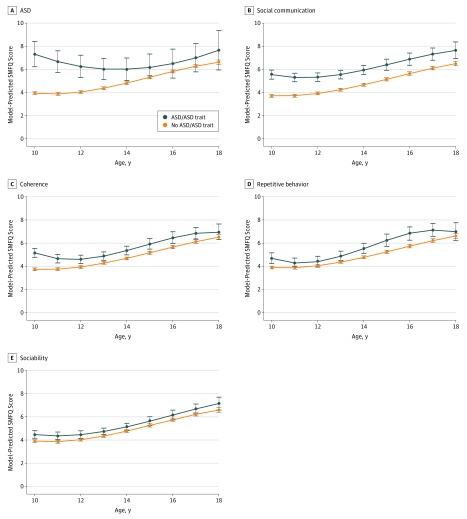
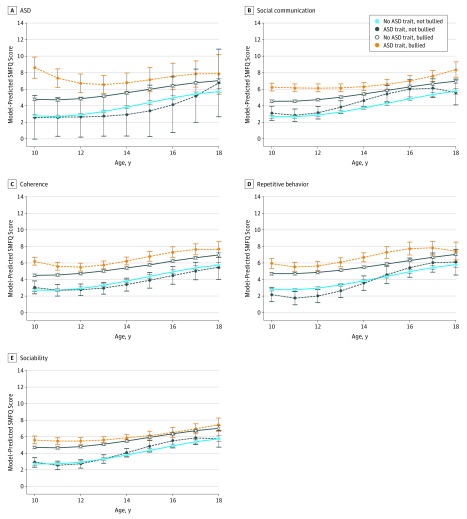
Importance: Population-based studies following trajectories of depression in autism spectrum disorders (ASD) from childhood into early adulthood are rare. The role of genetic confounding and of potential environmental intermediaries, such as bullying, in any associations is unclear. Objectives: To compare trajectories of depressive symptoms from ages 10 to 18 years for children with or without ASD and autistic traits, to assess associations between ASD and autistic traits and an International Statistical Classification of Diseases, 10th Revision (ICD-10) depression diagnosis at age 18 years, and to explore the importance of genetic confounding and bullying. Design, Setting, and Participants: Longitudinal study of participants in the Avon Longitudinal Study of Parents and Children birth cohort in Bristol, United Kingdom, followed up through age 18 years. Data analysis was conducted from January to November 2017. Main Outcomes and Measures: Depressive symptoms were assessed using the Short Mood and Feelings Questionnaire (SMFQ) at 6 time points between ages 10 and 18 years. An ICD-10 depression diagnosis at age 18 years was established using the Clinical Interview Schedule-Revised. Exposures were ASD diagnosis and 4 dichotomized autistic traits (social communication, coherence, repetitive behavior, and sociability). An autism polygenic risk score was derived using the Psychiatric Genomics Consortium autism discovery genome-wide association study summary data. Bullying was assessed at ages 8, 10, and 13 years. Results: The maximum sample with complete data was 6091 for the trajectory analysis (48.8% male) and 3168 for analysis of depression diagnosis at age 18 years (44.4% male). Children with ASD and autistic traits had higher average SMFQ depressive symptom scores than the general population at age 10 years (eg, for social communication 5.55 [95% CI, 5.16-5.95] vs 3.73 [95% CI, 3.61-3.85], for ASD 7.31 [95% CI, 6.22-8.40] vs 3.94 [95% CI, 3.83-4.05], remaining elevated in an upward trajectory until age 18 years (eg, for social communication 7.65 [95% CI, 6.92-8.37] vs 6.50 [95% CI, 6.29-6.71], for ASD 7.66 [95% CI, 5.96-9.35] vs 6.62 [95% CI, 6.43-6.81]). Social communication impairments were associated with depression at age 18 years (adjusted relative risk, 1.68; 95% CI, 1.05-2.70), and bullying explained a substantial proportion of this risk. There was no evidence of confounding by the autism polygenic risk score. Analysis in larger samples using multiple imputation led to similar but more precise results. Conclusions and Relevance: Children with ASD and ASD traits have higher depressive symptom scores than the general population by age 10 years, which persist to age 18 years, particularly in the context of bullying. Social communication impairments are an important autistic trait in relation to depression. Bullying, as an environmental intermediary, could be a target for interventions.
Overview
The claims and statistics of this paper haven’t been checked yet.
Run the check — free, no account needed. It reads the open-access text and checks the sources it cites.
Integrity signals
Registry
Cites
Statistics
Figures
Verification
Claims the paper makes
The claims and statistics of this paper haven’t been checked yet.
Run the check — free, no account needed. It reads the open-access text and checks the sources it cites.
Claims other papers make about this one
Each is checked against this paper’s own text: does it say what the citing paper says it does?
The cited source says what the claim attributes to it.
In the citing paper
“The onset of depressive symptoms in autism appears to be early.”
From Guided self-help for depression in autistic adults: The ADEPT feasibility RCT (2019) · cites this paper as [10]
The cited source says what the claim attributes to it.
In the citing paper
“A UK-based cohort study 10 reported that autistic children and children with higher autism traits have higher depressive symptoms at the age of 10 years and that these remain elevated with an upwards trajectory until the age of 18 years.”
From Guided self-help for depression in autistic adults: The ADEPT feasibility RCT (2019) · cites this paper as [10]
Self-check
Percentages, sums and reported differences re-computed from the paper’s own numbers.
The self-check needs the paper’s full text.
Citations
Cites
Multiple Imputation for Nonresponse in Surveys
Rubin, D. B. (1987) · Wiley Series in Probability and Statistics · doi:10.1002/9780470316696 · Cited by 20,701
Detection of Postnatal Depression: Development of the 10-item Edinburgh Postnatal Depression Scale
Cox, J. L., Holden, J. M., & Sagovsky, R. (1987) · British Journal of Psychiatry · doi:10.1192/bjp.150.6.782 · Cited by 14,183
A Modified Poisson Regression Approach to Prospective Studies with Binary Data
Zou, G. (2004) · American Journal of Epidemiology · doi:10.1093/aje/kwh090 · Cited by 9,920
Sterne, J. A. C., White, I. R., Carlin, J. B., Spratt, M., Royston, P., Kenward, M. G., Wood, A. M., & Carpenter, J. R. (2009) · BMJ · doi:10.1136/bmj.b2393 · Cited by 7,299
Wiley Series in Probability and Statistics
(2008) · Wiley series in probability and statistics · doi:10.1002/series1345 · Cited by 4,443
Boyd, A., Golding, J., Macleod, J., Lawlor, D. A., Fraser, A., Henderson, J., Molloy, L., Ness, A., Ring, S., & Davey Smith, G. (2013) · International Journal of Epidemiology · doi:10.1093/ije/dys064 · Cited by 2,996
Cohort Profile: The Avon Longitudinal Study of Parents and Children: ALSPAC mothers cohort
Fraser, A., Macdonald-Wallis, C., Tilling, K., Boyd, A., Golding, J., Davey Smith, G., Henderson, J., Macleod, J., Molloy, L., Ness, A., et al. (2013) · International Journal of Epidemiology · doi:10.1093/ije/dys066 · Cited by 2,494
Lai, M.-C., Lombardo, M. V., & Baron-Cohen, S. (2014) · The Lancet · doi:10.1016/s0140-6736(13)61539-1 · Cited by 2,371
Genetic relationship between five psychiatric disorders estimated from genome-wide SNPs
Cross-Disorder Group of the Psychiatric Genomics Consortium (2013) · Nature Genetics · doi:10.1038/ng.2711 · Cited by 2,263
Lewis, G., Pelosi, A. J., Araya, R., & Dunn, G. (1992) · Psychological Medicine · doi:10.1017/s0033291700030415 · Cited by 1,487
Cited by
Sorted by citations
Lai, M.-C., Kassee, C., Besney, R., Bonato, S., Hull, L., Mandy, W., Szatmari, P., & Ameis, S. H. (2019) · The Lancet Psychiatry · doi:10.1016/s2215-0366(19)30289-5 · Cited by 1,892
Kwong, A. S. F., López-López, J. A., Hammerton, G., Manley, D., Timpson, N. J., Leckie, G., & Pearson, R. M. (2019) · JAMA Network Open · doi:10.1001/jamanetworkopen.2019.6587 · Cited by 198
Depression in Youth with Autism Spectrum Disorder
Pezzimenti, F., Han, G. T., Vasa, R. A., & Gotham, K. (2019) · Child and Adolescent Psychiatric Clinics of North America · doi:10.1016/j.chc.2019.02.009 · Cited by 144
Chapman, L., Rose, K., Hull, L., & Mandy, W. (2022) · Research in Autism · doi:10.1016/j.rasd.2022.102069 · Cited by 171
Depression in Children and Adolescents with Autism Spectrum Disorder
DeFilippis, M. (2018) · Children · doi:10.3390/children5090112 · Cited by 149
Metadata
- Authors
- Rai, D., Culpin, I., Heuvelman, H., Magnusson, C. M. K., Carpenter, P., Jones, H. J., Emond, A. M., Zammit, S., Golding, J., & Pearson, R. M.
- Affiliations
- National Health Service (GB)
- University of Bristol (GB)
- Karolinska Institutet (SE)
- National Institute for Health and Care Research (GB)
- Corresponding author
- Rai, Dheeraj
- ORCID
- Venue
- JAMA Psychiatry
- Publisher
- American Medical Association (AMA)
- Published
- 2018-08-01
- Volume
- 75
- Issue
- 8
- Pages
- 835
- ISSN
- 2168-622X (ISSN-L)
- PMC
- PMC6143081
- OpenAlex
- W2808175745
- Cited by
- 185
- References
- 44
- Citations by year
- 2026: 17 · 2025: 25 · 2024: 36 · 2023: 30 · 2022: 17 · 2021: 27 · 2020: 16 · 2019: 13 · 2018: 4
- FWCI
- 8.93
- Type
- journal article
- Language
- en
- Open access
- hybrid
- doi.org
- Licence
- cc-by
- Locations
- JAMA Psychiatry (publishedVersion, cc-by)
- Europe PMC (PubMed Central) (publishedVersion, cc-by)
- PubMed Central (publishedVersion, cc-by)
- PubMed (publishedVersion)
- ORCA Online Research @Cardiff (Cardiff University) (acceptedVersion)
- Explore Bristol Research (submittedVersion, cc-by)
- Research Portal (King's College London) (submittedVersion, other-oa)
- Bristol Research (University of Bristol) (submittedVersion, cc-by)
- Funders
- Wellcome Trust (08426812/Z/07/Z)
- National Institute for Health and Care Research
- Cardiff University
- University of Bristol
- Karolinska Institutet
- Medical Research Council (MR/L010305/1, MC_PC_15018)
- Topics
- Life Sciences › Neuroscience › Cognitive Neuroscience › Autism Spectrum Disorder Research
- Social Sciences › Psychology › Clinical Psychology › Child and Adolescent Psychosocial and Emotional Development
- Health Sciences › Medicine › Psychiatry and Mental health › Child Nutrition and Feeding Issues
- Keywords
- autism spectrum disorder, autistic traits, depression, depressive symptoms, bullying, genetic confounding, polygenic risk score, social communication, repetitive behavior, sociability, coherence, adolescence, early adulthood, Avon Longitudinal Study of Parents and Children, mental health trajectories, birth cohort follow-up, environmental risk factors, genetic risk factors
- MeSH terms
- Autism Spectrum Disorder, Adolescent, Child, Depression, Female, United Kingdom, Humans, Interview, Psychological, Longitudinal Studies, Male, Risk, Psychological Distance, Social Environment, Multifactorial Inheritance, International Classification of Diseases, Genome-Wide Association Study, Bullying
About these checks
Registry, retraction, Cites and statistics results are computed, not judged, with one exception: a printed reference that no index lists is read once by a model before it counts as a citation error. Claims are extracted by a model and kept only when their quote appears verbatim in the text; each cited source is then checked, with a model’s help, for whether it says what the claim relies on. Those verdicts can be wrong — read the claim’s quote and the cited source before relying on one.
Statistics and arithmetic are recomputed, not judged.
Confidence bands are shown only for fields calibrated on our annotated test set. None is calibrated yet, so no band is shown.
What counts as a claim ›How we measure confidence ›How we check this ›
Are you an author, or do you see a problem with this page? Request a review
