

The DOI matches its Crossref record; 45 of the 47 references it cites were found in a registry or an index.
Shared Neural Phenotypes for Mood and Anxiety Disorders: A Meta-analysis of 226 Task-Related Functional Imaging Studies
Open accessAbstract
Importance: Major depressive disorder, bipolar disorder, posttraumatic stress disorder, and anxiety disorders are highly comorbid and have shared clinical features. It is not yet known whether their clinical overlap is reflected at the neurobiological level. Objective: To detect transdiagnostic convergence in abnormalities in task-related brain activation. Data Source: Task-related functional magnetic resonance imaging articles published in PubMed, Web of Science, and Google Scholar during the last decade comparing control individuals with patients with mood, posttraumatic stress, and anxiety disorders were examined. Study Selection: Following Preferred Reporting Items for Systematic Reviews and Meta-analyses reporting guidelines, articles were selected if they reported stereotactic coordinates of whole-brain-based activation differences between adult patients and control individuals. Data Extraction and Synthesis: Coordinates of case-control differences coded by diagnosis and by cognitive domain based on the research domain criteria were analyzed using activation likelihood estimation. Main Outcomes and Measures: Identification of transdiagnostic clusters of aberrant activation and quantification of the contribution of diagnosis and cognitive domain to each cluster. Results: A total of 367 experiments (major depressive disorder, 149; bipolar disorder, 103; posttraumatic stress disorder, 55; and anxiety disorders, 60) were included comprising observations from 4507 patients and 4755 control individuals. Three right-sided clusters of hypoactivation were identified centered in the inferior prefrontal cortex/insula (volume, 2120 mm3), the inferior parietal lobule (volume, 1224 mm3), and the putamen (volume, 888 mm3); diagnostic differences were noted only in the putamen (χ23 = 8.66; P = .03), where hypoactivation was more likely in bipolar disorder (percentage contribution = 72.17%). Tasks associated with cognitive systems made the largest contribution to each cluster (percentage contributions >29%). Clusters of hyperactivation could only be detected using a less stringent threshold. These were centered in the perigenual/dorsal anterior cingulate cortex (volume, 2208 mm3), the left amygdala/parahippocampal gyrus (volume, 2008 mm3), and the left thalamus (volume, 1904 mm3). No diagnostic differences were observed (χ23 < 3.06; P > .38), while tasks associated with negative valence systems made the largest contribution to each cluster (percentage contributions >49%). All findings were robust to the moderator effects of age, sex, and magnetic field strength of the scanner and medication. Conclusions and Relevance: In mood disorders, posttraumatic stress disorder, and anxiety disorders, the most consistent transdiagnostic abnormalities in task-related brain activity converge in regions that are primarily associated with inhibitory control and salience processing. Targeting these shared neural phenotypes could potentially mitigate the risk of affective morbidity in the general population and improve outcomes in clinical populations.
Overview
The claims and statistics of this paper haven’t been checked yet.
Run the check — free, no account needed. It reads the open-access text and checks the sources it cites.
Integrity signals
Registry
Cites
Statistics
Figures
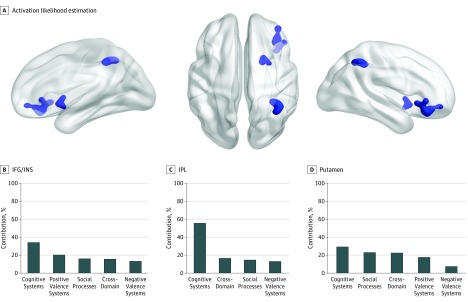
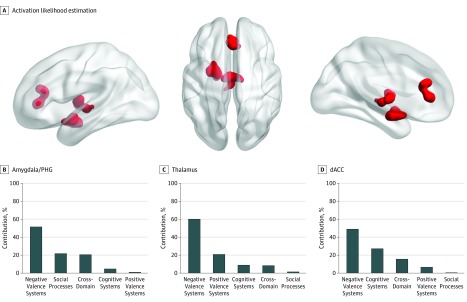
Verification
Claims the paper makes
The claims and statistics of this paper haven’t been checked yet.
Run the check — free, no account needed. It reads the open-access text and checks the sources it cites.
Claims other papers make about this one
Each is checked against this paper’s own text: does it say what the citing paper says it does?
The source backs part of the claim, not all of it — or backs it for a different population, condition or comparison.
In the citing paper
“Since its inception, support for this model has been rapidly mounting within the ID-domain (e.g. [56–59]).”
From Infraslow closed-loop brain training for anxiety and depression (ISAD): a protocol for a randomized, double-blind, sham-controlled pilot trial in adult females with internalizing disorders (2022) · cites this paper as [56]
Experimental — accuracy not yet measured
Self-check
Percentages, sums and reported differences re-computed from the paper’s own numbers.
The self-check needs the paper’s full text.
Citations
Cites
Kessler, R. C., Berglund, P., Demler, O., Jin, R., Merikangas, K. R., & Walters, E. E. (2005) · Archives of General Psychiatry · doi:10.1001/archpsyc.62.6.593 · Cited by 20,391
Control of goal-directed and stimulus-driven attention in the brain
Corbetta, M., & Shulman, G. L. (2002) · Nature Reviews Neuroscience · doi:10.1038/nrn755 · Cited by 12,881
Insel, T., Cuthbert, B., Garvey, M., Heinssen, R., Pine, D. S., Quinn, K., Sanislow, C., & Wang, P. (2010) · American Journal of Psychiatry · doi:10.1176/appi.ajp.2010.09091379 · Cited by 7,067
How do you feel — now? The anterior insula and human awareness
(Bud) Craig, A. D. (2009) · Nature Reviews Neuroscience · doi:10.1038/nrn2555 · Cited by 6,657
Whiteford, H. A., Degenhardt, L., Rehm, J., Baxter, A. J., Ferrari, A. J., Erskine, H. E., Charlson, F. J., Norman, R. E., Flaxman, A. D., Johns, N., et al. (2013) · The Lancet · doi:10.1016/s0140-6736(13)61611-6 · Cited by 6,006
Saliency, switching, attention and control: a network model of insula function
Menon, V., & Uddin, L. Q. (2010) · Brain Structure and Function · doi:10.1007/s00429-010-0262-0 · Cited by 5,592
Neural systems supporting interoceptive awareness
Critchley, H. D., Wiens, S., Rotshtein, P., Öhman, A., & Dolan, R. J. (2004) · Nature Neuroscience · doi:10.1038/nn1176 · Cited by 3,406
Inhibition and the right inferior frontal cortex
Aron, A. R., Robbins, T. W., & Poldrack, R. A. (2004) · Trends in Cognitive Sciences · doi:10.1016/j.tics.2004.02.010 · Cited by 3,197
Emotional processing in anterior cingulate and medial prefrontal cortex
Etkin, A., Egner, T., & Kalisch, R. (2011) · Trends in Cognitive Sciences · doi:10.1016/j.tics.2010.11.004 · Cited by 3,059
Sridharan, D., Levitin, D. J., & Menon, V. (2008) · Proceedings of the National Academy of Sciences · doi:10.1073/pnas.0800005105 · Cited by 2,892
Cited by
Sorted by citations
Penninx, B. W., Pine, D. S., Holmes, E. A., & Reif, A. (2021) · The Lancet · doi:10.1016/s0140-6736(21)00359-7 · Cited by 740
Understanding Emotions: Origins and Roles of the Amygdala
Šimić, G., Tkalčić, M., Vukić, V., Mulc, D., Španić, E., Šagud, M., Olucha-Bordonau, F. E., Vukšić, M., & Hof, P. R. (2021) · Biomolecules · doi:10.3390/biom11060823 · Cited by 631
Chavanne, A. V., & Robinson, O. J. (2020) · American Journal of Psychiatry · doi:10.1176/appi.ajp.2020.19111153 · Cited by 249
Air pollution, depressive and anxiety disorders, and brain effects: A systematic review
Zundel, C. G., Ryan, P., Brokamp, C., Heeter, A., Huang, Y., Strawn, J. R., & Marusak, H. A. (2022) · NeuroToxicology · doi:10.1016/j.neuro.2022.10.011 · Cited by 236
Ali, A. M., Alkhamees, A. A., Hori, H., Kim, Y., & Kunugi, H. (2021) · International Journal of Environmental Research and Public Health · doi:10.3390/ijerph181910142 · Cited by 193
Metadata
- Authors
- Janiri, D., Moser, D. A., Doucet, G. E., Luber, M. J., Rasgon, A., Lee, W. H., Murrough, J. W., Sani, G., Eickhoff, S. B., & Frangou, S.
- Affiliations
- Sapienza University of Rome (IT)
- Icahn School of Medicine at Mount Sinai (US)
- Azienda Ospedaliera Sant'Andrea (IT)
- Forschungszentrum Jülich (DE)
- Corresponding author
- Frangou, Sophia
- ORCID
- Venue
- JAMA Psychiatry
- Publisher
- American Medical Association (AMA)
- Published
- 2020-02-01
- Volume
- 77
- Issue
- 2
- Pages
- 172
- ISSN
- 2168-622X (ISSN-L)
- PMC
- PMC6822098
- OpenAlex
- W2982542860
- Cited by
- 173
- References
- 47
- Citations by year
- 2026: 20 · 2025: 25 · 2024: 25 · 2023: 16 · 2022: 31 · 2021: 41 · 2020: 14
- FWCI
- 3.25
- Type
- journal article
- Language
- en
- Open access
- hybrid
- doi.org
- Licence
- cc-by
- Locations
- JAMA Psychiatry (publishedVersion, cc-by)
- PubMed Central (publishedVersion, cc-by)
- PubMed (publishedVersion)
- IRIS Research product catalog (Sapienza University of Rome) (submittedVersion)
- PubliCatt (Università Cattolica del Sacro Cuore) (submittedVersion, other-oa)
- Funders
- European Commission
- National Institutes of Health (1s10od018522-01)
- National Institute of Mental Health (R01MH116147, R01MH074457, R01MH104284)
- Topics
- Social Sciences › Psychology › Experimental and Cognitive Psychology › Anxiety, Depression, Psychometrics, Treatment, Cognitive Processes
- Life Sciences › Neuroscience › Cognitive Neuroscience › Neural and Behavioral Psychology Studies
- Life Sciences › Neuroscience › Cognitive Neuroscience › Functional Brain Connectivity Studies
- Keywords
- mood disorders, anxiety disorders, post-traumatic stress disorder, major depressive disorder, bipolar disorder, task-related brain activation, hypoactivation, hyperactivation, inferior prefrontal cortex, insula, inferior parietal lobule, putamen, anterior cingulate cortex, amygdala, thalamus, Research Domain Criteria, cognitive domain, negative valence
- MeSH terms
- Anxiety Disorders, Brain, Humans, Mood Disorders, Functional Neuroimaging
About these checks
Registry, retraction, Cites and statistics results are computed, not judged, with one exception: a printed reference that no index lists is read once by a model before it counts as a citation error. Claims are extracted by a model and kept only when their quote appears verbatim in the text; each cited source is then checked, with a model’s help, for whether it says what the claim relies on. Those verdicts can be wrong — read the claim’s quote and the cited source before relying on one.
Statistics and arithmetic are recomputed, not judged.
Confidence bands are shown only for fields calibrated on our annotated test set. None is calibrated yet, so no band is shown.
What counts as a claim ›How we measure confidence ›How we check this ›
Are you an author, or do you see a problem with this page? Request a review
