

Assessing Toxicity and Nuclear and Mitochondrial DNA Damage Caused by Exposure of Mammalian Cells to Lunar Regolith Simulants
Open accessThe DOI matches its Crossref record; 44 of the 45 references it cites were found in a registry or an index.
Abstract
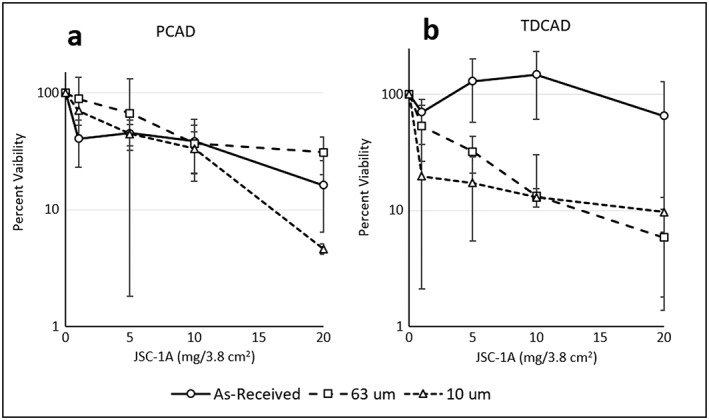
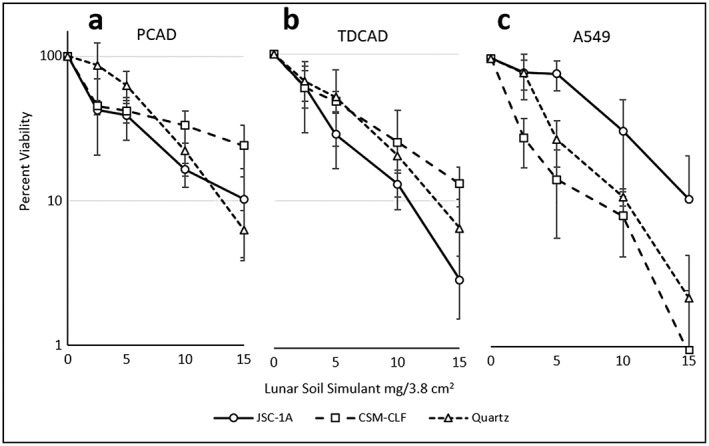
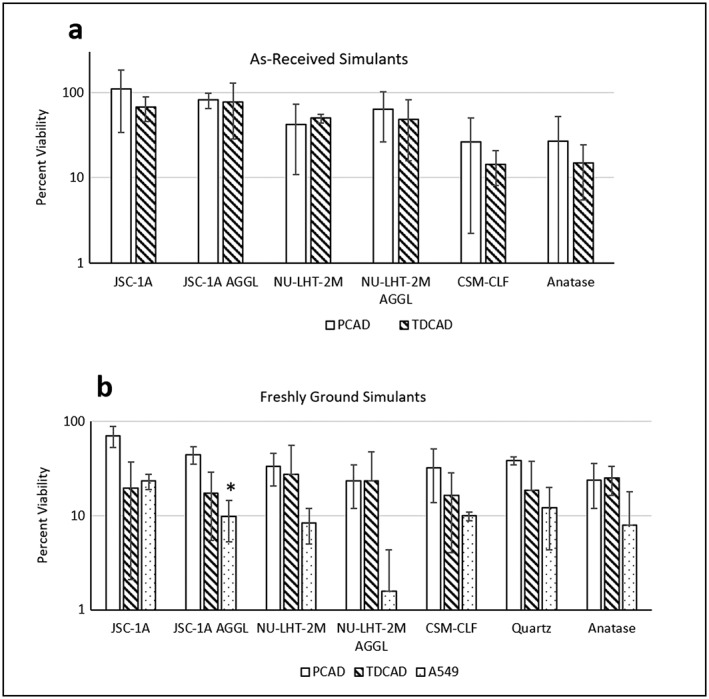
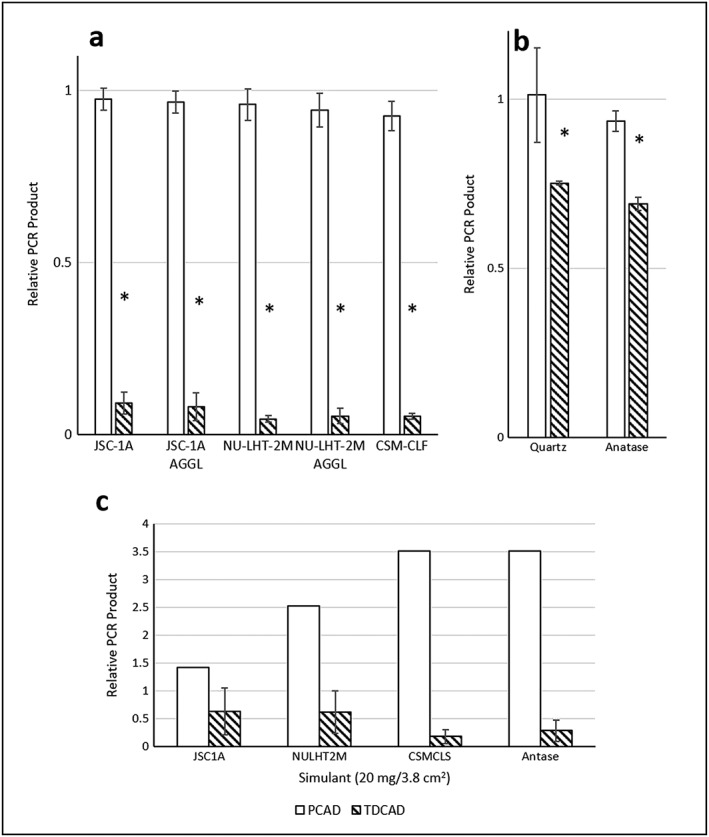
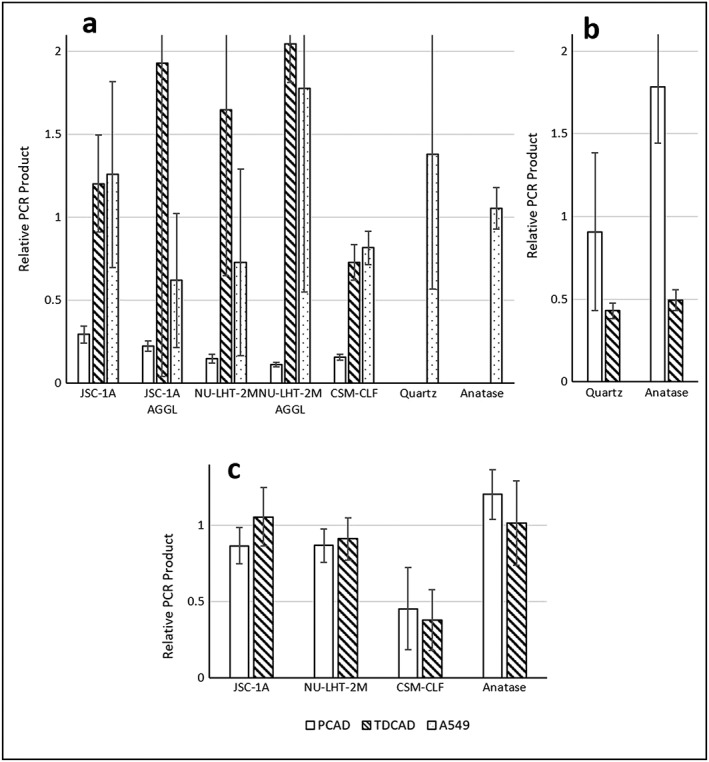
Previous missions to the lunar surface implicated potential dangers of lunar soil. In future explorations, astronauts may spend weeks or months on the Moon, increasing the risk of inhaling lunar dust. In an effort to understand the biological impact of lunar regolith, cell cultures derived from lung or neuronal cells were challenged with lunar soil simulants to assess cell survival and genotoxicity. Lunar soil simulants were capable of causing cell death and DNA damage in neuronal and lung cell lines, and freshly crushed lunar soil simulants were more effective at causing cell death and DNA damage than were simulants as received from the supplier. The ability of the simulants to generate reactive oxygen species in aqueous suspensions was not correlated with their cytotoxic or genotoxic affects. Furthermore, the cytotoxicity was not correlated with the accumulation of detectable DNA lesions. These results determine that lunar soil simulants are, with variable activity, cytotoxic and genotoxic to both neuronal and lung‐derived cells in culture.
Overview
The claims and statistics of this paper haven’t been checked yet.
Free: it reads the open-access text and checks the first 5 claims that cite a source we can check. Create a free account to check every claim.
Integrity signals
Registry
Cites
Statistics
Figures
Verification
Claims the paper makes
The claims and statistics of this paper haven’t been checked yet.
Free: it reads the open-access text and checks the first 5 claims that cite a source we can check. Create a free account to check every claim.
Claims other papers make about this one
Each is checked against this paper’s own text: does it say what the citing paper says it does?
The source backs part of the claim, not all of it — or backs it for a different population, condition or comparison.
In the citing paper
“While this no doubt requires further study, LADTAG determined that any increased surface reactivity is likely less important than direct toxicity with respect to adverse human health effects33,34.”
From Overview of lunar dust toxicity risk (2022) · cites this paper as [33]
Experimental — accuracy not yet measuredThe cited source says what the claim attributes to it.
In the citing paper
“Among less explored potential toxicities, concern exists for neurological consequences of exposure as a result of multiple studies examining the direct cytotoxic effects of simulant LD, though no comprehensive studies have yet confirmed such findings with native LD33,53.”
From Overview of lunar dust toxicity risk (2022) · cites this paper as [33]
Self-check
Percentages, sums and reported differences re-computed from the paper’s own numbers.
The self-check needs the paper’s full text.
Citations
Cites
Nanotoxicology: An Emerging Discipline Evolving from Studies of Ultrafine Particles
Oberdörster, G., Oberdörster, E., & Oberdörster, J. (2005) · Environmental Health Perspectives · doi:10.1289/ehp.7339 · Cited by 7,891
Physiological Roles of Mitochondrial Reactive Oxygen Species
Sena, L. A., & Chandel, N. S. (2012) · Molecular Cell · doi:10.1016/j.molcel.2012.09.025 · Cited by 2,632
Translocation of inhaled ultrafine particles to the brain
Oberdörster, G., Sharp, Z., Atudorei, V., Elder, A., Gelein, R., Kreyling, W., & Cox, C. (2004) · Inhalation Toxicology · doi:10.1080/08958370490439597 · Cited by 2,606
Nanoparticle uptake: The phagocyte problem
Gustafson, H. H., Holt-Casper, D., Grainger, D. W., & Ghandehari, H. (2015) · Nano Today · doi:10.1016/j.nantod.2015.06.006 · Cited by 1,411
Mechanisms of nanotoxicity: Generation of reactive oxygen species
Fu, P. P., Xia, Q., Hwang, H.-M., Ray, P. C., & Yu, H. (2014) · Journal of Food and Drug Analysis · doi:10.1016/j.jfda.2014.01.005 · Cited by 1,398
DNA damage and the balance between survival and death in cancer biology
Roos, W. P., Thomas, A. D., & Kaina, B. (2016) · Nature Reviews Cancer · doi:10.1038/nrc.2015.2 · Cited by 1,189 · cited 1×
“Mutations in nuclear DNA may lead to cell death or cancer, and these endpoints are not mutually exclusive (Roos & Kaina, 2013; Roos et al., 2016), because dying cells can signal to neighboring cells to promote cell division (Labi & Erlacher, 2015).”
BackgroundRole of Particle Size in Phagocytosis of Polymeric Microspheres
Champion, J. A., Walker, A., & Mitragotri, S. (2008) · Pharmaceutical Research · doi:10.1007/s11095-008-9562-y · Cited by 888
DNA damage-induced cell death: From specific DNA lesions to the DNA damage response and apoptosis
Roos, W. P., & Kaina, B. (2013) · Cancer Letters · doi:10.1016/j.canlet.2012.01.007 · Cited by 879
Lunar sourcebook : a user's guide to the moon
Heiken, G. H., Vaniman, D. T., & French, B. M. (1991) · Cited by 809
DNA repair mechanisms in dividing and non-dividing cells
Iyama, T., & Wilson, D. M. (2013) · DNA Repair · doi:10.1016/j.dnarep.2013.04.015 · Cited by 697
Warheit, D. B., Webb, T. R., Reed, K. L., Frerichs, S., & Sayes, C. M. (2007) · Toxicology · doi:10.1016/j.tox.2006.11.002 · Cited by 644
Giglia-Mari, G., Zotter, A., & Vermeulen, W. (2011) · Cold Spring Harbor Perspectives in Biology · doi:10.1101/cshperspect.a000745 · Cited by 472
Mitochondria‐targeted antioxidants
Oyewole, A. O., & Birch‐Machin, M. A. (2015) · The FASEB Journal · doi:10.1096/fj.15-275404 · Cited by 464
Lunar surface: Dust dynamics and regolith mechanics
Colwell, J. E., Batiste, S., Horányi, M., Robertson, S., & Sture, S. (2007) · Reviews of Geophysics · doi:10.1029/2005rg000184 · Cited by 437
Particulate Matter in Polluted Air May Increase Biomarkers of Inflammation in Mouse Brain
Campbell, A., Oldham, M., Becaria, A., Bondy, S. C., Meacher, D., Sioutas, C., Misra, C., Mendez, L. B., & Kleinman, M. (2005) · NeuroToxicology · doi:10.1016/j.neuro.2004.08.003 · Cited by 421
Furda, A., Santos, J. H., Meyer, J. N., & Van Houten, B. (2014) · Methods in Molecular Biology · doi:10.1007/978-1-62703-739-6_31 · Cited by 384
A Dynamic Fountain Model for Lunar Dust
Farrell, W. M., Stubbs, T. J., & Vondrak, R. R. (n.d.) · NASA STI Repository (National Aeronautics and Space Administration) · Cited by 359
Qi, Y., Wang, J. K. T., McMillian, M., & Chikaraishi, D. M. (1997) · The Journal of Neuroscience · doi:10.1523/jneurosci.17-04-01217.1997 · Cited by 330 · cited 4×
“-a-differentiated (CAD) cells were isolated from a mouse neuroblastoma (Qi et al., 1997).”
BackgroundMethodInfluentialBasic pathogenetic mechanisms in silicosis: current understanding
Rimal, B., Greenberg, A. K., & Rom, W. N. (2005) · Current Opinion in Pulmonary Medicine · doi:10.1097/01.mcp.0000152998.11335.24 · Cited by 326 · cited 2×
“A common outcome of this exposure is silicosis, a disease that develops from long-term exposure to crystalline silica (Rimal et al., 2005).”
BackgroundYauk, C., Polyzos, A., Rowan-Carroll, A., Somers, C. M., Godschalk, R. W., Van Schooten, F. J., Berndt, M. L., Pogribny, I. P., Koturbash, I., Williams, A., et al. (2008) · Proceedings of the National Academy of Sciences · doi:10.1073/pnas.0705896105 · Cited by 312
Labi, V, & Erlacher, M. (2015) · Cell Death & Disease · doi:10.1038/cddis.2015.20 · Cited by 295
Role of point defects on the reactivity of reconstructed anatase titanium dioxide (001) surface
Wang, Y., Sun, H., Tan, S., Feng, H., Cheng, Z., Zhao, J., Zhao, A., Wang, B., Luo, Y., Yang, J., et al. (2013) · Nature Communications · doi:10.1038/ncomms3214 · Cited by 221
The Effects of Lunar Dust on Eva Systems During the Apollo Missions
Gaier, J. R. (2013) · NASA Technical Reports Server (NASA) · Cited by 217
Upadhyay, D., Panduri, V., Ghio, A., & Kamp, D. W. (2003) · American Journal of Respiratory Cell and Molecular Biology · doi:10.1165/rcmb.2002-0269oc · Cited by 191
Measuring Oxidative mtDNA Damage and Repair Using Quantitative PCR
Santos, J. H., Mandavilli, B. S., & Van Houten, B. (2003) · Mitochondrial DNA · doi:10.1385/1-59259-284-8:159 · Cited by 158
JSC-1A lunar soil simulant: Characterization, glass formation, and selected glass properties
Ray, C. S., dos Reis, S. T., Sen, S., & O'Dell, J. S. (2010) · Journal of Non-Crystalline Solids · doi:10.1016/j.jnoncrysol.2010.04.049 · Cited by 157
The role of mitochondrial DNA mutation on neurodegenerative diseases
Cha, M.-Y., Kim, D. K., & Mook-Jung, I. (2015) · Experimental & Molecular Medicine · doi:10.1038/emm.2014.122 · Cited by 156
Lunar sourcebook—A user's guide to the moon
Collinson, D. W. (1992) · Physics of The Earth and Planetary Interiors · doi:10.1016/0031-9201(92)90060-9 · Cited by 153
Selective mitochondrial DNA degradation following double-strand breaks
Moretton, A., Morel, F., Macao, B., Lachaume, P., Ishak, L., Lefebvre, M., Garreau-Balandier, I., Vernet, P., Falkenberg, M., & Farge, G. (2017) · PLOS ONE · doi:10.1371/journal.pone.0176795 · Cited by 129
Nose-to-brain transport of aerosolised quantum dots following acute exposure
Hopkins, L. E., Patchin, E. S., Chiu, P., Brandenberger, C., Smiley‐Jewell, S. M., & Pinkerton, K. E. (2013) · Nanotoxicology · doi:10.3109/17435390.2013.842267 · Cited by 119
Selective removal of deletion-bearing mitochondrial DNA in heteroplasmic Drosophila
Kandul, N. P., Zhang, T., Hay, B. A., & Guo, M. (2016) · Nature Communications · doi:10.1038/ncomms13100 · Cited by 107
Production of hydrogen peroxide in Martian and lunar soils
Hurowitz, J. A., Tosca, N. J., McLennan, S. M., & Schoonen, M. A. A. (2007) · Earth and Planetary Science Letters · doi:10.1016/j.epsl.2006.12.004 · Cited by 98 · cited 3×
“Compared to the lunar soil simulants, quartz does not generate high concentrations of ROS in solution (Hurowitz et al., 2007).”
BackgroundResultSelf-citationBaxter, P. J., Ing, R., Falk, H., & Plikaytis, B. (1983) · Archives of Environmental Health: An International Journal · doi:10.1080/00039896.1983.10543994 · Cited by 86
Lehle, S., Hildebrand, D. G., Merz, B., Malak, P. N. Z., Becker, M. S., Schmezer, P., Eßmann, F., Schulze‐Osthoff, K., & Rothfuss, O. C. (2013) · Nucleic Acids Research · doi:10.1093/nar/gkt1349 · Cited by 79
Does size really matter?: Relationship of particle size to lung deposition and exhaled fraction
Jabbal, S., Poli, G., & Lipworth, B. J. (2017) · Journal of Allergy and Clinical Immunology · doi:10.1016/j.jaci.2016.11.036 · Cited by 76
Neutrophil-derived ROS contribute to oxidative DNA damage induction by quartz particles
van Berlo, D., Wessels, A., Boots, A. W., Wilhelmi, V., Scherbart, A. M., Gerloff, K., van Schooten, F., Albrecht, C., & Schins, R. P. F. (2010) · Free Radical Biology and Medicine · doi:10.1016/j.freeradbiomed.2010.08.031 · Cited by 74
A dynamic fountain model for lunar dust
Stubbs, T. J., VONDRAK, R. R., & Farrell, W. M. (2005) · Advances in Space Research · doi:10.1016/j.asr.2005.04.048 · Cited by 74
Sample contamination by grinding
Hickson, C. J., & Juras, S. J. (1986) · The Canadian Mineralogist · Cited by 64
Toxicity of lunar dust assessed in inhalation-exposed rats
Lam, C.-W., Scully, R. R., Zhang, Y., Renne, R. A., Hunter, R. L., McCluskey, R. A., Chen, B. T., Castranova, V., Driscoll, K. E., Gardner, D. E., et al. (2013) · Inhalation Toxicology · doi:10.3109/08958378.2013.833660 · Cited by 60 · cited 1×
“A study in rats revealed that exposure to lunar soil led to a concentration-dependent increase in lung inflammation and cytotoxicity over the course of 13 weeks (Lam et al., 2013).”
BackgroundNon-occupational exposure to silica dust
Bhagia, L. (2012) · Indian Journal of Occupational and Environmental Medicine · doi:10.4103/0019-5278.111744 · Cited by 59
Mechano-radicals produced from ground quartz and quartz glass
Hasegawa, M., Ogata, T., & Sato, M. (1995) · Powder Technology · doi:10.1016/0032-5910(96)80150-1 · Cited by 56
Lam, C.-W., James, J. T., McCluskey, R., Cowper, S., Balis, J., & Muro-Cacho, C. (2002) · Inhalation Toxicology · doi:10.1080/08958370290084683 · Cited by 55
Physicochemical properties of respirable-size lunar dust
McKay, D. S., Cooper, B. L., Taylor, L. A., James, J. T., Thomas-Keprta, K., Pieters, C. M., Wentworth, S. J., Wallace, W. T., & Lee, T. S. (2015) · Acta Astronautica · doi:10.1016/j.actaastro.2014.10.032 · Cited by 39 · cited 1×
“Lunar dust in the lunar exploration module represents a potential biological hazard to astronauts, with particles of 5–10 μm capable of accumulating in the central airways and smaller particles, 0.5–5 μm, infiltrating the alveoli (Jabbal et al., 2017; Mckay et al., 2015).”
BackgroundInfluentialTurci, F., Corazzari, I., Alberto, G., Martra, G., & Fubini, B. (2015) · Astrobiology · doi:10.1089/ast.2014.1216 · Cited by 31
Reactive Oxygen Species (ROS) generation by lunar simulants
Kaur, J., Rickman, D. L., & Schoonen, M. A. A. (2016) · Acta Astronautica · doi:10.1016/j.actaastro.2016.02.002 · Cited by 23
Cited by
Overview of lunar dust toxicity risk
Pohlen, M., Carroll, D., Prisk, G. K., & Sawyer, A. J. (2022) · npj Microgravity · doi:10.1038/s41526-022-00244-1 · Cited by 72
Space Medicines for Space Health
Tran, Q. D., Tran, V., Toh, L. S., Williams, P. M., Tran, N. N., & Hessel, V. (2022) · ACS Medicinal Chemistry Letters · doi:10.1021/acsmedchemlett.1c00681 · Cited by 42
Utilizing the Analytical Hierarchy Process to determine the optimal lunar habitat configuration
Higgins, M., & Benaroya, H. (2020) · Acta Astronautica · doi:10.1016/j.actaastro.2020.04.012 · Cited by 34
“For crewed missions, the greatest danger that lunar dust poses might be its effects on the human body; exposure to regolith is known to cause cell death and DNA damage [17].”
BackgroundMiranda, S., Marchal, S., Cumps, L., Dierckx, J., Krüger, M., Grimm, D. G., Baatout, S., Tabury, K., & Baselet, B. (2023) · Biomedicines · doi:10.3390/biomedicines11071921 · Cited by 35
“Mutations in nuclear DNA may lead to cell death or cancer [93].”
BackgroundAstroimmunology: the effects of spaceflight and its associated stressors on the immune system
Winer, D. A., Du, H., Kim, J., Chang, V., Burke, M., Winer, S., Costes, S. V., Frippiat, J., Sams, C. F., Paul, A. M., et al. (2025) · Nature reviews. Immunology · doi:10.1038/s41577-025-01226-6 · Cited by 38
“The increased formation of ROS linked to LDS could potentiate DNA damage 190 , which would be compounded by other hostile elements on the Moon such as cosmic radiation.”
Metadata
- Authors
- Caston, R., Luc, K., Hendrix, D., Hurowitz, J. A., & Demple, B.
- Affiliations
- Stony Brook School (US)
- Stony Brook University (US)
- Corresponding author
- Demple, Bruce
- Venue
- GeoHealth
- Publisher
- Wiley
- Published
- 2018-04
- Volume
- 2
- Issue
- 4
- Pages
- 139-148
- ISSN
- 2471-1403 (ISSN-L)
- PMC
- PMC7007071
- OpenAlex
- W2800312102
- Cited by
- 45
- References
- 45
- Citations by year
- 2026: 7 · 2025: 9 · 2024: 8 · 2023: 5 · 2022: 5 · 2021: 4 · 2020: 2 · 2019: 3 · 2018: 2
- FWCI
- 0.83
- Type
- journal article
- Language
- en
- Open access
- gold
- doi.org
- Licence
- Locations
- GeoHealth (publishedVersion, cc-by-nc-nd)
- Europe PMC (PubMed Central) (publishedVersion, cc-by-nc-nd)
- PubMed Central (publishedVersion, cc-by-nc-nd)
- PubMed (publishedVersion)
- DOAJ (DOAJ: Directory of Open Access Journals) (submittedVersion, cc-by-sa)
- Funders
- National Aeronautics and Space Administration (NNA‐14AB04A)
- Topics
- Life Sciences › Biochemistry, Genetics and Molecular Biology › Cancer Research › Carcinogens and Genotoxicity Assessment
- Health Sciences › Medicine › Physiology (medical) › Spaceflight effects on biology
- Health Sciences › Medicine › Radiology, Nuclear Medicine and Imaging › Effects of Radiation Exposure
- Keywords
- lunar regolith simulant, lunar dust, genotoxicity, cytotoxicity, DNA damage, nuclear DNA damage, mitochondrial DNA damage, neurons, lung cells, reactive oxygen species, cell survival, space radiation exposure, astronaut health risk
About these checks
Registry, retraction, Cites and statistics results are computed, not judged, with one exception: a printed reference that no index lists is read once by a model before it counts as a citation error. Claims are extracted by a model and kept only when their quote appears verbatim in the text; each cited source is then checked, with a model’s help, for whether it says what the claim relies on. Those verdicts can be wrong — read the claim’s quote and the cited source before relying on one.
Statistics and arithmetic are recomputed, not judged.
Confidence bands are shown only for fields calibrated on our annotated test set. None is calibrated yet, so no band is shown.
What counts as a claim ›How we measure confidence ›How we check this ›
Are you an author, or do you see a problem with this page? Request a review
Data sources
Bibliographic data: Semantic Scholar, OpenAlex, Crossref.
Contains information from the Semantic Scholar Academic Graph Datasets, made available under the ODC Attribution License (ODC-BY 1.0).
Semantic Scholar’s data is described in: Kinney, R., et al. (2023). The Semantic Scholar Open Data Platform. arXiv:2301.10140.
