

The DOI matches its Crossref record; 80 of the 80 references it cites were found in a registry or an index.
High‐Performance Recyclable Polyester Elastomers Through Transient Strain‐Stiffening
Open accessAbstract
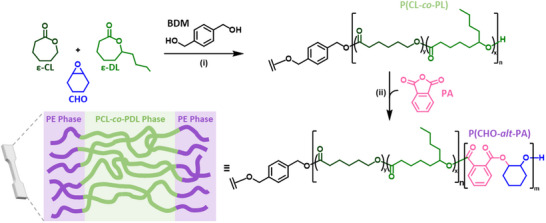
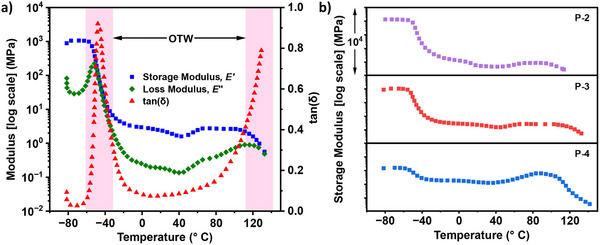
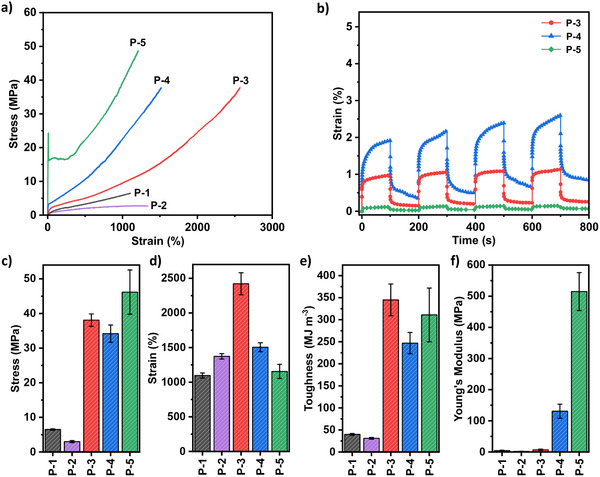
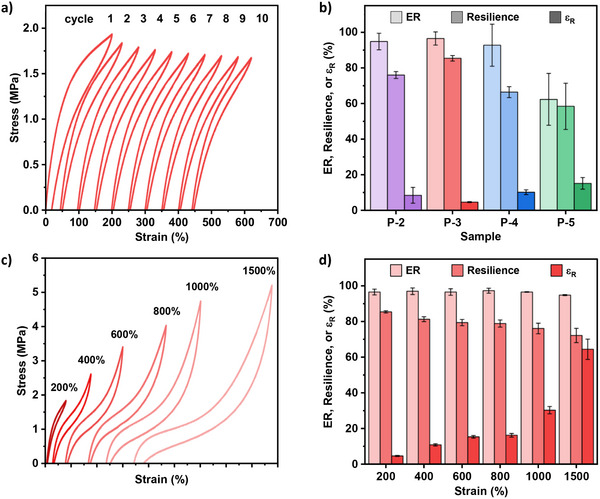
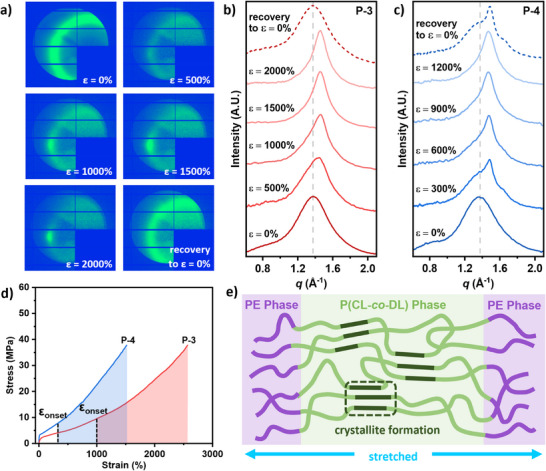
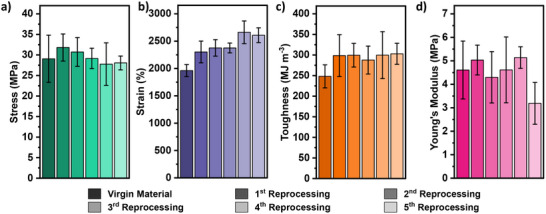
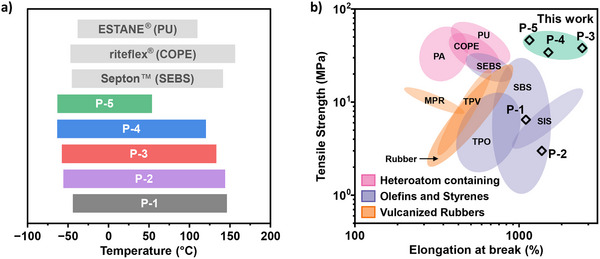
Polyester thermoplastic elastomers are promising sustainable materials but their mechanical properties need improvement, in particular, attempts to increase strength often result in compromised elasticity. Strong and tough elastomers are known but require complex polymer formulations together with control over cross‐linking or crystallinity, both of which challenge recycling. Here, the introduction of transient strain‐stiffening approaches into fully amorphous structures show both strengthening and toughening of elastomers while conserving recyclability. The new amorphous block polyester elastomers are prepared by controlled polymerization methods using commercial monomers. The block polymers comprise a central poly(ɛ‐caprolactone‐ co ‐ɛ‐decalactone) block flanked by poly(cyclohexene oxide‐ alt ‐phthalate) blocks. Elastomer thermomechanical properties are tuned by varying ratios of ɛ‐caprolactone to ɛ‐decalactone within the mid‐block to access materials with excellent mechanical properties. The best elastomers feature 30–50 wt.% polycaprolactone and exhibit tensile strengths up to 40 MPa, elongations at break above 2000%, with excellent elastic recovery (>90%). These materials exhibit strain‐induced crystallization and outperform current commercial elastomers, entering a new region of tensile mechanical property space. They have service temperature ranges from −60 to 140 °C and high temperature stability (≥300 °C), with wide thermal (re)processing windows. These new polyester elastomers also show high resistance to creep, humidity resistance, and excellent recyclability.
Overview
The claims and statistics of this paper haven’t been checked yet.
Free: it reads the open-access text and checks the first 5 claims that cite a source we can check. Create a free account to check every claim.
Integrity signals
Registry
Cites
Statistics
Figures
Verification
Claims the paper makes
The claims and statistics of this paper haven’t been checked yet.
Free: it reads the open-access text and checks the first 5 claims that cite a source we can check. Create a free account to check every claim.
Claims other papers make about this one
Each is checked against this paper’s own text: does it say what the citing paper says it does?
The cited source doesn’t support the claim as written.
In the citing paper
“Collectively, these results confirm that the metal-free one-pot synthesis yields triblock copolymers with thermal resistance comparable to those prepared by conventional metal-catalyzed methods.[28][29][30]”
From Metal-Free Synthesis of Tough PLLA- b -PCVL- b -PLLA Triblock Polyester Thermoplastic Elastomers from Mixed Monomers (2026) · cites this paper as [28]
Checked by a reasoning model — may be wrong.
Experimental — accuracy not yet measured
Self-check
Percentages, sums and reported differences re-computed from the paper’s own numbers.
The self-check needs the paper’s full text.
Citations
Cites
The conflicts between strength and toughness
Ritchie, R. O. (2011) · Nature Materials · doi:10.1038/nmat3115 · Cited by 3,989
Sustainable polymers from renewable resources
Zhu, Y., Romain, C., & Williams, C. K. (2016) · Nature · doi:10.1038/nature21001 · Cited by 2,762
Self-citationChemical recycling to monomer for an ideal, circular polymer economy
Coates, G. W., & Getzler, Y. D. Y. L. (2020) · Nature Reviews Materials · doi:10.1038/s41578-020-0190-4 · Cited by 1,644
The future of plastics recycling
Garcia, J. M., & Robertson, M. L. (2017) · Science · doi:10.1126/science.aaq0324 · Cited by 1,346
Strategies to reduce the global carbon footprint of plastics
Zheng, J., & Suh, S. (2019) · Nature Climate Change · doi:10.1038/s41558-019-0459-z · Cited by 1,252
50th Anniversary Perspective: There Is a Great Future in Sustainable Polymers
Schneiderman, D. K., & Hillmyer, M. A. (2017) · Macromolecules · doi:10.1021/acs.macromol.7b00293 · Cited by 1,003
Catalysis as an Enabling Science for Sustainable Polymers
Zhang, X., Fevre, M., Jones, G. O., & Waymouth, R. M. (2018) · Chemical Reviews · doi:10.1021/acs.chemrev.7b00329 · Cited by 936
Scheutz, G. M., Lessard, J. J., Sims, M. B., & Sumerlin, B. S. (2019) · Journal of the American Chemical Society · doi:10.1021/jacs.9b07922 · Cited by 934
Chemically recyclable polymers: a circular economy approach to sustainability
Hong, M., & Chen, E. Y.-X. (2017) · Green Chemistry · doi:10.1039/c7gc01496a · Cited by 876
Aliphatic Polyester Block Polymers: Renewable, Degradable, and Sustainable
Hillmyer, M. A., & Tolman, W. B. (2014) · Accounts of Chemical Research · doi:10.1021/ar500121d · Cited by 635
Research works printed but not linked: 7
- Dupont J., 2000, J. Braz. Chem. Soc., 11, 239
- Miao X., 2024, Angew. Chem., Int. Ed.
- Drobny J. G., 2014, Handbook of Thermoplastic Elastomers, Ch6
- Drobny J. G., 2014, Handbook of Thermoplastic Elastomers, Ch7
- Drobny J. G., 2014, Handbook of Thermoplastic Elastomers, Ch9
- Drobny J. G., 2014, Handbook of Thermoplastic Elastomers, Ch10
- Drobny J. G., 2014, Handbook of Thermoplastic Elastomers, Ch11
Cited by
Sha, Y., Sun, W., Ding, S., Ye, P., Zhang, Y., & Jia, P. (2025) · ACS Polymers Au · doi:10.1021/acspolymersau.5c00033 · Cited by 12
Pressure-sensitive adhesives from polyester pentablock copolymers
Gao, C., Poon, K. C., & Williams, C. K. (2025) · Polymer Chemistry · doi:10.1039/d5py01006c · Cited by 7
Self-citationWang, M. S., Yuan, L., Chen, S., Fu, R., Gu, Y., Yang, Q., & Yan, B. (2025) · Macromolecules · doi:10.1021/acs.macromol.5c01106 · Cited by 6
Lyu, C.-Y., Xia, W., Ma, T., Weng, C., Sun, M., Wu, B., Tang, X., Liu, G., Lu, H., & Chen, E. (2026) · Advanced Materials · doi:10.1002/adma.202521662 · Cited by 5
“This is particularly evidenced in recent studies on recyclable polyesters such as polyhydroxybutyrate [7–9], poly( γ -butyrolactone) [10, 11], poly( δ -valerolactone) [12–14], and others [15–17].”
Closed‐Loop Chemically Recyclable Separation Membranes With Superior Pervaporation Performance
Zhuang, Y., Chen, J. F., Ren, Q., Wang, L., Yao, S., Chen, J. F., Lu, L., Ren, Z., Si, Z., Xie, Z., et al. (2026) · Advanced Materials · doi:10.1002/adma.73725 · Cited by 5
“[20–22], they are mostly focused on the thermal process (Table S1).”
Metadata
- Authors
- Gao, C., Poon, K. C., Concilio, M., Zinn, T., Gregory, G. L., & Williams, C. K.
- Affiliations
- University of Oxford (GB)
- Diamond Light Source (GB)
- Corresponding author
- Williams, Charlotte K.
- Venue
- Advanced Materials
- Publisher
- Wiley
- Published
- 2025-04-16
- Volume
- 37
- Issue
- 27
- Pages
- e2416674-e2416674
- ISSN
- 0935-9648 (ISSN-L)
- 1521-4095
- PMC
- PMC12243709
- OpenAlex
- W4409507961
- Cited by
- 26
- References
- 79
- Citations by year
- 2026: 20 · 2025: 6
- FWCI
- 6.00
- Type
- journal article
- Language
- en
- Open access
- hybrid
- doi.org
- Licence
- Locations
- Advanced Materials (publishedVersion, cc-by)
- PubMed Central (publishedVersion, cc-by)
- PubMed (publishedVersion)
- Funders
- Engineering and Physical Sciences Research Council (EP/S023828/1, EP/Z532782/1, EP/S018603/1)
- Topics
- Physical Sciences › Materials Science › Polymers and Plastics › Polymer composites and self-healing
- Physical Sciences › Materials Science › Biomaterials › biodegradable polymer synthesis and properties
- Physical Sciences › Materials Science › Polymers and Plastics › Polymer crystallization and properties
- Keywords
- recyclable elastomers, strain-induced crystallization, tensile strength, elongation at break, elastic recovery, thermomechanical properties, creep resistance, moisture resistance, thermal stability
About these checks
Registry, retraction, Cites and statistics results are computed, not judged, with one exception: a printed reference that no index lists is read once by a model before it counts as a citation error. Claims are extracted by a model and kept only when their quote appears verbatim in the text; each cited source is then checked, with a model’s help, for whether it says what the claim relies on. Those verdicts can be wrong — read the claim’s quote and the cited source before relying on one.
Statistics and arithmetic are recomputed, not judged.
Confidence bands are shown only for fields calibrated on our annotated test set. None is calibrated yet, so no band is shown.
What counts as a claim ›How we measure confidence ›How we check this ›
Are you an author, or do you see a problem with this page? Request a review
How to cite
Cite CoChat for the checks on this page, and the paper for its own findings.
- This page
- CoChat. (2026). Citation check: High‐Performance Recyclable Polyester Elastomers Through Transient Strain‐Stiffening. https://app.cochat.ai/papers/10.1002/adma.202416674
- The paper
- Gao, C., Poon, K. C., Concilio, M., Zinn, T., Gregory, G. L., & Williams, C. K. (2025). High‐Performance Recyclable Polyester Elastomers Through Transient Strain‐Stiffening. Advanced Materials. https://doi.org/10.1002/adma.202416674
Data sources
Bibliographic data: Semantic Scholar, OpenAlex, Crossref.
Contains information from the Semantic Scholar Academic Graph Datasets, made available under the ODC Attribution License (ODC-BY 1.0).
Semantic Scholar’s data is described in: Kinney, R., et al. (2023). The Semantic Scholar Open Data Platform. arXiv:2301.10140.
