

Self‐Powered Bio‐Inspired Spider‐Net‐Coding Interface Using Single‐Electrode Triboelectric Nanogenerator
Open accessThe DOI matches its Crossref record; 88 of the 89 references it cites were found in a registry or an index.
Abstract
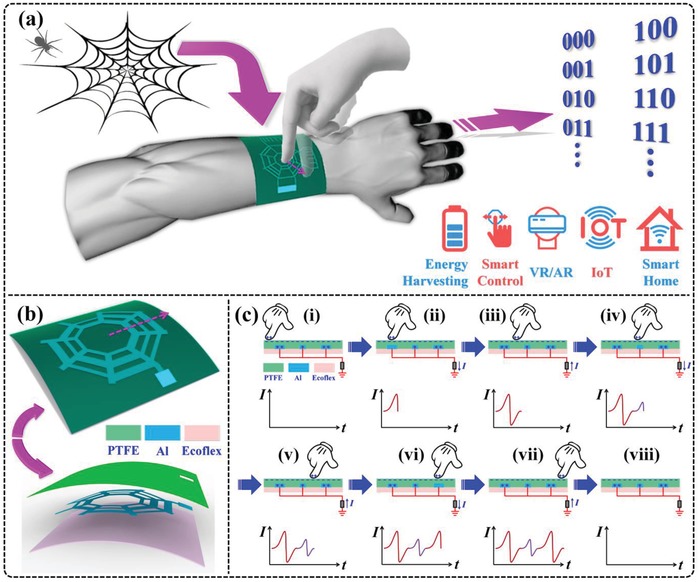
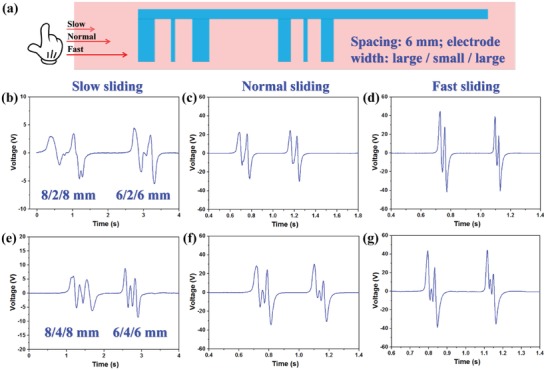
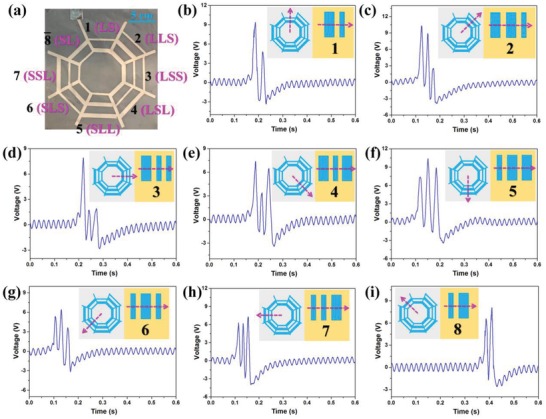
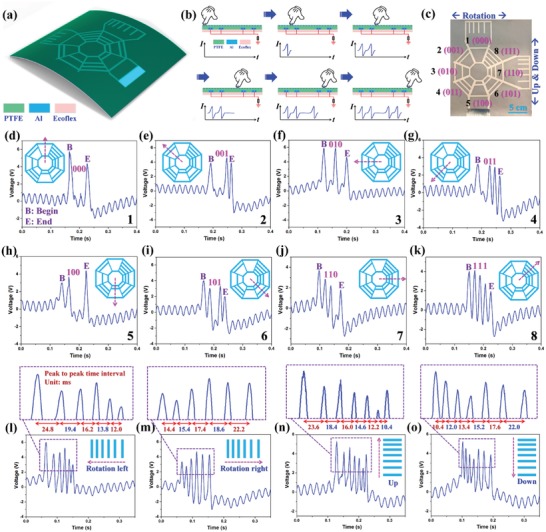
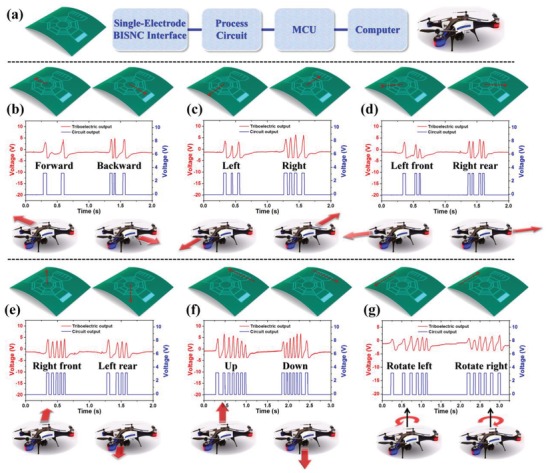
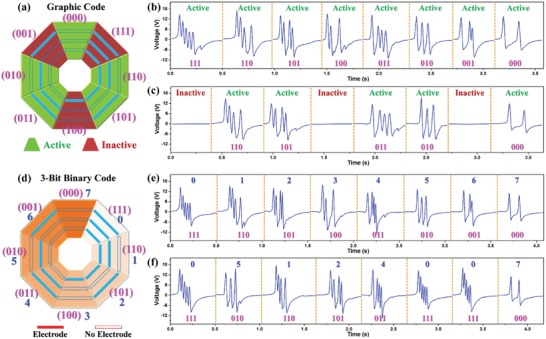
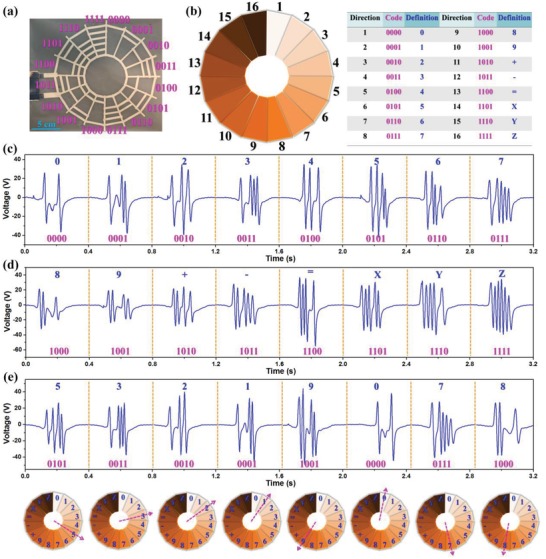
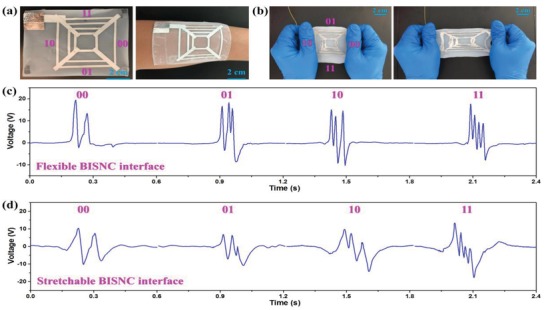
Human–machine interfaces are essential components between various human and machine interactions such as entertainment, robotics control, smart home, virtual/augmented reality, etc. Recently, various triboelectric‐based interfaces have been developed toward flexible wearable and battery‐less applications. However, most of them exhibit complicated structures and a large number of electrodes for multidirectional control. Herein, a bio‐inspired spider‐net‐coding (BISNC) interface with great flexibility, scalability, and single‐electrode output is proposed, through connecting information‐coding electrodes into a single triboelectric electrode. Two types of coding designs are investigated, i.e., information coding by large/small electrode width (L/S coding) and information coding with/without electrode at a predefined position (0/1 coding). The BISNC interface shows high scalability with a single electrode for detection and/or control of multiple directions, by detecting different output signal patterns. In addition, it also has excellent reliability and robustness in actual usage scenarios, since recognition of signal patterns is in regardless of absolute amplitude and thereby not affected by sliding speed/force, humidity, etc. Based on the spider‐net‐coding concept, single‐electrode interfaces for multidirectional 3D control, security code systems, and flexible wearable electronics are successfully developed, indicating the great potentials of this technology in diversified applications such as human–machine interaction, virtual/augmented reality, security, robotics, Internet of Things, etc.
Overview
The claims and statistics of this paper haven’t been checked yet.
Free: it reads the open-access text and checks the first 5 claims that cite a source we can check. Create a free account to check every claim.
Integrity signals
Registry
Cites
Statistics
Figures
Verification
Claims the paper makes
The claims and statistics of this paper haven’t been checked yet.
Free: it reads the open-access text and checks the first 5 claims that cite a source we can check. Create a free account to check every claim.
Claims other papers make about this one
Each is checked against this paper’s own text: does it say what the citing paper says it does?
In the citing paper
“Previously, TENG has been applied as a sensory device in VR/AR system. For example, Lee’s group (23–26) has reported human-machine interfaces for VR applications based on this kind of self-powered sensors.”
From Self-powered electro-tactile system for virtual tactile experiences (2021) · cites this paper as [23]
Self-check
Percentages, sums and reported differences re-computed from the paper’s own numbers.
The self-check needs the paper’s full text.
Citations
Cites
Flexible triboelectric generator
Fan, F.-R., Tian, Z.-Q., & Lin Wang, Z. (2012) · Nano Energy · doi:10.1016/j.nanoen.2012.01.004 · Cited by 6,705
Fully integrated wearable sensor arrays for multiplexed in situ perspiration analysis
Gao, W., Emaminejad, S., Nyein, H. Y. Y., Challa, S., Chen, K., Peck, A., Fahad, H. M., Ota, H., Shiraki, H., Kiriya, D., et al. (2016) · Nature · doi:10.1038/nature16521 · Cited by 5,087
Hammock, M. L., Chortos, A., Tee, B. C. ‐., Tok, J. B. ‐., & Bao, Z. (2013) · Advanced Materials · doi:10.1002/adma.201302240 · Cited by 2,396
Pursuing prosthetic electronic skin
Chortos, A., Liu, J., & Bao, Z. (2016) · Nature Materials · doi:10.1038/nmat4671 · Cited by 2,396
Skin electronics from scalable fabrication of an intrinsically stretchable transistor array
Wang, S., Xu, J., Wang, W., Wang, G.-J. N., Rastak, R., Molina-Lopez, F., Chung, J. W., Niu, S., Feig, V. R., Lopez, J., et al. (2018) · Nature · doi:10.1038/nature25494 · Cited by 2,198
Wearable Electronics and Smart Textiles: A Critical Review
Stoppa, M., & Chiolerio, A. (2014) · Sensors · doi:10.3390/s140711957 · Cited by 2,107
Lab-on-Skin: A Review of Flexible and Stretchable Electronics for Wearable Health Monitoring
Liu, Y., Pharr, M., & Salvatore, G. A. (2017) · ACS Nano · doi:10.1021/acsnano.7b04898 · Cited by 1,725
Bariya, M., Nyein, H. Y. Y., & Javey, A. (2018) · Nature Electronics · doi:10.1038/s41928-018-0043-y · Cited by 1,486
Skin-inspired highly stretchable and conformable matrix networks for multifunctional sensing
Hua, Q., Sun, J., Liu, H., Bao, R., Yu, R., Zhai, J., Pan, C., & Wang, Z. L. (2018) · Nature Communications · doi:10.1038/s41467-017-02685-9 · Cited by 1,413
Recent Advances in Flexible and Stretchable Bio‐Electronic Devices Integrated with Nanomaterials
Choi, S., Lee, H., Ghaffari, R., Hyeon, T., & Kim, D. (2016) · Advanced Materials · doi:10.1002/adma.201504150 · Cited by 1,104
Research works printed but not linked: 3
- Wu C., 2018, Adv. Energy Mater., 8, 1802906
- Kim J., 2018, Int. Conf. Information Science and Applications, 15
- Chong Z., 2018, 2018 Joint Int. Advanced Engineering and Technology Research Conf. (JIAET 2018), 206
Cited by
Items 101–173 of 173
Triboelectric Nanogenerators for Scientific Instruments and Devices
Xu, Z., Cao, L. N. Y., & Wang, Z. L. (2024) · Advanced Devices & Instrumentation · doi:10.34133/adi.0026 · Cited by 36
Hou, C., Geng, J., Yang, Z. Y., Tang, T., Sun, Y., Wang, F., Liu, H., Chen, T., & Sun, L. (2020) · Advanced Materials Technologies · doi:10.1002/admt.202000912 · Cited by 30
Zinc Oxide Nano‐Spicules on Polylactic Acid for Super‐Hydrophilic and Bactericidal Surfaces
Park, B. C., Byun, S. W., Ju, Y., Lee, D. B., Shin, J. B., Yeon, K., Kim, Y. J., Sharma, P., Cho, N., Kim, J., et al. (2021) · Advanced Functional Materials · doi:10.1002/adfm.202100844 · Cited by 30
Bioinspired Triboelectric Nanosensors for Self-Powered Wearable Applications
Zheng, Y., Omar, R., Hu, Z., Duong, T. D., Wang, J., & Haick, H. (2021) · ACS Biomaterials Science & Engineering · doi:10.1021/acsbiomaterials.1c01106 · Cited by 31
Wearable patterned single electrode-based triboelectric nanogenerator for peak-encoded interface
Li, S., Xia, Y., Zhang, S., Liu, K., Yang, B., Li, M., Zhi, X., & Wang, X. (2024) · Nano Energy · doi:10.1016/j.nanoen.2024.109421 · Cited by 30
Flexible nanogenerators for intelligent robotics: design, manufacturing, and applications
Zhao, H., Ruan, L., Wang, Z., Shu, M., Lyu, C., Bulathsinghala, R. L., Dharmasena, I., Wu, C., & Ding, W. (2024) · International Journal of Extreme Manufacturing · doi:10.1088/2631-7990/ad94b8 · Cited by 41
“These include tactile sensors for precise manipulation and safe interaction [17–21], auditory sensors for speech recognition and sound analysis [22–24], olfactory sensors for detecting hazardous gases and assessing product quality [25–27], and gustatory sensors for chemical analysis and quality…”
Fang, D., Ding, S., Dai, Z., Zhong, J., & Zhou, B. (2023) · Chemical Engineering Journal · doi:10.1016/j.cej.2023.143664 · Cited by 27
Wu, W., Ren, Y., Jiang, T., Hou, L., Zhou, J., & Jiang, H. (2021) · Chemical Engineering Journal · doi:10.1016/j.cej.2021.132635 · Cited by 26
Triboelectric nanogenerator–based wireless sensing for food precise positioning
Yang, Y., Mu, B., Wang, M., Nikitina, M. A., Zafari, U., & Xiao, X. (2022) · Materials Today Sustainability · doi:10.1016/j.mtsust.2022.100220 · Cited by 30
An AI-enabled self-sustaining sensing lower-limb motion detection system for HMI in the metaverse
Chen, H., He, D., Xiong, K., Zhao, X., Fang, Z., Zou, R., Zhi, J., & Zhang, Z. (2025) · Nano Energy · doi:10.1016/j.nanoen.2025.110724 · Cited by 23
Wang, Y., Liu, G., Meng, Q., Jiang, X., Li, X., Liu, H., & Li, Z. (2024) · Nano Energy · doi:10.1016/j.nanoen.2024.110631 · Cited by 20
Fine Tactile Representation of Materials for Virtual Reality
Yoon, Y., Moon, D., & Chin, S. (2020) · Journal of Sensors · doi:10.1155/2020/7296204 · Cited by 23
“Additionally, recent progressive research studies regarding 3D control sensors and glove-based interface technology with effective results are mentioned in [4, 19, 20].”
BackgroundRecent Progress of Nanogenerators Acting as Self‐Powered Drug Delivery Devices
Zhao, C., Cui, X. J., Wu, Y., & Li, Z. (2021) · Advanced Sustainable Systems · doi:10.1002/adsu.202000268 · Cited by 19
Ji, B., Yue, J., Zhou, Q., Fang, Y., Zheng, B., Wang, J., Zhai, Y., Zhou, B., & Tang, D. (2025) · Advanced Materials · doi:10.1002/adma.202511275 · Cited by 18
Smart IoT enabled interactive self-powered security tag designed with functionalized paper
Ferreira, G., Opinião, A., Das, S., Goswami, S., Pereira, L., Nandy, S., Martins, R., & Fortunato, E. M. C. (2022) · Nano Energy · doi:10.1016/j.nanoen.2022.107021 · Cited by 19
Sensory-Glove-Based Human Machine Interface for Augmented Reality (AR) Applications
Zhu, M., Sun, Z., Zhang, Z., Shi, Q., Chen, T., Liu, H., & Lee, C. (2020) · IEEE International Conference on Micro Electro Mechanical Systems (MEMS) · doi:10.1109/mems46641.2020.9056153 · Cited by 19
“Numerous designs of soft and stretchable electronics have been reported [4-5], especially, various nanogenerators as the devices that convert the diversified ambient energy into electricity are frequently studied [6].”
BackgroundSelf-citationWang, M., Hou, X., Qian, S., Xian, S., Yu, J., He, J., & Chou, X. (2023) · Electronics · doi:10.3390/electronics12081782 · Cited by 17
Triboelectric nanogenerators as self-powered sensors for biometric authentication
Shi, X., Han, K., Pang, Y., Mai, W., & Luo, J. (2023) · Nanoscale · doi:10.1039/d3nr01334k · Cited by 15
Zhang, B., Jiang, Y., Chen, B., Li, H., & Mao, Y. (2024) · Nanoenergy Advances · doi:10.3390/nanoenergyadv4010003 · Cited by 16
Zhang, Z., He, T., Zhu, M., Shi, Q., & Lee, C. (2020) · IEEE International Conference on Micro Electro Mechanical Systems (MEMS) · doi:10.1109/mems46641.2020.9056149 · Cited by 17
Self-citationEnergy harvesting devices and smart sensors based on porous sponge-type triboelectric nanogenerators
Mao, Y., Cheng, T., Zhang, B., & Luo, S. (2024) · Journal of Materials Chemistry C · doi:10.1039/d4tc02884h · Cited by 14
Sagar, H. P., Meti, S., Bhat, K. U., & Gupta, D. (2021) · Measurement Science and Technology · doi:10.1088/1361-6501/abe6d2 · Cited by 12
Nazar, A. M., Xu, H., & Huang, M. (2024) · Journal of Zhejiang University. Science A · doi:10.1631/jzus.a2300530 · Cited by 9
“…charges via the triboelectric effect, wherein contact between dissimilar materials transfers elec‐ trons and creates charge imbalances on their surfaces (Niu et al., 2013, 2014; Yang et al., 2013a; Niu and Wang, 2015; Roshani et al., 2016; Wang, 2017; Shi and Lee, 2019; Zhang ZL et al., 2019).”
Body‐Coupled Multifunctional Human‐Machine Interfaces with Double Spiral Electrode Structure
Ma, G., Pu, L., Gu, C., Shen, H., Meng, F., Ma, K., Wang, D., Liu, L., Wang, C., Ba, K., et al. (2025) · Advanced Functional Materials · doi:10.1002/adfm.202424979 · Cited by 11
Wu, Z., Chen, X., Wan, Z., Chi, J., Zhang, R., Wang, M., Song, D., & Xiao, X. (2024) · Materials Today Sustainability · doi:10.1016/j.mtsust.2024.100781 · Cited by 10
Multiplexed Complementary Signal Transmission for a Self‐Regulating Artificial Nervous System
Choi, Y. J., Roe, D. G., Choi, Y. Y., Kim, S., Jo, S. B., Lee, H. S., Kim, D. H., & Cho, J. H. (2022) · Advanced Science · doi:10.1002/advs.202205155 · Cited by 9
Self-Powered Wireless IoT Sensor Based on Triboelectric Textile
He, T., Wen, F., Wang, H., Shi, Q., Sun, Z., Zhang, Z., Zhang, T., & Lee, C. (2020) · IEEE International Conference on Micro Electro Mechanical Systems (MEMS) · doi:10.1109/mems46641.2020.9056302 · Cited by 9
Self-citationWang, T., Gao, Z., Li, C., Min, G., Xu, K., Zhao, E., Wang, W. K., & Tang, W. (2025) · Materials Science and Engineering R Reports · doi:10.1016/j.mser.2025.101113 · Cited by 10
Kim, D., Yu, J., Lee, C., Seo, M., Kim, S. S., Joo, H., Song, Y., Bae, S., Lee, J., Lee, S., et al. (2025) · Advanced Materials · doi:10.1002/adma.202515466 · Cited by 9
Self-citationGrid-free touch recognition on arbitrary surface using triboelectric vibration sensor
Shi, C., Ye, T., Li, X., Li, S., Mao, K., Guo, W., Zhou, J., Zhang, X., Xue, R., & Ren, Y. (2024) · Nano Energy · doi:10.1016/j.nanoen.2024.109419 · Cited by 9
Cho, H., Jung, Y., Kim, G., & Kim, D. (2025) · Advanced Functional Materials · doi:10.1002/adfm.202422259 · Cited by 7
Multi-material co-extrusion for precise 3D printing of miniaturized wearable TENG sensors
Kwak, M., Lee, M., & Lee, H. (2025) · Nano Energy · doi:10.1016/j.nanoen.2025.111593 · Cited by 7
HTPad: Hexagon-fractal TENG Pad for Scalable Touch Control
Yang, X., Yin, J., Wang, Z., Song, Z., Song, J., & Ding, W. (2021) · ACM International Joint Conference on Pervasive and Ubiquitous Computing (UbiComp) · doi:10.1145/3460418.3480408 · Cited by 7
“proposed a bio-inspired spider-net-coding interface which could detect multidirectional sliding signals with only one electrode, independent of different sliding force and speed [13].”
BackgroundDevelopment and Prospects of Triboelectric Nanogenerators in Sports and Physical State Monitoring
Zhang, J., Yang, Z., & Liang, X. M. (2022) · Frontiers in Materials · doi:10.3389/fmats.2022.902499 · Cited by 11
“Reproduced with permission (Shi and Lee, 2019).”
BackgroundLi, L., Chen, W., Liu, L., Lin, Y., Guo, Y., Jiang, S., Sun, L., ZHANG, Y., Guo, T., Wu, C., et al. (2026) · Chemical Engineering Journal · doi:10.1016/j.cej.2026.174425 · Cited by 6
Li, T., Long, W., Xu, X., Feng, L., & Chen, Y. (2024) · Energy Technology · doi:10.1002/ente.202301168 · Cited by 6
Xiong, K., Fan, C., He, D., Chen, H., Zhao, X., Xu, F., Zhang, Z., & Wu, X. (2025) · Energy · doi:10.1016/j.energy.2025.136434 · Cited by 5
Li, Q., Dai, K., Zhang, W., Wang, X., You, Z., & Zhang, H. (2022) · Digital Signal Processing · doi:10.1016/j.dsp.2022.103570 · Cited by 5
Sun, Z., Zhu, M., Zhang, Z., Chen, Z., Shi, Q., Shan, X., & Lee, C. (2021) · IEEE International Conference on Micro Electro Mechanical Systems (MEMS) · doi:10.1109/mems51782.2021.9375221 · Cited by 5
Self-citationQi, B., Liang, Y., Ding, S., Fang, D., Lei, M., Zhou, Q., Peng, C., & Zhou, B. (2025) · Chemical Engineering Journal · doi:10.1016/j.cej.2025.167133 · Cited by 5
Triboelectric Nanogenerator for Human-Machine Interfacing
Wu, Z. (2023) · Springer eBooks · doi:10.1007/978-3-031-28111-2_44 · Cited by 4
Perdomo, N. V., Kim, M. P., Li, X., & Cuccia, L. A. (2024) · DeCarbon · doi:10.1016/j.decarb.2024.100093 · Cited by 4
Triboelectric Nanogenerators for the Internet of Things
Zhang, R. (2023) · Springer eBooks · doi:10.1007/978-3-031-28111-2_22 · Cited by 4
Han, W., Qiu, C., & Yuce, M. R. (2024) · Nano Energy · doi:10.1016/j.nanoen.2024.109885 · Cited by 4
Research on Shape Perception of the Soft Gripper Based on Triboelectric Nanogenerator
Li, L., Wang, T., Jin, T., Ma, P., Jiang, Y., Yuan, G., & Tian, Y. (2019) · IEEE International Conference on Robotics and Biomimetics (ROBIO) · doi:10.1109/robio49542.2019.8961413 · Cited by 5
“Due to the diversity of the flexible material, the sensor based on TENG technology also can be compatible with the soft robotics [20].”
MethodZhou, Q., Yue, J., Fang, D., Zhou, B., Ji, B., & Yang, J. (2024) · ACS Applied Materials & Interfaces · doi:10.1021/acsami.4c13206 · Cited by 4
Triboelectric nanogenerators enabled smart wearables for health monitoring
Hasan, M. Z., Akter, A., Luo, L., Motaleb, K. Z. M. A., Ünal, M., Sha, S., Zhang, R., Zhu, J., & Zhu, L. C. (2026) · Chemical Engineering Journal · doi:10.1016/j.cej.2026.178369 · Cited by 3
Ye, F., Cao, Y. H., Yan, M., Wang, L., Sun, C., Zhong, C., & Lu, Y. (2021) · Macromolecular Materials and Engineering · doi:10.1002/mame.202100447 · Cited by 3
Ba, N., Wang, Y., Zhang, K., & Mao, Y. (2025) · Sustainable materials and technologies · doi:10.1016/j.susmat.2025.e01452 · Cited by 11
Zhong, Y., Li, Y., Dai, S., Shi, L., Hu, M., & Cheng, G. (2025) · Measurement · doi:10.1016/j.measurement.2025.119358 · Cited by 2
Triboelectric Nanogenerator for Tactile Sensing and AI
Xu, S., & Wu, W. (2023) · Springer eBooks · doi:10.1007/978-3-031-28111-2_43 · Cited by 2
Shi, Q., Zhang, Z., & Lee, C. (2019) · International Conference on Micro and Nanotechnology for Power Generation and Energy Conversion Applications (PowerMEMS) · doi:10.1109/powermems49317.2019.92321102886 · Cited by 2
“Since 2012, extensive research effort has been conducted to develop high-efficient triboelectric nanogenerators and self-powered sensors [5-9].”
BackgroundSelf-citationWu, Z., Chen, X., Wan, Z., Chi, J., Zhang, R., Wang, M., Song, D., & Xiao, X. (2023) · SSRN Electronic Journal · doi:10.2139/ssrn.4661331 · Cited by 2
Zhou, Q., Li, Y., Wang, Y., Zhou, H., He, P., Ji, B., Zhou, B., & Yang, J. (2026) · Applied Physics Reviews · doi:10.1063/5.0301455 · Cited by 1
Lin, W., Chen, J., Miao, Y., Kong, J., Chen, Z., & Liao, X. (2026) · Materials Horizons · doi:10.1039/d6mh00815a · Cited by 2
Triboelectric Nanogenerator for Human-Machine Interfacing
Wu, Z. (2023) · Springer eBooks · doi:10.1007/978-3-031-05722-9_44-1 · Cited by 1
Knitted Graphene Supercapacitor and Pressure-Sensing Fabric
Zhou, Y., Zhang, C., Myant, C., & Stewart, R. (2022) · International Conference on the Challenges, Opportunities, Innovations and Applications in Electronic Textiles (E-Textiles) · doi:10.3390/engproc2022015005 · Cited by 1
“Introduction Stretchable and wearable electronics have attracted extensive attention from both academia and industry due to their unique flexibility, deformability, and portability [1].”
BackgroundA switchable fabric-triboelectric nanogenerators (SF-TENGs) profile sensing application
Wang, H., Liu, S., He, T., Dong, S., & Lee, C. (2019) · International Conference on Micro and Nanotechnology for Power Generation and Energy Conversion Applications (PowerMEMS) · doi:10.1109/powermems49317.2019.30773701048
“Owing to its versatile capability, a variety of self-powered sensors were developed for various kinds of mechanical and chemical sensing applications [5–12].”
BackgroundSelf-citationHe, T., Wang, H., & Lee, C. (2019) · International Conference on Micro and Nanotechnology for Power Generation and Energy Conversion Applications (PowerMEMS) · doi:10.1109/powermems49317.2019.71805304506
Self-citationWearable Power Sources and Self-powered Sensors Based on the Triboelectric Nanogenerators
Feng, Z. (2020) · VTechWorks (Virginia Tech)
Is 4D Printing Disruptive or Incremental, or a Bit of Both?
Demoly, F., & André, J. (2022) · Wiley eBooks · doi:10.1002/9781394163786.ch1
Triboelectric Nanogenerators for the Internet of Things
Zhang, R. (2022) · Springer eBooks · doi:10.1007/978-3-031-05722-9_22-1
Triboelectric Nanogenerators for Information Security and Identification
Zhang, X., & Zhang, H. (2023) · Springer eBooks · doi:10.1007/978-3-031-05722-9_21-1
Triboelectric Nanogenerator for Tactile Sensing and AI
Xu, S., & Wu, W. (2023) · Springer eBooks · doi:10.1007/978-3-031-05722-9_43-1
Triboelectric Nanogenerators for Information Security and Identification
Zhang, X., & Zhang, H. (2023) · Springer eBooks · doi:10.1007/978-3-031-28111-2_21
Accelerating Development of Medical Devices Using Human‐Machine Interface
Karati, D., Mukherjee, S., Roy, S., & Prajapati, B. G. (2023) · Wiley eBooks · doi:10.1002/9781394200344.ch6 · Cited by 1
Wang, Y., Liu, G., Meng, Q., Jiang, X., Li, X., Liu, H., & Li, Z. (2024) · SSRN Electronic Journal · doi:10.2139/ssrn.5012335
Wearable sensors for biomedical application
Singh, A., Janjua, A. N., & Arya, S. (2025) · Elsevier eBooks · doi:10.1016/b978-0-443-24790-3.00012-0
Smart Infrastructure: Bridge Monitoring with Triboelectric Nanogenerators
Nazar, A. M., Rashidi, M., & Bozorg, B. (2025) · Lecture notes in civil engineering · doi:10.1007/978-981-96-8769-5_26
Yao, F., Wang, Y., Zheng, B., Yang, L., Yue, J., Zhou, Q., Huang, J., Mao, Y., Li, Q., Wang, J., et al. (2026) · Advanced Science · doi:10.1002/advs.76197
A Body‐Coupled Electronic Skin With Branch‐Enhanced Grid Architecture for Fine Tactile Sensing
Ma, G., Ma, K., Gu, C., Tian, H., Zhang, T., Jiang, X., Zhang, M., Li, J., Ba, K., & Yu, B. (2026) · Energy & environment materials · doi:10.1002/eem2.70503
Yu, S., Kim, Y.-S., La, M., Park, S. J., Ra, Y., & Choi, D. (2026) · International Journal of Energy Research · doi:10.1155/er/6425434
Jingyan, D., Jun, L., Liu, L., Wu, H., Hu, D., Chen, X., & Ou‐Yang, W. (2026) · Small · doi:10.1002/smll.75850
Metadata
- Authors
- Shi, Q., & Lee, C.
- Affiliations
- National University of Singapore (SG)
- Corresponding author
- Lee, Chengkuo
- Venue
- Advanced Science
- Publisher
- Wiley
- Published
- 2019-05-29
- Volume
- 6
- Issue
- 15
- Pages
- 1900617-1900617
- ISSN
- 2198-3844 (ISSN-L)
- PMC
- PMC6685466
- OpenAlex
- W2947518122
- Cited by
- 174
- References
- 89
- Citations by year
- 2026: 8 · 2025: 14 · 2024: 21 · 2023: 23 · 2022: 28 · 2021: 33 · 2020: 34 · 2019: 12
- FWCI
- 9.43
- Type
- journal article
- Language
- en
- Open access
- gold
- doi.org
- Licence
- cc-by
- creativecommons.org/licenses/by/4.0/ (vor)
- doi.wiley.com/10.1002/tdm_license_1.1 (tdm)
- Locations
- Advanced Science (publishedVersion, cc-by)
- Europe PMC (PubMed Central) (publishedVersion, cc-by)
- PubMed Central (publishedVersion, cc-by)
- PubMed (publishedVersion)
- National University of Singapore (submittedVersion)
- DOAJ (DOAJ: Directory of Open Access Journals) (submittedVersion)
- Funders
- National University of Singapore
- Topics
- Physical Sciences › Engineering › Biomedical Engineering › Advanced Sensor and Energy Harvesting Materials
- Physical Sciences › Engineering › Electrical and Electronic Engineering › Nanomaterials and Printing Technologies
- Life Sciences › Neuroscience › Cognitive Neuroscience › Tactile and Sensory Interactions
- Keywords
- triboelectric nanogenerator, biomimetic design, human-machine interaction, wearable electronics, battery-free devices, flexible electronics
About these checks
Registry, retraction, Cites and statistics results are computed, not judged, with one exception: a printed reference that no index lists is read once by a model before it counts as a citation error. Claims are extracted by a model and kept only when their quote appears verbatim in the text; each cited source is then checked, with a model’s help, for whether it says what the claim relies on. Those verdicts can be wrong — read the claim’s quote and the cited source before relying on one.
Statistics and arithmetic are recomputed, not judged.
Confidence bands are shown only for fields calibrated on our annotated test set. None is calibrated yet, so no band is shown.
What counts as a claim ›How we measure confidence ›How we check this ›
Are you an author, or do you see a problem with this page? Request a review
Data sources
Bibliographic data: Semantic Scholar, OpenAlex, Crossref.
Contains information from the Semantic Scholar Academic Graph Datasets, made available under the ODC Attribution License (ODC-BY 1.0).
Semantic Scholar’s data is described in: Kinney, R., et al. (2023). The Semantic Scholar Open Data Platform. arXiv:2301.10140.
