

Self‐Powered Bio‐Inspired Spider‐Net‐Coding Interface Using Single‐Electrode Triboelectric Nanogenerator
Open accessThe DOI matches its Crossref record; 88 of the 89 references it cites were found in a registry or an index.
Abstract
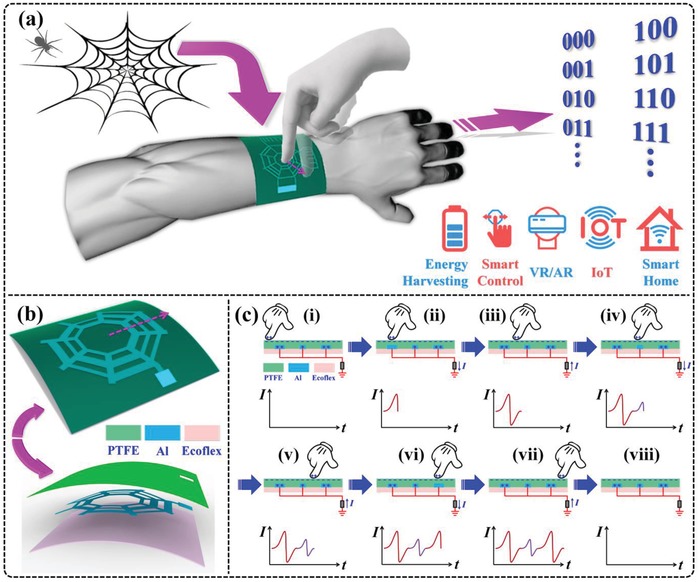
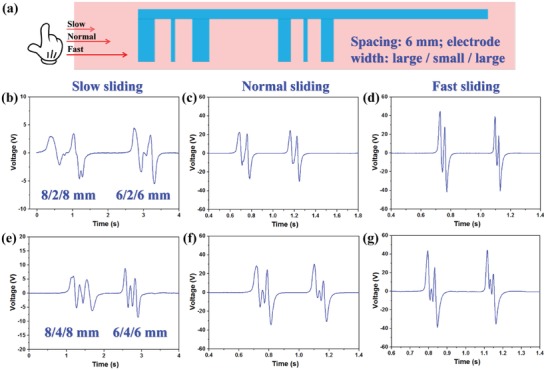
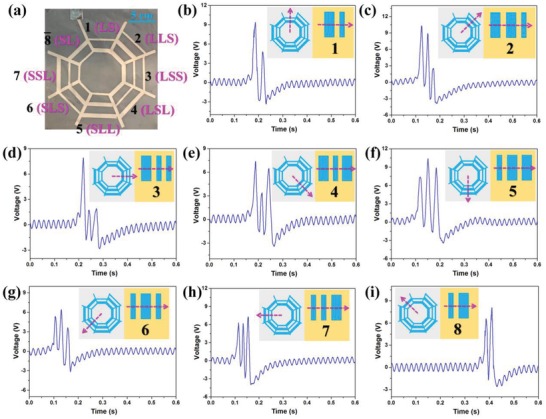
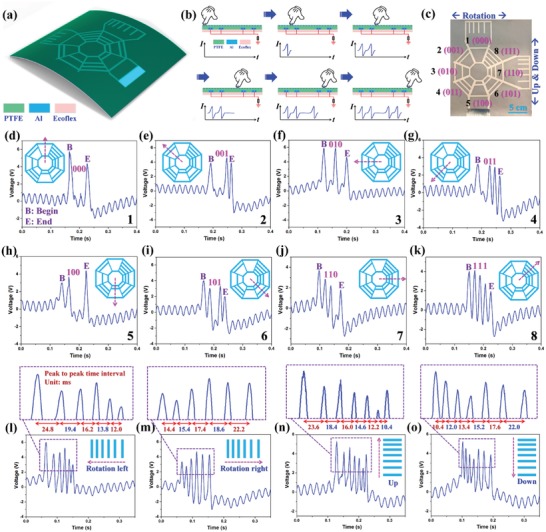
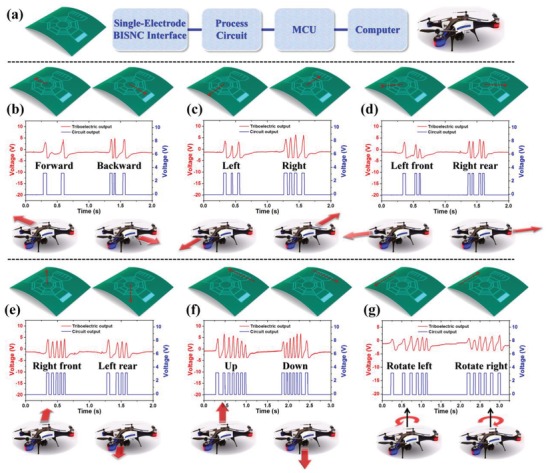
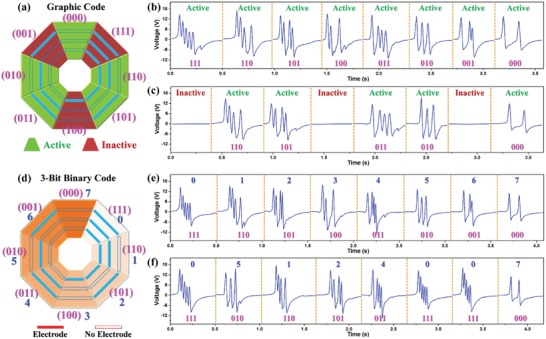
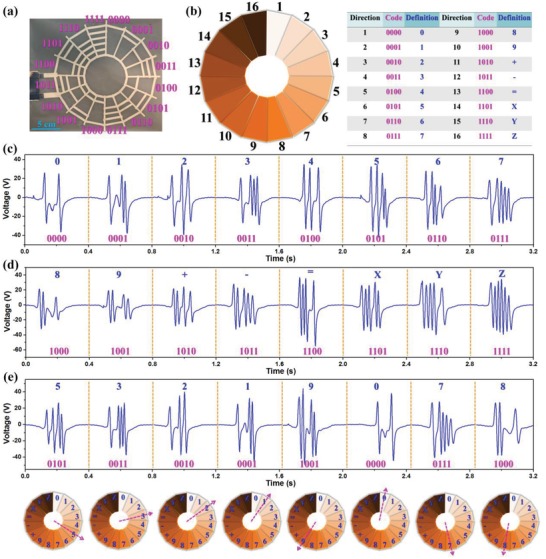
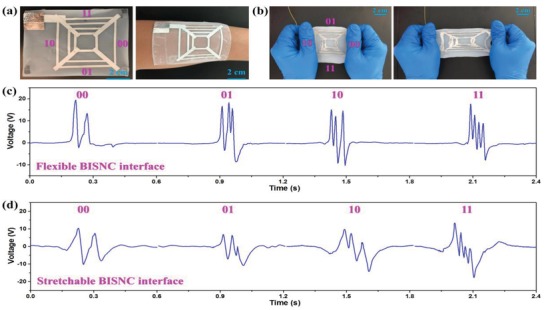
Human–machine interfaces are essential components between various human and machine interactions such as entertainment, robotics control, smart home, virtual/augmented reality, etc. Recently, various triboelectric‐based interfaces have been developed toward flexible wearable and battery‐less applications. However, most of them exhibit complicated structures and a large number of electrodes for multidirectional control. Herein, a bio‐inspired spider‐net‐coding (BISNC) interface with great flexibility, scalability, and single‐electrode output is proposed, through connecting information‐coding electrodes into a single triboelectric electrode. Two types of coding designs are investigated, i.e., information coding by large/small electrode width (L/S coding) and information coding with/without electrode at a predefined position (0/1 coding). The BISNC interface shows high scalability with a single electrode for detection and/or control of multiple directions, by detecting different output signal patterns. In addition, it also has excellent reliability and robustness in actual usage scenarios, since recognition of signal patterns is in regardless of absolute amplitude and thereby not affected by sliding speed/force, humidity, etc. Based on the spider‐net‐coding concept, single‐electrode interfaces for multidirectional 3D control, security code systems, and flexible wearable electronics are successfully developed, indicating the great potentials of this technology in diversified applications such as human–machine interaction, virtual/augmented reality, security, robotics, Internet of Things, etc.
Overview
The claims and statistics of this paper haven’t been checked yet.
Free: it reads the open-access text and checks the first 5 claims that cite a source we can check. Create a free account to check every claim.
Integrity signals
Registry
Cites
Statistics
Figures
Verification
Claims the paper makes
The claims and statistics of this paper haven’t been checked yet.
Free: it reads the open-access text and checks the first 5 claims that cite a source we can check. Create a free account to check every claim.
Claims other papers make about this one
Each is checked against this paper’s own text: does it say what the citing paper says it does?
In the citing paper
“Previously, TENG has been applied as a sensory device in VR/AR system. For example, Lee’s group (23–26) has reported human-machine interfaces for VR applications based on this kind of self-powered sensors.”
From Self-powered electro-tactile system for virtual tactile experiences (2021) · cites this paper as [23]
Self-check
Percentages, sums and reported differences re-computed from the paper’s own numbers.
The self-check needs the paper’s full text.
Citations
Cites
Flexible triboelectric generator
Fan, F.-R., Tian, Z.-Q., & Lin Wang, Z. (2012) · Nano Energy · doi:10.1016/j.nanoen.2012.01.004 · Cited by 6,705
Fully integrated wearable sensor arrays for multiplexed in situ perspiration analysis
Gao, W., Emaminejad, S., Nyein, H. Y. Y., Challa, S., Chen, K., Peck, A., Fahad, H. M., Ota, H., Shiraki, H., Kiriya, D., et al. (2016) · Nature · doi:10.1038/nature16521 · Cited by 5,087
Hammock, M. L., Chortos, A., Tee, B. C. ‐., Tok, J. B. ‐., & Bao, Z. (2013) · Advanced Materials · doi:10.1002/adma.201302240 · Cited by 2,396
Pursuing prosthetic electronic skin
Chortos, A., Liu, J., & Bao, Z. (2016) · Nature Materials · doi:10.1038/nmat4671 · Cited by 2,396
Skin electronics from scalable fabrication of an intrinsically stretchable transistor array
Wang, S., Xu, J., Wang, W., Wang, G.-J. N., Rastak, R., Molina-Lopez, F., Chung, J. W., Niu, S., Feig, V. R., Lopez, J., et al. (2018) · Nature · doi:10.1038/nature25494 · Cited by 2,198
Wearable Electronics and Smart Textiles: A Critical Review
Stoppa, M., & Chiolerio, A. (2014) · Sensors · doi:10.3390/s140711957 · Cited by 2,107
Lab-on-Skin: A Review of Flexible and Stretchable Electronics for Wearable Health Monitoring
Liu, Y., Pharr, M., & Salvatore, G. A. (2017) · ACS Nano · doi:10.1021/acsnano.7b04898 · Cited by 1,725
Bariya, M., Nyein, H. Y. Y., & Javey, A. (2018) · Nature Electronics · doi:10.1038/s41928-018-0043-y · Cited by 1,486
Skin-inspired highly stretchable and conformable matrix networks for multifunctional sensing
Hua, Q., Sun, J., Liu, H., Bao, R., Yu, R., Zhai, J., Pan, C., & Wang, Z. L. (2018) · Nature Communications · doi:10.1038/s41467-017-02685-9 · Cited by 1,413
Recent Advances in Flexible and Stretchable Bio‐Electronic Devices Integrated with Nanomaterials
Choi, S., Lee, H., Ghaffari, R., Hyeon, T., & Kim, D. (2016) · Advanced Materials · doi:10.1002/adma.201504150 · Cited by 1,104
Self-powered ultra-flexible electronics via nano-grating-patterned organic photovoltaics
Park, S., Heo, S. W., Lee, W., Inoue, D., Jiang, Z., Yu, K., Jinno, H., Hashizume, D., Sekino, M., Yokota, T., et al. (2018) · Nature · doi:10.1038/s41586-018-0536-x · Cited by 1,068
Micro-cable structured textile for simultaneously harvesting solar and mechanical energy
Chen, J., Huang, Y., Zhang, N., Zou, H., Liu, R., Tao, C., Fan, X., & Wang, Z. L. (2016) · Nature Energy · doi:10.1038/nenergy.2016.138 · Cited by 1,060
Highly stretchable, transparent ionic touch panel
Kim, C.-C., Lee, H.-H., Oh, K. H., & Sun, J.-Y. (2016) · Science · doi:10.1126/science.aaf8810 · Cited by 1,047
Recent Progress in Electronic Skin
Wang, X., Dong, L., Zhang, H., Yu, R., Pan, C., & Wang, Z. L. (2015) · Advanced Science · doi:10.1002/advs.201500169 · Cited by 976
Conformal piezoelectric energy harvesting and storage from motions of the heart, lung, and diaphragm
Dagdeviren, C., Yang, B. D., Su, Y., Tran, P. L., Joe, P., Anderson, E., Xia, J., Doraiswamy, V., Dehdashti, B., Feng, X., et al. (2014) · Proceedings of the National Academy of Sciences · doi:10.1073/pnas.1317233111 · Cited by 975
Liu, H., Zhong, J., Lee, C., Lee, S.-W., & Lin, L. (2018) · Applied Physics Reviews · doi:10.1063/1.5074184 · Cited by 905
Self-citationMonitoring of the central blood pressure waveform via a conformal ultrasonic device
Wang, C., Li, X., Hu, H., Zhang, L., Huang, Z., Lin, M., Zhang, Z., Yin, Z., Huang, B., Gong, H., et al. (2018) · Nature Biomedical Engineering · doi:10.1038/s41551-018-0287-x · Cited by 895
A skin-inspired organic digital mechanoreceptor
Tee, B. C.-K., Chortos, A., Berndt, A., Nguyen, A. K., Tom, A., McGuire, A., Lin, Z. C., Tien, K., Bae, W.-G., Wang, H., et al. (2015) · Science · doi:10.1126/science.aaa9306 · Cited by 882
A transparent bending-insensitive pressure sensor
Lee, S., Reuveny, A., Reeder, J., Lee, S., Jin, H., Liu, Q., Yokota, T., Sekitani, T., Isoyama, T., Abe, Y., et al. (2016) · Nature Nanotechnology · doi:10.1038/nnano.2015.324 · Cited by 833
Nature-Inspired Structural Materials for Flexible Electronic Devices
Liu, Y., He, K., Chen, G., Leow, W. R., & Chen, X. (2017) · Chemical Reviews · doi:10.1021/acs.chemrev.7b00291 · Cited by 798
A highly sensitive, self-powered triboelectric auditory sensor for social robotics and hearing aids
Guo, H., Pu, X., Chen, J., Meng, Y., Yeh, M.-H., Liu, G., Tang, Q., Chen, B., Liu, D., Qi, S., et al. (2018) · Science Robotics · doi:10.1126/scirobotics.aat2516 · Cited by 786
Nanopatterned Textile-Based Wearable Triboelectric Nanogenerator
Seung, W., Gupta, M. K., Lee, K. Y., Shin, K.-S., Lee, J.-H., Kim, T. Y., Kim, S., Lin, J., Kim, J. H., & Kim, S.-W. (2015) · ACS Nano · doi:10.1021/nn507221f · Cited by 714
Printable Transparent Conductive Films for Flexible Electronics
Li, D., Lai, W., Zhang, Y., & Huang, W. (2018) · Advanced Materials · doi:10.1002/adma.201704738 · Cited by 714
Hwang, G., Park, H., Lee, J., Oh, S., Park, K., Byun, M., Park, H., Ahn, G., Jeong, C. K., No, K., et al. (2014) · Advanced Materials · doi:10.1002/adma.201400562 · Cited by 672
Zhang, F., Zang, Y., Huang, D., Di, C.-A., & Zhu, D. (2015) · Nature Communications · doi:10.1038/ncomms9356 · Cited by 668
Bae, G. Y., Pak, S. W., Kim, D., Lee, G., Kim, D. H., Chung, Y., & Cho, K. (2016) · Advanced Materials · doi:10.1002/adma.201600408 · Cited by 646
Choi, C., Choi, M. K., Liu, S., Kim, M., Park, O. K., Im, C., Kim, J., Qin, X., Lee, G. J., Cho, K. W., et al. (2017) · Nature Communications · doi:10.1038/s41467-017-01824-6 · Cited by 540
Soft network composite materials with deterministic and bio-inspired designs
Jang, K.-I., Chung, H. U., Xu, S., Lee, C. H., Luan, H., Jeong, J., Cheng, H., Kim, G.-T., Han, S. Y., Lee, J. W., et al. (2015) · Nature Communications · doi:10.1038/ncomms7566 · Cited by 533
Self-citationSkin-Inspired Electronics: An Emerging Paradigm
Wang, S., Oh, J. Y., Xu, J., Tran, H., & Bao, Z. (2018) · Accounts of Chemical Research · doi:10.1021/acs.accounts.8b00015 · Cited by 527
Dong, K., Wu, Z., Deng, J., Wang, A. C., Zou, H., Chen, C., Hu, D., Gu, B., Sun, B., & Wang, Z. L. (2018) · Advanced Materials · doi:10.1002/adma.201804944 · Cited by 499
Scavenging Wind Energy by Triboelectric Nanogenerators
Chen, B., Yang, Y., & Wang, Z. L. (2018) · Advanced Energy Materials · doi:10.1002/aenm.201702649 · Cited by 493
Cao, R., Pu, X., Du, X., Yang, W., Wang, J., Guo, H., Zhao, S., Yuan, Z., Zhang, C., Li, C., et al. (2018) · ACS Nano · doi:10.1021/acsnano.8b02477 · Cited by 486
Jinno, H., Fukuda, K., Xu, X., Park, S., Suzuki, Y., Koizumi, M., Yokota, T., Osaka, I., Takimiya, K., & Someya, T. (2017) · Nature Energy · doi:10.1038/s41560-017-0001-3 · Cited by 471
3D Printed Stretchable Tactile Sensors
Guo, S., Qiu, K., Meng, F., Park, S. H., & McAlpine, M. C. (2017) · Advanced Materials · doi:10.1002/adma.201701218 · Cited by 445
Self-assembled three dimensional network designs for soft electronics
Jang, K.-I., Li, K., Chung, H. U., Xu, S., Jung, H. N., Yang, Y., Kwak, J. W., Jung, H. H., Song, J., Yang, C., et al. (2017) · Nature Communications · doi:10.1038/ncomms15894 · Cited by 445
Quantum design of photosynthesis for bio-inspired solar-energy conversion
Romero, E., Novoderezhkin, V. I., & van Grondelle, R. (2017) · Nature · doi:10.1038/nature22012 · Cited by 436
Wang, X., Zhang, Y., Zhang, X., Huo, Z., Li, X., Que, M., Peng, Z., Wang, H., & Pan, C. (2018) · Advanced Materials · doi:10.1002/adma.201706738 · Cited by 434
Jiang, Q., Wu, C., Wang, Z., Wang, A. C., He, J.-H., Wang, Z. L., & Alshareef, H. N. (2018) · Nano Energy · doi:10.1016/j.nanoen.2018.01.004 · Cited by 425
Zhu, M., Shi, Q., He, T., Yi, Z., Ma, Y., Yang, B., Chen, T., & Lee, C. (2019) · ACS Nano · doi:10.1021/acsnano.8b08329 · Cited by 411
Self-citationBioinspired neuron-like electronics
Yang, X., Zhou, T., Zwang, T. J., Hong, G., Zhao, Y., Viveros, R. D., Fu, T.-M., Gao, T., & Lieber, C. M. (2019) · Nature Materials · doi:10.1038/s41563-019-0292-9 · Cited by 384
Lai, Y., Deng, J., Liu, R., Hsiao, Y., Zhang, S. L., Peng, W., Wu, H., Wang, X., & Wang, Z. L. (2018) · Advanced Materials · doi:10.1002/adma.201801114 · Cited by 347
Zhang, X.-S., Han, M.-D., Wang, R.-X., Meng, B., Zhu, F.-Y., Sun, X.-M., Hu, W., Wang, W., Li, Z.-H., & Zhang, H.-X. (2014) · Nano Energy · doi:10.1016/j.nanoen.2013.12.016 · Cited by 339
Self-Healable, Stretchable, Transparent Triboelectric Nanogenerators as Soft Power Sources
Sun, J., Pu, X., Liu, M., Yu, A., Du, C., Zhai, J., Hu, W., & Wang, Z. L. (2018) · ACS Nano · doi:10.1021/acsnano.8b02479 · Cited by 332
Shi, Q., He, T., & Lee, C. (2019) · Nano Energy · doi:10.1016/j.nanoen.2019.01.002 · Cited by 318
Self-citationLai, Y., Hsiao, Y., Wu, H., & Wang, Z. L. (2019) · Advanced Science · doi:10.1002/advs.201801883 · Cited by 314
Pan, R., Xuan, W., Chen, J., Dong, S., Jin, H., Wang, X., Li, H., & Luo, J. (2018) · Nano Energy · doi:10.1016/j.nanoen.2017.12.048 · Cited by 308
Natural Leaf Made Triboelectric Nanogenerator for Harvesting Environmental Mechanical Energy
Jie, Y., Jia, X., Zou, J., Chen, Y., Wang, N., Wang, Z. L., & Cao, X. (2018) · Advanced Energy Materials · doi:10.1002/aenm.201703133 · Cited by 308
Transcatheter Self‐Powered Ultrasensitive Endocardial Pressure Sensor
Liu, Z., Ma, Y., Ouyang, H., Shi, B., Li, N., Jiang, D., Xie, F., Qu, D., Zou, Y., Huang, Y., et al. (2019) · Advanced Functional Materials · doi:10.1002/adfm.201807560 · Cited by 308
Implantable Energy‐Harvesting Devices
Shi, B., Li, Z., & Fan, Y. (2018) · Advanced Materials · doi:10.1002/adma.201801511 · Cited by 290
Fang, H., Yu, K. J., Gloschat, C., Yang, Z., Song, E., Chiang, C.-H., Zhao, J., Won, S. M., Xu, S., Trumpis, M., et al. (2017) · Nature Biomedical Engineering · doi:10.1038/s41551-017-0038 · Cited by 278
High-Performance Flexible Thermoelectric Power Generator Using Laser Multiscanning Lift-Off Process
Kim, S. J., Lee, H. E., Choi, H., Kim, Y., We, J. H., Shin, J. S., Lee, K. J., & Cho, B. J. (2016) · ACS Nano · doi:10.1021/acsnano.6b05004 · Cited by 257
Self-powered electronic skin based on the triboelectric generator
Chen, H., Song, Y., Cheng, X., & Zhang, H. (2019) · Nano Energy · doi:10.1016/j.nanoen.2018.11.061 · Cited by 245
Rotation sensing and gesture control of a robot joint via triboelectric quantization sensor
Pu, X., Guo, H., Tang, Q., Chen, J., Feng, L., Liu, G., Wang, X., Xi, Y., Hu, C., & Wang, Z. L. (2018) · Nano Energy · doi:10.1016/j.nanoen.2018.10.044 · Cited by 244
Chen, T., Shi, Q., Zhu, M., He, T., Sun, L., Yang, L., & Lee, C. (2018) · ACS Nano · doi:10.1021/acsnano.8b06747 · Cited by 225
Self-citationNie, J., Ren, Z., Shao, J., Deng, C., Xu, L., Chen, X., Li, M., & Wang, Z. L. (2018) · ACS Nano · doi:10.1021/acsnano.7b08014 · Cited by 204
Sustainable direct current powering a triboelectric nanogenerator via a novel asymmetrical design
Ryu, H., Lee, J. H., Khan, U., Kwak, S. S., Hinchet, R., & Kim, S.-W. (2018) · Energy & Environmental Science · doi:10.1039/c8ee00188j · Cited by 199
Liu, H., Hou, C., Lin, J., Li, Y., Shi, Q., Chen, T., Sun, L., & Lee, C. (2018) · Applied Physics Letters · doi:10.1063/1.5053945 · Cited by 198
Self-citationDynamic Triboelectrification‐Induced Electroluminescence and its Use in Visualized Sensing
Wei, X. Y., Wang, X., Kuang, S. Y., Su, L., Li, H. Y., Wang, Y., Pan, C., Wang, Z. L., & Zhu, G. (2016) · Advanced Materials · doi:10.1002/adma.201600604 · Cited by 197
Zhu, H., Liu, A., Luque, H. L., Sun, H., Ji, D., & Noh, Y.-Y. (2019) · ACS Nano · doi:10.1021/acsnano.8b07567 · Cited by 197
Nature‐Inspired Electrochemical Energy‐Storage Materials and Devices
Wang, H., Yang, Y., & Guo, L. (2017) · Advanced Energy Materials · doi:10.1002/aenm.201601709 · Cited by 189
A silk-fibroin-based transparent triboelectric generator suitable for autonomous sensor network
Zhang, X.-S., Brugger, J., & Kim, B. (2016) · Nano Energy · doi:10.1016/j.nanoen.2015.11.036 · Cited by 171
Progress in textile-based triboelectric nanogenerators for smart fabrics
Hu, Y., & Zheng, Z. (2019) · Nano Energy · doi:10.1016/j.nanoen.2018.11.025 · Cited by 169
Controlling surface charge generated by contact electrification: Strategies and applications
Chen, L., Shi, Q., Sun, Y., Nguyen, T., Lee, C., & Soh, S. (2018) · Advanced Materials · doi:10.1002/adma.201802405 · Cited by 156
Self-citationLee, S., Wang, H., Shi, Q., Dhakar, L., Wang, J., Thakor, N. V., Yen, S.-C., & Lee, C. (2017) · Nano Energy · doi:10.1016/j.nanoen.2016.12.038 · Cited by 148
Self-citationSustainable powering triboelectric nanogenerators: Approaches and the path towards efficient use
Yoon, H., Ryu, H., & Kim, S. (2018) · Nano Energy · doi:10.1016/j.nanoen.2018.06.075 · Cited by 146
Jin, S., Wang, Y., Motlag, M., Gao, S., Xu, J. K., Nian, Q., Wu, W., & Cheng, G. J. (2018) · Advanced Materials · doi:10.1002/adma.201705840 · Cited by 141
Gupta, R. K., Shi, Q., Dhakar, L., Wang, T., Heng, C. H., & Lee, C. (2017) · Scientific Reports · doi:10.1038/srep41396 · Cited by 127
Self-citationTunable Optical Modulator by Coupling a Triboelectric Nanogenerator and a Dielectric Elastomer
Chen, X., Pu, X., Jiang, T., Yu, A., Xu, L., & Wang, Z. L. (2016) · Advanced Functional Materials · doi:10.1002/adfm.201603788 · Cited by 123
Self‐Powered Gyroscope Ball Using a Triboelectric Mechanism
Shi, Q., Wu, H., Wang, H., Wu, H., & Lee, C. (2017) · Advanced Energy Materials · doi:10.1002/aenm.201701300 · Cited by 120
Self-citationSun, C., Shi, Q., Hasan, D. M. N., Yazici, M. S., Zhu, M., Ma, Y., Dong, B., Liu, Y., & Lee, C. (2019) · Nano Energy · doi:10.1016/j.nanoen.2019.01.096 · Cited by 115
Self-citationZheng, L., Wu, Y., Chen, X., Yu, A., Xu, L., Liu, Y., Li, H., & Wang, Z. L. (2017) · Advanced Functional Materials · doi:10.1002/adfm.201606408 · Cited by 105
Ji, Y., Zhang, K., & Yang, Y. F. (2017) · Advanced Science · doi:10.1002/advs.201700622 · Cited by 104
Han, C. B., Zhang, C., Li, X. H., Zhang, L., Zhou, T., Hu, W., & Wang, Z. L. (2014) · Nano Energy · doi:10.1016/j.nanoen.2014.07.025 · Cited by 100
Triboelectric Nanogenerators as a Self‐Powered Motion Tracking System
Chen, M., Li, X., Lin, L., Du, W., Han, X., Zhu, J., Pan, C., & Wang, Z. L. (2014) · Advanced Functional Materials · doi:10.1002/adfm.201400431 · Cited by 99
Triboelectric Nanogenerator Boosts Smart Green Tires
Wu, W., Cao, X., Zou, J., Ma, Y., Wu, X., Sun, C., Li, M., Wang, N., Wang, Z., & Zhang, L. (2019) · Advanced Functional Materials · doi:10.1002/adfm.201806331 · Cited by 97
Chen, T., Zhao, M., Shi, Q., Yang, Z., Liu, H., Sun, L., Ouyang, J., & Lee, C. (2018) · Nano Energy · doi:10.1016/j.nanoen.2018.06.022 · Cited by 89
Self-citationStandardization of triboelectric nanogenerators: Progress and perspectives
Li, X., Xu, G., Xia, X., Fu, J., Huang, L., & Zi, Y. (2018) · Nano Energy · doi:10.1016/j.nanoen.2018.11.029 · Cited by 89
Triboelectric single-electrode-output control interface using patterned grid electrode
Shi, Q., Qiu, C., He, T., Wu, F., Zhu, M., Dziuban, J., Walczak, R., Yuce, M. R., & Lee, C. (2019) · Nano Energy · doi:10.1016/j.nanoen.2019.03.090 · Cited by 87
Self-citationChen, J., Pu, X., Guo, H., Tang, Q., Feng, L., Wang, X., & Hu, C. (2017) · Nano Energy · doi:10.1016/j.nanoen.2017.11.028 · Cited by 77
Zhao, G., Yang, J., Chen, J., Zhu, G., Jiang, Z., Liu, X., Niu, G., Wang, Z. L., & Zhang, B. (2019) · Advanced Materials Technologies · doi:10.1002/admt.201800167 · Cited by 76
Gao, L., Hu, D., Qi, M., Gong, J. L., Zhou, H., Chen, X., Chen, J., Cai, J., Wu, L., Hu, N., et al. (2018) · Nanoscale · doi:10.1039/c8nr05957h · Cited by 57
Shi, Q., Wang, T., Kobayashi, T., & Lee, C. (2016) · Applied Physics Letters · doi:10.1063/1.4948973 · Cited by 54
Self-citationHand‐Driven Gyroscopic Hybrid Nanogenerator for Recharging Portable Devices
Chung, J., Yong, H., Moon, H., Duong, Q. V., Choi, S. T., Kim, D., & Lee, S. (2018) · Advanced Science · doi:10.1002/advs.201801054 · Cited by 53
Triboelectric‐Based Transparent Secret Code
Yuan, Z., Du, X., Li, N., Yin, Y., Cao, R., Zhang, X., Zhao, S., Niu, H., Jiang, T., Xu, W., et al. (2018) · Advanced Science · doi:10.1002/advs.201700881 · Cited by 31
Chip-integrated all-optical 4-bit Gray code generation based on silicon microring resonators
Liu, L., Dong, J., & Zhang, X. (2015) · Optics Express · doi:10.1364/oe.23.021414 · Cited by 26
Self‐Powered Cursor Using a Triboelectric Mechanism
Wu, H., Shi, Q., Wang, F., Thean, A., & Lee, C. (2018) · Small Methods · doi:10.1002/smtd.201800078 · Cited by 25
Self-citationA Self-Powered Six-Axis Tactile Sensor by Using Triboelectric Mechanism
Chen, T., Shi, Q., Yang, Z. Y., Liu, J., Liu, H., Sun, L., & Lee, C. (2018) · Nanomaterials · doi:10.3390/nano8070503 · Cited by 24
Self-citationTriboelectrification‐Enabled Self‐Powered Data Storage
Kuang, S., Zhu, G., & Wang, Z. L. (2018) · Advanced Science · doi:10.1002/advs.201700658 · Cited by 22
Research works printed but not linked: 3
- Wu C., 2018, Adv. Energy Mater., 8, 1802906
- Kim J., 2018, Int. Conf. Information Science and Applications, 15
- Chong Z., 2018, 2018 Joint Int. Advanced Engineering and Technology Research Conf. (JIAET 2018), 206
Cited by
Zhu, M., Sun, Z., Zhang, Z., Shi, Q., He, T., Liu, H., Chen, T., & Lee, C. (2020) · Science Advances · doi:10.1126/sciadv.aaz8693 · Cited by 784
Self-citationWearable Sensors‐Enabled Human–Machine Interaction Systems: From Design to Application
Yin, R., Wang, D., Zhao, S., Lou, Z., & Shen, G. (2021) · Advanced Functional Materials · doi:10.1002/adfm.202008936 · Cited by 769
Shi, Q., Dong, B., He, T., Sun, Z., Zhu, J., Zhang, Z., & Lee, C. (2020) · InfoMat · doi:10.1002/inf2.12122 · Cited by 661
“As depicted in Figure 7F, a single-electrode triboelectric interface is developed based on the bio-inspired spidernet structure.(259) All the electrode patterns are connected into one spider-net layout, with unique information coding (eg, binary 0 and 1 coding) introduced on the grating electrodes along the eight radi…”
MethodSelf-citationFrom contact electrification to triboelectric nanogenerators
Wang, Z. L. (2021) · Reports on Progress in Physics · doi:10.1088/1361-6633/ac0a50 · Cited by 553
“For example, a singleelectrode TENG textile was prepared with different coding designs for remote control of vehicles or virtual reality games [165, 166].”
MethodRetractedWen, F., Zhang, Z., He, T., & Lee, C. (2021) · Nature Communications · doi:10.1038/s41467-021-25637-w · Cited by 494
Self-citation
Metadata
- Authors
- Shi, Q., & Lee, C.
- Affiliations
- National University of Singapore (SG)
- Corresponding author
- Lee, Chengkuo
- Venue
- Advanced Science
- Publisher
- Wiley
- Published
- 2019-05-29
- Volume
- 6
- Issue
- 15
- Pages
- 1900617-1900617
- ISSN
- 2198-3844 (ISSN-L)
- PMC
- PMC6685466
- OpenAlex
- W2947518122
- Cited by
- 174
- References
- 89
- Citations by year
- 2026: 8 · 2025: 14 · 2024: 21 · 2023: 23 · 2022: 28 · 2021: 33 · 2020: 34 · 2019: 12
- FWCI
- 9.43
- Type
- journal article
- Language
- en
- Open access
- gold
- doi.org
- Licence
- cc-by
- creativecommons.org/licenses/by/4.0/ (vor)
- doi.wiley.com/10.1002/tdm_license_1.1 (tdm)
- Locations
- Advanced Science (publishedVersion, cc-by)
- Europe PMC (PubMed Central) (publishedVersion, cc-by)
- PubMed Central (publishedVersion, cc-by)
- PubMed (publishedVersion)
- National University of Singapore (submittedVersion)
- DOAJ (DOAJ: Directory of Open Access Journals) (submittedVersion)
- Funders
- National University of Singapore
- Topics
- Physical Sciences › Engineering › Biomedical Engineering › Advanced Sensor and Energy Harvesting Materials
- Physical Sciences › Engineering › Electrical and Electronic Engineering › Nanomaterials and Printing Technologies
- Life Sciences › Neuroscience › Cognitive Neuroscience › Tactile and Sensory Interactions
- Keywords
- triboelectric nanogenerator, biomimetic design, human-machine interaction, wearable electronics, battery-free devices, flexible electronics
About these checks
Registry, retraction, Cites and statistics results are computed, not judged, with one exception: a printed reference that no index lists is read once by a model before it counts as a citation error. Claims are extracted by a model and kept only when their quote appears verbatim in the text; each cited source is then checked, with a model’s help, for whether it says what the claim relies on. Those verdicts can be wrong — read the claim’s quote and the cited source before relying on one.
Statistics and arithmetic are recomputed, not judged.
Confidence bands are shown only for fields calibrated on our annotated test set. None is calibrated yet, so no band is shown.
What counts as a claim ›How we measure confidence ›How we check this ›
Are you an author, or do you see a problem with this page? Request a review
Data sources
Bibliographic data: Semantic Scholar, OpenAlex, Crossref.
Contains information from the Semantic Scholar Academic Graph Datasets, made available under the ODC Attribution License (ODC-BY 1.0).
Semantic Scholar’s data is described in: Kinney, R., et al. (2023). The Semantic Scholar Open Data Platform. arXiv:2301.10140.
