

The DOI matches its Crossref record; 10 of the 10 references it cites were found in a registry or an index.
In Vitro Transcribed mRNA Immunogenicity Induces Chemokine‐Mediated Lymphocyte Recruitment and Can Be Gradually Tailored by Uridine Modification
Abstract
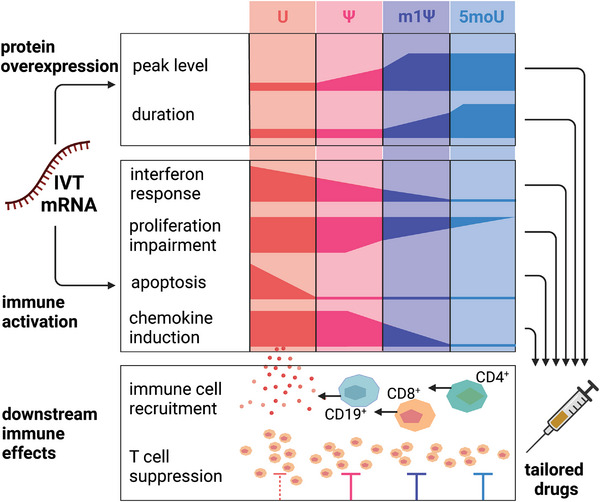
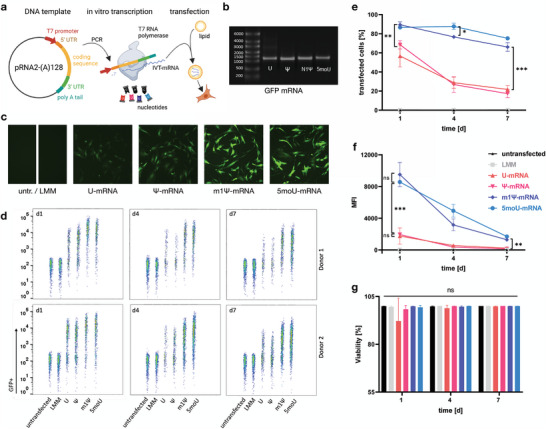
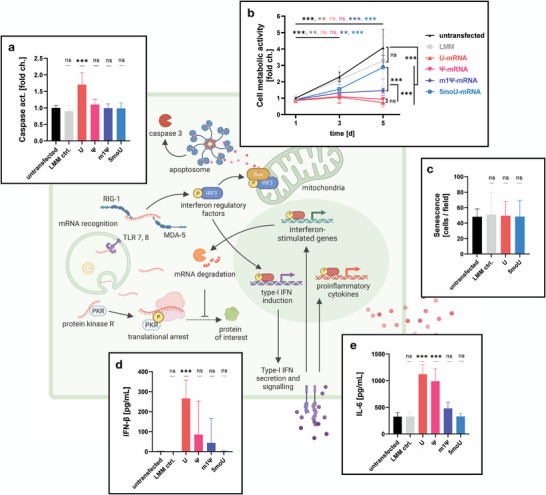
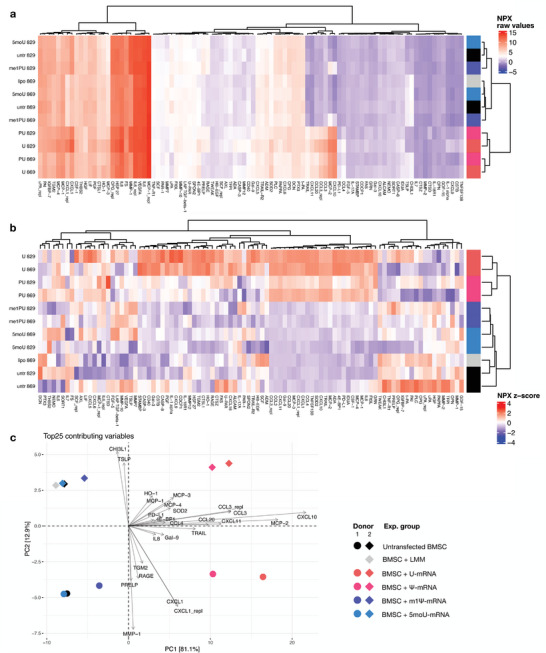
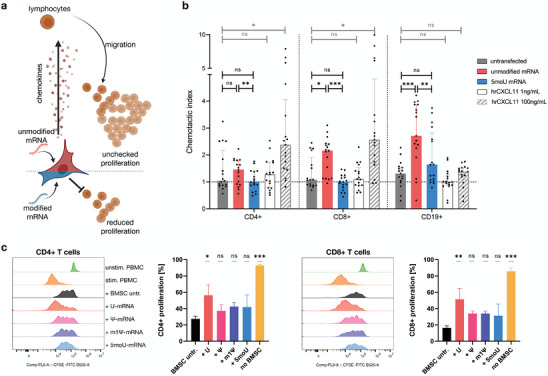
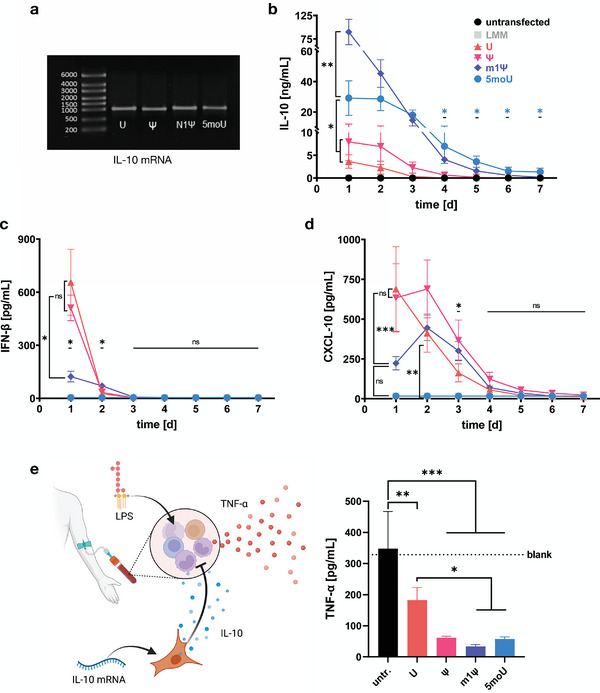
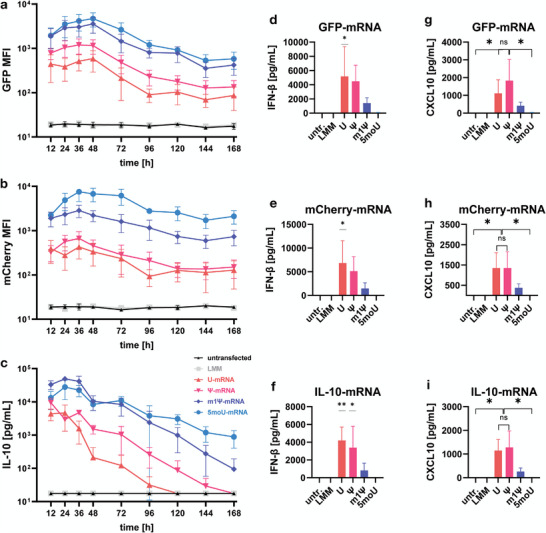
Beyond SARS‐CoV2 vaccines, mRNA drugs are being explored to overcome today's greatest healthcare burdens, including cancer and cardiovascular disease. Synthetic mRNA triggers immune responses in transfected cells, which can be reduced by chemically modified nucleotides. However, the side effects of mRNA‐triggered immune activation on cell function and how different nucleotides, such as the N1‐methylpseudouridine (m1Ψ) used in SARS‐CoV2 vaccines, can modulate cellular responses is not fully understood. Here, cellular responses toward a library of uridine‐modified mRNAs are investigated in primary human cells. Targeted proteomics analyses reveal that unmodified mRNA induces a pro‐inflammatory paracrine pattern marked by the secretion of chemokines, which recruit T and B lymphocytes toward transfected cells. Importantly, the magnitude of mRNA‐induced changes in cell function varies quantitatively between unmodified, Ψ‐, m1Ψ‐, and 5moU‐modified mRNA and can be gradually tailored, with implications for deliberately exploiting this effect in mRNA drug design. Indeed, both the immunosuppressive effect of stromal cells on T‐cell proliferation, and the anti‐inflammatory effect of IL‐10 mRNA are enhanced by appropriate uridine modification. The results provide new insights into the effects of mRNA drugs on cell function and cell‐cell communication and open new possibilities to tailor mRNA‐triggered immune activation to the desired pro‐ or anti‐inflammatory application.
Overview
The claims and statistics of this paper haven’t been checked yet.
Run the check — free, no account needed. It reads the open-access text and checks the sources it cites.
Integrity signals
Registry
Cites
Statistics
Figures
Verification
Claims the paper makes
The claims and statistics of this paper haven’t been checked yet.
Run the check — free, no account needed. It reads the open-access text and checks the sources it cites.
Claims other papers make about this one
Each is checked against this paper’s own text: does it say what the citing paper says it does?
The source backs part of the claim, not all of it — or backs it for a different population, condition or comparison.
In the citing paper
“The divergent dynamics observed in Treg, monocyte, DCs, and Prof T clusters further suggest that mRNA modification and antigen design may influence both the magnitude and kinetics of immune activation [29,46].”
From Systemic profiling of immune responses in healthy adults vaccinated with an RBD-targeting COVID-19 mRNA vaccine (2025) · cites this paper as [46]
Experimental — accuracy not yet measuredIn the citing paper
“This enhanced response may reflect the modified mRNA’s increased translational efficiency and reduced toll-like receptor sensing, enabling sustained protein expression without early innate immune suppression [29,46].”
From Systemic profiling of immune responses in healthy adults vaccinated with an RBD-targeting COVID-19 mRNA vaccine (2025) · cites this paper as [46]
In the citing paper
“This decreasing trend in monocyte and DC proportions contrasts with responses to other vaccines, such as mRNA vaccine BNT162b2 and inactivated vaccine BBIBP-CorV [26,42], possibly due to the shorter antigen encoded by ARCoV and the unmodified uridine [46].”
From Systemic profiling of immune responses in healthy adults vaccinated with an RBD-targeting COVID-19 mRNA vaccine (2025) · cites this paper as [46]
In the citing paper
“This reduction may be attributed to LNP-driven monocyte recruitment or unmodified mRNA-induced apoptosis [46].”
From Systemic profiling of immune responses in healthy adults vaccinated with an RBD-targeting COVID-19 mRNA vaccine (2025) · cites this paper as [46]
Self-check
Percentages, sums and reported differences re-computed from the paper’s own numbers.
The self-check needs the paper’s full text.
Citations
Cites
Efficacy and Safety of the mRNA-1273 SARS-CoV-2 Vaccine
Baden, L. R., El Sahly, H. M., Essink, B., Kotloff, K., Frey, S., Novak, R., Diemert, D., Spector, S. A., Rouphael, N., Creech, C. B., et al. (2021) · New England Journal of Medicine · doi:10.1056/nejmoa2035389 · Cited by 10,119
CAR T cells produced in vivo to treat cardiac injury
Rurik, J. G., Tombácz, I., Yadegari, A., Méndez Fernández, P. O., Shewale, S. V., Li, L., Kimura, T., Soliman, O. Y., Papp, T. E., Tam, Y. K., et al. (2022) · Science · doi:10.1126/science.abm0594 · Cited by 1,400
Monocyte deactivation in septic patients: Restoration by IFN-γ treatment
Döcke, W.-D., Randow, F., Syrbe, U., Krausch, D., Asadullah, K., Reinke, P., Volk, H.-D., & Kox, W. (1997) · Nature Medicine · doi:10.1038/nm0697-678 · Cited by 1,190
Self-citationIncorporation of pseudouridine into mRNA enhances translation by diminishing PKR activation
Anderson, B. R., Muramatsu, H., Nallagatla, S. R., Bevilacqua, P. C., Sansing, L. H., Weissman, D., & Karikó, K. (2010) · Nucleic Acids Research · doi:10.1093/nar/gkq347 · Cited by 682
Thess, A., Grund, S., Mui, B. L., Hope, M. J., Baumhof, P., Fotin-Mleczek, M., & Schlake, T. (2015) · Molecular Therapy · doi:10.1038/mt.2015.103 · Cited by 513
Modifications in an Emergency: The Role of N1-Methylpseudouridine in COVID-19 Vaccines
Nance, K. D., & Meier, J. L. (2021) · ACS Central Science · doi:10.1021/acscentsci.1c00197 · Cited by 466
Anderson, B. R., Muramatsu, H., Jha, B. K., Silverman, R. H., Weissman, D., & Kariko, K. (2011) · Nucleic Acids Research · doi:10.1093/nar/gkr586 · Cited by 356
Svitkin, Y. V., Cheng, Y. M., Chakraborty, T., Presnyak, V., John, M., & Sonenberg, N. (2017) · Nucleic Acids Research · doi:10.1093/nar/gkx135 · Cited by 278
Sittplangkoon, C., Alameh, M.-G., Weissman, D., Lin, P. J. C., Tam, Y. K., Prompetchara, E., & Palaga, T. (2022) · Frontiers in Immunology · doi:10.3389/fimmu.2022.983000 · Cited by 79
Unexpected CRISPR on-target effects
Lee, H., & Kim, J.-S. (2018) · Nature Biotechnology · doi:10.1038/nbt.4207 · Cited by 46
Research works printed but not linked: 38
- 10.1126/science.aay5967 · DOI · Paper page
- 10.1038/s41586-023-06063-y · DOI · Paper page
- 10.1038/s41573-021-00355-6 · DOI
- 10.1016/j.omtm.2020.05.030 · DOI
- 10.1182/blood-2013-04-495119 · DOI
- 10.1038/nbt.2682 · DOI · Paper page
- 10.1016/j.bbrc.2010.02.150 · DOI
- 10.1158/1078-0432.CCR-21-4384 · DOI
- 10.1172/JCI61852 · DOI
- 10.1021/acs.bioconjchem.6b00090 · DOI
- 10.1016/j.omtn.2021.07.009 · DOI
- 10.1016/j.tcb.2015.02.001 · DOI
- 10.1016/j.biomaterials.2022.121971 · DOI
- 10.1021/acs.nanolett.9b04246 · DOI · Paper page
- 10.1038/s41467-019-08852-4 · DOI
- 10.1016/j.immuni.2005.06.008 · DOI · Paper page
- 10.1016/j.jconrel.2015.08.051 · DOI · Paper page
- 10.1016/j.stem.2018.05.004 · DOI · Paper page
- 10.3390/cells10113101 · DOI
- 10.1124/pr.55.2.4 · DOI
- 10.1038/nri2436 · DOI
- 10.1038/nrmicro2655 · DOI
- 10.1002/eji.200737744 · DOI
- 10.1128/JVI.02133-10 · DOI
- 10.1371/journal.pone.0011756 · DOI
- 10.1042/BC20080221 · DOI
- 10.1126/scitranslmed.3000112 · DOI
- 10.1126/scitranslmed.abb3735 · DOI
- 10.3389/fimmu.2019.02474 · DOI · Paper page
- 10.1097/SHK.0000000000000557 · DOI
- 10.1136/thx.51.2.143 · DOI
- 10.1126/scitranslmed.3004754 · DOI
- 10.1002/term.1505 · DOI
- 10.1186/ar2823 · DOI
- 10.1084/jem.187.4.655 · DOI
- 10.4049/jimmunol.172.5.2731 · DOI · Paper page
- 10.1088/1758-5090/ac0a32 · DOI
- 10.3389/fnins.2010.00181 · DOI
Cited by
Sorted by citations
Zhou, C., Sun, M., Huang, X., Liu, P., Ouyang, Z., Wu, M., Yuan, L., Chen, J., Shu, W., Cao, T., et al. (2025) · hLife · doi:10.1016/j.hlife.2025.04.008 · Cited by 5
Metadata
- Authors
- Drzeniek, N. M., Kahwaji, N., Picht, S., Dimitriou, I. M., Schlickeiser, S., Moradian, H., Geissler, S., Schmueck‐Henneresse, M., Gossen, M., & Volk, H.
- Affiliations
- Charité – Universitätsmedizin Berlin, corporate member of Freie Universitaet Berlin and Humboldt‐Universitaet zu Berlin Institute of Medical Immunology Augustenburger Platz 1 13353 Berlin Germany
- Berlin Institute of Health at Charité – Universitätsmedizin Berlin BIH Center for Regenerative Therapies (BCRT) Föhrer Straße 15 13353 Berlin Germany
- Institute of Active Polymers Helmholtz‐Zentrum Hereon Kantstraße 55 14513 Teltow Germany
- Venue
- Advanced Science
- Publisher
- Wiley
- Published
- 2024-03-16
- Volume
- 11
- Issue
- 21
- ISSN
- 2198-3844
- PMC
- PMC11151007
- Cited by
- 18
- References
- 10
- Language
- en
- Funders
- Deutsche Forschungsgemeinschaft (CollaborativeResearchCenter1444(CRC1444))
- European Health and Digital Executive Agency (101095635—PROTO)
- Einstein Stiftung Berlin (Advanced_Scientist_Kickbox)
- Horizon 2020 Framework Programme (733006, 779293)
About these checks
Registry, retraction, Cites and statistics results are computed, not judged, with one exception: a printed reference that no index lists is read once by a model before it counts as a citation error. Claims are extracted by a model and kept only when their quote appears verbatim in the text; each cited source is then checked, with a model’s help, for whether it says what the claim relies on. Those verdicts can be wrong — read the claim’s quote and the cited source before relying on one.
Statistics and arithmetic are recomputed, not judged.
Confidence bands are shown only for fields calibrated on our annotated test set. None is calibrated yet, so no band is shown.
What counts as a claim ›How we measure confidence ›How we check this ›
Are you an author, or do you see a problem with this page? Request a review
