

Stable Diffusion Models Reveal a Persisting Human–AI Gap in Visual Creativity
Open accessThe DOI matches its Crossref record; 56 of the 56 references it cites were found in a registry or an index.
Abstract
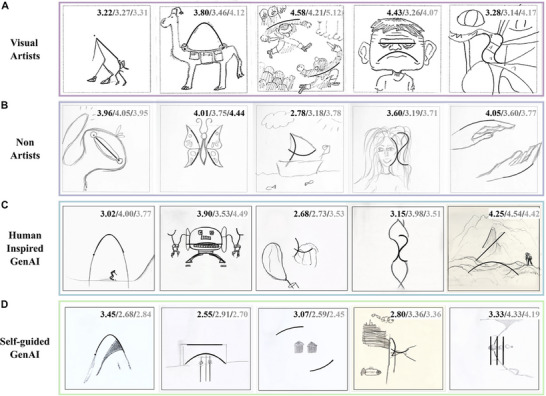
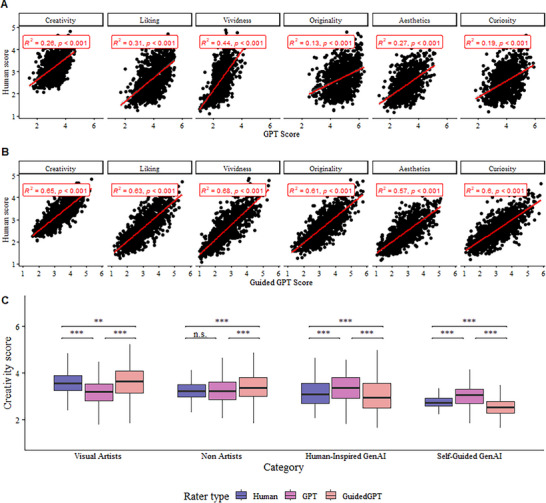
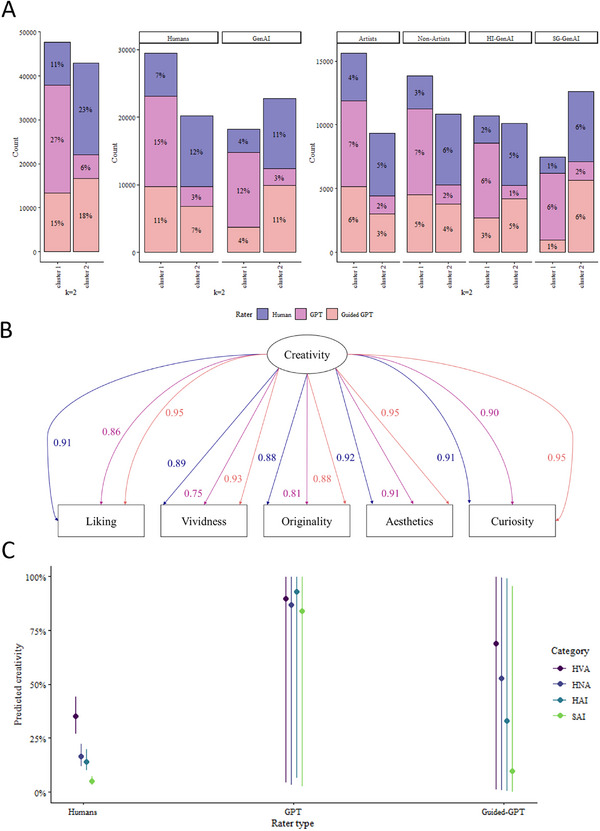
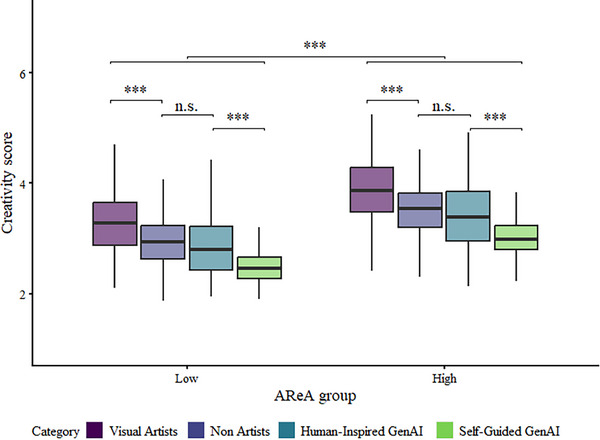
While recent research suggests Large Language Models match human creative performance in divergent thinking tasks, visual creativity remains underexplored. This study compared image generation in human participants (Visual Artists and Non‐Artists) and using an image‐generation AI model (two prompting conditions with varying human input: high for Human‐Inspired, low for Self‐Guided). The creativity of the resulting images was evaluated by human raters (N = 255) and GPT‐4o acting as an AI rater under two conditions: strictly mirroring the human rating task and using in‐context learning with human‐rated examples as guidance. We observed a clear creativity gradient: Visual Artists > Non‐Artists ≥ Human‐Inspired GenAI > Self‐Guided GenAI. Increased human guidance strongly improved GenAI's creative output, bringing its productions close to those of Non‐Artists. Moreover, while Guided‐GPT‐4o more closely approximated human creativity judgment patterns, baseline GPT‐4o (without guidance) exhibited markedly different creativity evaluations, showing reduced discrimination between image categories and inflated scores for GenAI outputs. These results suggest that, in contrast to language‐centered tasks, GenAI models may face unique challenges in visual domains, where creativity depends on perceptual nuance and contextual sensitivity, distinctly human capacities that may not be readily transferable from language models.
Overview
The claims and statistics of this paper haven’t been checked yet.
Free: it reads the open-access text and checks the first 5 claims that cite a source we can check. Create a free account to check every claim.
Integrity signals
Registry
Cites
Statistics
Figures


Verification
Claims the paper makes
The claims and statistics of this paper haven’t been checked yet.
Free: it reads the open-access text and checks the first 5 claims that cite a source we can check. Create a free account to check every claim.
Self-check
Percentages, sums and reported differences re-computed from the paper’s own numbers.
The self-check needs the paper’s full text.
Citations
Cites
On the Dangers of Stochastic Parrots: Can Language Models Be Too Big? 🦜
Bender, E. M., Gebru, T., McMillan-Major, A., & Shmitchell, S. (2021) · Proceedings of the 2021 ACM Conference on Fairness, Accountability, and Transparency · doi:10.1145/3442188.3445922 · Cited by 6,988
PsychoPy2: Experiments in behavior made easy
Peirce, J., Gray, J. R., Simpson, S., MacAskill, M., Höchenberger, R., Sogo, H., Kastman, E., & Lindeløv, J. K. (2019) · Behavior Research Methods · doi:10.3758/s13428-018-01193-y · Cited by 5,166
The standard definition of creativity
Runco, M. A., & Jaeger, G. J. (2012) · Creativity Research Journal · doi:10.1080/10400419.2012.650092 · Cited by 3,895 · cited 1×
“Overall, considering these recent studies and the standardized definition of creativity as the process leading to the production of something both novel and useful [ 17 ], GenAI could indeed be regarded as a ‘creative agent,’ and a remarkably powerful one at that.”
Guilford, J. P. (1950) · American Psychologist · doi:10.1037/h0063487 · Cited by 3,588
On the Opportunities and Risks of Foundation Models
Bommasani, R., Hudson, D. A., Adeli, E., Altman, R., Arora, S., von Arx, S., Bernstein, M. S., Bohg, J., Bosselut, A., Brunskill, E., et al. (2021) · arXiv · doi:10.48550/arxiv.2108.07258 · Cited by 2,676
Image And Brain: The Resolution of the Imagery Debate
Kosslyn, S. M. (1994) · doi:10.7551/mitpress/3653.001.0001 · Cited by 1,977
Society, Culture, and Person: A Systems View of Creativity
Csikszentmihalyi, M. (2014) · The Systems Model of Creativity · doi:10.1007/978-94-017-9085-7_4 · Cited by 1,289 · cited 1×
“Human cognition, on the other hand, evolved in the context of maximizing a biological agent’s adaptation and survival in an uncertain world, requiring a high degree of openness and generalization abilities [ 52 ].”
Talebi, H., & Milanfar, P. (2018) · IEEE Transactions on Image Processing · doi:10.1109/tip.2018.2831899 · Cited by 1,023
Kosslyn, S. M., Thompson, W. L., & Ganis, G. (2006) · doi:10.1093/acprof:oso/9780195179088.001.0001 · Cited by 909
The human imagination: the cognitive neuroscience of visual mental imagery
Pearson, J. (2019) · Nature Reviews Neuroscience · doi:10.1038/s41583-019-0202-9 · Cited by 820 · cited 2×
“What we term “Cr eative Mental Imagery” (CMI) in this paper, however, refers to the internal creation of original images: a testament to the brain’s capacity to synthesize new ideas and scenarios independent of direct perception.”
Art and the science of generative AI
Epstein, Z., Hertzmann, A., the Investigators of Human Creativity, Akten, M., Farid, H., Fjeld, J., Frank, M. R., Groh, M., Herman, L., Leach, N., et al. (2023) · Science · doi:10.1126/science.adh4451 · Cited by 788
The Cambridge Handbook of Creativity
(2019) · Cambridge University Press eBooks · doi:10.1017/9781316979839 · Cited by 463
Pelowski, M., Markey, P. S., Forster, M., Gerger, G., & Leder, H. (2017) · Physics of Life Reviews · doi:10.1016/j.plrev.2017.02.003 · Cited by 456
Self-citation(2014) · The MIT Press eBooks · doi:10.7551/mitpress/9504.001.0001 · Cited by 427
Catalyzing next-generation Artificial Intelligence through NeuroAI
Zador, A., Escola, S., Richards, B., Ölveczky, B., Bengio, Y., Boahen, K., Botvinick, M., Chklovskii, D., Churchland, A., Clopath, C., et al. (2023) · Nature Communications · doi:10.1038/s41467-023-37180-x · Cited by 300
Disentangling visual imagery and perception of real-world objects
Lee, S.-H., Kravitz, D. J., & Baker, C. I. (2012) · NeuroImage · doi:10.1016/j.neuroimage.2011.10.055 · Cited by 263
Best humans still outperform artificial intelligence in a creative divergent thinking task
Koivisto, M., & Grassini, S. (2023) · Scientific Reports · doi:10.1038/s41598-023-40858-3 · Cited by 247
Prompting AI Art: An Investigation into the Creative Skill of Prompt Engineering
Oppenlaender, J., Linder, R., & Silvennoinen, J. (2025) · International Journal of Human–Computer Interaction · doi:10.1080/10447318.2024.2431761 · Cited by 237
Artificial muses: Generative artificial intelligence chatbots have risen to human-level creativity
Haase, J., & Hanel, P. H. P. (2023) · Journal of Creativity · doi:10.1016/j.yjoc.2023.100066 · Cited by 233 · cited 9×
“GenAI models have been dubbed “Artificial Muses” [ 3 ], “Engines of Wow” [ 4 ], “Socio-Technical Monsters” [ 5 ], depending on the observer’s placement on the AI utopia-dystopia spectrum [ 6 ].”
InfluentialA taxonomy of prompt modifiers for text-to-image generation
Oppenlaender, J. (2024) · Behaviour & Information Technology · doi:10.1080/0144929x.2023.2286532 · Cited by 225
Hubert, K. F., Awa, K. N., & Zabelina, D. L. (2024) · Scientific Reports · doi:10.1038/s41598-024-53303-w · Cited by 221
Organisciak, P., Acar, S., Dumas, D., & Berthiaume, K. (2023) · Thinking Skills and Creativity · doi:10.1016/j.tsc.2023.101356 · Cited by 202
AI can only produce artificial creativity
Runco, M. A. (2023) · Journal of Creativity · doi:10.1016/j.yjoc.2023.100063 · Cited by 182
The originality of machines: AI takes the Torrance test
Guzik, E. E., Byrge, C., & Gilde, C. (2023) · Journal of Creativity · doi:10.1016/j.yjoc.2023.100065 · Cited by 165 · cited 2×
“The existing research has repeatedly shown that LLMs may often outperform humans in DT [ 2, 13, 14 ], with the exception of a few studies where the most creative humans still outdid the models [ 3, 10, 15 ].”
Scale validation in applied health research: tutorial for a 6-step R-based psychometrics protocol
Dima, A. L. (2018) · Health Psychology and Behavioral Medicine · doi:10.1080/21642850.2018.1472602 · Cited by 157
Divergent creativity in humans and large language models
Bellemare-Pepin, A., Lespinasse, F., Thölke, P., Harel, Y., Mathewson, K. W., Olson, J. A., Bengio, Y., & Jerbi, K. (2026) · Scientific Reports · doi:10.1038/s41598-025-25157-3 · Cited by 144
Steady-state evoked potentials as an index of multisensory temporal binding
Nozaradan, S., Peretz, I., & Mouraux, A. (2011) · NeuroImage · doi:10.1016/j.neuroimage.2011.11.065 · Cited by 130
Measuring creative imagery abilities
Jankowska, D. M., & Karwowski, M. (2015) · Frontiers in Psychology · doi:10.3389/fpsyg.2015.01591 · Cited by 114
AesBench: An Expert Benchmark for Multimodal Large Language Models on Image Aesthetics PerceptionPreprint
Huang, Y., Yuan, Q., Sheng, X., Yang, Z., Wu, H., Chen, P., Yang, Y., Li, L., & Lin, W. (2024) · arXiv (Cornell University) · doi:10.48550/arxiv.2401.08276 · Cited by 112
AesExpert: Towards Multi-modality Foundation Model for Image Aesthetics Perception
Huang, Y., Sheng, X., Yang, Z., Yuan, Q., Duan, Z., Chen, P., Li, L., Lin, W., & Shi, G. (2024) · ACM International Conference on Multimedia (ACM MM) · doi:10.1145/3664647.3680649 · Cited by 109
Runco, M. A., & Acar, S. (2019) · Cambridge University Press eBooks · doi:10.1017/9781316979839.013 · Cited by 109
Scoring divergent thinking tests by computer with a semantics-based algorithm
Beketayev, K., & Runco, M. A. (2016) · Europe’s Journal of Psychology · doi:10.5964/ejop.v12i2.1127 · Cited by 107
A Prompt Log Analysis of Text-to-Image Generation Systems
Xie, Y., Pan, Z., Ma, J., Jie, L., & Mei, Q. (2023) · International World Wide Web Conference (WWW) · doi:10.1145/3543507.3587430 · Cited by 94
Naturalizing relevance realization: why agency and cognition are fundamentally not computational
Jaeger, J., Riedl, A., Djedovic, A., Vervaeke, J., & Walsh, D. M. (2024) · Frontiers in Psychology · doi:10.3389/fpsyg.2024.1362658 · Cited by 91
Schlotz, W., Wallot, S., Omigie, D., Masucci, M. D., Hoelzmann, S. C., & Vessel, E. A. (2020) · Psychology of Aesthetics Creativity and the Arts · doi:10.1037/aca0000348 · Cited by 89
Handbook of Imagination and Culture
Zittoun, T., & Glăveanu, V. P. (2017) · Oxford University Press eBooks · doi:10.1093/oso/9780190468712.001.0001 · Cited by 80
Grassini, S., & Koivisto, M. (2024) · International Journal of Human-Computer Interaction · doi:10.1080/10447318.2024.2345430 · Cited by 70
Hentschel, S., Kobs, K., & Hotho, A. (2022) · Frontiers in Artificial Intelligence · doi:10.3389/frai.2022.976235 · Cited by 70
The evolutionary roots of creativity: mechanisms and motivations
Wiggins, G. A., Tyack, P. L., Scharff, C., & Rohrmeier, M. (2015) · Philosophical Transactions of the Royal Society B Biological Sciences · doi:10.1098/rstb.2014.0099 · Cited by 58
Quo Vadis ChatGPT? From large language models to Large Knowledge Models
Venkatasubramanian, V., & Chakraborty, A. (2024) · Computers & Chemical Engineering · doi:10.1016/j.compchemeng.2024.108895 · Cited by 54
GenAI Creativity in Narrative Tasks: Exploring New Forms of Creativity
Vinchon, F., Gironnay, V., & Lubart, T. (2024) · Journal of Intelligence · doi:10.3390/jintelligence12120125 · Cited by 46
Can AI Demonstrate Creativity?
Kirkpatrick, K. (2023) · Communications of the ACM · doi:10.1145/3575665 · Cited by 46
Prompting for Discovery: Flexible Sense-Making for AI Art-Making with Dreamsheets
Almeda, S. G., Zamfirescu-Pereira, J. D., Kim, K. W., Mani Rathnam, P., & Hartmann, B. (2024) · Proceedings of the CHI Conference on Human Factors in Computing Systems · doi:10.1145/3613904.3642858 · Cited by 46
The Turing Test and our shifting conceptions of intelligence
Mitchell, M. (2024) · Science · doi:10.1126/science.adq9356 · Cited by 37
Enhancing creativity by training metacognitive skills in mental imagery
May, J., Redding, E., Whatley, S., Łucznik, K., Clements, L., Weber, R., Sikorski, J., & Reed, S. (2020) · Thinking Skills and Creativity · doi:10.1016/j.tsc.2020.100739 · Cited by 37
The discovery and innovation of AI does not qualify as creativity
Runco, M. A. (2024) · Journal of Cognitive Psychology · doi:10.1080/20445911.2024.2436362 · Cited by 27
A monstrous matter: The three faces of artificial creativity
Edgell, R. (2024) · Journal of Creativity · doi:10.1016/j.yjoc.2024.100075 · Cited by 25
The influence of imaging capacity on visual art skills
Pérez-Fabello, M. J., & Campos, A. (2007) · Thinking Skills and Creativity · doi:10.1016/j.tsc.2007.09.002 · Cited by 25
How AI Outperforms Humans at Creative Idea GenerationPreprint
Castelo, N., Katona, Z., Li, P., & Sárváry, M. (2024) · SSRN Electronic Journal · doi:10.2139/ssrn.4751779 · Cited by 21
Evolutionary Explanations for Humor and Creativity
Kozbelt, A. (2018) · Elsevier eBooks · doi:10.1016/b978-0-12-813802-1.00010-7 · Cited by 21
Navigating the Utopia and Dystopia Perspectives of Artificial Intelligence
Carroll, N., Holmström, J., Stahl, B. C., & Fabian, N. E. (2024) · Communications of the Association for Information Systems · doi:10.17705/1cais.05533 · Cited by 20
Drago, V., & Heilman, K. M. (2012) · Elsevier eBooks · doi:10.1016/b978-0-12-375000-6.00112-9 · Cited by 20
Vividness and Control of Mental Imagery and the Components of In-Depth Drawing
Pérez-Fabello, M. J., Campos, A., & Meana, J. C. (2014) · Creativity Research Journal · doi:10.1080/10400419.2014.901097 · Cited by 18
Vellera, C., & Gavard-Perret, M.-L. (2016) · Recherche et Applications en Marketing (English Edition) · doi:10.1177/2051570716658462 · Cited by 16
Evolution and The Knightian Blindspot of Machine LearningPreprint
Lehman, J., Meyerson, E., El-Gaaly, T., Stanley, K. O., & Ziyaee, T. (2025) · arXiv (Cornell University) · doi:10.48550/arxiv.2501.13075 · Cited by 15
Scrutinizing the foundations: could large language models be solipsistic?
Esanu, A. (2024) · Synthese · doi:10.1007/s11229-024-04589-w · Cited by 6
Research works printed but not linked: 11
- F.Goes P.Sawicki M.Grzes M.Volpe andJ.Watson “Pushing GPT's Creativity to Its Limits: Alternative Uses and Torrance Tests ” inProceedings of the 14th International Conference for Computational Creativity(Association for Computational Creativity 2023) 342–346.
- 10.52202/068431-1522 · DOI
- V.Boutin T.Fel andL.Singhal “Diffusion Models as Artists: Are We Closing the Gap between Humans and Machines?” inProceedings of the 40th International Conference on Machine Learning(PMLR 2023) 2953–3002.
- Boutin V., 2024, Advances in Neural Information Processing Systems
- Sternberg R. J., 1999, Handbook of Creativity, 3
- Kearney R., 2005, The Wake of Imagination: Toward a Postmodern Culture
- Montell C., 2002, On Evolution of God‐Seeking Mind: An Inquiry into Why Natural Selection Would Favor Imagination and Distortion of Sensory Experience, Evolutionary Cognition, 8, 1
- Vyshedskiy A., 2019, Neuroscience of Imagination and Implications for Human Evolution, Current Neurobiology, 10, 89
- Mithen S., 1996, The Prehistory of the Mind: A Search for the Origins of Art, Religion and Science
- Pfeiffer J. E., 1982, The Creative Explosion: An Enquiry Into the Origins of Art and Religion
- Schuhmann C., 2022, Advances in Neural Information Processing Systems
Cited by
Tao, Y., Ryan, M., Bialy, F., & Zhang, X. (2026) · Research Square (preprint) · doi:10.21203/rs.3.rs-10029667/v1
From individual gains to collective risks in human–AI co-creativity
DiStefano, P. V., & Beaty, R. E. (2026) · Current Opinion in Behavioral Sciences · doi:10.1016/j.cobeha.2026.101695
Metadata
- Authors
- Rondini, S., Alvarez‐Martin, C., Angermair‐Barkai, P., Penacchio, O., Paz, M., Pelowski, M., Dediu, D., Rodriguez‐Fornells, A., & Cerda‐Company, X.
- Affiliations
- Institut d'Investigació Biomédica de Bellvitge (ES)
- Cognition and Brain Plasticity Unit Bellvitge Biomedical Research Institute L'Hospitalet De Llobregat Spain
- Vienna Cognitive Science Hub Vienna Austria
- Universitat Autònoma de Barcelona (ES)
- Computer Vision Center (ES)
- University of Vienna (AT)
- Institució Catalana de Recerca i Estudis Avançats (ES)
- Bridging Research in AI and Neuroscience Computer Vision Center Bellaterra Spain
- ORCID
- Venue
- Advanced Science
- Publisher
- Wiley
- Published
- 2026-03-24
- Volume
- 13
- Issue
- 27
- Pages
- e24142-e24142
- ISSN
- 2198-3844 (ISSN-L)
- PMC
- PMC13170252
- OpenAlex
- W4416666700
- Cited by
- 2
- References
- 43
- Citations by year
- 2026: 2
- FWCI
- 5.62
- Type
- journal article
- Language
- en
- Open access
- gold
- doi.org
- Licence
- cc-by
- creativecommons.org/licenses/by/4.0/ (vor)
- doi.wiley.com/10.1002/tdm_license_1.1 (tdm)
- Locations
- Advanced Science (publishedVersion, cc-by)
- PubMed (publishedVersion)
- PubMed Central (publishedVersion, cc-by)
- arXiv (Cornell University) (submittedVersion, cc-by)
- HAL (submittedVersion, cc-by)
- DOAJ (DOAJ: Directory of Open Access Journals) (submittedVersion, cc-by-sa)
- arXiv (Cornell University) (cc-by)
- Funders
- Agència de Gestió d'Ajuts Universitaris i de Recerca (SDC007/25/000029, SDC007/25/000005)
- H2020 Marie Skłodowska-Curie Actions (945408)
- Topics
- Physical Sciences › Computer Science › Computer Vision and Pattern Recognition › Generative Adversarial Networks and Image Synthesis
- Social Sciences › Psychology › Experimental and Cognitive Psychology › Creativity in Education and Neuroscience
- Life Sciences › Neuroscience › Cognitive Neuroscience › Aesthetic Perception and Analysis
- Keywords
- visual creativity, image generation, large language models, GPT-4o, creativity assessment, in-context learning, human guidance, divergent thinking
- MeSH terms
- Large Language Models, Generative Artificial Intelligence, Adult, Artificial Intelligence, Creativity, Female, Humans, Male, Young Adult
About these checks
Registry, retraction, Cites and statistics results are computed, not judged, with one exception: a printed reference that no index lists is read once by a model before it counts as a citation error. Claims are extracted by a model and kept only when their quote appears verbatim in the text; each cited source is then checked, with a model’s help, for whether it says what the claim relies on. Those verdicts can be wrong — read the claim’s quote and the cited source before relying on one.
Statistics and arithmetic are recomputed, not judged.
Confidence bands are shown only for fields calibrated on our annotated test set. None is calibrated yet, so no band is shown.
What counts as a claim ›How we measure confidence ›How we check this ›
Are you an author, or do you see a problem with this page? Request a review
Data sources
Bibliographic data: Semantic Scholar, OpenAlex, Crossref.
Contains information from the Semantic Scholar Academic Graph Datasets, made available under the ODC Attribution License (ODC-BY 1.0).
Semantic Scholar’s data is described in: Kinney, R., et al. (2023). The Semantic Scholar Open Data Platform. arXiv:2301.10140.
