

Reservoir Computing Using Diffusive Memristors
Open accessThe DOI matches its Crossref record; 37 of the 38 references it cites were found in a registry or an index.
Abstract
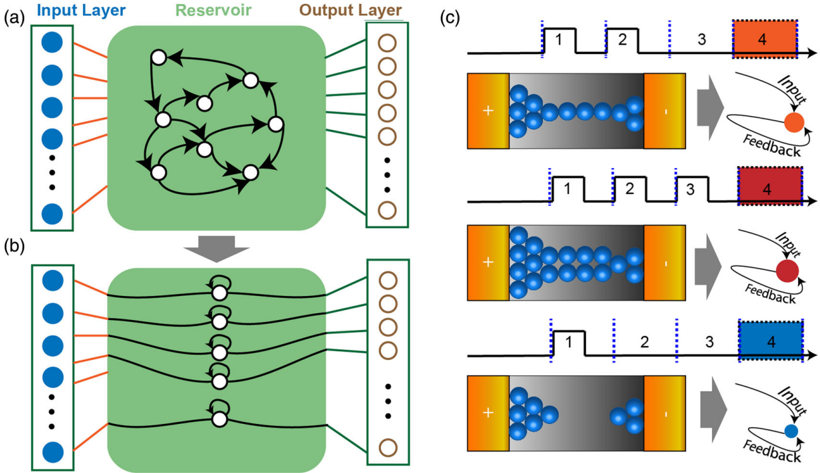
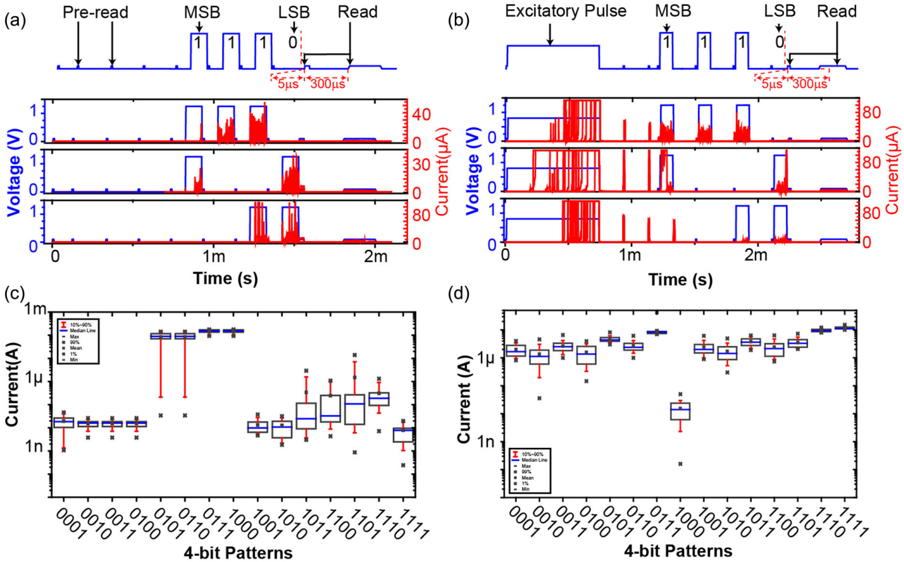
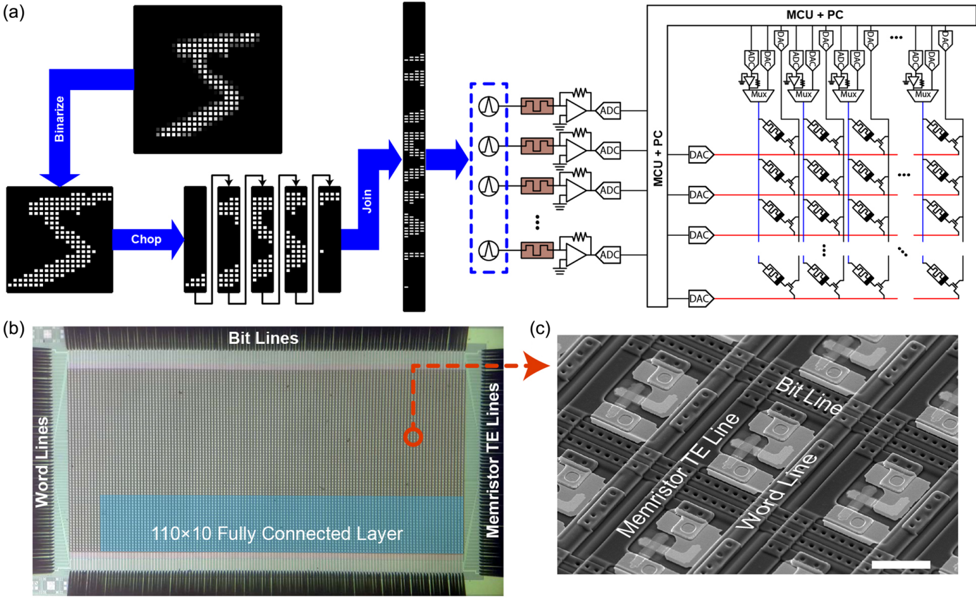
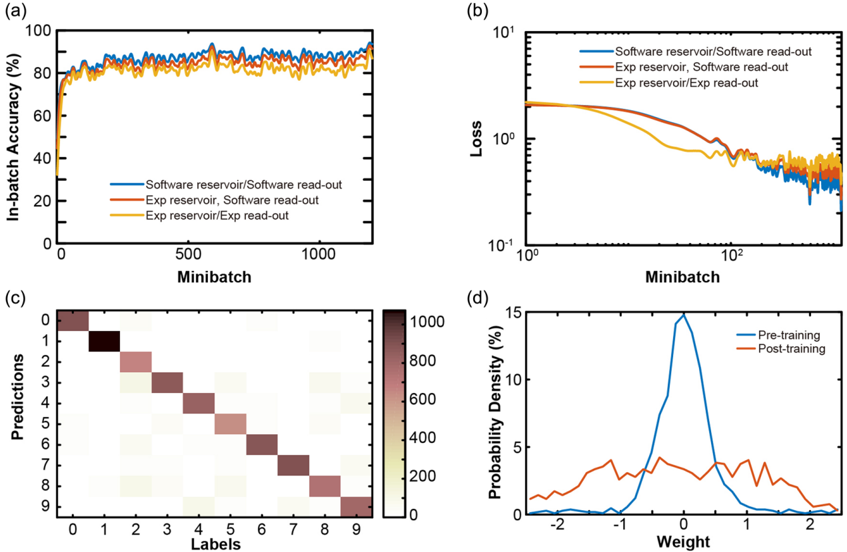
Reservoir computing (RC) is a framework that can extract features from a temporal input into a higher‐dimension feature space. The reservoir is followed by a readout layer that can analyze the extracted features to accomplish tasks such as inference and classification. RC systems inherently exhibit an advantage, since the training is only performed at the readout layer, and therefore they are able to compute complicated temporal data with a low training cost. Herein, a physical reservoir computing system using diffusive memristor‐based reservoir and drift memristor‐based readout layer is experimentally implemented. The rich nonlinear dynamic behavior exhibited by a diffusive memristor due to Ag migration and the robust in situ training of drift memristor arrays makes the combined system ideal for temporal pattern classification. It is then demonstrated experimentally that the RC system can successfully identify handwritten digits from the Modified National Institute of Standards and Technology (MNIST) dataset, achieving an accuracy of 83%.
Overview
The claims and statistics of this paper haven’t been checked yet.
Free: it reads the open-access text and checks the first 5 claims that cite a source we can check. Create a free account to check every claim.
Integrity signals
Registry
Cites
Statistics
Figures
Verification
Claims the paper makes
The claims and statistics of this paper haven’t been checked yet.
Free: it reads the open-access text and checks the first 5 claims that cite a source we can check. Create a free account to check every claim.
Self-check
Percentages, sums and reported differences re-computed from the paper’s own numbers.
The self-check needs the paper’s full text.
Citations
Cites
Deep learning in neural networks: an overview
Schmidhuber, J. (2015) · Neural Networks · doi:10.1016/j.neunet.2014.09.003 · Cited by 18,570
Strukov, D. B., Snider, G. S., Stewart, D. R., & Williams, R. S. (2008) · Nature · doi:10.1038/nature06932 · Cited by 11,828
Nanoscale Memristor Device as Synapse in Neuromorphic Systems
Jo, S. H., Chang, T., Ebong, I., Bhadviya, B. B., Mazumder, P., & Lu, W. (2010) · Nano Letters · doi:10.1021/nl904092h · Cited by 4,174
Maass, W., Natschläger, T., & Markram, H. (2002) · Neural Computation · doi:10.1162/089976602760407955 · Cited by 4,025
Memristive devices for computing
Yang, J. J., Strukov, D. B., & Stewart, D. R. (2013) · Nature Nanotechnology · doi:10.1038/nnano.2012.240 · Cited by 3,885
Self-citationHarnessing Nonlinearity: Predicting Chaotic Systems and Saving Energy in Wireless Communication
Jaeger, H., & Haas, H. (2004) · Science · doi:10.1126/science.1091277 · Cited by 3,811
Networks of spiking neurons: The third generation of neural network models
Maass, W. (1997) · Neural Networks · doi:10.1016/s0893-6080(97)00011-7 · Cited by 3,481
Training and operation of an integrated neuromorphic network based on metal-oxide memristors
Prezioso, M., Merrikh-Bayat, F., Hoskins, B. D., Adam, G. C., Likharev, K. K., & Strukov, D. B. (2015) · Nature · doi:10.1038/nature14441 · Cited by 3,001
Reservoir computing approaches to recurrent neural network training
Lukoševičius, M., & Jaeger, H. (2009) · Computer Science Review · doi:10.1016/j.cosrev.2009.03.005 · Cited by 2,956
Memristors with diffusive dynamics as synaptic emulators for neuromorphic computing
Wang, Z., Joshi, S., Savel’ev, S. E., Jiang, H., Midya, R., Lin, P., Hu, M., Ge, N., Strachan, J. P., Li, Z., et al. (2017) · Nature Materials · doi:10.1038/nmat4756 · Cited by 2,358
Self-citation
Research works printed but not linked: 5
- 5. H. Jaeger, in German National Research Center for Information Technology GMD Technical Report, Vol. 148, Bonn, Germany 2001, p. 13.
- 8. J. J. Steil, in 2004 IEEE Int. Joint Conf. on Neural Networks (IEEE Cat. No.04CH37541), Vol. 842, IEEE, Budapest 2004, pp. 843-848.
- 9. H. Jaeger, Tutorial on Training Recurrent Neural Networks, Covering BPPT, RTRL, EKF and the "Echo State Network" Approach, Vol. 5, GMD-Forschungszentrum Informationstechnik Bonn, Bonn 2002.
- 22. J. Lin, Annadi, S. Sonde, C. Chen, L. Stan, K. V. L. V. Achari, S. Ramanathan, S. Guha, in 2016 IEEE Int. Electron Devices Meeting (IEDM), IEEE, San Francisco 2016, pp. 34.35.31-34.35.34.
- 42. Z. Wang, C. Li, W. Song, M. Rao, D. Belkin, Y. Li, P. Yan, H. Jiang, P. Lin, M. Hu, J. P. Strachan, Nat. Electron. 2019, 2, 115. · DOI · Paper page
Cited by
Items 101–200 of 289
Electromagnetic wave-based extreme deep learning with nonlinear time-Floquet entanglement
Momeni, A., & Fleury, R. (2022) · Nature Communications · doi:10.1038/s41467-022-30297-5 · Cited by 43
Shibata, K., Nishioka, D., Namiki, W., Tsuchiya, T., Higuchi, T., & Terabe, K. (2023) · Scientific Reports · doi:10.1038/s41598-023-48135-z · Cited by 33
“Without physical masking, reservoir states are concentrated in a narrow region from 1.92 to 2.17.”
BackgroundInfluentialSoft Memristor at a Microbubble Interface
Niu, Y., Ma, Y., & Xie, Y. (2024) · Nano Letters · doi:10.1021/acs.nanolett.4c02136 · Cited by 29
Printed and flexible organic and inorganic memristor devices for non-volatile memory applications
Jaafar, A. H., Gee, A., & Kemp, N. T. (2023) · Journal of Physics D Applied Physics · doi:10.1088/1361-6463/acfaaa · Cited by 31
“…required for memory applications [112], memris-tors can also show volatile switching (temporal or STP) or temporal dynamic behaviour, which is desirable for neuromorphic and reservoir computing (RC) applications such as speech recognition, classification and time series forecasting [30, 113–116].”
BackgroundMoiré Synaptic Transistor for Homogeneous-Architecture Reservoir Computing
王, P. 鹏. W., Chen, M., 谢, Y. 永. X., 潘, C. 晨. P., Watanabe, K., Taniguchi, T., 程, B. 斌. C., 梁, S.-J. 世. L., & 缪, F. 峰. M. (2023) · Chinese Physics Letters · doi:10.1088/0256-307x/40/11/117201 · Cited by 30
Liu, K., Li, J., Li, F., Lin, Y., Liu, H., Liang, L., Luo, Z., Liu, W., Wang, M., Zhou, F., et al. (2023) · Nano Research · doi:10.1007/s12274-023-6343-1 · Cited by 29
Physical Reservoir Computing Using van der Waals Ferroelectrics for Acoustic Keyword Spotting
Cao, Y. H., Zhang, Z., Qin, B.-W., Sang, W., Li, H., Wang, T., Tan, F., Yang, G., Zhang, X., Liu, T., et al. (2024) · ACS Nano · doi:10.1021/acsnano.4c06144 · Cited by 28
Self-citationRyabova, M. A., Matsukatova, A. N., Emelyanov, A. V., Несмелов, А. А., Patsaev, T. D., & Demin, V. A. (2024) · Nanoscale · doi:10.1039/d4nr03368j · Cited by 29
Reservoir computing system using discrete memristor for chaotic temporal signal processing
Deng, Y., Zhang, S., Yuan, F., Li, Y., & Wang, G. (2025) · Chaos Solitons & Fractals · doi:10.1016/j.chaos.2025.116230 · Cited by 28
Hossain, M. R., Mohamed, A. S. I., Armendarez, N. X., Najem, J. S., & Hasan, M. S. (2023) · Advanced Intelligent Systems · doi:10.1002/aisy.202300346 · Cited by 28
“Finally, we present the device’s power and energy per spike consumption and compare them with the consumption of other state-of-the-art memristors which were deployed as reservoirs [32, 34, 35, 37, 61, 62].”
BackgroundInfluentialSrikimkaew, O., Banerjee, D., Azhari, S., Usami, Y., & Tanaka, H. (2023) · ACS Applied Electronic Materials · doi:10.1021/acsaelm.3c01046 · Cited by 34
Reservoir Computing System with Diverse Input Patterns in HfAlO-Based Ferroelectric Memristor
Ju, D., Noh, M., Kim, G., Park, Y., Lee, S., & Kim, S. (2024) · ACS Applied Materials & Interfaces · doi:10.1021/acsami.4c14910 · Cited by 27
Physical reservoir computing for Edge AI applications
Liu, J., Feng, G., Li, W., Hao, S., Han, S., Zhu, Q., Tian, B., Duan, C., & Chu, J. (2025) · The Innovation Materials · doi:10.59717/j.xinn-mater.2025.100127 · Cited by 29
In-materio reservoir working at low frequencies in a Ag 2 S-island network
Nakajima, M., Minegishi, K., Shimizu, Y., Usami, Y., Tanaka, H., & Hasegawa, T. (2022) · Nanoscale · doi:10.1039/d2nr01439d · Cited by 29
Transforming memristor noises into computational innovations
Ding, C., Ren, Y., Liu, Z., & Wong, N. (2025) · Communications Materials · doi:10.1038/s43246-025-00876-2 · Cited by 31
“AsshowninFig.5a,b,dynamicmemristor-basedRC 23,81,82 forms the reservoir layer with a single physical node using dynamic memristor and a sequence of virtual nodes created by the evolution of the physical node output over time 25,83 .”
Inkjet printed IGZO memristors with volatile and non-volatile switching
Franco, M., Kiazadeh, A., Deuermeier, J., Lanceros-Méndez, S., Martins, R., & Carlos, E. (2024) · Scientific Reports · doi:10.1038/s41598-024-58228-y · Cited by 26
Seizure detection via reservoir computing in MoS 2 -based charge trap memory devices
Farronato, M., Mannocci, P., Milozzi, A., Compagnoni, C. M., Barcellona, A., Arena, A., Crepaldi, M., Panuccio, G., & Ielmini, D. (2025) · Science Advances · doi:10.1126/sciadv.adr3241 · Cited by 27
Prudnikov, N. V., Kulagin, V. A., Battistoni, S., Demin, V. A., Erokhin, V. V., & Emelyanov, A. V. (2023) · physica status solidi (a) · doi:10.1002/pssa.202200700 · Cited by 28
Disposable and Flexible Paper‐Based Optoelectronic Synaptic Devices for Physical Reservoir Computing
Komatsu, H., Hosoda, N., Kounoue, T., Tokiwa, K., & Ikuno, T. (2024) · Advanced Electronic Materials · doi:10.1002/aelm.202300749 · Cited by 25
Zhong, W. M., Luo, C. L., Tang, X., Lu, X., & Dai, J. (2023) · Materials Today Nano · doi:10.1016/j.mtnano.2023.100357 · Cited by 26
Design Strategies and Applications of Reservoir Computing: Recent Trends and Prospects [Feature]
Bai, K., Thiem, C., Lombardi, J. P., Liang, Y., & Yi, Y. (2023) · IEEE Circuits and Systems Magazine · doi:10.1109/mcas.2023.3325496 · Cited by 26
“…unique hardware properties from a variety of devices, circuits, and systems, including photonics [46], [47], [48], [49], [50], embedded development platforms [51], [52], [53], [54], mixed-signal integrated circuits [55], [56], [57], [58], [59], and emerging materials [60], [61], [62], [63], [64].”
BackgroundMagnetization Vector Rotation Reservoir Computing Operated by Redox Mechanism
Namiki, W., Nishioka, D., Tsuchiya, T., Higuchi, T., & Terabe, K. (2024) · Nano Letters · doi:10.1021/acs.nanolett.3c05029 · Cited by 25
A review of memristive reservoir computing for temporal data processing and sensing
Jang, Y. H., Han, J., & Hwang, C. S. (2024) · InfoScience. · doi:10.1002/inc2.12013 · Cited by 25
Gaurav, A., Song, X., Manhas, S. K., Gilra, A., Vasilaki, E., Roy, P. P., & Souza, M. M. D. (2022) · Frontiers in Electronics · doi:10.3389/felec.2022.869013 · Cited by 25
“Midya et al. (2019) demonstrated a diffusive memristor-based reservoir with a drift memristor-based readout function.”
BackgroundMethodResultInfluentialJaafar, A. H., Habsi, S. K. S. A., Braben, T., Venables, C., Francesconi, M. G., Stasiuk, G. J., & Kemp, N. T. (2024) · ACS Applied Materials & Interfaces · doi:10.1021/acsami.4c07820 · Cited by 22
“22,23 24 − 29 In this article, we report the first example of a hybrid nanocomposite device that shows both volatile and nonvolatile modes that are programmable by controlling the stopping voltage.”
BackgroundDeep reservoir computing based on self-rectifying memristor synapse for time series prediction
Wang, R., Qi, L., Wang, S., Cao, Y., Ma, X., Wang, H., & Hao, Y. (2023) · Applied Physics Letters · doi:10.1063/5.0158076 · Cited by 22
Reservoir computing using back-end-of-line SiC-based memristors
Guo, D., Kapur, O. R., Dai, P., Han, Y., Beanland, R., Jiang, L., de Groot, C. H., & Huang, R. (2023) · Materials Advances · doi:10.1039/d3ma00141e · Cited by 24
Li, L., Xiang, H., Zheng, H., Chien, Y., Duong, N. T., Gao, J. L., & Ang, K. (2024) · Nanoscale Horizons · doi:10.1039/d3nh00524k · Cited by 22
Namiki, W., Yamaguchi, Y., Nishioka, D., Tsuchiya, T., & Terabe, K. (2024) · Materials Today Physics · doi:10.1016/j.mtphys.2024.101465 · Cited by 23
InSe Dynamic Memristor-Based Reservoir Computing for Temporal and Spatial Signal Recognition
Chen, J., Zhu, J., Li, P., Hu, J., Li, Q., Wang, Z.-H., Zhang, Z., Li, H., Lin, S., Yue, X., et al. (2025) · Nano Letters · doi:10.1021/acs.nanolett.5c03781 · Cited by 22
Self-citationMemristors Based on 2D Materials: Bridging Device Theory and Potential Applications
Liu, X., Pan, Z., Xia, Z., Li, L., Deng, Q., Pan, Y., Li, J., & Huo, N. (2025) · Advanced Functional Materials · doi:10.1002/adfm.202520816 · Cited by 26
Sun, W., Zhang, W., Yu, J., Li, Y., Guo, Z., Lai, J., Dong, D., Zheng, X., Wang, F., Fan, S., et al. (2022) · IEEE Symposium on VLSI Technology and Circuits (VLSI Technology and Circuits) · doi:10.1109/vlsitechnologyandcir46769.2022.9830310 · Cited by 22
Chu, F., Chen, Y., Shih, L., Mao, S., & Chen, J. (2023) · Advanced Functional Materials · doi:10.1002/adfm.202310951 · Cited by 21
Tsuchiya, T., Nishioka, D., Namiki, W., & Terabe, K. (2024) · Advanced Electronic Materials · doi:10.1002/aelm.202400625 · Cited by 21
A Bifunctional Memristor Enables Multiple Neuromorphic Computing Applications
Lyapunov, N., Zheng, X. D., Yang, K., Liu, H. M., Zhou, K., Cai, S., Ho, T. L., Suen, C. H., Yang, M., Zhao, J. X., et al. (2022) · Advanced Electronic Materials · doi:10.1002/aelm.202101235 · Cited by 20
Iono–Magnonic Reservoir Computing With Chaotic Spin Wave Interference Manipulated by Ion‐Gating
Namiki, W., Nishioka, D., Nomura, Y., Tsuchiya, T., Yamamoto, K., & Terabe, K. (2024) · Advanced Science · doi:10.1002/advs.202411777 · Cited by 22
Nishioka, D., Tsuchiya, T., Higuchi, T., & Terabe, K. (2023) · Neuromorphic Computing and Engineering · doi:10.1088/2634-4386/acf1c6 · Cited by 19
Diffusive Memristor with CuS Nanoparticles Embedded in Polymeric Film as Artificial Nociceptor
Deb, R., Panda, D., Nair, M. G., Yasmin, F., Mishra, Y., Thakur, A. K., & Mohapatra, S. R. (2024) · ACS Applied Materials & Interfaces · doi:10.1021/acsami.4c12607 · Cited by 20
Milano, G., Boarino, L., Valov, I., & Ricciardi, C. (2022) · Semiconductor Science and Technology · doi:10.1088/1361-6641/ac4b8a · Cited by 19
Adjustable short-term memory of SiO x :Ag-based memristor for reservoir computing
Li, R., Yang, H., Zhang, Y., Tang, N., Chen, R., Zhou, Z., Liu, L., Kang, J., & Huang, P. C. (2023) · Nanotechnology · doi:10.1088/1361-6528/acfb0a · Cited by 18
“Tasks including pattern recognition [ 26, 28, 31, 34 – 36 ] , waveform classi fi cation [ 20 ] and time-series prediction [ 26 – 29, 37 – 39 ] have been successfully demonstrated.”
Switching Dynamics in Anti‐Ferroelectric Transistor for Multimodal Reservoir Computing
Shi, Y., Duong, N. T., Chien, Y., Li, S., Xiang, H., Zheng, H., & Ang, K. (2024) · Advanced Functional Materials · doi:10.1002/adfm.202400879 · Cited by 18
Fast physical reservoir computing, achieved with nonlinear interfered spin waves
Namiki, W., Nishioka, D., Tsuchiya, T., & Terabe, K. (2024) · Neuromorphic Computing and Engineering · doi:10.1088/2634-4386/ad561a · Cited by 19
Homogeneous Memristors with Tunable Decay Dynamics for Self-Adaptive Reservoir Computing
Li, Y., Tang, W., Li, Z., Niu, W., Han, S., Miao, X., & Yang, R. (2025) · ACS Nano · doi:10.1021/acsnano.5c03500 · Cited by 18
Mohamed, A. S. I., Dhungel, A., Hasan, M. S., & Najem, J. S. (2024) · ACS Applied Engineering Materials · doi:10.1021/acsaenm.4c00309 · Cited by 16
Shi, Z., Liao, Z., & Tabata, H. (2022) · Chaos Solitons & Fractals · doi:10.1016/j.chaos.2022.112314 · Cited by 19
Milano, G., Miranda, E. A., Fretto, M., Valov, I., & Ricciardi, C. (2022) · ACS Applied Materials & Interfaces · doi:10.1021/acsami.2c11022 · Cited by 16
Bioderived materials for stimuli-responsive, adaptive, and neuromorphic systems: A perspective
Makhoul-Mansour, M. M., Maraj, J. J., & Sarles, S. A. (2022) · Journal of Composite Materials · doi:10.1177/00219983221135055 · Cited by 16
Performance Improvement of Memristor-Based Echo State Networks by Optimized Programming Scheme
Yu, J., Sun, W., Lai, J., Zheng, X., Dong, D., Luo, Q., Lv, H., & Xu, X. (2022) · IEEE Electron Device Letters · doi:10.1109/led.2022.3165831 · Cited by 15
Prudnikov, N. V., Malakhov, S. N., Kulagin, V. A., Emelyanov, A. V., Чвалун, С. Н., Demin, V. A., & Erokhin, V. V. (2023) · Biomimetics · doi:10.3390/biomimetics8020189 · Cited by 15
“Due to the extremely wide range of dynamical characteristics provided by different memristive devices, these systems have found applications in various tasks from image classification [10,11] to processing of biological signals, behaving as an internal part of biosensors [12].”
BackgroundHigh‐Performance GdNiO3 Epitaxial Film Memristor for Neuralactivity Analysis
Bai, B., Liu, G., Sun, Y., Liu, P., Zhao, Z., Guo, Z., & Yan, X. (2024) · Advanced Functional Materials · doi:10.1002/adfm.202305261 · Cited by 14
Emerging Materials and Computing Paradigms for Temporal Signal Analysis
Zhang, T., Woźniak, S., Syed, G. S., Mannocci, P., Farronato, M., Ielmini, D., Sebastian, A., & Yang, Y. (2025) · Advanced Materials · doi:10.1002/adma.202408566 · Cited by 14
Hybrid MoS2/PbS Quantum Dots Toward In-Sensor Reservoir Computing
Wu, G., Zhang, Z., Ba, K., Zhang, X., Zeng, J., Bai, C., Liu, Q., & Wang, J. (2023) · IEEE Electron Device Letters · doi:10.1109/led.2023.3262520 · Cited by 15
“[7], [10], [11], [12], [13], [14], which hardly respond to visible or infrared light.”
BackgroundSelf-citationLeaky FinFET for Reservoir Computing with Temporal Signal Processing
Han, J., Yun, S., Yu, J., & Choi, Y. (2023) · ACS Applied Materials & Interfaces · doi:10.1021/acsami.3c02630 · Cited by 16
Sato, D., Shima, H., Matsuo, T., Yonezawa, M., Kinoshita, K., Kobayashi, M., Naitoh, Y., Akinaga, H., Miyamoto, S., Nokami, T., et al. (2023) · ACS Applied Materials & Interfaces · doi:10.1021/acsami.3c08638 · Cited by 16
Liu, Z., Gao, C., Yang, J., Chen, Z., Li, E., Li, J., Li, M., & Zhang, J. (2025) · International Journal of Extreme Manufacturing · doi:10.1088/2631-7990/ae053a · Cited by 18
“However, unlike data storage applications that merely require maintenance of a specific resistance window, inference tasks are highly sensitive to resistance drift (Figure 2(d)) [49,50] .”
Self-citationYu, T., Li, J., Lei, W., Shafe, S. B., Mohtar, M. N., Jindapetch, N., van Dommelen, P., & Zhao, Z. (2024) · Nano Research · doi:10.1007/s12274-024-6966-x · Cited by 13
Lee, K. H., Park, S., Kang, M., Oh, J., Ahn, W., Lee, H., Yoo, S., Kim, H. A., Lee, M. K., & Choi, S. (2025) · Advanced Materials · doi:10.1002/adma.202507979 · Cited by 16
Tsioustas, C., Bousoulas, P., Kleitsiotis, G., & Tsoukalas, D. (2023) · APL Machine Learning · doi:10.1063/5.0131524 · Cited by 14
A time-delayed physical reservoir with various time constants
Yamazaki, Y., & Kinoshita, K. (2024) · Applied Physics Express · doi:10.35848/1882-0786/ad2782 · Cited by 12
Spiking Reservoir Computing Based on Stochastic Diffusive Memristors
Ma, Z., Ge, J., & Pan, S. (2024) · Advanced Electronic Materials · doi:10.1002/aelm.202400469 · Cited by 13
Moon, S., Park, C., Jung, Y. K., Min, K., Ko, H., & Yoon, T. (2025) · Journal of Materials Chemistry C · doi:10.1039/d4tc05041j · Cited by 12
Neuromorphic Light‐Responsive Organic Matter for in Materia Reservoir Computing
Lupi, F. F., Rosero‐Realpe, M., Ocarino, A., Frascella, F., Milano, G., & Angelini, A. (2025) · Advanced Materials · doi:10.1002/adma.202501813 · Cited by 14
Wang, X., Meng, Y., Zeng, Y., Lin, Z., & Iu, H. H. (2025) · Cognitive Neurodynamics · doi:10.1007/s11571-025-10295-1 · Cited by 12
“In 2019, Midya et, al. constructed a physical RC system using a diffusive memristor-based reservoir and a drift memristor crossbar array-based readout layer for MNIST handwritten digit classification, achieving an accuracy of 83% (Midya et al. 2019).”
Fully Flash-Based Reservoir Computing Network With Low Power and Rich States
Feng, Y., Tang, M., Sun, Z. H., Qi, Y., Zhan, X., Liu, J., Zhang, J., Wu, J., & Chen, J. (2023) · IEEE Transactions on Electron Devices · doi:10.1109/ted.2023.3295791 · Cited by 13
“To enhance the performance of the hardware RC system, it is necessary to increase the diversity of reservoir states [8].”
BackgroundTunable synaptic working memory with volatile memristive devices
Ricci, S., Kappel, D., Tetzlaff, C., Ielmini, D., & Covi, E. (2023) · Neuromorphic Computing and Engineering · doi:10.1088/2634-4386/ad01d6 · Cited by 11
Bio‐Voltage Diffusive Memristor from CVD Grown WSe2 as Artificial Nociceptor
Yadav, R., Rajarapu, R., Poudyal, S., Biswal, B., Barman, P. K., Novoselov, K. S., & Misra, A. (2024) · Advanced Materials Technologies · doi:10.1002/admt.202401048 · Cited by 11
Multi-timescale temporal processing for ion-motion memristor-based physical reservoir computing
Hwang, S. I., Yang, D. Y., Cho, H. Y., & Yoon, J. H. (2025) · Device · doi:10.1016/j.device.2025.100907 · Cited by 12
Learning by mistakes in memristor networks
Carbajal, J. P., Mártin, D. A., & Chialvo, D. R. (2022) · Physical review. E · doi:10.1103/physreve.105.054306 · Cited by 11
Memristors With Controllable Data Volatility by Loading Metal Ion-Added Ionic Liquids
Sato, H., Shima, H., Nokami, T., Itoh, T., Honma, Y., Naitoh, Y., Akinaga, H., & Kinoshita, K. (2021) · Frontiers in Nanotechnology · doi:10.3389/fnano.2021.660563 · Cited by 13
“Recently, the unstable filament also attracts considerable attention because the resultant temporal resistance change is applicable to the emerging devices for the human brain inspired computing (Hasegawa et al., 2011; Deng et al., 2015; Ascoli et al., 2016; Zhang et al., 2018; Midya et al., 2019; Wang et al., 2019; Z…”
BackgroundMemory properties of electromigrated Au nanogaps to realize reservoir computing
Sakai, K., Yagi, M., Ito, M., & Shirakashi, J. (2021) · Applied Physics Letters · doi:10.1063/5.0055352 · Cited by 11
Reservoir Computing With Dynamic Reservoir using Cascaded DNA Memristors
Liu, X., & Parhi, K. K. (2023) · IEEE Transactions on Biomedical Circuits and Systems · doi:10.1109/tbcas.2023.3312300 · Cited by 10
“Physical RC systems have been implemented by using a diffusive memristor-based reservoir or a dynamic memristor array [7], [35].”
MethodNoh, M., Park, H., & Kim, S. (2025) · Chaos Solitons & Fractals · doi:10.1016/j.chaos.2025.116381 · Cited by 10
Songlu, W., Chen, Q., Cao, Y. H., Wang, H., Chen, H., Sang, W., Gan, Y., Tian, S., Yu, Y., Zhou, X., et al. (2025) · Advanced Intelligent Systems · doi:10.1002/aisy.202401073 · Cited by 11
Self-citationSynaptic Functionality and Neuromorphic Information Processing in Membrane Ion Channel Junctions
Li, Z., Feng, J., Xiao, J., Leuski, A., & Noy, A. (2026) · Advanced Materials · doi:10.1002/adma.202519525 · Cited by 11
“…for physical device variability, we modeled noise in the conductance responses as a normal distribution, using the mean [20], metal ion transport [57], electron transport [59], and vacancy motion [56, 60–62]. and standard error derived from repeated measurements of each pulse pattern (Figure 3B).”
Configurable activation function realized by non-linear memristor for neural network
Li, K., Sun, Y. K., Wang, W., Zhu, X. J., Song, B., Cao, R., Liu, S., & Li, Q. (2020) · AIP Advances · doi:10.1063/5.0013510 · Cited by 10
Weng, Z., Ji, T., Yu, Y., Fang, Y., Wei, L., Shafie, S. B., Jindapetch, N., & Zhao, Z. (2024) · ACS Applied Nano Materials · doi:10.1021/acsanm.4c04063 · Cited by 10
A Faithful and Compact Diffusive Memristor Model
Wang, T., Zhao, R., Xu, Y., Zhuo, Y., Williams, R. S., & Yang, J. J. (2024) · IEEE transactions on circuits and systems for artificial intelligence. · doi:10.1109/tcasai.2024.3484370 · Cited by 11
“It exhibits complex intrinsic dynamic behavior due to the complexity of ion migration, making it suitable for various applications ranging from stochastic computing [6], [7], reservoir computing [8], [9], [10] to neuromorphic computing [11], [12], [13], [14], [15], [16], [17], [18].”
Self-citationArmendarez, N. X., Hasan, M. S., & Najem, J. S. (2024) · Nanoscale · doi:10.1039/d4nr03439b · Cited by 10
Abdi, G., Karacali, A., Zaman, A. S. K., Gryl, M., Sławek, A., Szkudlarek, A., Tanaka, H., & Szacilowski, K. T. (2025) · Advanced Electronic Materials · doi:10.1002/aelm.202500049 · Cited by 10
A memristive computational neural network model for time-series processing
Pistolesi, V., Ceni, A., Milano, G., Ricciardi, C., & Gallicchio, C. (2025) · APL Machine Learning · doi:10.1063/5.0255168 · Cited by 9
Flexible artificial vision computing system based on FeO x optomemristor for speech recognition
Li, J., Yue, X., Sun, B. T., Gu, D., Liao, C., Hu, X., Wang, L., Duan, S., & Zhou, G. (2025) · Journal of Semiconductors · doi:10.1088/1674-4926/24080004 · Cited by 9
Liu, K., Zha, J., Huang, H., Luo, Z., Du, Z., Zheng, X., Zhou, B., Liu, Y., Li, C., & Tan, C. (2025) · Small · doi:10.1002/smll.202505436 · Cited by 9
Electrically tunable physical reservoir computing on two-terminal devices
Lee, S. H., Kim, S., Han, J., Shim, S. K., Son, K., Shin, D. H., Jeong, H., Park, J., Shin, S. J., Jang, Y. H., et al. (2025) · npj Unconventional Computing · doi:10.1038/s44335-025-00043-3 · Cited by 9
“While this method offers a simple structure, it lacks tunability 26,27 .”
Unraveling Origin of Stochasticity in Multi‐Filamentary Memristor
Soh, K., Koo, S., Yoon, B., Kim, J. E., Chun, S. Y., Hwang, S. I., Jung, J., Jang, H. K., Hur, S., Kim, K., et al. (2026) · Advanced Functional Materials · doi:10.1002/adfm.202527482 · Cited by 9
Device‐Level Implementation of Reservoir Computing With Memristors
Park, S., Kim, H., & Jang, H. W. (2026) · Advanced Intelligent Systems · doi:10.1002/aisy.202500843 · Cited by 9
Pulse width dependent operations of a Ag2S island network reservoir
Minegishi, K., Shimizu, Y., & Hasegawa, T. (2023) · Japanese Journal of Applied Physics · doi:10.35848/1347-4065/acb8c0 · Cited by 9
Zhang, Z., Zhan, G., Gan, W., Cheng, Y., Zhang, X., Peng, Y., Tang, J., Zhang, F., Huo, J., Xu, G., et al. (2023) · Advanced Intelligent Systems · doi:10.1002/aisy.202300275 · Cited by 9
Self-citationOrganic Polymer-Based Photodiodes for Optoelectronic Reservoir Computing with Time-Based Coding
Wan, X., Yan, J., Wang, R., Chen, K., Ji, T., Chen, X., Chen, L., Zhu, L. Q., Khim, D., Yu, Z., et al. (2024) · The Journal of Physical Chemistry Letters · doi:10.1021/acs.jpclett.4c02571 · Cited by 9
Komatsu, H., Hosoda, N., & Ikuno, T. (2024) · ACS Applied Materials & Interfaces · doi:10.1021/acsami.4c11061 · Cited by 9
Cheng, J., Zhang, P., Ouyang, X., Tang, W., Song, B., Zhang, Y., Zheng, Y., & Pan, A. (2024) · Advanced Functional Materials · doi:10.1002/adfm.202416333 · Cited by 9
Neuromorphic Electronic Systems for Reservoir Computing
Hadaeghi, F. (2021) · Natural computing series · doi:10.1007/978-981-13-1687-6_10 · Cited by 12
Reservoir Computing-Based Design of ZnO Memristor-Type Digital Identification Circuits
Wang, L., Zhang, Y., Guo, Z., Wu, Z., Chen, X., & Du, S. Q. (2022) · Micromachines · doi:10.3390/mi13101700 · Cited by 9
“Finally, in comparison with the diffusive memristor-based RC system [36], the recognition accuracy of the present design is also improved by 6.52% with superior image size and trainable parameters.”
InfluentialShort-term memory characteristics of TiN/WOX/FTO-based transparent memory device
Kim, G., Cho, Y., & Kim, S. (2024) · Chinese Journal of Physics · doi:10.1016/j.cjph.2024.02.049 · Cited by 9
Memristor-based input delay reservoir computing system for temporal signal prediction
Lu, Z., Ye, J.-T., Zhang, Z., Cai, J.-W., Pan, X.-Y., Xu, J., Gao, X., Zhong, Y., & Wang, S. (2024) · Microelectronic Engineering · doi:10.1016/j.mee.2024.112240 · Cited by 10
Homogeneous photoelectric reservoir computing system based on chalcogenide phase change materials
Zhao, P., Yan, S., Xing, R., Yao, J., Ge, X., Li, K., Cheng, X., & Miao, X. (2025) · Materials Today Nano · doi:10.1016/j.mtnano.2025.100576 · Cited by 9
Hardware‐Software Codesign of 2D Neuromorphic Optoelectronic Device for Dynamic Gesture Recognition
Wang, J., Lin, Y., You, J., Yu, T., Meng, W., & Sun, L. (2025) · Advanced Intelligent Systems · doi:10.1002/aisy.202401057 · Cited by 8
Okour, M., Nikfarjam, H., Fayad, M. A., Tafti, F. F., Takallou, M. A., Pipinos, I. I., Pourkamali, S., Myers, S. A., & Alsaleem, F. (2025) · Sensors and Actuators A Physical · doi:10.1016/j.sna.2025.116318 · Cited by 7
Versatile and Robust Reservoir Computing with PWM‐Driven Heterogenous R – C Circuits
Ma, Z., Yi, H., Zheng, Z., Chen, Z., Liu, W., Chen, Y., Cheng, B., Cai, C., Pan, S., & Ge, J. (2025) · Advanced Science · doi:10.1002/advs.202416413 · Cited by 8
Advanced Time Series Data Processing Using Various Memristor‐Integrated Devices
Shim, S. K., Han, J., Han, J., Lee, S. H., Shin, D. H., Cheong, S., Kim, S., Jeong, H., Jang, Y. H., & Hwang, C. S. (2025) · Advanced Materials Technologies · doi:10.1002/admt.202500838 · Cited by 7
Park, T., Seo, S., Kim, Y., Park, S., Choi, S., Hong, S., Jeong, H., & Choi, S. (2024) · Advanced Electronic Materials · doi:10.1002/aelm.202300904 · Cited by 7
Metadata
- Authors
- Midya, R., Wang, Z., Asapu, S., Zhang, X., Rao, M., Song, W., Zhuo, Y., Upadhyay, N., Xia, Q., & Yang, J. J.
- Affiliations
- University of Massachusetts Amherst (US)
- Corresponding author
- Xia, Qiangfei
- Yang, J. Joshua
- ORCID
- Venue
- Advanced Intelligent Systems
- Publisher
- Wiley
- Published
- 2019-09-25
- Volume
- 1
- Issue
- 7
- ISSN
- 2640-4567 (ISSN-L)
- OpenAlex
- W2971405544
- Cited by
- 279
- References
- 38
- Citations by year
- 2026: 36 · 2025: 49 · 2024: 59 · 2023: 55 · 2022: 36 · 2021: 26 · 2020: 15 · 2019: 2
- FWCI
- 9.01
- Type
- journal article
- Language
- en
- Open access
- gold
- doi.org
- Locations
- Advanced Intelligent Systems (publishedVersion, cc-by)
- Funders
- Air Force Office of Scientific Research (FA9550-19-1-0213)
- Topics
- Physical Sciences › Computer Science › Artificial Intelligence › Neural Networks and Reservoir Computing
- Physical Sciences › Engineering › Electrical and Electronic Engineering › Advanced Memory and Neural Computing
- Physical Sciences › Mathematics › Theoretical Computer Science › DNA and Biological Computing
- Keywords
- reservoir computing, diffusive memristors, physical reservoir computing, nonlinear dynamics, in situ training, handwritten digit recognition, MNIST
About these checks
Registry, retraction, Cites and statistics results are computed, not judged, with one exception: a printed reference that no index lists is read once by a model before it counts as a citation error. Claims are extracted by a model and kept only when their quote appears verbatim in the text; each cited source is then checked, with a model’s help, for whether it says what the claim relies on. Those verdicts can be wrong — read the claim’s quote and the cited source before relying on one.
Statistics and arithmetic are recomputed, not judged.
Confidence bands are shown only for fields calibrated on our annotated test set. None is calibrated yet, so no band is shown.
What counts as a claim ›How we measure confidence ›How we check this ›
Are you an author, or do you see a problem with this page? Request a review
Data sources
Bibliographic data: Semantic Scholar, OpenAlex, Crossref.
Contains information from the Semantic Scholar Academic Graph Datasets, made available under the ODC Attribution License (ODC-BY 1.0).
Semantic Scholar’s data is described in: Kinney, R., et al. (2023). The Semantic Scholar Open Data Platform. arXiv:2301.10140.
