

Reservoir Computing Using Diffusive Memristors
Open accessThe DOI matches its Crossref record; 37 of the 38 references it cites were found in a registry or an index.
Abstract
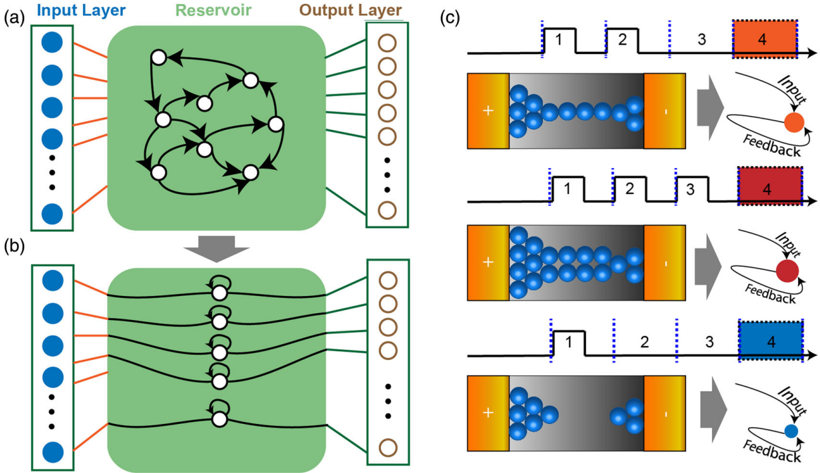
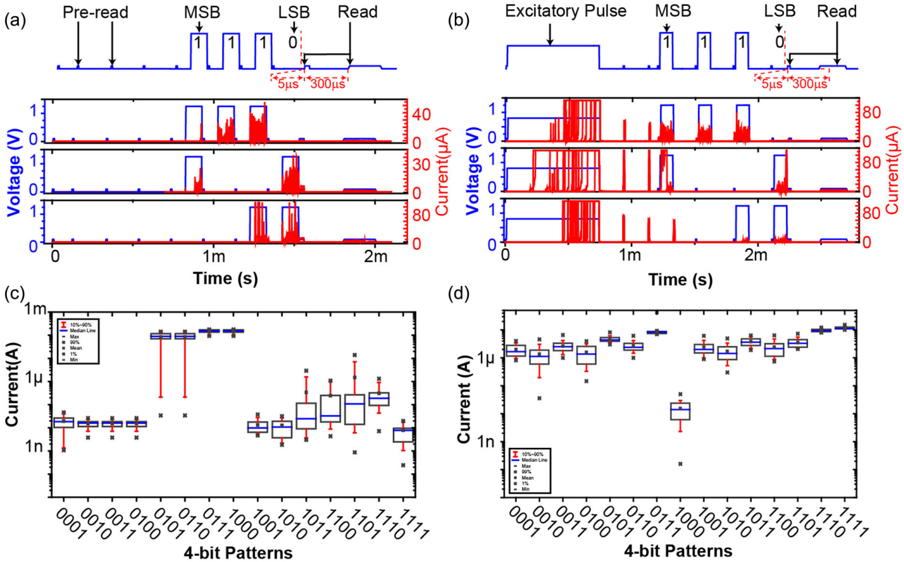
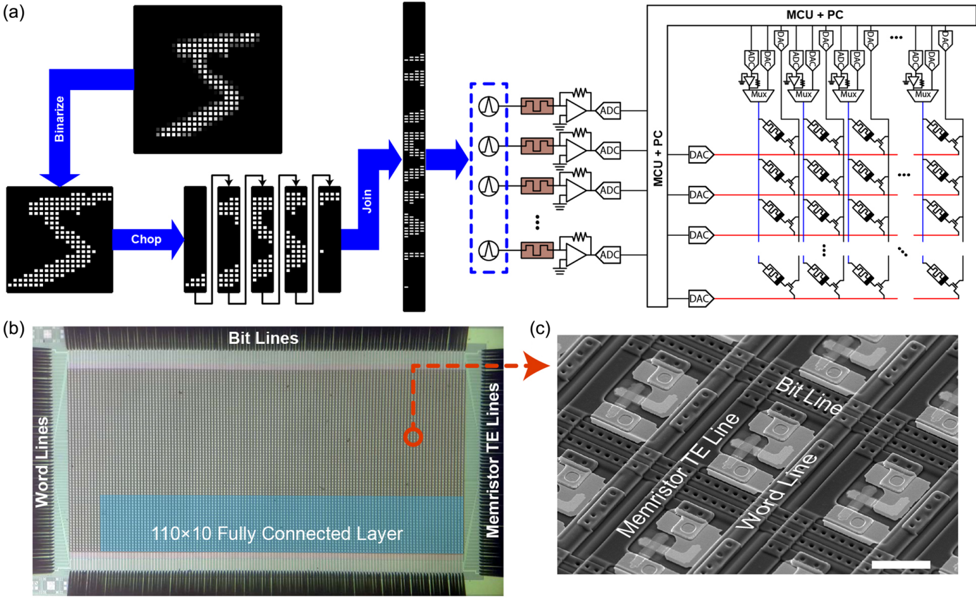
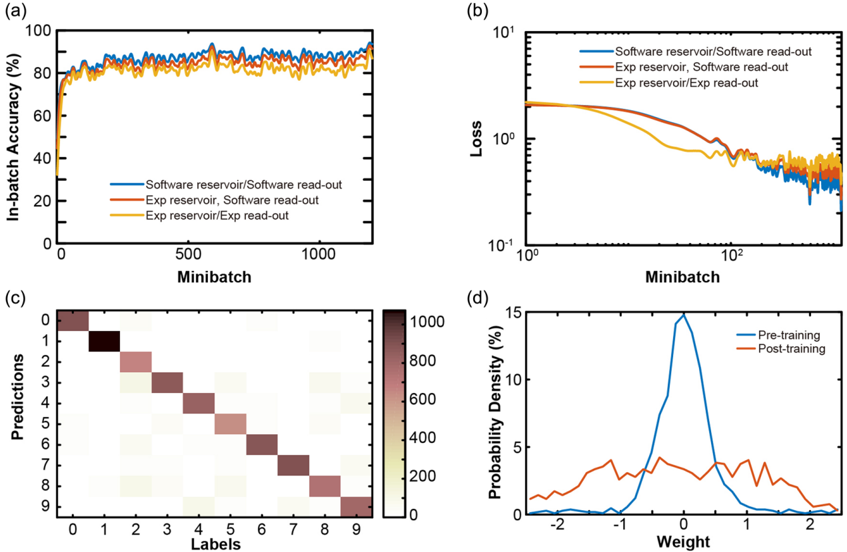
Reservoir computing (RC) is a framework that can extract features from a temporal input into a higher‐dimension feature space. The reservoir is followed by a readout layer that can analyze the extracted features to accomplish tasks such as inference and classification. RC systems inherently exhibit an advantage, since the training is only performed at the readout layer, and therefore they are able to compute complicated temporal data with a low training cost. Herein, a physical reservoir computing system using diffusive memristor‐based reservoir and drift memristor‐based readout layer is experimentally implemented. The rich nonlinear dynamic behavior exhibited by a diffusive memristor due to Ag migration and the robust in situ training of drift memristor arrays makes the combined system ideal for temporal pattern classification. It is then demonstrated experimentally that the RC system can successfully identify handwritten digits from the Modified National Institute of Standards and Technology (MNIST) dataset, achieving an accuracy of 83%.
Overview
The claims and statistics of this paper haven’t been checked yet.
Free: it reads the open-access text and checks the first 5 claims that cite a source we can check. Create a free account to check every claim.
Integrity signals
Registry
Cites
Statistics
Figures
Verification
Claims the paper makes
The claims and statistics of this paper haven’t been checked yet.
Free: it reads the open-access text and checks the first 5 claims that cite a source we can check. Create a free account to check every claim.
Self-check
Percentages, sums and reported differences re-computed from the paper’s own numbers.
The self-check needs the paper’s full text.
Citations
Cites
Deep learning in neural networks: an overview
Schmidhuber, J. (2015) · Neural Networks · doi:10.1016/j.neunet.2014.09.003 · Cited by 18,570
Strukov, D. B., Snider, G. S., Stewart, D. R., & Williams, R. S. (2008) · Nature · doi:10.1038/nature06932 · Cited by 11,828
Nanoscale Memristor Device as Synapse in Neuromorphic Systems
Jo, S. H., Chang, T., Ebong, I., Bhadviya, B. B., Mazumder, P., & Lu, W. (2010) · Nano Letters · doi:10.1021/nl904092h · Cited by 4,174
Maass, W., Natschläger, T., & Markram, H. (2002) · Neural Computation · doi:10.1162/089976602760407955 · Cited by 4,025
Memristive devices for computing
Yang, J. J., Strukov, D. B., & Stewart, D. R. (2013) · Nature Nanotechnology · doi:10.1038/nnano.2012.240 · Cited by 3,885
Self-citationHarnessing Nonlinearity: Predicting Chaotic Systems and Saving Energy in Wireless Communication
Jaeger, H., & Haas, H. (2004) · Science · doi:10.1126/science.1091277 · Cited by 3,811
Networks of spiking neurons: The third generation of neural network models
Maass, W. (1997) · Neural Networks · doi:10.1016/s0893-6080(97)00011-7 · Cited by 3,481
Training and operation of an integrated neuromorphic network based on metal-oxide memristors
Prezioso, M., Merrikh-Bayat, F., Hoskins, B. D., Adam, G. C., Likharev, K. K., & Strukov, D. B. (2015) · Nature · doi:10.1038/nature14441 · Cited by 3,001
Reservoir computing approaches to recurrent neural network training
Lukoševičius, M., & Jaeger, H. (2009) · Computer Science Review · doi:10.1016/j.cosrev.2009.03.005 · Cited by 2,956
Memristors with diffusive dynamics as synaptic emulators for neuromorphic computing
Wang, Z., Joshi, S., Savel’ev, S. E., Jiang, H., Midya, R., Lin, P., Hu, M., Ge, N., Strachan, J. P., Li, Z., et al. (2017) · Nature Materials · doi:10.1038/nmat4756 · Cited by 2,358
Self-citation
Research works printed but not linked: 5
- 5. H. Jaeger, in German National Research Center for Information Technology GMD Technical Report, Vol. 148, Bonn, Germany 2001, p. 13.
- 8. J. J. Steil, in 2004 IEEE Int. Joint Conf. on Neural Networks (IEEE Cat. No.04CH37541), Vol. 842, IEEE, Budapest 2004, pp. 843-848.
- 9. H. Jaeger, Tutorial on Training Recurrent Neural Networks, Covering BPPT, RTRL, EKF and the "Echo State Network" Approach, Vol. 5, GMD-Forschungszentrum Informationstechnik Bonn, Bonn 2002.
- 22. J. Lin, Annadi, S. Sonde, C. Chen, L. Stan, K. V. L. V. Achari, S. Ramanathan, S. Guha, in 2016 IEEE Int. Electron Devices Meeting (IEDM), IEEE, San Francisco 2016, pp. 34.35.31-34.35.34.
- 42. Z. Wang, C. Li, W. Song, M. Rao, D. Belkin, Y. Li, P. Yan, H. Jiang, P. Lin, M. Hu, J. P. Strachan, Nat. Electron. 2019, 2, 115. · DOI · Paper page
Cited by
Items 201–289 of 289
Kurenkov, A., Maes, J., Pac, A., Macauley, G. M., Waeyenberge, B. V., Hrabec, A., & Heyderman, L. J. (2025) · Communications Engineering · doi:10.1038/s44172-025-00499-y · Cited by 8
Nonlinear System Identification Using Dynamic Memristor-Based Reservoir Computing System
Liu, H., Duan, S., Jiang, W., Li, J., & Wang, L. (2022) · International Conference on Electronics Technology (ICET) · doi:10.1109/icet55676.2022.9824316 · Cited by 7
Carstens, N., Strunskus, T., Faupel, F., Hassanien, A., & Vahl, A. (2022) · Particle & Particle Systems Characterization · doi:10.1002/ppsc.202200131 · Cited by 7
Low-Voltage Organic Transistor-Based Reservoir Computing for Multitask Applications
Liu, S., Dai, W., Liu, X., Fan, H., Su, Y., Veeramuthu, L., Zhao, P., Jia, Z., Lv, Z., Zhai, Y., et al. (2025) · The Journal of Physical Chemistry Letters · doi:10.1021/acs.jpclett.5c03357 · Cited by 6
Mo, L., Fan, Z., Ou, J., Chen, Z., Lin, H., Hu, W., Li, W., Li, M., Cui, B., Fan, H., et al. (2026) · Reports on Progress in Physics · doi:10.1088/1361-6633/ae3984 · Cited by 7
“Notably, most of these devices are resistive devices whose conductance states are harnessed as reservoir states (figure 1(b)) [1, 2, 9, 13, 17–19 , 41– 43].”
InfluentialInoue, K., Kubota, T., Tran, Q. H., Akashi, N., Terajima, R., Kabayama, T., Guan, J., & Nakajima, K. (2026) · Chaos An Interdisciplinary Journal of Nonlinear Science · doi:10.1063/5.0283386 · Cited by 7
Lai, B.-R., Chen, K., Chaurasiya, R., You, S., Hsu, W.-D., & Chen, J. (2024) · Nanoscale · doi:10.1039/d3nr05401b · Cited by 6
Highly textured CMOS-compatible hexagonal boron nitride-based neuristor for reservoir computing
Zhang, H., Li, J., Ju, X., Jiang, J., Wu, J., Chi, D., Ang, D. S., Hu, W., Wei, R., Zhu, M., et al. (2024) · Chemical Engineering Journal · doi:10.1016/j.cej.2024.155651 · Cited by 6
Subquantum Semimetal Bi and Oxygen Vacancy Filament Memristors for Neuromorphic Computing
Zhuge, C., Jiang, J., Chen, L., Xie, Z., Shen, G., Fu, Y., Wang, Q., & He, D. (2025) · ACS Applied Materials & Interfaces · doi:10.1021/acsami.5c02955 · Cited by 6
Learning to Approximate Functions Using Nb-Doped SrTiO3 Memristors
Tiotto, T. F., Goossens, A. S., Borst, J. P., Banerjee, T., & Taatgen, N. (2021) · Frontiers in Neuroscience · doi:10.3389/fnins.2020.627276 · Cited by 6
Photomemristor Structures Based on 2D Crystals for Biocompatible Information Sensor Systems
Panin, G. N., & Kapitanova, O. O. (2021) · Nanobiotechnology Reports · doi:10.1134/s2635167621060173 · Cited by 5
Enabling Mycelium-Inspired Reservoir Computing with Memristive Oscillating Cellular Automata
Chatzinikolaou, T. P., Mavropopoulis, A., Tompris, I., Kleitsiotis, G., Chatzipaschalis, I. K., Τσάκαλος, Κ.-Α., Fyrigos, I.-A., Tsompanas, M., Adamatzky, A., Dimitrakis, P., et al. (2025) · IEEE International Symposium on Circuits and Systems proceedings · doi:10.1109/iscas56072.2025.11043767 · Cited by 5
In-sensor computing with halide perovskite-based optoelectronic reservoir networks
de Boer, J. J., Alvarez, A. O., Schmidt, M. C., & Ehrler, B. (2025) · Device · doi:10.1016/j.device.2025.101000 · Cited by 8
A memphotoristor for high-efficiency temporal vision processing
Kumar, M., Kim, J., & Seo, H. (2023) · Materials Today Physics · doi:10.1016/j.mtphys.2023.101176 · Cited by 7
Implementation of rock-paper-scissors judgment systems with a Ag2S reservoir
Mizuno, A., Ohno, Y., Hayakawa, M., Yoshimura, K., & Hasegawa, T. (2023) · Japanese Journal of Applied Physics · doi:10.35848/1347-4065/ad18cf · Cited by 5
Cao, X., Xiao, Y., Ma, Z., Chen, W., Diao, S., Zheng, Z., Liu, Z., Pan, S., & Ge, J. (2024) · ACS Applied Nano Materials · doi:10.1021/acsanm.3c05797 · Cited by 5
Kim, D., Park, H., & Park, H. J. (2025) · ACS Materials Letters · doi:10.1021/acsmaterialslett.5c00790 · Cited by 4
Zhang, D., Li, R., Zou, X., Meng, H., Liu, Q., Li, Y., & Zhang, C. (2025) · IEEE Transactions on Electron Devices · doi:10.1109/ted.2025.3584318 · Cited by 4
“Midya et al. [13] implemented a physical reservoir computing system that utilizes a diffusive memristor-based reservoir and a drift memristor-based readout layer.”
Printed Zinc Tin Oxide Memristors for Reservoir Computing
Martins, R. A., Silva, C., Deuermeier, J., Milano, G., Rosero‐Realpe, M., Parreira, C., Fortunato, E. M. C., Martins, R., Kiazadeh, A., & Carlos, E. (2025) · Advanced Intelligent Systems · doi:10.1002/aisy.202500450 · Cited by 5
Morphologically tunable mycelium chips for physical reservoir computing
Telhan, O., Winiski, J., Schaak, D. D., Siegel, M., Petrillo, N., & Bayer, E. (2026) · Scientific Reports · doi:10.1038/s41598-026-55550-5 · Cited by 4
“For example within the domain of Electrical RC, different memristor architectures provide non-linearity through modulating conductivity over analog resistive elements [12, 13, 14].”
Ghafoor, F., Kim, H., Zhang, H., Ghafoor, B., Lee, M., Shi, T., & Kim, D. (2026) · Advanced Composites and Hybrid Materials · doi:10.1007/s42114-025-01566-w · Cited by 4
Physical reservoir computing using vertically aligned graphene/diamond photomemristors
Ito, Y., Iwane, H., Jia, S., & Ueda, K. (2023) · Applied Physics Express · doi:10.35848/1882-0786/ace8ef · Cited by 4
Near-sensor reservoir computing for Braille recognition via high stability memristors
Qin, Z., Shen, G., Jiang, J., Fu, Y., Qiao, L., Wang, Q., & He, D. (2025) · Applied Physics Letters · doi:10.1063/5.0253801 · Cited by 4
Kim, H., Byun, J., Park, J., Lee, K., Ha, D., & Kim, S. (2025) · Advanced Intelligent Systems · doi:10.1002/aisy.202500285 · Cited by 4
Memristor, mem-systems and neuromorphic applications: a review
Pham, V., VOLOS, C. K., & Kapitaniak, T. (2021) · Elsevier eBooks · doi:10.1016/b978-0-12-821184-7.00022-0 · Cited by 5
Elsonbaty, A., Elsadany, A. A., & Adel, W. (2023) · Fractal and Fractional · doi:10.3390/fractalfract7040282 · Cited by 5
Yamada, R., Watanabe, S., & Tada, H. (2023) · RSC Advances · doi:10.1039/d3ra04614a · Cited by 4
Choi, Y.-J., Bang, S., Kim, T., Lee, D. K., Hong, K., Kim, S., & Park, B. (2021) · Semiconductor Science and Technology · doi:10.1088/1361-6641/abdbc2 · Cited by 4
Dynamic Memristor based Cyclic Echo State Network for Time Series Prediction
Li, G., Xia, L., Fu, J., Duan, S., Tang, J., & Wang, L. (2024) · International Conference on Neural Networks, Information and Communication Engineering (NNICE) · doi:10.1109/nnice61279.2024.10498345 · Cited by 3
Geopolymer memristor-based physical reservoir computing for digit recognition
Shakib, M. A., Maraj, J. J., Gao, Z., Ahmadipour, M., Montazami, R., Sarles, S. A., & Lamuta, C. (2025) · AIP Advances · doi:10.1063/5.0285689 · Cited by 3
Shingaya, Y., Nishioka, D., Terabe, K., & Tsuchiya, T. (2025) · Applied Physics Letters · doi:10.1063/5.0266816 · Cited by 3
Jeong, M., Kim, D. J., Hwang, S. I., Kwon, T., Yoon, J. H., & Park, M. H. (2026) · Journal of Materials Chemistry C · doi:10.1039/d5tc03936c · Cited by 3
Printing polyaniline based organic memristive devices for neuromorphic computing applications
Battistoni, S., Matsukatova, A. N., Carcione, R., Ferrucci, L., Parmeggiani, M., Cocuzza, M., Marasso, S. L., Emelyanov, A. V., Demin, V. A., & Erokhin, V. V. (2026) · Materials Today Chemistry · doi:10.1016/j.mtchem.2026.103500 · Cited by 3
Gaurav, A., Song, X., Manhas, S. K., Roy, P. P., & Souza, M. M. D. (2025) · ACS Applied Materials & Interfaces · doi:10.1021/acsami.5c00092 · Cited by 3
Xia, Q., Yang, J. J., & Midya, R. (2021) · Nature Materials · doi:10.1038/s41563-021-01110-3 · Cited by 3
Self-citationJu, D., Lee, J., Kim, S., & Cho, S. (2024) · The Journal of Chemical Physics · doi:10.1063/5.0218677 · Cited by 2
Serenko, M. V., Serenko, A. V., Emelyanov, A. V., Liu, G., & Demin, V. A. (2026) · BioNanoScience · doi:10.1007/s12668-026-02542-4 · Cited by 2
Jung, H., Cho, H., Lee, Y., Baek, S., Kim, H., Ro, Y. G., Ko, H., Suh, J., Noh, Y., & Kwon, J. (2026) · Advanced Materials · doi:10.1002/adma.202523703 · Cited by 2
“…devices decouple ionic transport (write path) from electronic conduction (read path), enabling non-destructive read-out, reduced read–write interference, and independent control of programming and sensing operations, which are difficult to achieve in two-terminal memristive synapses [ 22–24 ].”
Nishimura, M., Namiki, W., Nishioka, D., Hikasa, S., Iguchi, R., Terabe, K., & TSUCHIYA, T. (2026) · Japanese Journal of Applied Physics · doi:10.35848/1347-4065/ae43f6 · Cited by 2
Kobayashi, M., Orii, Y., Shima, H., Naitoh, Y., Akinaga, H., Sato, D., Matsuo, T., Kinoshita, K., Nokami, T., & Itoh, T. (2022) · IEEE Journal of the Electron Devices Society · doi:10.1109/jeds.2022.3199205 · Cited by 2
“A physical reservoir device with a time–series data treatment function and a high-dimensional feature space is also a feasible candidate of its fading property [15], [16].”
BackgroundGaurav, A., Song, X., Manhas, S. K., Roy, P. P., & Souza, M. M. D. (2023) · IEEE Electron Devices Technology & Manufacturing Conference (EDTM) · doi:10.1109/edtm55494.2023.10103131 · Cited by 2
“In these studies, the reservoirs were constructed based on diffusive memristors which are a class of volatile memristors whose switching is governed by fast diffusive species (e.g., Ag) [2].”
BackgroundNeuromorphic Computing Based on Memristor Dynamics
Duan, Q., Xiao, Z., Ke, Y., & Yang, Y. (2022) · Springer eBooks · doi:10.1007/978-3-031-11506-6_1 · Cited by 1
Song, X., Gaurav, A., Pillai, P. B., Kumar, A., Manhas, S. K., Gilra, A., Vasilaki, E., & Souza, M. M. D. (2023) · IEEE International Flexible Electronics Technology Conference (IFETC) · doi:10.1109/ifetc57334.2023.10254868 · Cited by 1
Introduction to Memristive Mechanisms and Models
Cipollini, D., & Schomaker, L. (2025) · Recent Patents on Nanotechnology · doi:10.2174/0118722105327900250115102034 · Cited by 2
Physical reservoir computing for biomedical applications
Ding, Y., Yalagala, B. P., Li, H., Mughal, W., & Heidari, H. (2025) · Neuromorphic Computing and Engineering · doi:10.1088/2634-4386/ae006c · Cited by 1
Programmable Photosensor with a Gate‐Tunable Schottky Barrier for Multiscale Reservoir Computing
Li, K., Wu, C., Feng, S., Zhao, P. J., Cheng, X., & Miao, X. (2026) · Advanced Functional Materials · doi:10.1002/adfm.202529105 · Cited by 1
Wang, Y., Shan, X., Wang, Q., Wang, Z., Liu, S., Liu, W., Zheng, J., Zhao, X., Wang, Z., Lin, Y., et al. (2026) · Science China Information Sciences · doi:10.1007/s11432-025-4643-6 · Cited by 1
Self-citationXiao, Y., Rodríguez‐Patón, A., Wang, J., Zheng, P., Ma, T., & Song, T. (2026) · ACS Synthetic Biology · doi:10.1021/acssynbio.5c00925 · Cited by 1
Digit image classification using magnonic reservoir computing
Ustinov, A. B., Кондрашов, А. В., Nikitin, A. A., Burovikhin, A. P., Semenov, A. A., & Kostylev, M. (2026) · Journal of Applied Physics · doi:10.1063/5.0313414 · Cited by 3
Ion‐Gating Reservoir Computing for Preprocessing‐Free Speech Recognition from Throat Vibrations
Nishioka, D., Tateyama, A., Kitano, H., Nakanishi, T., Terabe, K., & Tsuchiya, T. (2026) · Advanced Electronic Materials · doi:10.1002/aelm.202600006 · Cited by 3
On the Role of Preprocessing and Memristor Dynamics in Reservoir Computing for Image Classification
Daniels, R., Wattad, D., Ronen, R., Saad, D., & Kvatinsky, S. (2026) · Advanced Electronic Materials · doi:10.1002/aelm.202500866 · Cited by 1
“Nonvolatile memristors that possess long-term memory are ideal for implementing the readout layer weights that are updated during training and remain fixed during inference [43].”
Huang, Y., Zhang, R., Chen, J., Cheng, L., Li, Z., Hu, C., Yang, J., Li, N., Zhang, B., Da, Q., et al. (2026) · Nano Research · doi:10.26599/nr.2026.94908805 · Cited by 1
Self-citationMiao, Z., Zhang, S., Hong, C., Li, Y., Luo, Y., Wang, S., Long, J. L., & Sun, Z. X. (2026) · Electronics · doi:10.3390/electronics15102028 · Cited by 2
Takanashi, K., Miyazaki, M., Yamasaki, I., Komatsu, H., Kounoue, T., Koyama, M., & Ikuno, T. (2026) · Electronic Materials · doi:10.3390/electronicmat7020012 · Cited by 1
“The detailed experimental conditions related to the above tasks are described elsewhere [21–25].”
Ding, B., Zhang, T., Shao, L., Zhelev, N., Hector, A. L., & Huang, R. (2026) · Advanced Science · doi:10.1002/advs.76163 · Cited by 1
“These devices have been successfully employed as dynamic reservoirs for processing speech, biosignals, and sequential patterns [ 13–16 ].”
Volatile and Non‐Volatile Ferroelectric HZO for Low‐Power Reservoir Computing
Xu, Y., Rossetti, D., Asapu, S., Moon, T., Zhao, J., Zhao, R., Kim, S. J., Wang, T., Bonnin, M., Ascoli, A., et al. (2026) · Advanced Materials Technologies · doi:10.1002/admt.71125 · Cited by 1
Self-citationShort-Term Plasticity in 2D Materials for Neuromorphic Computing
Yang, H. (2022) · Springer eBooks · doi:10.1007/978-3-031-11506-6_2 · Cited by 1
RF-wave induced CBRAM characteristic modulation specific to sheet-like conductive filaments
Yin, Y., Tsukamoto, K., Hayashi, H., & Nakaoka, T. (2023) · Materials Research Express · doi:10.1088/2053-1591/ad0dcf · Cited by 1
Reservoir Computation with Networks of Differentiating Neuron Ring Oscillators
Yeung, A., DelMastro, P., Karuvally, A., Siegelmann, H. T., Rietman, E. A., & Hazan, H. (2025) · Analytics · doi:10.3390/analytics4040028 · Cited by 1
Морфологическая характеристика алмазов из туффизитов месторождения «Ефимовское» Вишерского Урала
Korotchenkova, O. V., & Чайковский, И. И. (2012) · CyberLeninK (CyberLeninka)
Erokhin, V. V. (2023) · Elsevier eBooks · doi:10.1016/b978-0-323-96027-4.00004-8
Reservoir Computing Using Series-Parallel-Connected Au Nanogaps and Electromigrated Coulomb Islands
Sakai, K., Tanaka, Y., Yagi, M., Ito, M., & Shirakashi, J. (2025) · ACS Applied Electronic Materials · doi:10.1021/acsaelm.5c01068
A Deep Reservoir Computing Architecture for Dynamic Generative Modeling
Zhang, W., Kuan, Y.-H., Chang, S., & Li, J.-S. (2025) · International Joint Conference on Neural Networks (IJCNN) · doi:10.1109/ijcnn64981.2025.11227706
Modeling artificial neuron spiking based on diffusive memristor with two filaments
Akther, A., Pattnaik, D. P., Borisov, P., Savel'ev, S. E., & Balanov, A. G. (2025) · APL Machine Learning · doi:10.1063/5.0294184
Effects of Different Conductance Mechanisms and Temperature on Memristive Neural Networks
Ghadge, A., Kumar, A., & Bag, M. (2025) · physica status solidi (a) · doi:10.1002/pssa.202500536
“Memristive implementations of ESN leverage the inherent dynamics of memristors, particularly those with volatile characteristics, to naturally implement the fading memory required for temporal processing [70].”
Mohan, J. R. (2023) · Institutional Repositories DataBase (IRDB) · doi:10.18997/0002000488
Design, manufacturing, and characterization of advanced ceramics
Shakib, M. A. (2025) · Iowa Research Online (The University of Iowa) · doi:10.25820/etd.007835
Υλοποίηση νευρομορφικών υπολογισμών με δικτυώματα μνημών μεταβλητής αντίστασης
Tsioustas, C. (2026) · DSpace - NTUA (National Technical University of Athens) · doi:10.26240/heal.ntua.31922
1-Transistor-Dynamic Random Access Memory as Reservoir for Temporal Signal Processing
Bashir, Y., Channapragada, L. A. S., & Sahay, S. (2026) · IEEE Journal on Exploratory Solid-State Computational Devices and Circuits · doi:10.1109/jxcdc.2026.3690766
Nanomaterials and nanodevices for physical reservoir computing
Jeong, S., Kang, B., Lee, J., & Oh, H. (2026) · Current Applied Physics · doi:10.1016/j.cap.2026.06.005
Wang, Z., & Zhu, Y. (2026) · IEEE Transactions on Systems Man and Cybernetics Systems · doi:10.1109/tsmc.2026.3701842
“In such devices, volatile “fading memory” e ff ects are physically implemented by the dynamic formation and spontaneous filamentary conductive pathways, or the migration of mobile ions under applied electric fields [53], [54], [55], [56].”
Self-citationMizumoto, T., Banerjee, A., Hirotani, J., & Tsuchiya, T. (2026) · SSRN Electronic Journal · doi:10.2139/ssrn.7051361
Wafer-Scale All-Silicon Self-Rectifying Memristor for Synaptic Response and Reservoir Computing
Yoon, J. H., Cho, S. H., Moroshkin, P., Kim, S., Bo, M. D., Kwon, J., Nam, K. T., & Xu, J. (2026) · Nano Letters · doi:10.1021/acs.nanolett.6c00994
Neuromorphic tissues: Soft biomolecular networks for brain-inspired temporal computing
Armendarez, N. X., Mohamed, A. S. I., Hasan, M. S., & Najem, J. S. (2026) · Science Advances · doi:10.1126/sciadv.aed0971
“S2 ) ( 9 , 10 , 15 , 17 , 19 , 21 , 33 – 36 ).”
Frequency-Modulation-Based Physical Reservoir Computing With Tunable MEMS Oscillator
Chuang, Y.-C., Liu, C.-P., Hsiao, H.-C., & Chiu, Y. (2026) · IEEE Sensors Letters · doi:10.1109/lsens.2026.3720575
Analysis and Applications of Neuromorphic Memristors in Artificial Intelligence Computing
Wang, J., Chen, Q., Zhang, J., Meng, J., & Wang, T. (2026) · Nano-Micro Letters · doi:10.1007/s40820-026-02322-5
“3a [43–45].”
Lin, Z., Li, R., Wang, Y., Gao, K., Cao, Z., Liu, W., Sun, B. T., Geng, L., & Han, C. Y. (2026) · Neurocomputing · doi:10.1016/j.neucom.2026.135047
Fida, A. A., Abbas, H., Nisar, A., Zahoor, F., & Mittal, S. (2026) · IEEE Transactions on Electron Devices · doi:10.1109/ted.2026.3729186
Singh, K. R., Zaman, A. S. K., Xu, M., Usami, Y., Das, S., & Tanaka, H. (2026) · Advanced Materials · doi:10.1002/adma.74897
A low-power multichannel seizure detection system based on MoS 2 neuromorphic reservoir computing
Pittoni, L., Farronato, M., Capodiferro, A., Chen, L., Carletti, F., Larelli, G., Curia, G., & Ielmini, D. (2026) · Neuromorphic Computing and Engineering · doi:10.1088/2634-4386/aeae69
“Thanks to the use of MoS 2 - CTM devices, which operate at very low current, we can achieve very low power consumption for the feature extraction operation, which is a substantial advantage with respect to other solutions like diffusive memristors [16, 17, 45, 46].”
Shim, S. K., Choi, W., Cheong, S., Shin, D. H., Shin, J., Han, J., Im, J., Kim, S., Son, K., Kim, H. W., et al. (2026) · Nature Communications · doi:10.1038/s41467-026-78364-5
Elamaran, D., Sakai, M., Huiqin, L., Naoi, R., Kobayashi, T., Qi, K., Tung, V., Sakota, S., Yoshimura, T., Fujimura, N., et al. (2026) · ACS Nano · doi:10.1021/acsnano.6c10356
Monolithic zero-bias memristive vision device with in-materio spectral kernels
Kumar, M., Dang, H., & Seo, H. (2026) · Nano Today · doi:10.1016/j.nantod.2026.103211
Memcapacitive-Dominated Reservoir Computing with Self-Organizing Nanowire Networks
Wang, H., Wu, Z., Guo, W., Wang, Z., Hao, Y., Wang, W., Zhang, X., Zhao, X., Lu, J., Cao, R., et al. (2026) · ACS Applied Materials & Interfaces · doi:10.1021/acsami.6c12382 · Cited by 1
Self-citationAn, X., Lu, G., Liu, X., Ki, S. J., Debnath, S., Chen, C., & Liang, X. (2026) · Applied Physics Letters · doi:10.1063/5.0344143
Zhang, J., Wang, K., Qiao, P., Shen, Z., Huang, S., Dong, Z., Tao, J., Kuang, Y., Tu, X., Mitrović, I. Z., et al. (2026) · Small · doi:10.1002/smll.76406
Orpella, A. (2026) · SSRN Electronic Journal · doi:10.2139/ssrn.7650121
Memristive Neural Networks-Assisted Training Algorithms: Current State and Future Challenges
Samardžić, N., Vranjković, V. S., Teodorovic, P., Maričić, J., Shchanikov, S., Gordleeva, S., Mikhaylov, A. N., Talanov, M. O., Kazantsev, V., STRUHARIK, R. J. R., et al. (2026) · Electronics · doi:10.3390/electronics15214892
Gao, K., Cao, Z., Wang, M., Yang, B., Wang, Z., Wang, S. L., Sun, B. T., & Li, X. (2026) · Advanced Functional Materials · doi:10.1002/adfm.79538
Self-citation
Metadata
- Authors
- Midya, R., Wang, Z., Asapu, S., Zhang, X., Rao, M., Song, W., Zhuo, Y., Upadhyay, N., Xia, Q., & Yang, J. J.
- Affiliations
- University of Massachusetts Amherst (US)
- Corresponding author
- Xia, Qiangfei
- Yang, J. Joshua
- ORCID
- Venue
- Advanced Intelligent Systems
- Publisher
- Wiley
- Published
- 2019-09-25
- Volume
- 1
- Issue
- 7
- ISSN
- 2640-4567 (ISSN-L)
- OpenAlex
- W2971405544
- Cited by
- 279
- References
- 38
- Citations by year
- 2026: 36 · 2025: 49 · 2024: 59 · 2023: 55 · 2022: 36 · 2021: 26 · 2020: 15 · 2019: 2
- FWCI
- 9.01
- Type
- journal article
- Language
- en
- Open access
- gold
- doi.org
- Locations
- Advanced Intelligent Systems (publishedVersion, cc-by)
- Funders
- Air Force Office of Scientific Research (FA9550-19-1-0213)
- Topics
- Physical Sciences › Computer Science › Artificial Intelligence › Neural Networks and Reservoir Computing
- Physical Sciences › Engineering › Electrical and Electronic Engineering › Advanced Memory and Neural Computing
- Physical Sciences › Mathematics › Theoretical Computer Science › DNA and Biological Computing
- Keywords
- reservoir computing, diffusive memristors, physical reservoir computing, nonlinear dynamics, in situ training, handwritten digit recognition, MNIST
About these checks
Registry, retraction, Cites and statistics results are computed, not judged, with one exception: a printed reference that no index lists is read once by a model before it counts as a citation error. Claims are extracted by a model and kept only when their quote appears verbatim in the text; each cited source is then checked, with a model’s help, for whether it says what the claim relies on. Those verdicts can be wrong — read the claim’s quote and the cited source before relying on one.
Statistics and arithmetic are recomputed, not judged.
Confidence bands are shown only for fields calibrated on our annotated test set. None is calibrated yet, so no band is shown.
What counts as a claim ›How we measure confidence ›How we check this ›
Are you an author, or do you see a problem with this page? Request a review
Data sources
Bibliographic data: Semantic Scholar, OpenAlex, Crossref.
Contains information from the Semantic Scholar Academic Graph Datasets, made available under the ODC Attribution License (ODC-BY 1.0).
Semantic Scholar’s data is described in: Kinney, R., et al. (2023). The Semantic Scholar Open Data Platform. arXiv:2301.10140.
