

Reservoir Computing Using Diffusive Memristors
Open accessThe DOI matches its Crossref record; 37 of the 38 references it cites were found in a registry or an index.
Abstract
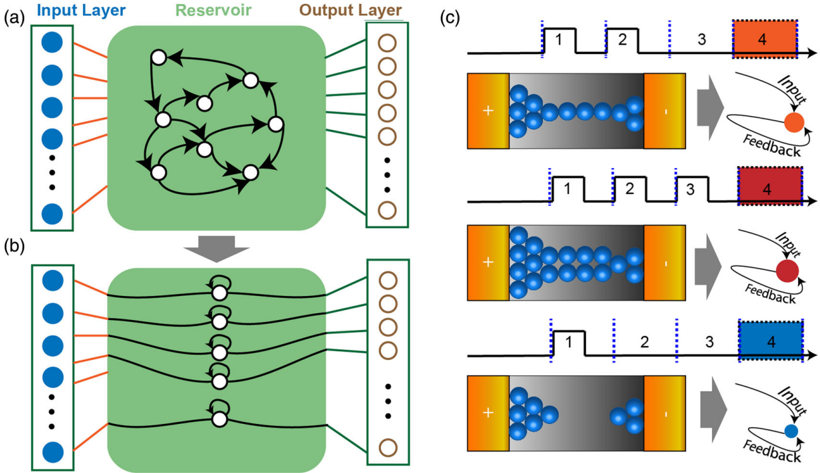
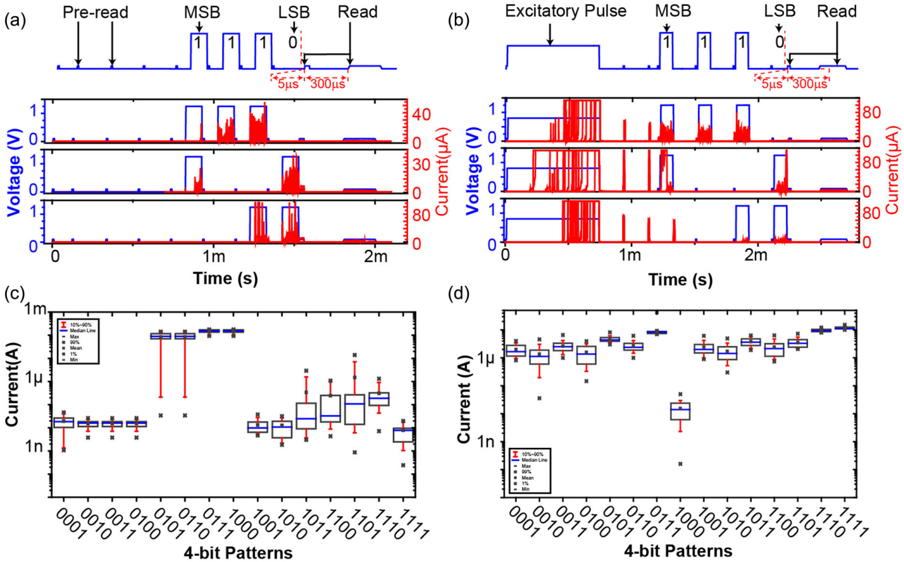
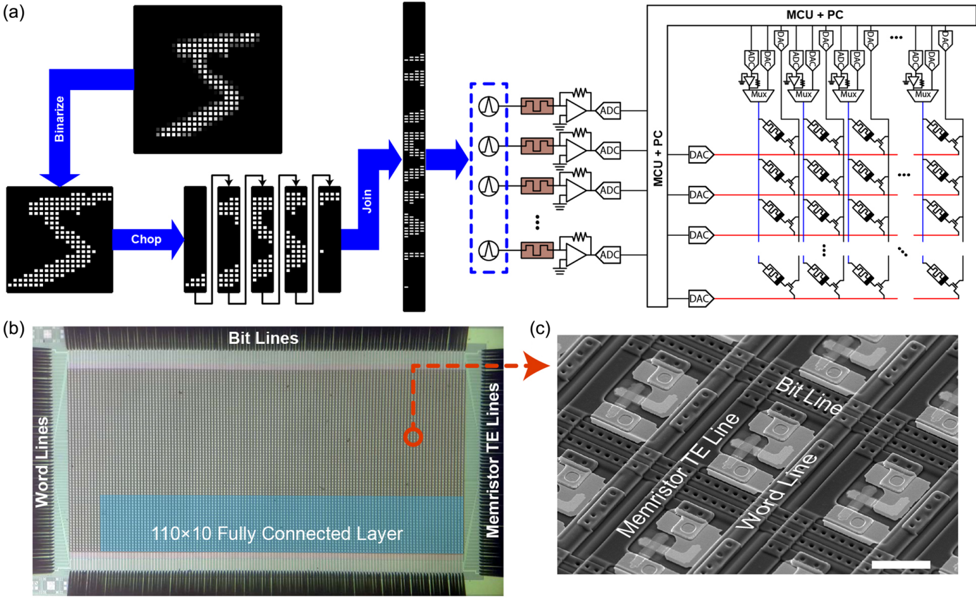
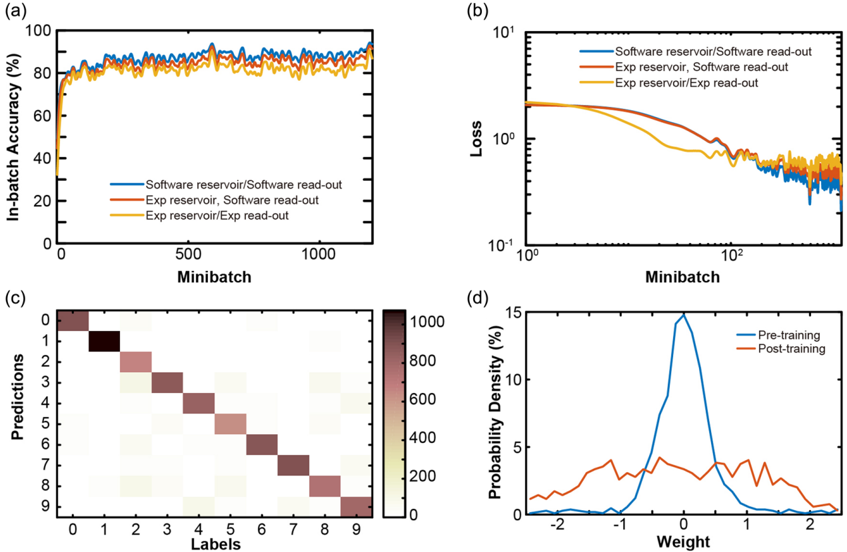
Reservoir computing (RC) is a framework that can extract features from a temporal input into a higher‐dimension feature space. The reservoir is followed by a readout layer that can analyze the extracted features to accomplish tasks such as inference and classification. RC systems inherently exhibit an advantage, since the training is only performed at the readout layer, and therefore they are able to compute complicated temporal data with a low training cost. Herein, a physical reservoir computing system using diffusive memristor‐based reservoir and drift memristor‐based readout layer is experimentally implemented. The rich nonlinear dynamic behavior exhibited by a diffusive memristor due to Ag migration and the robust in situ training of drift memristor arrays makes the combined system ideal for temporal pattern classification. It is then demonstrated experimentally that the RC system can successfully identify handwritten digits from the Modified National Institute of Standards and Technology (MNIST) dataset, achieving an accuracy of 83%.
Overview
The claims and statistics of this paper haven’t been checked yet.
Free: it reads the open-access text and checks the first 5 claims that cite a source we can check. Create a free account to check every claim.
Integrity signals
Registry
Cites
Statistics
Figures
Verification
Claims the paper makes
The claims and statistics of this paper haven’t been checked yet.
Free: it reads the open-access text and checks the first 5 claims that cite a source we can check. Create a free account to check every claim.
Self-check
Percentages, sums and reported differences re-computed from the paper’s own numbers.
The self-check needs the paper’s full text.
Citations
Cites
Deep learning in neural networks: an overview
Schmidhuber, J. (2015) · Neural Networks · doi:10.1016/j.neunet.2014.09.003 · Cited by 18,570
Strukov, D. B., Snider, G. S., Stewart, D. R., & Williams, R. S. (2008) · Nature · doi:10.1038/nature06932 · Cited by 11,828
Nanoscale Memristor Device as Synapse in Neuromorphic Systems
Jo, S. H., Chang, T., Ebong, I., Bhadviya, B. B., Mazumder, P., & Lu, W. (2010) · Nano Letters · doi:10.1021/nl904092h · Cited by 4,174
Maass, W., Natschläger, T., & Markram, H. (2002) · Neural Computation · doi:10.1162/089976602760407955 · Cited by 4,025
Memristive devices for computing
Yang, J. J., Strukov, D. B., & Stewart, D. R. (2013) · Nature Nanotechnology · doi:10.1038/nnano.2012.240 · Cited by 3,885
Self-citationHarnessing Nonlinearity: Predicting Chaotic Systems and Saving Energy in Wireless Communication
Jaeger, H., & Haas, H. (2004) · Science · doi:10.1126/science.1091277 · Cited by 3,811
Networks of spiking neurons: The third generation of neural network models
Maass, W. (1997) · Neural Networks · doi:10.1016/s0893-6080(97)00011-7 · Cited by 3,481
Training and operation of an integrated neuromorphic network based on metal-oxide memristors
Prezioso, M., Merrikh-Bayat, F., Hoskins, B. D., Adam, G. C., Likharev, K. K., & Strukov, D. B. (2015) · Nature · doi:10.1038/nature14441 · Cited by 3,001
Reservoir computing approaches to recurrent neural network training
Lukoševičius, M., & Jaeger, H. (2009) · Computer Science Review · doi:10.1016/j.cosrev.2009.03.005 · Cited by 2,956
Memristors with diffusive dynamics as synaptic emulators for neuromorphic computing
Wang, Z., Joshi, S., Savel’ev, S. E., Jiang, H., Midya, R., Lin, P., Hu, M., Ge, N., Strachan, J. P., Li, Z., et al. (2017) · Nature Materials · doi:10.1038/nmat4756 · Cited by 2,358
Self-citation
Research works printed but not linked: 5
- 5. H. Jaeger, in German National Research Center for Information Technology GMD Technical Report, Vol. 148, Bonn, Germany 2001, p. 13.
- 8. J. J. Steil, in 2004 IEEE Int. Joint Conf. on Neural Networks (IEEE Cat. No.04CH37541), Vol. 842, IEEE, Budapest 2004, pp. 843-848.
- 9. H. Jaeger, Tutorial on Training Recurrent Neural Networks, Covering BPPT, RTRL, EKF and the "Echo State Network" Approach, Vol. 5, GMD-Forschungszentrum Informationstechnik Bonn, Bonn 2002.
- 22. J. Lin, Annadi, S. Sonde, C. Chen, L. Stan, K. V. L. V. Achari, S. Ramanathan, S. Guha, in 2016 IEEE Int. Electron Devices Meeting (IEDM), IEEE, San Francisco 2016, pp. 34.35.31-34.35.34.
- 42. Z. Wang, C. Li, W. Song, M. Rao, D. Belkin, Y. Li, P. Yan, H. Jiang, P. Lin, M. Hu, J. P. Strachan, Nat. Electron. 2019, 2, 115. · DOI · Paper page
Cited by
Resistive switching materials for information processing
Wang, Z., Wu, H., Burr, G. W., Hwang, C. S., Wang, K. L., Xia, Q., & Yang, J. J. (2020) · Nature Reviews Materials · doi:10.1038/s41578-019-0159-3 · Cited by 1,214
Self-citationTang, J., Yuan, F., Shen, X., Wang, Z., Rao, M., He, Y., Sun, Y., Li, X., Zhang, W., Li, Y., et al. (2019) · Advanced Materials · doi:10.1002/adma.201902761 · Cited by 834
Self-citationDynamic memristor-based reservoir computing for high-efficiency temporal signal processing
(2021) · doi:10.1038/s41467-020-20692-1 · Cited by 597
Physical reservoir computing—an introductory perspective
Nakajima, K. (2020) · Japanese Journal of Applied Physics · doi:10.35848/1347-4065/ab8d4f · Cited by 422
Milano, G., Pedretti, G., Montano, K., Ricci, S., Hashemkhani, S., Boarino, L., Ielmini, D., & Ricciardi, C. (2022) · Nature Materials · doi:10.1038/s41563-021-01099-9 · Cited by 462
In-sensor reservoir computing for language learning via two-dimensional memristors
Sun, L., Wang, Z., Jiang, J., Kim, Y., Joo, B., Zheng, S., Lee, S., Yu, W. J., Kong, B.-S., & Yang, H. (2021) · Science Advances · doi:10.1126/sciadv.abg1455 · Cited by 439
“For example, RC systems have been built on memristors with a simple structure, high density, good energy efficiency, and threedimensional (3D) stackability (9).”
BackgroundSelf-citationEmerging Memristive Artificial Synapses and Neurons for Energy‐Efficient Neuromorphic Computing
Choi, S., Yang, J., & Wang, G. (2020) · Advanced Materials · doi:10.1002/adma.202004659 · Cited by 424
Self-citationZhang, Z., Zhao, X., Zhang, X., Hou, X., Ma, X., Tang, S., Zhang, Y., Xu, G., Liu, Q., & Long, S. (2022) · Nature Communications · doi:10.1038/s41467-022-34230-8 · Cited by 377
Self-citationBrain-inspired computing with memristors: Challenges in devices, circuits, and systems
Zhang, Y., Wang, Z., Zhu, J., Yang, Y., Rao, M., Song, W., Zhuo, Y., Zhang, X., Cui, M., Shen, L., et al. (2020) · Applied Physics Reviews · doi:10.1063/1.5124027 · Cited by 384
Self-citationPark, S.-O., Jeong, H., Park, J., Bae, J., & Choi, S. (2022) · Nature Communications · doi:10.1038/s41467-022-30539-6 · Cited by 331
“Similar approaches to process sequential/temporal data with volatile memristors 12,13,27 – 29 have been extensively studied, but there have been several limitations.”
MethodRecent Advances of Volatile Memristors: Devices, Mechanisms, and Applications
Wang, R., Yang, J.-Q., Mao, J.-Y., Wang, Z.-P., Wu, S., Zhou, M., Chen, T., Zhou, Y., & Han, S.-T. (2020) · Advanced Intelligent Systems · doi:10.1002/aisy.202000055 · Cited by 239
Self-citationAll-ferroelectric implementation of reservoir computing
Chen, Z., Li, W., Fan, Z., Dong, S., Chen, Y., Qin, M., Zeng, M., Lu, X., Zhou, G., Gao, X., et al. (2023) · Nature Communications · doi:10.1038/s41467-023-39371-y · Cited by 183
“higher than that achieved by a pioneering diffusive memristor-based RC system [10], whose image pre-processing approach, reservoir architecture, and readout network size are similar to ours.”
Amirsoleimani, A., Alibart, F., Yon, V., Xu, J., Pazhouhandeh, M. R., Ecoffey, S., Beilliard, Y., Genov, R., & Drouin, D. (2020) · Advanced Intelligent Systems · doi:10.1002/aisy.202000115 · Cited by 216
Memristive Crossbar Arrays for Storage and Computing Applications
Li, H., Wang, S., Zhang, X., Wang, W., Yang, R., Sun, Z., Feng, W., Lin, P., Wang, Z., Sun, L., et al. (2021) · Advanced Intelligent Systems · doi:10.1002/aisy.202100017 · Cited by 205
Self-citationRoadmap on emerging hardware and technology for machine learning
Berggren, K., Xia, Q., Likharev, K. K., Strukov, D. B., Jiang, H., Mikolajick, T., Querlioz, D., Salinga, M., Erickson, J. R., Pi, S., et al. (2021) · Nanotechnology · doi:10.1088/1361-6528/aba70f · Cited by 190
Self-citationAdaptive Extreme Edge Computing for Wearable Devices
Covi, E., Donati, E., Liang, X., Kappel, D., Heidari, H., Payvand, M., & Wang, W. (2021) · Frontiers in Neuroscience · doi:10.3389/fnins.2021.611300 · Cited by 177
“The Ag filament based resistive switching device shows short retention time and high switching dynamics, thus was proposed for reservoir computing (Midya et al., 2019) and spatiotemporal computing (Wang et al.”
BackgroundUltralow‐Power Machine Vision with Self‐Powered Sensor Reservoir
Lao, J., Yan, M., Tian, B., Jiang, C., Luo, C., Xie, Z., Zhu, Q., Bao, Z., Zhong, N., Tang, X., et al. (2022) · Advanced Science · doi:10.1002/advs.202106092 · Cited by 184
John, R. A., Yantara, N., Ng, S. E., Patdillah, M. I. B., Kulkarni, M. R., Jamaludin, N. F., Basu, J., Ankit, Mhaisalkar, S. G., Basu, A., et al. (2021) · Advanced Materials · doi:10.1002/adma.202007851 · Cited by 178
Liu, K., Dang, B., Zhang, T., Yang, Z., Bao, L., Xu, L., Cheng, C., Huang, R., & Yang, Y. (2022) · Advanced Materials · doi:10.1002/adma.202108826 · Cited by 173
Nanostructured perovskites for nonvolatile memory devices
Liu, Q., Gao, S., Xu, L., Yue, W., Zhang, C., Kan, H., Li, Y., & Shen, G. (2022) · Chemical Society Reviews · doi:10.1039/d1cs00886b · Cited by 163
Nonlinearity in memristors for neuromorphic dynamic systems
Yang, K., Joshua Yang, J., Huang, R., & Yang, Y. (2022) · Small Science · doi:10.1002/smsc.202100049 · Cited by 151
Short-term synaptic plasticity in emerging devices for neuromorphic computing
Li, C., Zhang, X., Chen, P., Zhou, K., Yu, J., Wu, G., Xiang, D., Jiang, H., Wang, M., & Liu, Q. (2023) · iScience · doi:10.1016/j.isci.2023.106315 · Cited by 158
Self-citationBrain-inspired computing with fluidic iontronic nanochannels
Kamsma, T. M., Kim, J., Kim, K., Boon, W. Q., Spitoni, C., Park, J., & van Roij, R. (2024) · Proceedings of the National Academy of Sciences · doi:10.1073/pnas.2320242121 · Cited by 144
“…in the form of voltage pulse trains, that together represent (handwritten) numbers were distinguished by individual channels for subsequent in silico classification with a simple readout function, demonstrating (at least) comparable performance to more conventional solid-state platforms [32–35].”
BackgroundMethodResultInfluentialEmerging dynamic memristors for neuromorphic reservoir computing
Cao, J., Zhang, X., Cheng, H., Qiu, J., Liu, X., Wang, M., & Liu, Q. (2022) · Nanoscale · doi:10.1039/d1nr06680c · Cited by 134
Self-citationAdvances in Memristor-Based Neural Networks
Xu, W., Wang, J., & Yan, X. (2021) · Frontiers in Nanotechnology · doi:10.3389/fnano.2021.645995 · Cited by 143
“Thus, combining the advantages of ANN and SNN and using ANN-SNN converters to improve SNN performance is a valuable method, which has been experimentally demonstrated (Midya et al., 2019a).”
BackgroundMethodFunctional Materials for Memristor‐Based Reservoir Computing: Dynamics and Applications
Zhang, G., Qin, J., Zhang, Y., Gong, G., Xiong, Z., Ma, X., Lv, Z., Zhou, Y., & Han, S. (2023) · Advanced Functional Materials · doi:10.1002/adfm.202302929 · Cited by 132
Memristor‐Based Intelligent Human‐Like Neural Computing
Wang, S., Song, L., Chen, W., Wang, G., Hao, E., Li, C., Hu, Y., Pan, Y., Nathan, A., Hu, G., et al. (2022) · Advanced Electronic Materials · doi:10.1002/aelm.202200877 · Cited by 133
Nakajima, M., Inoue, K., Tanaka, K., Kuniyoshi, Y., Hashimoto, T., & Nakajima, K. (2022) · Nature Communications · doi:10.1038/s41467-022-35216-2 · Cited by 140
Edge-of-chaos learning achieved by ion-electron–coupled dynamics in an ion-gating reservoir
Nishioka, D., Tsuchiya, T., Namiki, W., Takayanagi, M., Imura, M., Koide, Y., Higuchi, T., & Terabe, K. (2022) · Science Advances · doi:10.1126/sciadv.ade1156 · Cited by 127
Polaritonic Neuromorphic Computing Outperforms Linear Classifiers
Ballarini, D., Gianfrate, A., Panico, R., Opala, A., Ghosh, S., Dominici, L., Ardizzone, V., Giorgi, M. D., Lerario, G., Gigli, G., et al. (2020) · Nano Letters · doi:10.1021/acs.nanolett.0c00435 · Cited by 136
Multimode transistors and neural networks based on ion-dynamic capacitance
Liang, X., Luo, Y., Pei, Y., Wang, M., & Liu, C. (2022) · Nature Electronics · doi:10.1038/s41928-022-00876-x · Cited by 119
Versatile memristor for memory and neuromorphic computing
Guo, T., Pan, K., Jiao, Y., Sun, B. T., Du, C., Mills, J. P., Chen, Z., Zhao, X., Wei, L., Zhou, Y., et al. (2022) · Nanoscale Horizons · doi:10.1039/d1nh00481f · Cited by 120
Brain-inspired computing via memory device physics
Ielmini, D., Wang, Z., & Liu, Y. (2021) · APL Materials · doi:10.1063/5.0047641 · Cited by 110
Self-citationPower‐Efficient Multisensory Reservoir Computing Based on Zr‐Doped HfO2 Memcapacitive Synapse Arrays
Pei, M., Zhu, Y., Liu, S., Cui, H., Li, Y., Yan, Y., Li, Y., Wan, C., & Wan, Q. C. (2023) · Advanced Materials · doi:10.1002/adma.202305609 · Cited by 116
Zhang, X., Lü, J., Wang, Z., Wang, R., Wei, J., Shi, T., Dou, C., Wu, Z., Zhu, J., Shang, D., et al. (2021) · 中国科学通报:英文版 · doi:10.1016/j.scib.2021.04.014 · Cited by 116
Self-citationTime-varying data processing with nonvolatile memristor-based temporal kernel
Jang, Y. H., Kim, W., Kim, J., Woo, K. S., Lee, H. J., Jeon, J. W., Shim, S. K., Han, J., & Hwang, C. S. (2021) · Nature Communications · doi:10.1038/s41467-021-25925-5 · Cited by 101
“An Ag-fi lament-based diffusive memristor exhibits stochastic switching 20 , so the variation of the reservoir state will be large.”
BackgroundMethodResultInfluentialNeuromorphic computing with antiferromagnetic spintronics
Kurenkov, A., Fukami, S., & Ohno, H. (2020) · Journal of Applied Physics · doi:10.1063/5.0009482 · Cited by 99
Lilak, S., Woods, W., Scharnhorst, K. S., Dunham, C. S., Teuscher, C., Stieg, A. Z., & Gimzewski, J. K. (2021) · Frontiers in Nanotechnology · doi:10.3389/fnano.2021.675792 · Cited by 95
“, 2021), handwritten digit identification (Midya et al., 2019) and biosignal processing (Kudithipudi et al.”
BackgroundA Perovskite Memristor with Large Dynamic Space for Analog-Encoded Image Recognition
Yang, J., Zhang, F., Xiao, H.-M., Wang, Z., Xie, P., Feng, Z., Wang, J., Mao, J., Zhou, Y., & Han, S. (2022) · ACS Nano · doi:10.1021/acsnano.2c09569 · Cited by 89
Self-citationIntegration and Co-design of Memristive Devices and Algorithms for Artificial Intelligence
Wang, W., Song, W., Yao, P., Li, Y., Van Nostrand, J., Qiu, Q., Ielmini, D., & Yang, J. J. (2020) · iScience · doi:10.1016/j.isci.2020.101809 · Cited by 84
Self-citationAn artificial olfactory inference system based on memristive devices
Wang, T., Huang, H., Wang, X., & Guo, X. (2021) · InfoMat · doi:10.1002/inf2.12196 · Cited by 85
“31,38,39 The conductance of the volatile memristive device was changed nonlinearly under applied pulses and recovered to the initial state spontaneously, which is similar to a reservoir.”
BackgroundMethodChoi, S., Shin, J., Park, G., Eo, J. S., Jang, J., Yang, J. J., & Wang, G. (2024) · Nature Communications · doi:10.1038/s41467-024-46323-7 · Cited by 92
“13).”
Self-citationArtificial Neural Networks Based on Memristive Devices: From Device to System
Huang, H.-M., Wang, Z., Wang, T., Xiao, Y., & Guo, X. (2020) · Advanced Intelligent Systems · doi:10.1002/aisy.202000149 · Cited by 82
Self-citationPhysical Reservoir Computing Based on Nanoscale Materials and Devices
Qi, Z., Mi, L., Qian, H., Zheng, W., Guo, Y., & Chai, Y. (2023) · Advanced Functional Materials · doi:10.1002/adfm.202306149 · Cited by 83
Thin-film transistor for temporal self-adaptive reservoir computing with closed-loop architecture
Chen, R., Yang, H., Li, R., Yu, G., Zhang, Y., Dong, J., Han, D., Zhou, Z., Huang, P. C., Liu, L., et al. (2024) · Science Advances · doi:10.1126/sciadv.adl1299 · Cited by 81
“…developed for RC with a single nonlinear node ( 14 , 23 , 24 ), constructing RC systems with electronic devices, including memristor devices ( 25 – 29 ), ferroelectric devices ( 30 – 32 ), nanowire network ( 33 – 35 ), and spintronic oscillator ( 36 – 38 ), is successfully demonstrated with…”
MethodIn‐Sensor Reservoir Computing Based on Optoelectronic Synapse
Sun, Y. K., Li, Q., Zhu, X. J., Liao, C., Wang, Y., Li, Z., Liu, S., Xu, H., & Wang, W. (2022) · Advanced Intelligent Systems · doi:10.1002/aisy.202200196 · Cited by 76
Matsukatova, A. N., Prudnikov, N. V., Kulagin, V. A., Battistoni, S., Minnekhanov, A. A., Trofimov, A. D., Несмелов, А. А., Zavyalov, S. A., Malakhova, Y. N., Parmeggiani, M., et al. (2023) · Advanced Intelligent Systems · doi:10.1002/aisy.202200407 · Cited by 73
Online dynamical learning and sequence memory with neuromorphic nanowire networks
Zhu, R., Lilak, S., Loeffler, A., Lizier, J. T., Stieg, A. Z., Gimzewski, J. K., & Kuncic, Z. (2023) · Nature Communications · doi:10.1038/s41467-023-42470-5 · Cited by 76
“Other studies using memristor cross-bar arrays as physical reservoirs achieved lower MNIST classi fi cation accuracies 74,75 .”
Near‐Sensor Reservoir Computing for Gait Recognition via a Multi‐Gate Electrolyte‐Gated Transistor
Liu, X., Sun, C., Guo, Z., Xia, X., Jiang, Q., Ye, X., Shang, J., Zhang, Y., Zhu, X., & Li, R. (2023) · Advanced Science · doi:10.1002/advs.202300471 · Cited by 65
Memristors with Tunable Volatility for Reconfigurable Neuromorphic Computing
Woo, K. S., Park, H., Ghenzi, N., Talin, A. A., Jeong, T.-Y., Choi, J., Oh, S., Jang, Y. H., Han, J., Williams, R. S., et al. (2024) · ACS Nano · doi:10.1021/acsnano.4c03238 · Cited by 67
Memristor-Based Artificial Neural Networks for Hardware Neuromorphic Computing
Jin, B., Wang, Z., Wang, T., & Meng, J. (2025) · Research · doi:10.34133/research.0758 · Cited by 68
“Midya et al. [ 67 ], capitalizing on the fixed initialization of weights between the hidden layer and the reservoir, focused on training the weights from the reservoir to the output layer and proposed a row-wise programming 1T1R array based on SiO x ∕ Ag mem-ristors.”
Self-citationRyu, H., & Kim, S. (2021) · Chaos Solitons & Fractals · doi:10.1016/j.chaos.2021.111223 · Cited by 63
Recent Progress in Neuromorphic Computing from Memristive Devices to Neuromorphic Chips
Xiao, Y., Gao, C., Jin, J., Sun, W., Wang, B., Bao, Y., Liu, C., Huang, W., Zeng, H., & Yu, Y. (2024) · Advanced Devices & Instrumentation · doi:10.34133/adi.0044 · Cited by 68
Ryu, J., Kim, B., Hussain, F. A., Mahata, C., Ismail, M., Kim, Y., & Kim, S. (2020) · Applied Surface Science · doi:10.1016/j.apsusc.2020.148796 · Cited by 61
Filament Engineering of Two‐Dimensional h‐BN for a Self‐Power Mechano‐Nociceptor System
Ding, G., Chen, R., Xie, P., Yang, B., Shang, G., Liu, Y., Gao, L., Mo, W., Zhou, K., Han, S., et al. (2022) · Small · doi:10.1002/smll.202200185 · Cited by 67
An Optoelectronic Reservoir Computing for Temporal Information Processing
Du, W., Li, C., Huang, Y., Zou, J., Luo, L., Teng, C., Kuo, H., Wu, J., & Wang, Z. (2022) · IEEE Electron Device Letters · doi:10.1109/led.2022.3142257 · Cited by 62
Self-citationAn overview of critical applications of resistive random access memory
Zahoor, F., Nisar, A., Bature, U. I., Abbas, H., Bashir, F. I., Chattopadhyay, A., Kaushik, B. K., Alzahrani, A., & Hussin, F. A. (2024) · Nanoscale Advances · doi:10.1039/d4na00158c · Cited by 60
Memristive Ion Dynamics to Enable Biorealistic Computing
Zhao, R., Kim, S. J., Xu, Y., Zhao, J., Wang, T., Midya, R., Ganguli, S., Roy, A. K., Dubey, M., Williams, R. S., et al. (2024) · Chemical Reviews · doi:10.1021/acs.chemrev.4c00587 · Cited by 61
Self-citation2D-Material-Based Volatile and Nonvolatile Memristive Devices for Neuromorphic Computing
Xia, X., Huang, W., Hang, P., Guo, T., Yan, Y., Yang, J., Yang, D., Yu, X., & Li, X. (2023) · ACS Materials Letters · doi:10.1021/acsmaterialslett.2c01026 · Cited by 59
Self-citationLeveraging volatile memristors in neuromorphic computing: from materials to system implementation
Moon, T., Soh, K., Kim, J. S., Kim, J. E., Chun, S. Y., Cho, K., Yang, J. J., & Yoon, J. H. (2024) · Materials Horizons · doi:10.1039/d4mh00675e · Cited by 62
Self-citationIm, I. H., Kim, S. J., Baek, J. H., Kwak, K. J., Lee, T. H., Yang, J. W., Lee, D. E., Kim, J. Y., Kwon, H. R., Heo, D. Y., et al. (2022) · Advanced Functional Materials · doi:10.1002/adfm.202211358 · Cited by 56
Self-citationJiang, J., Xiao, W., Li, X., Zhao, Y., Qin, Z., Xie, Z., Shen, G., Zhou, J., Fu, Y., Wang, Y., et al. (2024) · Advanced Functional Materials · doi:10.1002/adfm.202313507 · Cited by 58
A spiking artificial neuron based on one diffusive memristor, one transistor and one resistor
Zhao, R., Wang, T., Moon, T., Xu, Y., Zhao, J., Sud, P., Kim, S. J., Liao, H.-T., Zhuo, Y., Midya, R., et al. (2025) · Nature Electronics · doi:10.1038/s41928-025-01488-x · Cited by 59
“Diffusive mem-ristors are, thus, of potential use in a range of applications, including threshold switching, reservoir computing and synaptic plasticity 23,24 .”
Self-citationReservoir computing with dielectric relaxation at an electrode–ionic liquid interface
Koh, S.-G., Shima, H., Naitoh, Y., Akinaga, H., & Kinoshita, K. (2022) · Scientific Reports · doi:10.1038/s41598-022-10152-9 · Cited by 55
Namiki, W., Nishioka, D., Yamaguchi, Y., Tsuchiya, T., Higuchi, T., & Terabe, K. (2023) · Advanced Intelligent Systems · doi:10.1002/aisy.202300228 · Cited by 60
Brain-Inspired Reservoir Computing Using Memristors with Tunable Dynamics and Short-Term Plasticity
Armendarez, N. X., Mohamed, A. S. I., Dhungel, A., Hossain, M. R., Hasan, M. S., & Najem, J. S. (2024) · ACS Applied Materials & Interfaces · doi:10.1021/acsami.3c16003 · Cited by 54
Dynamic Electrical Pathway Tuning in Neuromorphic Nanowire Networks
Li, Q., Álvarez, A. D., Iguchi, R., Hochstetter, J., Loeffler, A., Zhu, R., Shingaya, Y., Kuncic, Z., Uchida, K., & Nakayama, T. (2020) · Advanced Functional Materials · doi:10.1002/adfm.202003679 · Cited by 57
Wada, T., Nishioka, D., Namiki, W., Tsuchiya, T., Higuchi, T., & Terabe, K. (2023) · Advanced Intelligent Systems · doi:10.1002/aisy.202300123 · Cited by 54
Jang, Y. H., Han, J., Moon, S., Shim, S. K., Han, J., Cheong, S., Lee, S. H., & Hwang, C. S. (2023) · Materials Horizons · doi:10.1039/d3mh01584j · Cited by 50
Kim, D., Lee, S., Lee, Y., Park, Y., Lee, J. W., & Kim, S. (2024) · Advanced Functional Materials · doi:10.1002/adfm.202409095 · Cited by 52
Hierarchical architectures in reservoir computing systems
Moon, J., Wu, Y., & Lu, W. D. (2021) · Neuromorphic Computing and Engineering · doi:10.1088/2634-4386/ac1b75 · Cited by 58
“Recently, hardware implementations of RC systems have paved the way for applying RC systems to real-time operating hardware systems in powerconstrained environments [12, 13, 36].”
BackgroundXu, Y., Xu, X., Huang, Y., Tian, Y., Cheng, M., Deng, J., Xie, Y., Zhang, Y., Zhang, P., Wang, X., et al. (2024) · Advanced Materials · doi:10.1002/adma.202402903 · Cited by 51
Self-citationBio‐Inspired In‐Sensor Compression and Computing Based on Phototransistors
Wang, R., Wang, S., Liang, K., Xin, Y., Li, F., Cao, Y., Lv, J., Liang, Q., Peng, Y., Zhu, B., et al. (2022) · Small · doi:10.1002/smll.202201111 · Cited by 48
In materia implementation strategies of physical reservoir computing with memristive nanonetworks
Milano, G., Montano, K., & Ricciardi, C. (2023) · Journal of Physics D Applied Physics · doi:10.1088/1361-6463/acb7ff · Cited by 48
Analysis and fully memristor-based reservoir computing for temporal data classification
Singh, A., Choi, S., Wang, G., Daimari, M., & Lee, B. (2024) · Neural Networks · doi:10.1016/j.neunet.2024.106925 · Cited by 47
Reservoir computing and photoelectrochemical sensors: A marriage of convenience
Abdi, G., Alluhaibi, L., Kowalewska, E., Mazur, T., Mech, K., Podborska, A., Sławek, A., Tanaka, H., & Szacilowski, K. T. (2023) · Coordination Chemistry Reviews · doi:10.1016/j.ccr.2023.215155 · Cited by 45
Neuromorphic ionic computing in droplet interface synapses
Li, Z., Myers, S. K., Xiao, J., Li, Y., Noy, N. F., Leuski, A., & Noy, A. (2025) · Science Advances · doi:10.1126/sciadv.adv6603 · Cited by 49
3D-structured mesoporous silica memristors for neuromorphic switching and reservoir computing
Jaafar, A. H., Shao, L., Dai, P. C., Zhang, T., Han, Y., Beanland, R., Kemp, N. T., Bartlett, P. N., Hector, A. L., & Huang, R. (2022) · Nanoscale · doi:10.1039/d2nr05012a · Cited by 45
Heterogeneous reservoir computing in second-order Ta 2 O 5 /HfO 2 memristors
Ghenzi, N., Park, T. W., Kim, S. S., Kim, H. J., Jang, Y. H., Woo, K. S., & Hwang, C. S. (2023) · Nanoscale Horizons · doi:10.1039/d3nh00493g · Cited by 43
Kim, J., Park, Y., Lee, J. W., Lim, E., Lee, J., & Kim, S. (2024) · Advanced Materials Technologies · doi:10.1002/admt.202400050 · Cited by 43
A Dynamical Compact Model of Diffusive and Drift Memristors for Neuromorphic Computing
Zhuo, Y., Midya, R., Song, W., Wang, Z., Asapu, S., Rao, M., Lin, P., Jiang, H., Xia, Q., Williams, R. S., et al. (2021) · Advanced Electronic Materials · doi:10.1002/aelm.202100696 · Cited by 43
Self-citationIn-memory and in-sensor reservoir computing with memristive devices
Lin, N., Chen, J., Zhao, R., He, Y., Wong, K., Qiu, Q., Wang, Z., & Yang, J. J. (2024) · APL Machine Learning · doi:10.1063/5.0174863 · Cited by 42
Self-citationIslam, R., Shi, Y., Silva, G. V. D. O., Sachdev, M., & Miao, G. (2024) · ACS Nano · doi:10.1021/acsnano.4c05137 · Cited by 43
Oh, J., Kim, S., Lee, C., Cha, J., Yang, S. Y., Im, S. G., Park, C., Jang, B. C., & Choi, S. (2023) · Advanced Materials · doi:10.1002/adma.202300023 · Cited by 45
Sensory Adaptation in Biomolecular Memristors Improves Reservoir Computing Performance
Maraj, J. J., Haughn, K. P. T., Inman, D. J., & Sarles, S. A. (2023) · Advanced Intelligent Systems · doi:10.1002/aisy.202300049 · Cited by 42
Physical Reservoir Computing Using Tellurium-Based Gate-Tunable Artificial Photonic Synapses
Jo, H., Jang, J., Park, H. J., Lee, H., An, S. J., Hong, J. P., Jeong, M. S., & Oh, H. (2024) · ACS Nano · doi:10.1021/acsnano.4c10489 · Cited by 40
Photonic Physical Reservoir Computing with Tunable Relaxation Time Constant
Yamazaki, Y., & Kinoshita, K. (2023) · Advanced Science · doi:10.1002/advs.202304804 · Cited by 41
Oscillatory Neural Network-Based Ising Machine Using 2D Memristors
Chen, X., Yang, D., Hwang, G., Dong, Y., Cui, B., Wang, D., Chen, H., Lin, N., Zhang, W., Li, H., et al. (2024) · ACS Nano · doi:10.1021/acsnano.3c10559 · Cited by 45
Self-citationA Dynamic Memory for Reservoir Computing Utilizing Ion Migration in CuInP2S6
Wu, Y., Duong, N. T., Chien, Y., Liu, S., & Ang, K. (2023) · Advanced Electronic Materials · doi:10.1002/aelm.202300481 · Cited by 37
A Dual‐Modal Memory Organic Electrochemical Transistor Implementation for Reservoir Computing
Yin, Y., Wang, S., Weng, R., Xiao, N., Deng, J., Wang, Q., Wang, Z., & Chan, P. K. L. (2024) · Small Science · doi:10.1002/smsc.202400415 · Cited by 38
Self-citationA 2D Hyperchaotic Discrete Memristive Map and Application in Reservoir Computing
Deng, Y., & Li, Y. (2021) · IEEE Transactions on Circuits & Systems II Express Briefs · doi:10.1109/tcsii.2021.3118646 · Cited by 47
“In [21], a physical reservoir computing system was experimentally implemented by using a diffusive memristor-based reservoir and drift memristor-based readout layer.”
MethodDynamic Nonlinear Behavior of Ionic Liquid-Based Reservoir Computing Devices
Matsuo, T., Sato, D., Koh, S.-G., Shima, H., Naitoh, Y., Akinaga, H., Itoh, T., Nokami, T., Kobayashi, M., & Kinoshita, K. (2022) · ACS Applied Materials & Interfaces · doi:10.1021/acsami.2c04167 · Cited by 37
From memristive devices to neuromorphic systems
Huang, Y., Kiani, F., Ye, F., & Xia, Q. (2023) · Applied Physics Letters · doi:10.1063/5.0133044 · Cited by 37
Self-citationFilament-free memristors for computing
Choi, S., Moon, T., Wang, G., & Yang, J. J. (2023) · Nano Convergence · doi:10.1186/s40580-023-00407-0 · Cited by 36
Self-citationIliasov, A. I., Matsukatova, A. N., Emelyanov, A. V., Slepov, P. S., Nikiruy, K. E., & Rylkov, V. V. (2023) · Nanoscale Horizons · doi:10.1039/d3nh00421j · Cited by 34
Nano device fabrication for in-memory and in-sensor reservoir computing
Lin, Y., Chen, X., Zhang, Q., You, J., Xu, R., Wang, Z., & Sun, L. (2024) · International Journal of Extreme Manufacturing · doi:10.1088/2631-7990/ad88bb · Cited by 36
“In 2019, a study expanded on previous work by employing a different type of memristor known as the diffusive memristor [97] for RC [96].”
Self-citationA high-performance deep reservoir computer experimentally demonstrated with ion-gating reservoirs
Nishioka, D., Tsuchiya, T., Imura, M., Koide, Y., Higuchi, T., & Terabe, K. (2024) · Communications Engineering · doi:10.1038/s44172-024-00227-y · Cited by 35
Neuromorphic iontronic devices based on soft ionic conductors
Wang, L., Jiao, Y., Zhang, H., Liu, Y., Zhang, Y., Wu, P., & Xiao, K. (2026) · Chemical Society Reviews · doi:10.1039/d5cs00580a · Cited by 34
Nishioka, D., Shingaya, Y., Tsuchiya, T., Higuchi, T., & Terabe, K. (2024) · Science Advances · doi:10.1126/sciadv.adk6438 · Cited by 37
Charge transport mechanism in SiNx-based memristor
Gismatulin, A. A., Gritsenko, V. A., Yen, T. J., & Chin, A. (2019) · Applied Physics Letters · doi:10.1063/1.5127039 · Cited by 31
Metadata
- Authors
- Midya, R., Wang, Z., Asapu, S., Zhang, X., Rao, M., Song, W., Zhuo, Y., Upadhyay, N., Xia, Q., & Yang, J. J.
- Affiliations
- University of Massachusetts Amherst (US)
- Corresponding author
- Xia, Qiangfei
- Yang, J. Joshua
- ORCID
- Venue
- Advanced Intelligent Systems
- Publisher
- Wiley
- Published
- 2019-09-25
- Volume
- 1
- Issue
- 7
- ISSN
- 2640-4567 (ISSN-L)
- OpenAlex
- W2971405544
- Cited by
- 279
- References
- 38
- Citations by year
- 2026: 36 · 2025: 49 · 2024: 59 · 2023: 55 · 2022: 36 · 2021: 26 · 2020: 15 · 2019: 2
- FWCI
- 9.01
- Type
- journal article
- Language
- en
- Open access
- gold
- doi.org
- Locations
- Advanced Intelligent Systems (publishedVersion, cc-by)
- Funders
- Air Force Office of Scientific Research (FA9550-19-1-0213)
- Topics
- Physical Sciences › Computer Science › Artificial Intelligence › Neural Networks and Reservoir Computing
- Physical Sciences › Engineering › Electrical and Electronic Engineering › Advanced Memory and Neural Computing
- Physical Sciences › Mathematics › Theoretical Computer Science › DNA and Biological Computing
- Keywords
- reservoir computing, diffusive memristors, physical reservoir computing, nonlinear dynamics, in situ training, handwritten digit recognition, MNIST
About these checks
Registry, retraction, Cites and statistics results are computed, not judged, with one exception: a printed reference that no index lists is read once by a model before it counts as a citation error. Claims are extracted by a model and kept only when their quote appears verbatim in the text; each cited source is then checked, with a model’s help, for whether it says what the claim relies on. Those verdicts can be wrong — read the claim’s quote and the cited source before relying on one.
Statistics and arithmetic are recomputed, not judged.
Confidence bands are shown only for fields calibrated on our annotated test set. None is calibrated yet, so no band is shown.
What counts as a claim ›How we measure confidence ›How we check this ›
Are you an author, or do you see a problem with this page? Request a review
Data sources
Bibliographic data: Semantic Scholar, OpenAlex, Crossref.
Contains information from the Semantic Scholar Academic Graph Datasets, made available under the ODC Attribution License (ODC-BY 1.0).
Semantic Scholar’s data is described in: Kinney, R., et al. (2023). The Semantic Scholar Open Data Platform. arXiv:2301.10140.
