

Loading-dependent structural model of polymeric micelles encapsulating curcumin by solid-state NMR spectroscopy
Open accessPublished version of a preprint
The DOI matches its Crossref record; 35 of the 36 references it cites were found in a registry or an index.
Abstract
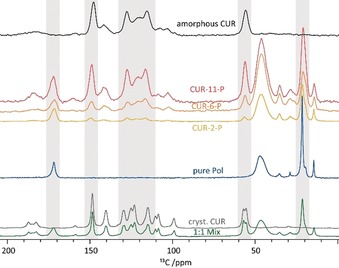
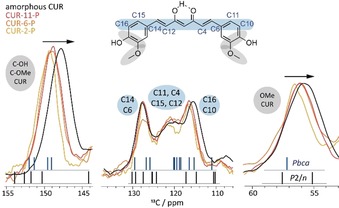
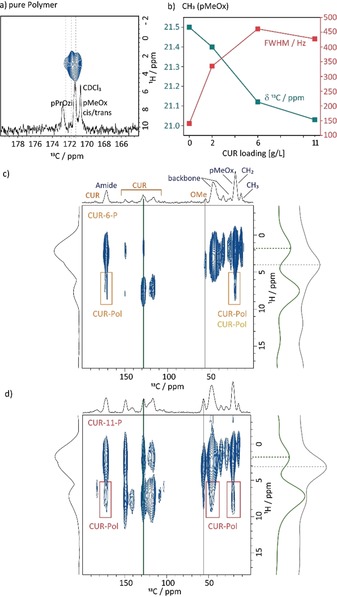
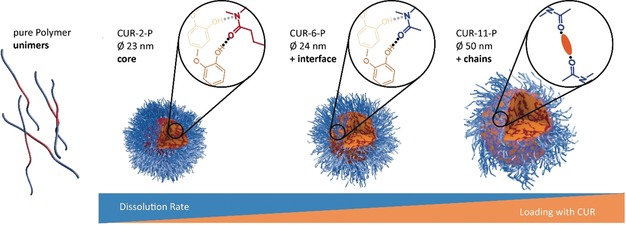
Detailed insight into the internal structure of drug‐loaded polymeric micelles is scarce, but important for developing optimized delivery systems. We observed that an increase in the curcumin loading of triblock copolymers based on poly(2‐oxazolines) and poly(2‐oxazines) results in poorer dissolution properties. Using solid‐state NMR spectroscopy and complementary tools we propose a loading‐dependent structural model on the molecular level that provides an explanation for these pronounced differences. Changes in the chemical shifts and cross‐peaks in 2D NMR experiments give evidence for the involvement of the hydrophobic polymer block in the curcumin coordination at low loadings, while at higher loadings an increase in the interaction with the hydrophilic polymer blocks is observed. The involvement of the hydrophilic compartment may be critical for ultrahigh‐loaded polymer micelles and can help to rationalize specific polymer modifications to improve the performance of similar drug delivery systems.
Overview
The claims and statistics of this paper haven’t been checked yet.
Free: it reads the open-access text and checks the first 5 claims that cite a source we can check. Create a free account to check every claim.
Integrity signals
Registry
Cites
Statistics
Figures


Verification
Claims the paper makes
The claims and statistics of this paper haven’t been checked yet.
Free: it reads the open-access text and checks the first 5 claims that cite a source we can check. Create a free account to check every claim.
Claims other papers make about this one
Each is checked against this paper’s own text: does it say what the citing paper says it does?
The source backs part of the claim, not all of it — or backs it for a different population, condition or comparison.
In the citing paper
“More recently, a variety of POx and poly(2-oxazine) (POzi) based polymers such as poly(2-n-butyl-2-oxazoline) (PBuOx) and poly(2-n-butyl-2-oxazine) (PBuOzi) have gained much attention due to their high loading for physically encapsulating drugs [45, 63, 65].”
From Polymeric micelles for the delivery of poorly soluble drugs: From nanoformulation to clinical approval. (2020) · cites this paper as [65]
Experimental — accuracy not yet measuredThe source backs part of the claim, not all of it — or backs it for a different population, condition or comparison.
In the citing paper
“Interestingly, ssNMR analysis of the changes in the chemical shifts and cross-peaks in 2D correlation revealed that the degree of curcumin loading in polymeric micelle affected the localization of the drug in the micelle.”
From Polymeric micelles for the delivery of poorly soluble drugs: From nanoformulation to clinical approval. (2020) · cites this paper as [65]
Experimental — accuracy not yet measuredThe cited source says what the claim attributes to it.
In the citing paper
“Recent studies on the experimental analysis of polymeric micelles have shown that the drug-polymer compatibility was achieved via more complex molecular mechanisms of interaction than simple hydrophobic interactions [63, 65, 115].”
From Polymeric micelles for the delivery of poorly soluble drugs: From nanoformulation to clinical approval. (2020) · cites this paper as [65]
The cited source says what the claim attributes to it.
In the citing paper
“In some cases, these interactions can involve not only the core-forming hydrophobic blocks but also the shell-forming hydrophilic blocks and selected drugs can be at least partially incorporated in the shell of the micelle [46, 65].”
From Polymeric micelles for the delivery of poorly soluble drugs: From nanoformulation to clinical approval. (2020) · cites this paper as [65]
The cited source says what the claim attributes to it.
In the citing paper
“At a low loading, the drug primarily accumulated in the core of the micelle where it interacted with the hydrophobic PPrOzi block via hydrogen bonding between phenolic OH group of curcumin and the amide group in the polymer backbone.”
From Polymeric micelles for the delivery of poorly soluble drugs: From nanoformulation to clinical approval. (2020) · cites this paper as [65]
1 more claim about this paper
Create a free account to see every claim other papers make about this one.
Self-check
Percentages, sums and reported differences re-computed from the paper’s own numbers.
The self-check needs the paper’s full text.
Citations
Cites
The dawning era of polymer therapeutics
Duncan, R. (2003) · Nature Reviews Drug Discovery · doi:10.1038/nrd1088 · Cited by 3,269
Biodegradable Long-Circulating Polymeric Nanospheres
Gref, R., Minamitake, Y., Peracchia, M. T., Trubetskoy, V., Torchilin, V., & Langer, R. (1994) · Science · doi:10.1126/science.8128245 · Cited by 2,920
Targeted polymeric therapeutic nanoparticles: design, development and clinical translation
Kamaly, N., Xiao, Z., Valencia, P. M., Radovic-Moreno, A. F., & Farokhzad, O. C. (2012) · Chemical Society Reviews · doi:10.1039/c2cs15344k · Cited by 1,730
The emerging nanomedicine landscape
Wagner, V., Dullaart, A., Bock, A.-K., & Zweck, A. (2006) · Nature Biotechnology · doi:10.1038/nbt1006-1211 · Cited by 1,630
Block copolymer micelles in nanomedicine applications
Cabral, H., Miyata, K., Osada, K., & Kataoka, K. (2018) · Chemical Reviews · doi:10.1021/acs.chemrev.8b00199 · Cited by 1,309
Progress of drug-loaded polymeric micelles into clinical studies
Cabral, H., & Kataoka, K. (2014) · Journal of Controlled Release · doi:10.1016/j.jconrel.2014.06.042 · Cited by 837
Fundamental aspects of solid dispersion technology for poorly soluble drugs
Huang, Y., & Dai, W.-G. (2014) · Acta Pharmaceutica Sinica B · doi:10.1016/j.apsb.2013.11.001 · Cited by 596
Chen, H., Kim, S., Li, L., Wang, S., Park, K., & Cheng, J.-X. (2008) · Proceedings of the National Academy of Sciences · doi:10.1073/pnas.0707046105 · Cited by 394
Sanphui, P., Goud, N. R., Khandavilli, U. B. R., Bhanoth, S., & Nangia, A. (2011) · Chemical Communications · doi:10.1039/c1cc10204d · Cited by 291
Doubly amphiphilic poly(2-oxazoline)s as high-capacity delivery systems for hydrophobic drugs
Luxenhofer, R., Schulz, A., Roques, C., Li, S., Bronich, T. K., Batrakova, E. V., Jordan, R., & Kabanov, A. V. (2010) · Biomaterials · doi:10.1016/j.biomaterials.2010.02.057 · Cited by 286
Self-citationGorske, B. C., Stringer, J. R., Bastian, B. L., Fowler, S. A., & Blackwell, H. E. (2009) · Journal of the American Chemical Society · doi:10.1021/ja907184g · Cited by 204
Lidocaine loaded biodegradable nanospheres
Polakovič, M., Görner, T., Gref, R., & Dellacherie, E. (1999) · Journal of Controlled Release · doi:10.1016/s0168-3659(99)00012-7 · Cited by 203
Analysis of Amorphous Solid Dispersions Using 2D Solid-State NMR and 1H T1 Relaxation Measurements
Pham, T. N., Watson, S. A., Edwards, A. J., Chavda, M., Clawson, J. S., Strohmeier, M., & Vogt, F. G. (2010) · Molecular Pharmaceutics · doi:10.1021/mp100205g · Cited by 188
Block copolymer micelles as long-circulating drug vehicles
Kwon, G. S., & Kataoka, K. (2012) · Advanced Drug Delivery Reviews · doi:10.1016/j.addr.2012.09.016 · Cited by 179
Kinetics and Equilibria of Cis/Trans Isomerization of Backbone Amide Bonds in Peptoids
Sui, Q., Borchardt, D., & Rabenstein, D. L. (2007) · Journal of the American Chemical Society · doi:10.1021/ja0740925 · Cited by 167
Polymer Infiltration into Metal–Organic Frameworks in Mixed-Matrix Membranes Detected in Situ by NMR
Duan, P., Moreton, J. C., Tavares, S. R., Semino, R., Maurin, G., Cohen, S. M., & Schmidt‐Rohr, K. (2019) · Journal of the American Chemical Society · doi:10.1021/jacs.9b02789 · Cited by 162
Polymeric Micelles for Multi-Drug Delivery in Cancer
Cho, H., Lai, T. C., Tomoda, K., & Kwon, G. S. (2015) · AAPS PharmSciTech · doi:10.1208/s12249-014-0251-3 · Cited by 159
Drug-induced morphology switch in drug delivery systems based on poly(2-oxazoline)s
Schulz, A., Jaksch, S., Schubel, R., Wegener, E., Di, Z., Han, Y., Meister, A., Kressler, J., Kabanov, A. V., Luxenhofer, R., et al. (2014) · ACS Nano · doi:10.1021/nn406388t · Cited by 142
Self-citationLefort, R., Gusseme, A. D., Willart, J., Danède, F., & Descamps, M. (2004) · International Journal of Pharmaceutics · doi:10.1016/j.ijpharm.2004.05.012 · Cited by 126
Lübtow, M. M., Hahn, L., Haider, M. S., & Luxenhofer, R. (2017) · Journal of the American Chemical Society · doi:10.1021/jacs.7b05376 · Cited by 120
Self-citationEditorial: Drug Delivery: Too Much Complexity, Not Enough Reproducibility?
Leroux, J. (2017) · Angewandte Chemie International Edition · doi:10.1002/anie.201709002 · Cited by 113
Lübtow, M. M., Nelke, L. C., Seifert, J., Kühnemundt, J., Sahay, G., Dandekar, G., Nietzer, S. L., & Luxenhofer, R. (2019) · Journal of Controlled Release · doi:10.1016/j.jconrel.2019.04.014 · Cited by 85
Self-citationCallari, M., De Souza, P. L., Rawal, A., & Stenzel, M. H. (2017) · Angewandte Chemie International Edition · doi:10.1002/anie.201701471 · Cited by 68
Tam, Y. T., Gao, J., & Kwon, G. S. (2016) · Journal of the American Chemical Society · doi:10.1021/jacs.6b03995 · Cited by 66
Brus, J., Urbanová, M., Šeděnková, I., & Brusova, H. (2011) · International Journal of Pharmaceutics · doi:10.1016/j.ijpharm.2011.02.030 · Cited by 63
Cao, C., Zhao, J., Chen, F., Lu, M., Khine, Y. Y., Macmillan, A., Garvey, C. J., & Stenzel, M. H. (2018) · Chemistry of Materials · doi:10.1021/acs.chemmater.8b01882 · Cited by 58
Kong, X., Brinkmann, A., Terskikh, V. V., Wasylishen, R. E., Bernard, G. M., Duan, Z., Wu, Q., & Wu, G. (2016) · The Journal of Physical Chemistry B · doi:10.1021/acs.jpcb.6b08091 · Cited by 51
Luxenhofer, R. (2015) · Nanomedicine · doi:10.2217/nnm.15.139 · Cited by 42
Self-citationCapturing Elusive Polymorphs of Curcumin: A Structural Characterization and Computational Study
Matlinska, M. A., Wasylishen, R. E., Bernard, G. M., Terskikh, V. V., Brinkmann, A., & Michaelis, V. K. (2018) · Crystal Growth & Design · doi:10.1021/acs.cgd.8b00859 · Cited by 40
Lübtow, M. M., Keßler, L., Appelt‐Menzel, A., Lorson, T., Gangloff, N., Kirsch, M., Dahms, S., & Luxenhofer, R. (2018) · Macromolecular Bioscience · doi:10.1002/mabi.201800155 · Cited by 40
Self-citationLübtow, M. M., Marciniak, H., Schmiedel, A., Roos, M., Lambert, C., & Luxenhofer, R. (2019) · Chemistry – A European Journal · doi:10.1002/chem.201902619 · Cited by 35
Self-citationNuclear magnetic resonance spectra of poly(N‐alkylamino acid)s
Sisido, M., Imanishi, Y., & Higashimura, T. (1972) · Biopolymers · doi:10.1002/bip.1972.360110207 · Cited by 30
Callari, M., de Souza, P. L., Rawal, A., & Stenzel, M. H. (2017) · Angewandte Chemie · doi:10.1002/ange.201701471 · Cited by 25
Procházková, E., Cao, C., Rawal, A., Dračínský, M., Bhattacharyya, S., Císařová, I., Hook, J. M., & Stenzel, M. H. (2019) · ACS Applied Materials & Interfaces · doi:10.1021/acsami.9b05514 · Cited by 22
Editorial: Drug Delivery: zu kompliziert und nicht reproduzierbar genug?
Leroux, J. (2017) · Angewandte Chemie · doi:10.1002/ange.201709002 · Cited by 7
Research works printed but not linked: 1
- Duan P., 2019, J. Am. Chem. Soc., 141
Cited by
Hwang, D., Ramsey, J. D., & Kabanov, A. V. (2020) · Advanced drug delivery reviews · doi:10.1016/j.addr.2020.09.009 · Cited by 699
“More recently, a variety of POx and poly(2-oxazine) (POzi) based polymers such as poly(2-n-butyl-2-oxazoline) (PBuOx) and poly(2-n-butyl-2-oxazine) (PBuOzi) have gained much attention due to their high loading for physically encapsulating drugs [45,63,65].”
BackgroundCurcumin: Biological Activities and Modern Pharmaceutical Forms
Urošević, M., Nikolić, L., Gajić, I., Nikolić, V., Dinić, A., & Miljković, V. (2022) · Antibiotics · doi:10.3390/antibiotics11020135 · Cited by 347
Lin, D., Xiao, L., Qin, W., Loy, D. A., Wu, Z., Chen, H., & Zhang, Q. (2022) · Carbohydrate Polymers · doi:10.1016/j.carbpol.2021.119080 · Cited by 172
Zahoranová, A., & Luxenhofer, R. (2021) · Advanced Healthcare Materials · doi:10.1002/adhm.202001382 · Cited by 119
Self-citationHaider, M. S., Lübtow, M. M., Endres, S., Forster, S., Flegler, V. J., Böttcher, B., Aseyev, V., Pöppler, A.-C., & Luxenhofer, R. (2020) · ACS Applied Materials & Interfaces · doi:10.1021/acsami.9b22495 · Cited by 100
Self-citation
Metadata
- Authors
- Pöppler, A., Lübtow, M. M., Schlauersbach, J., Wiest, J., Meinel, L., & Luxenhofer, R.
- Affiliations
- University of Würzburg (DE)
- Corresponding author
- Pöppler, Ann‐Christin
- Venue
- Angewandte Chemie International Edition
- Publisher
- Wiley
- Published
- 2019-11-04
- Volume
- 58
- Issue
- 51
- Pages
- 18540-18546
- ISSN
- 1433-7851 (ISSN-L)
- 1521-3773
- PMC
- PMC6916580
- OpenAlex
- W2973422107
- Cited by
- 72
- References
- 36
- Citations by year
- 2026: 4 · 2025: 7 · 2024: 6 · 2023: 19 · 2022: 7 · 2021: 9 · 2020: 17 · 2019: 3
- FWCI
- 2.62
- Type
- journal article
- Language
- en
- Open access
- hybrid
- doi.org
- Licence
- Locations
- Angewandte Chemie International Edition (publishedVersion, cc-by-nc-nd)
- ChemRxiv (acceptedVersion, cc-by-nc-nd)
- Europe PMC (PubMed Central) (publishedVersion, cc-by-nc-nd)
- PubMed Central (publishedVersion, cc-by-nc-nd)
- PubMed (publishedVersion)
- Figshare (submittedVersion, cc-by-nc-nd)
- Online Publication Service of Würzburg University (Würzburg University) (submittedVersion, cc-by-nc-nd)
- Funders
- Verband der Chemischen Industrie
- Evonik Stiftung
- Topics
- Physical Sciences › Materials Science › Biomaterials › Nanoparticle-Based Drug Delivery
- Physical Sciences › Chemistry › Physical and Theoretical Chemistry › Surfactants and Colloidal Systems
- Physical Sciences › Chemistry › Organic Chemistry › Advanced Polymer Synthesis and Characterization
- Keywords
- polymeric micelles, curcumin, drug loading, triblock copolymers, poly(2-oxazoline), drug encapsulation, drug dissolution, drug delivery systems, structural model
About these checks
Registry, retraction, Cites and statistics results are computed, not judged, with one exception: a printed reference that no index lists is read once by a model before it counts as a citation error. Claims are extracted by a model and kept only when their quote appears verbatim in the text; each cited source is then checked, with a model’s help, for whether it says what the claim relies on. Those verdicts can be wrong — read the claim’s quote and the cited source before relying on one.
Statistics and arithmetic are recomputed, not judged.
Confidence bands are shown only for fields calibrated on our annotated test set. None is calibrated yet, so no band is shown.
What counts as a claim ›How we measure confidence ›How we check this ›
Are you an author, or do you see a problem with this page? Request a review
Data sources
Bibliographic data: Semantic Scholar, OpenAlex, Crossref.
Contains information from the Semantic Scholar Academic Graph Datasets, made available under the ODC Attribution License (ODC-BY 1.0).
Semantic Scholar’s data is described in: Kinney, R., et al. (2023). The Semantic Scholar Open Data Platform. arXiv:2301.10140.
