

The DOI matches its Crossref record; 75 of the 76 references it cites were found in a registry or an index.
A Near‐Infrared‐II Emissive Chromium(III) Complex
Open accessAbstract
The combination of π‐donating amido with π‐accepting pyridine coordination units in a tridentate chelate ligand causes a strong nephelauxetic effect in a homoleptic Cr III complex, which shifts its luminescence to the NIR‐II spectral range. Previously explored Cr III polypyridine complexes typically emit between 727 and 778 nm (in the red to NIR‐I spectral region), and ligand design strategies have so far concentrated on optimizing the ligand field strength. The present work takes a fundamentally different approach and focusses on increasing metal–ligand bond covalence to shift the ruby‐like 2 E emission of Cr III to 1067 nm at 77 K.
Overview
The claims and statistics of this paper haven’t been checked yet.
Run the check — free, no account needed. It reads the open-access text and checks the sources it cites.
Integrity signals
Registry
Cites
Statistics
Figures
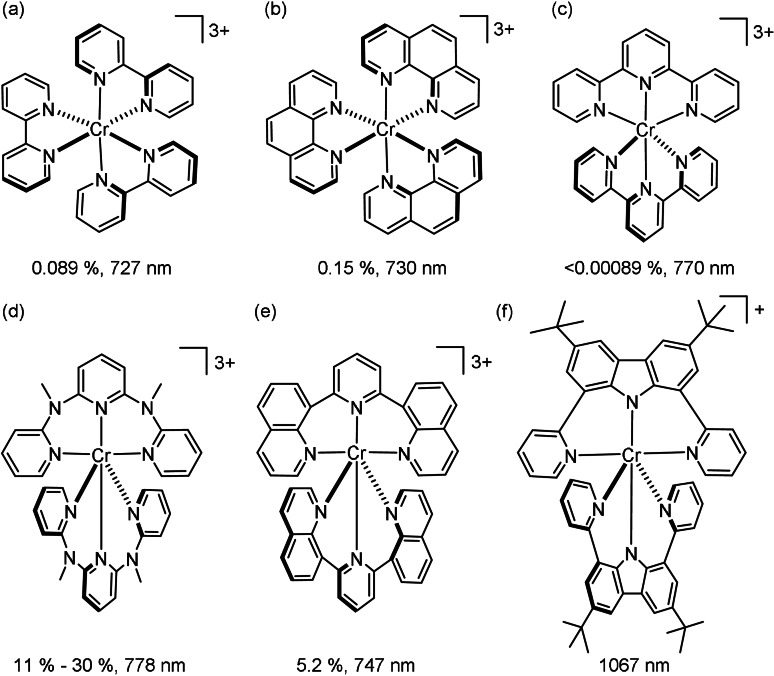
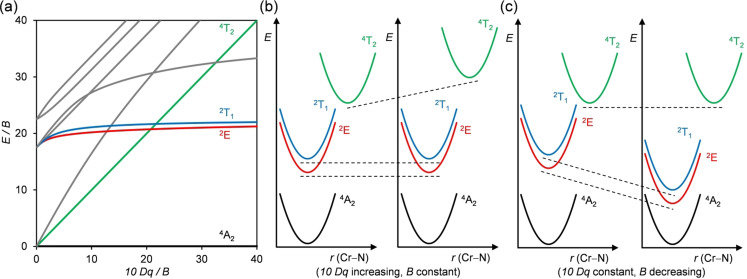
.](/paper-figures/fd7d2d452a5d41a3a8f1bf5acece755e/a-nearinfraredii-emissive-chromium-iii-complex-figure-3.jpg)
⋅2.5(C2H4Cl2) (H atoms, the counter ion and solvent molecules are omitted for clarity, 50 % probability ellipsoids). Selected bond angles (°) and bond distances (Å): N2‐Cr1‐N5, 173.69(8); N1‐Cr1‐N3, 173.66(7); N4‐Cr1‐N6, 173.16(7); Cr1‐N2, 1.969(2); Cr1‐N5, 1.962(3); Cr1‐N1, 2.133(2); Cr1‐N3, 2.115(3); Cr1‐N4, 2.109(3); Cr1‐N6, 2.133(2). CCDC 2082071 ([Cr(dpc)2](PF6)⋅2.5(C2H4Cl2)) contains the supplementary crystallographic data for this paper. These data can be obtained free of charge from the Cambridge Crystallographic Data Centre.](/paper-figures/64c63769876e45ac931f3aa1880b0575/a-nearinfraredii-emissive-chromium-iii-complex-figure-3.jpg)
 in acetonitrile with 0.1 M ( n Bu4N)(PF6) as supporting electrolyte, recorded at a scan rate of 100 mV s−1. (The Fc+/0 potential corresponds to 0.63 V vs. NHE). [34] (b) UV/Vis absorption spectrum of [Cr(dpc)2](PF6) in acetonitrile at 20 °C (black trace). The red trace shows the long‐wavelength part of this spectrum on a magnified ϵ‐scale (right y‐axis, recorded on a more concentrated solution, see inset). The vertical black and red bars mark the energies of DFT‐calculated vertical transitions, the heights of these bars reflect relative oscillator strengths. The heights of the vertical red bars were multiplied by a factor of 10 relative to the vertical black bars. (c) Luminescence spectrum of [Cr(dpc)2](PF6) in acetonitrile at 77 K, obtained after excitation at 450 nm.](/paper-figures/353c2a29ee144fa0b174d6640fe5eeac/a-nearinfraredii-emissive-chromium-iii-complex-figure-4.jpg)
Verification
Claims the paper makes
The claims and statistics of this paper haven’t been checked yet.
Run the check — free, no account needed. It reads the open-access text and checks the sources it cites.
Claims other papers make about this one
Each is checked against this paper’s own text: does it say what the citing paper says it does?
The source backs part of the claim, not all of it — or backs it for a different population, condition or comparison.
In the citing paper
“Nevertheless, their biomedical application is hindered by a reliance on high-energy, short-wavelength excitation, which leads to phototoxicity and poor tissue penetration.”
From Organic small-molecule NIR-II fluorophores for tumor phototheranostics (2026) · cites this paper as [194]
Experimental — accuracy not yet measuredThe source backs part of the claim, not all of it — or backs it for a different population, condition or comparison.
In the citing paper
“Metal complexes are promising photofunctional materials due to their superior photostability, large Stokes shifts, and high emission quantum yields compared to organic chromophores”
From Organic small-molecule NIR-II fluorophores for tumor phototheranostics (2026) · cites this paper as [194]
Experimental — accuracy not yet measuredThe source backs part of the claim, not all of it — or backs it for a different population, condition or comparison.
In the citing paper
“By employing tridentate ligands with a central π-donor amine and σ-donor/π-acceptor pyridines, they created the homoleptic Cr(III) complex Cr(dpc)2.”
From Organic small-molecule NIR-II fluorophores for tumor phototheranostics (2026) · cites this paper as [194]
Experimental — accuracy not yet measuredThe cited source says what the claim attributes to it.
In the citing paper
“Traditional Cr(III) polypyridyl complexes typically emit in the 727–778 nm range, limited to the red/NIR-I region.”
From Organic small-molecule NIR-II fluorophores for tumor phototheranostics (2026) · cites this paper as [194]
The cited source says what the claim attributes to it.
In the citing paper
“Wenger et al. developed a strategy centered on increasing metal-ligand bond covalence rather than merely optimizing the ligand field strength194.”
From Organic small-molecule NIR-II fluorophores for tumor phototheranostics (2026) · cites this paper as [194]
The cited source says what the claim attributes to it.
In the citing paper
“This complex exhibited a dominant emission peak at 1067 nm, extending into the NIR-II region, a significant red-shift from conventional Cr(III) polypyridyl complexes.”
From Organic small-molecule NIR-II fluorophores for tumor phototheranostics (2026) · cites this paper as [194]
Self-check
Percentages, sums and reported differences re-computed from the paper’s own numbers.
The self-check needs the paper’s full text.
Citations
Cites
Lanthanide luminescence for functional materials and bio-sciences
Eliseeva, S. V., & Bünzli, J. G. (2009) · Chemical Society Reviews · doi:10.1039/b905604c · Cited by 3,542
Specification of Molecular Chirality
Cahn, R. S., Ingold, C. K., & Prelog, V. (1966) · Angewandte Chemie International Edition in English · doi:10.1002/anie.196603851 · Cited by 1,884
On the Absorption Spectra of Complex Ions II
Tanabe, Y., & Sugano, S. (1954) · Journal of the Physical Society of Japan · doi:10.1143/jpsj.9.766 · Cited by 1,807
Pavlishchuk, V. V., & Addison, A. W. (2000) · Inorganica Chimica Acta · doi:10.1016/s0020-1693(99)00407-7 · Cited by 1,531
Phosphorescent heavy-metal complexes for bioimaging
Zhao, Q., Huang, C., & Li, F. (2011) · Chemical Society Reviews · doi:10.1039/c0cs00114g · Cited by 1,262
Near-infrared phosphorescence: materials and applications
Xiang, H., Cheng, J., Ma, X., Zhou, X., & Chruma, J. J. (2013) · Chemical Society Reviews · doi:10.1039/c3cs60029g · Cited by 721
Spezifikation der molekularen Chiralität
Cahn, R. S., Ingold, C. K., & Prelog, V. (1966) · Angewandte Chemie · doi:10.1002/ange.19660780803 · Cited by 719
Eliminating nonradiative decay in Cu(I) emitters: >99% quantum efficiency and microsecond lifetime
Hamze, R., Peltier, J. L., Ravinson, D. S. M., Jung, M. C., y Cárdenas, J. R. M., Haiges, R., Soleilhavoup, M., Jazzar, R. F. R., Djurovich, P. I., Bertrand, G., et al. (2019) · Science · doi:10.1126/science.aav2865 · Cited by 708
Near-infrared organic light-emitting diodes with very high external quantum efficiency and radiance
Ly, K. T., Chen-Cheng, R.-W., Lin, H., Shiau, Y.-J., Liu, S., Chou, P., Tsao, C.-S., Huang, Y., & Chi, Y. (2016) · Nature Photonics · doi:10.1038/nphoton.2016.230 · Cited by 679
Photoactive Complexes with Earth-Abundant Metals
Wenger, O. S. (2018) · Journal of the American Chemical Society · doi:10.1021/jacs.8b08822 · Cited by 595
Self-citation
Cited by
Sorted by citations
Luminescent First-Row Transition Metal Complexes
Wegeberg, C., & Wenger, O. S. (2021) · JACS Au · doi:10.1021/jacsau.1c00353 · Cited by 345
Self-citationShen, H., Sun, F., Zhu, X., Zhang, J., Ou, X., Zhang, J., Xu, C., Sung, H. H. Y., Williams, I. D., Chen, S., et al. (2022) · Journal of the American Chemical Society · doi:10.1021/jacs.2c07443 · Cited by 292
Lee, L. C., & Lo, K. K. (2022) · Journal of the American Chemical Society · doi:10.1021/jacs.2c03437 · Cited by 284
Sinha, N., & Wenger, O. S. (2023) · Journal of the American Chemical Society · doi:10.1021/jacs.2c13432 · Cited by 211
Self-citationLi, C., Pang, Y., Xu, Y., Lu, M., Tu, L., Li, Q., Sharma, A., Guo, Z., Li, X., & Sun, Y. (2023) · Chemical Society Reviews · doi:10.1039/d3cs00227f · Cited by 157
Kitzmann, W. R., Moll, J., & Heinze, K. (2022) · Photochemical & Photobiological Sciences · doi:10.1007/s43630-022-00186-3 · Cited by 121
Sinha, N., Pfund, B., Wegeberg, C., Prescimone, A., & Wenger, O. S. (2022) · Journal of the American Chemical Society · doi:10.1021/jacs.2c02592 · Cited by 116
Self-citationCharge‐Transfer and Spin‐Flip States: Thriving as Complements
Kitzmann, W. R., & Heinze, K. (2022) · Angewandte Chemie International Edition · doi:10.1002/anie.202213207 · Cited by 115
Bürgin, T. H., Glaser, F., & Wenger, O. S. (2022) · Journal of the American Chemical Society · doi:10.1021/jacs.2c04465 · Cited by 103
Self-citationWang, C., Reichenauer, F., Kitzmann, W. R., Kerzig, C., Heinze, K., & Resch‐Genger, U. (2022) · Angewandte Chemie International Edition · doi:10.1002/anie.202202238 · Cited by 93
Morselli, G., Reber, C., & Wenger, O. S. (2025) · Journal of the American Chemical Society · doi:10.1021/jacs.5c02096 · Cited by 89
Self-citationRecent progress in metal-based molecular probes for optical bioimaging and biosensing
Ning, Y., Jin, G., Wang, M., Gao, S. W., & Zhang, J. (2021) · Current Opinion in Chemical Biology · doi:10.1016/j.cbpa.2021.102097 · Cited by 80
Ogawa, T., Sinha, N., Pfund, B., Prescimone, A., & Wenger, O. S. (2022) · Journal of the American Chemical Society · doi:10.1021/jacs.2c08838 · Cited by 80
Self-citationWegeberg, C., Häußinger, D., & Wenger, O. S. (2021) · Journal of the American Chemical Society · doi:10.1021/jacs.1c07345 · Cited by 77
Self-citationSinha, N., Yaltseva, P., & Wenger, O. S. (2023) · Angewandte Chemie International Edition · doi:10.1002/anie.202303864 · Cited by 75
Self-citationRecent Advances in Photoactive First‐Row Transition Metal Complexes for Organic Synthesis
Huang, T., Du, P., & Lin, Y. (2025) · Chinese Journal of Chemistry · doi:10.1002/cjoc.70135 · Cited by 57
LNL-Carbazole Pincer Ligand: More than the Sum of Its Parts
Kleinhans, G., Karhu, A. J., Boddaert, H., Tanweer, S., WUNDERLIN, D. A., & Bezuidenhout, D. I. (2023) · Chemical Reviews · doi:10.1021/acs.chemrev.3c00202 · Cited by 51
Manganese Complexes with Consecutive Mn(IV) → Mn(III) Excitation for Versatile Photoredox Catalysis
Huang, T., Du, P., Cheng, X., & Lin, Y. (2024) · Journal of the American Chemical Society · doi:10.1021/jacs.4c07084 · Cited by 50
Could the Quantum Internet Be Comprised of Molecular Spins with Tunable Optical Interfaces?
Laorenza, D. W., & Freedman, D. E. (2022) · Journal of the American Chemical Society · doi:10.1021/jacs.2c07775 · Cited by 50
Stable Molybdenum(0) Carbonyl Complex for Upconversion and Photoredox Catalysis
Kitzmann, W. R., Bertrams, M., Boden, P., Fischer, A. C., Klauer, R., Sutter, J., Naumann, R., Förster, C., Niedner‐Schatteburg, G., Bings, N. H., et al. (2023) · Journal of the American Chemical Society · doi:10.1021/jacs.3c03832 · Cited by 47
Molecular ruby: exploring the excited state landscape
Kitzmann, W. R., Ramanan, C., Naumann, R., & Heinze, K. (2022) · Dalton Transactions · doi:10.1039/d2dt00569g · Cited by 46
Luminescence and Excited-State Reactivity in a Heteroleptic Tricyanido Fe(III) Complex
Ye, Y., Garrido‐Barros, P., Wellauer, J., Cruz, C. M., Lescouëzec, R., Wenger, O. S., Herrera, J. M., & Jiménez, J. (2023) · Journal of the American Chemical Society · doi:10.1021/jacs.3c11517 · Cited by 43
Self-citationIron(III) Carbene Complexes with Tunable Excited State Energies for Photoredox and Upconversion
Wellauer, J., Ziereisen, F., Sinha, N., Prescimone, A., Velić, A., Meyer, F., & Wenger, O. S. (2024) · Journal of the American Chemical Society · doi:10.1021/jacs.4c00605 · Cited by 41
Self-citationFeng, R., Li, G., Ko, C.-N., Zhang, Z., Wan, J., & Zhang, Q. (2022) · Small Structures · doi:10.1002/sstr.202200131 · Cited by 39
Nickel(II) Analogues of Phosphorescent Platinum(II) Complexes with Picosecond Excited‐State Decay
Ogawa, T., & Wenger, O. S. (2023) · Angewandte Chemie International Edition · doi:10.1002/anie.202312851 · Cited by 38
Self-citationThe overlooked NIR luminescence of Cr(ppy) 3
Stein, L., Boden, P., Naumann, R., Förster, C., Niedner‐Schatteburg, G., & Heinze, K. (2022) · Chemical Communications · doi:10.1039/d2cc00680d · Cited by 35
The energy gap law for NIR-phosphorescent Cr( iii ) complexes
Cheng, Y., Yang, Q., He, J., Zou, W., Liao, K., Chang, X., Zou, C., & Lu, W. (2022) · Dalton Transactions · doi:10.1039/d2dt02872g · Cited by 32
McNamara, L. E., Boyn, J.-N., Melnychuk, C., Anferov, S. W., Mazziotti, D. A., Schaller, R. D., & Anderson, J. S. (2022) · Journal of the American Chemical Society · doi:10.1021/jacs.2c04976 · Cited by 33
Jones, R. W., Auty, A. J., Wu, G., Persson, P., Appleby, M. V., Chekulaev, D., Rice, C. R., Weinstein, J. A., Elliott, P. I. P., & Scattergood, P. A. (2023) · Journal of the American Chemical Society · doi:10.1021/jacs.3c01543 · Cited by 30
Matrix Effects on Photoluminescence and Oxygen Sensitivity of a Molecular Ruby
Wang, C., Kitzmann, W. R., Weigert, F., Förster, C., Wang, X., Heinze, K., & Resch‐Genger, U. (2022) · ChemPhotoChem · doi:10.1002/cptc.202100296 · Cited by 28
Bulky ligands protect molecular ruby from oxygen quenching
Stein, L., Wang, C., Förster, C., Resch‐Genger, U., & Heinze, K. (2022) · Dalton Transactions · doi:10.1039/d2dt02950b · Cited by 27
Recent progress on photoactive nonprecious transition-metal complexes
Gong, Z., Zhang, H., Yan, C., Liu, J., Ai, Y., Li, Y., Feng, Z., Zhang, Q., Gong, S., Chen, Y., et al. (2024) · Science China Chemistry · doi:10.1007/s11426-024-2345-0 · Cited by 31
Poncet, M., Cuevas-Contreras, L., Ye, Y., Guénée, L., Cruz, C. M., Piguet, C., & Jiménez, J. (2025) · Journal of the American Chemical Society · doi:10.1021/jacs.5c06196 · Cited by 25
Self-citationMorselli, G., Eggenweiler, T. H., Villa, M., Prescimone, A., & Wenger, O. S. (2025) · Journal of the American Chemical Society · doi:10.1021/jacs.5c08541 · Cited by 24
Self-citationEnter MnIV–NHC: A Dark Photooxidant with a Long-Lived Charge-Transfer Excited State
Kaul, N., Asempa, E., Valdez-Moreira, J. A., Smith, J. M., Jakubı́ková, E., & Hammarström, L. (2024) · Journal of the American Chemical Society · doi:10.1021/jacs.4c08588 · Cited by 22
Shi, B., Zhang, L., Yan, K., Ming, J., Chen, Z., Chen, Y., He, H., Zhang, H., Wang, L., Wang, S., et al. (2024) · Angewandte Chemie International Edition · doi:10.1002/anie.202410118 · Cited by 21
Bridge editing of spin-flip emitters gives insight into excited state energies and dynamics
Reichenauer, F., Naumann, R., Förster, C., Kitzmann, W. R., Reponen, A. M., Feldmann, S., & Heinze, K. (2024) · Chemical Science · doi:10.1039/d4sc05860g · Cited by 20
“1 p -Electron donating amido (carbazolato or iso-indolinato) donors 46,50 and cyclometalating ligands 45,47 shi the ruby-like luminescence above 900 nm (Scheme 1).”
Wei, W., Wang, J., Kang, X., Li, H., He, Q., Chang, G., & Bu, W. (2023) · Chemical Science · doi:10.1039/d3sc03508e · Cited by 20
Luminescent Metal Complexes for Bioassays in the Near-Infrared (NIR) Region
Jin, G., Guo, L.-J., Zhang, J., Gao, S. W., & Zhang, J. (2022) · Topics in Current Chemistry · doi:10.1007/s41061-022-00386-6 · Cited by 19
“devoted to increasing the covalence of metal–ligand bond by designing a new [Cr(dpc)2]+ complex (39) (dpc = 3,6-di-tert-butyl-1,8-di(pyridine2-yl)-carbazolato) and shifted the emission of Cr(III) from typically 727–778 nm to 1067 nm in acetonitrile at 77 K [75].”
BackgroundKönig, A., Naumann, R., Förster, C., Klett, J., & Heinze, K. (2025) · Journal of the American Chemical Society · doi:10.1021/jacs.5c04471 · Cited by 20
Photon upconversion sensitized by earth-abundant transition metal complexes
Jin, P., & Wang, C. (2025) · Physical Chemistry Chemical Physics · doi:10.1039/d5cp00333d · Cited by 18
Chong, J., Besnard, C., Cruz, C. M., Piguet, C., & Jiménez, J. (2022) · Dalton Transactions · doi:10.1039/d2dt00126h · Cited by 18
Self-citationCircularly polarized near-infrared phosphorescence of chiral chromium( iii ) complexes
Cheng, Y., He, J., Zou, W., Chang, X., Yang, Q., & Lu, W. (2023) · Chemical Communications · doi:10.1039/d2cc06548g · Cited by 18
Deep‐Red Luminescent Molybdenum(0) Complexes with Bi‐ and Tridentate Isocyanide Chelate Ligands
Herr, P., Schwab, A., Kupfer, S., & Wenger, O. S. (2022) · ChemPhotoChem · doi:10.1002/cptc.202200052 · Cited by 17
Self-citationOrganic small-molecule NIR-II fluorophores for tumor phototheranostics
Xiang, D., Wang, Z., Zheng, H., Tang, Y., & Li, Q. (2026) · Light: Science & Applications · doi:10.1038/s41377-026-02212-w · Cited by 22
“To overcome this, Wenger et al. developed a strategy centered on increasing metal-ligand bond covalence rather than merely optimizing the ligand fi eld strength 194 .”
Yaltseva, P., Maisuradze, T., Prescimone, A., Kupfer, S., & Wenger, O. S. (2025) · Journal of the American Chemical Society · doi:10.1021/jacs.5c09616 · Cited by 16
Self-citationJiménez, J., Míguez‐Lago, S., Poncet, M., Ye, Y., Ruiz, C. L., Cruz, C. M., Campaña, A. G., Colacio, E., Piguet, C., & Herrera, J. M. (2023) · Journal of Materials Chemistry C · doi:10.1039/d2tc05344f · Cited by 16
Self-citationThe photophysics and applications of molecular rubies
Förster, C., & Heinze, K. (2024) · Advances in inorganic chemistry · doi:10.1016/bs.adioch.2024.01.002 · Cited by 16
Ossinger, S., Prescimone, A., Häußinger, D., & Wenger, O. S. (2022) · Inorganic Chemistry · doi:10.1021/acs.inorgchem.2c01438 · Cited by 15
Self-citationLiang, S., Wang, X., Wei, C., Xie, L., Song, Z., & Dang, X. (2024) · Journal of Bioresources and Bioproducts · doi:10.1016/j.jobab.2024.11.003 · Cited by 15
Factorizing the Nephelauxetic Effect in Heteroleptic Molecular Rubies
Reichenauer, F., Zorn, D., Naumann, R., Förster, C., & Heinze, K. (2024) · Inorganic Chemistry · doi:10.1021/acs.inorgchem.4c04167 · Cited by 15
Sittel, S., Neuner, J., Grenz, J. M., Förster, C., Naumann, R., & Heinze, K. (2025) · Advanced Synthesis & Catalysis · doi:10.1002/adsc.202500075 · Cited by 15
Herbert, D. E. (2023) · Canadian Journal of Chemistry · doi:10.1139/cjc-2022-0314 · Cited by 14
A Near-Infrared Luminescent Cr(III) N -Heterocyclic Carbene Complex
Jones, R. W., Cowin, R. A., Ivalo, I. I., Chekulaev, D., Roseveare, T. M., Rice, C. R., Weinstein, J. A., Elliott, P. I. P., & Scattergood, P. A. (2024) · Inorganic Chemistry · doi:10.1021/acs.inorgchem.4c01270 · Cited by 14
Photodynamics of the Molecular Ruby [Cr(ddpd)2]3+
Zobel, J. P., Radatz, H., & González, L. (2023) · Molecules · doi:10.3390/molecules28041668 · Cited by 13
“exhibited phosphorescence only at 77 K, while emission was quenched at room temperature [22].”
BackgroundEffective Near-Infrared Triplet Emitter Based on Hetero-Metal–Metal Interaction
Zhou, N., Zhang, Y., Wang, X., Yang, P., Lu, W., & Wan, Q. (2025) · Journal of the American Chemical Society · doi:10.1021/jacs.5c04585 · Cited by 14
Joyce, J. P., Portillo, R. I., Rappé, A. K., & Shores, M. P. (2022) · Inorganic Chemistry · doi:10.1021/acs.inorgchem.1c03418 · Cited by 13
Ye, Y., Poncet, M., Yaltseva, P., Salcedo‐Abraira, P., Rodríguez‐Diéguez, A., Martín, J. H., Cuevas-Contreras, L., Cruz, C. M., Doistau, B., Piguet, C., et al. (2025) · Chemical Science · doi:10.1039/d4sc08021a · Cited by 12
Self-citationKitzmann, W. R., Hunger, D., Reponen, A. M., Förster, C., Schoch, R., Bauer, M., Feldmann, S., van Slageren, J., & Heinze, K. (2023) · Inorganic Chemistry · doi:10.1021/acs.inorgchem.3c02186 · Cited by 12
Tuning the circularly polarized luminescence in homoleptic and heteroleptic chiral CrIII complexes
Poncet, M., Besnard, C., Guénée, L., Jiménez, J., & Piguet, C. (2024) · Frontiers in Chemistry · doi:10.3389/fchem.2024.1472943 · Cited by 11
“The obtained values in oxygen-free solutions are 12.4%, making complexes 1 and 2 in the same range as the previously reported record-holding deuterium-free Cr III complexes (Jimenez et al., 2019; Jimenez et al., 2021).”
BackgroundMethodResultInfluentialSelf-citationWang, C., Reichenauer, F., Kitzmann, W. R., Kerzig, C., Heinze, K., & Resch‐Genger, U. (2022) · Angewandte Chemie · doi:10.1002/ange.202202238 · Cited by 11
Ferromagnetically Coupled Chromium(III) Dimer Shows Luminescence and Sensitizes Photon Upconversion
Trippmacher, S., Demeshko, S., Prescimone, A., Meyer, F., Wenger, O. S., & Wang, C. (2024) · Chemistry - A European Journal · doi:10.1002/chem.202400856 · Cited by 10
Self-citationPadhiar, M. A., Zhang, S., Wang, M., Khan, N. Z., Iqbal, S., Ji, Y., Muhammad, N., Khan, S. A., & Pan, S. (2023) · Nanomaterials · doi:10.3390/nano13192703 · Cited by 10
Luminescent Cyclometalated Chromium(III) Complexes
Stein, L., Förster, C., & Heinze, K. (2024) · Organometallics · doi:10.1021/acs.organomet.4c00075 · Cited by 10
Ortiz, R. J., Shepit, M., van Lierop, J., Krzystek, J., Telser, J., & Herbert, D. E. (2023) · European Journal of Inorganic Chemistry · doi:10.1002/ejic.202300446 · Cited by 9
Lim, H., Yang, X., Larsen, C. B., Ledbetter, K., Zorić, M. R., Raj, S. L., Kumar, G., Powers‐Riggs, N. E., Hoffmann, M. C., Chollet, M., et al. (2025) · Journal of the American Chemical Society · doi:10.1021/jacs.4c16212 · Cited by 7
Origin of the Unusual Narrowband Near-Infrared Emission from Cr 3+ -Doped Oxides
Xiao, Y., Xiao, W., Zheng, T., Zhao, H., Du, P., Zhang, R., Lou, C., Tang, M., Chen, M.-X., Yang, W., et al. (2026) · Journal of the American Chemical Society · doi:10.1021/jacs.6c00117 · Cited by 8
Shi, B., Zhang, L., Yan, K., Ming, J., Chen, Z., Chen, Y., He, H., Zhang, H., Wang, L., Wang, S., et al. (2024) · Angewandte Chemie · doi:10.1002/ange.202410118 · Cited by 7
Decoupling Redox Potentials and Excited State Energies in Substituted Chromium(III) Chromophores
Sittel, S., Zorn, D., König, A., Grenz, J. M., Förster, C., Naumann, R., & Heinze, K. (2025) · Chemistry - A European Journal · doi:10.1002/chem.202502668 · Cited by 6
Benchohra, A., Chong, J., Cruz, C. M., Besnard, C., Guénée, L., Rosspeintner, A., & Piguet, C. (2024) · Inorganic Chemistry · doi:10.1021/acs.inorgchem.3c03422 · Cited by 6
Self-citationThermally Activated and Nonactivated Excited State Decay of [Cr(dgpy)2]3+
Sittel, S., Naumann, R., Förster, C., Huber, M. E., Meyer, J., & Heinze, K. (2025) · Inorganic Chemistry · doi:10.1021/acs.inorgchem.5c03668 · Cited by 5
Excited State Dynamics of the Carbazolato‐Carbene Chromium(III) Complex [Cr(bimca) 2 ] +
Sander, J., Gauder, F., Schicktanz, S. J., Maulbetsch, T., Kalmbach, J., Zorn, D., Naumann, R., Förster, C., Kunz, D., & Heinze, K. (2025) · Zeitschrift für anorganische und allgemeine Chemie · doi:10.1002/zaac.202500125 · Cited by 5
Doistau, B., Jiménez, J., Daku, L. M. L., & Piguet, C. (2022) · Inorganic Chemistry · doi:10.1021/acs.inorgchem.2c01940 · Cited by 5
Self-citationSinha, N., Yaltseva, P., & Wenger, O. S. (2023) · Angewandte Chemie · doi:10.1002/ange.202303864 · Cited by 5
Self-citationCharge‐Transfer und Spin‐Flip‐Zustände als sich ergänzende Gegensätze
Kitzmann, W. R., & Heinze, K. (2022) · Angewandte Chemie · doi:10.1002/ange.202213207 · Cited by 5
Ancillary Ligand-Promoted Charge Transfer in Bis-indole Pyridine Ligand-Based Nickel Complexes
Sarkar, A., Pal, A. K., Kumar, A., Dasgupta, S., Kandoth, N., Datta, A., Datta, A., & Gupta, S. S. (2024) · Inorganic Chemistry · doi:10.1021/acs.inorgchem.4c03419 · Cited by 4
Mochimaru, T., Ogawa, T., Honda, T., Segawa, K., Wakabayashi, T., Harakawa, Y., Yoshida, T., Miyata, K., & Onda, K. (2026) · Journal of the American Chemical Society · doi:10.1021/jacs.6c08685 · Cited by 3
Law, K.-C., Tang, Z., Wu, L., Wan, Q., To, W., Chang, X., Low, K., Liu, Y., & Che, C. (2022) · Organometallics · doi:10.1021/acs.organomet.1c00677 · Cited by 3
Deep-red to near-infrared emission of binuclear platinum( ii ) complexes by breaking hydrogen bonds
Xie, M., Yu, M., Liu, C., Zhao, Y., Li, Z., Li, S., Jiang, F., Chen, L., & Hong, M. (2022) · Journal of Materials Chemistry C · doi:10.1039/d2tc02750j · Cited by 3
Harnessing the Spin-Flip Radiative Lifetimes of Optically Addressable Molecular Qubits
Sorbelli, D., & Galli, G. (2026) · JACS Au · doi:10.1021/jacsau.6c00464 · Cited by 2
Deciphering the excited-state landscape of Cr( iii ) tris(diimines) using [Cr(phen) 3 ] 3+
Barth, A. T., Farkhutdinova, D., Faulkner, A. P., Dzaye, I. Y., Wheeler, J. P., González, L., & Castellano, F. N. (2026) · Inorganic Chemistry Frontiers · doi:10.1039/d6qi00728g · Cited by 2
May, A. M., Hearne, W. A., Chen, C., Danilov, E. O., & Castellano, F. N. (2026) · Inorganic Chemistry · doi:10.1021/acs.inorgchem.6c01290 · Cited by 2
Redox Chemistry and Photophysics of the [V(dgpy) 2 ] 3+/2+ Redox Pair
König, A., Goetz, M., NAUMANN, R. J., Förster, C., Klett, J., Huber, M. E., Weber, P., Riehn, C., Meyer, J., & Heinze, K. (2026) · Inorganic Chemistry · doi:10.1021/acs.inorgchem.6c00836 · Cited by 2
Visible Light Harvesting Cr(III) Photocatalysts
Wheeler, J. P., Barth, A. T., Thomas, J. E., May, A. M., Kromer, S., Danilov, E. O., & Castellano, F. N. (2026) · Journal of the American Chemical Society · doi:10.1021/jacs.6c11305 · Cited by 2
From ruby to molecular ruby: Excited state understanding and design
Heinze, K., & Förster, C. (2026) · Chemical Physics Reviews · doi:10.1063/5.0325796 · Cited by 2
Kitzmann, W. R., Hunger, D., Reponen, A. M., Förster, C., Schoch, R., Bauer, M., Feldmann, S., van Slageren, J., & Heinze, K. (2023) · ChemRxiv · doi:10.26434/chemrxiv-2023-pm760 · Cited by 2
Taming 2,2′-biimidazole ligands in trivalent chromium complexes
Chong, J., Benchohra, A., Besnard, C., Guénée, L., Rosspeintner, A., Cruz, C. M., Jiménez, J., & Piguet, C. (2024) · Dalton Transactions · doi:10.1039/d4dt01608d · Cited by 1
Self-citationPark, G. M., Lim, S., Lee, S., Park, S., Oh, J., Seo, M. S., Kim, S. H., Betley, T. A., Lee, H. B., & Lee, Y. (2025) · Inorganic Chemistry Frontiers · doi:10.1039/d5qi02144h · Cited by 1
Abedin, T., Biswas, R., Mardanya, S., & Baitalik, S. (2026) · Physical Chemistry Chemical Physics · doi:10.1039/d5cp05064b · Cited by 1
Liu, W., Zeng, X. H., Zhao, W., Lu, H., Wang, H., Niu, X., Wang, Z., Shao, T., Gull, S., Sun, B., et al. (2026) · Journal of the American Chemical Society · doi:10.1021/jacs.6c07991 · Cited by 1
Molecular design and properties of near-infrared emitting Cr(III) complexes
Pan, Q.-J., Gong, Z., Li, Z., & Zhong, Y. (2022) · Scientia Sinica Chimica · doi:10.1360/ssc-2022-0182 · Cited by 1
Self-Assembled Tetrahedral [CrIII4L6]12+ Cage Displaying Near-Infrared Spin-Flip Photoluminescence
Ye, Y., Cruz, C. M., Doistau, B., Colacio, E., Piguet, C., Herrera, J. M., & Jiménez, J. (2024) · Inorganic Chemistry · doi:10.1021/acs.inorgchem.4c04180 · Cited by 1
Self-citationTrendbericht Anorganik 2022 Teil 2: Nebengruppen und Koordinationschemie, Bioanorganik und mehr
Ringenberg, M. R., & Werncke, C. G. (2022) · Nachrichten aus der Chemie · doi:10.1002/nadc.20224121461
Reber, C., Dab, C., & Blanc, P.-F. (2022) · De Gruyter eBooks · doi:10.1515/9783110668612-008
Nickel(II) Analogues of Phosphorescent Platinum(II) Complexes with Picosecond Excited‐State Decay
Ogawa, T., & Wenger, O. S. (2023) · Angewandte Chemie · doi:10.1002/ange.202312851
Self-citationPhotophysics of transition metal complexes (2021–2022)
Cognata, S. L., Vadivel, D., Poggi, A., Dondi, D., & Amendola, V. (2023) · Royal Society of Chemistry eBooks · doi:10.1039/bk9781837672301-00194
Padmaningrum, R. T., Maryuni, T., Yunita, Y., Laksono, E. W., Pratomo, H., & Sugiyarto, K. H. (2024) · Malaysian Journal of Fundamental and Applied Sciences · doi:10.11113/mjfas.v20n3.3379
“The spectra of the complexes under study show bands below 30000 cm -1 [25] and the extinction coefficient (Figure 2) is too high which cannot be interpreted in terms of idealized O h symmetry.”
BackgroundChen, J., Jin, Y. P., Bai, L., Sun, Q., Huang, K., Gong, W., Zhang, Y., & Wang, J. (2026) · Polymer · doi:10.1016/j.polymer.2026.130335
Cui, C., & Cheng, T. (2026) · Inorganic Chemistry · doi:10.1021/acs.inorgchem.6c01313
Metadata
- Authors
- Sinha, N., Jiménez, J., Pfund, B., Prescimone, A., Piguet, C., & Wenger, O. S.
- Affiliations
- University of Basel (CH)
- University of Geneva (CH)
- Corresponding author
- Piguet, Claude
- Wenger, Oliver S.
- ORCID
- Venue
- Angewandte Chemie International Edition
- Publisher
- Wiley
- Published
- 2021-07-12
- Volume
- 60
- Issue
- 44
- Pages
- 23722-23728
- ISSN
- 1433-7851 (ISSN-L)
- 1521-3773
- PMC
- PMC8597102
- OpenAlex
- W3168007982
- Cited by
- 105
- References
- 76
- Citations by year
- 2026: 17 · 2025: 15 · 2024: 19 · 2023: 21 · 2022: 29 · 2021: 4
- FWCI
- 5.54
- Type
- journal article
- Language
- en
- Open access
- hybrid
- doi.org
- Licence
- Locations
- Angewandte Chemie International Edition (publishedVersion, cc-by-nc-nd)
- PubMed Central (publishedVersion, cc-by-nc-nd)
- PubMed (publishedVersion)
- edoc (University of Basel) (acceptedVersion)
- Archive ouverte UNIGE (University of Geneva) (acceptedVersion, other-oa)
- Archive ouverte UNIGE (University of Geneva) (submittedVersion, cc-by)
- edoc (University of Basel)
- Funders
- Schweizerischer Nationalfonds zur Förderung der Wissenschaftlichen Forschung (200021_178760, 200020_178758)
- Fonds National de la Recherche Luxembourg
- Topics
- Physical Sciences › Materials Science › Materials Chemistry › Lanthanide and Transition Metal Complexes
- Physical Sciences › Materials Science › Materials Chemistry › Luminescence and Fluorescent Materials
- Physical Sciences › Engineering › Electrical and Electronic Engineering › Organic Light-Emitting Diodes Research
- Keywords
- chromium(III) complexes, NIR-II emission, nephelauxetic effect, luminescence shift, low-temperature luminescence
About these checks
Registry, retraction, Cites and statistics results are computed, not judged, with one exception: a printed reference that no index lists is read once by a model before it counts as a citation error. Claims are extracted by a model and kept only when their quote appears verbatim in the text; each cited source is then checked, with a model’s help, for whether it says what the claim relies on. Those verdicts can be wrong — read the claim’s quote and the cited source before relying on one.
Statistics and arithmetic are recomputed, not judged.
Confidence bands are shown only for fields calibrated on our annotated test set. None is calibrated yet, so no band is shown.
What counts as a claim ›How we measure confidence ›How we check this ›
Are you an author, or do you see a problem with this page? Request a review
