

The DOI matches its Crossref record; 75 of the 76 references it cites were found in a registry or an index.
A Near‐Infrared‐II Emissive Chromium(III) Complex
Open accessAbstract
The combination of π‐donating amido with π‐accepting pyridine coordination units in a tridentate chelate ligand causes a strong nephelauxetic effect in a homoleptic Cr III complex, which shifts its luminescence to the NIR‐II spectral range. Previously explored Cr III polypyridine complexes typically emit between 727 and 778 nm (in the red to NIR‐I spectral region), and ligand design strategies have so far concentrated on optimizing the ligand field strength. The present work takes a fundamentally different approach and focusses on increasing metal–ligand bond covalence to shift the ruby‐like 2 E emission of Cr III to 1067 nm at 77 K.
Overview
The claims and statistics of this paper haven’t been checked yet.
Run the check — free, no account needed. It reads the open-access text and checks the sources it cites.
Integrity signals
Registry
Cites
Statistics
Figures
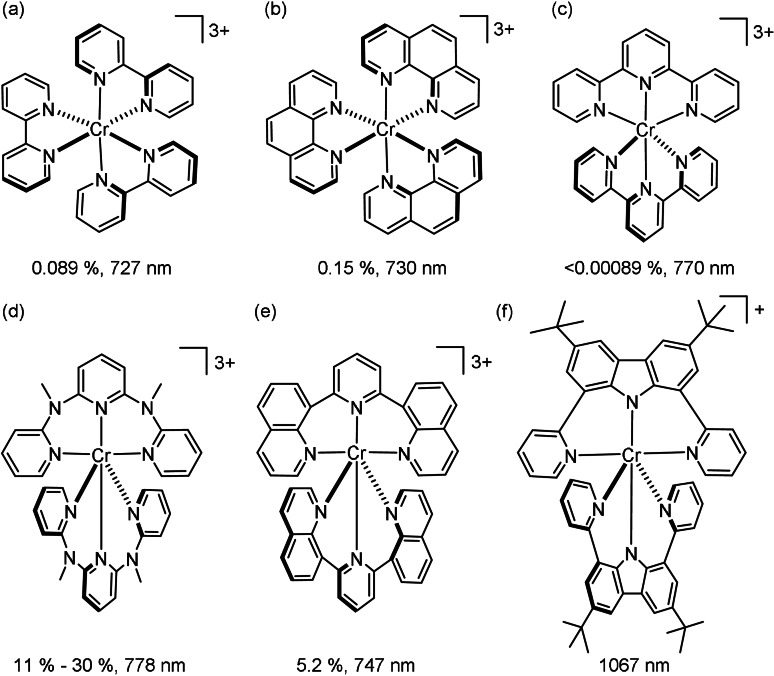
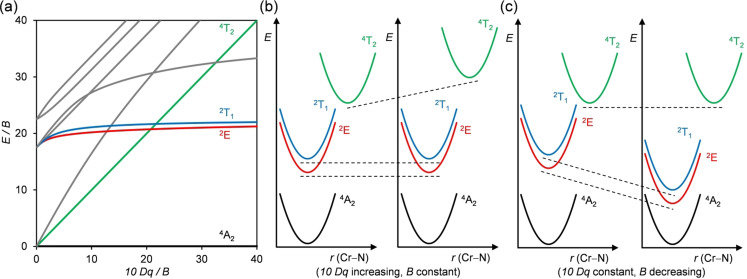
.](/paper-figures/fd7d2d452a5d41a3a8f1bf5acece755e/a-nearinfraredii-emissive-chromium-iii-complex-figure-3.jpg)
⋅2.5(C2H4Cl2) (H atoms, the counter ion and solvent molecules are omitted for clarity, 50 % probability ellipsoids). Selected bond angles (°) and bond distances (Å): N2‐Cr1‐N5, 173.69(8); N1‐Cr1‐N3, 173.66(7); N4‐Cr1‐N6, 173.16(7); Cr1‐N2, 1.969(2); Cr1‐N5, 1.962(3); Cr1‐N1, 2.133(2); Cr1‐N3, 2.115(3); Cr1‐N4, 2.109(3); Cr1‐N6, 2.133(2). CCDC 2082071 ([Cr(dpc)2](PF6)⋅2.5(C2H4Cl2)) contains the supplementary crystallographic data for this paper. These data can be obtained free of charge from the Cambridge Crystallographic Data Centre.](/paper-figures/64c63769876e45ac931f3aa1880b0575/a-nearinfraredii-emissive-chromium-iii-complex-figure-3.jpg)
 in acetonitrile with 0.1 M ( n Bu4N)(PF6) as supporting electrolyte, recorded at a scan rate of 100 mV s−1. (The Fc+/0 potential corresponds to 0.63 V vs. NHE). [34] (b) UV/Vis absorption spectrum of [Cr(dpc)2](PF6) in acetonitrile at 20 °C (black trace). The red trace shows the long‐wavelength part of this spectrum on a magnified ϵ‐scale (right y‐axis, recorded on a more concentrated solution, see inset). The vertical black and red bars mark the energies of DFT‐calculated vertical transitions, the heights of these bars reflect relative oscillator strengths. The heights of the vertical red bars were multiplied by a factor of 10 relative to the vertical black bars. (c) Luminescence spectrum of [Cr(dpc)2](PF6) in acetonitrile at 77 K, obtained after excitation at 450 nm.](/paper-figures/353c2a29ee144fa0b174d6640fe5eeac/a-nearinfraredii-emissive-chromium-iii-complex-figure-4.jpg)
Verification
Claims the paper makes
The claims and statistics of this paper haven’t been checked yet.
Run the check — free, no account needed. It reads the open-access text and checks the sources it cites.
Claims other papers make about this one
Each is checked against this paper’s own text: does it say what the citing paper says it does?
The source backs part of the claim, not all of it — or backs it for a different population, condition or comparison.
In the citing paper
“Nevertheless, their biomedical application is hindered by a reliance on high-energy, short-wavelength excitation, which leads to phototoxicity and poor tissue penetration.”
From Organic small-molecule NIR-II fluorophores for tumor phototheranostics (2026) · cites this paper as [194]
Experimental — accuracy not yet measuredThe source backs part of the claim, not all of it — or backs it for a different population, condition or comparison.
In the citing paper
“Metal complexes are promising photofunctional materials due to their superior photostability, large Stokes shifts, and high emission quantum yields compared to organic chromophores”
From Organic small-molecule NIR-II fluorophores for tumor phototheranostics (2026) · cites this paper as [194]
Experimental — accuracy not yet measuredThe source backs part of the claim, not all of it — or backs it for a different population, condition or comparison.
In the citing paper
“By employing tridentate ligands with a central π-donor amine and σ-donor/π-acceptor pyridines, they created the homoleptic Cr(III) complex Cr(dpc)2.”
From Organic small-molecule NIR-II fluorophores for tumor phototheranostics (2026) · cites this paper as [194]
Experimental — accuracy not yet measuredThe cited source says what the claim attributes to it.
In the citing paper
“Traditional Cr(III) polypyridyl complexes typically emit in the 727–778 nm range, limited to the red/NIR-I region.”
From Organic small-molecule NIR-II fluorophores for tumor phototheranostics (2026) · cites this paper as [194]
The cited source says what the claim attributes to it.
In the citing paper
“Wenger et al. developed a strategy centered on increasing metal-ligand bond covalence rather than merely optimizing the ligand field strength194.”
From Organic small-molecule NIR-II fluorophores for tumor phototheranostics (2026) · cites this paper as [194]
The cited source says what the claim attributes to it.
In the citing paper
“This complex exhibited a dominant emission peak at 1067 nm, extending into the NIR-II region, a significant red-shift from conventional Cr(III) polypyridyl complexes.”
From Organic small-molecule NIR-II fluorophores for tumor phototheranostics (2026) · cites this paper as [194]
Self-check
Percentages, sums and reported differences re-computed from the paper’s own numbers.
The self-check needs the paper’s full text.
Citations
Cites
Lanthanide luminescence for functional materials and bio-sciences
Eliseeva, S. V., & Bünzli, J. G. (2009) · Chemical Society Reviews · doi:10.1039/b905604c · Cited by 3,542
Specification of Molecular Chirality
Cahn, R. S., Ingold, C. K., & Prelog, V. (1966) · Angewandte Chemie International Edition in English · doi:10.1002/anie.196603851 · Cited by 1,884
On the Absorption Spectra of Complex Ions II
Tanabe, Y., & Sugano, S. (1954) · Journal of the Physical Society of Japan · doi:10.1143/jpsj.9.766 · Cited by 1,807
Pavlishchuk, V. V., & Addison, A. W. (2000) · Inorganica Chimica Acta · doi:10.1016/s0020-1693(99)00407-7 · Cited by 1,531
Phosphorescent heavy-metal complexes for bioimaging
Zhao, Q., Huang, C., & Li, F. (2011) · Chemical Society Reviews · doi:10.1039/c0cs00114g · Cited by 1,262
Near-infrared phosphorescence: materials and applications
Xiang, H., Cheng, J., Ma, X., Zhou, X., & Chruma, J. J. (2013) · Chemical Society Reviews · doi:10.1039/c3cs60029g · Cited by 721
Spezifikation der molekularen Chiralität
Cahn, R. S., Ingold, C. K., & Prelog, V. (1966) · Angewandte Chemie · doi:10.1002/ange.19660780803 · Cited by 719
Eliminating nonradiative decay in Cu(I) emitters: >99% quantum efficiency and microsecond lifetime
Hamze, R., Peltier, J. L., Ravinson, D. S. M., Jung, M. C., y Cárdenas, J. R. M., Haiges, R., Soleilhavoup, M., Jazzar, R. F. R., Djurovich, P. I., Bertrand, G., et al. (2019) · Science · doi:10.1126/science.aav2865 · Cited by 708
Near-infrared organic light-emitting diodes with very high external quantum efficiency and radiance
Ly, K. T., Chen-Cheng, R.-W., Lin, H., Shiau, Y.-J., Liu, S., Chou, P., Tsao, C.-S., Huang, Y., & Chi, Y. (2016) · Nature Photonics · doi:10.1038/nphoton.2016.230 · Cited by 679
Photoactive Complexes with Earth-Abundant Metals
Wenger, O. S. (2018) · Journal of the American Chemical Society · doi:10.1021/jacs.8b08822 · Cited by 595
Self-citationDonor Engineering for NIR-II Molecular Fluorophores with Enhanced Fluorescent Performance
Yang, Q., Hu, Z., Zhu, S., Ma, R., Ma, H., Ma, Z., Wan, H., Zhu, T., Jiang, Z., Liu, W., et al. (2018) · Journal of the American Chemical Society · doi:10.1021/jacs.7b10334 · Cited by 554
Photophysics and photochemistry with Earth-abundant metals – fundamentals and concepts
Förster, C., & Heinze, K. (2020) · Chemical Society Reviews · doi:10.1039/c9cs00573k · Cited by 447
Luminescence and reactivity of a charge-transfer excited iron complex with nanosecond lifetime
Kjær, K. S., Kaul, N., Prakash, O., Chábera, P., Rosemann, N. W., Honarfar, A., Gordivska, O., Fredin, L. A., Bergquist, K., Häggström, L., et al. (2018) · Science · doi:10.1126/science.aau7160 · Cited by 406
Shriver and Atkins' Inorganic Chemistry
Atkins, P. J., Overton, T., Rourke, J., Weller, M. T., Armstrong, F. A., & Hagerman, M. (2006) · Oxford University Press eBooks · Cited by 389
Electronic structure in the transition metal block and its implications for light harvesting
McCusker, J. K. (2019) · Science · doi:10.1126/science.aav9104 · Cited by 385
Organic NIR-II molecule with long blood half-life for in vivo dynamic vascular imaging
Li, B., Zhao, M., Feng, L., Dou, C., Ding, S., Zhou, G., Lu, L., Zhang, H., Chen, F., Li, X., et al. (2020) · Nature Communications · doi:10.1038/s41467-020-16924-z · Cited by 374
Ting, S. I., Garakyaraghi, S., Taliaferro, C. M., Shields, B. J., Scholes, G. D., Castellano, F. N., & Doyle, A. G. (2020) · Journal of the American Chemical Society · doi:10.1021/jacs.0c00781 · Cited by 306
Wenger, O. S. (2019) · Chemistry - A European Journal · doi:10.1002/chem.201806148 · Cited by 296
Self-citationLanthanide near infrared imaging in living cells with Yb 3+ nano metal organic frameworks
Foucault‐Collet, A., Gogick, K. A., White, K. A., Villette, S., Pallier, A., Collet, G., Kiéda, C., Li, T., Geib, S. J., Rosi, N. L., et al. (2013) · Proceedings of the National Academy of Sciences · doi:10.1073/pnas.1305910110 · Cited by 289
Singh, S. K., Eng, J., Atanasov, M., & Neese, F. (2017) · Coordination Chemistry Reviews · doi:10.1016/j.ccr.2017.03.018 · Cited by 287
Gernert, M., Balles-Wolf, L., Kerner, F., Müller, U., Schmiedel, A., Holzapfel, M., Marian, C. M., Pflaum, J., Lambert, C., & Steffen, A. (2020) · Journal of the American Chemical Society · doi:10.1021/jacs.0c02234 · Cited by 254
[Cr(ddpd)2]3+: A Molecular, Water‐Soluble, Highly NIR‐Emissive Ruby Analogue
Otto, S., Grabolle, M., Förster, C., Kreitner, C., Resch‐Genger, U., & Heinze, K. (2015) · Angewandte Chemie International Edition · doi:10.1002/anie.201504894 · Cited by 243
Chiral Molecular Ruby [Cr(dqp)2]3+ with Long-Lived Circularly Polarized Luminescence
Jiménez, J., Doistau, B., Cruz, C. M., Besnard, C., Cuerva, J. M., Campaña, A. G., & Piguet, C. (2019) · Journal of the American Chemical Society · doi:10.1021/jacs.9b06524 · Cited by 218
Self-citationBraun, J. D., Lozada, I. B., Kolodziej, C., Burda, C., Newman, K. M. E., van Lierop, J., Davis, R. L., & Herbert, D. E. (2019) · Nature Chemistry · doi:10.1038/s41557-019-0357-z · Cited by 201
Pal, A. K., Li, C., Hanan, G. S., & Zysman‐Colman, E. (2018) · Angewandte Chemie International Edition · doi:10.1002/anie.201802532 · Cited by 176
The nephelauxetic series of ligands corresponding to increasing tendency of partly covalent bonding
Schäffer, C. E., & Jørgensen, C. K. (1958) · Journal of Inorganic and Nuclear Chemistry · doi:10.1016/0022-1902(58)80176-1 · Cited by 169
Near‐IR Phosphorescent Ruthenium(II) and Iridium(III) Perylene Bisimide Metal Complexes
Schulze, M., Steffen, A., & Würthner, F. (2014) · Angewandte Chemie International Edition · doi:10.1002/anie.201410437 · Cited by 161
Organo-erbium systems for optical amplification at telecommunications wavelengths
Ye, H., Li, Z., Yu, P., Wang, C. C., Li, T., Zheng, Y.-X., Sapelkin, A., Adamopoulos, G., Hernández, I. C., Wyatt, P. B., et al. (2014) · Nature Materials · doi:10.1038/nmat3910 · Cited by 152
Understanding and exploiting long-lived near-infrared emission of a molecular ruby
Otto, S., Dorn, M., Förster, C., Bauer, M., Seitz, M., & Heinze, K. (2018) · Coordination Chemistry Reviews · doi:10.1016/j.ccr.2018.01.004 · Cited by 152
Scarborough, C. C., Lancaster, K. M., DeBeer, S., Weyhermüller, T., Sproules, S. A., & Wieghardt, K. E. (2012) · Inorganic Chemistry · doi:10.1021/ic2027219 · Cited by 142
Deuterated Molecular Ruby with Record Luminescence Quantum Yield
Wang, C., Otto, S., Dorn, M., Kreidt, E., Lebon, J., Sršan, L., Martino‐Fumo, P. D., Gerhards, M., Resch‐Genger, U., Seitz, M., et al. (2017) · Angewandte Chemie International Edition · doi:10.1002/anie.201711350 · Cited by 133
Excited-state behavior of polypyridyl complexes of chromium(III)
Serpone, N., JAMIESON, M. A., Henry, M. S., Hoffman, M. Z., Bolletta, F., & Maestri, M. (1979) · Journal of the American Chemical Society · doi:10.1021/ja00505a019 · Cited by 133
Treiling, S., Wang, C., Förster, C., Reichenauer, F., Kalmbach, J., Boden, P., Harris, J. P., Carrella, L. M., Rentschler, E., Resch‐Genger, U., et al. (2019) · Angewandte Chemie International Edition · doi:10.1002/anie.201909325 · Cited by 132
Recent Advances on Metal-Based Near-Infrared and Infrared Emitting OLEDs
Ibrahim‐Ouali, M., & Dumur, F. (2019) · Molecules · doi:10.3390/molecules24071412 · Cited by 125
Büldt, L. A., & Wenger, O. S. (2017) · Chemical Science · doi:10.1039/c7sc03372a · Cited by 120
Self-citationBright Long‐Lived Circularly Polarized Luminescence in Chiral Chromium(III) Complexes
Jiménez, J., Poncet, M., Míguez‐Lago, S., Grass, S., Lacour, J., Besnard, C., Cuerva, J. M., Campaña, A. G., & Piguet, C. (2021) · Angewandte Chemie International Edition · doi:10.1002/anie.202101158 · Cited by 116
Self-citationDing, F., Chen, Z., Kim, W. Y., Sharma, A. K., Li, C., Ouyang, Q., Zhu, H., Yang, G., Sun, Y., & Kim, J. S. (2019) · Chemical Science · doi:10.1039/c9sc02466b · Cited by 113
A Vanadium(III) Complex with Blue and NIR-II Spin-Flip Luminescence in Solution
Dorn, M., Kalmbach, J., Boden, P., Päpcke, A., Gómez, S., Förster, C., Kuczelinis, F., Carrella, L. M., Büldt, L. A., Bings, N. H., et al. (2020) · Journal of the American Chemical Society · doi:10.1021/jacs.0c02122 · Cited by 113
Heberle, M., Tschierlei, S., Rockstroh, N., Ringenberg, M. R., Frey, W. U., Junge, H., Beller, M., Lochbrunner, S., & Karnahl, M. (2016) · Chemistry - A European Journal · doi:10.1002/chem.201604005 · Cited by 109
Strong circularly polarized luminescence of an octahedral chromium( iii ) complex
Dee, C., Zinna, F., Kitzmann, W. R., Pescitelli, G., Heinze, K., Bari, L. D., & Seitz, M. (2019) · Chemical Communications · doi:10.1039/c9cc06909g · Cited by 107
Photoactive Nickel Complexes in Cross‐Coupling Catalysis
Wenger, O. S. (2020) · Chemistry - A European Journal · doi:10.1002/chem.202003974 · Cited by 106
Self-citationOtto, S., Nauth, A. M., Ermilov, E. A., Scholz, N., Friedrich, A., Resch‐Genger, U., Lochbrunner, S., Opatz, T., & Heinze, K. (2017) · ChemPhotoChem · doi:10.1002/cptc.201700077 · Cited by 102
Kaufhold, S., Rosemann, N. W., Chábera, P., Lindh, L., Losada, I. B., Uhlig, J., Pascher, T., Strand, D., Wärnmark, K., Yartsev, A. P., et al. (2021) · Journal of the American Chemical Society · doi:10.1021/jacs.0c12151 · Cited by 102
Thermo‐Chromium: A Contactless Optical Molecular Thermometer
Otto, S., Scholz, N., Behnke, T., Resch‐Genger, U., & Heinze, K. (2017) · Chemistry - A European Journal · doi:10.1002/chem.201701726 · Cited by 99
Wong, Y., Tang, M., Ng, M., & Yam, V. W. (2020) · Journal of the American Chemical Society · doi:10.1021/jacs.0c02172 · Cited by 94
Moser, M., Wucher, B., Kunz, D., & Röminger, F. (2007) · Organometallics · doi:10.1021/om060952z · Cited by 93
Harris, J. P., Reber, C., Colmer, H. E., Jackson, T. A., Forshaw, A. P., Smith, J. M., Kinney, R. A., & Telser, J. (2017) · Canadian Journal of Chemistry · doi:10.1139/cjc-2016-0607 · Cited by 81
A NIR-to-NIR upconversion luminescence system for security printing applications
Baride, A., Meruga, J., Douma, C. C., Langerman, D., Crawford, G. A., Kellar, J. J., Cross, W. M., & May, P. S. (2015) · RSC Advances · doi:10.1039/c5ra20785a · Cited by 78
Otto, S., Harris, J. P., Heinze, K., & Reber, C. (2018) · Angewandte Chemie International Edition · doi:10.1002/anie.201806755 · Cited by 72
The interelectronic repulsion and partly covalent bonding in transition-group complexes
Jørgensen, C. K. (1958) · Discussions of the Faraday Society · doi:10.1039/df9582600110 · Cited by 71
HOMO inversion as a strategy for improving the light-absorption properties of Fe( ii ) chromophores
Mukherjee, S., Torres, D. E., & Jakubı́ková, E. (2017) · Chemical Science · doi:10.1039/c7sc02926h · Cited by 67
Luminescence of chromium(III) complexes
Kirk, A. D., & Porter, G. B. (1980) · The Journal of Physical Chemistry · doi:10.1021/j100445a020 · Cited by 64
Wenger, O. S., & Güdel, H. U. (2001) · The Journal of Chemical Physics · doi:10.1063/1.1352730 · Cited by 62
Self-citationPreparation and Study of 1,8-Di(pyrid-2′-yl)carbazoles
Mudadu, M. S., Singh, A. N., & Thummel, R. P. (2008) · The Journal of Organic Chemistry · doi:10.1021/jo801132w · Cited by 61
[Cr(ddpd)2]3+: ein molekulares, wasserlösliches, hoch NIR‐lumineszentes Rubin‐Analogon
Otto, S., Grabolle, M., Förster, C., Kreitner, C., Resch‐Genger, U., & Heinze, K. (2015) · Angewandte Chemie · doi:10.1002/ange.201504894 · Cited by 54
Förster, C., Dorn, M., Reuter, T., Otto, S., Davarci, G., Reich, T., Carrella, L. M., Rentschler, E., & Heinze, K. (2018) · Inorganics · doi:10.3390/inorganics6030086 · Cited by 54
Schwartz, R. W. (1976) · Inorganic Chemistry · doi:10.1021/ic50165a050 · Cited by 48
Predicting the Optical Pressure Sensitivity of 2E → 4A2 Spin-Flip Transition in Cr3+-Doped Crystals
Back, M., Ueda, J., Hua, H., & Tanabe, S. (2021) · Chemistry of Materials · doi:10.1021/acs.chemmater.1c00678 · Cited by 48
Jiménez, J., Doistau, B., Besnard, C., & Piguet, C. (2018) · Chemical Communications · doi:10.1039/c8cc07671e · Cited by 46
Self-citationJiménez, J., Poncet, M., Doistau, B., Besnard, C., & Piguet, C. (2020) · Dalton Transactions · doi:10.1039/d0dt02872j · Cited by 43
Self-citationPal, A. K., Li, C., Hanan, G. S., & Zysman‐Colman, E. (2018) · Angewandte Chemie · doi:10.1002/ange.201802532 · Cited by 43
Spin Crossover and Long‐Lived Excited States in a Reduced Molecular Ruby
Becker, P., Förster, C., Carrella, L. M., Boden, P., Hunger, D., van Slageren, J., Gerhards, M., Rentschler, E., & Heinze, K. (2020) · Chemistry - A European Journal · doi:10.1002/chem.202001237 · Cited by 41
Near‐IR Phosphorescent Ruthenium(II) and Iridium(III) Perylene Bisimide Metal Complexes
Schulze, M., Steffen, A., & Würthner, F. (2014) · Angewandte Chemie · doi:10.1002/ange.201410437 · Cited by 41
Braun, J. D., Lozada, I. B., & Herbert, D. E. (2020) · Inorganic Chemistry · doi:10.1021/acs.inorgchem.0c02973 · Cited by 39
Heteroleptic Ter–Bidentate Cr(III) Complexes as Tunable Optical Sensitizers
Doistau, B., Collet, G., Bolomey, E. A., Sadat-Noorbakhsh, V., Besnard, C., & Piguet, C. (2018) · Inorganic Chemistry · doi:10.1021/acs.inorgchem.8b02530 · Cited by 38
Self-citationDill, R. D., Portillo, R. I., Shepard, S. G., Shores, M. P., Rappé, A. K., & Damrauer, N. H. (2020) · Inorganic Chemistry · doi:10.1021/acs.inorgchem.0c01950 · Cited by 33
Spectroscopy and Chemical Bonding in Transition Metal Complexes
Hauser, A., & Reber, C. (2016) · Structure and bonding · doi:10.1007/430_2015_195 · Cited by 31
Engelhardt, F., Maaß, C., Andrada, D. M., Herbst‐Irmer, R., & Stalke, D. (2018) · Chemical Science · doi:10.1039/c7sc05368a · Cited by 30
Treiling, S., Wang, C., Förster, C., Reichenauer, F., Kalmbach, J., Boden, P., Harris, J. P., Carrella, L. M., Rentschler, E., Resch‐Genger, U., et al. (2019) · Angewandte Chemie · doi:10.1002/ange.201909325 · Cited by 26
Deuterierter molekularer Rubin mit Rekord‐Lumineszenzquantenausbeute
Wang, C., Otto, S., Dorn, M., Kreidt, E., Lebon, J., Sršan, L., Martino‐Fumo, P. D., Gerhards, M., Resch‐Genger, U., Seitz, M., et al. (2017) · Angewandte Chemie · doi:10.1002/ange.201711350 · Cited by 21
The central role of the metal ion for photoactivity: Zn– vs. Ni–Mabiq
Lauenstein, R., Mader, S. L., Derondeau, H., Esezobor, O. Z., Block, M., Römer, A. J., Jandl, C., Riedle, E., Kaila, V. R. I., Hauer, J., et al. (2021) · Chemical Science · doi:10.1039/d0sc06096h · Cited by 20
Bright Long‐Lived Circularly Polarized Luminescence in Chiral Chromium(III) Complexes
Jiménez, J., Poncet, M., Míguez‐Lago, S., Grass, S., Lacour, J., Besnard, C., Cuerva, J. M., Campaña, A. G., & Piguet, C. (2021) · Angewandte Chemie · doi:10.1002/ange.202101158 · Cited by 17
Self-citation[Cr(ttpy)2]3+ as a multi-electron reservoir for photoinduced charge accumulation
Farran, R., Le‐Quang, L., Mouesca, J., Maurel, V., Jouvenot, D., Loiseau, F., Deronzier, A., & Chauvin, J. (2019) · Dalton Transactions · doi:10.1039/c9dt00848a · Cited by 16
Otto, S., Harris, J. P., Heinze, K., & Reber, C. (2018) · Angewandte Chemie · doi:10.1002/ange.201806755 · Cited by 13
Chromium(III)-trisoxalate, a versatile building block for luminescent materials
Milos, M., & Hauser, A. (2011) · Journal of Luminescence · doi:10.1016/j.jlumin.2011.12.053 · Cited by 7
Cited by
Sorted by citations
Luminescent First-Row Transition Metal Complexes
Wegeberg, C., & Wenger, O. S. (2021) · JACS Au · doi:10.1021/jacsau.1c00353 · Cited by 345
Self-citationShen, H., Sun, F., Zhu, X., Zhang, J., Ou, X., Zhang, J., Xu, C., Sung, H. H. Y., Williams, I. D., Chen, S., et al. (2022) · Journal of the American Chemical Society · doi:10.1021/jacs.2c07443 · Cited by 292
Lee, L. C., & Lo, K. K. (2022) · Journal of the American Chemical Society · doi:10.1021/jacs.2c03437 · Cited by 284
Sinha, N., & Wenger, O. S. (2023) · Journal of the American Chemical Society · doi:10.1021/jacs.2c13432 · Cited by 211
Self-citationLi, C., Pang, Y., Xu, Y., Lu, M., Tu, L., Li, Q., Sharma, A., Guo, Z., Li, X., & Sun, Y. (2023) · Chemical Society Reviews · doi:10.1039/d3cs00227f · Cited by 157
Metadata
- Authors
- Sinha, N., Jiménez, J., Pfund, B., Prescimone, A., Piguet, C., & Wenger, O. S.
- Affiliations
- University of Basel (CH)
- University of Geneva (CH)
- Corresponding author
- Piguet, Claude
- Wenger, Oliver S.
- ORCID
- Venue
- Angewandte Chemie International Edition
- Publisher
- Wiley
- Published
- 2021-07-12
- Volume
- 60
- Issue
- 44
- Pages
- 23722-23728
- ISSN
- 1433-7851 (ISSN-L)
- 1521-3773
- PMC
- PMC8597102
- OpenAlex
- W3168007982
- Cited by
- 105
- References
- 76
- Citations by year
- 2026: 17 · 2025: 15 · 2024: 19 · 2023: 21 · 2022: 29 · 2021: 4
- FWCI
- 5.54
- Type
- journal article
- Language
- en
- Open access
- hybrid
- doi.org
- Licence
- Locations
- Angewandte Chemie International Edition (publishedVersion, cc-by-nc-nd)
- PubMed Central (publishedVersion, cc-by-nc-nd)
- PubMed (publishedVersion)
- edoc (University of Basel) (acceptedVersion)
- Archive ouverte UNIGE (University of Geneva) (acceptedVersion, other-oa)
- Archive ouverte UNIGE (University of Geneva) (submittedVersion, cc-by)
- edoc (University of Basel)
- Funders
- Schweizerischer Nationalfonds zur Förderung der Wissenschaftlichen Forschung (200021_178760, 200020_178758)
- Fonds National de la Recherche Luxembourg
- Topics
- Physical Sciences › Materials Science › Materials Chemistry › Lanthanide and Transition Metal Complexes
- Physical Sciences › Materials Science › Materials Chemistry › Luminescence and Fluorescent Materials
- Physical Sciences › Engineering › Electrical and Electronic Engineering › Organic Light-Emitting Diodes Research
- Keywords
- chromium(III) complexes, NIR-II emission, nephelauxetic effect, luminescence shift, low-temperature luminescence
About these checks
Registry, retraction, Cites and statistics results are computed, not judged, with one exception: a printed reference that no index lists is read once by a model before it counts as a citation error. Claims are extracted by a model and kept only when their quote appears verbatim in the text; each cited source is then checked, with a model’s help, for whether it says what the claim relies on. Those verdicts can be wrong — read the claim’s quote and the cited source before relying on one.
Statistics and arithmetic are recomputed, not judged.
Confidence bands are shown only for fields calibrated on our annotated test set. None is calibrated yet, so no band is shown.
What counts as a claim ›How we measure confidence ›How we check this ›
Are you an author, or do you see a problem with this page? Request a review
