

A Survey of Catalytic Materials for Ammonia Electrooxidation to Nitrite and Nitrate
Open accessThe DOI matches its Crossref record; 50 of the 51 references it cites were found in a registry or an index.
Abstract
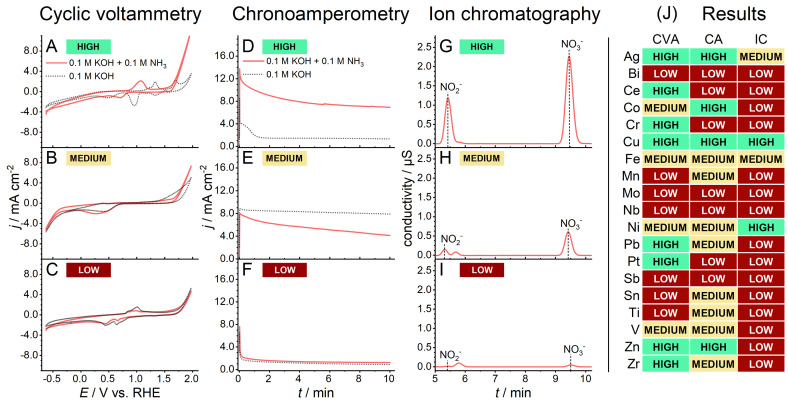
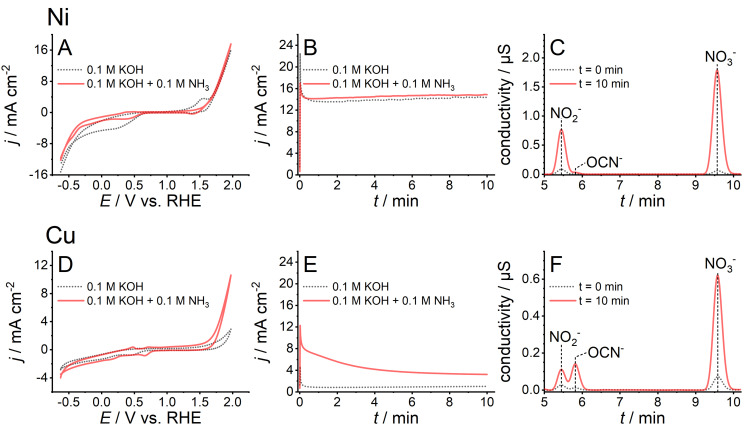
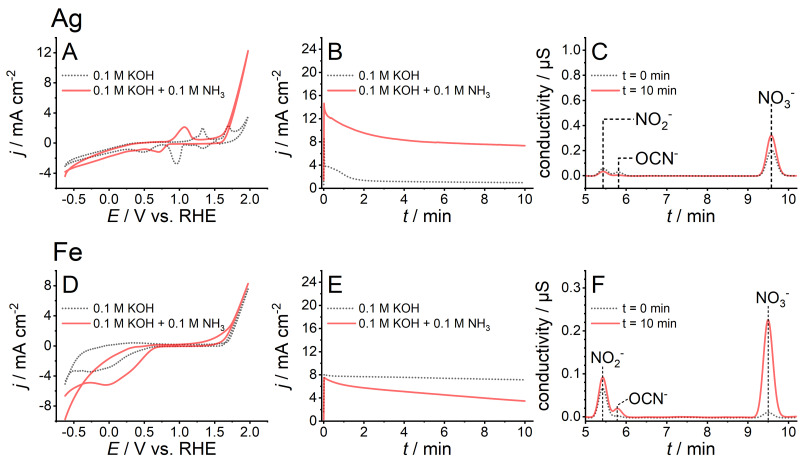
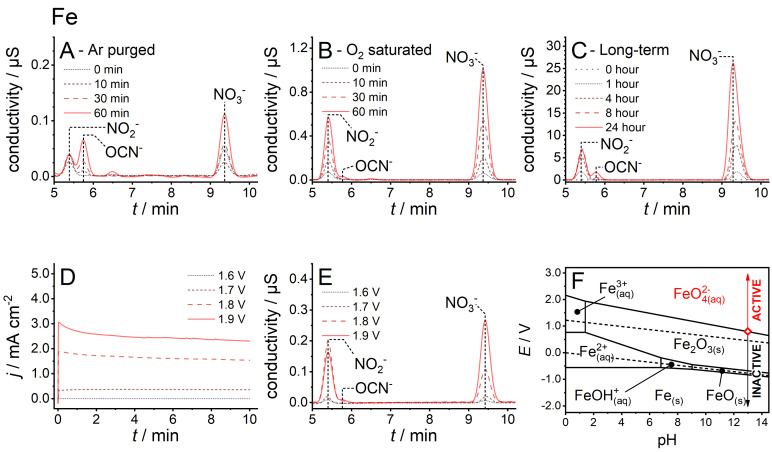
Studies of the ammonia oxidation reaction (AOR) for the synthesis of nitrite and nitrate (NO 2/3 − ) have been limited to a small number of catalytic materials, majorly Pt based. As the demand for nitrate‐based products such as fertilisers continues to grow, exploration of alternative catalysts is needed. Herein, 19 metals immobilised as particles on carbon fibre electrodes were tested for their catalytic activity for the ammonia electrooxidation to NO 2/3 − under alkaline conditions (0.1 m KOH). Nickel‐based electrodes showed the highest overall NO 2/3 − yield with a rate of 5.0±1.0 nmol s −1 cm −2 , to which nitrate contributed 62±8 %. Cu was the only catalyst that enabled formation of nitrate, at a rate of 1.0±0.4 nmol s −1 cm −2 , with undetectable amounts of nitrite produced. Previously unexplored in this context, Fe and Ag also showed promise and provided new insights into the mechanisms of the process. Ag‐based electrodes showed strong indications of activity towards NH 3 oxidation in electrochemical measurements but produced relatively low NO 2/3 − yields, suggesting the formation of alternate oxidation products. NO 2/3 − production over Fe‐based electrodes required the presence of dissolved O 2 and was more efficient than with Ni on longer timescales. These results highlight the complexity of the AOR mechanism and provide a broad set of catalytic activity and nitrate versus nitrite yield data, which might guide future development of a practical process for the distributed sustainable production of nitrates and nitrites at low and medium scales.
Overview
The claims and statistics of this paper haven’t been checked yet.
Free: it reads the open-access text and checks the first 5 claims that cite a source we can check. Create a free account to check every claim.
Integrity signals
Registry
Cites
Statistics
Figures
Verification
Claims the paper makes
The claims and statistics of this paper haven’t been checked yet.
Free: it reads the open-access text and checks the first 5 claims that cite a source we can check. Create a free account to check every claim.
Claims other papers make about this one
Each is checked against this paper’s own text: does it say what the citing paper says it does?
The check wasn’t confident either way, so it gives no verdict — never disputed.
In the citing paper
“The combination of N-FeNiCoA as the anode and C-FeNiCoA as the cathode to replace Pt/C (as it is similar to the carbon-doped cathodes described in the literature [60,61]) should also yield the most suitable materials according to the electrochemical activity observed in the CVs in Fig. 4.”
From Hydrogen production via ammonia using trimetallic-doped aerogels based on Fe, Ni, Co (2025) · cites this paper as [61]
Experimental — accuracy not yet measured
Self-check
Percentages, sums and reported differences re-computed from the paper’s own numbers.
The self-check needs the paper’s full text.
Citations
Cites
Climate Change 2007: Mitigation of Climate Change
Change, I. P. O. C. (2007) · Cambridge University Press eBooks · doi:10.1017/cbo9780511546013 · Cited by 7,729
Burke, M. S., Enman, L. J., Batchellor, A. S., Zou, S., & Boettcher, S. W. (2015) · Chemistry of Materials · doi:10.1021/acs.chemmater.5b03148 · Cited by 1,177
Ammonia as a Renewable Energy Transportation Media
Giddey, S., Badwal, S. P. S., Munnings, C., & Dolan, M. (2017) · ACS Sustainable Chemistry & Engineering · doi:10.1021/acssuschemeng.7b02219 · Cited by 893
Self-citationBurke, M. S., Zou, S., Enman, L. J., Kellon, J. E., Gabor, C. A., Pledger, E., & Boettcher, S. W. (2015) · The Journal of Physical Chemistry Letters · doi:10.1021/acs.jpclett.5b01650 · Cited by 548
Persson, K. A., Waldwick, B., Lazic, P., & Ceder, G. (2012) · Physical Review B · doi:10.1103/physrevb.85.235438 · Cited by 518
de Vooys, A. C. A., Koper, M. T. M., van Santen, R. A., & van Veen, J. A. R. (2001) · Journal of Electroanalytical Chemistry · doi:10.1016/s0022-0728(01)00491-0 · Cited by 441
Untersuchungen Zur anodischen Oxidation von Ammoniak an Platin-Elektroden
Gerischer, H., & Mauerer, A. (1970) · Journal of Electroanalytical Chemistry and Interfacial Electrochemistry · doi:10.1016/s0022-0728(70)80103-6 · Cited by 404
On the use of ammonia electrolysis for hydrogen production
Vitse, F., Cooper, M., & Botte, G. G. (2005) · Journal of Power Sources · doi:10.1016/j.jpowsour.2004.09.043 · Cited by 325
Review—Ammonia Oxidation Electrocatalysis for Hydrogen Generation and Fuel Cells
Adli, N. M., Zhang, H., Mukherjee, S., & Wu, G. (2018) · Journal of The Electrochemical Society · doi:10.1149/2.0191815jes · Cited by 311
Li, G., Anderson, L., Chen, Y., Pan, M., & Abel Chuang, P.-Y. (2018) · Sustainable Energy & Fuels · doi:10.1039/c7se00337d · Cited by 306
Ammonia removal in electrochemical oxidation: Mechanism and pseudo-kinetics
Li, L., & Liu, Y. (2009) · Journal of Hazardous Materials · doi:10.1016/j.jhazmat.2008.04.047 · Cited by 270
THE ANODIC OXIDATION OF AMMONIA AT PLATINUM BLACK ELECTRODES IN AQUEOUS KOH ELECTROLYTE
Oswin, H. G., & Salomon, M. (1963) · Canadian Journal of Chemistry · doi:10.1139/v63-243 · Cited by 238
Xu, W., Lan, R., Du, D., Humphreys, J., Walker, M., Wu, Z., Wang, H., & Tao, S. (2017) · Applied Catalysis B: Environmental · doi:10.1016/j.apcatb.2017.07.005 · Cited by 227
Electrochemical behavior of ammonia at Ni/Ni(OH)2 electrode
Kapałka, A., Cally, A., Neodo, S., Comninellis, C., Wächter, M., & Udert, K. M. (2010) · Electrochemistry Communications · doi:10.1016/j.elecom.2009.10.026 · Cited by 209
Shih, Y.-J., Huang, Y.-H., & Huang, C. P. (2018) · Electrochimica Acta · doi:10.1016/j.electacta.2018.01.045 · Cited by 208
A DEMS and cyclic voltammetry study of NH3 oxidation on platinized platinum
Gootzen, J. F. E., Wonders, A. H., Visscher, W., van Santen, R. A., & van Veen, J. A. R. (1998) · Electrochimica Acta · doi:10.1016/s0013-4686(97)00285-5 · Cited by 164
Siddharth, K., Chan, Y., Wang, L., & Shao, M. (2018) · Current Opinion in Electrochemistry · doi:10.1016/j.coelec.2018.03.011 · Cited by 156
Revisiting the electrochemical oxidation of ammonia on carbon-supported metal nanoparticle catalysts
Li, Z.-F., Wang, Y., & Botte, G. G. (2017) · Electrochimica Acta · doi:10.1016/j.electacta.2017.01.020 · Cited by 149
Fundamental studies on direct ammonia fuel cell employing anion exchange membrane
Suzuki, S., Muroyama, H., Matsui, T., & Eguchi, K. (2012) · Journal of Power Sources · doi:10.1016/j.jpowsour.2012.02.043 · Cited by 138
Effect of catalyst on electrolysis of ammonia effluents
Bonnin, E. P., Biddinger, E. J., & Botte, G. G. (2008) · Journal of Power Sources · doi:10.1016/j.jpowsour.2008.03.046 · Cited by 137
Electrochemical oxidation of ammonia on nickel oxide nanoparticles
Almomani, F., Bhosale, R., Khraisheh, M., Kumar, A., & Tawalbeh, M. (2020) · International Journal of Hydrogen Energy · doi:10.1016/j.ijhydene.2019.11.071 · Cited by 136
Electro-oxidation of ammonia in waste water
Marinčić, L., & Leitz, F. B. (1978) · Journal of Applied Electrochemistry · doi:10.1007/bf00612687 · Cited by 132
Direct ammonia fuel cell performance using PtIr/C as anode electrocatalysts
Assumpção, M. H. M. T., da Silva, S. G., Souza, R. F. B. D., Buzzo, G. S., Spinace, E. V., Neto, A. O., & Silva, J. C. M. (2014) · International Journal of Hydrogen Energy · doi:10.1016/j.ijhydene.2014.01.053 · Cited by 128
Zöllig, H., Fritzsche, C., Morgenroth, E., & Udert, K. M. (2014) · Water Research · doi:10.1016/j.watres.2014.11.031 · Cited by 125
Shih, Y.-J., Huang, Y.-H., & Huang, C. P. (2018) · Electrochimica Acta · doi:10.1016/j.electacta.2018.05.169 · Cited by 124
de Mishima, B. A. L., Lescano, D. E., Holgado, T. M., & Mishima, H. T. (1998) · Electrochimica Acta · doi:10.1016/s0013-4686(97)00061-3 · Cited by 117
Cairns, E. J., Simons, E. L., & Tevebaugh, A. D. (1968) · Nature · doi:10.1038/217780a0 · Cited by 107
Ag-Cu based catalysts for the selective ammonia oxidation into nitrogen and water vapour
Jabłońska, M., Beale, A. M., Nocuń, M., & Palkovits, R. (2018) · Applied Catalysis B: Environmental · doi:10.1016/j.apcatb.2018.03.029 · Cited by 103
Alumina-Supported Cu–Ag Catalysts for Ammonia Oxidation to Nitrogen at Low Temperature
Gang, L., Anderson, B. G., van Grondelle, J., van Santen, R. A., van Gennip, W. J. H., Niemantsverdriet, J. W., Kooyman, P. J., Knoester, A., & Brongersma, H. H. (2002) · Journal of Catalysis · doi:10.1006/jcat.2001.3470 · Cited by 103
Enriching the Earth: Fritz Haber, Carl Bosch, and the Transformation of World Food Production
Streatfeild, R. A. (2002) · Electronic Green Journal · doi:10.5070/g311710494 · Cited by 99
Room-temperature-functioning ammonia sensor based on solid-state CuxS films
Galdikas, A., Mironas, A., Strazdien≐, V., Šetkus, A., Ancutien≐, I., & Janickis, V. (2000) · Sensors and Actuators B Chemical · doi:10.1016/s0925-4005(00)00408-1 · Cited by 91
The mechanism of ammonia oxidation and certain analogous reactions
Zawadzki, J. (1950) · Discussions of the Faraday Society · doi:10.1039/df9500800140 · Cited by 78
The Performance of Direct Ammonia Fuel Cells
Simons, E. L., Cairns, E. J., & Surd, D. J. (1969) · Journal of The Electrochemical Society · doi:10.1149/1.2411961 · Cited by 76
Evaluation of anode materials for the electro-oxidation of ammonia and ammonium ions
Maia, L. C. C., & Gomes, J. A. D. C. P. (2011) · Materials Chemistry and Physics · doi:10.1016/j.matchemphys.2011.05.080 · Cited by 72
Medvedev, J. J., Tobolovskaya, Y., Medvedeva, X. V., Tatarchuk, S. W., Li, F., & Klinkova, A. (2022) · Green Chemistry · doi:10.1039/d1gc04140a · Cited by 69
Ueber ammon‐alkalische Silberlösung als Reagens auf Aldehyd
Tollens, B. (1882) · Berichte der deutschen chemischen Gesellschaft · doi:10.1002/cber.18820150243 · Cited by 67
Selective oxidation of ammonia over copper-silver-based catalysts
Yang, M., Wu, C., Zhang, C., & He, H. (2004) · Catalysis Today · doi:10.1016/j.cattod.2004.04.035 · Cited by 64
High catalytic performance of CuCo/nickel foam electrode for ammonia electrooxidation
Tsai, M., Chen, T.-C., Juang, Y., Hua, L.-C., & Huang, C. (2020) · Electrochemistry Communications · doi:10.1016/j.elecom.2020.106875 · Cited by 60
As Precious as Platinum: Iron Nitride for Electrocatalytic Oxidation of Liquid Ammonia
Little, D. J., Edwards, D. O., Smith, M. R., & Hamann, T. W. (2017) · ACS Applied Materials & Interfaces · doi:10.1021/acsami.7b02639 · Cited by 56
Johnston, S., Kemp, L., Turay, B., Simonov, A. N., Suryanto, B. H. R., & MacFarlane, D. R. (2021) · ChemSusChem · doi:10.1002/cssc.202101557 · Cited by 55
Self-citationJi, X., Banks, C. E., & Compton, R. G. (2005) · The Analyst · doi:10.1039/b508975a · Cited by 44
Current Efficiencies for the Anodic Oxidation of Ammonia in Potassium Hydroxide Solution
Katan, T., & Galiotto, R. J. (1963) · Journal of The Electrochemical Society · doi:10.1149/1.2425915 · Cited by 43
Oxidation and Adsorption of Ammonia on a Platinized Platinum Electrode
Sasaki, K., & Hisatomi, Y. (1970) · Journal of The Electrochemical Society · doi:10.1149/1.2407624 · Cited by 43
Solubility and Stability of Silver Oxides in Alkaline Electrolytes
Amlie, R. F., & Rüetschi, P. (1961) · Journal of The Electrochemical Society · doi:10.1149/1.2428228 · Cited by 37
Kirova-Yordanova, Z. (2011) · Energy · doi:10.1016/j.energy.2010.12.039 · Cited by 31
Traube, W., & Biltz, A. (1904) · Berichte der deutschen chemischen Gesellschaft · doi:10.1002/cber.190403703107 · Cited by 17
Polarization Behaviour of Silver in Model Solutions
Pargar, F., & Koleva, D. A. (2017) · International Journal of Structural and Civil Engineering Research · doi:10.18178/ijscer.6.3.172-176 · Cited by 15
Hydrodynamic analysis and simulation of a flow cell ammonia electrolyzer
Diaz, L. A., & Botte, G. G. (2015) · Electrochimica Acta · doi:10.1016/j.electacta.2015.04.153 · Cited by 14
Cheremisinoff, P. N. (1995) · Elsevier eBooks · doi:10.1016/b978-081551388-9.50009-9 · Cited by 14
Акользин, А. П., Kharitonov, Y. Y., & Kovalenko, S. G. (1987) · Materials and Corrosion · doi:10.1002/maco.19870380804 · Cited by 5
Research works printed but not linked: 1
- W. Laue, M. Thiemann, E. Scheibler, K. W. Wiegand, in Ullmann's Encycl. Ind. Chem., Wiley-VCH Verlag GmbH & Co. KGaA, Weinheim, Germany, 2000.
Cited by
Green Chemistry: Advanced Electrocatalysts and System Design for Ammonia Oxidation
Tian, Y., Mao, Z., Wang, L., & Liang, J. (2023) · Small Structures · doi:10.1002/sstr.202200266 · Cited by 112
Ammonia as a Green Carbon-Free Fuel: A Pathway to the Sustainable Energy Economy
Tan, H., Sang, Z., Tian, Y., Peng, W., Liu, X., & Liang, J. (2024) · ACS Energy Letters · doi:10.1021/acsenergylett.4c02288 · Cited by 115
Electrochemical Ammonia Oxidation with Molecular Catalysts
Liu, H., Lant, H. M. C., Cody, C. C., Jelušić, J., Crabtree, R. H., & Brudvig, G. W. (2023) · ACS Catalysis · doi:10.1021/acscatal.3c00032 · Cited by 84
Electrocatalytic Ammonia Oxidation to Nitrite and Nitrate with NiOOH‐Ni
Liu, H., Yang, C., Dong, C., Wang, J., Zhang, X., Lyalin, A., Taketsugu, T., Chen, Z., Guan, D., Xu, X., et al. (2024) · Advanced Energy Materials · doi:10.1002/aenm.202401675 · Cited by 87
Venturini, S. I., Godoi, D. R. M., & Perez, J. (2023) · ACS Catalysis · doi:10.1021/acscatal.3c00677 · Cited by 74
Metadata
- Authors
- Johnston, S., Cohen, S., Nguyen, C. K., Dinh, K. N., Nguyen, T. D., Giddey, S., Munnings, C., Simonov, A. N., & MacFarlane, D. R.
- Affiliations
- Monash University (AU)
- Commonwealth Scientific and Industrial Research Organisation (AU)
- Corresponding author
- Simonov, Alexandr N.
- MacFarlane, Douglas R.
- ORCID
- Venue
- ChemSusChem
- Publisher
- Wiley
- Published
- 2022-09-29
- Volume
- 15
- Issue
- 20
- Pages
- e202200614-e202200614
- ISSN
- 1864-5631 (ISSN-L)
- 1864-564X
- PMC
- PMC9827930
- OpenAlex
- W4287877623
- Cited by
- 50
- References
- 51
- Citations by year
- 2026: 10 · 2025: 13 · 2024: 18 · 2023: 8 · 2022: 1
- FWCI
- 1.80
- Type
- journal article
- Language
- en
- Open access
- hybrid
- doi.org
- Licence
- Locations
- ChemSusChem (publishedVersion, cc-by-nc-nd)
- PubMed Central (publishedVersion, cc-by-nc-nd)
- PubMed (publishedVersion)
- Funders
- Australian Research Council (DP200101491)
- Topics
- Physical Sciences › Energy › Renewable Energy, Sustainability and the Environment › Electrocatalysts for Energy Conversion
- Physical Sciences › Chemical Engineering › Catalysis › Ammonia Synthesis and Nitrogen Reduction
- Physical Sciences › Materials Science › Materials Chemistry › Catalytic Processes in Materials Science
- Keywords
- ammonia electrooxidation, nitrite production, nitrate formation, electrocatalysts, nickel catalysts, copper catalysts, iron catalysts, silver catalysts, carbon fiber electrodes, alkaline conditions
- MeSH terms
- Carbon Fiber, Ammonia, Fertilizers, Nickel, Nitrates, Nitrites, Oxidation-Reduction
About these checks
Registry, retraction, Cites and statistics results are computed, not judged, with one exception: a printed reference that no index lists is read once by a model before it counts as a citation error. Claims are extracted by a model and kept only when their quote appears verbatim in the text; each cited source is then checked, with a model’s help, for whether it says what the claim relies on. Those verdicts can be wrong — read the claim’s quote and the cited source before relying on one.
Statistics and arithmetic are recomputed, not judged.
Confidence bands are shown only for fields calibrated on our annotated test set. None is calibrated yet, so no band is shown.
What counts as a claim ›How we measure confidence ›How we check this ›
Are you an author, or do you see a problem with this page? Request a review
Data sources
Bibliographic data: Semantic Scholar, OpenAlex, Crossref.
Contains information from the Semantic Scholar Academic Graph Datasets, made available under the ODC Attribution License (ODC-BY 1.0).
Semantic Scholar’s data is described in: Kinney, R., et al. (2023). The Semantic Scholar Open Data Platform. arXiv:2301.10140.
