Cited by 39

The DOI matches its Crossref record; 6 of the 6 references it cites were found in a registry or an index.

Symmetry‐Protected Photonic Chiral Spin Textures by Spin–Orbit Coupling

Shi, Peng, Du, Luping, Li, Mingjie, Yuan, Xiaocong·2021·Laser & Photonics Reviews

Abstract

Chiral spin textures are widely researched in condensed matter systems and have shown potential for use in spintronics and storage applications. Photonic counterparts of these textures are observed in various optical systems with broken inversion symmetry. Unfortunately, the resemblances are only phenomenological. This work proposes a theoretical framework based on the variational theorem to show that the photonic chiral spin textures in an optical interface originate from the system's symmetry and relativity. Analysis of the rotational symmetry in optical systems indicates that the conservation of the total angular momentum is preserved from the local variations of spin vectors. Specifically, although the integral spin momentum does not carry net energy, the local spin momentum distribution, which determines the local subluminal energy transport and minimization variation of the square of the total angular momentum, results in the chiral twisting of the local spin vectors. The findings of this study deepen the understanding of the symmetries, conservative laws, and energy transport in optical systems, reveal the similarities in the formation mechanisms and the geometries of photonic and condensed‐matter chiral spin textures, and have potential applications in chiral and spin photonics.

Overview

The claims and statistics of this paper haven’t been checked yet.

Run the check — free, no account needed. It reads the open-access text and checks the sources it cites.

A few free checks a day · papers already verified open instantly · results are public

Integrity signals

Registry

Crossref · 10.1002/lpor.202000554

Cites

6 of 6 references verified0 citation errors · 0 not checkable

Statistics

Figures

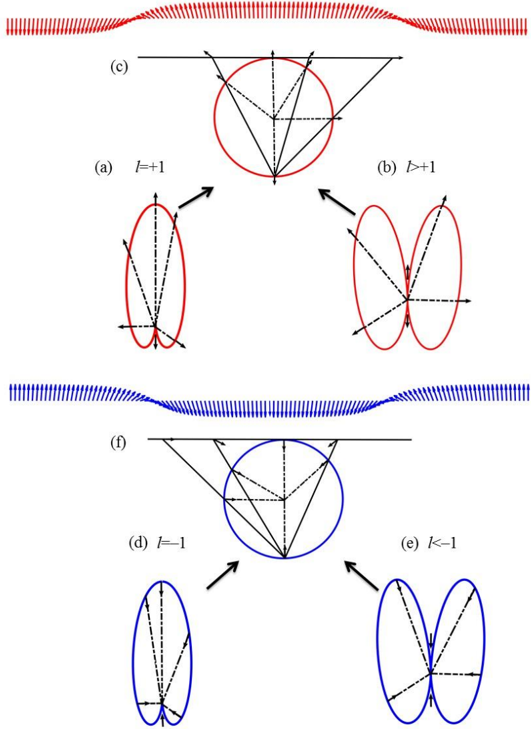
Figure 1 Geometry of photonic skyrmions. Projections of the skyrmion-like spin textures in cylindrical coordinates with quantum numbers (a) l =+1 and (b) l >+1 to a specific spherical coordinate; (c) corresponding projection of the normalized spin texture (top panel) to a specific spherical coordinate. These projections indicate that the skyrmion numbers of the spin textures for photonic skyrmions with positive integer quantum numbers are -1 uniformly. The directional vector of the iSAM is in the outer direction along the connecting line between the centre (0, 0) and red rings and its relative intensity is proportional to the length of connecting line. Projection of the skyrmion-like spin texture in cylindrical coordinates with quantum numbers (d) l =-1 and (e) l <-1 to a specific spherical coordinate; (f) corresponding projection of the normalized spin texture (top panel) to a specific spherical coordinate. These projections indicate the skyrmion numbers of the spin textures for photonic skyrmions with negative integer quantum numbers are +1. The directional vector of iSAM is in the inner direction along the connecting line between the centre (0, 0) and blue rings. It should be noted that the geometries of photonic skyrmions with quantum numbers l >+1 or l <-1 are approximately identical. Therefore, only (b) and (e) are exhibited here. The skyrmion-like spin texture is cylindrically symmetrical and thus the 2D contours in the xz -plane are shown here. The photonic skyrmions are constructed by the p -polarized light at air-gold interface.
Figure 1 Geometry of photonic skyrmions. Projections of the skyrmion-like spin textures in cylindrical coordinates with quantum numbers (a) l =+1 and (b) l >+1 to a specific spherical coordinate; (c) corresponding projection of the normalized spin texture (top panel) to a specific spherical coordinate. These projections indicate that the skyrmion numbers of the spin textures for photonic skyrmions with positive integer quantum numbers are -1 uniformly. The directional vector of the iSAM is in the outer direction along the connecting line between the centre (0, 0) and red rings and its relative intensity is proportional to the length of connecting line. Projection of the skyrmion-like spin texture in cylindrical coordinates with quantum numbers (d) l =-1 and (e) l <-1 to a specific spherical coordinate; (f) corresponding projection of the normalized spin texture (top panel) to a specific spherical coordinate. These projections indicate the skyrmion numbers of the spin textures for photonic skyrmions with negative integer quantum numbers are +1. The directional vector of iSAM is in the inner direction along the connecting line between the centre (0, 0) and blue rings. It should be noted that the geometries of photonic skyrmions with quantum numbers l >+1 or l <-1 are approximately identical. Therefore, only (b) and (e) are exhibited here. The skyrmion-like spin texture is cylindrically symmetrical and thus the 2D contours in the xz -plane are shown here. The photonic skyrmions are constructed by the p -polarized light at air-gold interface.CC-BY-NC-ND · From the PDF
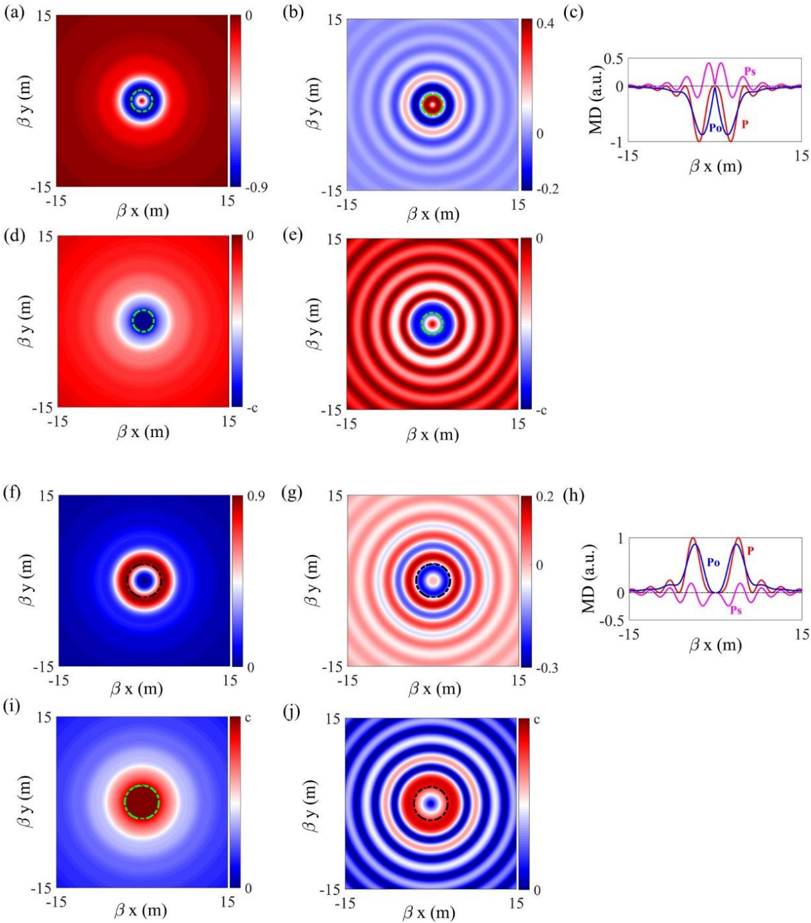
Figure 2 Dynamical properties of photonic skyrmions. (a) Orbital/canonical MD, (b) spin MD, (c) 1D contours of kinetic MD (red line), orbital/canonical MD (blue line), spin MD (magenta line), (d) orbital/canonical group velocity and (e) group velocity of photonic skyrmion with vortex topological charge l =-2; (f) orbital/canonical MD, (g) spin MD, (h) 1D contours of kinetic MD (red line), orbital/canonical MD (blue line), spin MD (magenta line), (i) orbital/canonical group velocity and (j) group velocity of photonic skyrmion with vortex topological charge l =+3. The dotted circles indicate the region where l / k 0 r =1. In the region where l / k 0 r >1, the spin MD must be inverted with respect to the orbital/canonical MD, which leads to the subluminal group velocity of the photonic skyrmion. The opearting wavelength is 633nm and the MDs are normalized with respect to the maximal absolute value of the corresponding kinetic MD. Here, the photonic skyrmions are constructed by the p -polarized light at air-gold interface.
Figure 2 Dynamical properties of photonic skyrmions. (a) Orbital/canonical MD, (b) spin MD, (c) 1D contours of kinetic MD (red line), orbital/canonical MD (blue line), spin MD (magenta line), (d) orbital/canonical group velocity and (e) group velocity of photonic skyrmion with vortex topological charge l =-2; (f) orbital/canonical MD, (g) spin MD, (h) 1D contours of kinetic MD (red line), orbital/canonical MD (blue line), spin MD (magenta line), (i) orbital/canonical group velocity and (j) group velocity of photonic skyrmion with vortex topological charge l =+3. The dotted circles indicate the region where l / k 0 r =1. In the region where l / k 0 r >1, the spin MD must be inverted with respect to the orbital/canonical MD, which leads to the subluminal group velocity of the photonic skyrmion. The opearting wavelength is 633nm and the MDs are normalized with respect to the maximal absolute value of the corresponding kinetic MD. Here, the photonic skyrmions are constructed by the p -polarized light at air-gold interface.CC-BY-NC-ND · From the PDF
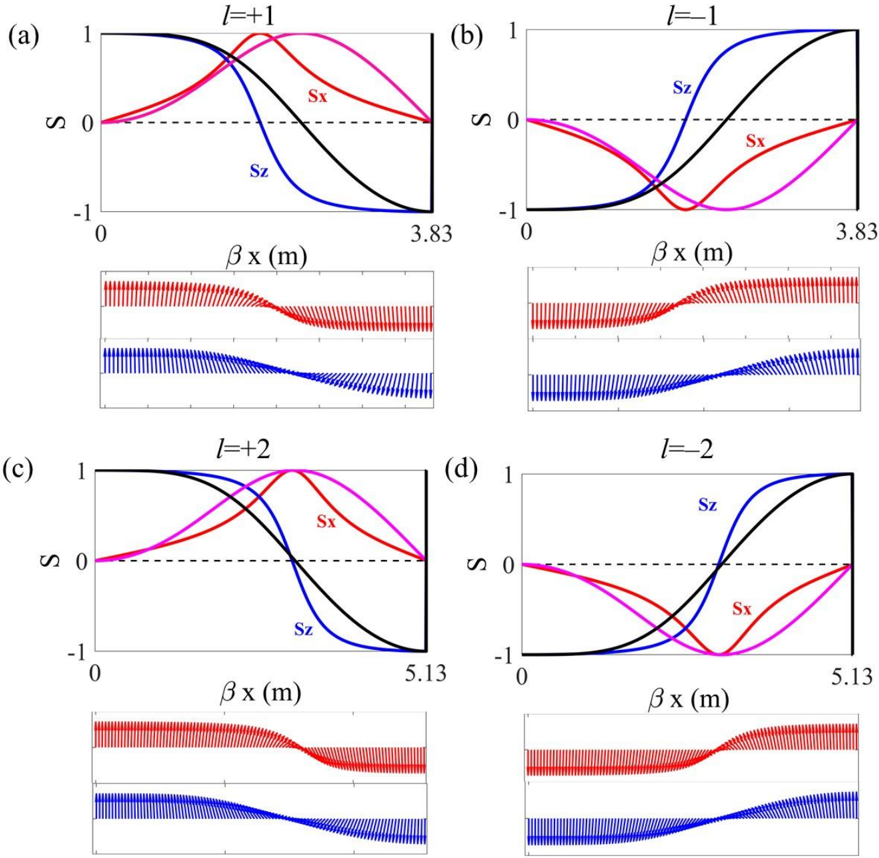
Figure 3 Comparison of theoretical and variational results for the skyrmion-like spin textures. 1D contours of Sz and Sx for the photonic skyrmions with quantum numbers (a) l =+1; (b) l =-1; (c) l =+2; and (d) l =-2. The Sz and Sx characteristics of the photonic skyrmions formed by Bessel-type surface waves are labelled by blue and red lines, respectively, while the corresponding Sz and Sx characteristics solved using the variational Equation 3 are shown as black and magenta lines, respectively (top panels). The middle panels show the spin textures of the photonic skyrmions formed by Bessel-type surface waves with various quantum numbers. The bottom panels show the spin textures given by solving the variational Equation 3 . The 2nd-order differential equation is solved using the Runge-Kutta method or Euler method and the boundary conditions are: Θ(0.001)=0, Θ′(0.001)=1×10 -3 for l =+1 and Θ(0.001)=π, Θ′(0.001)=-1× 10 -3 for l =-1; Θ(0.001)=0, Θ′(0.001)=5.5×10 -4 for l =+2 and Θ(0.001)=π, Θ′(0.001)=-5.5× 10 -4 for l =-2. Here, the photonic skyrmions are constructed by the p -polarized light at air-gold interface. The operating wavelength is 632.8nm. The horizontal axis of vectorgraph is consistent with the corresponding 1D contours of spin vectors.
Figure 3 Comparison of theoretical and variational results for the skyrmion-like spin textures. 1D contours of Sz and Sx for the photonic skyrmions with quantum numbers (a) l =+1; (b) l =-1; (c) l =+2; and (d) l =-2. The Sz and Sx characteristics of the photonic skyrmions formed by Bessel-type surface waves are labelled by blue and red lines, respectively, while the corresponding Sz and Sx characteristics solved using the variational Equation 3 are shown as black and magenta lines, respectively (top panels). The middle panels show the spin textures of the photonic skyrmions formed by Bessel-type surface waves with various quantum numbers. The bottom panels show the spin textures given by solving the variational Equation 3 . The 2nd-order differential equation is solved using the Runge-Kutta method or Euler method and the boundary conditions are: Θ(0.001)=0, Θ′(0.001)=1×10 -3 for l =+1 and Θ(0.001)=π, Θ′(0.001)=-1× 10 -3 for l =-1; Θ(0.001)=0, Θ′(0.001)=5.5×10 -4 for l =+2 and Θ(0.001)=π, Θ′(0.001)=-5.5× 10 -4 for l =-2. Here, the photonic skyrmions are constructed by the p -polarized light at air-gold interface. The operating wavelength is 632.8nm. The horizontal axis of vectorgraph is consistent with the corresponding 1D contours of spin vectors.CC-BY-NC-ND · From the PDF
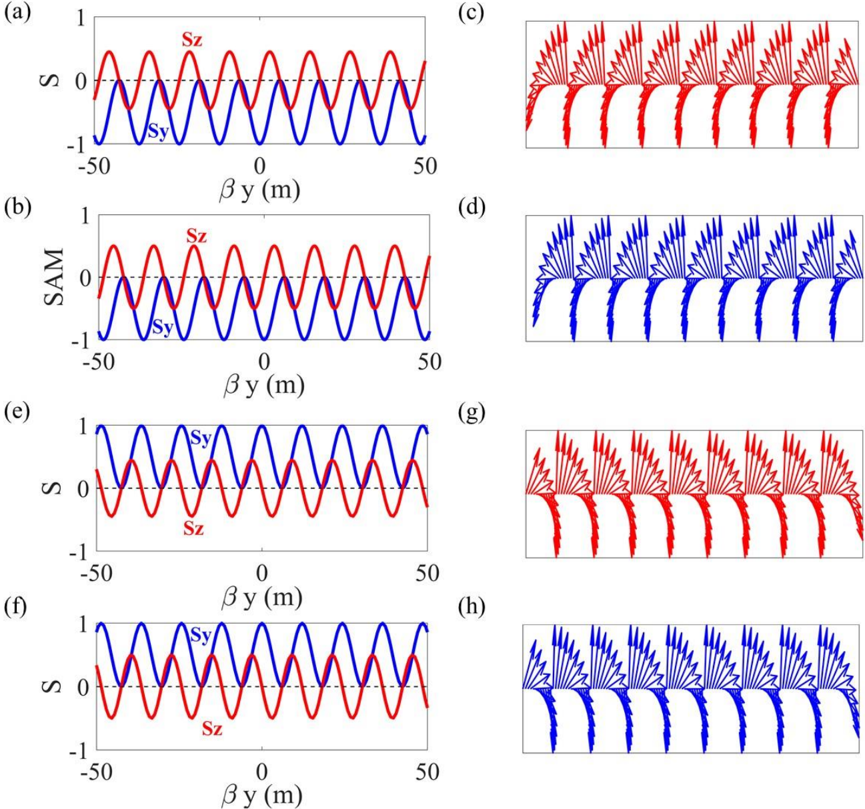
Figure 4 Comparison of domain wall-like spin texture between theoretical and variational results. (a) the theoretical and (b) variational results as the in-plane wave number component ky = kr sin(15º ). The corresponding vector vectorgraphs for (c) theoretical (red) and (d) variational (blue) results in (a) and (b), respectively. (e) the theoretical and (f) variational results as the in-plane wave number component ky = kr sin(165º ). The corresponding vector vectorgraphs for (g) theoretical (red) and (g) variational (blue) results in (e) and (f), respectively. The theoretical and variational results match very well. Here, the photonic domain wall-like textures are constructed by the p -polarized light at air-gold interface. The wavelength is 632.8nm. The horizontal axis of vectorgraph is consistent with the corresponding 1D contour of spin vectors.
Figure 4 Comparison of domain wall-like spin texture between theoretical and variational results. (a) the theoretical and (b) variational results as the in-plane wave number component ky = kr sin(15º ). The corresponding vector vectorgraphs for (c) theoretical (red) and (d) variational (blue) results in (a) and (b), respectively. (e) the theoretical and (f) variational results as the in-plane wave number component ky = kr sin(165º ). The corresponding vector vectorgraphs for (g) theoretical (red) and (g) variational (blue) results in (e) and (f), respectively. The theoretical and variational results match very well. Here, the photonic domain wall-like textures are constructed by the p -polarized light at air-gold interface. The wavelength is 632.8nm. The horizontal axis of vectorgraph is consistent with the corresponding 1D contour of spin vectors.CC-BY-NC-ND · From the PDF

Verification

Claims the paper makes

The claims and statistics of this paper haven’t been checked yet.

Run the check — free, no account needed. It reads the open-access text and checks the sources it cites.

A few free checks a day · papers already verified open instantly · results are public

Claims other papers make about this one

Each is checked against this paper’s own text: does it say what the citing paper says it does?

Self-check

Percentages, sums and reported differences re-computed from the paper’s own numbers.

The self-check needs the paper’s full text.

Citations

Cites

Show all 6 references

Research works printed but not linked: 53

  1. 10.1103/PhysRevLett.100.013904 · DOI · Paper page
  2. 10.1103/PhysRevLett.124.106103 · DOI
  3. 10.1364/OME.9.000095 · DOI
  4. 10.1126/science.1260635 · DOI
  5. 10.1103/PhysRevLett.117.013601 · DOI
  6. 10.1103/PhysRevLett.122.153907 · DOI
  7. 10.1002/lpor.202000049 · DOI
  8. 10.1038/nphoton.2016.262 · DOI
  9. 10.1038/s41567-019-0487-7 · DOI · Paper page
  10. 10.1021/acs.nanolett.9b01343 · DOI · Paper page
  11. 10.1038/s41467-021-21250-z · DOI · Paper page
  12. 10.1103/PhysRevA.102.053513 · DOI · Paper page
  13. 10.1088/2040-8986/abe8b2 · DOI
  14. 10.1103/PhysRevResearch.3.023055 · DOI · Paper page
  15. 10.1038/s41586-020-3030-1 · DOI
  16. X.Lei A.Yang P.Shi Z.Xie L.Du A. V.Zayats X.‐C.Yuan arXiv:2103.15366 2021. · arXiv
  17. 10.1103/PhysRevResearch.3.023109 · DOI · Paper page
  18. 10.1038/nnano.2013.243 · DOI
  19. 10.1103/RevModPhys.89.025006 · DOI
  20. 10.1038/s41586-018-0745-3 · DOI · Paper page
  21. 10.1038/nature21037 · DOI
  22. 10.1126/science.1257671 · DOI · Paper page
  23. 10.1126/science.1233739 · DOI · Paper page
  24. 10.1117/1.AP.1.1.014001 · DOI
  25. 10.1103/PhysRevLett.125.227201 · DOI
  26. 10.1103/PhysRevA.102.063105 · DOI
  27. 10.1073/pnas.2020055118 · DOI
  28. 10.1117/1.AP.3.3.034001 · DOI
  29. 10.1073/pnas.2018816118 · DOI · Paper page
  30. Shi P., 2020, Nanophotonics, 9, 2020430
  31. 10.1038/s41377-019-0194-2 · DOI · Paper page
  32. 10.1007/978-3-642-32858-9 · DOI
  33. 10.1038/s41567-018-0301-y · DOI
  34. 10.1038/ncomms11286 · DOI
  35. 10.1016/j.physrep.2004.11.001 · DOI
  36. 10.1126/science.aaa9519 · DOI · Paper page
  37. 10.1364/OPTICA.3.000118 · DOI
  38. 10.1088/1367-2630/abc853 · DOI
  39. 10.1103/PhysRevB.89.064425 · DOI
  40. 10.1126/science.aaz6626 · DOI
  41. Y.Dai Z.Zhou A.Ghosh K.Kapoor M.Dąbrowski A.Kubo C.‐B.Huang H.Petek arXiv:1912.03826 2019. · arXiv
  42. 10.1039/D0NR00618A · DOI
  43. 10.1080/00411457108231446 · DOI
  44. 10.1016/j.physrep.2015.06.003 · DOI · Paper page
  45. 10.1039/C9NR08399E · DOI
  46. 10.1103/PhysRevLett.93.083901 · DOI · Paper page
  47. 10.1103/PhysRevLett.96.073903 · DOI · Paper page
  48. Sakurai J. J., 1994, Modern Quantum Mechanics
  49. 10.1103/PhysRevB.99.174310 · DOI
  50. 10.1126/sciadv.abd4632 · DOI
  51. 10.1073/pnas.1808534115 · DOI
  52. 10.1103/PhysRevD.101.084046 · DOI
  53. 10.1103/PhysRevLett.123.054301 · DOI

Cited by

Sorted by citations

See all 39

Metadata

Authors
Shi, P., Du, L., Li, M., & Yuan, X.
Venue
Laser & Photonics Reviews
Publisher
Wiley
Published
2021-07-29
Volume
15
Issue
9
ISSN
  • 1863-8880
  • 1863-8899
Cited by
39
References
6
Language
en
Funders
  • National Natural Science Foundation of China (U1701661, 61935013, 62075139, 61427819, 61622504, 61705135)
  • Natural Science Foundation of Guangdong Province (2016A030312010)
  • Shenzhen Peacock Plan (KQTD20170330110444030)

About these checks

Registry, retraction, Cites and statistics results are computed, not judged, with one exception: a printed reference that no index lists is read once by a model before it counts as a citation error. Claims are extracted by a model and kept only when their quote appears verbatim in the text; each cited source is then checked, with a model’s help, for whether it says what the claim relies on. Those verdicts can be wrong — read the claim’s quote and the cited source before relying on one.

Statistics and arithmetic are recomputed, not judged.

Confidence bands are shown only for fields calibrated on our annotated test set. None is calibrated yet, so no band is shown.

What counts as a claim ›How we measure confidence ›How we check this ›

Are you an author, or do you see a problem with this page? Request a review

How to cite

Cite CoChat for the checks on this page, and the paper for its own findings.

This page
CoChat. (2026). Citation check: Symmetry‐Protected Photonic Chiral Spin Textures by Spin–Orbit Coupling. https://app.cochat.ai/papers/10.1002/lpor.202000554
The paper
Shi, P., Du, L., Li, M., & Yuan, X. (2021). Symmetry‐Protected Photonic Chiral Spin Textures by Spin–Orbit Coupling. Laser & Photonics Reviews. https://doi.org/10.1002/lpor.202000554