

The DOI matches its Crossref record; 14 of the 14 references it cites were found in a registry or an index.
Engineering serendipity: When does knowledge sharing lead to knowledge production?
Abstract
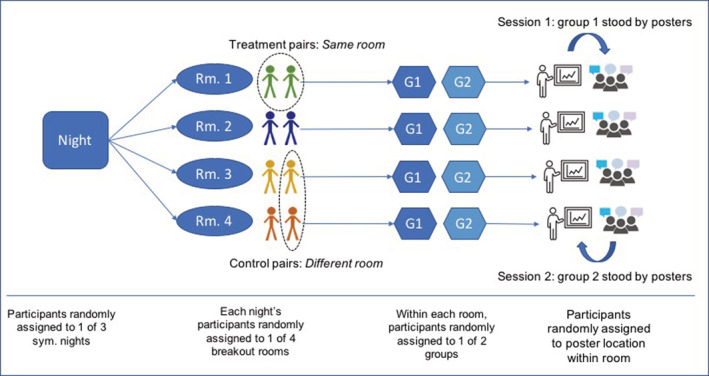
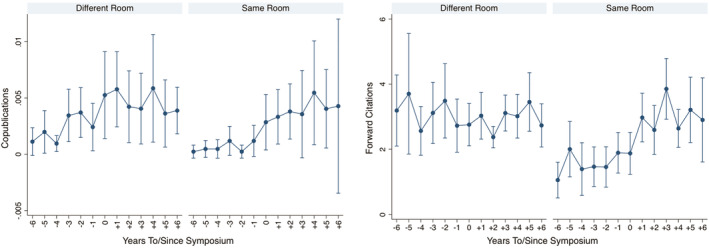
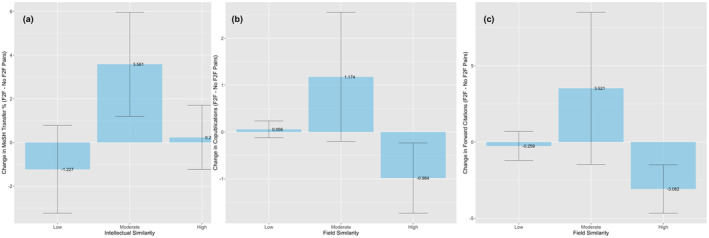
Research Summary: We investigate how knowledge similarity between two individuals is systematically related to the likelihood that a serendipitous encounter results in knowledge production. We conduct a field experiment at a medical research symposium, where we exogenously varied opportunities for face‐to‐face encounters among 15,817 scientist‐pairs. Our data include direct observations of interaction patterns collected using sociometric badges, and detailed, longitudinal data of the scientists' postsymposium publication records over 6 years. We find that interacting scientists acquire more knowledge and coauthor 1.2 more papers when they share some overlapping interests, but cite each other's work between three and seven times less when they are from the same field. Our findings reveal both collaborative and competitive effects of knowledge similarity on knowledge production outcomes. Managerial Summary: Managers often try to stimulate innovation by encouraging serendipitous interactions between employees, for example by using office space redesigns, conferences and similar events. Are such interventions effective? This article proposes that an effective encounter depends on the degree of common knowledge shared by the individuals. We find that scientists who attend the same conference are more likely to learn from each other and collaborate effectively when they have some common interests, but may view each other competitively when they work in the same field. Hence, when designing opportunities for face‐to‐face interactions, managers should consider knowledge similarity as a criteria for fostering more productive exchanges.
Overview
The claims and statistics of this paper haven’t been checked yet.
Free: it reads the open-access text and checks the first 5 claims that cite a source we can check. Create a free account to check every claim.
Integrity signals
Registry
Cites
Statistics
Figures
Verification
Claims the paper makes
The claims and statistics of this paper haven’t been checked yet.
Free: it reads the open-access text and checks the first 5 claims that cite a source we can check. Create a free account to check every claim.
Claims other papers make about this one
Each is checked against this paper’s own text: does it say what the citing paper says it does?
In the citing paper
“The wide focus of a poster session may also promote serendipitous learning of stumbling across unexpected insight outside an attendee's normal research area (Lane et al., 2021).”
From Billboard-style posters preferred overall at two conferences, but should include more methods and limitations (2024) · cites this paper as Lane et al., 2021
Self-check
Percentages, sums and reported differences re-computed from the paper’s own numbers.
The self-check needs the paper’s full text.
Citations
Cites
Grant, R. M. (1996) · Organization Science · doi:10.1287/orsc.7.4.375 · Cited by 5,649
The Social Self: On Being the Same and Different at the Same Time
Brewer, M. B. (1991) · Personality and Social Psychology Bulletin · doi:10.1177/0146167291175001 · Cited by 5,107
Social Capital, Networks, and Knowledge Transfer
Inkpen, A. C., & Tsang, E. W. K. (2005) · Academy of Management Review · doi:10.5465/amr.2005.15281445 · Cited by 3,864
The Increasing Dominance of Teams in Production of Knowledge
Wuchty, S., Jones, B. F., & Uzzi, B. (2007) · Science · doi:10.1126/science.1136099 · Cited by 3,615
Robust Inference With Multiway Clustering
Cameron, A. C., Gelbach, J. B., & Miller, D. L. (2011) · Journal of Business & Economic Statistics · doi:10.1198/jbes.2010.07136 · Cited by 3,203
Bounded rationality and organizational learning
Simon, H. A. (1991) · Organization Science · doi:10.1287/orsc.2.1.125 · Cited by 3,028
Inferring friendship network structure by using mobile phone data
Eagle, N., Pentland, A. (., & Lazer, D. (2009) · Proceedings of the National Academy of Sciences · doi:10.1073/pnas.0900282106 · Cited by 1,856
Marsden, P. V., & Campbell, K. E. (1984) · Social Forces · doi:10.1093/sf/63.2.482 · Cited by 1,731
Technology Transfer by Multinational Firms: The Resource Cost of Transferring Technological Know-How
Teece, D. J. (1977) · The Economic Journal · doi:10.2307/2232084 · Cited by 1,464
Technology as a complex adaptive system: evidence from patent data
Fleming, L., & Sorenson, O. (2001) · Research Policy · doi:10.1016/s0048-7333(00)00135-9 · Cited by 1,315
Team Assembly Mechanisms Determine Collaboration Network Structure and Team Performance
Guimerà, R., Uzzi, B., Spiro, J., & Amaral, L. A. N. (2005) · Science · doi:10.1126/science.1106340 · Cited by 1,126
The Burden of Knowledge and the “Death of the Renaissance Man”: Is Innovation Getting Harder?
JONES, B. F. (2009) · Review of Economic Studies · doi:10.1111/j.1467-937x.2008.00531.x · Cited by 1,058
McFadyen, M. A., & Cannella, A. A. (2004) · Academy of Management Journal · doi:10.2307/20159615 · Cited by 1,039
Resources, Knowledge and Influence: The Organizational Effects of Interorganizational Collaboration*
Hardy, C., Phillips, N., & Lawrence, T. B. (2003) · Journal of Management Studies · doi:10.1111/1467-6486.00342 · Cited by 741
Research works printed but not linked: 69
- Abbott A., 2001, Time matters: On theory and method
- 10.1016/j.respol.2005.01.014 · DOI · Paper page
- 10.1257/aer.98.4.1578 · DOI · Paper page
- Allen T. J., 1977, Managing the flow of technology: Technology transfer and the dissemination of technological information within the R&D organisation
- Argote L., 2012, Organizational learning: Creating, retaining and transferring knowledge
- 10.2307/20777571 · DOI
- 10.1016/j.respol.2018.07.021 · DOI
- 10.1016/j.jebo.2006.05.015 · DOI · Paper page
- 10.1287/orsc.1100.0603 · DOI · Paper page
- 10.1016/j.respol.2018.01.014 · DOI
- 10.1287/orsc.2013.0882 · DOI
- 10.1287/mnsc.2015.2285 · DOI · Paper page
- 10.1016/j.respol.2014.08.001 · DOI
- 10.1162/REST_a_00676 · DOI · Paper page
- Bourdieu P., 1984, Distinction: A social critique of the judgement of taste
- Bower G. H., 1981, Theories of learning
- 10.1002/asi.20556 · DOI
- 10.1111/ecoj.12566 · DOI
- 10.1287/orsc.1040.0094 · DOI · Paper page
- 10.1287/mnsc.2017.2798 · DOI · Paper page
- 10.1287/mnsc.2019.3381 · DOI
- 10.1177/0001839217733972 · DOI · Paper page
- 10.1002/smj.3062 · DOI
- 10.1002/smj.2987 · DOI · Paper page
- 10.2307/2393553 · DOI · Paper page
- 10.1136/jamia.2001.0080317 · DOI · Paper page
- 10.1177/0001839212474272 · DOI · Paper page
- 10.1002/smj.2342 · DOI · Paper page
- 10.1287/orsc.1090.0468 · DOI · Paper page
- 10.1287/mnsc.47.1.117.10671 · DOI · Paper page
- 10.2189/asqu.52.3.443 · DOI · Paper page
- 10.1257/app.20160180 · DOI
- 10.1002/smj.4250171110 · DOI · Paper page
- 10.1287/orsc.1090.0500 · DOI
- 10.1016/j.respol.2013.08.017 · DOI
- 10.2307/2094272 · DOI · Paper page
- 10.2307/2667032 · DOI · Paper page
- 10.2307/2667123 · DOI · Paper page
- 10.2307/2393655 · DOI · Paper page
- 10.1002/smj.3032 · DOI
- 10.2189/asqu.52.4.558 · DOI · Paper page
- 10.1287/orsc.1090.0491 · DOI · Paper page
- 10.1002/job.1776 · DOI
- 10.1287/orsc.1120.0804 · DOI · Paper page
- 10.1287/orsc.3.3.383 · DOI · Paper page
- 10.2307/j.ctt32bbxc · DOI · Paper page
- 10.1177/0001839216665364 · DOI · Paper page
- 10.1287/orsc.2019.1291 · DOI
- 10.1002/smj.4250141009 · DOI · Paper page
- 10.1016/j.respol.2012.04.020 · DOI
- 10.2189/asqu.51.2.262 · DOI · Paper page
- 10.2307/2095356 · DOI · Paper page
- Merton R. K., 1973, The sociology of science: Theoretical and empirical investigations
- 10.1287/orsc.1070.0325 · DOI · Paper page
- 10.1287/orsc.5.1.14 · DOI · Paper page
- Pain E., 2018, Collaborating for the win, Science
- 10.1177/0149206311432640 · DOI · Paper page
- 10.1177/0001839217731997 · DOI
- 10.2307/2094753 · DOI · Paper page
- 10.1287/mnsc.49.6.751.16026 · DOI · Paper page
- 10.1287/mnsc.1040.0349 · DOI · Paper page
- 10.1287/mnsc.1090.1072 · DOI · Paper page
- 10.2307/2667108 · DOI · Paper page
- Stephan P. E., 1996, The economics of science, Journal of Economic literature, 34, 1199
- 10.1002/smj.4250171106 · DOI · Paper page
- 10.1002/smj.4250171105 · DOI · Paper page
- 10.2307/2393808 · DOI · Paper page
- 10.1126/science.1240474 · DOI · Paper page
- 10.1177/0001839219834011 · DOI
Cited by
N. Lane, J., Friis, S., Cai, T., Menietti, M., Weber, G., & Guinan, E. (2024) · doi:10.2139/ssrn.4769282 · Cited by 3
Self-citationOronje, B., Morrison, M., Suharlim, C., Folkman, K., Glaude-Hosh, A., & Jeisy-Scott, V. (2024) · doi:10.32388/p7n5bo.2 · Cited by 2
Metadata
- Authors
- Lane, J. N., Ganguli, I., Gaule, P., Guinan, E., & Lakhani, K. R.
- Affiliations
- Laboratory for Innovation Science at Harvard Harvard Business School Boston Massachusetts USA
- Department of Economics University of Massachusetts Amherst Amherst Massachusetts USA
- Department of Economics University of Bath Bath UK
- Dana‐Farber Cancer Institute Boston Massachusetts USA
- Venue
- Strategic Management Journal
- Publisher
- Wiley
- Published
- 2020-11-24
- Volume
- 42
- Issue
- 6
- Pages
- 1215-1244
- ISSN
- 0143-2095
- 1097-0266
- PMC
- PMC8297436
- Cited by
- 68
- References
- 14
- Language
- en
- Funders
- Harvard Catalyst
- NIH Clinical Center (UL1RR025758‐02S4, UL1TR000170, UL1TR001102, UL1TR002541)
About these checks
Registry, retraction, Cites and statistics results are computed, not judged, with one exception: a printed reference that no index lists is read once by a model before it counts as a citation error. Claims are extracted by a model and kept only when their quote appears verbatim in the text; each cited source is then checked, with a model’s help, for whether it says what the claim relies on. Those verdicts can be wrong — read the claim’s quote and the cited source before relying on one.
Statistics and arithmetic are recomputed, not judged.
Confidence bands are shown only for fields calibrated on our annotated test set. None is calibrated yet, so no band is shown.
What counts as a claim ›How we measure confidence ›How we check this ›
Are you an author, or do you see a problem with this page? Request a review
Data sources
Bibliographic data: Semantic Scholar, OpenAlex, Crossref.
Contains information from the Semantic Scholar Academic Graph Datasets, made available under the ODC Attribution License (ODC-BY 1.0).
Semantic Scholar’s data is described in: Kinney, R., et al. (2023). The Semantic Scholar Open Data Platform. arXiv:2301.10140.
