

The Effectiveness of Pedagogical Agents’ Prompting and Feedback in Facilitating Co-adapted Learning with MetaTutor
Open accessThe DOI matches its Crossref record; 21 of the 22 references it cites were found in a registry or an index.
Abstract
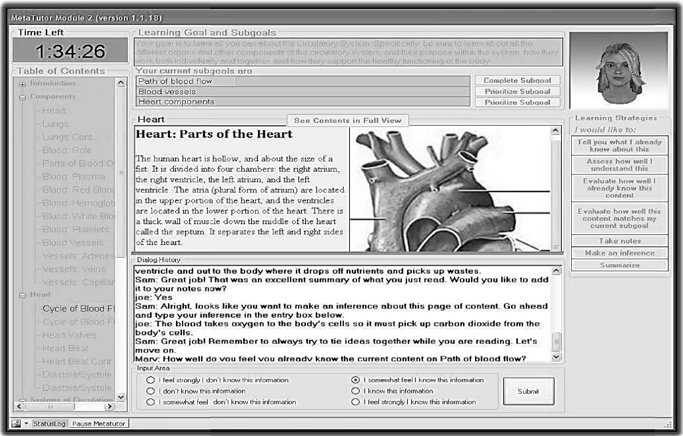
Co-adapted learning involves complex, dynamically unfolding interactions between human and artificial pedagogical agents (PAs) during learning with intelligent systems. In general, these interactions lead to effective learning when (1) learners correctly monitor and regulate their cognitive and metacognitive processes in response to internal (e.g., accurate metacognitive judgments followed by the selection of effective learning strategies) and external (e.g., response to agents' prompting and feedback) conditions, and (2) pedagogical agents can adequately and correctly detect, track, model, and foster learners' self-regulatory processes. In this study, we tested the effectiveness of PAs' prompting and feedback on learners' self-regulated learning about the human circulatory system with MetaTutor, an adaptive, multi-agent learning environment. Sixty-nine (N=69) undergraduates learned about the topic with MetaTutor, during a 2-hour session under one of three conditions: prompt and feedback (PF), prompt-only (PO), and no prompt (NP) condition. The PF condition received timely prompts from several pedagogical agents to deploy various SRL processes and received immediate directive feedback concerning the deployment of the processes. The PO condition received the same timely prompts, without feedback. Finally, the NP condition learned without assistance from the agents. Results indicate that those in the PF condition had significantly higher learning efficiency scores than those in both the PO and control conditions. In addition, log-file data provided evidence of the effectiveness of the PA's timely scaffolding and feedback in facilitating learners' (in the PF condition) metacognitive monitoring and regulation during learning.
Overview
The claims and statistics of this paper haven’t been checked yet.
Free: it reads the open-access text and checks the first 5 claims that cite a source we can check. Create a free account to check every claim.
Integrity signals
Registry
Cites
Statistics
Figures
Verification
Claims the paper makes
The claims and statistics of this paper haven’t been checked yet.
Free: it reads the open-access text and checks the first 5 claims that cite a source we can check. Create a free account to check every claim.
Claims other papers make about this one
Each is checked against this paper’s own text: does it say what the citing paper says it does?
In the citing paper
“In previous studies [2,29] with text-based pedagogical agents (e.g., MetaTutor), SRL strategies like scafolding building, self-explanation, self-assessment, and motivations have been used.”
From “A Painless Way to Learn:” Designing an Interactive Storytelling Voice User Interface to Engage Older Adults in Informal Health Information Learning (2023) · cites this paper as [2]
Self-check
Percentages, sums and reported differences re-computed from the paper’s own numbers.
The self-check needs the paper’s full text.
Citations
Cites
VanLEHN, K. (2011) · Educational Psychologist · doi:10.1080/00461520.2011.611369 · Cited by 2,323 · cited 1×
“Our study also contributes to an emerging body of evidence which illustrates the critical role of SRL in students’ learning with hypermedia [1,2,6,8,11], and extends recent research regarding the role of intelligent, adaptive scaffolding in facilitating students’ learning with hypermedia [13].”
ResultHandbook of Self-Regulation of Learning and Performance
Schunk, D. H. (2011) · Routledge eBooks · doi:10.4324/9780203839010 · Cited by 2,122
Handbook of Self-Regulation of Learning and Performance
(2017) · Routledge eBooks · doi:10.4324/9781315697048 · Cited by 1,816 · cited 1×
“The successful use of cognitive and metacognitive SRL processes involves setting meaningful goals for one’s learning, planning a course of action for attaining these goals, deploying a diverse set of effective learning strategies in pursuit of the goals, continuously monitoring one’s own understanding of the material…”
BackgroundHandbook of Metacognition in Education
Hacker, D. J., Dunlosky, J., & Graesser, A. C. (2009) · doi:10.4324/9780203876428 · Cited by 1,509
Dynamics of affective states during complex learning
D’Mello, S., & Graesser, A. (2012) · Learning and Instruction · doi:10.1016/j.learninstruc.2011.10.001 · Cited by 1,087 · cited 1×
“In addition, collecting various data streams is critical to enhancing our understanding of when, how, and why students regulate or don’t regulate their learning and adapt their regulatory behaviors [15,16,17].”
BackgroundSelf-Regulated, Co-Regulated, and Socially Shared Regulation of Learning
Hadwin, A. F., Järvelä, S., & Miller, M. (2015) · Handbook of Self-Regulation of Learning and Performance · doi:10.4324/9780203839010.ch5 · Cited by 506
International Handbook of Metacognition and Learning Technologies
(2013) · Springer International Handbooks of Education · doi:10.1007/978-1-4419-5546-3 · Cited by 403
Self-citationAZEVEDO, R., MOOS, D. C., JOHNSON, A. M., & CHAUNCEY, A. D. (2010) · Educational Psychologist · doi:10.1080/00461520.2010.515934 · Cited by 324
Self-citationDesigning Learning by Teaching Agents: The Betty's Brain System
Leelawong, K., & Biswas, G. (2008) · International Journal of Artificial Intelligence in Education · doi:10.3233/irg-2008-18(3)02 · Cited by 311 · cited 5×
“Learners attempting to self-regulate often face limitations in their own metacognitive skills, which, when compounded with lack of domain knowledge, can result in cognitive overload in open-ended learning environments [7,8,9].”
BackgroundResultInfluentialNew Perspectives on Affect and Learning Technologies
(2011) · Springer eBooks · doi:10.1007/978-1-4419-9625-1 · Cited by 173
Research works printed but not linked: 2
- White, B., Frederiksen, J., Collins, A.: The interplay of scientific inquiry and metacogni- tion: More than a marriage of convenience. In: Hacker, D.J., Dunlosky, J., Graesser, A.C. (eds.) Handbook of Metacognition in Education, pp. 175-205. Routledge, New York (2009)
- Azevedo, R., Witherspoon, A.M.: Self-regulated use of hypermedia. In: Hacker, D.J., Dun- losky, J., Graesser, A.C. (eds.) Handbook of Metacognition in Education, pp. 319-339. Routledge, New York (2009)
Cited by
AutoTutor and Family: A Review of 17 Years of Natural Language Tutoring
Nye, B. D., Graesser, A. C., & Hu, X. (2014) · International Journal of Artificial Intelligence in Education · doi:10.1007/s40593-014-0029-5 · Cited by 286
“Azevedo et al. (2012) reported higher learning efficiency when tutors assisted students with prompts and feedback as they explored the hypermedia pages (0.84σ).”
BackgroundHelp Helps, But Only So Much: Research on Help Seeking with Intelligent Tutoring Systems
Aleven, V., Roll, I., McLaren, B. M., & Koedinger, K. R. (2016) · International Journal of Artificial Intelligence in Education · doi:10.1007/s40593-015-0089-1 · Cited by 255
“Our hunch is that it will be useful to take a more comprehensive view of self-regulation, as a number of researchers have started to do, and study multiple SRL constructs in conjunction, consistent with SRL theories (Azevedo et al. 2012; Kinnebrew et al. 2013; Long and Aleven 2013b; Poitras and Lajoie 2013; Roll et al…”
ResultConversational Agents: Goals, Technologies, Vision and Challenges
Allouch, M., Azaria, A., & Azoulay, R. (2021) · Sensors · doi:10.3390/s21248448 · Cited by 168
“The smart-learning environment may involve task assignments adapted to the learner’s abilities [122], smart hints and feedbacks [123], smart guidance during the learning process [124], and personalized conversational agents who assist in the learning process [125].”
BackgroundAzevedo, R., Harley, J. M., Trevors, G., Duffy, M. C., Feyzi-Behnagh, R., Bouchet, F., & Landis, R. S. (2013) · Springer international handbooks of education · doi:10.1007/978-1-4419-5546-3_28 · Cited by 190
Self-citationTaub, M., Azevedo, R., Bouchet, F., & Khosravifar, B. (2014) · Computers in Human Behavior · doi:10.1016/j.chb.2014.07.018 · Cited by 184
“In contrast, the MetaTutor (Azevedo et al., 2012a) learning session lasts for one hour.”
BackgroundMethodInfluentialSelf-citationBouchet, F., Harley, J. M., Trevors, G., & Azevedo, R. (2013) · Journal of Educational Data Mining · doi:10.5281/zenodo.3554613 · Cited by 133
“…learning environments are predicated on the extent to which they can systematically and dynamically adapt their scaffolding of key SRL processes to the diverse needs of learners [Azevedo et al. 2012; Biswas et al. 2010; Graesser et al. in press; McGuiggan and Lester 2009; White et al. 2009].”
BackgroundMethodResultInfluentialSelf-citationSabourin, J. L., Shores, L. R., Mott, B. W., & Lester, J. C. (2013) · International Journal of Artificial Intelligence in Education · doi:10.1007/s40593-013-0004-6 · Cited by 91
“Further studies have examined the role of prompts encouraging students to set and monitor specific learning goals (Azevedo et al. 2012).”
BackgroundWhat can moment-by-moment learning curves tell about students’ self-regulated learning?
Molenaar, I., Horvers, A., & Baker, R. S. (2021) · Learning and Instruction · doi:10.1016/j.learninstruc.2019.05.003 · Cited by 77
Supporting learning from text: A meta-analysis on the timing and content of effective feedback
Swart, E. K., Nielen, T. M. J., & Sikkema - de Jong, M. T. (2019) · Educational Research Review · doi:10.1016/j.edurev.2019.100296 · Cited by 68
Bondareva, D., Conati, C., Feyzi-Behnagh, R., Harley, J. M., Azevedo, R., & Bouchet, F. (2013) · Lecture notes in computer science · doi:10.1007/978-3-642-39112-5_24 · Cited by 66
“A study was conducted in 2012 with the goal of collecting multi-channel data to examine the role of cognitive, metacognitive, and affective processes during learning with MetaTutor [12].”
BackgroundSelf-citationHarley, J. M., Taub, M., Azevedo, R., & Bouchet, F. (2018) · IEEE Transactions on Learning Technologies · doi:10.1109/tlt.2017.2756629 · Cited by 64
“Other studies have, however, found that differences between the PF and control conditions for learning outcomes with the version of MetaTutor examined in this study were not significant [55].”
BackgroundResultSelf-citationDever, D. A., Sonnenfeld, N. A., Wiedbusch, M. D., Schmorrow, S. G., Amon, M. J., & Azevedo, R. (2023) · Metacognition and Learning · doi:10.1007/s11409-023-09346-x · Cited by 83
“Within MetaTutor, planning strategies were enacted when learners set goals and subgoals.”
BackgroundInfluentialSelf-citationMultiple Agent Designs in Conversational Intelligent Tutoring Systems
Lippert, A., Shubeck, K. T., Morgan, B., Hampton, A. J., & Graesser, A. C. (2019) · Technology Knowledge and Learning · doi:10.1007/s10758-019-09431-8 · Cited by 71
“When this feedback is adaptive and designed to regulate learning, it facilitates learning (Azevedo et al. 2012) and produces higher learning gains than feed-back from single agent designs (Martin et al. 2016).”
BackgroundLavoué, É., Molinari, G., Prié, Y., & Khezami, S. (2015) · Computers & Education · doi:10.1016/j.compedu.2015.05.001 · Cited by 45
“The MetaTutor platform (Azevedo, Witherspoon, Chauncey, Burkett, & Fike, 2009; Azevedo et al., 2012) offers an adaptive scaffolding and feedback provided by a human tutor or a pedagogical agent that leads to greater deployment of sophisticated planning processes, meta-cognitive monitoring…”
MethodMultimedia Learning of Metacognitive Strategies
Azevedo, R. (2014) · Cambridge University Press eBooks · doi:10.1017/cbo9781139547369.032 · Cited by 34
Self-citationTemporal Aspects of Learning Analytics - Grounding Analyses in Concepts of Time
Molenaar, I., & Wise, A. F. (2022) · Solar eBooks · doi:10.18608/hla22.007 · Cited by 37
Desai, S., Lundy, M., & Chin, J. (2023) · Proceedings of the 5th International Conference on Conversational User Interfaces · doi:10.1145/3571884.3597141 · Cited by 25
“In previous studies [2, 29] with text-based pedagogical agents (e.”
BackgroundBouchet, F., Harley, J. M., & Azevedo, R. (2016) · Lecture notes in computer science · doi:10.1007/978-3-319-39583-8_43 · Cited by 27
“MetaTutor [6] is an intelligent, hypermedia learning environment in which four embedded PAs help the student learn by prompting them to engage in SRL processes (cf.”
BackgroundSelf-citationMolenaar, I., Horvers, A., & Baker, R. S. (2019) · International Conference on Learning Analytics and Knowledge (LAK) · doi:10.1145/3303772.3303780 · Cited by 42
“, prompts [9], scaffolding [33], intelligent tutor systems [4]) are used to assist learners’ in regulating their learning.”
A Model-Based Behavior Analysis Approach for Open-Ended Environments
Segedy, J. R., Biswas, G., & Sulcer, B. (2014) · Educational Technology & Society · Cited by 28
Modeling Student Learning Behavior Patterns in an Online Science Inquiry Environment
Brenner, D. G., Matlen, B. J., Timms, M. J., Gochyyev, P., Grillo-Hill, A., Luttgen, K., & Varfolomeeva, M. (2017) · Technology Knowledge and Learning · doi:10.1007/s10758-017-9325-0 · Cited by 22
“As Aleven et al. point out, other researchers have started to examine these various aspects of self-regulated learning (e.g., Azevedo et al. 2012; Kinnebrew et al. 2014; Long and Aleven 2013; Poitras and Lajoie 2013; Roll et al. 2012; Sabourin et al. 2013).”
BackgroundRaedts, M., Steendam, E. V., Grez, L. D., Hendrickx, J., & Masui, C. (2017) · Journal of Writing Research · doi:10.17239/jowr-2017.08.03.01 · Cited by 31
Facial Emotion Detection in Massive Open Online Courses
Soltani, M., Zarzour, H., & Babahenini, M. C. (2018) · Advances in intelligent systems and computing · doi:10.1007/978-3-319-77703-0_28 · Cited by 21
There Are Multiple Paths to Personalized Education, and They Should Be Combined
Brod, G. (2024) · Current Directions in Psychological Science · doi:10.1177/09637214241242459 · Cited by 25
Utilizing Dynamic Bayes Nets to Improve Early Prediction Models of Self-regulated Learning
Sabourin, J. L., Mott, B., & Lester, J. C. (2013) · Lecture notes in computer science · doi:10.1007/978-3-642-38844-6_19 · Cited by 20
“For example, in MetaTutor, a hypermedia environment for learning biology, think-aloud protocols have been used to examine which regulatory strategies students use, while analysis of students’ navigation through the hypermedia environment helps to identify profiles of self-regulated learners [24, 25].”
BackgroundMultimedia Learning with Animated Pedagogical Agents
Wang, F., Li, W., & Zhao, T. (2021) · Cambridge University Press eBooks · doi:10.1017/9781108894333.047 · Cited by 15
Alexiou, A., & Paraskeva, F. (2020) · International Journal of Information and Learning Technology · doi:10.1108/ijilt-12-2019-0120 · Cited by 25
Harley, J. M., & Azevedo, R. (2014) · International Journal of Gaming and Computer-Mediated Simulations · doi:10.4018/ijgcms.2014070102 · Cited by 15
Self-citationGuided Skill Practice as an Adaptive Scaffolding Strategy in Open-Ended Learning Environments
Segedy, J. R., Biswas, G., Blackstock, E., & Jenkins, A. T. (2013) · Lecture notes in computer science · doi:10.1007/978-3-642-39112-5_54 · Cited by 15
“Examples include hypermedia and modeling and simulation learning environments [3-4].”
BackgroundDEBE feedback for large lecture classroom analytics
Mitra, R., & Chavan, P. (2019) · International Conference on Learning Analytics and Knowledge (LAK) · doi:10.1145/3303772.3303821 · Cited by 10
“Consequently, the focus of research in LA has been mostly on online learning environments and student facing tools [3, 19].”
BackgroundCognitive Ability-Demand Gap Analysis With Latent Response Models
Hossain, G., & Yeasin, M. (2014) · IEEE Access · doi:10.1109/access.2014.2339328 · Cited by 8
“The ability-demand gap paradigm can be used with assistive intelligent tutoring system [17], multimodal user interface in crisis management [23], brain computer interfacing research [24], assistive technology design [15] and collaborative sense-making [12], [13].”
BackgroundSelf-citationTeachable Agents with Intrinsic Motivation
Borjigin, A., Miao, C., Lim, S. F., Li, S., & Shen, Z. (2015) · Lecture notes in computer science · doi:10.1007/978-3-319-19773-9_4 · Cited by 8
“[8] studied how to design dynamic prompting and feedback to improve students’ learning efficiency.”
BackgroundAdaptive Scaffolds in Open-Ended Computer-Based Learning Environments
Segedy, J. R. (2014) · Cited by 14
Becker, F., Wirzberger, M., Pammer-Schindler, V., Srinivas, S., & Lieder, F. (2023) · Judgment and Decision Making · doi:10.1017/jdm.2023.16 · Cited by 6
“…on behavior improves subsequent behavior (Ellis et al., 2014), and about helping students reflect on and regulate their study behavior through prompting and learning analytics (e.g., Azevedo, 2005; Azevedo et al., 2012; Bannert et al., 2009; Bannert and Reimann, 2012; Hilliger et al., 2020).”
BackgroundSmart Open-Ended Learning Environments That Support Learners Cognitive and Metacognitive Processes
Biswas, G., Segedy, J. R., & Kinnebrew, J. S. (2013) · Lecture notes in computer science · doi:10.1007/978-3-642-39146-0_27 · Cited by 10
“Learners with poor selfjudgment abilities often resort to suboptimal strategies in performing their tasks [6,7].”
BackgroundAnalyzing Students' Metacognitive Strategies in Open-Ended Learning Environments
Biswas, G., Kinnebrew, J. S., & Segedy, J. R. (2013) · eScholarship (California Digital Library) · Cited by 5
Adaptive Scaffolds in Open-Ended Learning Environments
Segedy, J. R. (2013) · Lecture notes in computer science · doi:10.1007/978-3-642-39112-5_139 · Cited by 6
An Affective Tutoring System for Massive Open Online Courses
Soltani, M., Zarzour, H., Babahenini, M. C., & Chemam, C. (2019) · Smart innovation, systems and technologies · doi:10.1007/978-3-030-21005-2_20 · Cited by 5
The MindfulMath Tutor: A Mindfulness-Infused Learning Environment to Battle Math Anxiety
Hladký, M., Silber, M., & Nagashima, T. (2025) · CHI Conference Extended Abstracts on Human Factors in Computing Systems (CHI EA) · doi:10.1145/3706599.3719922 · Cited by 8
Knowledge Inference Models Used in Adaptive Learning
Pedro, M. O. Z. S., & Baker, R. S. (2021) · Methodology of educational measurement and assessment · doi:10.1007/978-3-030-74394-9_5 · Cited by 4
Sergent, T., Daniel, M., Bouchet, F., & Carron, T. (2024) · IEEE Transactions on Learning Technologies · doi:10.1109/tlt.2024.3360121 · Cited by 6
Self-citationSidekick: A Tool for Helping Students Manage Behavior in Self-initiated Learning Scenarios
Inventado, P. S., Legaspi, R., Moriyama, K., Fukui, K., & Numao, M. (2014) · International Journal of Distance Education Technologies · doi:10.4018/ijdet.2014100103 · Cited by 3
Privitera, A. J., Ng, S. H. S., & Chen, S. A. (2025) · Neuroscience & Biobehavioral Reviews · doi:10.1016/j.neubiorev.2025.106281 · Cited by 4
WIP: CyberSkiller: Empowering STEM Undergraduates for the Future of Cybersecurity
Hossain, G., & Kinshuk, K. (2024) · IEEE Frontiers in Education Conference (FIE) · doi:10.1109/fie61694.2024.10893186 · Cited by 2
“Investigation on various intelligent tutoring systems, such as AutoTutor [4, 5], MetaTutor [6, 7], Deep Tutor [8], and a virtual reality-based tutor [9] show that such tutors are capable of enhancing the training effectiveness .”
Self-citationMultimedia Learning with Media
Mayer, R. E., & Fiorella, L. (2021) · Cambridge University Press eBooks · doi:10.1017/9781108894333.045 · Cited by 2
The Role of Pedagogical Agents on Learning: Issues and Trends
Taub, M., Martin, S. A., Azevedo, R., & Mudrick, N. V. (2016) · Advances in game-based learning book series · doi:10.4018/978-1-5225-0125-1.ch015 · Cited by 1
“…have determined that students often require assistance when learning complex topics (e.g., Azevedo, Moos, Johnson, & Chauncey, 2010), and thus, researchers have been developing virtual and hypermedia learning environments to help foster students’ learning of various topics (Azevedo et al., 2012b).”
BackgroundSelf-citationJucks, R., Brummernhenrich, B., Becker, B.-M., & Bromme, R. (2014) · Swiss Journal of Psychology · doi:10.1024/1421-0185/a000135
BUILDING POLICIES FOR SUPPORTIVE FEEDBACK IN SELF-DIRECTED LEARNING SCENARIOS
Inventado, P. S., Legaspi, R., Moriyama, K., Fukui, K., & Numao, M. (2014) · Workshop on Computation: Theory and Practice (WCTP) · doi:10.1142/9789814612883_0010
Predicting affect in an Intelligent Tutoring System
Jaques, N. (2014) · cIRcle (University of British Columbia) · doi:10.14288/1.0135541 · Cited by 2
“We report classification results in terms of both accuracy (percentage of correctly classified data points), as well as Cohen‘s kappa, a measure of classification performance that accounts for correct predictions occurring by chance [8].”
MethodInfluentialWang, C., Rowe, G. B., Giacaman, N., & Gunn, C. (2014) · 25th Annual Conference of the Australasian Association for Engineering Education : Engineering the Knowledge Economy: Collaboration, Engagement & Employability
Possible approaches to personalisation at Cass Business School
Rich, M., Newman, D. R., Brown, S. A., Joshi, Y., Eyt-Dessus, A., & Mandal, A. K. (2014) · City Research Online (City University London)
Lavoué, É., Molinari, G., Prié, Y., & Khezami, S. (2015) · arXiv (Cornell University) · doi:10.48550/arxiv.1505.04609
“The MetaTutor platform (Azevedo, Witherspoon, Chauncey, Burkett, & Fike, 2009; Azevedo et al., 2012) offers an adaptive scaffolding and feedback provided by a human tutor or a pedagogical agent that leads to greater deployment of sophisticated planning processes, meta-cognitive monitoring…”
MethodHarley, J. M., & Azevedo, R. (2015) · IGI Global eBooks · doi:10.4018/978-1-4666-8200-9.ch108
Self-citationYang, B. N. (2019) · Digital Repository Service (Northeastern University) · doi:10.17760/d20316549 · Cited by 3
Bagthariya, R. (2021) · IAAR Journal of Education Peer-Reviewed Journal · doi:10.58213/education.v3i1.20
Uncovering Key Cognitive Traits for Placement Success: A Multi-Dimensional Data Mining Approach
Kumar, D. V. H. V., Deepthi, R., Godi, S., Hota, C. P. P. K., Babu, P. V., & V.Priyadarshani (2025) · International Conference on Evolutionary Computing and Mobile Sustainable Networks (ICECMSN) · doi:10.1109/icecmsn68058.2025.11382563
“HURAA[32] is an ethical reasoning in human experiments using hypertext multimedia. iDRIVE is deep reasoning in vicarious learning settings. iSTART[34] and its improved variant, iSTART-ME[35], is concerned with reading comprehension by use of interactive playing.”
Urgo, K., Arguello, J., & Capra, R. (2026) · Conference on Human Information Interaction and Retrieval · doi:10.1145/3786304.3787890 · Cited by 2
“Studies have investigated the extent to which students engage in specific SRL processes [10, 17], the effects of SRL processes on learning [27, 28, 43, 44], and the effects of tools to encourage and support effective SRL engagement [1, 2].”
Manchem, S. R., Dash, S., & Rao, M. J. (2025) · Global AI Summit - International Conference on Artificial Intelligence and Emerging Technology (AI Summit) · doi:10.1109/aisummit66170.2025.11411579 · Cited by 5
“HURAA[22] ethical reasoning is trained in human experiments using hypertext multimedia, iDRIVE trains deep reasoning in vicarious learning environments, and iSTART[23] and its improvement, iSTART-ME[24], is concerned with reading comprehension using interactive gaming.”
Modelling communicative behaviours for different roles of pedagogical agents
Krishna, S. (2021) · theses.fr (ABES) · doi:10.70675/f8e9d4b6z9585z4883z8fa1z2afa484bd27b · Cited by 1
Metadata
- Authors
- Azevedo, R., Landis, R. S., Feyzi-Behnagh, R., Duffy, M., Trevors, G., Harley, J. M., Bouchet, F., Burlison, J., Taub, M., Pacampara, N., Yeasin, M., Rahman, A. K. M. M., Tanveer, M. I., & Hossain, G.
- Affiliations
- McGill University (CA)
- Illinois Institute of Technology (US)
- University of Memphis (US)
- Corresponding author
- Azevedo, Roger
- ORCID
- Venue
- Lecture Notes in Computer Science
- Publisher
- Springer Berlin Heidelberg
- Published
- 2012
- Pages
- 212-221
- ISSN
- 0302-9743 (ISSN-L)
- 1611-3349
- OpenAlex
- W2196092571
- Cited by
- 58
- References
- 22
- Citations by year
- 2026: 1 · 2025: 4 · 2024: 3 · 2023: 3 · 2022: 1 · 2021: 6 · 2020: 1 · 2019: 6 · 2018: 1 · 2017: 3 · 2016: 3 · 2015: 4 · 2014: 13 · 2013: 9
- FWCI
- 6.38
- Type
- conference paper
- Language
- en
- Open access
- green
- hdl.handle.net
- Licence
- cc-by-nc-nd
- Locations
- Lecture notes in computer science (publishedVersion)
- eScholarship@McGill (McGill) (submittedVersion, cc-by-nc-nd)
- Lecture notes in computer science
- Funders
- National Science Foundation (0841835, 1008282, 0633918)
- Topics
- Physical Sciences › Computer Science › Artificial Intelligence › Intelligent Tutoring Systems and Adaptive Learning
- Social Sciences › Psychology › Developmental and Educational Psychology › Innovative Teaching and Learning Methods
- Social Sciences › Psychology › Experimental and Cognitive Psychology › Visual and Cognitive Learning Processes
- Keywords
- educational agents, prompting, feedback, student self-regulation, metacognition, adaptive learning systems, scaffolding, cardiovascular system, learning efficiency
About these checks
Registry, retraction, Cites and statistics results are computed, not judged, with one exception: a printed reference that no index lists is read once by a model before it counts as a citation error. Claims are extracted by a model and kept only when their quote appears verbatim in the text; each cited source is then checked, with a model’s help, for whether it says what the claim relies on. Those verdicts can be wrong — read the claim’s quote and the cited source before relying on one.
Statistics and arithmetic are recomputed, not judged.
Confidence bands are shown only for fields calibrated on our annotated test set. None is calibrated yet, so no band is shown.
What counts as a claim ›How we measure confidence ›How we check this ›
Are you an author, or do you see a problem with this page? Request a review
Data sources
Bibliographic data: Semantic Scholar, OpenAlex, Crossref.
Contains information from the Semantic Scholar Academic Graph Datasets, made available under the ODC Attribution License (ODC-BY 1.0).
Semantic Scholar’s data is described in: Kinney, R., et al. (2023). The Semantic Scholar Open Data Platform. arXiv:2301.10140.
