

Replica wormholes for an evaporating 2D black hole
Open accessThe DOI matches its Crossref record; 118 of the 125 references it cites were found in a registry or an index; 86 of the 90 sources its claims cite were checked for support.
Abstract
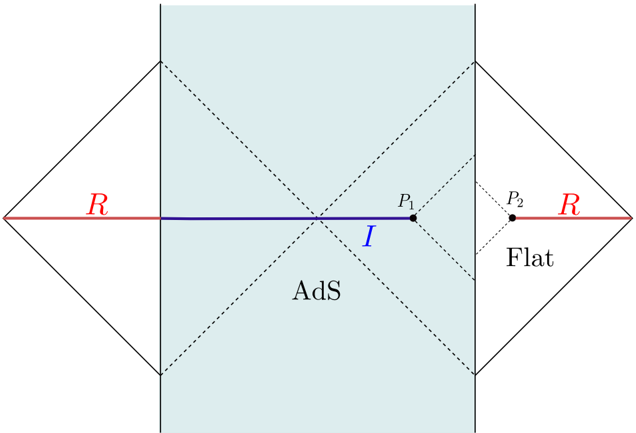
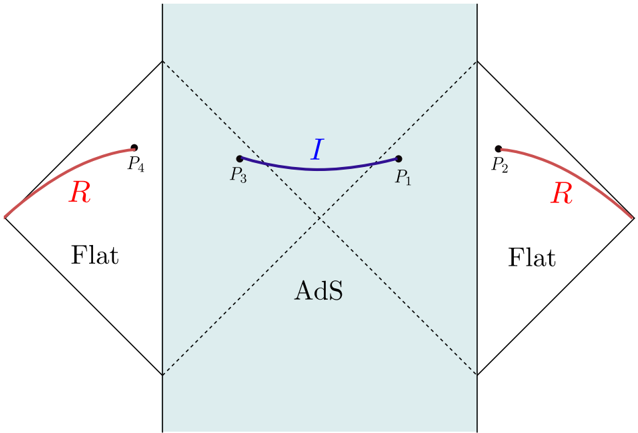
A bstract Quantum extremal islands reproduce the unitary Page curve of an evaporating black hole. This has been derived by including replica wormholes in the gravitational path integral, but for the transient, evaporating black holes most relevant to Hawking’s paradox, these wormholes have not been analyzed in any detail. In this paper we study replica wormholes for black holes formed by gravitational collapse in Jackiw-Teitelboim gravity, and confirm that they lead to the island rule for the entropy. The main technical challenge is that replica wormholes rely on a Euclidean path integral, while the quantum extremal islands of an evaporating black hole exist only in Lorentzian signature. Furthermore, the Euclidean equations for the Schwarzian mode are non-local, so it is unclear how to connect to the local, Lorentzian dynamics of an evaporating black hole. We address these issues with Schwinger-Keldysh techniques and show how the non-local equations reduce to the local ‘boundary particle’ description in special cases.
Overview
CoChat Summary
TL;DR
The paper analyzes replica wormholes for an evaporating two-dimensional black hole in JT gravity coupled to a CFT, using Euclidean path integrals, conformal welding, and Schwinger-Keldysh techniques. It confirms that the replica equations lead to the island rule and the unitary Page curve for a black hole formed by gravitational collapse.
Key findings
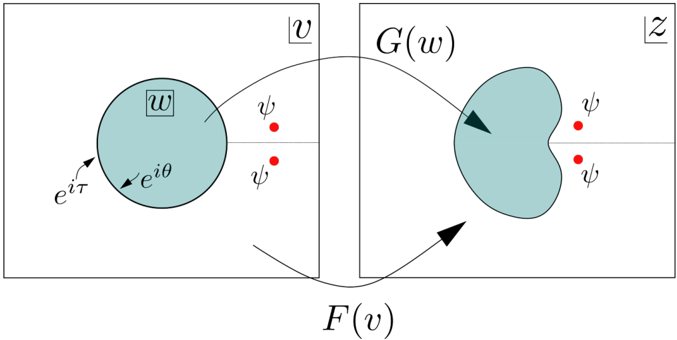
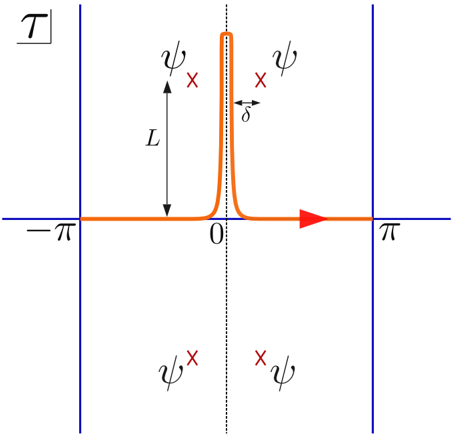
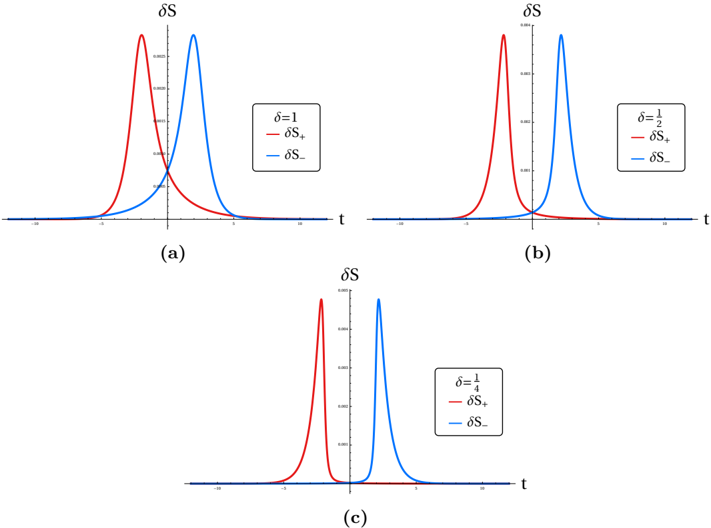
- The Euclidean non-local conformal welding equations become exactly solvable in the \(\delta \to 0\) shockwave limit and reduce to the local Lorentzian Schwarzian “boundary particle” equations used in earlier work.
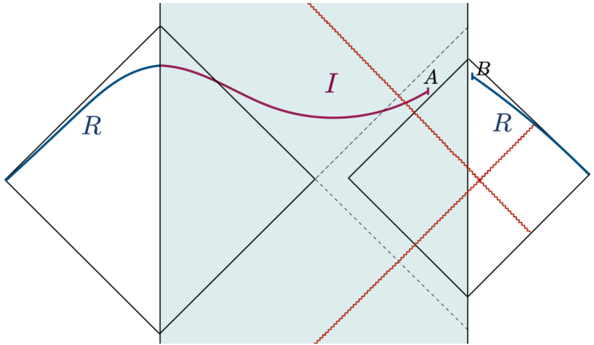
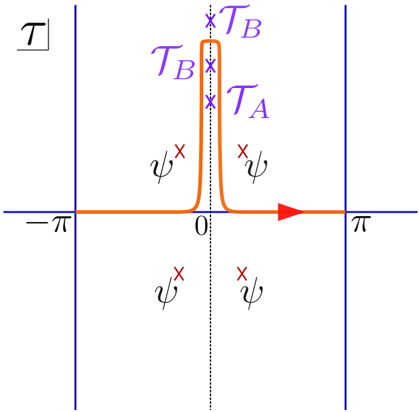
- The replica equations for the Schwarzian theory on a Schwinger-Keldysh contour yield the quantum extremal surface conditions \(\partial_A(\phi/4G_N + S_{\rm CFT}) = \partial_{\bar A}(\phi/4G_N + S_{\rm CFT}) = 0\), and the gravitational Ward identity then gives \(S = S_{\rm CFT} + \phi/4G_N\), i.e. the island formula.
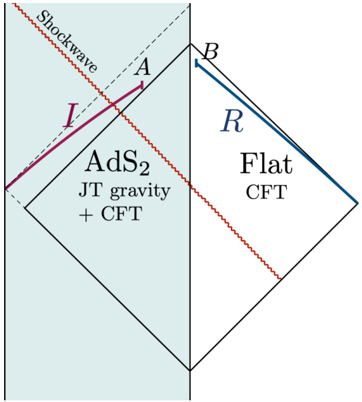
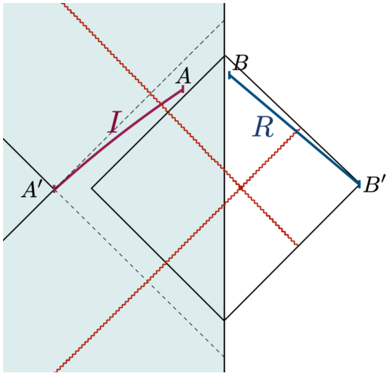
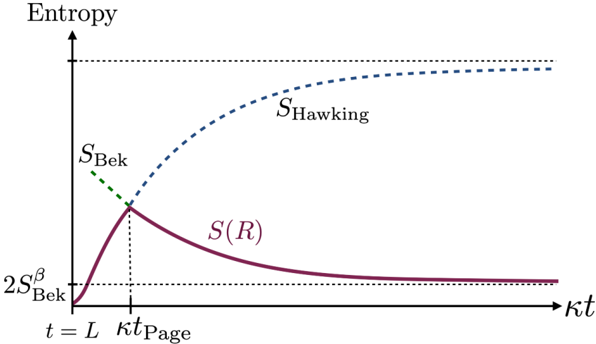
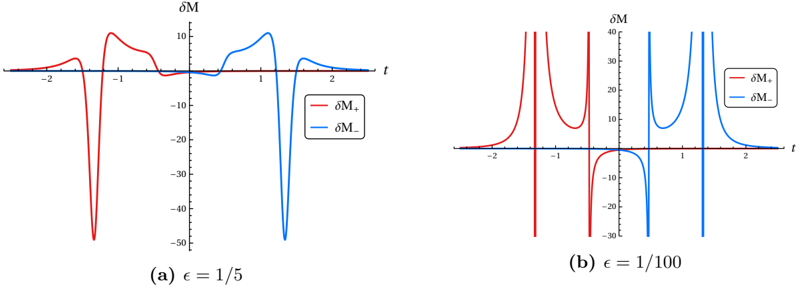
- For the evaporating shockwave, in the weak-gravity limit \(\kappa \ll 1\), \(c \gg 1\), with \(\kappa E_\psi/c\) fixed, the right QES has a scrambling-time delay \(y_A^+ \sim t - \frac{1}{2\pi T(t)}\log\frac{16(S_{\rm Bek}(t)-S_0)}{c}\); after the Page time \(S(R) \approx S_{\rm BH}\), giving the unitary Page curve.
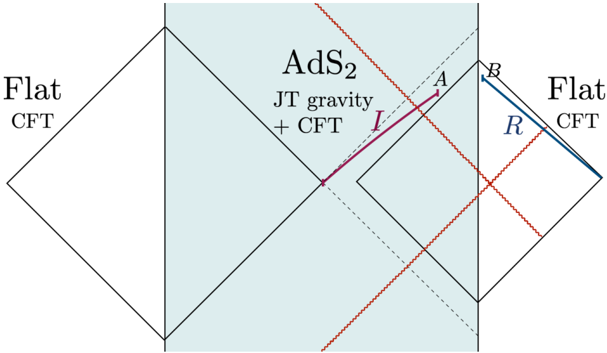
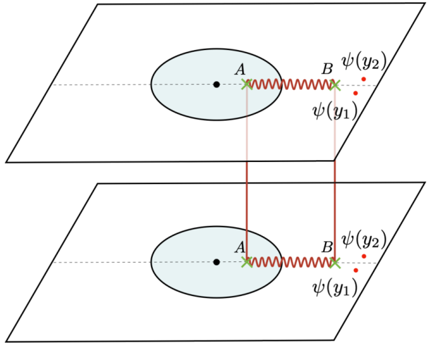
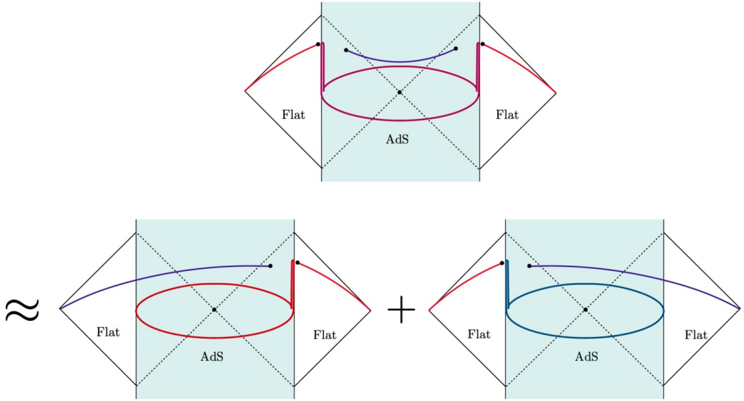
- The two-interval replica wormhole for an eternal black hole at late times factorizes into two copies of the one-interval solution, confirming the OPE factorization assumption needed for the eternal-black-hole information paradox.
Methods
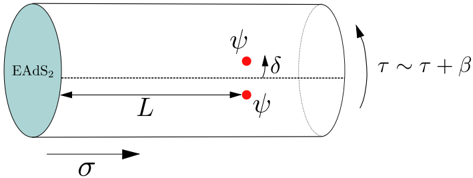
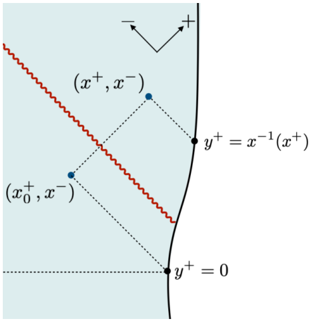
- JT gravity in AdS\(_2\) coupled to a large-\(N\) CFT and glued to a non-dynamical flat bath; the black hole is formed by a shockwave from local operator insertions \(\psi(y_1)\psi(y_2)\) smeared over width \(\delta\), with \(E_\psi = h_\psi/\delta\), at finite inverse temperature \(\beta\).
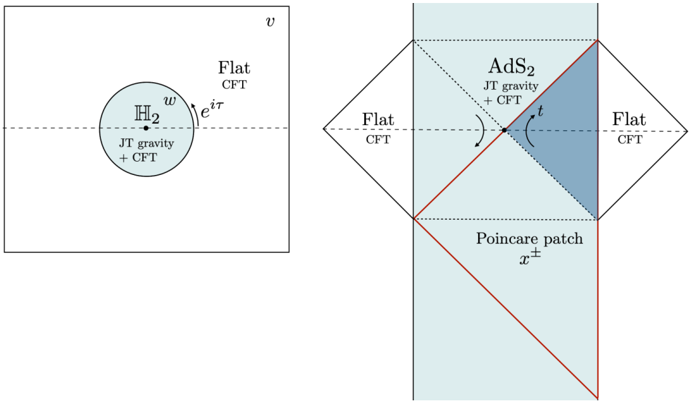
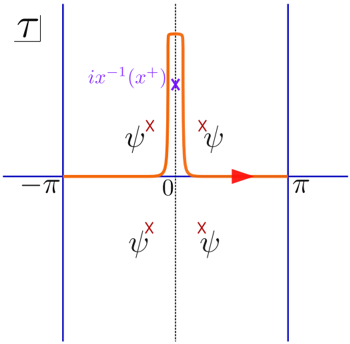
- Euclidean path integral and conformal welding are analytically continued to Lorentzian signature; replica equations are written on a Schwinger-Keldysh contour and solved for \(n \sim 1\) and \(\delta \to 0\).
- The QES and entropy are derived from the Schwarzian replica equations and a CFT-plus-gravity Ward identity; factorization of the matter entropy is checked in an appendix, including an explicit free Dirac fermion example.
Limitations
- The paper states that, as with other replica derivations of gravitational entropy, the calculation computes entropy without identifying the microstates responsible or whether such microstates exist.
- The paper states that the finite-\(\delta\) equations are non-local and generally not solved analytically; the main simplification uses \(\delta \to 0\), \(n \sim 1\), and the weak-gravity regime \(\kappa \ll 1\), \(c \gg 1\), with \(\kappa E_\psi/c\) fixed.
- The paper notes that replica-symmetric contributions are assumed dominant away from the Page transition, and that a better understanding of the two-interval replica manifold and its moduli is left for future work; the text also makes evident that factorization checks are performed in specific limits or examples rather than fully generally.
Model-written summary. Check it against the paper before relying on it.
Integrity signals
Registry
Cites
Statistics
Figures
Verification
Claims the paper makes
41 Valid · 6 Not valid · 6 Not checked · 188 Own results and interpretations
The cited sources support only part of this claim — read each source’s verdict below.
In the paper
“The answer we will find is that as δ → 0, the conformal welding equations have an exact nonlinear solution in Lorentzian signature that agrees with [1].”
§ Replica wormholes for an evaporating 2D black hole > JHEP04(2021)289
What the sources say
- Partly supportedcites [1] 1. A. Almheiri, N. Engelhardt, D. Marolf and H. Maxfield, The entropy of bulk quantum fields and the entanglement wedge of an evaporating black hole, JHEP 12 (2019) 063 [arXiv:1905.08762] [INSPIRE]. sourceExperimental — accuracy not yet measured
The paper derives a Lorentzian boundary reparameterization for an evaporating black hole in its evaporation analysis (eqs. 2.17–2.20) and gives a conformal coordinate map in eq. 3.5. These provide a plausible result for the citing authors’ solution to agree with, but our copy does not identify it as an exact nonlinear solution of conformal welding equations or discuss a δ → 0 limit. (LLM, conf=0.78)
plainstates an association- Asserted: passes — The authors put it forward as true.
- Checkable: passes — It can be checked against evidence.
- Load-bearing: passes — The paper’s conclusions depend on it.
- Based: passes — The paper gives a reason why it holds.
- Partly supported
Every source the paper cites for this claim was checked and supports it.
In the paper
“For t > 0, this solution is nearly identical to the evaporating black hole studied in [1] (AEMM).”
§ Replica wormholes for an evaporating 2D black hole > 1.1 Summary
What the sources say
- Supportedcites [1] 1. A. Almheiri, N. Engelhardt, D. Marolf and H. Maxfield, The entropy of bulk quantum fields and the entanglement wedge of an evaporating black hole, JHEP 12 (2019) 063 [arXiv:1905.08762] [INSPIRE]. source
Section 2.2 describes coupling the black hole to an external bath to evaporate it. The discussion of positive-time evolution in section 2 identifies the cited work as the evaporating-black-hole study referred to as AEMM; the comparison with the citing paper’s own solution is the citing authors’ characterization. (LLM, conf=0.88)
plain- Asserted: passes — The authors put it forward as true.
- Checkable: passes — It can be checked against evidence.
- Load-bearing: passes — The paper’s conclusions depend on it.
- Based: passes — The paper gives a reason why it holds.
- Supported
The cited sources support only part of this claim — read each source’s verdict below.
In the paper
“The theory is JT gravity in AdS 2 coupled to a large-N CFT, glued to a flat spacetime as in [1,42].”
§ Replica wormholes for an evaporating 2D black hole > 1.1 Summary
What the sources say
- Partly supportedcites [1] 1. A. Almheiri, N. Engelhardt, D. Marolf and H. Maxfield, The entropy of bulk quantum fields and the entanglement wedge of an evaporating black hole, JHEP 12 (2019) 063 [arXiv:1905.08762] [INSPIRE]. sourceExperimental — accuracy not yet measured
Section 2.1 describes JT gravity coupled to conformal matter in locally AdS2, and the paper’s model description says the AdS2 boundary is glued to a CFT bath on Minkowski space. Our copy does not establish that the CFT is large-N, so that qualifier is unsupported. (LLM, conf=0.82)
- Partly supportedcites [42] 42. J. Engelsöy, T.G. Mertens and H. Verlinde, An investigation of AdS 2 backreaction and holography, JHEP 07 (2016) 139 [arXiv:1606.03438] [INSPIRE]. JHEP04(2021)289 sourceExperimental — accuracy not yet measured
Section 2 describes JT gravity in AdS₂ coupled to matter, and section 4.1 discusses the matter as a CFT. Section 6.2 describes a CFT on flat spacetime as a way to view an effective Hamiltonian, but does not say that flat spacetime is glued to the AdS₂ region; the cited passages also do not establish a large-N CFT. No page numbers are available in our copy. (LLM, conf=0.85)
plain- Asserted: passes — The authors put it forward as true.
- Checkable: passes — It can be checked against evidence.
- Load-bearing: passes — The paper’s conclusions depend on it.
- Based: passes — The paper gives a reason why it holds.
- Partly supported
Every source the paper cites for this claim was checked and supports it.
In the paper
“This turns out to reproduce the local Lorentzian equations for the Schwarzian 'boundary particle' derived in [41,42] and studied in AEMM [1].”
§ Replica wormholes for an evaporating 2D black hole > JHEP04(2021)289
What the sources say
- Supportedcites [41] 41. J. Maldacena, D. Stanford and Z. Yang, Conformal symmetry and its breaking in two dimensional Nearly Anti-de-Sitter space, PTEP 2016 (2016) 12C104 [arXiv:1606.01857] [INSPIRE]. source
Section 3 derives the boundary Schwarzian equation of motion (3.10). Section 5.1 (p. 12/26) gives the Lorentzian Schwarzian action and its fluctuation solutions. These support the attribution that this paper derives local Lorentzian equations for the boundary degree of freedom; whether the citing paper’s scaling limit reproduces them is its own conclusion. (LLM, conf=0.90)
- Supportedcites [42] 42. J. Engelsöy, T.G. Mertens and H. Verlinde, An investigation of AdS 2 backreaction and holography, JHEP 07 (2016) 139 [arXiv:1606.03438] [INSPIRE]. JHEP04(2021)289 source
Section 3.1 derives a local equation of motion for the dynamical boundary time, and Section 4 gives a Schwarzian action for that boundary dynamics. This supports the attribution that the cited paper studied the Schwarzian boundary equations. The citing authors’ claim about their own scaling limit is not attributed to this source. (LLM, conf=0.91)
- Supportedcites [1] 1. A. Almheiri, N. Engelhardt, D. Marolf and H. Maxfield, The entropy of bulk quantum fields and the entanglement wedge of an evaporating black hole, JHEP 12 (2019) 063 [arXiv:1905.08762] [INSPIRE]. source
The paper’s discussion around eqs. (2.7)–(2.9) identifies the Schwarzian action and the trajectory of the ‘boundary particle.’ It then gives an equation for that trajectory in eq. (2.22), supporting the attribution that AEMM studied these equations. The separate claim that [41,42] derived them is not being attributed to AEMM. (LLM, conf=0.92)
plainstates a cause- Asserted: passes — The authors put it forward as true.
- Checkable: passes — It can be checked against evidence.
- Load-bearing: passes — The paper’s conclusions depend on it.
- Based: passes — The paper gives a reason why it holds.
- Supported
Every source the paper cites for this claim was checked and supports it.
In the paper
“This result, which is logically JHEP04(2021)289 independent from the rest of the paper, confirms a physical argument made in [13] that wormholes factorize in the OPE limit of the twist operators.”
§ Replica wormholes for an evaporating 2D black hole > JHEP04(2021)289
What the sources say
- Supportedcites [13] 13. A. Almheiri, T. Hartman, J. Maldacena, E. Shaghoulian and A. Tajdini, Replica Wormholes and the Entropy of Hawking Radiation, JHEP 05 (2020) 013 [arXiv:1911.12333] [INSPIRE]. source
In §7 (Discussion; page unavailable), the paper says that at late times an OPE-like expansion of the twist-operator insertions makes the solution similar to two non-interacting copies of the single-interval solution. This supports the attributed physical argument for wormhole factorization in that limit. (LLM, conf=0.90)
boostedstates a cause- Asserted: passes — The authors put it forward as true.
- Checkable: passes — It can be checked against evidence.
- Load-bearing: unclear — It is unclear whether the paper’s conclusions depend on it.
- Based: passes — The paper gives a reason why it holds.
- Supported
127 more claims · 14 with their cited sources checked
Create a free account to see all 241 claims and every source verdict.
- It may state two separate claims as one. 73
- Probably not a substantial claim. 48
- The quote only partly states this claim. 1
Claims other papers make about this one
Each is checked against this paper’s own text: does it say what the citing paper says it does?
The cited source says what the claim attributes to it.
In the citing paper
“At early times , the minimal is found to be the no-island situation where , located on the initial Poincaré horizon. This leads to zero contribution from the BH entropy in the entropy formula, and the rising Hawking semi-classical radiation entropy (2.104) is retrieved:”
From Solvable models of quantum black holes: a review on Jackiw–Teitelboim gravity (2023) · cites this paper as Goto et al. 2021
The cited source says what the claim attributes to it.
In the citing paper
“It is straightforward to show that in the case of no ingoing flux , the dilaton solution (2.44) can be written explicitly in terms of the solution F(t) of Eq. (2.98) as (Goto et al. 2021):5.2”
From Solvable models of quantum black holes: a review on Jackiw–Teitelboim gravity (2023) · cites this paper as Goto et al. 2021
Citations
Cites
Holographic Derivation of Entanglement Entropy from AdS/CFT
Ryu, S., & Takayanagi, T. (2006) · arXiv · doi:10.48550/arxiv.hep-th/0603001 · Cited by 4,321
Ryu, S., & Takayanagi, T. (2006) · Physical Review Letters · doi:10.1103/physrevlett.96.181602 · Cited by 4,302
Entanglement Entropy and Quantum Field Theory
Calabrese, P., & Cardy, J. (2004) · arXiv · doi:10.48550/arxiv.hep-th/0405152 · Cited by 3,275
Entanglement entropy and quantum field theory
Calabrese, P., & Cardy, J. (2004) · Journal of Statistical Mechanics: Theory and Experiment · doi:10.1088/1742-5468/2004/06/p06002 · Cited by 3,275
A covariant holographic entanglement entropy proposal
Hubeny, V. E., Rangamani, M., & Takayanagi, T. (2007) · Journal of High Energy Physics · doi:10.1088/1126-6708/2007/07/062 · Cited by 1,822
A Covariant Holographic Entanglement Entropy Proposal
Hubeny, V. E., Rangamani, M., & Takayanagi, T. (2007) · arXiv · doi:10.48550/arxiv.0705.0016 · Cited by 1,822
Entanglement entropy and conformal field theory
Calabrese, P., & Cardy, J. (2009) · Journal of Physics A: Mathematical and Theoretical · doi:10.1088/1751-8113/42/50/504005 · Cited by 1,688 · cited 4×
“The expansion of this stress tensor near the twist point is known [52, 67], and its residue is proportional to ∂AS CFT.”
BackgroundMethodInfluentialBlack holes as mirrors: quantum information in random subsystems
Hayden, P., & Preskill, J. (2007) · Journal of High Energy Physics · doi:10.1088/1126-6708/2007/09/120 · Cited by 1,332 · cited 1×
“This time delay can be interpreted as the scrambling time in the thermal system with temperature T (t) and gives a nice geometric realization of the Hayden-Preskill protocol [1, 2, 55].”
Generalized gravitational entropy
Lewkowycz, A., & Maldacena, J. (2013) · Journal of High Energy Physics · doi:10.1007/jhep08(2013)090 · Cited by 1,183
Jackiw, R. (1985) · Nuclear Physics B · doi:10.1016/0550-3213(85)90448-1 · Cited by 1,111
Cited by
Solvable models of quantum black holes: a review on Jackiw–Teitelboim gravity
Mertens, T. G., & Turiaci, G. J. (2023) · Living Reviews in Relativity · doi:10.1007/s41114-023-00046-1 · Cited by 181
Information paradox and its resolution in de Sitter holography
Geng, H., Nomura, Y., & Sun, H.-Y. (2021) · Physical Review D · doi:10.1103/physrevd.103.126004 · Cited by 127
Holographic BCFTs and communicating black holes
Geng, H., Lüst, S., Mishra, R. K., & Wakeham, D. (2021) · Journal of High Energy Physics · doi:10.1007/jhep08(2021)003 · Cited by 131
Islands in charged linear dilaton black holes
Ahn, B., Bak, S.-E., Jeong, H.-S., Kim, K.-Y., & Sun, Y.-W. (2022) · Physical review. D/Physical review. D. · doi:10.1103/physrevd.105.046012 · Cited by 96
BCFT and Islands in two dimensions
Suzuki, K., & Takayanagi, T. (2022) · Journal of High Energy Physics · doi:10.1007/jhep06(2022)095 · Cited by 83
Metadata
- Authors
- Goto, K., Hartman, T., & Tajdini, A.
- Affiliations
- Cornell University (US)
- University of California, Santa Barbara (US)
- Corresponding author
- Goto, Kanato
- Venue
- Journal of High Energy Physics
- Published
- 2021-04
- Volume
- 2021
- Issue
- 4
- ISSN
- 1029-8479 (ISSN-L)
- OpenAlex
- W3099121184
- Cited by
- 94
- References
- 61
- Citations by year
- 2026: 11 · 2025: 7 · 2024: 9 · 2023: 21 · 2022: 28 · 2021: 18
- FWCI
- 4.99
- Type
- journal article
- Language
- en
- Open access
- diamond
- doi.org
- Licence
- cc-by
- creativecommons.org/licenses/by/4.0 (tdm)
- creativecommons.org/licenses/by/4.0 (vor, 28 d)
- Locations
- Journal of High Energy Physics (publishedVersion, cc-by)
- arXiv (Cornell University) (submittedVersion)
- DOAJ (DOAJ: Directory of Open Access Journals) (submittedVersion, cc-by-sa)
- arXiv (Cornell University)
- Funders
- U.S. Department of Energy (DESC0020397)
- Simons Foundation
- U.S. Air Force (FA9550, -19-1-)
- Japan Society for the Promotion of Science (21K13930)
- Air Force Office of Scientific Research (FA9550-, FA9550-19- 1-0360)
- Topics
- Physical Sciences › Physics and Astronomy › Nuclear and High Energy Physics › Black Holes and Theoretical Physics
- Physical Sciences › Physics and Astronomy › Nuclear and High Energy Physics › Noncommutative and Quantum Gravity Theories
- Physical Sciences › Physics and Astronomy › Statistical and Nonlinear Physics › Quantum chaos and dynamical systems
- Keywords
- replica wormholes, evaporating black holes, Page curve, black hole information paradox, Jackiw-Teitelboim gravity, island rule, Euclidean path integral, Lorentzian signature, gravitational collapse, 2D black holes
About these checks
Registry, retraction, Cites and statistics results are computed, not judged, with one exception: a printed reference that no index lists is read once by a model before it counts as a citation error. Claims are extracted by a model and kept only when their quote appears verbatim in the text; each cited source is then checked, with a model’s help, for whether it says what the claim relies on. Those verdicts can be wrong — read the claim’s quote and the cited source before relying on one.
The claim verdicts this report counts are experimental: their accuracy is not yet measured.
A language model drew the claims from the paper on 2026-09-28, under version 3 of the claim definition (prompt extract-v3).
A second model labelled each claim on 2026-09-28 (model jev-1.13-20260917, definition revision gold-guideline-v0.2).
Cited sources are checked with a language model’s help (gpt-6-sol).
Statistics and arithmetic are recomputed, not judged.
Confidence bands are shown only for fields calibrated on our annotated test set. None is calibrated yet, so no band is shown.
What counts as a claim ›How we measure confidence ›How we check this ›
Are you an author, or do you see a problem with this page? Request a review
Data sources
Bibliographic data: Semantic Scholar, OpenAlex, Crossref.
Contains information from the Semantic Scholar Academic Graph Datasets, made available under the ODC Attribution License (ODC-BY 1.0).
Semantic Scholar’s data is described in: Kinney, R., et al. (2023). The Semantic Scholar Open Data Platform. arXiv:2301.10140.
