

The DOI matches its Crossref record; 100 of the 100 references it cites were found in a registry or an index.
The powers of monodromy
Abstract
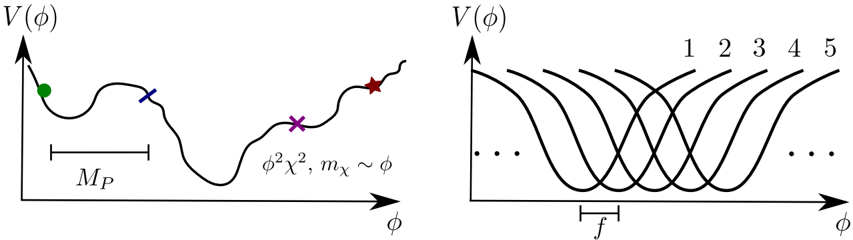
Flux couplings to string theory axions yield super-Planckian field ranges along which the axion potential energy grows. At the same time, other aspects of the physics remain essentially unchanged along these large displacements, respecting a discrete shift symmetry with a sub-Planckian period. After a general overview of this monodromy effect and its application to large-field inflation, we present new classes of specific models of monodromy inflation, with monomial potentials μ 4−p ϕ p . A key simplification in these models is that the inflaton potential energy plays a leading role in moduli stabilization during inflation. The resulting inflaton-dependent shifts in the moduli fields lead to an effective flattening of the inflaton potential, i.e. a reduction of the exponent from a fiducial value p 0 to p < p 0. We focus on examples arising in compactifications of type IIB string theory on products of tori or Riemann surfaces, where the inflaton descends from the NS-NS two-form potential B 2, with monodromy induced by a coupling to the R-R field strength F 1. In this setting we exhibit models with p = 2/3, 4/3, 2, and 3, corresponding to predictions for the tensor-to-scalar ratio of r ≈ 0.04, 0.09, 0.13, and 0.2, respectively. Using mirror symmetry, we also motivate a second class of examples with the role of the axions played by the real parts of complex structure moduli, with fluxes inducing monodromy.
Overview
The claims and statistics of this paper haven’t been checked yet.
Run the check — free, no account needed. It reads the open-access text and checks the sources it cites.
Integrity signals
Registry
Cites
Statistics
Figures
Verification
Claims the paper makes
The claims and statistics of this paper haven’t been checked yet.
Run the check — free, no account needed. It reads the open-access text and checks the sources it cites.
Claims other papers make about this one
Each is checked against this paper’s own text: does it say what the citing paper says it does?
In the citing paper
“Manifolds such as those in [25] contain a substantial fraction of their volume in cusps.”
From Hyperbolic compactification of M-theory and de Sitter quantum gravity (2022) · cites this paper as [25]
In the citing paper
“Our mechanism requires a certain parameter regime for integrated quantities, one which we find to be readily available by working with known classes of hyperbolic manifolds such as [25][26][27]”
From Hyperbolic compactification of M-theory and de Sitter quantum gravity (2022) · cites this paper as [25]
In the citing paper
“Starting from manifolds such as [25], summarized in appendix A, we may add bulk regions which contribute negatively to a.”
From Hyperbolic compactification of M-theory and de Sitter quantum gravity (2022) · cites this paper as [25]
In the citing paper
“It is straightforward to obtain a parametrically large asymmetry in an elementary way by taking covers of explicit manifolds with symmetric cusps such as the 7-manifold in [25] to construct hyperbolic manifolds with arbitrarily asymmetric cusps.”
From Hyperbolic compactification of M-theory and de Sitter quantum gravity (2022) · cites this paper as [25]
In the citing paper
“The set of 7-manifolds in [25] includes a minimal example with 4032 cusps and volume ∼ 1.3 * 10 5 , so that the ratio n c /v 7 appearing in (4.11) is ∼ 1/30.”
From Hyperbolic compactification of M-theory and de Sitter quantum gravity (2022) · cites this paper as [25]
5 more claims about this paper
Create a free account to see every claim other papers make about this one.
Self-check
Percentages, sums and reported differences re-computed from the paper’s own numbers.
The self-check needs the paper’s full text.
Citations
Cites
Inflationary universe: A possible solution to the horizon and flatness problems
Guth, A. H. (1981) · Physical Review D · doi:10.1103/physrevd.23.347 · Cited by 9,983
A new type of isotropic cosmological models without singularity
Starobinsky, A. A. (1980) · Physics Letters B · doi:10.1016/0370-2693(80)90670-x · Cited by 7,677
Linde, A. D. (1982) · Physics Letters B · doi:10.1016/0370-2693(82)91219-9 · Cited by 6,405
Cosmology for Grand Unified Theories with Radiatively Induced Symmetry Breaking
Albrecht, A., & Steinhardt, P. J. (1982) · Physical Review Letters · doi:10.1103/physrevlett.48.1220 · Cited by 4,981
de Sitter vacua in string theory
Kachru, S., Kallosh, R., Linde, A., & Trivedi, S. P. (2003) · Physical Review D · doi:10.1103/physrevd.68.046005 · Cited by 3,321
Linde, A. D. (1983) · Physics Letters B · doi:10.1016/0370-2693(83)90837-7 · Cited by 3,299
The statistics of peaks of Gaussian random fields
Bardeen, J. M., Bond, J. R., Kaiser, N., & Szalay, A. S. (1986) · The Astrophysical Journal · doi:10.1086/164143 · Cited by 3,270
Starobinsky, A. A. (1982) · Physics Letters B · doi:10.1016/0370-2693(82)90541-x · Cited by 2,656
Ade, P. A. R., Aghanim, N., Arnaud, M., Arroja, F. M. A., Ashdown, M., Aumont, J., Baccigalupi, C., Ballardini, M., Banday, A. J., Barreiro, R. B., et al. (2016) · ORCA Online Research @Cardiff (Cardiff University) · doi:10.17863/cam.52 · Cited by 2,473
Fluctuations in the New Inflationary Universe
Guth, A. H., & Pi, S.-Y. (1982) · Physical Review Letters · doi:10.1103/physrevlett.49.1110 · Cited by 2,387
Research works printed but not linked: 5
- F. Marchesano, G. Shiu and A.M. Uranga, F-term axion monodromy inflation, arXiv:1404.3040 [ INSPIRE ]. · arXiv
- T.C. Bachlechner, M. Dias, J. Frazer and L. McAllister, A new angle on chaotic inflation, arXiv:1404.7496 [ INSPIRE ]. · arXiv
- F.C. Adams, J.R. Bond, K. Freese, J.A. Frieman and A.V. Olinto, Natural inflation: particle physics models, power law spectra for large scale structure and constraints from COBE, Phys. Rev. D 47 (1993) 426 [ hep-ph/9207245 ] [ INSPIRE ]. · arXiv
- R. Bousso, D. Harlow and L. Senatore, Inflation after false vacuum decay: new evidence from BICEP2, arXiv:1404.2278 [ INSPIRE ]. · arXiv
- Planck collaboration, P.A.R. Ade et al., Planck 2013 results. XXII. Constraints on inflation, arXiv:1303.5082 [ INSPIRE ]. · arXiv
Cited by
Planck 2018 results: X. Constraints on inflation
Planck Collaboration, Akrami, Y., Arroja, F., Ashdown, M., Aumont, J., Baccigalupi, C., Ballardini, M., Banday, A. J., Barreiro, R. B., Bartolo, N., et al. (2020) · Astronomy & Astrophysics · doi:10.1051/0004-6361/201833887 · Cited by 2,442
Montero, M., Uranga, A. M., & Valenzuela, I. (2015) · Journal of High Energy Physics · doi:10.1007/jhep08(2015)032 · Cited by 200
Arvanitaki, A., Dimopoulos, S., Galanis, M., Lehner, L., Thompson, J. O., & Van Tilburg, K. (2020) · Physical Review D · doi:10.1103/physrevd.101.083014 · Cited by 175
Natural inflation and quantum gravity
de la Fuente, A., Saraswat, P., & Sundrum, R. (2015) · Physical Review Letters · doi:10.1103/physrevlett.114.151303 · Cited by 156
Can gravitational instantons really constrain axion inflation?
Hebecker, A., Mangat, P., Theisen, S., & Witkowski, L. T. (2017) · Journal of High Energy Physics · doi:10.1007/jhep02(2017)097 · Cited by 66
Hyperbolic compactification of M-theory and de Sitter quantum gravity
De Luca, G. B., Silverstein, E., & Torroba, G. (2022) · SciPost Physics · doi:10.21468/scipostphys.12.3.083 · Cited by 39
Self-citation
Metadata
- Authors
- McAllister, L., Silverstein, E., Westphal, A., & Wrase, T.
- Venue
- Journal of High Energy Physics
- Published
- 2014-09
- Volume
- 2014
- Issue
- 9
- ISSN
- 1029-8479
- Cited by
- 194
- References
- 100
- Language
- en
About these checks
Registry, retraction, Cites and statistics results are computed, not judged, with one exception: a printed reference that no index lists is read once by a model before it counts as a citation error. Claims are extracted by a model and kept only when their quote appears verbatim in the text; each cited source is then checked, with a model’s help, for whether it says what the claim relies on. Those verdicts can be wrong — read the claim’s quote and the cited source before relying on one.
Statistics and arithmetic are recomputed, not judged.
Confidence bands are shown only for fields calibrated on our annotated test set. None is calibrated yet, so no band is shown.
What counts as a claim ›How we measure confidence ›How we check this ›
Are you an author, or do you see a problem with this page? Request a review
Data sources
Bibliographic data: Semantic Scholar, OpenAlex, Crossref.
Contains information from the Semantic Scholar Academic Graph Datasets, made available under the ODC Attribution License (ODC-BY 1.0).
Semantic Scholar’s data is described in: Kinney, R., et al. (2023). The Semantic Scholar Open Data Platform. arXiv:2301.10140.
