

The DOI matches its Crossref record; 100 of the 100 references it cites were found in a registry or an index.
The powers of monodromy
Abstract
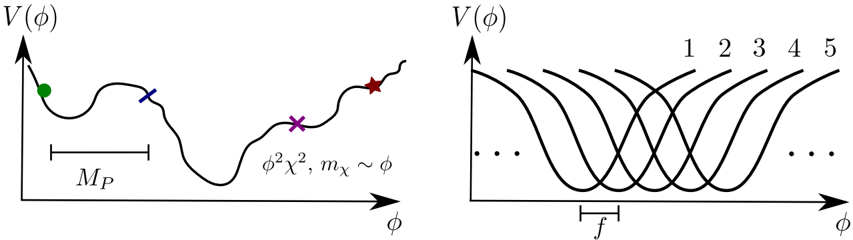
Flux couplings to string theory axions yield super-Planckian field ranges along which the axion potential energy grows. At the same time, other aspects of the physics remain essentially unchanged along these large displacements, respecting a discrete shift symmetry with a sub-Planckian period. After a general overview of this monodromy effect and its application to large-field inflation, we present new classes of specific models of monodromy inflation, with monomial potentials μ 4−p ϕ p . A key simplification in these models is that the inflaton potential energy plays a leading role in moduli stabilization during inflation. The resulting inflaton-dependent shifts in the moduli fields lead to an effective flattening of the inflaton potential, i.e. a reduction of the exponent from a fiducial value p 0 to p < p 0. We focus on examples arising in compactifications of type IIB string theory on products of tori or Riemann surfaces, where the inflaton descends from the NS-NS two-form potential B 2, with monodromy induced by a coupling to the R-R field strength F 1. In this setting we exhibit models with p = 2/3, 4/3, 2, and 3, corresponding to predictions for the tensor-to-scalar ratio of r ≈ 0.04, 0.09, 0.13, and 0.2, respectively. Using mirror symmetry, we also motivate a second class of examples with the role of the axions played by the real parts of complex structure moduli, with fluxes inducing monodromy.
Overview
The claims and statistics of this paper haven’t been checked yet.
Run the check — free, no account needed. It reads the open-access text and checks the sources it cites.
Integrity signals
Registry
Cites
Statistics
Figures
Verification
Claims the paper makes
The claims and statistics of this paper haven’t been checked yet.
Run the check — free, no account needed. It reads the open-access text and checks the sources it cites.
Claims other papers make about this one
Each is checked against this paper’s own text: does it say what the citing paper says it does?
In the citing paper
“Manifolds such as those in [25] contain a substantial fraction of their volume in cusps.”
From Hyperbolic compactification of M-theory and de Sitter quantum gravity (2022) · cites this paper as [25]
In the citing paper
“Our mechanism requires a certain parameter regime for integrated quantities, one which we find to be readily available by working with known classes of hyperbolic manifolds such as [25][26][27]”
From Hyperbolic compactification of M-theory and de Sitter quantum gravity (2022) · cites this paper as [25]
In the citing paper
“Starting from manifolds such as [25], summarized in appendix A, we may add bulk regions which contribute negatively to a.”
From Hyperbolic compactification of M-theory and de Sitter quantum gravity (2022) · cites this paper as [25]
In the citing paper
“It is straightforward to obtain a parametrically large asymmetry in an elementary way by taking covers of explicit manifolds with symmetric cusps such as the 7-manifold in [25] to construct hyperbolic manifolds with arbitrarily asymmetric cusps.”
From Hyperbolic compactification of M-theory and de Sitter quantum gravity (2022) · cites this paper as [25]
In the citing paper
“The set of 7-manifolds in [25] includes a minimal example with 4032 cusps and volume ∼ 1.3 * 10 5 , so that the ratio n c /v 7 appearing in (4.11) is ∼ 1/30.”
From Hyperbolic compactification of M-theory and de Sitter quantum gravity (2022) · cites this paper as [25]
5 more claims about this paper
Create a free account to see every claim other papers make about this one.
Self-check
Percentages, sums and reported differences re-computed from the paper’s own numbers.
The self-check needs the paper’s full text.
Citations
Cites
Inflationary universe: A possible solution to the horizon and flatness problems
Guth, A. H. (1981) · Physical Review D · doi:10.1103/physrevd.23.347 · Cited by 9,983
A new type of isotropic cosmological models without singularity
Starobinsky, A. A. (1980) · Physics Letters B · doi:10.1016/0370-2693(80)90670-x · Cited by 7,677
Linde, A. D. (1982) · Physics Letters B · doi:10.1016/0370-2693(82)91219-9 · Cited by 6,405
Cosmology for Grand Unified Theories with Radiatively Induced Symmetry Breaking
Albrecht, A., & Steinhardt, P. J. (1982) · Physical Review Letters · doi:10.1103/physrevlett.48.1220 · Cited by 4,981
de Sitter vacua in string theory
Kachru, S., Kallosh, R., Linde, A., & Trivedi, S. P. (2003) · Physical Review D · doi:10.1103/physrevd.68.046005 · Cited by 3,321
Linde, A. D. (1983) · Physics Letters B · doi:10.1016/0370-2693(83)90837-7 · Cited by 3,299
The statistics of peaks of Gaussian random fields
Bardeen, J. M., Bond, J. R., Kaiser, N., & Szalay, A. S. (1986) · The Astrophysical Journal · doi:10.1086/164143 · Cited by 3,270
Starobinsky, A. A. (1982) · Physics Letters B · doi:10.1016/0370-2693(82)90541-x · Cited by 2,656
Ade, P. A. R., Aghanim, N., Arnaud, M., Arroja, F. M. A., Ashdown, M., Aumont, J., Baccigalupi, C., Ballardini, M., Banday, A. J., Barreiro, R. B., et al. (2016) · ORCA Online Research @Cardiff (Cardiff University) · doi:10.17863/cam.52 · Cited by 2,473
Fluctuations in the New Inflationary Universe
Guth, A. H., & Pi, S.-Y. (1982) · Physical Review Letters · doi:10.1103/physrevlett.49.1110 · Cited by 2,387
GREENE, B. R., Morrison, D. R., & Polchinski, J. (1998) · Proceedings of the National Academy of Sciences · doi:10.1073/pnas.95.19.11039 · Cited by 2,215
The development of irregularities in a single bubble inflationary universe
Hawking, S. W. (1982) · Physics Letters B · doi:10.1016/0370-2693(82)90373-2 · Cited by 1,991
Detection of B -Mode Polarization at Degree Angular Scales by BICEP2
Ade, P. A. R., Aikin, R. W., Barkats, D., Benton, S. J., Bischoff, C. A., Bock, J. J., Brevik, J. A., Buder, I., Bullock, E., Dowell, C. D., et al. (2014) · Physical Review Letters · doi:10.1103/physrevlett.112.241101 · Cited by 1,896
Phases of N = 2 theories in two dimensions
Witten, E. (1993) · Nuclear Physics B · doi:10.1016/0550-3213(93)90033-l · Cited by 1,732
Polchinski, J. (1998) · Cambridge University Press eBooks · doi:10.1017/cbo9780511618123 · Cited by 1,602
Natural inflation with pseudo Nambu-Goldstone bosons
Freese, K., Frieman, J. A., & Olinto, A. V. (1990) · Physical Review Letters · doi:10.1103/physrevlett.65.3233 · Cited by 1,374
Hierarchies from fluxes in string compactifications
Giddings, S. B., Kachru, S., & Polchinski, J. (2002) · Physical Review D · doi:10.1103/physrevd.66.106006 · Cited by 1,328
Three-dimensional Einstein gravity: Dynamics of flat space
Deser, S., Jackiw, R., & 't Hooft, G. (1984) · Annals of Physics · doi:10.1016/0003-4916(84)90085-x · Cited by 1,222
On the geometry of the string landscape and the swampland
Ooguri, H., & Vafa, C. (2007) · Nuclear Physics B · doi:10.1016/j.nuclphysb.2006.10.033 · Cited by 1,186
Signature of Gravity Waves in the Polarization of the Microwave Background
Seljak, U., & Zaldarriaga, M. (1997) · Physical Review Letters · doi:10.1103/physrevlett.78.2054 · Cited by 978
Lyth, D. H. (1997) · Physical Review Letters · doi:10.1103/physrevlett.78.1861 · Cited by 902
A Probe of Primordial Gravity Waves and Vorticity
Kamionkowski, M., Kosowsky, A., & Stebbins, A. (1997) · Physical Review Letters · doi:10.1103/physrevlett.78.2058 · Cited by 834
Monodromy in the CMB: Gravity waves and string inflation
Silverstein, E., & Westphal, A. (2008) · Physical Review D · doi:10.1103/physrevd.78.106003 · Cited by 724
Self-citationDimopoulos, S., Shamit Kachru, A., McGreevy, J., & Wacker, J. G. (2008) · Journal of Cosmology and Astroparticle Physics · doi:10.1088/1475-7516/2008/08/003 · Cited by 677
Gravity waves and linear inflation from axion monodromy
McAllister, L., Silverstein, E., & Westphal, A. (2010) · Physical Review D · doi:10.1103/physrevd.82.046003 · Cited by 645
Self-citationKim, J. E., Nilles, H. P., & Peloso, M. (2005) · Journal of Cosmology and Astroparticle Physics · doi:10.1088/1475-7516/2005/01/005 · Cited by 634
Adams, F. C., Bond, J. R., Freese, K., Frieman, J. A., & Olinto, A. V. (1993) · Physical Review D · doi:10.1103/physrevd.47.426 · Cited by 598
Sen, A. (1996) · Nuclear Physics B · doi:10.1016/0550-3213(96)00347-1 · Cited by 526
Sen, A. (1996) · CERN Document Server (European Organization for Nuclear Research) · Cited by 461
Oscillations in the CMB from axion monodromy inflation
Flauger, R., McAllister, L., Pajer, E., Westphal, A., & Xu, G. (2010) · Journal of Cosmology and Astroparticle Physics · doi:10.1088/1475-7516/2010/06/009 · Cited by 422
Self-citationPlanck intermediate results. XIX. An overview of the polarized thermal emission from Galactic dust
Planck Collaboration:, Ade, P. A. R., Aghanim, N., Alina, D., Alves, M. I. R., Armitage-Caplan, C., Arnaud, M., Arzoumanian, D., Ashdown, M., Atrio-Barandela, F., et al. (2015) · Astronomy & Astrophysics · doi:10.1051/0004-6361/201424082 · Cited by 414
Duality of type-II 7-branes and 8-branes
Bergshoeff, E., de Roo, M., Green, M. B., Papadopoulos, G., & Townsend, P. K. (1996) · Nuclear Physics B · doi:10.1016/0550-3213(96)00171-x · Cited by 364
A Natural Framework for Chaotic Inflation
Kaloper, N., & Sorbo, L. (2009) · Physical Review Letters · doi:10.1103/physrevlett.102.121301 · Cited by 332
An ignoble approach to large field inflation
Kaloper, N., Lawrence, A., & Lorenzo Sorbo, B. (2011) · Journal of Cosmology and Astroparticle Physics · doi:10.1088/1475-7516/2011/03/023 · Cited by 308
Duality of type II 7-branes and 8-branes
Bergshoeff, E. A., De Roo, M., Green, M. B., Papadopoulos, G. J., & Townsend, P. K. (1996) · CERN Document Server (European Organization for Nuclear Research) · Cited by 286
An Ignoble Approach to Large Field InflationPreprint
Kaloper, N., Lawrence, A., & Lorenzo Sorbo, B. (2010) · Cited by 259
Inflation physics from the cosmic microwave background and large scale structure
Abazajian, K. N., Arnold, K., Austermann, J. E., Benson, B. A., Bischoff, C. A., Bock, J. J., Bond, J. R., Borrill, J., Buder, I., Burke, D. L., et al. (2014) · Astroparticle Physics · doi:10.1016/j.astropartphys.2014.05.013 · Cited by 232
Self-citationBICEP2. II. EXPERIMENT AND THREE-YEAR DATA SET
Ade, P. A. R., Aikin, R. W., Amiri, M., Barkats, D., Benton, S. J., Bischoff, C. A., Bock, J. J., Brevik, J. A., Buder, I., Bullock, E., et al. (2014) · The Astrophysical Journal · doi:10.1088/0004-637x/792/1/62 · Cited by 224
Ade, P. A. R., Alves, M. I. R., Aniano, G., Armitage-Caplan, C., Arnaud, M., Atrio-Barandela, F., Aumont, J., Baccigalupi, C., Banday, A. J., Barreiro, R. B., et al. (2015) · Astronomy and Astrophysics · doi:10.1051/0004-6361/201424088 · Cited by 208
Silverstein, E. M. (2008) · Physical review. D. Particles, fields, gravitation, and cosmology/Physical review. D. Particles and fields · doi:10.1103/physrevd.77.106006 · Cited by 200
Self-citation(A)dS Backgrounds from Asymmetric Orientifolds
Silverstein, E. M. (2001) · OSTI OAI (U.S. Department of Energy Office of Scientific and Technical Information) · doi:10.2172/787187 · Cited by 195
Self-citationSimple exercises to flatten your potential
Dong, X., Horn, B., Silverstein, E. M., & Westphal, A. (2011) · Physical review. D. Particles, fields, gravitation, and cosmology/Physical review. D. Particles and fields · doi:10.1103/physrevd.84.026011 · Cited by 194
Self-citationСтаробинский, А. А. (1983) · Cited by 192
Natural inflation with multiple sub-Planckian axions
Kiwoon Choi, A., Kim, H., & Yun, S. (2014) · Physical review. D. Particles, fields, gravitation, and cosmology/Physical review. D. Particles and fields · doi:10.1103/physrevd.90.023545 · Cited by 190
Roulette inflation with Kähler moduli and their axions
Bond, J. R., Kofman, L. A., Prokushkin, S., & Vaudrevange, P. M. (2007) · Physical review. D. Particles, fields, gravitation, and cosmology/Physical review. D. Particles and fields · doi:10.1103/physrevd.75.123511 · Cited by 151
Axion inflation in type II string theory
Grimm, T. W. (2008) · Physical review. D. Particles, fields, gravitation, and cosmology/Physical review. D. Particles and fields · doi:10.1103/physrevd.77.126007 · Cited by 148
Hebecker, A., Kraus, S. C., & Witkowski, L. T. (2014) · Physics Letters B · doi:10.1016/j.physletb.2014.08.028 · Cited by 147
Towards universal axion inflation and reheating in string theory
Blumenhagen, R., & Plauschinn, E. (2014) · Physics Letters B · doi:10.1016/j.physletb.2014.08.007 · Cited by 146
Spergel, D. N., Flauger, R., & Hložek, R. (2015) · Physical review. D. Particles, fields, gravitation, and cosmology/Physical review. D. Particles and fields · doi:10.1103/physrevd.91.023518 · Cited by 141
Chibisov, G. V., & Mukhanov, V. (1982) · Monthly Notices of the Royal Astronomical Society · doi:10.1093/mnras/200.3.535 · Cited by 136
Non-Bunch–Davis initial state reconciles chaotic models with BICEP and Planck
Ashoorioon, A., Dimopoulos, K., Sheikh-Jabbari, M. M., & Shiu, G. (2014) · Physics Letters B · doi:10.1016/j.physletb.2014.08.038 · Cited by 115
A new handle on de sitter compactifications
Saltman, A., & Silverstein, E. M. (2006) · Journal of High Energy Physics · doi:10.1088/1126-6708/2006/01/139 · Cited by 114
Self-citationde Sitter Space in Non-Critical String TheoryPreprint
Maloney, A., Silverstein, E. M., & Strominger, A. (2002) · arXiv (Cornell University) · doi:10.48550/arxiv.hep-th/0205316 · Cited by 109
Self-citationAligned natural inflation: Monodromies of two axions
Kappl, R., Krippendorf, S., & Nilles, H. P. (2014) · Physics Letters B · doi:10.1016/j.physletb.2014.08.045 · Cited by 95
Chaotic inflation in supergravity after Planck and BICEP2
Каллош, Р., Linde, A. D., & Westphal, A. (2014) · Physical review. D. Particles, fields, gravitation, and cosmology/Physical review. D. Particles and fields · doi:10.1103/physrevd.90.023534 · Cited by 93
Self-citationAligned natural inflation in string theory
Long, C., McAllister, L., & McGuirk, P. (2014) · Physical review. D. Particles, fields, gravitation, and cosmology/Physical review. D. Particles and fields · doi:10.1103/physrevd.90.023501 · Cited by 91
Self-citationEfstathiou, G., & Mack, K. J. (2005) · Journal of Cosmology and Astroparticle Physics · doi:10.1088/1475-7516/2005/05/008 · Cited by 90
The Power of Holomorphy -- Exact Results in 4D SUSY Field TheoriesPreprint
Nathan Seiberg, B. (1994) · arXiv (Cornell University) · doi:10.48550/arxiv.hep-th/9408013 · Cited by 85
Searching for oscillations in the primordial power spectrum. II. Constraints from Planck data
Meerburg, P. D., Spergel, D. N., & Wandelt, B. D. (2014) · Physical review. D. Particles, fields, gravitation, and cosmology/Physical review. D. Particles and fields · doi:10.1103/physrevd.89.063537 · Cited by 83
Towards large r from [p, q]-inflation
Palti, E., & Weigand, T. (2014) · Journal of High Energy Physics · doi:10.1007/jhep04(2014)155 · Cited by 82
Planck constraints on monodromy inflation
Easther, R., & Flauger, R. (2014) · Journal of Cosmology and Astroparticle Physics · doi:10.1088/1475-7516/2014/02/037 · Cited by 81
Landscaping with fluxes and the E8 Yukawa Point in F-theoryPreprint
Bizet, N. C., Klemm, A., & Lopes, D. V. (2014) · arXiv (Cornell University) · doi:10.48550/arxiv.1404.7645 · Cited by 77
Natural and multi-natural inflation in axion landscape
Higaki, T., & Takahashi, F. (2014) · Journal of High Energy Physics · doi:10.1007/jhep07(2014)074 · Cited by 76
D7‐brane moduli space in axion monodromy and fluxbrane inflation
Arends, M., Hebecker, A., Heimpel, K., Kraus, S., Lüst, D., Mayrhofer, C., Schick, C. H., & Weigand, T. (2014) · Fortschritte der Physik · doi:10.1002/prop.201400045 · Cited by 75
Natural chaotic inflation and ultraviolet sensitivity
Kaloper, N., & Lawrence, A. (2014) · Physical review. D. Particles, fields, gravitation, and cosmology/Physical review. D. Particles and fields · doi:10.1103/physrevd.90.023506 · Cited by 73
Axion monodromy in a model of holographic gluodynamics
Dubovsky, S., Lawrence, A., & Roberts, M. M. (2012) · Journal of High Energy Physics · doi:10.1007/jhep02(2012)053 · Cited by 71
Chaotic inflation with kinetic alignment of axion fields
Bachlechner, T. C., Dias, M., Frazer, J., & McAllister, L. (2015) · Physical review. D. Particles, fields, gravitation, and cosmology/Physical review. D. Particles and fields · doi:10.1103/physrevd.91.023520 · Cited by 67
Self-citationBen-Dayan, I., Pedro, F. G., & Westphal, A. (2014) · Physical Review Letters · doi:10.1103/physrevlett.113.261301 · Cited by 67
Self-citationThe inflaton as an MSSM Higgs and open string modulus monodromy inflation
Ibáñez, L. E., & Valenzuela, I. (2014) · Physics Letters B · doi:10.1016/j.physletb.2014.07.020 · Cited by 66
Aich, M., Hazra, D. K., Sriramkumar, L., & Souradeep, T. (2013) · Physical review. D. Particles, fields, gravitation, and cosmology/Physical review. D. Particles and fields · doi:10.1103/physrevd.87.083526 · Cited by 66
Grimm, T. W. (2014) · Physics Letters B · doi:10.1016/j.physletb.2014.10.043 · Cited by 64
Constraining monodromy inflation
Peiris, H. V., Easther, R., & Flauger, R. (2013) · Journal of Cosmology and Astroparticle Physics · doi:10.1088/1475-7516/2013/09/018 · Cited by 61
Gravitational radiative corrections as the origin of spontaneous symmetry breaking!
Smolin, L. (1980) · Physics Letters B · doi:10.1016/0370-2693(80)90103-3 · Cited by 60
D’Amico, G., Gobbetti, R., Kleban, M., & Schillo, M. (2013) · Journal of Cosmology and Astroparticle Physics · doi:10.1088/1475-7516/2013/03/004 · Cited by 60
Natural and multi-natural inflation in axion landscape
Higaki, T., & Takahashi, F. (2014) · Institutional Repositories DataBase (IRDB) · Cited by 59
Searching for oscillations in the primordial power spectrum. I. Perturbative approach
Meerburg, P. D., Spergel, D. N., & Wandelt, B. D. (2014) · Physical review. D. Particles, fields, gravitation, and cosmology/Physical review. D. Particles and fields · doi:10.1103/physrevd.89.063536 · Cited by 56
Constraining monodromy inflation
Peiris, H. V., Easther, R., & Flauger, R. (2013) · UCL Discovery (University College London) · Cited by 53
Axion monodromy inflation with multi-natural modulations
Higaki, T., Kobayashi, T., Seto, O., & Yamaguchi, Y. (2014) · Journal of Cosmology and Astroparticle Physics · doi:10.1088/1475-7516/2014/10/025 · Cited by 50
FRW solutions and holography from uplifted AdS/CFT systems
Dong, X., Horn, B., Matsuura, S., Silverstein, E. M., & Torroba, G. (2012) · Physical review. D. Particles, fields, gravitation, and cosmology/Physical review. D. Particles and fields · doi:10.1103/physrevd.85.104035 · Cited by 43
Self-citationOn Inflation and de Sitter in Non‐Geometric String Backgrounds
Haßler, F., Lüst, D., & Massai, S. (2017) · Fortschritte der Physik · doi:10.1002/prop.201700062 · Cited by 41
Simple realization of inflaton potential on a Riemann surface
Harigaya, K., & Ibe, M. (2014) · Physics Letters B · doi:10.1016/j.physletb.2014.09.061 · Cited by 36
Monodromy inflation in SUSY QCD
Michael Dine, B., Draper, P., & Monteux, A. (2014) · Journal of High Energy Physics · doi:10.1007/jhep07(2014)146 · Cited by 35
Quantifying the BICEP2-Planck Tension over Gravitational Waves
Smith, K. M., Dvorkin, C., Boyle, L. A., et al. (2014) · Physical Review Letters · doi:10.1103/physrevlett.113.031301 · Cited by 34
Axion monodromy inflation with sinusoidal corrections
Kobayashi, T., Seto, O., & Yamaguchi, Y. (2014) · Institutional Repositories DataBase (IRDB) · Cited by 29
D’Amico, G., Gobbetti, R., Kleban, M., & Schillo, M. (2013) · Physics Letters B · doi:10.1016/j.physletb.2013.07.050 · Cited by 28
Brane inflation and moduli stabilization on twisted tori
Gur-Ari, G. (2014) · Journal of High Energy Physics · doi:10.1007/jhep01(2014)179 · Cited by 27
Notes on natural inflationPreprint
Yonekura, K. (2016) · Cited by 27
Tilt and Tensor-to-Scalar Ratio in Multifield Monodromy InflationPreprint
Wenren, D. (2014) · arXiv (Cornell University) · doi:10.48550/arxiv.1405.1411 · Cited by 25
Farhang, M., Bond, J. R., Doré, O., & Netterfield, C. B. (2013) · The Astrophysical Journal · doi:10.1088/0004-637x/771/1/12 · Cited by 22
Angular correlation functions for models with logarithmic oscillations
Jackson, M. G., Wandelt, B. D., & Bouchet, F. R. (2014) · Physical review. D. Particles, fields, gravitation, and cosmology/Physical review. D. Particles and fields · doi:10.1103/physrevd.89.023510 · Cited by 21
New solutions with accelerated expansion in string theory
Dodelson, M., Dong, X., Silverstein, E., & Torroba, G. (2014) · Journal of High Energy Physics · doi:10.1007/jhep12(2014)050 · Cited by 20
Self-citationHelical Inflation and Cosmic StringsPreprint
Tye, S.-H. H., & Wong, S. S. C. (2014) · arXiv (Cornell University) · doi:10.48550/arxiv.1404.6988 · Cited by 19
Ashoorioon, A., & Sheikh-Jabbari, M. M. (2014) · Physics Letters B · doi:10.1016/j.physletb.2014.11.018 · Cited by 17
Kleban, M., & Michele Redi, B. (2007) · Journal of High Energy Physics · doi:10.1088/1126-6708/2007/09/038 · Cited by 16
Observational Consequences of a Landscape: EpiloguePreprint
Freivogel, B., Kleban, M., Martínez, M. R., & Susskind, L. (2014) · arXiv (Cornell University) · doi:10.48550/arxiv.1404.2274 · Cited by 14
Inflaton potential on a Riemann surfacePreprint
Harigaya, K., & Ibe, M. (2014) · arXiv (Cornell University) · Cited by 10
Shlaer, B. (2013) · Physical review. D. Particles, fields, gravitation, and cosmology/Physical review. D. Particles and fields · doi:10.1103/physrevd.88.103503 · Cited by 9
A note of clarification: BICEP2 and Planck are not in tensionPreprint
Audren, B., Figueroa, D. G., & Tram, T. (2014) · arXiv (Cornell University) · doi:10.48550/arxiv.1405.1390 · Cited by 8
On Inflation and de Sitter in Non-Geometric String BackgroundsPreprint
Haßler, F., Lüst, D., & Massai, S. (2014) · arXiv (Cornell University) · doi:10.48550/arxiv.1405.2325 · Cited by 8
Primordial Gravitational Wave Detectability with Deep Small-Sky CMB ExperimentsPreprint
Farhang, M., Bond, J. R., Doré, O., & Netterfield, C. B. (2011) · arXiv (Cornell University) · doi:10.48550/arxiv.1108.2043 · Cited by 7
Research works printed but not linked: 5
- F. Marchesano, G. Shiu and A.M. Uranga, F-term axion monodromy inflation, arXiv:1404.3040 [ INSPIRE ]. · arXiv
- T.C. Bachlechner, M. Dias, J. Frazer and L. McAllister, A new angle on chaotic inflation, arXiv:1404.7496 [ INSPIRE ]. · arXiv
- F.C. Adams, J.R. Bond, K. Freese, J.A. Frieman and A.V. Olinto, Natural inflation: particle physics models, power law spectra for large scale structure and constraints from COBE, Phys. Rev. D 47 (1993) 426 [ hep-ph/9207245 ] [ INSPIRE ]. · arXiv
- R. Bousso, D. Harlow and L. Senatore, Inflation after false vacuum decay: new evidence from BICEP2, arXiv:1404.2278 [ INSPIRE ]. · arXiv
- Planck collaboration, P.A.R. Ade et al., Planck 2013 results. XXII. Constraints on inflation, arXiv:1303.5082 [ INSPIRE ]. · arXiv
Cited by
Planck 2018 results: X. Constraints on inflation
Planck Collaboration, Akrami, Y., Arroja, F., Ashdown, M., Aumont, J., Baccigalupi, C., Ballardini, M., Banday, A. J., Barreiro, R. B., Bartolo, N., et al. (2020) · Astronomy & Astrophysics · doi:10.1051/0004-6361/201833887 · Cited by 2,442
Montero, M., Uranga, A. M., & Valenzuela, I. (2015) · Journal of High Energy Physics · doi:10.1007/jhep08(2015)032 · Cited by 200
Arvanitaki, A., Dimopoulos, S., Galanis, M., Lehner, L., Thompson, J. O., & Van Tilburg, K. (2020) · Physical Review D · doi:10.1103/physrevd.101.083014 · Cited by 175
Natural inflation and quantum gravity
de la Fuente, A., Saraswat, P., & Sundrum, R. (2015) · Physical Review Letters · doi:10.1103/physrevlett.114.151303 · Cited by 156
Can gravitational instantons really constrain axion inflation?
Hebecker, A., Mangat, P., Theisen, S., & Witkowski, L. T. (2017) · Journal of High Energy Physics · doi:10.1007/jhep02(2017)097 · Cited by 66
Metadata
- Authors
- McAllister, L., Silverstein, E., Westphal, A., & Wrase, T.
- Venue
- Journal of High Energy Physics
- Published
- 2014-09
- Volume
- 2014
- Issue
- 9
- ISSN
- 1029-8479
- Cited by
- 194
- References
- 100
- Language
- en
About these checks
Registry, retraction, Cites and statistics results are computed, not judged, with one exception: a printed reference that no index lists is read once by a model before it counts as a citation error. Claims are extracted by a model and kept only when their quote appears verbatim in the text; each cited source is then checked, with a model’s help, for whether it says what the claim relies on. Those verdicts can be wrong — read the claim’s quote and the cited source before relying on one.
Statistics and arithmetic are recomputed, not judged.
Confidence bands are shown only for fields calibrated on our annotated test set. None is calibrated yet, so no band is shown.
What counts as a claim ›How we measure confidence ›How we check this ›
Are you an author, or do you see a problem with this page? Request a review
Data sources
Bibliographic data: Semantic Scholar, OpenAlex, Crossref.
Contains information from the Semantic Scholar Academic Graph Datasets, made available under the ODC Attribution License (ODC-BY 1.0).
Semantic Scholar’s data is described in: Kinney, R., et al. (2023). The Semantic Scholar Open Data Platform. arXiv:2301.10140.
