

The double-dark portal
Open accessThe DOI matches its Crossref record; 172 of the 172 references it cites were found in a registry or an index; none of the 44 sources its claims cite is checked for support yet.
Abstract
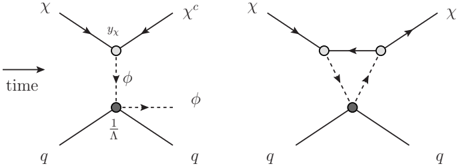
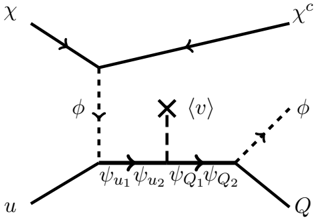
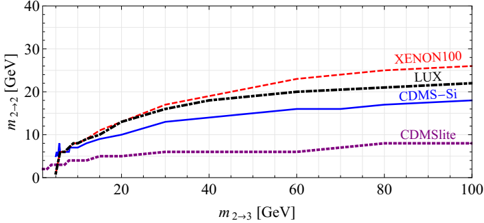
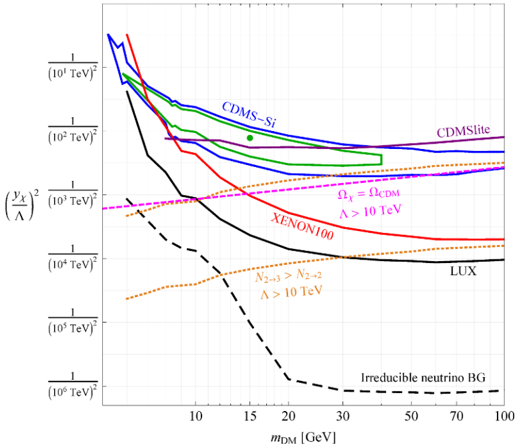
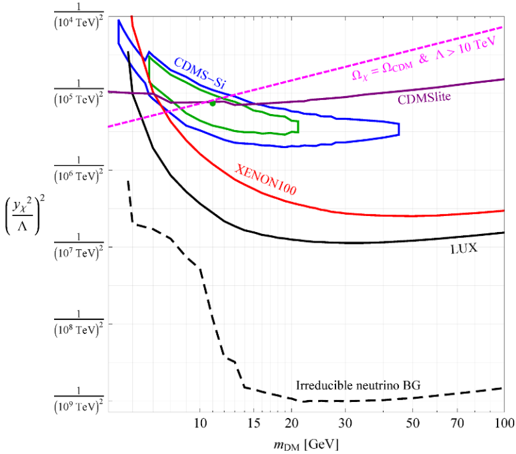
In most models of the dark sector, dark matter is charged under some new symmetry to make it stable. We explore the possibility that not just dark matter, but also the force carrier connecting it to the visible sector is charged under this symmetry. This dark mediator then acts as a Double-Dark Portal. We realize this setup in the dark mediator Dark matter model (dmDM), featuring a fermionic DM candidate χ with Yukawa couplings to light scalars ϕ i . The scalars couple to SM quarks via the operator $$ \overline{q}q{\phi}_i^{\ast }{\phi}_j/{\varLambda}_{ij} $$ . This can lead to large direct detection signals via the 2 → 3 process χN → χN ϕ if one of the scalars has mass ≲ 10 keV. For dark matter Yukawa couplings y χ ∼ 10−3 −10−2, dmDM features a thermal relic dark matter candidate while also implementing the SIDM scenario for ameliorating inconsistencies between dwarf galaxy simulations and observations. We undertake the first systematic survey of constraints on light scalars coupled to the SM via the above operator. The strongest constraints are derived from a detailed examination of the light mediator’s effects on stellar astrophysics. LHC experiments and cosmological considerations also yield important bounds. Observations of neutron star cooling exclude the minimal model with one dark mediator, but a scenario with two dark mediators remains viable and can give strong direct detection signals. We explore the direct detection consequences of this scenario and find that a heavy $$ \mathcal{O}\left(100\mathrm{GeV}\right) $$ dmDM candidate fakes different $$ \mathcal{O}\left(10\mathrm{GeV}\right) $$ WIMPs at different experiments. Large regions of dmDM parameter space are accessible above the irreducible neutrino background.
Overview
CoChat Summary
TL;DR
The paper introduces dark mediator dark matter (dmDM), in which the mediator connecting dark matter to the Standard Model is itself charged under the dark symmetry, leading to a 2→3 direct-detection process χN→χNφ. It performs a systematic survey of constraints on light scalars coupled via qqφ_iφ*_j/Λ_ij, finding that neutron-star cooling excludes the minimal one-mediator scenario but a two-mediator model remains viable and can give strong direct-detection signals.
Key findings
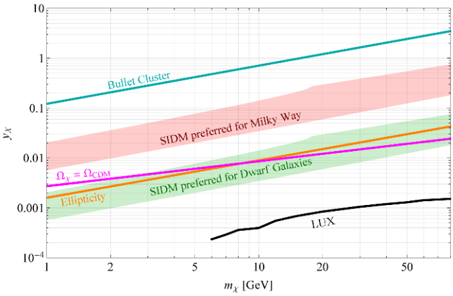
- For dark Yukawa couplings yχ ∼ 10⁻³–10⁻², dmDM can be a thermal relic and realize the self-interacting dark matter (SIDM) scenario for ameliorating dwarf-galaxy simulation/observation inconsistencies.
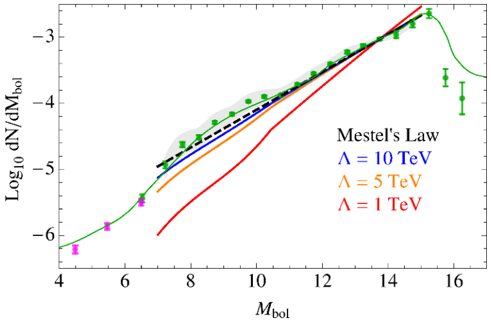
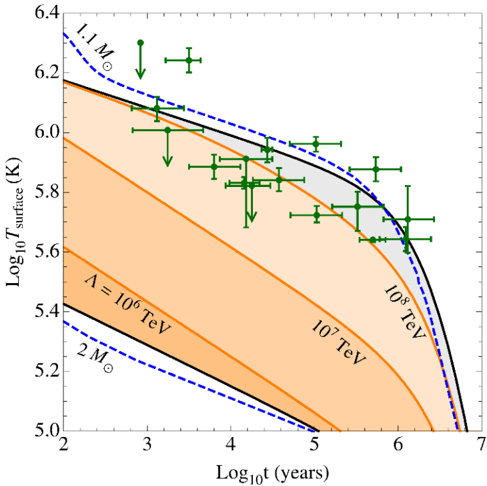
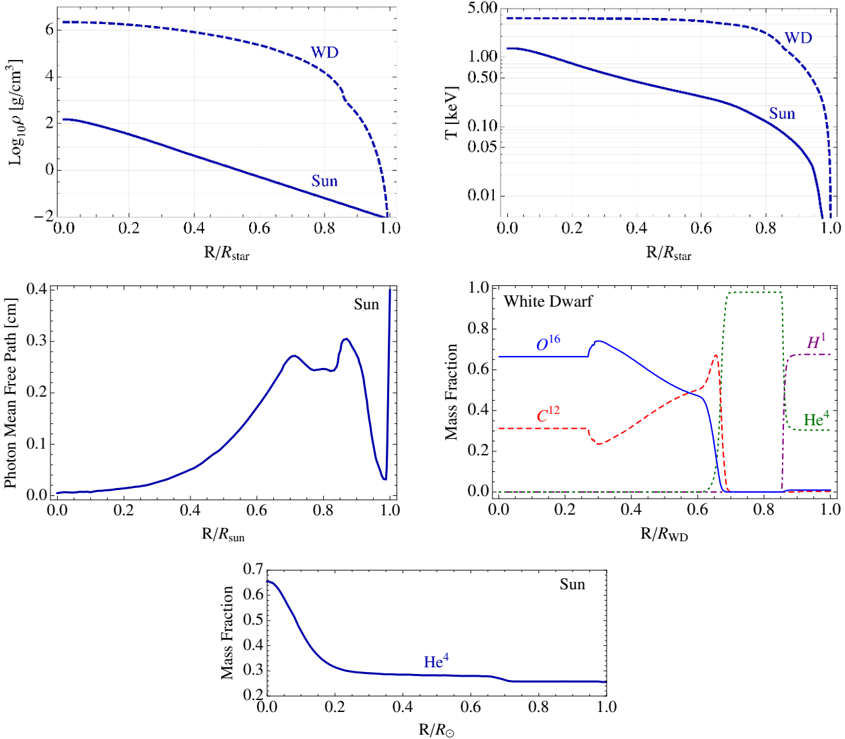
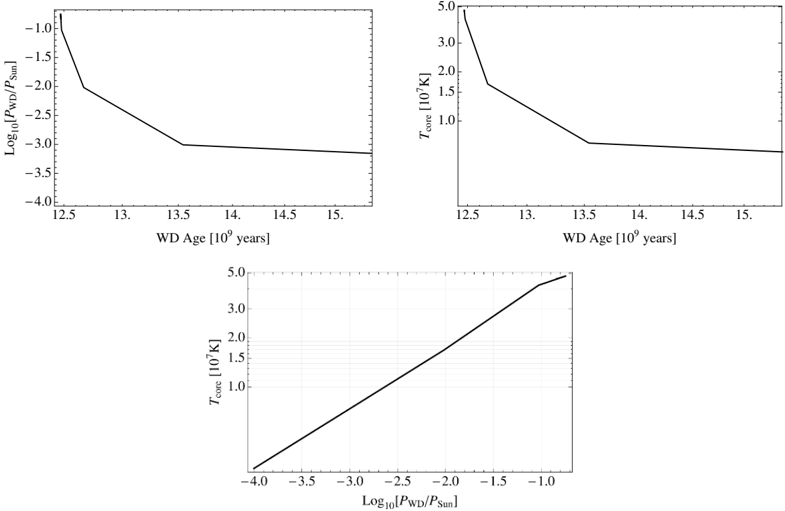
- Stellar astrophysics gives the strongest bounds: neutron-star cooling requires Λ ≳ 10⁸ TeV for mφ ≲ 100 keV, excluding the minimal nφ = 1 detectable dmDM scenario; solar heat transfer and white-dwarf cooling give Λ ≳ 10 TeV, and supernova bounds apply for mφ ≲ 10 MeV.
- A two-mediator model with φ_L ≲ eV and φ_H ∼ MeV evades all bounds while allowing direct detection; the neutron-star bound translates to Λ_LH ≳ 10 TeV, and the 2→3 process can dominate.
- Direct detection: the 2→3 recoil spectrum is dσ/dE_r ∝ (1/E_r)(1 − E_r/E_max)², with detection efficiency about 100–1000 times smaller than a standard WIMP; an O(100 GeV) dmDM candidate fakes different O(10 GeV) WIMPs at different experiments, and large regions are accessible above the irreducible neutrino background.
- LHC and cosmology: di-jet + MET gives M_Q > 1.5 TeV; mono-jet gives Λ_eff ≳ 2 (6.6) TeV for M_Q = 4 (1.5) TeV; the heaviest stable mediator must have mφ ≲ eV to avoid overclosure, and N_eff during BBN restricts nφ < 2 (1) if φ is real (complex).
Methods
- Model: effective Lagrangian with real or complex SM-singlet scalars φ_i coupled to quarks via qqφ_iφ*_j/Λ_ij and Yukawa couplings y_i χ^c χ φ_i, enforced by a Z₄ symmetry, with a possible UV completion using heavy vector-like quarks.
- Constraints surveyed: stellar astrophysics (Sun, white dwarfs, neutron stars, supernovae), cosmology (relic density, BBN, structure formation, dark acoustic oscillations), LHC searches (di-jet + MET, mono-jet), and direct detection (XENON100, LUX, CDMS-Si, CDMSlite).
- Analysis tools: MadGraph5, Pythia 6.420, and PGS4 for collider/direct-detection simulations; MESA for the white-dwarf benchmark; a modified maximum-likelihood analysis for direct-detection bounds; numerical convolution with a Maxwell-Boltzmann dark-matter speed distribution.
Limitations
- Stated: the white-dwarf cooling bound is a preliminary estimate using a single 0.5-solar-mass benchmark, and modeling a representative white-dwarf population is beyond scope; neutron-star cooling has SM uncertainties, the inner core composition is uncertain, and only nucleon cores are considered; the dark acoustic oscillation analysis is beyond scope and the bound is conservative; naturalness issues such as light-quark Yukawa tuning and the origin of the light scalar are set aside.
- Evident from the text: several estimates are explicitly rough or O(1), including the one-pion-exchange approximation, the γγ→φφ estimate with B² = 1–100, the neutron-star production cross-section uncertainty B_prod = 0.3–3, and the solar heat-transfer estimate.
- The direct-detection discussion works with the minimal nφ = 1 scenario for simplicity, with the understanding that the nφ = 2 scenario replicates the phenomenology.
Model-written summary. Check it against the paper before relying on it.
Integrity signals
Registry
Cites
Statistics
Figures
Verification
Claims the paper makes
0 Valid · 11 Not valid · 36 Not checked · 177 Own results and interpretations
A result the paper reports from its own data — it cites no other source for it, so there is none to check. The quote shows it is in the paper.
In the paper
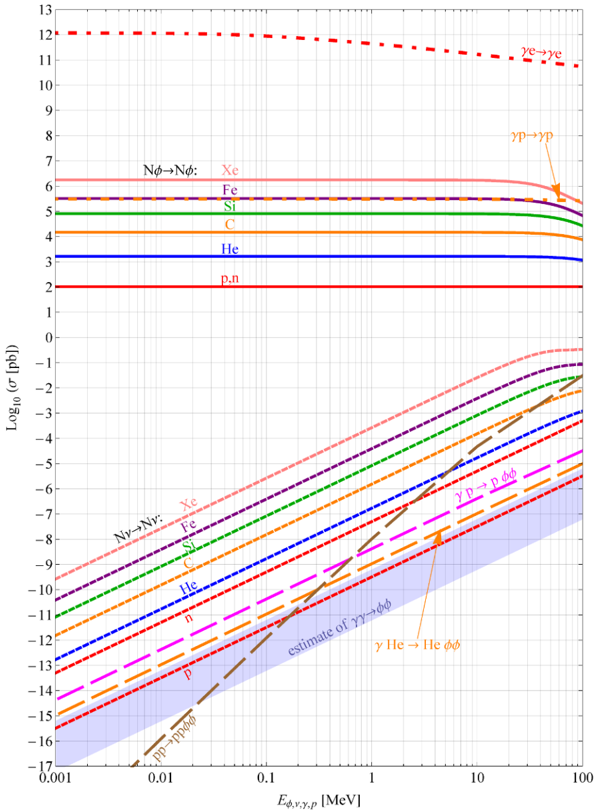
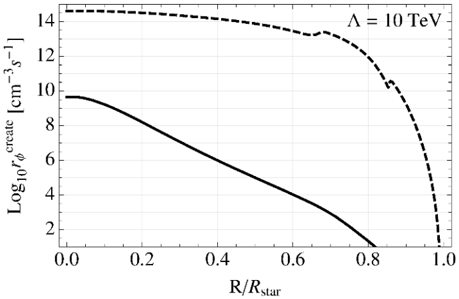
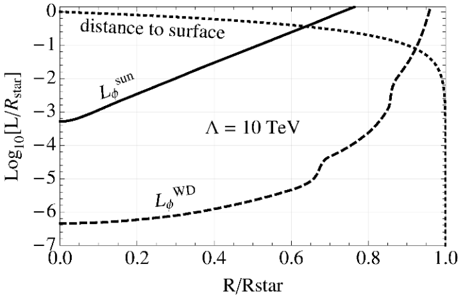
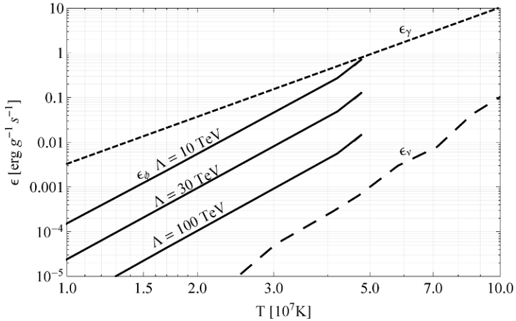
“Consulting figure 4 and eq.(4.6) it is clear that γN → N φφ * is the dominant production process for T ∼ keV.”
§ The double-dark portal > 4.3 Solar energy loss and radiative heat transfer
boostedstates a cause- Asserted: passes — The authors put it forward as true.
- Checkable: passes — It can be checked against evidence.
- Load-bearing: passes — The paper’s conclusions depend on it.
- Based: passes — The paper gives a reason why it holds.
A result the paper states — it cites no source for it, so there is none to check. The quote shows it is in the paper.
In the paper
“The φ production rate per second per volume via a process X 1 X 2 → φφ * + SM particles, with cross section σ φprod and parent particle number densities n”
§ The double-dark portal > 4.3 Solar energy loss and radiative heat transfer
plainstates a cause- Asserted: passes — The authors put it forward as true.
- Checkable: passes — It can be checked against evidence.
- Load-bearing: passes — The paper’s conclusions depend on it.
- Based: passes — The paper gives a reason why it holds.
A result the paper states — it cites no source for it, so there is none to check. The quote shows it is in the paper.
In the paper
“The resulting cross section is”
§ The double-dark portal > JHEP11(2014)136
plainstates a cause- Asserted: passes — The authors put it forward as true.
- Checkable: passes — It can be checked against evidence.
- Load-bearing: passes — The paper’s conclusions depend on it.
- Based: passes — The paper gives a reason why it holds.
A result the paper reports from its own data — it cites no other source for it, so there is none to check. The quote shows it is in the paper.
In the paper
“For this benchmark value assumption (c) is certainly satisfied.”
§ The double-dark portal > JHEP11(2014)136
boosted- Asserted: passes — The authors put it forward as true.
- Checkable: passes — It can be checked against evidence.
- Load-bearing: passes — The paper’s conclusions depend on it.
- Based: passes — The paper gives a reason why it holds.
- Rests on an assumption not shown here.
A result the paper reports from its own data — it cites no other source for it, so there is none to check. The quote shows it is in the paper.
In the paper
“Rescaling σ φN →φN ∝ Λ -2 at E φ ∼ 10 MeV from figure 4, we see that the former constraint is satisfied for Λ 10 6 TeV.”
§ The double-dark portal > 4.2 Supernovae
plainstates a cause- Asserted: passes — The authors put it forward as true.
- Checkable: passes — It can be checked against evidence.
- Load-bearing: passes — The paper’s conclusions depend on it.
- Based: passes — The paper gives a reason why it holds.
147 more claims
Create a free account to see all 224 claims and to verify the 41 references still open.
- It may state two separate claims as one. 44
- Probably not a substantial claim. 35
- The quote only partly states this claim. 4
Self-check
Percentages, sums and reported differences re-computed from the paper’s own numbers.
Each contradiction between two passages listed here was confirmed by an independent check.
Rated minor: it would not touch a result — a value no result rests on, a p-value that stays on the same side of the significance level, or a conflict that is clerical, resolved elsewhere in the paper, or outside its own findings.
In the paper
§ The double-dark portal > C.1 Dark matter speed distribution
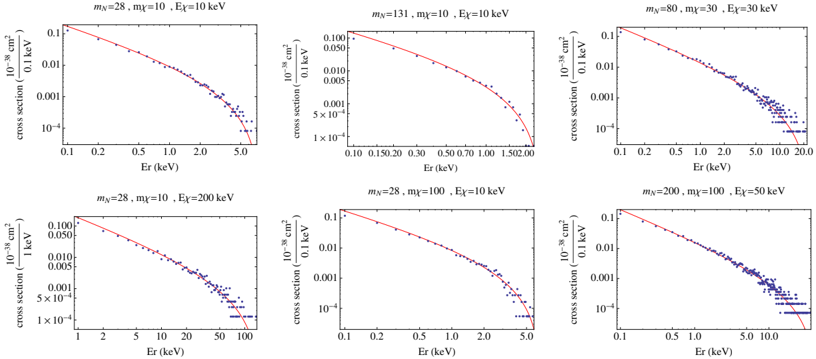
“Figure 15.Nuclear recoil spectra at CDMS II Silicon (m N = 28 GeV)”
§ The double-dark portal > Additional information
“The CDMS II Silicon detectors (m N = 38 GeV) have accumulated 140.2 kg•days of expsure”
Citations
Cites
Sjöstrand, T., Mrenna, S., & Skands, P. (2006) · Journal of High Energy Physics · doi:10.1088/1126-6708/2006/05/026 · Cited by 8,952
Eidelman, S., Hayes, K. G., Olive, K. A., Aguilar-Benitez, M., Amsler, C., Asner, D., Babu, K. S., Barnett, R. M., Beringer, J., Burchat, P. R., et al. (2004) · Physics Letters B · doi:10.1016/j.physletb.2004.06.001 · Cited by 6,673
Planck 2013 results. XVI. Cosmological parameters
Planck Collaboration, Ade, P. A. R., Aghanim, N., Armitage-Caplan, C., Arnaud, M., Ashdown, M., Atrio-Barandela, F., Aumont, J., Baccigalupi, C., Banday, A. J., et al. (2014) · Astronomy & Astrophysics · doi:10.1051/0004-6361/201321591 · Cited by 6,521
Beringer, J., Arguin, J. F., Barnett, R. M., Copic, K., Dahl, O., Groom, D. E., Lin, C. J., Lys, J., Murayama, H., Wohl, C. G., et al. (2012) · Physical Review D · doi:10.1103/physrevd.86.010001 · Cited by 5,978
Black Holes, White Dwarfs, and Neutron Stars: The Physics of Compact Objects
Shapiro, S. L., & Teukolsky, S. A. (1983) · Wiley eBooks · doi:10.1002/9783527617661 · Cited by 4,796
(1990) · Cited by 4,363
MODULES FOR EXPERIMENTS IN STELLAR ASTROPHYSICS (MESA)
Paxton, B., Bildsten, L., Dotter, A., Herwig, F., Lesaffre, P., & Timmes, F. (2011) · The Astrophysical Journal Supplement Series · doi:10.1088/0067-0049/192/1/3 · Cited by 4,360
Jungman, G., Kamionkowski, M., & Griest, K. (1996) · Physics Reports · doi:10.1016/0370-1573(95)00058-5 · Cited by 4,172
A two-solar-mass neutron star measured using Shapiro delay
Demorest, P. B., Pennucci, T., Ransom, S. M., Roberts, M. S. E., & Hessels, J. W. T. (2010) · Nature · doi:10.1038/nature09466 · Cited by 3,905
Alwall, J., Herquet, M., Maltoni, F., Mattelaer, O., & Stelzer, T. (2011) · Journal of High Energy Physics · doi:10.1007/jhep06(2011)128 · Cited by 2,578
Observational Evidence for Self-Interacting Cold Dark Matter
Spergel, D. N., & Steinhardt, P. J. (2000) · Physical Review Letters · doi:10.1103/physrevlett.84.3760 · Cited by 2,097
Estimation of oblique electroweak corrections
Peskin, M. E., & Takeuchi, T. (1992) · Physical Review D · doi:10.1103/physrevd.46.381 · Cited by 2,070
Alwall, J. (2023) · OSTI OAI (U.S. Department of Energy Office of Scientific and Technical Information) · doi:10.1007/jhep06%282011%29128 · Cited by 1,639
First Results from the LUX Dark Matter Experiment at the Sanford Underground Research Facility
Akerib, D. S., Araújo, H. M., Bai, X., Bailey, A. J., Balajthy, J., Bedikian, S., Bernard, E., Bernstein, A., Bolozdynya, A., Bradley, A., et al. (2014) · Physical Review Letters · doi:10.1103/physrevlett.112.091303 · Cited by 1,599
Modules for Experiments in Stellar Astrophysics (MESA)
Paxton, B. (2026) · doi:10.5281/zenodo.19685576 · Cited by 1,411
Dark Matter Results from 225 Live Days of XENON100 Data
Aprile, E., Alfonsi, M., Arisaka, K., Arneodo, F., Balan, C., Baudis, L., Bauermeister, B., Behrens, A., Beltrame, P., Bokeloh, K., et al. (2012) · Physical Review Letters · doi:10.1103/physrevlett.109.181301 · Cited by 1,394
Lewin, J. D., & Smith, P. F. (1996) · Astroparticle Physics · doi:10.1016/s0927-6505(96)00047-3 · Cited by 1,350
Detectability of certain dark-matter candidates
Goodman, M. W., & Witten, E. (1985) · Physical Review D · doi:10.1103/physrevd.31.3059 · Cited by 1,286
Abe, K., Abgrall, N., Aihara, H., Ajima, Y., Albert, J. B., Allan, D. A., Amaudruz, P.-A., Andreopoulos, C., Andrieu, B., Anerella, M. D., et al. (2011) · Nuclear Instruments and Methods in Physics Research Section A Accelerators Spectrometers Detectors and Associated Equipment · doi:10.1016/j.nima.2011.06.067 · Cited by 1,269
Black Holes, White Dwarfs, and Neutron Stars: The Physics of Compact Objects
Shapiro, S. L., Teukolsky, S. A., & Lightman, A. P. (1983) · Physics Today · doi:10.1063/1.2915325 · Cited by 1,185
Griest, K., & Kamionkowski, M. (2000) · Physics Reports · doi:10.1016/s0370-1573(00)00021-1 · Cited by 1,076
Fukuda, S., Fukuda, Y., Hayakawa, T., Ichihara, E., Ishitsuka, M., Itow, Y., Kajita, T., Kameda, J., Kaneyuki, K., Kasuga, S., et al. (2003) · Nuclear Instruments and Methods in Physics Research Section A Accelerators Spectrometers Detectors and Associated Equipment · doi:10.1016/s0168-9002(03)00425-x · Cited by 1,034
An Introduction to Modern Astrophysics
Carroll, B. W., & Ostlie, D. A. (2017) · Cambridge University Press eBooks · doi:10.1017/9781108380980 · Cited by 929
Dark Sectors and New, Light, Weakly-Coupled ParticlesPreprint
Essig, R., Jaros, J. A., Wester, W. C., Hansson, P., Andreas, S., Averett, T. D., Baker, O. K., Batell, B., Battaglieri, M., Beacham, J. B., et al. (2013) · arXiv (Cornell University) · doi:10.48550/arxiv.1311.0029 · Cited by 924
Yakovlev, D. G., & Pethick, C. J. (2004) · Annual Review of Astronomy and Astrophysics · doi:10.1146/annurev.astro.42.053102.134013 · Cited by 866
Smith, D., & Weiner, N. (2001) · Physical Review D · doi:10.1103/physrevd.64.043502 · Cited by 819
Dark Matter Results from 100 Live Days of XENON100 Data
Aprile, E., Arisaka, K., Arneodo, F., Askin, A., Baudis, L., Behrens, A., Bokeloh, K., Brown, E., Bruch, T., Bruno, G., et al. (2011) · Physical Review Letters · doi:10.1103/physrevlett.107.131302 · Cited by 798
Results from 730 kg days of the CRESST-II Dark Matter search
Angloher, G., Bauer, M., Bavykina, I., Bento, A., Bucci, C., Ciemniak, C., Deuter, G., von Feilitzsch, F., Hauff, D., Huff, P., et al. (2012) · The European Physical Journal C · doi:10.1140/epjc/s10052-012-1971-8 · Cited by 771
Dark matter direct detection rate in a generic model with micrOMEGAs_2.2
Bélanger, G., Boudjema, F., Pukhov, A., & Semenov, A. (2009) · Computer Physics Communications · doi:10.1016/j.cpc.2008.11.019 · Cited by 748
Billard, J., Figueroa-Feliciano, E., & Strigari, L. (2014) · Physical Review D · doi:10.1103/physrevd.89.023524 · Cited by 719
Improved Search for ν¯μ→ν¯e Oscillations in the MiniBooNE Experiment
Aguilar-Arevalo, A. A., Brown, B. C., Bugel, L., Cheng, G., Church, E., Conrad, J. M., Dharmapalan, R., Djurcic, Z., Finley, D. A., Ford, R. L., et al. (2013) · Physical Review Letters · doi:10.1103/physrevlett.110.161801 · Cited by 699
Direct URCA process in neutron stars
Lattimer, J. M., Pethick, C. J., Prakash, M., & Haensel, P. (1991) · Physical Review Letters · doi:10.1103/physrevlett.66.2701 · Cited by 693
Stars as laboratories for fundamental physics
Ramandurai, S. (1996) · Endeavour · doi:10.1016/s0160-9327(97)88948-x · Cited by 652
The RAVE survey: constraining the local Galactic escape speed
Smith, M. C., Ruchti, G. R., Helmi, A., Wyse, R. F. G., Fulbright, J. P., Freeman, K. C., Navarro, J. F., Seabroke, G. M., Steinmetz, M., Williams, M., et al. (2007) · Monthly Notices of the Royal Astronomical Society · doi:10.1111/j.1365-2966.2007.11964.x · Cited by 628
Results from 730 kg days of the CRESST-II Dark Matter SearchPreprint
(2016) · Cited by 568
Raffelt, G. G. (2008) · Lecture Notes in Physics · doi:10.1007/978-3-540-73518-2_3 · Cited by 566
Rapid Cooling of the Neutron Star in Cassiopeia A Triggered by Neutron Superfluidity in Dense Matter
Page, D. P., Prakash, M., Lattimer, J. M., & Steiner, A. W. (2011) · Physical Review Letters · doi:10.1103/physrevlett.106.081101 · Cited by 541
Page, D. P., Geppert, U. R. M. E., & Weber, F. (2005) · Nuclear Physics A · doi:10.1016/j.nuclphysa.2005.09.019 · Cited by 540
Beyond collisionless dark matter: Particle physics dynamics for dark matter halo structure
Tulin, S., Yu, H.-B., & Zurek, K. M. (2013) · Physical Review D · doi:10.1103/physrevd.87.115007 · Cited by 516 · cited 1×
“To derive the preferred range of yχ we follow the procedure in [26].”
MethodCosmological simulations with self-interacting dark matter – II. Halo shapes versus observations
Peter, A. H. G., Rocha, M., Bullock, J. S., & Kaplinghat, M. (2013) · Monthly Notices of the Royal Astronomical Society · doi:10.1093/mnras/sts535 · Cited by 514
Minimal Cooling of Neutron Stars: A New Paradigm
Page, D., Lattimer, J. M., Prakash, M., & Steiner, A. W. (2004) · The Astrophysical Journal Supplement Series · doi:10.1086/424844 · Cited by 502
Silicon Detector Dark Matter Results from the Final Exposure of CDMS II
Agnese, R., Ahmed, Z., Anderson, A. J., Arrenberg, S., Balakishiyeva, D., Basu Thakur, R., Bauer, D. A., Billard, J., Borgland, A., Brandt, D., et al. (2013) · Physical Review Letters · doi:10.1103/physrevlett.111.251301 · Cited by 487
A Combined $ν_μ\to ν_e$ and $\barν_μ\to \barν_e$ Oscillation Analysis of the MiniBooNE ExcessesPreprint
MiniBooNE Collaboration, Aguilar-Arevalo, A. A., Brown, B. C., Bugel, L., Cheng, G., Church, E., Conrad, J. M., Dharmapalan, R., Djurcic, Z., Finley, D. A., et al. (2012) · arXiv (Cornell University) · doi:10.48550/arxiv.1207.4809 · Cited by 477
Ackermann, M., Albert, A., Anderson, B., Baldini, L., Ballet, J., Barbiellini, G., Bastieri, D., Bechtol, K., Bellazzini, R., Bissaldi, E., et al. (2014) · Physical Review D · doi:10.1103/physrevd.89.042001 · Cited by 472
Cooling neutron star in the Cassiopeia A supernova remnant: evidence for superfluidity in the core
Shternin, P. S., Yakovlev, D. G., Heinke, C. O., Ho, W. C. G., & Patnaude, D. J. (2011) · Monthly Notices of the Royal Astronomical Society Letters · doi:10.1111/j.1745-3933.2011.01015.x · Cited by 464
Carlson, E. D., Machacek, M. E., & Hall, L. J. (1992) · The Astrophysical Journal · doi:10.1086/171833 · Cited by 458
Feng, J. L., Kaplinghat, M., Tu, H., & Yu, H.-B. (2009) · Journal of Cosmology and Astroparticle Physics · doi:10.1088/1475-7516/2009/07/004 · Cited by 446
CoGeNT: A search for low-mass dark matter usingp-type point contact germanium detectors
Aalseth, C. E., Barbeau, P. S., Colaresi, J., Collar, J. I., Diaz Leon, J., Fast, J. E., Fields, N. E., Hossbach, T. W., Knecht, A., Kos, M. S., et al. (2013) · Physical Review D · doi:10.1103/physrevd.88.012002 · Cited by 399
WIMP annihilation and cooling of neutron stars
Kouvaris, C. (2008) · Physical Review D · doi:10.1103/physrevd.77.023006 · Cited by 341
Feng, J. L., Kumar, J., Marfatia, D., & Sanford, D. (2011) · Physics Letters B · doi:10.1016/j.physletb.2011.07.083 · Cited by 337
Agnese, R., Anderson, A. J., Asai, M., Balakishiyeva, D., Basu Thakur, R., Bauer, D. A., Billard, J., Borgland, A., Bowles, M. A., Brandt, D., et al. (2014) · Physical Review Letters · doi:10.1103/physrevlett.112.041302 · Cited by 287
Working Group Report: New Light Weakly Coupled Particles
Essig, R., Steffen, J. H., Hatzikoutelis, A., Averett, T. D., Marsh, D. J. E., Bjorken, J. D., Andreas, S., Jaeckel, J., Ritz, A., Nelson, T. K., et al. (2013) · OSTI OAI (U.S. Department of Energy Office of Scientific and Technical Information) · Cited by 284
Sommerfeld enhancements for thermal relic dark matter
Feng, J. L., Kaplinghat, M., & Yu, H.-B. (2010) · Physical Review D · doi:10.1103/physrevd.82.083525 · Cited by 278
Structure of neutron star envelopes
Gudmundsson, E. H., Pethick, C. J., & Epstein, R. I. (1983) · The Astrophysical Journal · doi:10.1086/161292 · Cited by 273
NEUTRINO EMISSION FROM COOPER PAIRS AND MINIMAL COOLING OF NEUTRON STARS
Page, D., Lattimer, J. M., Prakash, M., & Steiner, A. W. (2009) · The Astrophysical Journal · doi:10.1088/0004-637x/707/2/1131 · Cited by 266
On the Theory of White Dwarf Stars: I. The Energy Sources of White Dwarfs
Mestel, L. (1952) · Monthly Notices of the Royal Astronomical Society · doi:10.1093/mnras/112.6.583 · Cited by 258
Nuclear form factors for the scattering of weakly interacting massive particles
Engel, J. (1991) · Physics Letters B · doi:10.1016/0370-2693(91)90712-y · Cited by 243
Cooling neutron star in the Cassiopeia A supernova remnant: evidence for superfluidity in the corePreprint
Shternin, P. S., Yakovlev, D. G., Heinke, C. O., Ho, W. C. G., & Patnaude, D. (n.d.) · Cited by 242
ϵK at next-to-next-to-leading order: The charm-top-quark contribution
Brod, J., & Gorbahn, M. (2010) · Physical review. D. Particles, fields, gravitation, and cosmology/Physical review. D. Particles and fields · doi:10.1103/physrevd.82.094026 · Cited by 233
Neutrinos Help Reconcile Planck Measurements with the Local Universe
Wyman, M., Rudd, D. H., Vanderveld, R. A., & Hu, W. (2014) · Physical Review Letters · doi:10.1103/physrevlett.112.051302 · Cited by 224
Waiting for precise measurements of K+→π+νν¯ and KL→π0νν¯
Buras, A. J., Selma Uhlig, A., & Schwab, F. (2008) · Reviews of Modern Physics · doi:10.1103/revmodphys.80.965 · Cited by 220
Barlow, R. (1990) · Nuclear Instruments and Methods in Physics Research Section A: Accelerators, Spectrometers, Detectors and Associated Equipment · doi:10.1016/0168-9002(90)91334-8 · Cited by 208
Kribs, G. D., Roy, T. S., Terning, J., & Zurek, K. M. (2010) · Physical review. D. Particles, fields, gravitation, and cosmology/Physical review. D. Particles and fields · doi:10.1103/physrevd.81.095001 · Cited by 200
The White Dwarf Luminosity Function from Sloan Digital Sky Survey Imaging Data
Harris, H. C., Munn, J. A., Kilic, M., Liebert, J., Williams, K. A., von Hippel, T., Levine, S. E., Monet, D. G., Eisenstein, D. J., Kleinman, S. J., et al. (2006) · The Astronomical Journal · doi:10.1086/497966 · Cited by 196
Composite inelastic dark matter
Alves, D. S. M., Behbahani, S. R., Schuster, P., & Wacker, J. G. (2010) · Physics Letters B · doi:10.1016/j.physletb.2010.08.006 · Cited by 191
Crivellin, A., Hoferichter, M., & Procura, M. (2014) · Physical review. D. Particles, fields, gravitation, and cosmology/Physical review. D. Particles and fields · doi:10.1103/physrevd.89.054021 · Cited by 190
DARK MATTER DYNAMICS AND INDIRECT DETECTION
Bertone, G., & MERRITT, D. (2005) · Modern Physics Letters A · doi:10.1142/s0217732305017391 · Cited by 188
Constraints on large-scale dark acoustic oscillations from cosmology
Cyr-Racine, F.-Y., de Putter, R., Raccanelli, A., & Sigurdson, K. (2014) · Physical Review D · doi:10.1103/physrevd.89.063517 · Cited by 183
Yakovlev, D. G., Gnedin, O. Y., Gusakov, M. E., Kaminker, A. D., Левенфиш, К. П., & Potekhin, A. Y. (2005) · Nuclear Physics A · doi:10.1016/j.nuclphysa.2005.02.061 · Cited by 181
Potekhin, A. Y. (2010) · Physics-Uspekhi · doi:10.3367/ufne.0180.201012c.1279 · Cited by 171
Momentum dependent dark matter scattering
Chang, S., Pierce, A., & Weiner, N. (2010) · Journal of Cosmology and Astroparticle Physics · doi:10.1088/1475-7516/2010/01/006 · Cited by 171
Graham, P. W., Harnik, R., Rajendran, S., & Saraswat, P. (2010) · Physical review. D. Particles, fields, gravitation, and cosmology/Physical review. D. Particles and fields · doi:10.1103/physrevd.82.063512 · Cited by 158
Dark matter thermalization in neutron stars
Bertoni, B., Nelson, A. E., & Reddy, S. K. (2013) · Physical review. D. Particles, fields, gravitation, and cosmology/Physical review. D. Particles and fields · doi:10.1103/physrevd.88.123505 · Cited by 155
DARK MATTER INVESTIGATION BY DAMA AT GRAN SASSO
Bernabei, R., Belli, P., d'ANGELO, S., Marco, A. D., MONTECCHIA, F., Cappella, F., d'ANGELO, A., Incicchitti, A., Caracciolo, V., Castellano, S., et al. (2013) · International Journal of Modern Physics A · doi:10.1142/s0217751x13300226 · Cited by 154
A Higgs conundrum with vector fermions
Dawson, S., & Furlan, E. (2012) · Physical review. D. Particles, fields, gravitation, and cosmology/Physical review. D. Particles and fields · doi:10.1103/physrevd.86.015021 · Cited by 153
Cooling rates of neutron stars and the young neutron star in the Cassiopeia A supernova remnant
Yakovlev, D. G., Ho, W. C. G., Shternin, P. S., Heinke, C. O., & Potekhin, A. Y. (2010) · Monthly Notices of the Royal Astronomical Society · doi:10.1111/j.1365-2966.2010.17827.x · Cited by 139
(2012) · doi:10.1103/physrevlett.108.121801 · Cited by 133
MEASURING THE COOLING OF THE NEUTRON STAR IN CASSIOPEIA A WITH ALLCHANDRA X-RAY OBSERVATORYDETECTORS
Elshamouty, K. G., Heinke, C. O., Sivakoff, G. R., Ho, W. C. G., Shternin, P. S., Yakovlev, D. G., Patnaude, D., & David, L. P. (2013) · The Astrophysical Journal · doi:10.1088/0004-637x/777/1/22 · Cited by 128
On the Origin of Light Dark Matter SpeciesPreprint
Essig, R., Kaplan, J., Schuster, P., & Toro, N. (2010) · Physical review. D/Physical review. D. · doi:10.48550/arxiv.1004.0691 · Cited by 122
Feldstein, B., Fitzpatrick, A. L., & Katz, E. (2010) · Journal of Cosmology and Astroparticle Physics · doi:10.1088/1475-7516/2010/01/020 · Cited by 116
Gudmundsson, E. H., Pethick, C. J., & Epstein, R. I. (1982) · The Astrophysical Journal · doi:10.1086/183840 · Cited by 98
White dwarfs constrain dark forces
Dreiner, H. K., Fortin, J.-F., Isern, J., & Ubaldi, L. (2013) · Physical review. D. Particles, fields, gravitation, and cosmology/Physical review. D. Particles and fields · doi:10.1103/physrevd.88.043517 · Cited by 97
Closing in on asymmetric dark matter I: model independent limits for interactions with quarks
March-Russell, J., Unwin, J., & West, S. M. (2012) · Journal of High Energy Physics · doi:10.1007/jhep08(2012)029 · Cited by 88
Bai, Y., & Fox, P. J. (2009) · Journal of High Energy Physics · doi:10.1088/1126-6708/2009/11/052 · Cited by 86
DARK MATTER DYNAMICS AND INDIRECT DETECTION
Bertone, G., & Merritt, D. R. (2005) · CERN Document Server (European Organization for Nuclear Research) · Cited by 82
On the photon diffusion time scale for the sun
Mitalas, R., & Sills, K. (1992) · The Astrophysical Journal · doi:10.1086/172103 · Cited by 82
Cooling rates of neutron stars and the young neutron star in the Cassiopeia A supernova remnantPreprint
Yakovlev, D. G., Ho, W. C. G., Shternin, P. S., Heinke, C. O., & Potekhin, E. Y. (2011) · Cited by 78
Measurements of atmospheric neutrinos and antineutrinos in the MINOS far detector
Adamson, P., Backhouse, C., Barr, G., Bishai, M., Blake, A., Bock, G. J., Boehnlein, D. J., Bogert, D., Cao, S., Chapman, J. D., et al. (2012) · Physical review. D. Particles, fields, gravitation, and cosmology/Physical review. D. Particles and fields · doi:10.1103/physrevd.86.052007 · Cited by 69
WHITE DWARF LUMINOSITY AND MASS FUNCTIONS FROM SLOAN DIGITAL SKY SURVEY SPECTRA
DeGennaro, S., von Hippel, T., Winget, D. E., Kepler, S. O., Nitta, A., Koester, D., & Althaus, L. (2008) · The Astronomical Journal · doi:10.1088/0004-6256/135/1/1 · Cited by 67
Brice, S. J., Cooper, R. L., DeJongh, F., Empl, A., Garrison, L. M., Hime, A., Hungerford, E. V., Kobilarcik, T., Loer, B., Mariani, C., et al. (2014) · Physical review. D. Particles, fields, gravitation, and cosmology/Physical review. D. Particles and fields · doi:10.1103/physrevd.89.072004 · Cited by 63
A hot white dwarf luminosity function from the Sloan Digital Sky Survey
Krzesiński, J., Kleinman, S. J., Nitta, A., Hügelmeyer, S. D., Dreizler, S., Liebert, J., & Harris, H. C. (2009) · Astronomy and Astrophysics · doi:10.1051/0004-6361/200912094 · Cited by 57
Composite magnetic dark matter and the 130 GeV line
Cline, J. M., Moore, G. D., & Frey, A. R. (2012) · Physical review. D. Particles, fields, gravitation, and cosmology/Physical review. D. Particles and fields · doi:10.1103/physrevd.86.115013 · Cited by 54
From Lagrangians to Events: Computer Tutorial at the MC4BSM-2012 WorkshopPreprint
Ask, S., Christensen, N. D., Duhr, C., Grojean, C., Höche, S., Matchev, K. T., Mattelaer, O., Mrenna, S., Papaefstathiou, A., Park, M., et al. (2012) · arXiv (Cornell University) · doi:10.48550/arxiv.1209.0297 · Cited by 53
Neutrino oscillation results from LSND
Mills, G. B. (2001) · Nuclear Physics B - Proceedings Supplements · doi:10.1016/s0920-5632(00)00941-5 · Cited by 48
Parity violation in composite inelastic dark matter models
Lisanti, M., & Wacker, J. G. (2010) · Physical review. D. Particles, fields, gravitation, and cosmology/Physical review. D. Particles and fields · doi:10.1103/physrevd.82.055023 · Cited by 42
Stellar energy transfer by keV-mass scalars
Raffelt, G. G., & Starkman, G. D. (1989) · Physical Review D · doi:10.1103/physrevd.40.942 · Cited by 39
Theory of cooling neutron stars versus observations
Yakovlev, D. G., Gnedin, O. Y., Kaminker, A. D., Potekhin, A. Y., Bassa, C., Wang, Z., Cumming, A., & Kaspi, V. M. (2008) · AIP Conference Proceedings · doi:10.1063/1.2900259 · Cited by 34
Theory of cooling neutron stars versus observationsPreprint
Yakovlev, D. G., Gnedin, O. Y., Kaminker, A. D., & Potekhin, A. Y. (n.d.) · Cited by 31
T2HK: J-PARC upgrade plan for future and beyond T2KPreprint
Ishida, T. (2013) · arXiv (Cornell University) · doi:10.48550/arxiv.1311.5287 · Cited by 25
Michael, D. (2003) · Nuclear Physics B - Proceedings Supplements · doi:10.1016/s0920-5632(03)01317-3 · Cited by 21
Pairing and the Cooling of Neutron Stars
Page, D. P. (2013) · WORLD SCIENTIFIC eBooks · doi:10.1142/9789814412490_0024 · Cited by 14
2γ decays of scalar mesons (σ(600), f 0(980), and a 0(980)) in the Nambu-Jona-Lasinio model
Volkov, M. K., Kuraev, E. A., & Bystritskiy, Y. M. (2010) · Physics of Atomic Nuclei · doi:10.1134/s1063778810030063 · Cited by 14
Volkov, M. K., Kuraev, E. A., & Bystritskiy, Y. M. (2010) · Open Physics · doi:10.2478/s11534-009-0131-8 · Cited by 11
Direct detection with dark mediators
Curtin, D., Surujon, Z., & Tsai, Y. (2014) · Physics Letters B · doi:10.1016/j.physletb.2014.10.027 · Cited by 6
Self-citationMINOS neutrino oscillation results
Barr, G. (2013) · International Conference on High Energy Physics (ICHEP) · doi:10.22323/1.174.0398 · Cited by 5
Silicon Detector Dark Matter Results from the Final Exposure of CDMS IIPreprint
CDMS Collaboration, Agnese, R., Ahmed, Z., et al. (2013) · arXiv (Cornell University) · doi:10.48550/arxiv.1304.4279 · Cited by 2
The MINOS experiment: 2012 results
Barr, G. (2012) · Cited by 1
Steigman, G. (1989) · Annals of the New York Academy of Sciences · doi:10.1111/j.1749-6632.1989.tb50491.x
Dark Matter Results from 100 Live Days of XENON100 DataPreprint
XENON100 Collaboration, Aprile, E., Arisaka, K., et al. (2011) · arXiv (Cornell University) · doi:10.48550/arxiv.1104.2549
(1990) · Frontiers in Physiology
(1996)
Planck 2013 results. XVI. Cosmological parameters
Ade, P. A. R., Aghanim, N., Armitage-Caplan, C., Arnaud, M., Ashdown, M., Atrio-Barandela, F., Aumont, J., Baccigalupi, C., Banday, A. J., Barreiro, R. B., et al. (2013) · arXiv · doi:10.48550/arxiv.1303.5076
Pairing and the Cooling of Neutron Stars
Page, D. (2012) · arXiv · doi:10.48550/arxiv.1206.5011
CoGeNT: A Search for Low-Mass Dark Matter using p-type Point Contact Germanium Detectors
Aalseth, C. E., Barbeau, P. S., Colaresi, J., Collar, J. I., Leon, J. D., Fast, J. E., Fields, N. E., Hossbach, T. W., Knecht, A., Kos, M. S., et al. (2012) · arXiv · doi:10.48550/arxiv.1208.5737
Smith, D., & Weiner, N. (2001) · arXiv · doi:10.48550/arxiv.hep-ph/0101138
Graham, P. W., Harnik, R., Rajendran, S., & Saraswat, P. (2010) · arXiv · doi:10.48550/arxiv.1004.0937
Kribs, G. D., Roy, T. S., Terning, J., & Zurek, K. M. (2009) · arXiv · doi:10.48550/arxiv.0909.2034
Parity Violation in Composite Inelastic Dark Matter Models
Lisanti, M., & Wacker, J. G. (2009) · arXiv · doi:10.48550/arxiv.0911.4483
Composite magnetic dark matter and the 130 GeV line
Cline, J. M., Frey, A. R., & Moore, G. D. (2012) · arXiv · doi:10.48550/arxiv.1208.2685
Beyond Collisionless Dark Matter: Particle Physics Dynamics for Dark Matter Halo Structure
Tulin, S., Yu, H.-B., & Zurek, K. M. (2013) · arXiv · doi:10.48550/arxiv.1302.3898
Cosmological Simulations with Self-Interacting Dark Matter II: Halo Shapes vs. Observations
Peter, A. H. G., Rocha, M., Bullock, J. S., & Kaplinghat, M. (2012) · arXiv · doi:10.48550/arxiv.1208.3026
Brice, S. J., Cooper, R. L., DeJongh, F., Empl, A., Garrison, L. M., Hime, A., Hungerford, E., Kobilarcik, T., Loer, B., Mariani, C., et al. (2013) · arXiv · doi:10.48550/arxiv.1311.5958
2γ-decays of scalar mesons (σ(600), f_0(980) and a_0(980)) in the Nambu-Jona-Lasinio model
Volkov, M. K., Bystritskiy, Y. M., & Kuraev, E. A. (2009) · arXiv · doi:10.48550/arxiv.0901.1981
Constraints on Large-Scale Dark Acoustic Oscillations from Cosmology
Cyr-Racine, F.-Y., de Putter, R., Raccanelli, A., & Sigurdson, K. (2013) · arXiv · doi:10.48550/arxiv.1310.3278
White Dwarfs constrain Dark Forces
Dreiner, H. K., Fortin, J.-F., Isern, J., & Ubaldi, L. (2013) · arXiv · doi:10.48550/arxiv.1303.7232
Dark Matter Thermalization in Neutron Stars
Bertoni, B., Nelson, A. E., & Reddy, S. (2013) · arXiv · doi:10.48550/arxiv.1309.1721
WIMP Annihilation and Cooling of Neutron Stars
Kouvaris, C. (2007) · arXiv · doi:10.48550/arxiv.0708.2362
Crivellin, A., Hoferichter, M., & Procura, M. (2013) · arXiv · doi:10.48550/arxiv.1312.4951
Billard, J., Strigari, L., & Figueroa-Feliciano, E. (2013) · arXiv · doi:10.48550/arxiv.1307.5458
Measurements of atmospheric neutrinos and antineutrinos in the MINOS Far Detector
Adamson, P., Backhouse, C., Barr, G., Bishai, M., Blake, A. S. T., Bock, G. J., Boehnlein, D. J., Bogert, D., Cao, S. V., Chapman, J. D., et al. (2012) · arXiv · doi:10.48550/arxiv.1208.2915
Epsilon_K at Next-to-Next-to-Leading Order: The Charm-Top-Quark Contribution
Brod, J., & Gorbahn, M. (2010) · arXiv · doi:10.48550/arxiv.1007.0684
A Higgs Conundrum with Vector Fermions
Dawson, S., & Furlan, E. (2012) · arXiv · doi:10.48550/arxiv.1205.4733
LAT Collaboration, Ackermann, M., Albert, A., Anderson, B., Baldini, L., Ballet, J., Barbiellini, G., Bastieri, D., Bechtol, K., Bellazzini, R., et al. (2013) · arXiv · doi:10.48550/arxiv.1310.0828
Sommerfeld Enhancements for Thermal Relic Dark Matter
Feng, J. L., Kaplinghat, M., & Yu, H.-B. (2010) · arXiv · doi:10.48550/arxiv.1005.4678
Jungman, G., Kamionkowski, M., & Griest, K. (1995) · arXiv · doi:10.48550/arxiv.hep-ph/9506380
Dark Matter Dynamics and Indirect Detection
Bertone, G., & Merritt, D. (2005) · arXiv · doi:10.48550/arxiv.astro-ph/0504422
First results from the LUX dark matter experiment at the Sanford Underground Research Facility
Akerib, D. S., Araujo, H. M., Bai, X., Bailey, A. J., Balajthy, J., Bedikian, S., Bernard, E., Bernstein, A., Bolozdynya, A., Bradley, A., et al. (2013) · arXiv · doi:10.48550/arxiv.1310.8214
Dark Matter Results from 225 Live Days of XENON100 Data
Aprile, E., Alfonsi, M., Arisaka, K., Arneodo, F., Balan, C., Baudis, L., Bauermeister, B., Behrens, A., Beltrame, P., Bokeloh, K., et al. (2012) · arXiv · doi:10.48550/arxiv.1207.5988
Dark Matter investigation by DAMA at Gran Sasso
Bernabei, R., Belli, P., d'Angelo, S., Marco, A. D., Montecchia, F., Cappella, F., d'Angelo, A., Incicchitti, A., Caracciolo, V., Castellano, S., et al. (2013) · arXiv · doi:10.48550/arxiv.1306.1411
Results from 730 kg days of the CRESST-II Dark Matter Search
Angloher, G., Bauer, M., Bavykina, I., Bento, A., Bucci, C., Ciemniak, C., Deuter, G., von Feilitzsch, F., Hauff, D., Huff, P., et al. (2011) · arXiv · doi:10.48550/arxiv.1109.0702
Direct Detection with Dark Mediators
Curtin, D., Surujon, Z., & Tsai, Y. (2013) · arXiv · doi:10.48550/arxiv.1312.2618
Self-citationClosing in on Asymmetric Dark Matter I: Model independent limits for interactions with quarks
March-Russell, J., Unwin, J., & West, S. M. (2012) · arXiv · doi:10.48550/arxiv.1203.4854
Momentum Dependent Dark Matter Scattering
Chang, S., Pierce, A., & Weiner, N. (2009) · arXiv · doi:10.48550/arxiv.0908.3192
Composite Inelastic Dark Matter
Alves, D. S. M., Behbahani, S. R., Schuster, P., & Wacker, J. G. (2009) · arXiv · doi:10.48550/arxiv.0903.3945
Feldstein, B., Fitzpatrick, A. L., & Katz, E. (2009) · arXiv · doi:10.48550/arxiv.0908.2991
Bai, Y., & Fox, P. J. (2009) · arXiv · doi:10.48550/arxiv.0909.2900
Observational evidence for self-interacting cold dark matter
Spergel, D. N., & Steinhardt, P. J. (1999) · arXiv · doi:10.48550/arxiv.astro-ph/9909386
Feng, J. L., Kumar, J., Marfatia, D., & Sanford, D. (2011) · arXiv · doi:10.48550/arxiv.1102.4331
Feng, J. L., Kaplinghat, M., Tu, H., & Yu, H.-B. (2009) · arXiv · doi:10.48550/arxiv.0905.3039
Alwall, J., Herquet, M., Maltoni, F., Mattelaer, O., & Stelzer, T. (2011) · arXiv · doi:10.48550/arxiv.1106.0522
Sjostrand, T., Mrenna, S., & Skands, P. (2006) · arXiv · doi:10.48550/arxiv.hep-ph/0603175
$νΛ$CDM: Neutrinos help reconcile Planck with the Local Universe
Wyman, M., Rudd, D. H., Vanderveld, R. A., & Hu, W. (2013) · arXiv · doi:10.48550/arxiv.1307.7715
Raffelt, G. G. (2006) · arXiv · doi:10.48550/arxiv.hep-ph/0611350
White Dwarf Luminosity and Mass Functions from Sloan Digital Sky Survey Spectra
DeGennaro, S., von Hippel, T., Winget, D. E., Kepler, S. O., Nitta, A., Koester, D., & Althaus, L. (2007) · arXiv · doi:10.48550/arxiv.0709.2190
Modules for Experiments in Stellar Astrophysics (MESA)
Paxton, B., Bildsten, L., Dotter, A., Herwig, F., Lesaffre, P., & Timmes, F. (2010) · arXiv · doi:10.48550/arxiv.1009.1622
The White Dwarf Luminosity Function from SDSS Imaging Data
Harris, H. C., Munn, J. A., Kilic, M., Liebert, J., Williams, K. A., von Hippel, T., Levine, S. E., Monet, D. G., Eisenstein, D. J., Kleinman, S. J., et al. (2005) · arXiv · doi:10.48550/arxiv.astro-ph/0510820
Yakovlev, D. G., & Pethick, C. J. (2004) · arXiv · doi:10.48550/arxiv.astro-ph/0402143
Theory of cooling neutron stars versus observations
Yakovlev, D. G., Gnedin, O. Y., Kaminker, A. D., & Potekhin, A. Y. (2007) · arXiv · doi:10.48550/arxiv.0710.2047
Page, D., Geppert, U., & Weber, F. (2005) · arXiv · doi:10.48550/arxiv.astro-ph/0508056
Neutrino Emission from Cooper Pairs and Minimal Cooling of Neutron Stars
Page, D., Lattimer, J. M., Prakash, M., & Steiner, A. W. (2009) · arXiv · doi:10.48550/arxiv.0906.1621
Cooling rates of neutron stars and the young neutron star in the Cassiopeia A supernova remnant
Yakovlev, D. G., Ho, W. C. G., Shternin, P. S., Heinke, C. O., & Potekhin, A. Y. (2010) · arXiv · doi:10.48550/arxiv.1010.1154
Rapid Cooling of the Neutron Star in Cassiopeia A Triggered by Neutron Superfluidity in Dense Matter
Page, D., Prakash, M., Lattimer, J. M., & Steiner, A. W. (2010) · arXiv · doi:10.48550/arxiv.1011.6142
Cooling neutron star in the Cassiopeia~A supernova remnant: Evidence for superfluidity in the core
Shternin, P. S., Yakovlev, D. G., Heinke, C. O., Ho, W. C. G., & Patnaude, D. J. (2010) · arXiv · doi:10.48550/arxiv.1012.0045
Potekhin, A. Y. (2011) · arXiv · doi:10.48550/arxiv.1102.5735
Elshamouty, K. G., Heinke, C. O., Sivakoff, G. R., Ho, W. C. G., Shternin, P. S., Yakovlev, D. G., Patnaude, D. J., & David, L. (2013) · arXiv · doi:10.48550/arxiv.1306.3387
Shapiro delay measurement of a two solar mass neutron star
Demorest, P., Pennucci, T., Ransom, S., Roberts, M., & Hessels, J. (2010) · arXiv · doi:10.48550/arxiv.1010.5788
Minimal Cooling of Neutron Stars: A New Paradigm
Page, D., Lattimer, J. M., Prakash, M., & Steiner, A. W. (2004) · arXiv · doi:10.48550/arxiv.astro-ph/0403657
Dark matter direct detection rate in a generic model with micrOMEGAs2.2
Belanger, G., Boudjema, F., Pukhov, A., & Semenov, A. (2008) · arXiv · doi:10.48550/arxiv.0803.2360
Abe, K., Abgrall, N., Aihara, H., Ajima, Y., Albert, J. B., Allan, D., Amaudruz, P. A., Andreopoulos, C., Andrieu, B., Anerella, M. D., et al. (2011) · arXiv · doi:10.48550/arxiv.1106.1238
Brod, J., & Gorbahn, M. (2011) · arXiv · doi:10.48550/arxiv.1108.2036
Waiting for Precise Measurements of K^+->pi^+ nu nu and K_L->pi^0 nu nu
Buras, A. J., Schwab, F., & Uhlig, S. (2004) · arXiv · doi:10.48550/arxiv.hep-ph/0405132
The RAVE Survey: Constraining the Local Galactic Escape Speed
Smith, M. C., Ruchti, G. R., Helmi, A., Wyse, R. F. G., Fulbright, J. P., Freeman, K. C., Navarro, J. F., Seabroke, G. M., Steinmetz, M., Williams, M., et al. (2006) · arXiv · doi:10.48550/arxiv.astro-ph/0611671
Cited by
MODULES FOR EXPERIMENTS IN STELLAR ASTROPHYSICS (MESA): BINARIES, PULSATIONS, AND EXPLOSIONS
Paxton, B., Marchant, P., Schwab, J., Bauer, E. B., Bildsten, L., Cantiello, M., Dessart, L., Farmer, R., Hu, H., Langer, N., et al. (2015) · The Astrophysical Journal Supplement Series · doi:10.1088/0067-0049/220/1/15 · Cited by 3,204
Neutrino Portal Dark Matter: From Dwarf Galaxies to IceCubePreprint
Cherry, J. F., Friedland, A., & Shoemaker, I. M. (2014) · arXiv (Cornell University) · doi:10.48550/arxiv.1411.1071 · Cited by 158
Reconciling large- and small-scale structure in Twin Higgs models
Prilepina, V., & Tsai, Y. (2017) · Journal of High Energy Physics · doi:10.1007/jhep09(2017)033 · Cited by 69
Self-citationSimplified dark matter models confront the gamma ray excess
Balázs, C., & Li, T. (2014) · Physical review. D. Particles, fields, gravitation, and cosmology/Physical review. D. Particles and fields · doi:10.1103/physrevd.90.055026 · Cited by 40
Direct detection of atomic dark matter in white dwarfs
Curtin, D. Y., & Setford, J. (2021) · Journal of High Energy Physics · doi:10.1007/jhep03(2021)166 · Cited by 35
Self-citation
Metadata
- Authors
- Curtin, D., & Tsai, Y.
- Affiliations
- Stony Brook University (US)
- University of California, Davis (US)
- Corresponding author
- Tsai, Yuhsin
- ORCID
- Curtin, David
- Venue
- Journal of High Energy Physics
- Published
- 2014-11
- Volume
- 2014
- Issue
- 11
- Pages
- 136
- ISSN
- 1029-8479 (ISSN-L)
- OpenAlex
- W2058223981
- Semantic Scholar
- 0400f77c3cc59ce237d0d59b0b12b1a8578482f5
- Cited by
- 9
- References
- 109
- Citations by year
- 2021: 1 · 2017: 1 · 2016: 2 · 2015: 2 · 2014: 3
- FWCI
- 0.80
- Type
- journal article
- Language
- en
- Open access
- diamond
- doi.org
- Licence
- cc-by
- Locations
- Journal of High Energy Physics (publishedVersion, cc-by)
- arXiv (Cornell University) (submittedVersion)
- arXiv (Cornell University)
- Funders
- National Science Foundation (0969739, 1066293)
- U.S. Department of Energy (DE‐FG02‐, FG02-91ER40674, DEFG0291ER40674)
- Aspen Center for Physics (1066293, PHYS-1066293)
- High Energy Physics (DE–FG02-91ER40674)
- Topics
- Physical Sciences › Physics and Astronomy › Nuclear and High Energy Physics › Dark Matter and Cosmic Phenomena
- Physical Sciences › Physics and Astronomy › Nuclear and High Energy Physics › Particle physics theoretical and experimental studies
- Physical Sciences › Physics and Astronomy › Nuclear and High Energy Physics › Neutrino Physics Research
- Keywords
- dark mediator, dark matter, dark sector, Yukawa couplings, light scalar fields, direct detection, thermal dark matter, self-interacting dark matter, neutron star cooling, stellar astrophysics, WIMPs, dark matter stability
About these checks
Registry, retraction, Cites and statistics results are computed, not judged, with one exception: a printed reference that no index lists is read once by a model before it counts as a citation error. Claims are extracted by a model and kept only when their quote appears verbatim in the text; each cited source is then checked, with a model’s help, for whether it says what the claim relies on. Those verdicts can be wrong — read the claim’s quote and the cited source before relying on one.
A language model drew the claims from the paper on 2026-11-23, under version 3 of the claim definition (model deepseek-v4.1-flash, prompt extract-v3).
A second model labelled each claim on 2026-11-23 (model jev-1.13-20260917, definition revision gold-guideline-v0.2).
Statistics and arithmetic are recomputed, not judged.
Confidence bands are shown only for fields calibrated on our annotated test set. None is calibrated yet, so no band is shown.
What counts as a claim ›How we measure confidence ›How we check this ›
Are you an author, or do you see a problem with this page? Request a review
Data sources
Bibliographic data: Semantic Scholar, OpenAlex, Crossref.
Contains information from the Semantic Scholar Academic Graph Datasets, made available under the ODC Attribution License (ODC-BY 1.0).
Semantic Scholar’s data is described in: Kinney, R., et al. (2023). The Semantic Scholar Open Data Platform. arXiv:2301.10140.
