

The DOI matches its Crossref record; 79 of the 79 references it cites were found in a registry or an index.
Fox-1 family of RNA-binding proteins
Open accessAbstract
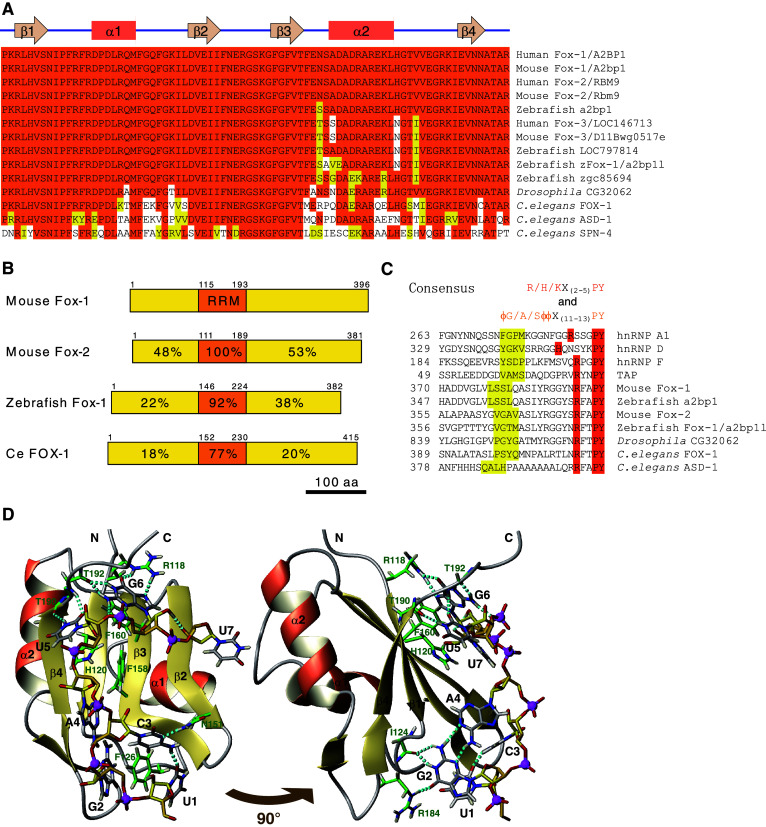
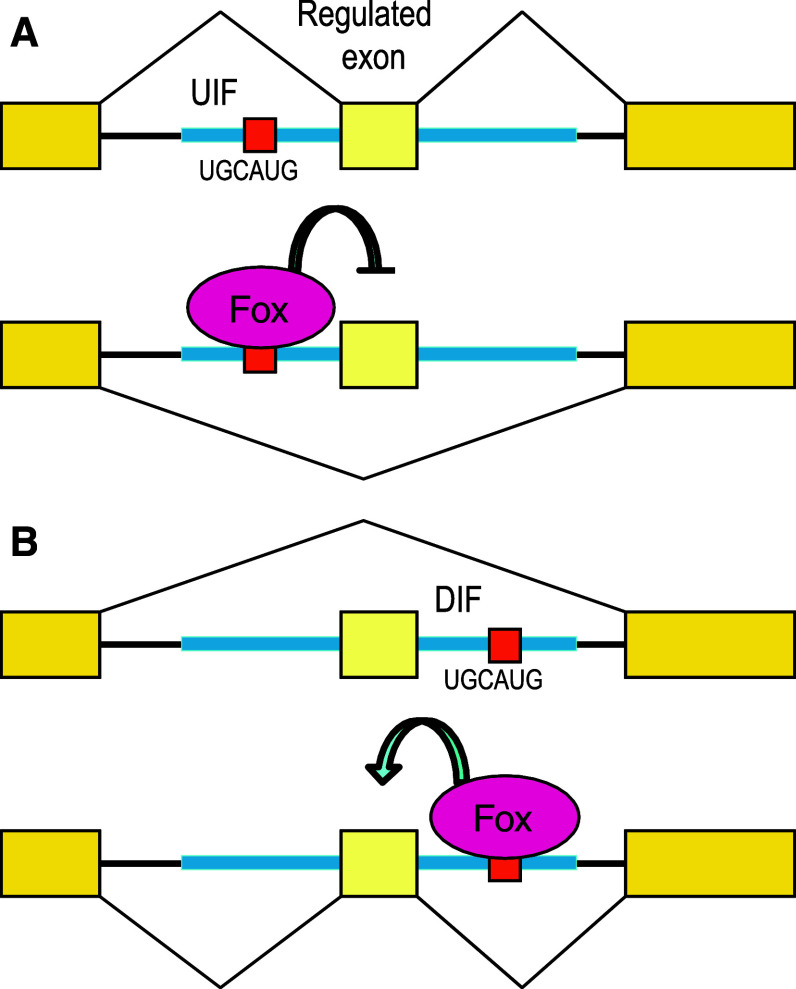
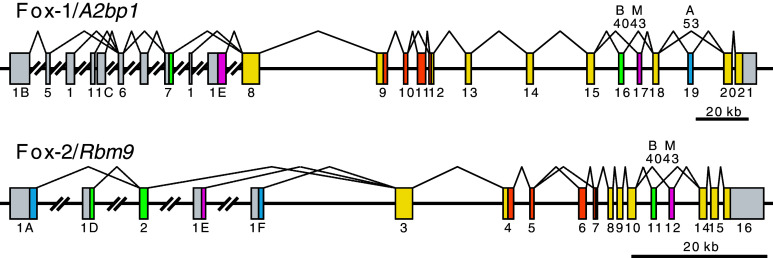
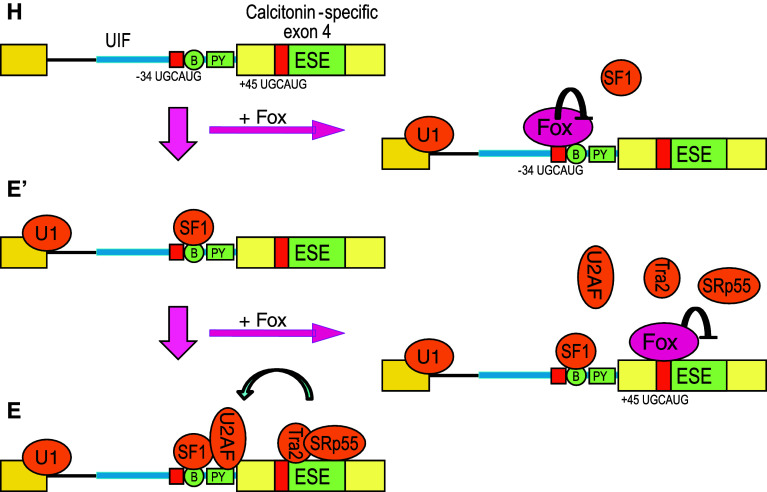
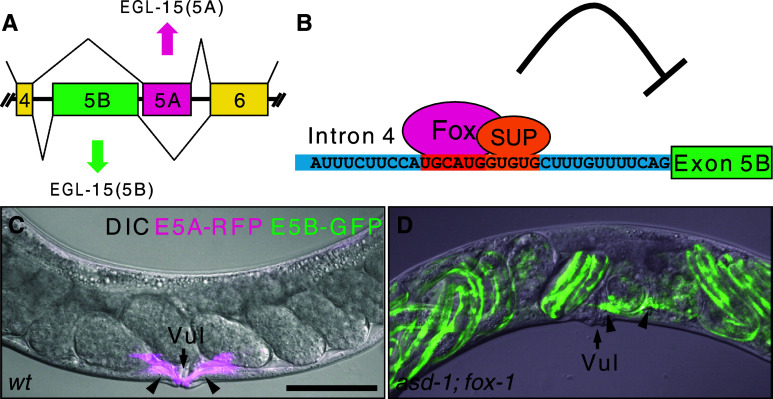
The Fox-1 family of RNA-binding proteins are evolutionarily conserved regulators of tissue-specific alternative splicing in metazoans. The Fox-1 family specifically recognizes the (U)GCAUG stretch in regulated exons or in flanking introns, and either promotes or represses target exons. Recent unbiased bioinformatics analyses of alternatively spliced exons and comparison of various vertebrate genomes identified the (U)GCAUG stretch as a highly conserved and widely distributed element enriched in intronic regions surrounding exons with altered inclusion in muscle, heart, and brain, consistent with specific expression of Fox-1 and Fox-2 in these tissues. Global identification of Fox-2 target RNAs in living cells revealed that many of the Fox-2 target genes themselves encode splicing regulators. Further systematic elucidation of target genes of the Fox-1 family and other splicing regulators in various tissues will lead to a comprehensive understanding of splicing regulatory networks.
Overview
The claims and statistics of this paper haven’t been checked yet.
Run the check — free, no account needed. It reads the open-access text and checks the sources it cites.
Integrity signals
Registry
Cites
Statistics
Figures
Verification
Claims the paper makes
The claims and statistics of this paper haven’t been checked yet.
Run the check — free, no account needed. It reads the open-access text and checks the sources it cites.
Claims other papers make about this one
Each is checked against this paper’s own text: does it say what the citing paper says it does?
In the citing paper
“RBFOX binding upstream of, or within, an alternative exon typically inhibits exon inclusion, whereas downstream binding usually promotes splicing48.”
From The neurogenetics of alternative splicing (2016) · cites this paper as [48]
Self-check
Percentages, sums and reported differences re-computed from the paper’s own numbers.
The self-check needs the paper’s full text.
Citations
Cites
MOLMOL: A program for display and analysis of macromolecular structures
Koradi, R., Billeter, M., & Wüthrich, K. (1996) · Journal of Molecular Graphics · doi:10.1016/0263-7855(96)00009-4 · Cited by 7,156
Alternative isoform regulation in human tissue transcriptomes
Wang, E. T., Sandberg, R., Luo, S., Khrebtukova, I., Zhang, L., Mayr, C., Kingsmore, S. F., Schroth, G. P., & Burge, C. B. (2008) · Nature · doi:10.1038/nature07509 · Cited by 5,181
Pan, Q., Shai, O., Lee, L. J., Frey, B. J., & Blencowe, B. J. (2008) · Nature Genetics · doi:10.1038/ng.259 · Cited by 3,951
Mechanisms of Alternative Pre-Messenger RNA Splicing
Black, D. L. (2003) · Annual Review of Biochemistry · doi:10.1146/annurev.biochem.72.121801.161720 · Cited by 2,704
HITS-CLIP yields genome-wide insights into brain alternative RNA processing
Licatalosi, D. D., Mele, A., Fak, J. J., Ule, J., Kayikci, M., Chi, S. W., Clark, T. A., Schweitzer, A. C., Blume, J. E., Wang, X., et al. (2008) · Nature · doi:10.1038/nature07488 · Cited by 1,352 · cited 2×
“These stories are reminiscent of the CLIP-seq analysis of NOVA that led to the discovery that NOVA interacts with 30 UTRs of target mRNAs and regulates alternative polyadenylation in the brain [43].”
MethodUnderstanding alternative splicing: towards a cellular code
Matlin, A. J., Clark, F., & Smith, C. W. J. (2005) · Nature Reviews Molecular Cell Biology · doi:10.1038/nrm1645 · Cited by 1,299
Alternative splicing: increasing diversity in the proteomic world
Graveley, B. R. (2001) · Trends in Genetics · doi:10.1016/s0168-9525(00)02176-4 · Cited by 1,228
Maris, C., Dominguez, C., & Allain, F. H. ‐. (2005) · FEBS Journal · doi:10.1111/j.1742-4658.2005.04653.x · Cited by 1,135
Lim, J., Hao, T., Shaw, C., Patel, A. J., Szabó, G., Rual, J.-F., Fisk, C. J., Li, N., Smolyar, A., Hill, D. E., et al. (2006) · Cell · doi:10.1016/j.cell.2006.03.032 · Cited by 789
ESRP1 and ESRP2 Are Epithelial Cell-Type-Specific Regulators of FGFR2 Splicing
Warzecha, C. C., Sato, T. K., Nabet, B., Hogenesch, J. B., & Carstens, R. P. (2009) · Molecular Cell · doi:10.1016/j.molcel.2009.01.025 · Cited by 580
Cited by
Sorted by citations
Mechanisms and Consequences of Alternative Polyadenylation
Di Giammartino, D. C., Nishida, K., & Manley, J. L. (2011) · Molecular Cell · doi:10.1016/j.molcel.2011.08.017 · Cited by 737
Evolution of SR protein and hnRNP splicing regulatory factors
Busch, A., & Hertel, K. J. (2011) · Wiley Interdisciplinary Reviews - RNA · doi:10.1002/wrna.100 · Cited by 418
Cell-Type-Specific Alternative Splicing Governs Cell Fate in the Developing Cerebral Cortex
Zhang, X., Chen, M. H., Wu, X., Kodani, A., Fan, J., Doan, R. N., Ozawa, M., Ma, J., Yoshida, N., Reiter, J. F., et al. (2016) · Cell · doi:10.1016/j.cell.2016.07.025 · Cited by 363
The neurogenetics of alternative splicing
Vuong, C. K., Black, D. L., & Zheng, S. (2016) · Nature Reviews Neuroscience · doi:10.1038/nrn.2016.27 · Cited by 340
The splicing regulator Rbfox1 (A2BP1) controls neuronal excitation in the mammalian brain
Gehman, L. T., Stoilov, P., Maguire, J., Damianov, A., Lin, C.-H., Shiue, L., Ares, M., Mody, I., & Black, D. L. (2011) · Nature Genetics · doi:10.1038/ng.841 · Cited by 331
Metadata
- Authors
- Kuroyanagi, H.
- Affiliations
- Tokyo Medical and Dental University (JP)
- Corresponding author
- Kuroyanagi, Hidehito
- ORCID
- Kuroyanagi, Hidehito
- Venue
- Cellular and Molecular Life Sciences
- Published
- 2009-08-18
- Volume
- 66
- Issue
- 24
- Pages
- 3895-3907
- ISSN
- 1420-682X (ISSN-L)
- 1420-9071
- PMC
- PMC2777236
- OpenAlex
- W2057774013
- Cited by
- 187
- References
- 78
- Citations by year
- 2026: 5 · 2025: 6 · 2024: 12 · 2023: 10 · 2022: 13 · 2021: 7 · 2020: 9 · 2019: 9 · 2018: 12 · 2017: 11 · 2016: 23 · 2015: 10 · 2014: 10 · 2013: 17 · 2012: 11
- FWCI
- 0.84
- Type
- journal article
- Language
- en
- Open access
- hybrid
- doi.org
- Licence
- cc-by-nc
- Locations
- Cellular and Molecular Life Sciences (publishedVersion, cc-by-nc)
- PubMed Central (publishedVersion, cc-by-nc)
- PubMed (publishedVersion)
- Funders
- Tokyo Medical and Dental University
- Japan Society for the Promotion of Science
- Topics
- Life Sciences › Biochemistry, Genetics and Molecular Biology › Molecular Biology › RNA Research and Splicing
- Life Sciences › Biochemistry, Genetics and Molecular Biology › Molecular Biology › RNA regulation and disease
- Life Sciences › Biochemistry, Genetics and Molecular Biology › Molecular Biology › RNA and protein synthesis mechanisms
- Keywords
- RNA-binding proteins, alternative splicing, intronic splicing enhancer, muscle, heart, brain, splicing regulators, splicing regulatory network, vertebrate genomes
- MeSH terms
- RNA Splicing Factors, Amino Acid Sequence, Animals, Base Sequence, Binding Sites, Humans, Molecular Sequence Data, RNA-Binding Proteins, Spliceosomes, Sequence Homology, Amino Acid, Alternative Splicing
About these checks
Registry, retraction, Cites and statistics results are computed, not judged, with one exception: a printed reference that no index lists is read once by a model before it counts as a citation error. Claims are extracted by a model and kept only when their quote appears verbatim in the text; each cited source is then checked, with a model’s help, for whether it says what the claim relies on. Those verdicts can be wrong — read the claim’s quote and the cited source before relying on one.
Statistics and arithmetic are recomputed, not judged.
Confidence bands are shown only for fields calibrated on our annotated test set. None is calibrated yet, so no band is shown.
What counts as a claim ›How we measure confidence ›How we check this ›
Are you an author, or do you see a problem with this page? Request a review
